




Short Intro
Exercise 3.2 of “The World of Numbers” focuses on integers, negative numbers, and Brahmagupta’s arithmetic laws. Students learn how to solve real-life problems involving temperature changes, debts, profits, and operations with negative numbers. These step-by-step solutions are written in simple English for easy understanding and exam preparation.
Quick Information Box
| Topic | Details |
|---|---|
| Chapter | The World of Numbers |
| Exercise | 3.2 |
| Subject | Mathematics |
| Class | Grade 9 |
| Main Concept | Integers & Brahmagupta’s Laws |
| Difficulty Level | Easy |
| Useful For | School Exams & Practice |
Concepts Used (Topics Covered)
- Positive and Negative Numbers
- Integers
- Brahmagupta’s Laws
- Multiplication of Integers
- Division of Integers
- Real-life Applications of Integers
- Temperature Problems
- Profit and Loss Using Integers
Important Formulas
Integer Set
Product Rules of Integers
Zero Property
Questions & Step-by-Step Solutions
Question 1
The temperature in the high-altitude desert of Ladakh is recorded as 4 °C at noon. By midnight, it drops by 15 °C. What is the midnight temperature?
Solution
Initial temperature = 4°C
Temperature drop = 15°C
So,
Answer
The midnight temperature is:
Question 2
A spice trader takes a loan (debt) of Rs. 850. The next day, he makes a profit (fortune) of Rs. 1,200. The following week, he incurs a loss of Rs. 450. Write this sequence as an equation using integers and calculate his final financial standing.
Solution
Loan = −850
Profit = +1200
Loss = −450
Equation:

Step 1:
Step 2:
Answer
Final financial standing:
This means the trader still has a debt/Loss of ₹100.
Question 3
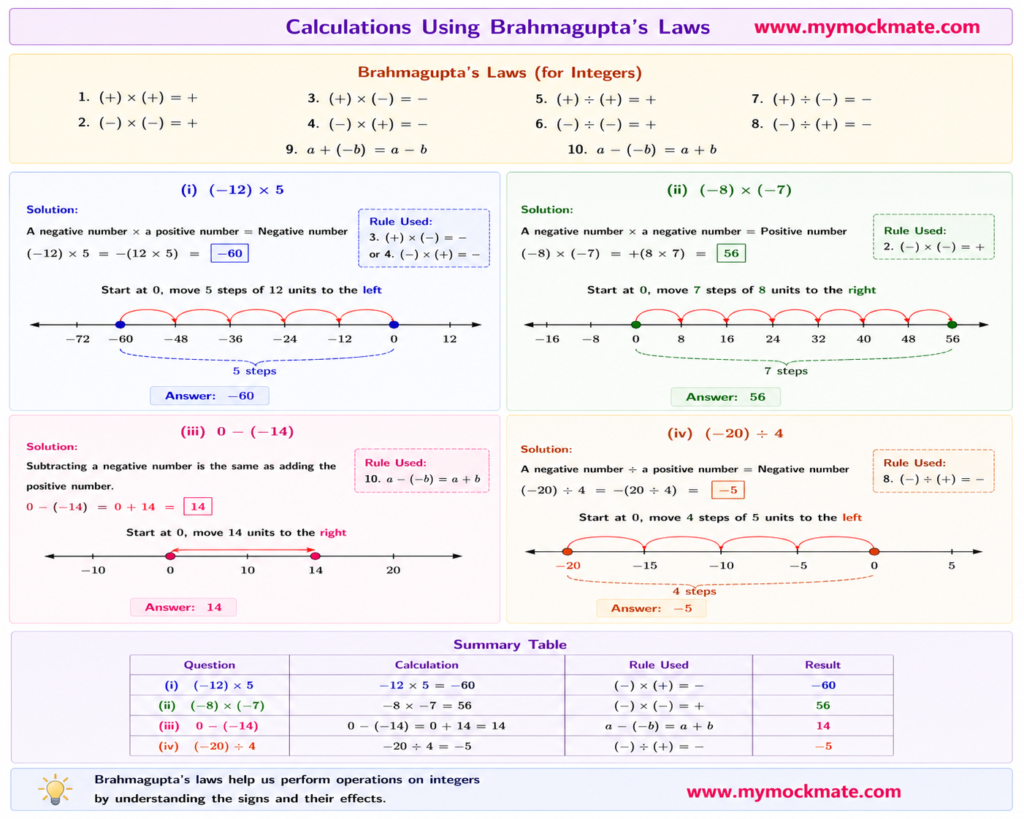
Calculate the following using Brahmagupta’s laws:
Question 4
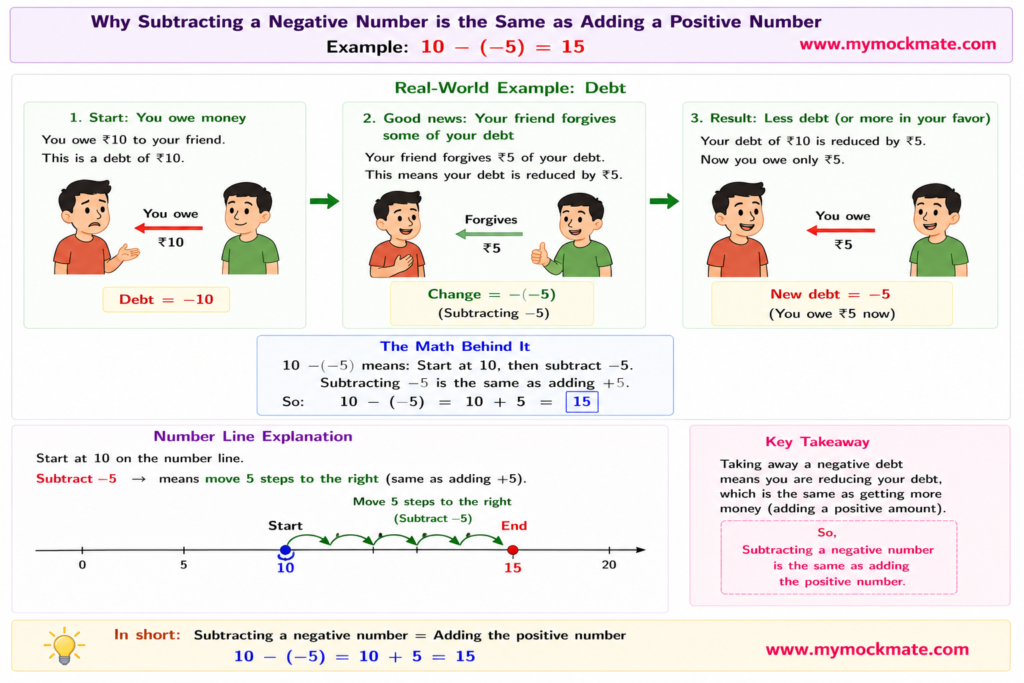
Explain using a real-life example why subtracting a negative number is the same as adding a positive number.
Solution
Common Mistakes
- Forgetting sign rules while multiplying integers
- Confusing subtraction of negative numbers
- Writing positive answers for negative operations
- Ignoring real-life meaning of debts and fortunes
- Division sign mistakes with integers
Exam Tips
- Remember:
- Positive × Positive = Positive
- Negative × Negative = Positive
- Positive × Negative = Negative
- Practice temperature and money-based questions
- Always write signs carefully
- Learn Brahmagupta’s laws properly
- Use step-by-step calculation in exams
Practice MCQs
1. What is the value of:
A) −24
B) 24
C) −10
D) 10
Answer
B) 24
2. What is:
A) −9
B) 0
C) 9
D) −18
Answer
C) 9
3. Which of the following is an integer?
A) 21
B) 2
C) −7
D) 3.5
Answer
C) −7
4. The result of:
is:
A) 5
B) −5
C) 45
D) −45
Answer
B) −5
FAQ Section
Q1. What are integers?
Integers are positive numbers, negative numbers, and zero.
Q2. Who introduced negative numbers formally?
Brahmagupta formally introduced negative numbers.
Q3. Why does negative × negative become positive?
Because removing a debt improves financial value.
Q4. Is zero a positive number?
No, zero is neither positive nor negative.
Q5. Can integers be represented on a number line?
Yes, integers are represented on a number line.
Master integers and number systems with detailed NCERT solutions, mock tests, and chapter-wise practice questions. Keep practicing daily to improve your Mathematics score and build strong concepts for higher classes.