



Short Intro
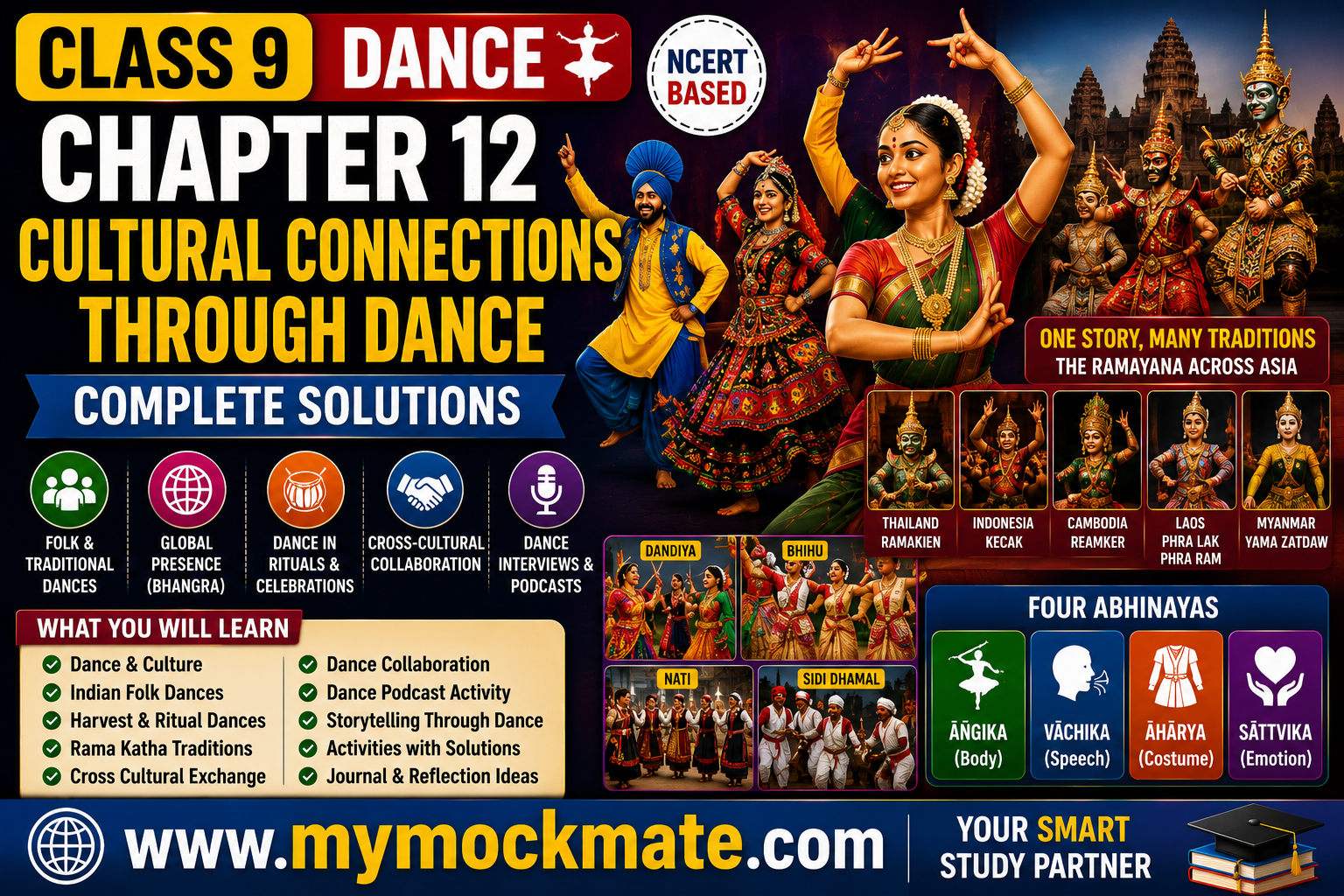
This chapter explains how dance connects people across cultures, regions, and countries. Students learn about folk dances, cultural exchange, diaspora traditions, dance storytelling, Rāmāyaṇa dance traditions across Asia, and collaborative dance performances. These solutions provide detailed explanations, MCQs, FAQs, exam tips, and step-by-step answers in simple language.
Quick Information Box
| Topic | Details |
|---|---|
| Chapter Name | Cultural Connections Through Dance |
| Subject | Dance |
| Class | 9 |
| Main Focus | Dance as a Cultural Bridge |
| Important Concepts | Folk Dance, Cultural Exchange, Rāmāyaṇa Traditions |
| Learning Goal | Understanding Unity Through Dance |
Concepts Used (Topics Covered)
- Dance and Culture
- Folk Dance Traditions
- Cross-Cultural Exchange
- Diaspora and Dance
- Dance and Rituals
- Harvest Festival Dances
- Dance Podcasts and Interviews
- Dance Collaboration
- Rāmāyaṇa Dance Traditions
- Global Presence of Indian Dance
- Storytelling Through Dance
- Dance and Community Identity
Important Formulas / Key Terms
- Diaspora = Community living outside its homeland
- Cross-cultural Collaboration = Fusion of different cultural traditions
- Folk Dance = Traditional dance of a community
- Dance Drama = Storytelling through dance and acting
- Rāmāyaṇa Traditions = Regional dance adaptations of the epic
- Community Dance = Dance performed for celebration and unity
Questions & Step-by-Step Solutions
Q1. Name a dance form that has a global presence. Describe where it is performed and by whom.
Solution
Dance Form
Bhangra
Global Presence
Bhangra is performed in:
- United Kingdom
- Canada
- United States
- Australia
- Singapore
Who Performs It?
- Indian diaspora communities
- International dance groups
- Students and cultural performers
- Stage competition teams
- Festival participants
Explanation
Originally from Punjab, Bhangra has become internationally popular because of migration and cultural exchange.
Q2. Match the following.
| Column A | Correct Match |
|---|---|
| i. Dance in funeral rites | b. Naṭa-Saṅkīrtana |
| ii. Dance as a celebration of good harvest | a. Bihu |
| iii. Martial art presented as a dance | d. Mayurbhanj Chhau |
| iv. Dance for community joy and togetherness | c. Garba |
Explanation
These dances represent different cultural functions such as rituals, celebrations, martial traditions, and community bonding.
Q3. What is the importance of taking consent from the interviewee as a part of the production process of any podcast/interview?
Solution
Taking consent from the interviewee is important because:
- It respects the person’s privacy and rights.
- It creates trust between interviewer and interviewee.
- It ensures ethical communication.
- It allows proper use of recordings and photographs.
- It avoids misunderstandings and misuse of content.
Explanation
Consent is an important part of responsible media production and professional communication.
Q4. Match the following.
| Column A | Correct Match |
|---|---|
| i. Thailand | c. Ramakien |
| ii. Java (Indonesia) | d. Sendratari |
| iii. Bali (Indonesia) | e. Kecak |
| iv. Laos | b. Phra Lak Phra Rām |
| v. Cambodia | a. Reamker |
Explanation
Different countries adapted the Rāmāyaṇa story into their own dance and theatre traditions.
Additional Conceptual Notes
Dance for Every Situation
Indian dances are connected with:
- Birth celebrations
- Weddings
- Harvest festivals
- Funeral rituals
- Religious events
- Community gatherings
Examples
| Occasion | Dance Form |
|---|---|
| Birth Celebration | Badhāī |
| Wedding Procession | Chholiyā Nṛitya |
| Harvest Festival | Bihu |
| Funeral Ritual | Naṭa-Saṅkīrtana |
Explanation
Dance reflects social traditions and human experiences across different stages of life.
Cross-Cultural Dance Collaboration
Features
- Combines elements from multiple dance forms
- Encourages creativity and respect
- Promotes cultural understanding
- Builds teamwork and artistic innovation
Example
Fusion of Bharatanatyam hand gestures with Bhangra energy movements.
Explanation
Cross-cultural dance collaborations create unity while respecting traditional identities.
Importance of Rāmāyaṇa Dance Traditions
The Rāmāyaṇa inspired many Asian dance traditions:
- Khon in Thailand
- Kecak in Bali
- Reamker in Cambodia
- Yama Zatdaw in Myanmar
Explanation
The same story connects different cultures through unique dance styles and local traditions.
Common Mistakes
- Confusing regional dance traditions
- Forgetting examples of global dance forms
- Mixing up Rāmāyaṇa adaptations
- Writing incomplete explanations
- Ignoring cultural significance in answers
Exam Tips
- Learn important dance forms and regions carefully.
- Remember examples of Rāmāyaṇa traditions across countries.
- Use tables for match-the-following answers.
- Practice short explanatory answers regularly.
- Revise concepts related to cultural exchange and diaspora.
Practice MCQs
1. Which dance form has gained international popularity from Punjab?
A. Kathak
B. Garba
C. Bhangra
D. Chhau

Answer:
C. Bhangra
2. Which dance is associated with harvest celebrations in Assam?
A. Garba
B. Bihu
C. Kecak
D. Chholiyā
Answer:
B. Bihu
3. Which country performs the Rāmāyaṇa tradition called Kecak?
A. Thailand
B. Indonesia (Bali)
C. Cambodia
D. Laos
Answer:
B. Indonesia (Bali)
4. What is the purpose of taking interview consent?
A. Decoration
B. Entertainment only
C. Ethical and respectful communication
D. Publicity only
Answer:
C. Ethical and respectful communication
5. Which dance form is related to funeral rituals in Manipur?
A. Naṭa-Saṅkīrtana
B. Bhangra
C. Garba
D. Bihu
Answer:
A. Naṭa-Saṅkīrtana
FAQ Section
Q1. How does dance connect cultures?
Dance connects cultures by sharing traditions, stories, music, and emotions across communities and countries.
Q2. What is cross-cultural dance collaboration?
It is the respectful fusion of elements from different dance traditions.
Q3. Why is Bhangra globally popular?
Bhangra became globally popular through migration, cultural festivals, and international performances.
Q4. What is special about Rāmāyaṇa dance traditions?
Different countries adapted the Rāmāyaṇa story into their own dance styles and cultural performances.
Q5. Why are folk dances important?
Folk dances preserve cultural identity, traditions, and community celebrations.
For more chapter-wise solutions, MCQs, notes, dance activities, and exam preparation materials, visit www.mymockmate.com and make your learning creative, cultural, and exam-ready.