
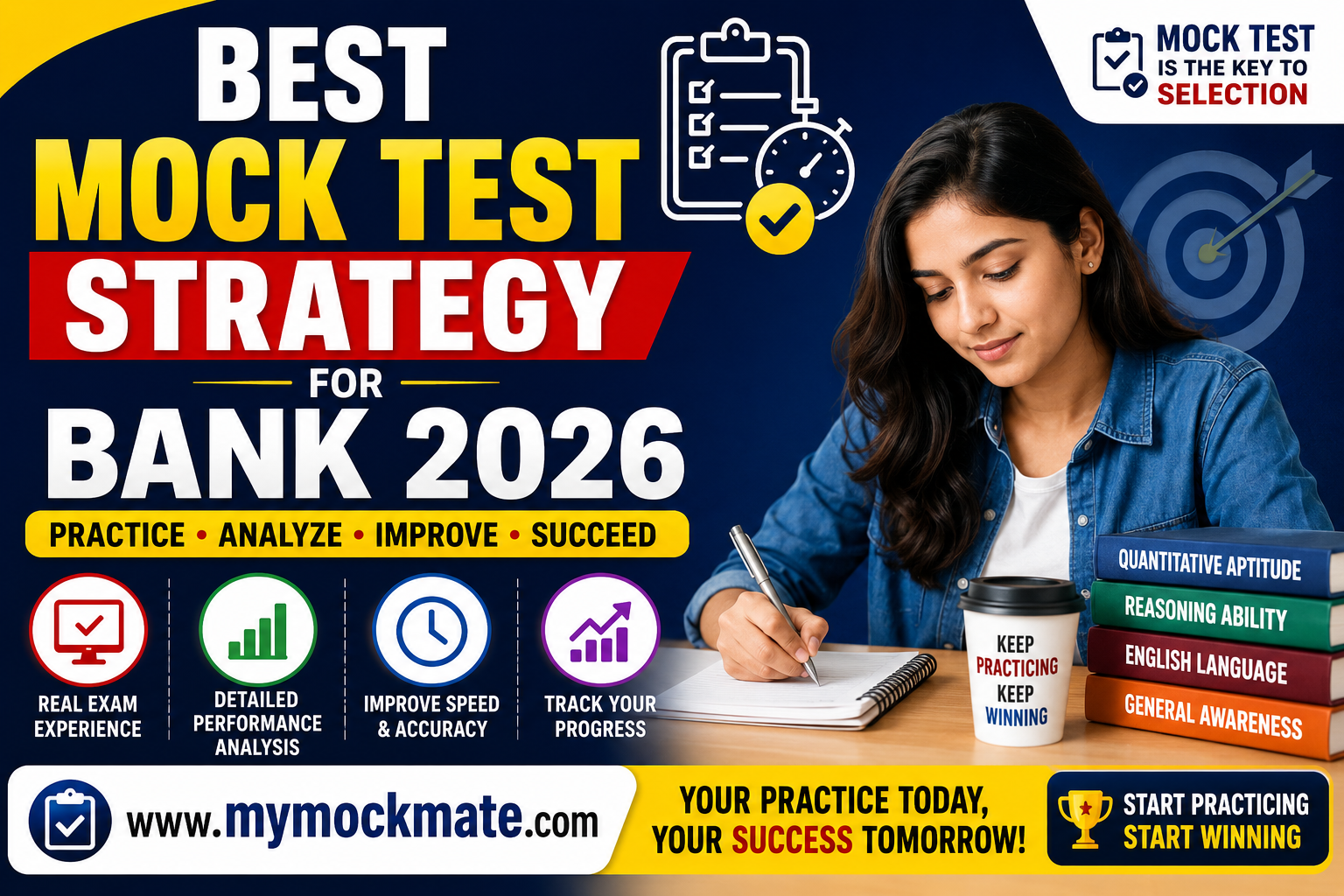

Introduction
Banking exams continue to be among the most competitive recruitment examinations in India. Every year, lakhs of candidates appear for examinations such as IBPS PO, IBPS Clerk, SBI PO, SBI Clerk, RBI Assistant, RBI Grade B, and various other banking recruitment tests. While understanding concepts and completing the syllabus are important, the real game-changer in bank exam preparation is a well-planned mock test strategy.
Many aspirants spend months studying Quantitative Aptitude, Reasoning Ability, English Language, General Awareness, and Computer Knowledge but fail to convert their preparation into selection due to poor exam temperament, lack of speed, and ineffective time management.
This is where www.mymockmate.com can significantly improve your preparation journey. Through realistic mock tests, instant performance reports, and detailed analysis, aspirants can identify weaknesses and improve systematically.
In this comprehensive guide, we will discuss the best mock test strategy for Bank Exams 2026 and how you can maximize your score using a structured approach.
Why Mock Tests Are Important for Bank Exams
Most bank exams are conducted online and have strict sectional and overall time limits. Knowledge alone is not enough.
Mock tests help candidates:
- Understand the exam pattern
- Improve speed and accuracy
- Develop time management skills
- Build confidence
- Identify weak topics
- Reduce exam anxiety
- Improve question selection skills
Aspirants who regularly take mock tests generally perform significantly better than those who rely only on theory.
Understanding the Bank Exam Pattern
Although patterns vary slightly across exams, most banking examinations include:
Preliminary Examination
English Language
- 30 Questions
- 30 Marks
Quantitative Aptitude
- 35 Questions
- 35 Marks
Reasoning Ability
- 35 Questions
- 35 Marks
Total: 100 Questions | 100 Marks
Main Examination
Reasoning & Computer Aptitude
Data Analysis & Interpretation
English Language
General/Economy/Banking Awareness
In mains examinations, both speed and accuracy become critical.
When Should You Start Taking Mock Tests?
Many aspirants make the mistake of waiting until syllabus completion.
The ideal approach is:
Beginner Stage
- Complete basic concepts
- Start sectional tests immediately
Intermediate Stage
- Begin full-length mock tests
Advanced Stage
- Increase mock test frequency
Mock tests should be part of preparation from the beginning.
Three-Phase Mock Test Strategy for Bank Exams 2026
Phase 1: Foundation Stage
Duration
First 2 Months
Goal
Concept Building

Mock Test Plan
- 3 sectional tests weekly
- Topic-wise quizzes daily
Focus on:
- Simplification
- Number Series
- Puzzles
- Seating Arrangement
- Reading Comprehension
- Vocabulary
At this stage, analysis is more important than scores.
Phase 2: Practice Stage
Duration
Next 2-3 Months
Goal
Speed Building
Mock Test Plan
- 2 full-length mocks weekly
- Daily sectional practice
Objectives:
- Improve question-solving speed
- Learn shortcuts
- Reduce calculation errors
This stage helps transition from learning to application.
Phase 3: Exam Simulation Stage
Duration
Final 30-45 Days
Goal
Exam Readiness
Mock Test Plan
- One full mock daily
- Detailed analysis after every test
Focus Areas:
- Time management
- Accuracy improvement
- Weak area correction
This phase determines final selection chances.
Section-Wise Mock Test Strategy
Quantitative Aptitude
Common Topics
- Simplification
- Approximation
- Number Series
- Arithmetic
- Data Interpretation
Mock Test Approach
Start with:
- Simplification
- Number Series
Move to:
- Arithmetic
- DI
Track:
- Time per question
- Accuracy percentage
Target:
- 90%+ accuracy
Reasoning Ability
Important Topics
- Seating Arrangement
- Puzzles
- Coding-Decoding
- Inequality
- Syllogism
Strategy
Practice puzzles daily.
Use mock tests to:
- Improve logical thinking
- Learn pattern recognition
- Reduce solving time
Aim to solve easy questions first.
English Language
Important Areas
- Reading Comprehension
- Cloze Test
- Error Detection
- Para Jumbles
- Vocabulary
Mock Test Strategy
Analyze:
- Reading speed
- Grammar mistakes
- Vocabulary gaps
Read newspapers daily to improve comprehension.
General Awareness
Important Areas
- Banking Awareness
- Financial News
- Current Affairs
- Government Schemes
Mock Test Strategy
Attempt weekly current affairs quizzes.
Maintain notes for revision.
The Golden Rule: Analyze Every Mock Test
Many candidates take mocks but never analyze them.
This is a major mistake.
After every test, evaluate:
Correct Answers
Why were they correct?
Wrong Answers
What caused the mistake?
- Concept issue?
- Silly error?
- Time pressure?
Unattempted Questions
Could they have been solved?
Analysis often provides more learning than the test itself.
How to Analyze Mock Tests Effectively
Step 1
Record:
- Score
- Accuracy
- Time spent
Step 2
Create a mistake notebook.
Categorize:
- Quant errors
- Reasoning mistakes
- English mistakes
Step 3
Revise weak topics immediately.
Step 4
Retake similar questions.
This process gradually improves performance.
Weekly Mock Test Schedule
Monday
Quant Sectional Test
Tuesday
Reasoning Sectional Test
Wednesday
English Sectional Test
Thursday
Mixed Practice Test
Friday
Current Affairs Quiz
Saturday
Full-Length Mock Test
Sunday
Mock Analysis and Revision
Time Management Strategy During Mock Tests
First Rule
Do not get stuck on difficult questions.
Second Rule
Attempt easy questions first.
Third Rule
Maintain sectional balance.
Fourth Rule
Avoid guesswork.
Fifth Rule
Keep track of time continuously.
These habits improve scores significantly.
Accuracy vs Speed: What Matters More?
Many candidates focus only on speed.
However, bank exams have negative marking.
Ideal Target
- Accuracy: 85-95%
- Speed: High enough to complete easy questions
A candidate with 90% accuracy usually outperforms one with high speed but low accuracy.
Common Mistakes Aspirants Make in Mock Tests
Taking Too Few Mock Tests
One mock weekly is insufficient during the final phase.
Ignoring Analysis
Analysis is where improvement happens.
Comparing Scores With Others
Focus on personal growth.
Attempting Difficult Questions First
This wastes valuable time.
Not Following Exam Conditions
Always attempt mocks in a distraction-free environment.
Mock Test Strategy for Different Bank Exams
SBI PO
Focus on:
- High-level puzzles
- Data Interpretation
- Banking Awareness
SBI Clerk
Focus on:
- Speed
- Accuracy
- Basic concepts
IBPS PO
Emphasize:
- Time management
- Moderate-to-high difficulty questions
IBPS Clerk
Prioritize:
- Quick calculations
- Basic reasoning
RBI Assistant
Focus on:
- General awareness
- Speed and precision
Role of Previous Year Papers
Mock tests and previous year papers complement each other.
Benefits:
- Understand trends
- Identify frequently asked topics
- Improve confidence
Combine PYQs with mock tests for maximum benefit.
Why www.mymockmate.com Is Ideal for Bank Exam Preparation
Aspirants need a platform that provides realistic exam practice.
www.mymockmate.com offers:
Real Exam Pattern Tests
Experience the actual exam environment.
Instant Results
Know your performance immediately.
Detailed Analysis
Identify strengths and weaknesses.
Performance Tracking
Monitor improvement over time.
Time-Based Practice
Learn effective time management.
Affordable Test Series
Access quality preparation without expensive coaching.
30-Day Mock Test Plan Before Bank Exam 2026
Days 1-10
- Alternate-day full mocks
- Daily sectional practice
Days 11-20
- Daily full mocks
- Current affairs revision
Days 21-30
- One mock daily
- Focus on accuracy
- Revise mistakes notebook
Avoid learning new topics during this phase.
Success Habits of Bank Exam Toppers
Top-performing candidates:
- Take regular mock tests
- Analyze mistakes thoroughly
- Maintain consistency
- Revise regularly
- Focus on accuracy
- Track progress weekly
Their success comes from disciplined practice rather than random studying.
Final Thoughts
Mock tests are not merely assessment tools—they are powerful learning tools. The difference between an average aspirant and a selected candidate often lies in how effectively mock tests are utilized.
For Bank Exam 2026 aspirants, the ideal strategy is simple:
- Learn concepts
- Practice daily
- Attempt mocks regularly
- Analyze thoroughly
- Improve continuously
Platforms like www.mymockmate.com make this process easier by providing realistic test environments, instant results, detailed performance reports, and exam-focused practice.
If you consistently follow this mock test strategy, your chances of clearing Bank Exams 2026 will increase significantly.
Frequently Asked Questions (FAQs)
Q1. How many mock tests should I take before Bank Exams 2026?
Ideally, 50-100 full-length mock tests along with sectional tests.
Q2. When should I start taking mock tests?
Start sectional tests after learning basic concepts and full mocks within the first month of preparation.
Q3. Is mock test analysis more important than taking tests?
Yes. Analysis helps identify mistakes and improve performance.
Q4. How can I improve my speed in bank exams?
Practice regularly, learn shortcuts, and attempt timed mock tests.
Q5. How many hours should I spend analyzing a mock test?
Typically 1-2 hours per mock test.
Q6. What is a good accuracy rate in bank exams?
Aim for at least 85-90% accuracy.
Q7. Should I attempt difficult questions first?
No. Always solve easy and moderate questions first.
Q8. Can mock tests improve my score significantly?
Yes. Regular mock practice can substantially improve speed, accuracy, and confidence.
Q9. Are sectional tests necessary?
Absolutely. They help strengthen individual subjects.
Q10. Where can I practice quality Bank Exam mock tests?
You can practice realistic Bank Exam mock tests with performance analysis, instant results, and exam-like experience on www.mymockmate.com.