




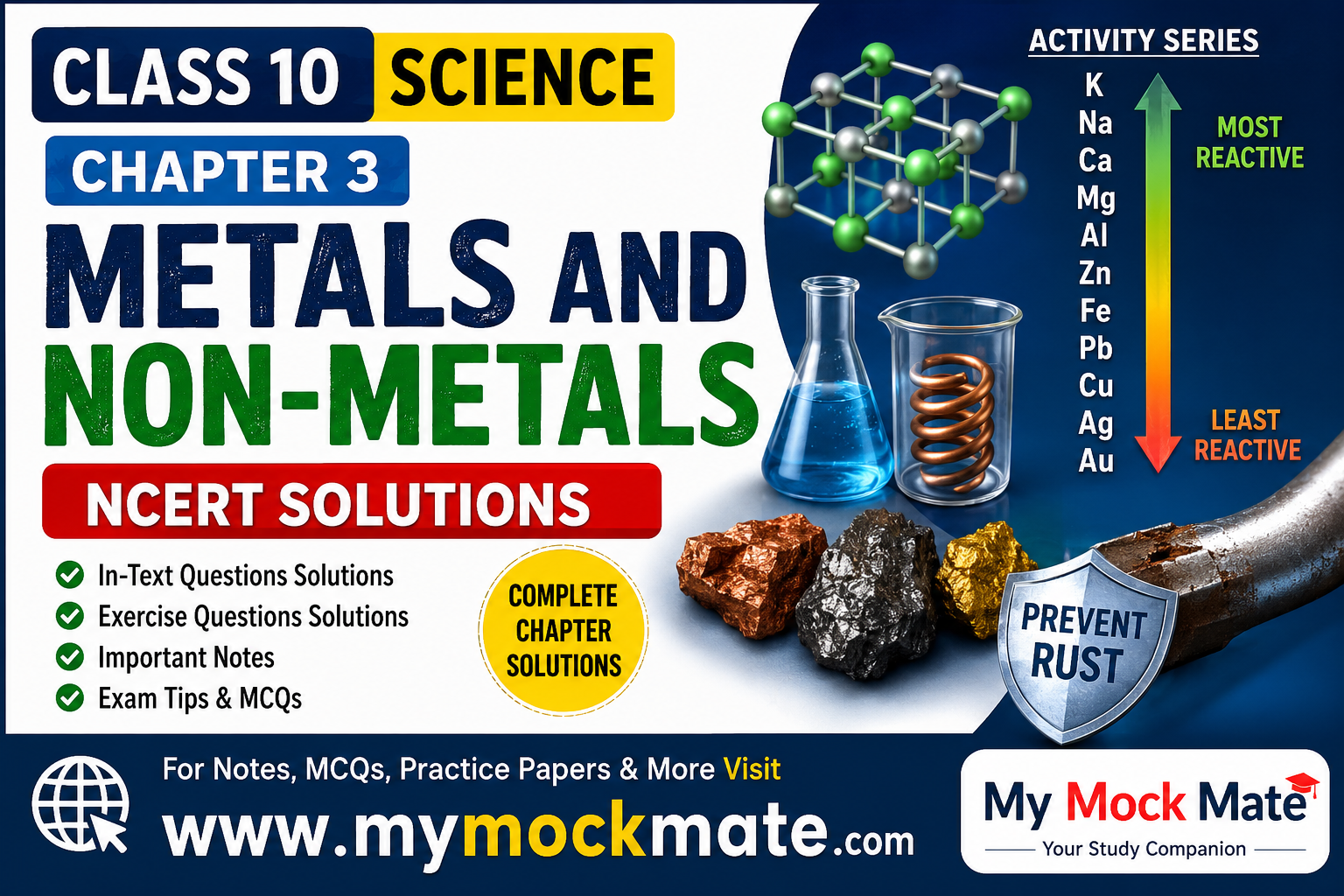

Short Introduction
This chapter explains the physical and chemical properties of metals and non-metals, their reactions with air, water and acids, reactivity series, ionic compounds, extraction of metals, corrosion and prevention of rusting. These detailed NCERT solutions help students understand concepts and prepare effectively for school and board examinations.
Quick Information Box
| Particular | Details |
|---|---|
| Chapter Name | Metals and Non-Metals |
| Class | 10 |
| Subject | Science |
| Board | CBSE/NCERT |
| Chapter Number | 3 |
| Important Topics | Metals, Non-metals, Reactivity Series, Ionic Compounds, Metallurgy, Corrosion |
Concepts Used (Topics Covered)
- Physical Properties of Metals
- Physical Properties of Non-metals
- Chemical Properties of Metals
- Reactivity Series
- Ionic Bond Formation
- Ionic Compounds
- Occurrence of Metals
- Extraction of Metals
- Refining of Metals
- Corrosion and Prevention
Important Formulas and Equations
- 2Mg + O₂ → 2MgO
- 2Na + 2H₂O → 2NaOH + H₂
- Zn + 2HCl → ZnCl₂ + H₂
- Fe + CuSO₄ → FeSO₄ + Cu
- Fe₂O₃ + 2Al → 2Fe + Al₂O₃
- ZnO + C → Zn + CO
- 2Cu + O₂ → 2CuO
NCERT In-Text Questions and Answers
Question 1
Give an example of a metal which:
(i) Is a liquid at room temperature
Answer: Mercury (Hg)
(ii) Can be easily cut with a knife
Answer: Sodium (Na)
(iii) Is the best conductor of heat
Answer: Silver (Ag)
(iv) Is a poor conductor of heat
Answer: Lead (Pb)
Explanation:
Different metals possess different physical properties. Silver conducts heat best, whereas lead is comparatively a poor conductor.
Question 2
Explain the meanings of malleable and ductile.
Solution
Malleable:
The property of a metal by which it can be beaten into thin sheets.
Example: Gold and silver.
Ductile:
The property of a metal by which it can be drawn into thin wires.
Example: Gold and copper.
Question 3
Why is sodium kept immersed in kerosene oil?
Solution
Sodium is highly reactive and reacts vigorously with oxygen and moisture present in air. It may catch fire. Therefore, it is stored under kerosene oil to prevent contact with air and water.
Question 4
Write equations for reactions of:

(i) Iron with steam
3Fe + 4H₂O → Fe₃O₄ + 4H₂
(ii) Calcium and potassium with water
Ca + 2H₂O → Ca(OH)₂ + H₂
2K + 2H₂O → 2KOH + H₂
Question 5
Samples of four metals A, B, C and D were tested.
(i) Which is the most reactive metal?
Answer: B
(ii) What happens when B is added to CuSO₄ solution?
Answer:
B will displace copper from copper sulphate solution.
(iii) Arrange metals in decreasing order of reactivity.
Answer:
B > A > C > D
Question 6
Which gas is produced when dilute HCl is added to a reactive metal?
Answer:
Hydrogen gas.
Reaction:
Fe + H₂SO₄ → FeSO₄ + H₂
Question 7
What happens when zinc is added to iron sulphate solution?
Solution
Zinc is more reactive than iron. Therefore, zinc displaces iron from iron sulphate solution.
Zn + FeSO₄ → ZnSO₄ + Fe
Observation:
Iron gets deposited and solution changes accordingly.
NCERT Exercise Solutions
Question 1
Which pair will give displacement reactions?
Answer:
(d) AgNO₃ solution and copper metal
Reason:
Copper is more reactive than silver.
Cu + 2AgNO₃ → Cu(NO₃)₂ + 2Ag
Question 2
Suitable method for preventing rusting of iron frying pan?
Answer:
(c) Applying a coating of zinc
Question 3
Element forms oxide having high melting point and soluble in water.
Answer:
(a) Calcium
Question 4
Food cans are coated with tin and not zinc because
Answer:
(c) Zinc is more reactive than tin.
Question 5
(a) Distinguish between metals and non-metals
Hammer Test:
Metals are malleable.
Non-metals are brittle.
Electrical Conductivity Test:
Metals conduct electricity.
Non-metals generally do not.
(b) Usefulness
Useful for most elements but exceptions exist such as graphite.
Question 6
What are amphoteric oxides?
Answer:
Oxides that react with both acids and bases.
Examples:
- Aluminium oxide (Al₂O₃)
- Zinc oxide (ZnO)
Question 7
Name two metals which displace hydrogen from acids and two which do not.
Displace:
- Zinc
- Magnesium
Do Not Displace:
- Copper
- Silver
Question 8
Electrolytic refining of metal M
Answer:
Anode: Impure metal
Cathode: Pure metal
Electrolyte: Solution of metal salt
Question 9
(a) Action of sulphur dioxide gas
(i) Dry litmus:
No effect
(ii) Moist litmus:
Turns blue litmus red
(b) Equation
S + O₂ → SO₂
Question 10
Two methods to prevent rusting
- Galvanisation
- Painting
Question 11
What type of oxides are formed by non-metals?
Answer:
Acidic oxides or neutral oxides.
Examples:
CO₂, SO₂
Question 12
Give reasons
(a)
Gold, platinum and silver are used in jewellery because they are lustrous and corrosion resistant.
(b)
Sodium, potassium and lithium are stored under oil because they react vigorously with air and water.
(c)
Aluminium is highly reactive but used for cooking utensils because it forms a protective oxide layer.
(d)
Carbonate and sulphide ores are converted into oxides because oxides are easier to reduce.
Question 13
Why are lemon and tamarind used to clean copper vessels?
Answer:
They contain acids which dissolve the green basic copper carbonate layer.
Question 14
Differentiate between metals and non-metals
| Metals | Non-metals |
| Form positive ions | Form negative ions |
| Basic oxides | Acidic oxides |
| React with acids releasing H₂ | Do not release H₂ |
| Lose electrons | Gain electrons |
Question 15
Goldsmith mystery question
Answer:
The solution used was Aqua Regia.
Reason:
Aqua regia dissolves a small amount of gold, reducing weight while restoring shine.
Question 16
Why is copper used for hot water tanks?
Answer:
- Good conductor of heat
- Corrosion resistant
- Does not react with water
Common Mistakes Students Make
- Confusing malleability with ductility.
- Forgetting exceptions like graphite and iodine.
- Incorrectly placing metals in reactivity series.
- Mixing up roasting and calcination.
- Writing unbalanced chemical equations.
Exam Tips
- Learn the reactivity series thoroughly.
- Memorize important reactions of metals with water and acids.
- Revise amphoteric oxides carefully.
- Practice metallurgy flowchart.
- Focus on corrosion and prevention methods.
Practice MCQs
1. Which metal is stored under kerosene?
A. Iron
B. Copper
C. Sodium
D. Silver
Answer: C
2. Which oxide is amphoteric?
A. MgO
B. Na₂O
C. ZnO
D. CaO
Answer: C
3. Which metal is least reactive?
A. Potassium
B. Zinc
C. Gold
D. Iron
Answer: C
4. Rust is mainly
A. Fe₂O₃·xH₂O
B. FeO
C. Fe₃O₄
D. FeS
Answer: A
5. Graphite conducts electricity because
A. It is a metal
B. It contains free electrons
C. It is an oxide
D. It is ionic
Answer: B
FAQ Section
Q1. What is the most reactive metal?
Potassium is the most reactive metal in the activity series.
Q2. Why does aluminium not rust easily?
Because it forms a protective oxide layer.
Q3. What is an alloy?
A homogeneous mixture of metals or a metal and a non-metal.
Q4. What is galvanisation?
Coating iron with zinc to prevent rusting.
Q5. What is aqua regia?
A mixture of concentrated HCl and HNO₃ in the ratio 3:1.
Looking for more NCERT Class 10 Science solutions? Visit www.mymockmate.com for chapter-wise solved questions, MCQs, notes, important formulas, previous year papers and board exam preparation resources.