
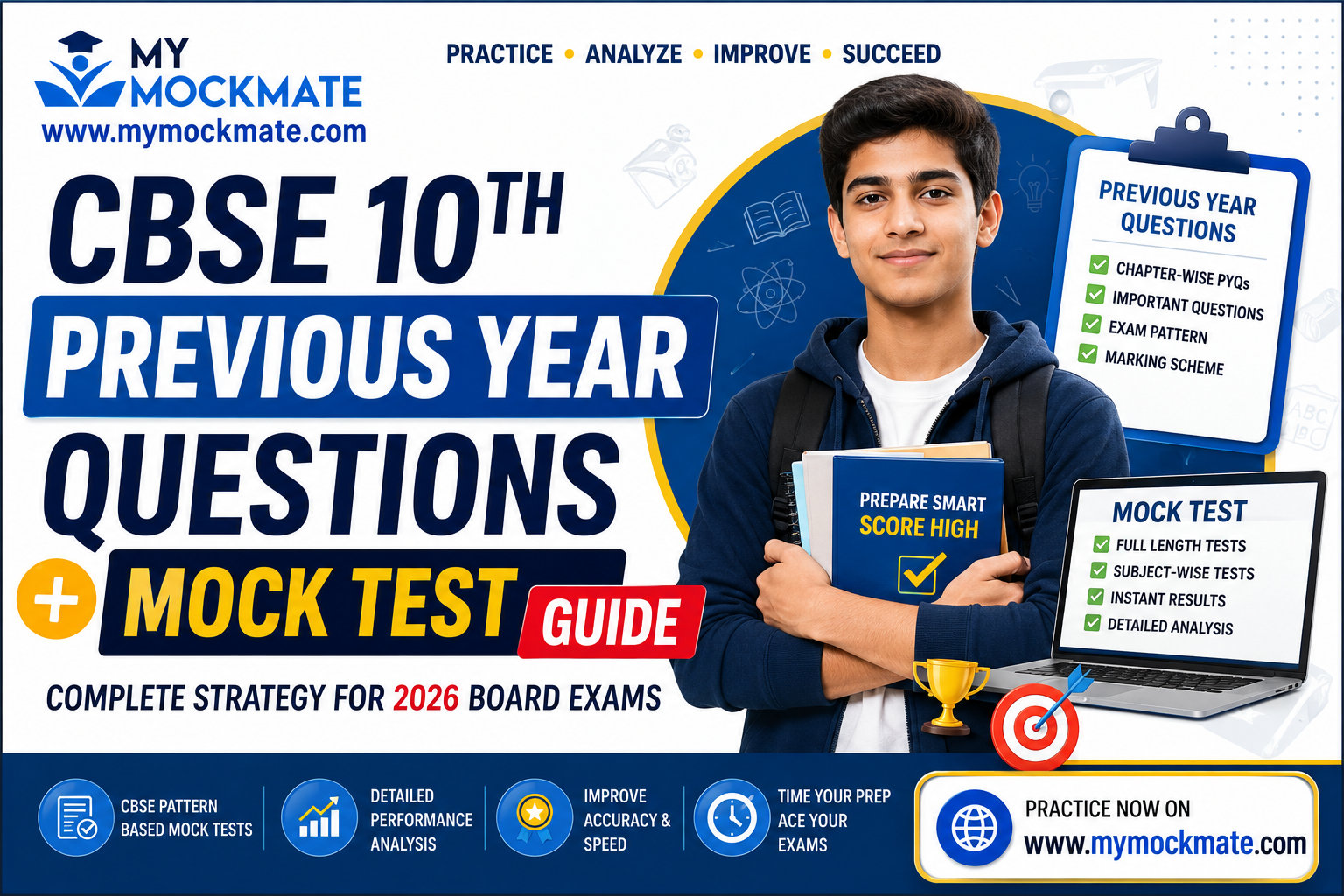

The CBSE Class 10 Board Examination is one of the most important milestones in a student’s academic journey. Every year, lakhs of students appear for the examination with the goal of securing excellent marks and building a strong foundation for higher studies.
However, many students make the mistake of focusing only on textbooks while ignoring two of the most powerful preparation tools:
- Previous Year Questions (PYQs)
- Mock Tests
These two resources help students understand the exam pattern, improve speed and accuracy, identify weak areas, and gain confidence before the actual examination.
At www.mymockmate.com, we strongly recommend combining Previous Year Question practice with regular mock tests to maximize board exam performance and achieve higher scores.
This comprehensive guide explains how to use previous year papers and mock tests effectively to score 90%+ in CBSE Class 10 Board Exams.
Why Previous Year Questions Are Important
CBSE continuously evolves its question patterns, but several concepts and question styles often repeat.
Previous Year Questions help students understand:
- Important chapters
- Frequently asked concepts
- Question trends
- Marking patterns
- Difficulty level
- Competency-based questions
Students who regularly solve PYQs generally perform better because they become familiar with the examiner’s expectations.
Benefits of Solving CBSE Previous Year Questions
1. Understand Exam Pattern
Previous papers reveal:
- Question distribution
- Internal choices
- Section-wise structure
- Competency-based questions
This reduces exam anxiety.
2. Identify Important Topics
Some chapters consistently contribute more questions.
For example:
Mathematics
- Trigonometry
- Statistics
- Probability
- Surface Areas and Volumes
Science
- Chemical Reactions
- Electricity
- Life Processes
- Heredity
Social Science
- Nationalism in India
- Resources and Development
- Political Parties
- Globalisation
Recognizing these trends helps prioritize revision.
3. Improve Answer Writing
Board examinations require:
- Precise answers
- Proper presentation
- Correct terminology
Previous year papers teach students how answers should be framed.

4. Build Confidence
Repeated practice creates familiarity with exam conditions.
Confidence directly impacts performance.
Importance of Mock Tests in CBSE Class 10 Preparation
Mock tests simulate real examination conditions.
They help students:
- Manage time effectively
- Improve accuracy
- Reduce stress
- Build stamina
- Track progress
At www.mymockmate.com, students can access structured mock tests designed according to the latest CBSE pattern.
Difference Between PYQs and Mock Tests
| Previous Year Questions | Mock Tests |
|---|---|
| Based on actual exams | Simulated exams |
| Show historical trends | Test current preparation |
| Improve concept familiarity | Improve exam readiness |
| Limited questions | Unlimited practice |
| Focus on patterns | Focus on performance |
Both are equally important.
Ideal Preparation Strategy
The best strategy is:
Step 1
Complete NCERT thoroughly.
Step 2
Solve chapter-wise PYQs.
Step 3
Attempt sectional mock tests.
Step 4
Take full-length mock tests.
Step 5
Analyze mistakes and revise.
Subject-Wise Previous Year Question Strategy
Mathematics
Mathematics requires consistent practice.
Focus Areas
- Algebra
- Geometry
- Trigonometry
- Probability
- Statistics
PYQ Strategy
Solve:
- Last 10 years questions
- Competency-based questions
- Case-study questions
Mock Test Strategy
Take:
- One Mathematics mock every week
Gradually increase speed.
Science
Science is often considered scoring when concepts are clear.
Important Sections
Physics
- Electricity
- Light
Chemistry
- Chemical Reactions
- Acids, Bases and Salts
Biology
- Life Processes
- Heredity
- Our Environment
PYQ Strategy
Practice:
- Diagrams
- Numerical problems
- Assertion-Reason questions
Mock Test Strategy
Attempt full-length science tests every week.
Social Science
Social Science requires understanding and retention.
Focus Areas
History:
- Nationalism
- Industrialisation
Geography:
- Resources
- Agriculture
Political Science:
- Democracy
- Political Parties
Economics:
- Money and Credit
- Globalisation
PYQ Strategy
Prepare answer-writing formats.
Mock Test Strategy
Practice map-based and case-study questions.
English Language and Literature
English often contributes significantly to overall percentage.
Focus Areas
- Reading comprehension
- Grammar
- Writing skills
- Literature
PYQ Strategy
Practice:
- Previous reading passages
- Letter writing
- Analytical paragraphs
Mock Test Strategy
Take timed writing practice tests.
Hindi
Focus Areas
- गद्य
- पद्य
- व्याकरण
- लेखन कौशल
PYQ Strategy
Practice:
- Previous comprehension passages
- Writing tasks
- Grammar exercises
How Many Previous Year Papers Should You Solve?
Minimum Target
Last 5 years
Recommended Target
Last 10 years
Ideal Target
10 years + Sample Papers + Mock Tests
This provides maximum exposure.
Recommended Mock Test Schedule
6 Months Before Exam
- One mock every two weeks
4 Months Before Exam
- One mock every week
2 Months Before Exam
- Two mocks every week
Final Month
- Three to four mocks every week
How to Analyze Mock Tests
Many students take mock tests but never analyze them.
This is a major mistake.
After every mock test:
Check
- Incorrect answers
- Silly mistakes
- Weak chapters
- Time management issues
Record
Maintain an error notebook.
Write:
- Mistake type
- Correct concept
- Revision date
This dramatically improves performance.
Common Mistakes Students Make
1. Ignoring NCERT
NCERT remains the most important resource.
2. Solving PYQs Without Revision
Concept revision should come first.
3. Taking Too Many Mocks
Quality analysis matters more than quantity.
4. Ignoring Weak Subjects
Balanced preparation is essential.
5. Not Practicing Writing
Board exams require written answers.
6. Studying Without Timers
Timed practice improves speed.
Daily Study Plan Using PYQs and Mock Tests
Morning
- Concept revision
- NCERT reading
Duration
2 Hours
Afternoon
- Chapter-wise PYQs
Duration
2 Hours
Evening
- Mock test or sectional test
Duration
2 Hours
Night
- Error analysis
- Revision
Duration
1 Hour
30-Day Board Exam Strategy
Days 1–10
- Complete syllabus revision
- Solve chapter-wise PYQs
Days 11–20
- Attempt full-length mocks
- Analyze performance
Days 21–30
- Final revision
- Important formulas
- Important diagrams
- Frequently repeated questions
Avoid new resources.
How www.mymockmate.com Helps CBSE Students
www.mymockmate.com provides:
CBSE Pattern-Based Mock Tests
Practice according to latest exam guidelines.
Detailed Performance Analysis
Identify strengths and weaknesses instantly.
Real Exam Experience
Timed environment similar to actual boards.
Instant Results
Track performance immediately.
Subject-Wise Tests
Focus on specific weak areas.
Affordable Learning
Quality practice at student-friendly costs.
These features help students improve confidence and board exam performance.
Expert Tips for Scoring 90%+ in CBSE Class 10
Follow NCERT First
NCERT is the foundation.
Solve PYQs Regularly
Practice every day.
Take Weekly Mock Tests
Consistency matters.
Revise Frequently
Revision is the key to retention.
Maintain Formula Sheets
Useful for Mathematics and Science.
Focus on Presentation
Neat answers earn better impressions.
Learn Time Management
Practice under exam conditions.
Stay Consistent
Small daily efforts create big results.
Conclusion
CBSE Class 10 Board Examination success depends on smart preparation rather than excessive study hours. Previous Year Questions help students understand exam trends and important topics, while mock tests improve speed, confidence, and exam readiness.
Students who combine NCERT study, PYQ practice, regular revision, and mock tests consistently achieve better scores than those who rely only on textbooks.
For structured preparation, real exam simulations, detailed analysis, and performance tracking, visit www.mymockmate.com and take your board exam preparation to the next level.
Frequently Asked Questions (FAQs)
Q1. Are Previous Year Questions enough for CBSE Class 10?
No. PYQs should be combined with NCERT, sample papers, and mock tests.
Q2. How many years of PYQs should I solve?
At least 5 years; ideally 10 years.
Q3. How many mock tests should I attempt before boards?
A minimum of 15–20 full-length mock tests is recommended.
Q4. Can I score 90%+ by solving PYQs?
Yes, if combined with strong NCERT preparation and regular revision.
Q5. Which is more important: PYQs or Mock Tests?
Both are equally important and complement each other.
Q6. When should I start mock tests?
After completing basic concepts and chapter revision.
Q7. Does CBSE repeat questions from previous years?
Exact questions may not repeat often, but concepts and patterns frequently recur.
Q8. How should I analyze mock tests?
Identify mistakes, revise weak topics, and maintain an error notebook.
Q9. Can online mock tests help improve board marks?
Yes. Quality mock tests improve speed, accuracy, and confidence.
Q10. Where can I practice CBSE-style mock tests?
Students can practice structured CBSE-style mock tests and performance analysis at www.mymockmate.com