




Short Introduction
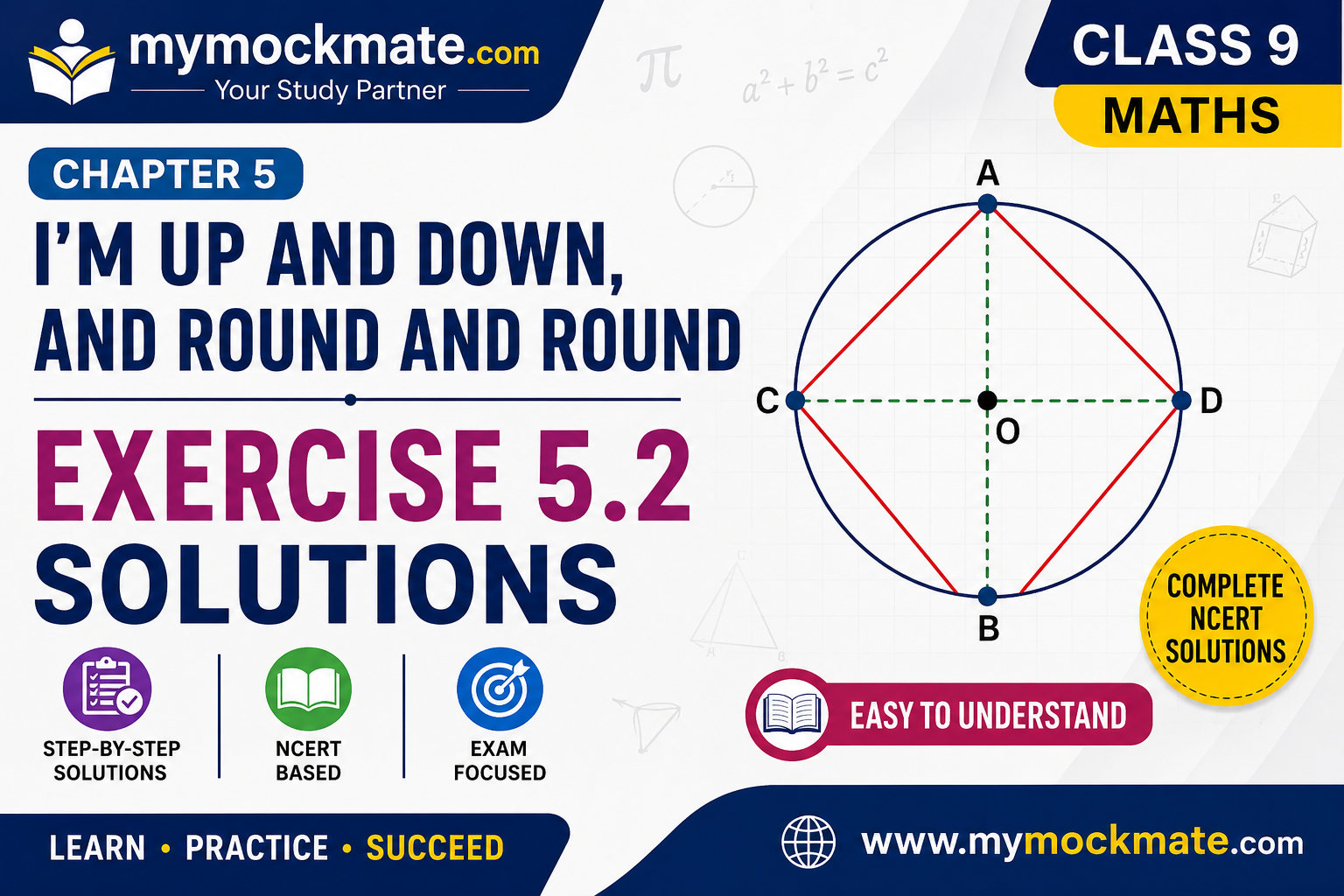
Exercise 5.2 of Chapter 5, I’m Up and Down, and Round and Round, introduces important properties of chords and circles. In this exercise, students learn that the triangle formed by joining a chord to the centre of a circle is an isosceles triangle and how equal chords lead to congruent triangles. These concepts are fundamental for understanding advanced circle theorems.
Quick Information Box
| Particular | Details |
|---|---|
| Class | 9 |
| Subject | Mathematics |
| Chapter | 5 – I’m Up and Down, and Round and Round |
| Exercise | 5.2 |
| Topic | Chords and Angles Subtended by Chords |
| Difficulty Level | Easy to Moderate |
| Important Concepts | Radius, Chord, Isosceles Triangle, Congruence |
Concepts Used (Topics Covered)
- Definition of a Circle
- Radius and Chord
- Isosceles Triangle
- SSS Congruence Criterion
- Equal Chords of a Circle
- Congruent Triangles
Important Formulas and Facts
- All radii of the same circle are equal.
- If two sides of a triangle are equal, then the triangle is an isosceles triangle.
- SSS Congruence Criterion:
If three sides of one triangle are equal to the corresponding three sides of another triangle, then the triangles are congruent.
Exercise 5.2 Solutions
Question 1
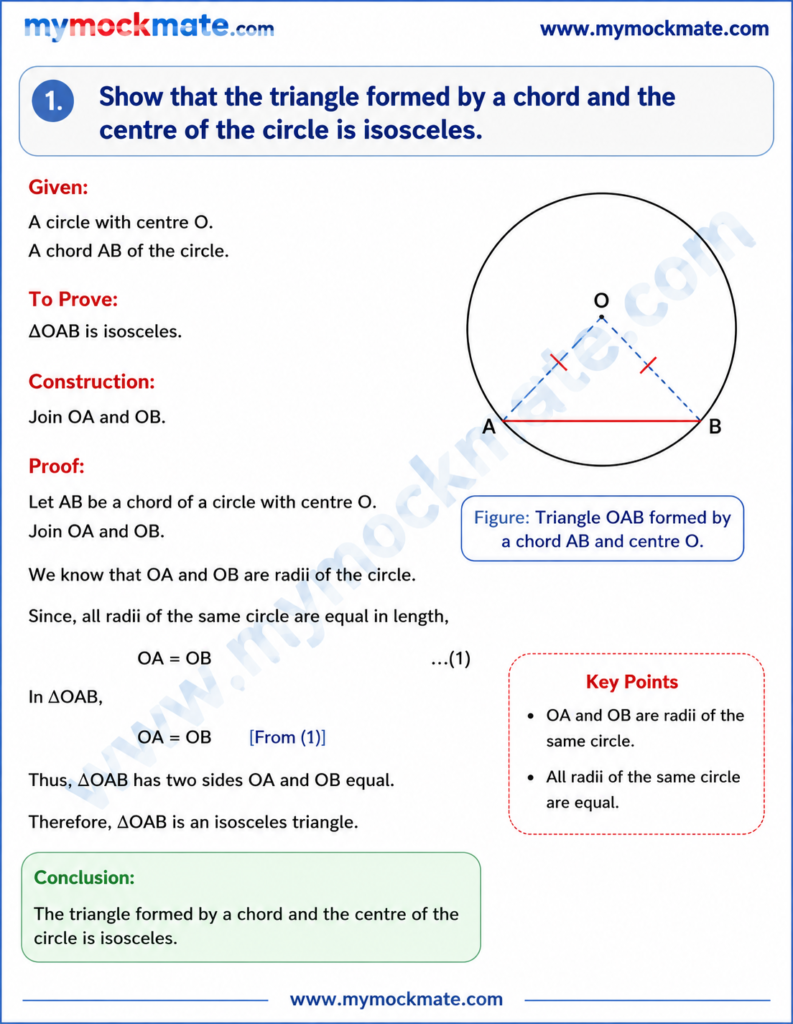
Show that the triangle formed by a chord and the centre of the circle is isosceles.
Solution
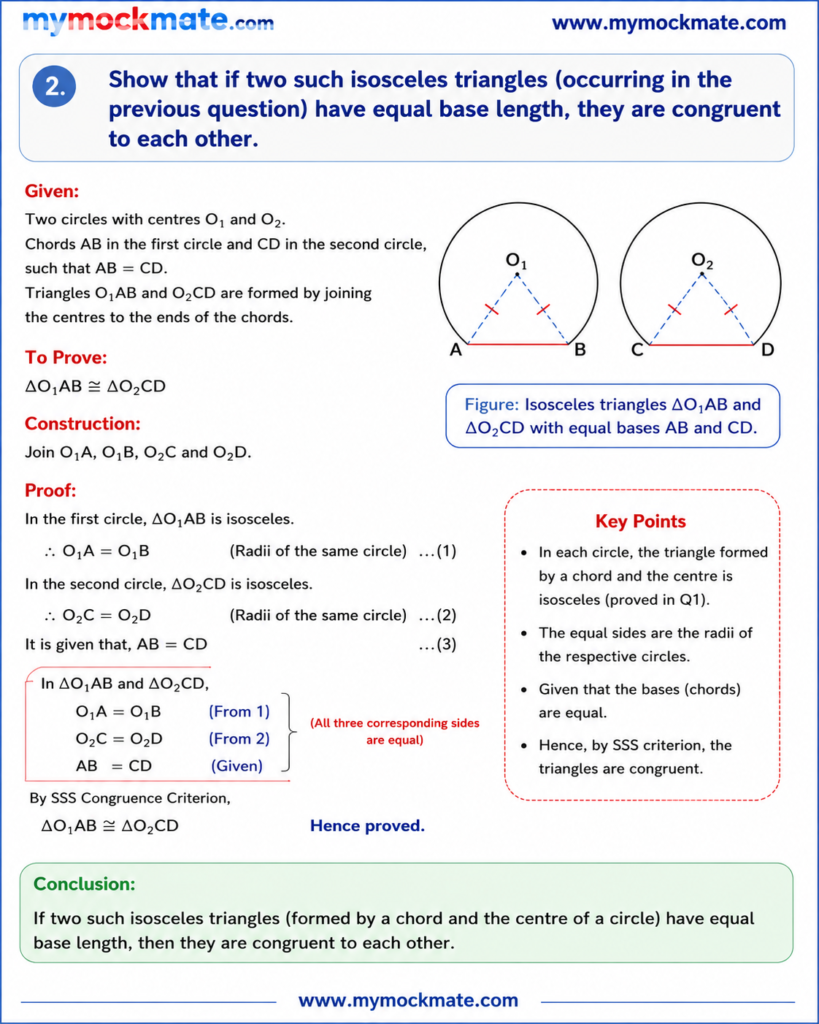
Question 2
Show that if two such isosceles triangles (occurring in the previous question) have equal base length, they are congruent to each other.
Solution
Common Mistakes
❌ Forgetting that all radii of a circle are equal.
❌ Using SAS congruence instead of SSS.
❌ Not mentioning the reason that OA, OB, OC and OD are radii.
❌ Writing only the answer without proving the theorem.
Exam Tips
✔ Always draw a neat labelled figure.
✔ Mention the theorem or congruence criterion used.
✔ Write statements and reasons separately.
✔ Remember: Equal radii → Isosceles triangle.
Practice MCQs
1. The triangle formed by a chord and the centre of a circle is:
A. Scalene
B. Right-angled
C. Isosceles
D. Equilateral
Answer: C. Isosceles
2. Which criterion is used in Question 2?
A. RHS
B. SAS
C. ASA
D. SSS
Answer: D. SSS

3. A chord joins two points on a circle. The segments joining these points to the centre are:
A. Unequal
B. Radii
C. Diameters
D. Tangents
Answer: B. Radii
4. If two chords are equal, then the corresponding triangles formed with the centre are:
A. Similar
B. Congruent
C. Scalene
D. Right-angled
Answer: B. Congruent
Frequently Asked Questions (FAQs)
Q1. Why is the triangle formed by a chord and the centre always isosceles?
Because the two sides joining the centre to the endpoints of the chord are radii and hence equal.
Q2. Which congruence theorem is used in Exercise 5.2 Question 2?
The SSS Congruence Criterion.
Q3. Are all triangles formed by chords and the centre congruent?
No. They are congruent only when the chords are equal.
Q4. Why are radii important in circle geometry?
Most circle theorems are based on the fact that all radii of a circle are equal.
Final Answer Summary
Question 1: The triangle formed by a chord and the centre is isosceles.
Question 2: Two such triangles with equal base lengths are congruent by SSS criterion.
📚 Looking for more NCERT Maths solutions and chapter-wise explanations?
Visit www.mymockmate.com for:
✅ Complete NCERT Solutions
✅ Step-by-Step Explanations
✅ Practice Questions and MCQs
✅ Exam Preparation Notes
✅ Chapter-wise Important Questions