




Short Introduction
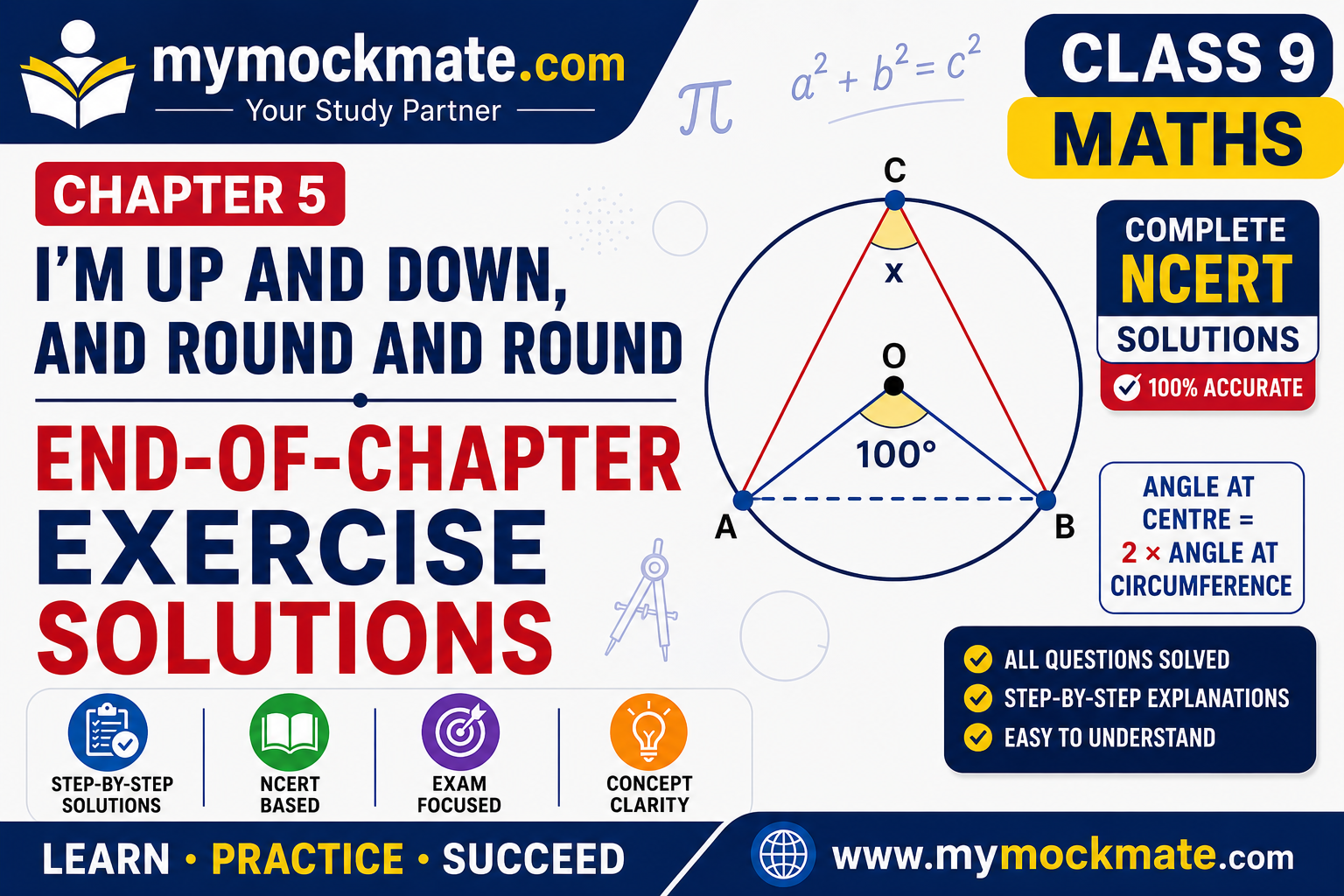
The End-of-Chapter Exercise of Chapter 5, I’m Up and Down, and Round and Round, helps students revise all important concepts related to circles. This exercise covers:
- Properties of chords
- Circumcircle and circumcentre
- Distance of chords from the centre
- Angles subtended by arcs
- Diameter theorem
- Concyclic points
- Applications of circle theorems
This chapter forms an important foundation for higher geometry in Classes 10 and 11.
Quick Information Box
| Particular | Details |
|---|---|
| Class | 9 |
| Subject | Mathematics |
| Chapter | 5 – I’m Up and Down, and Round and Round |
| Exercise | End-of-Chapter Exercise |
| Main Topic | Circle Theorems and Applications |
| Difficulty Level | Moderate |
| Important Topics | Chords, Angles, Circumcircle, Concyclicity |
Concepts Used (Topics Covered)
✔ Definition of Circle
✔ Radius, Chord and Diameter
✔ Circumcentre and Circumcircle
✔ Equal Chords and Equal Angles
✔ Perpendicular Bisector of Chords
✔ Distance of Chords from Centre
✔ Angles in the Same Segment
✔ Diameter Theorem
✔ Concyclic Points
Important Formulas and Theorems
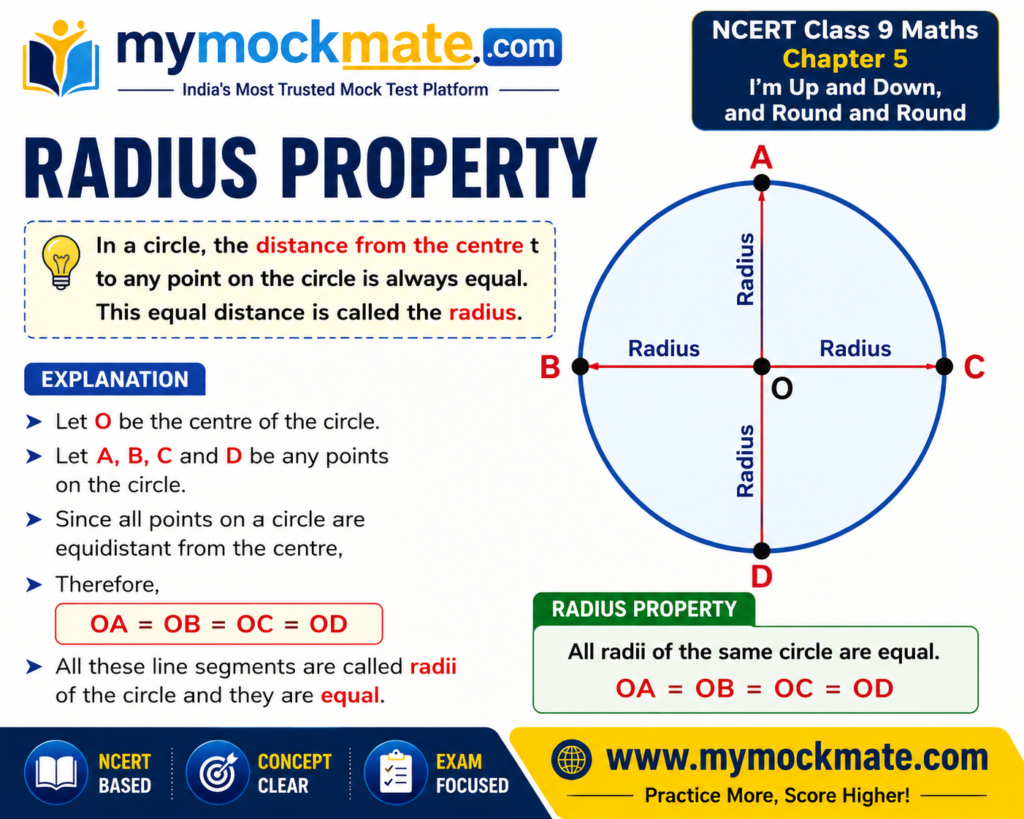
1. Radius Property
2. Chord Length Formula

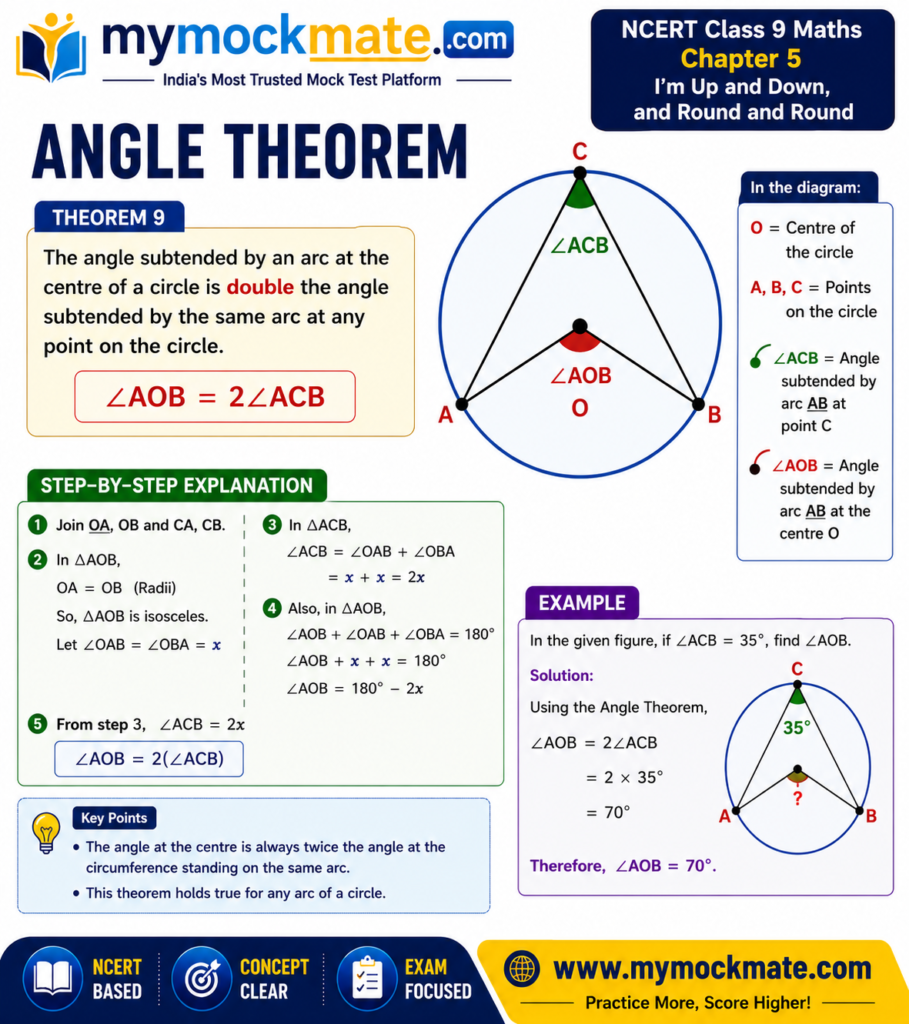
3. Angle Theorem
4. Diameter Theorem
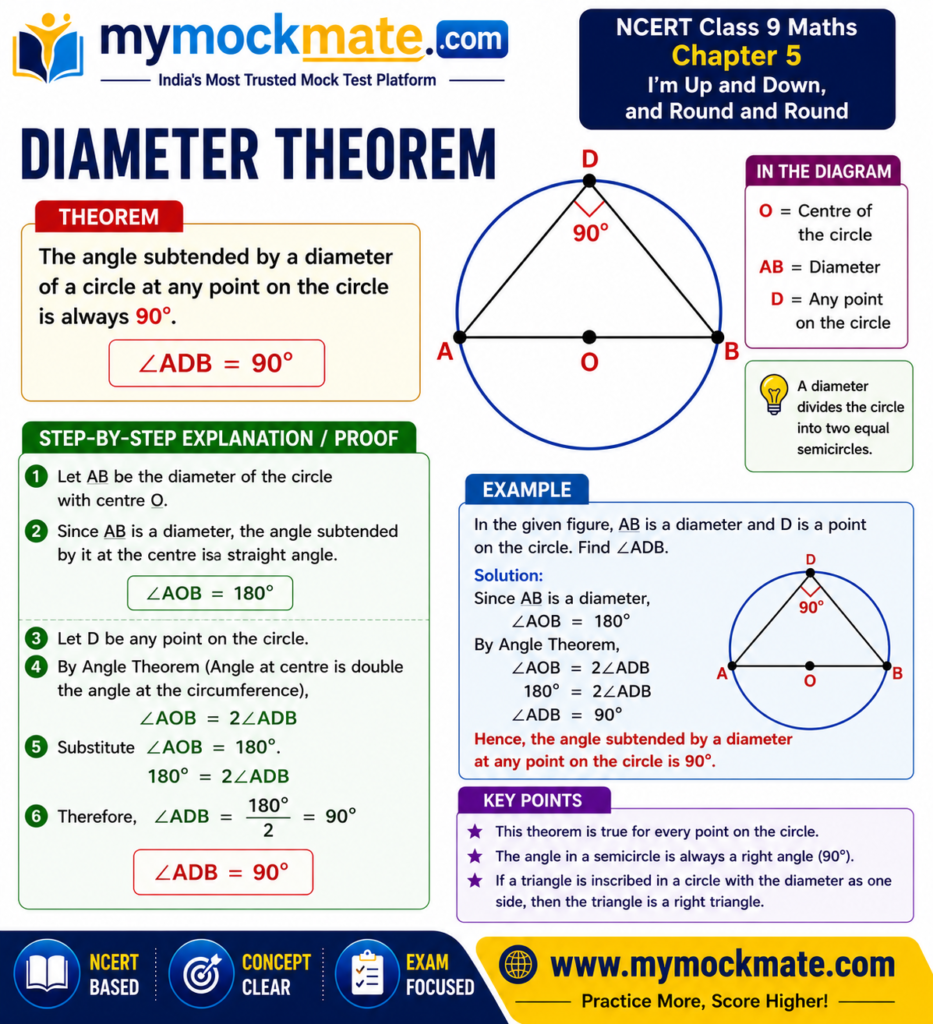
5. Equal Chords Theorem

6. Converse

End-of-Chapter Exercise Solutions
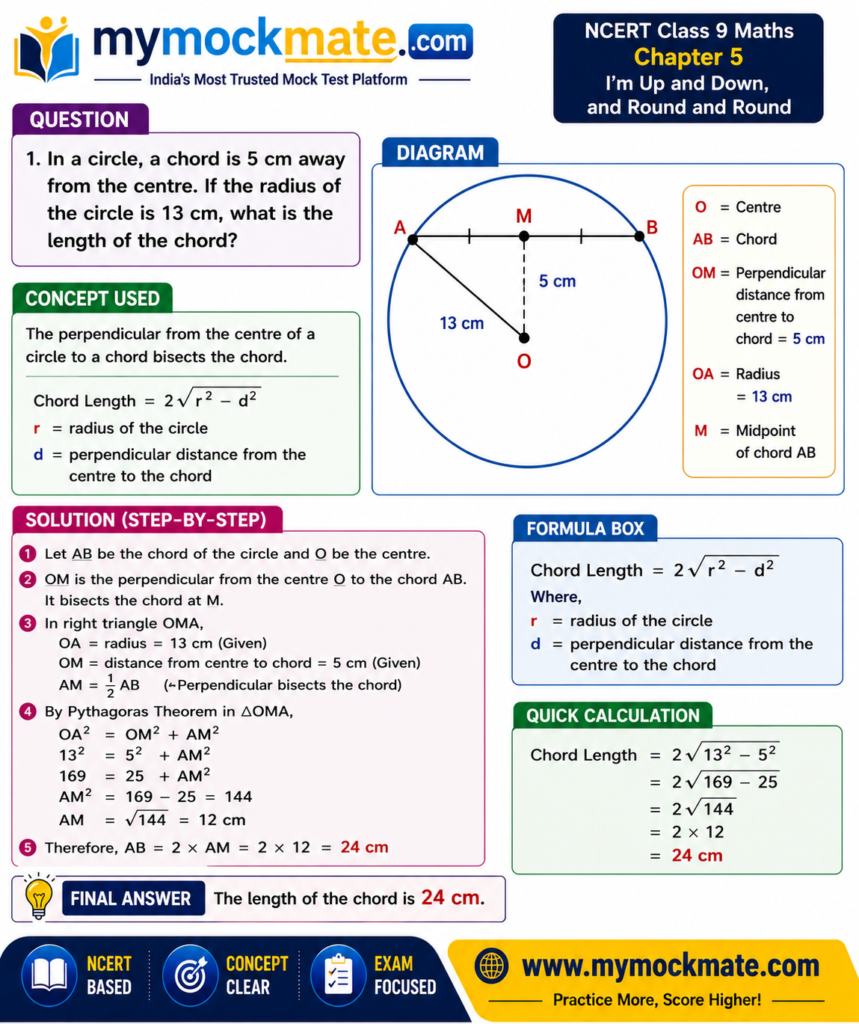
Question 1
In a circle, a chord is 5 cm away from the centre. If the radius of the circle is 13 cm, what is the length of the chord?
Solution
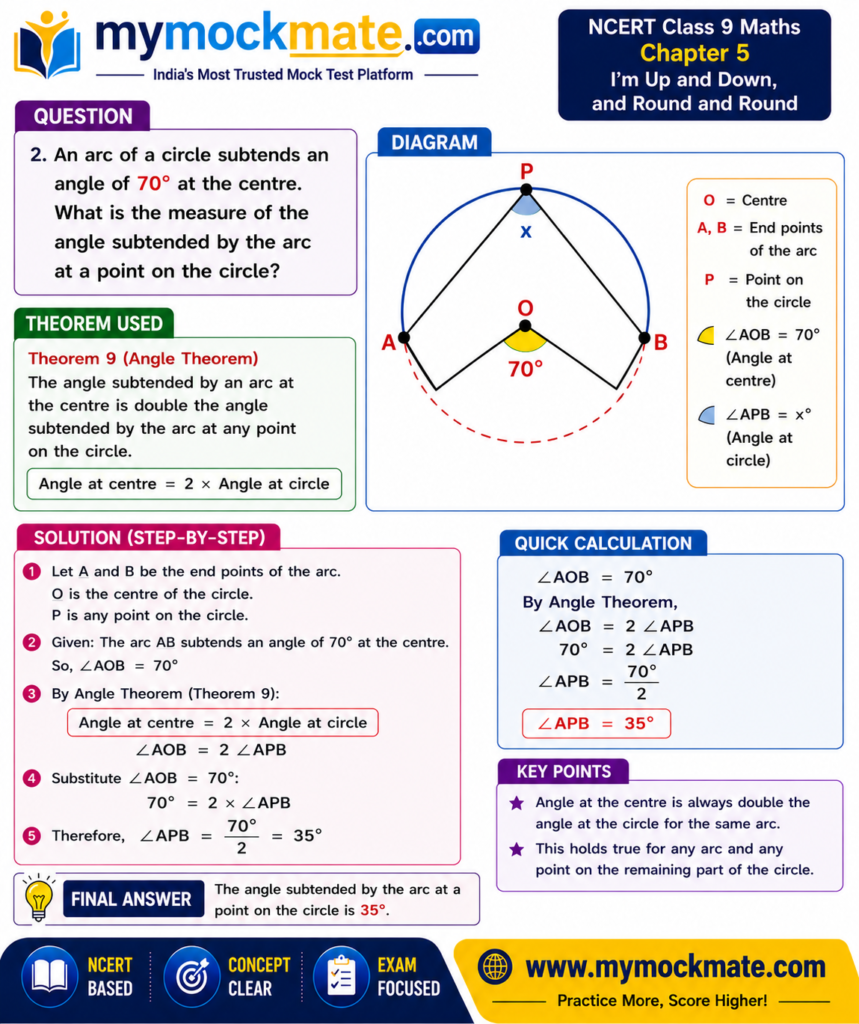
Question 2
An arc of a circle subtends an angle of 70° at the centre. What is the measure of the angle subtended by the arc at a point on the circle?
Solution
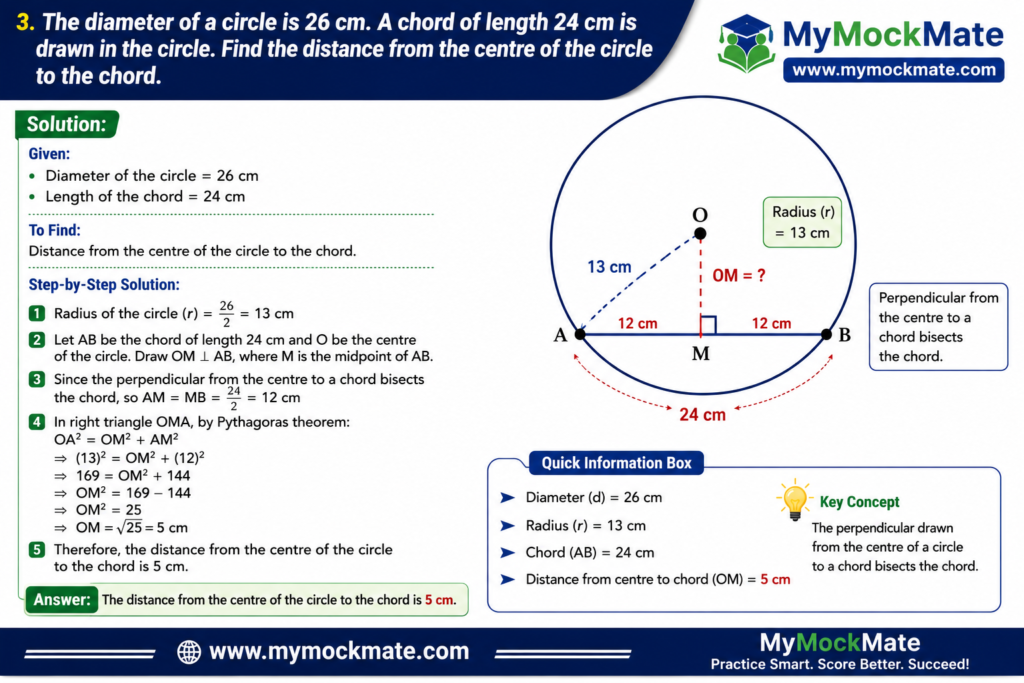
Question 3
The diameter of a circle is 26 cm. A chord of length 24 cm is drawn in the circle. Find the distance from the centre of the circle to the chord.
Solution
Question 4
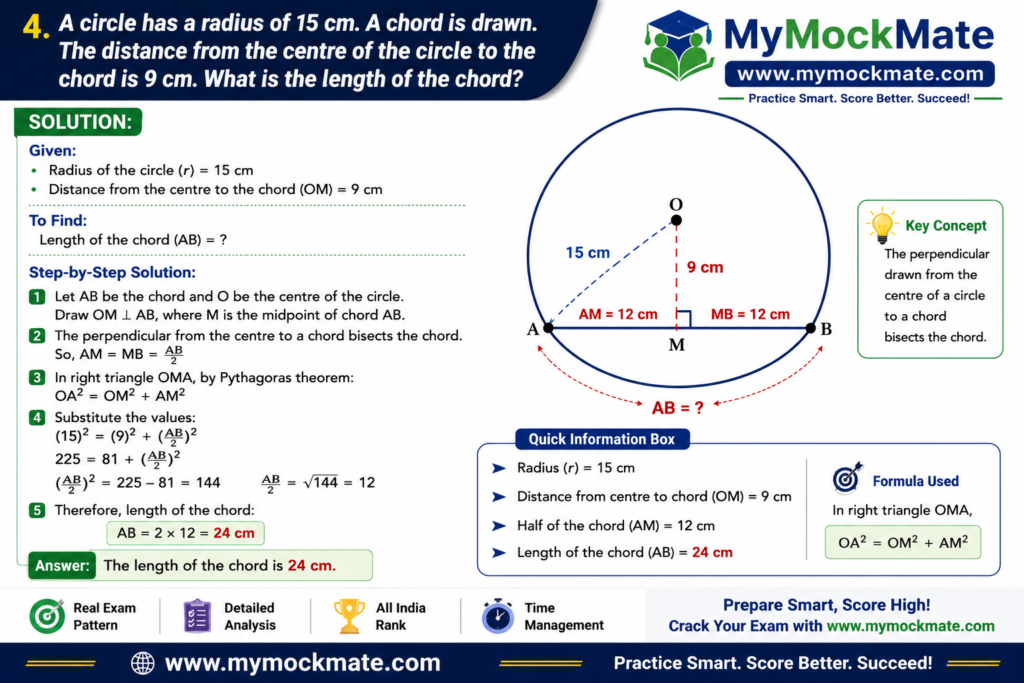
A circle has a radius of 15 cm. A chord is drawn. The distance from the centre of the circle to the chord is 9 cm. What is the length of the chord?

Solution
Question 5
Prove that the perpendicular bisector of a chord passes through the centre of the circle.
Solution

Question 6
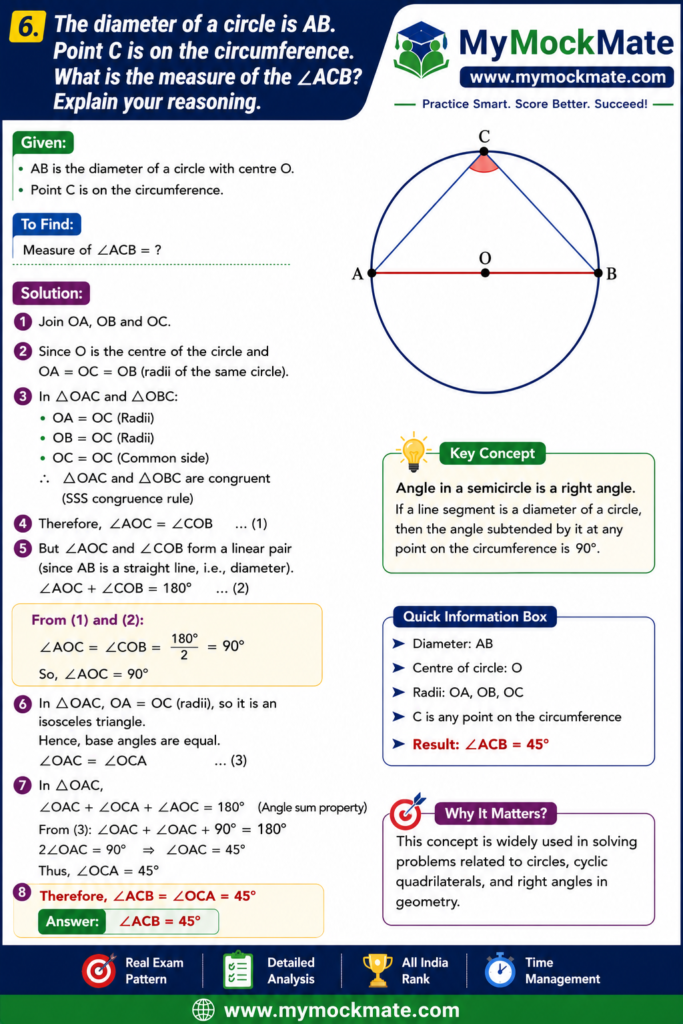
The diameter of a circle is AB. Point C is on the circumference. What is the measure of the ∠ACB? Explain your reasoning.
Solution
Question 7
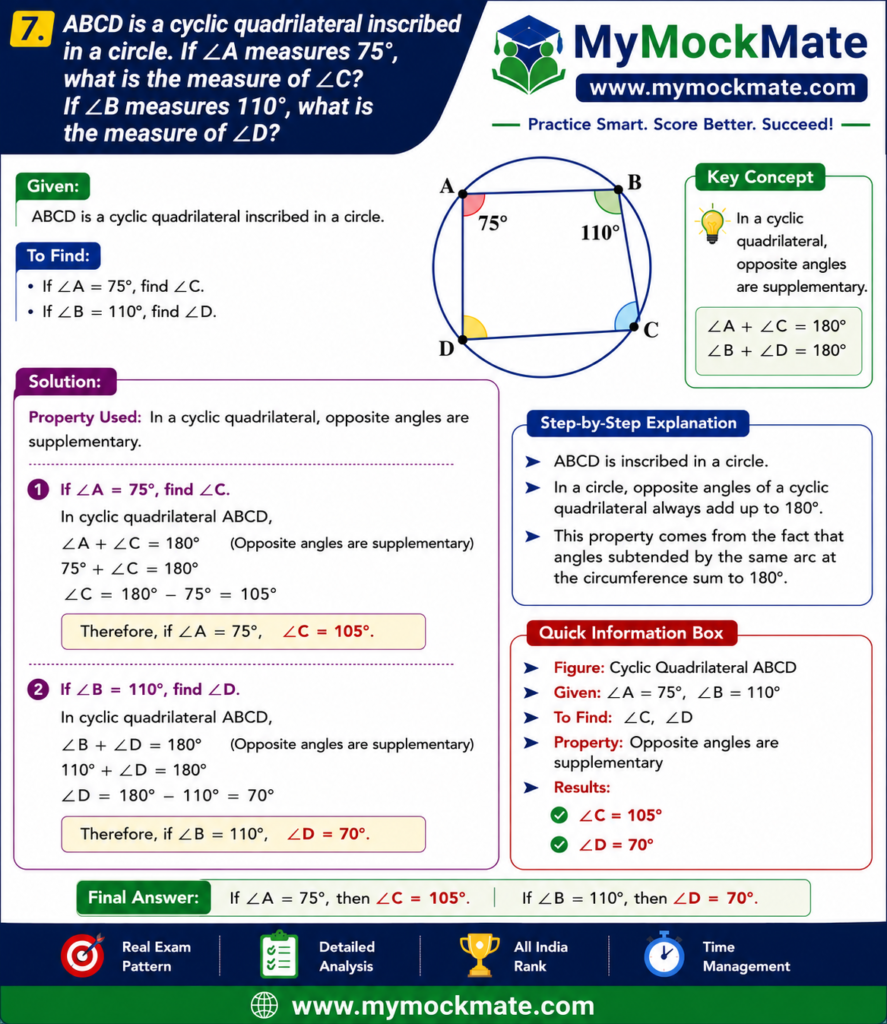
ABCD is a cyclic quadrilateral inscribed in a circle. If ∠A measures 75°, what is the measure of ∠C? If ∠B measures 110°, what is the measure of ∠D?
Solution
Question 8
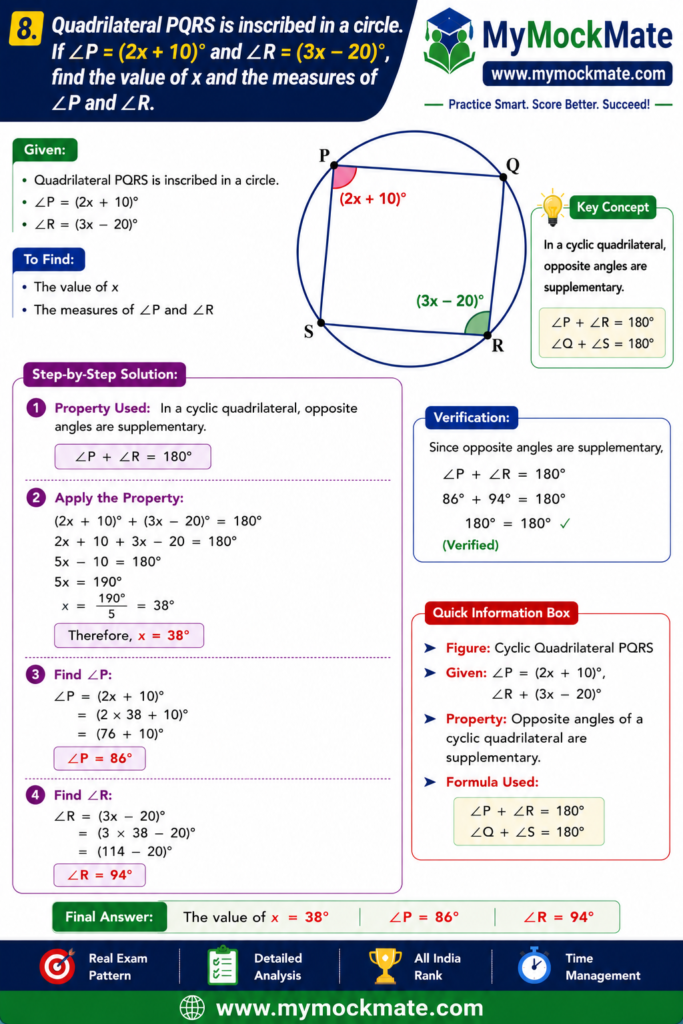
Quadrilateral PQRS is inscribed in a circle. If ∠P = (2x + 10)° and ∠R = (3x − 20)°, find the value of x and the measures of ∠P and ∠R.
Solution
Question 9
The distance of a chord of length 16 cm from the centre of a circle is 6 cm. Find the radius of the circle.
Solution

Question 10
What aA cyclic quadrilateral has sides 5, 5, 12, 12 units. Find its area.re concyclic points?
Solution

Question 11
Consider a cyclic quadrilateral. Without drawing its circumcircle, how can we find out whether the centre of the circumcircle lies inside the quadrilateral or outside? What is the best way of finding out?

Question 12
When two chords intersect, each of them is divided into two line segments. Show that if the intersecting chords are of equal length, then the line segments of one chord are equal to the
corresponding line segments of the other chord.

Question 13
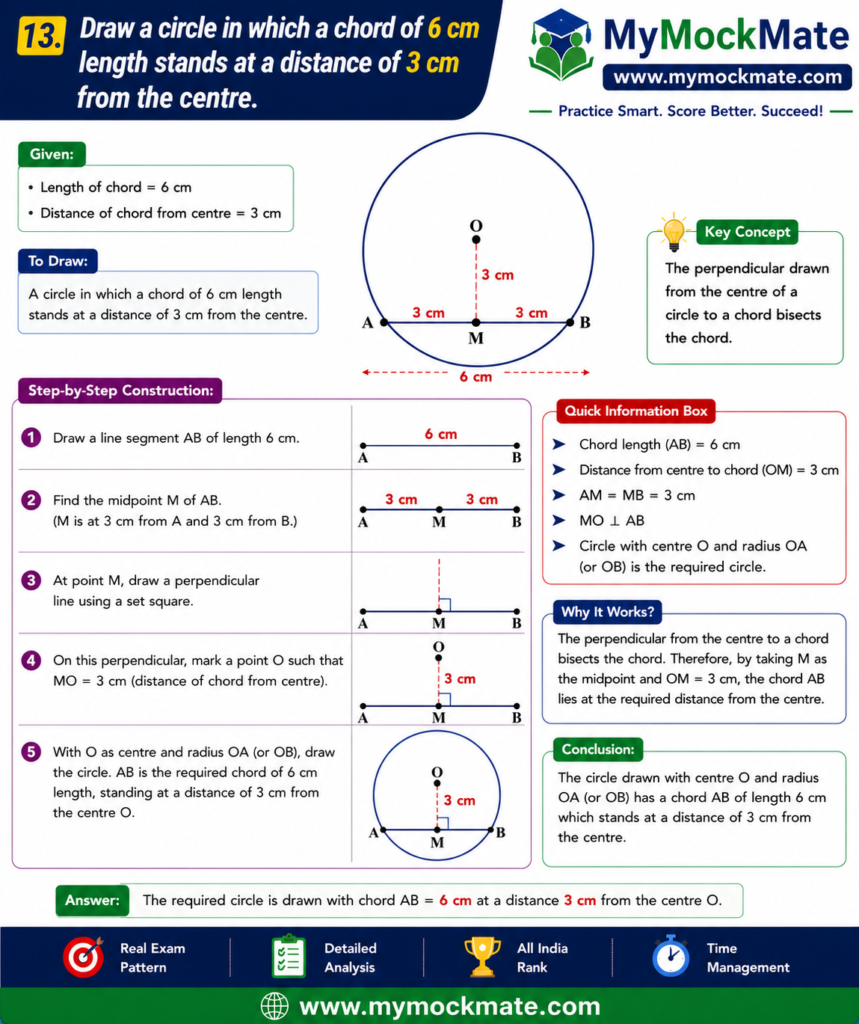
Draw a circle in which a chord of 6 cm length stands at a distance of 3 cm from the centre.
Question 14
Show that rectangle is the only parallelogram that can be inscribed in a circle.

Question 15
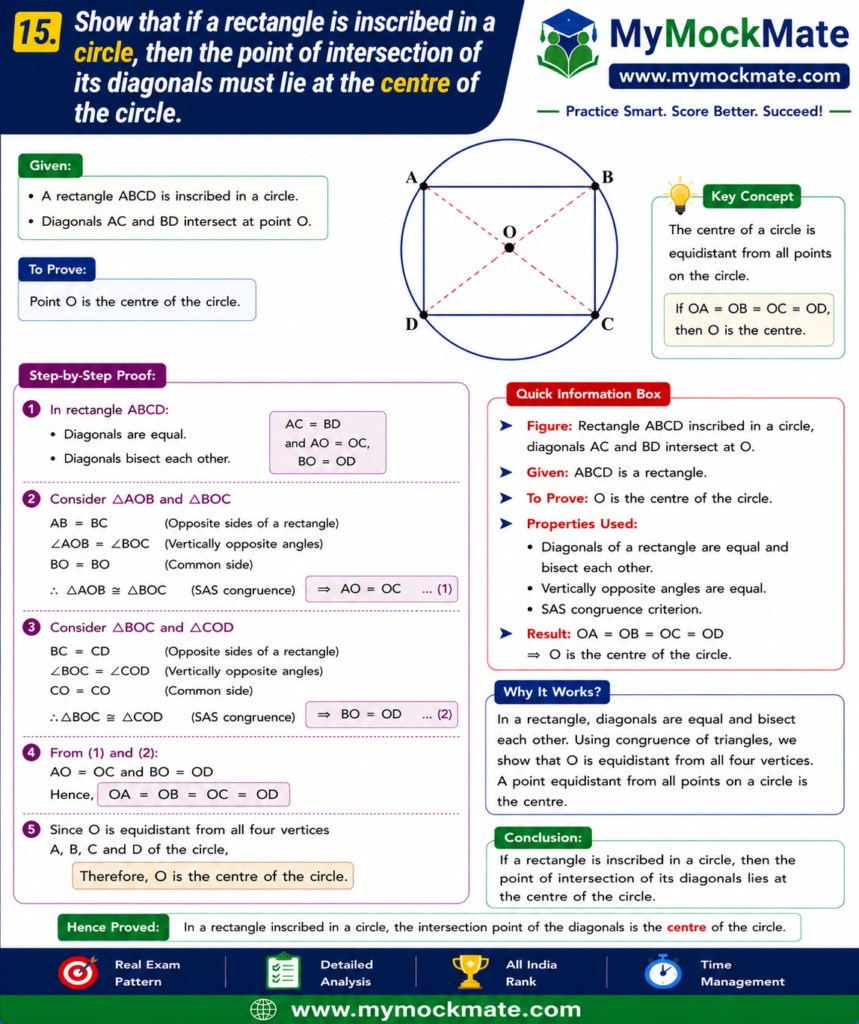
Show that if a rectangle is inscribed in a circle, then the point of intersection of its diagonals must lie at the centre of the circle.
Question 16
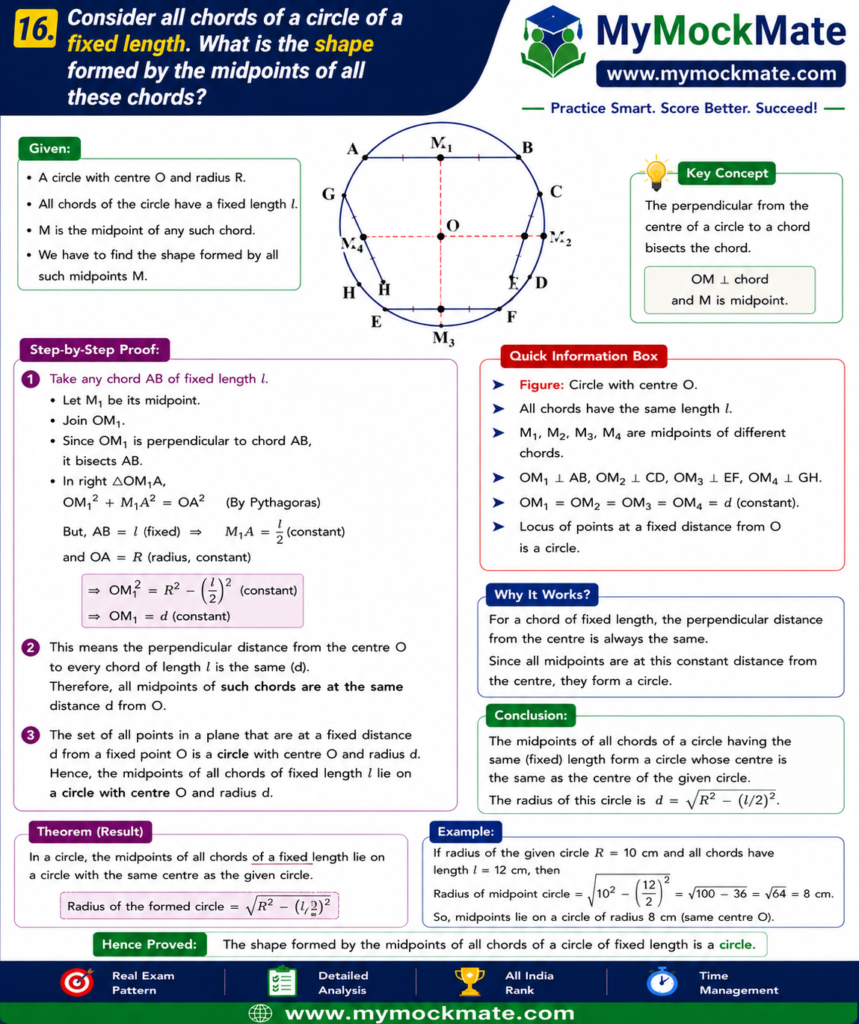
Consider all chords of a circle of a fixed length. What is the shape formed by the midpoints of all these chords?
Question 17
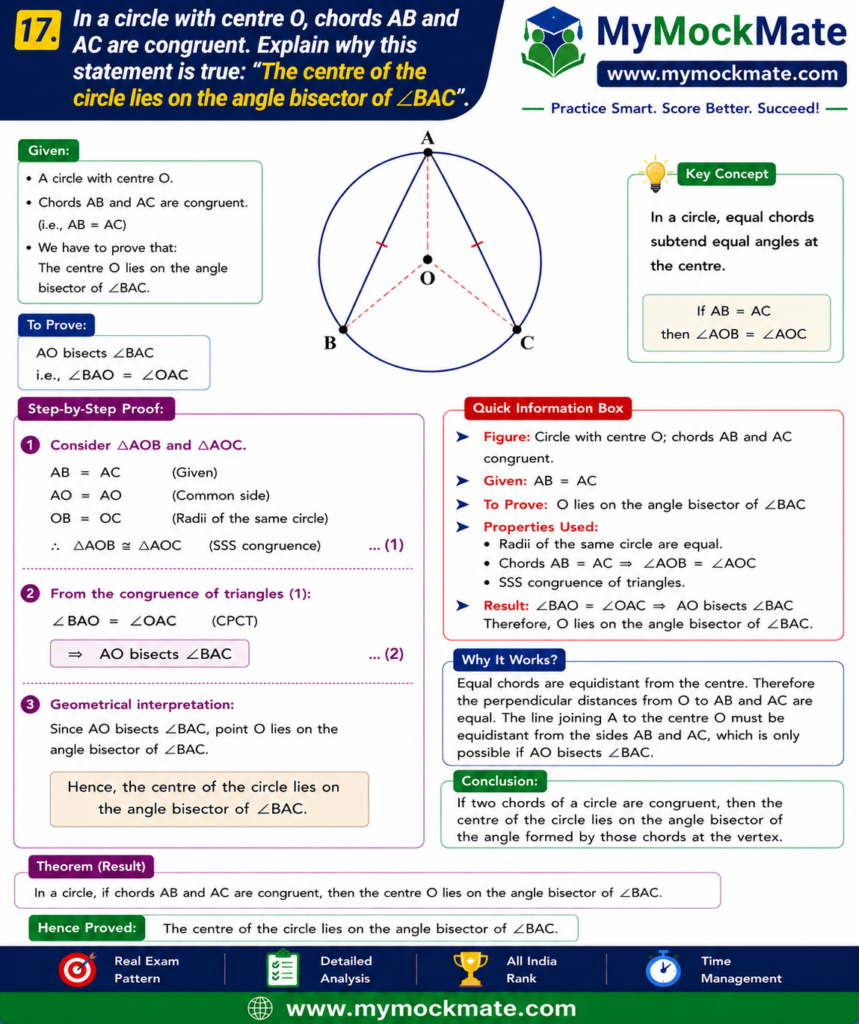
In a circle with centre O, chords AB and AC are congruent. Explain why this statement is true: “The centre of the circle lies on the angle bisector of ∠BAC”.
Question 18
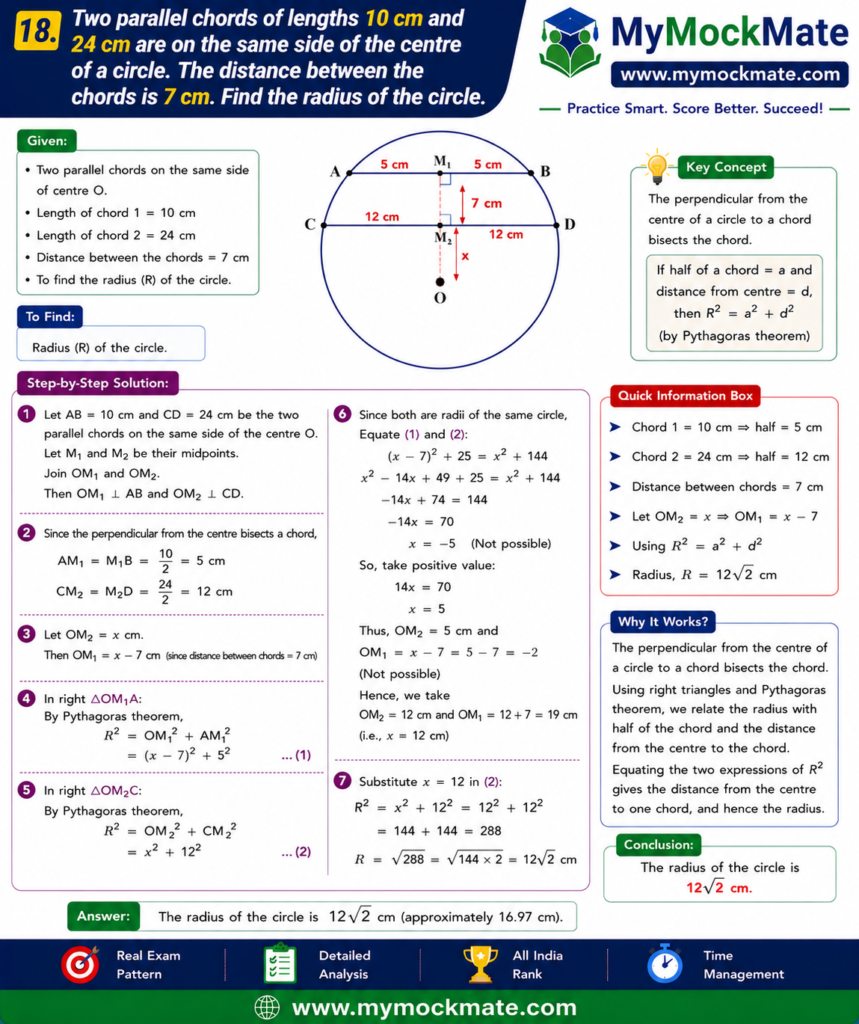
Two parallel chords of lengths 10 cm and 24 cm are on the same side of the centre of a circle. The distance between the chords is 7 cm. Find the radius of the circle.
Question 19
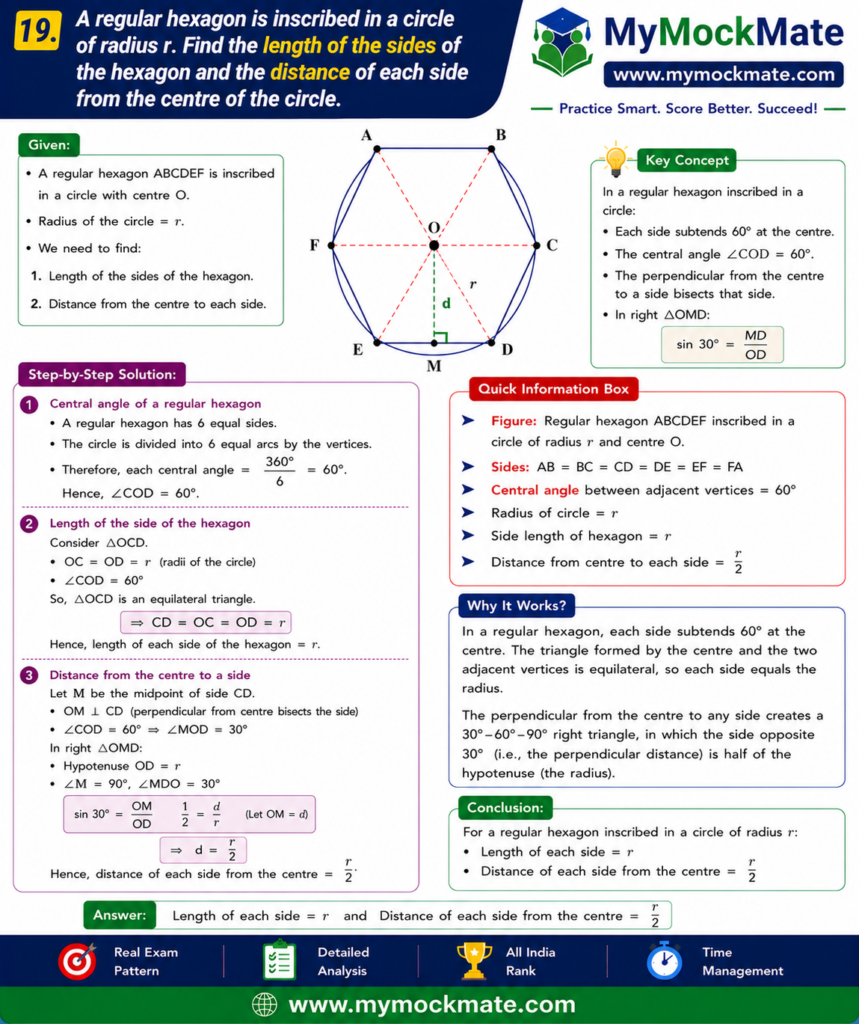
A regular hexagon is inscribed in a circle of radius r. Find the length of the sides of the hexagon and the distance of each side from the centre of the circle.
Question 20
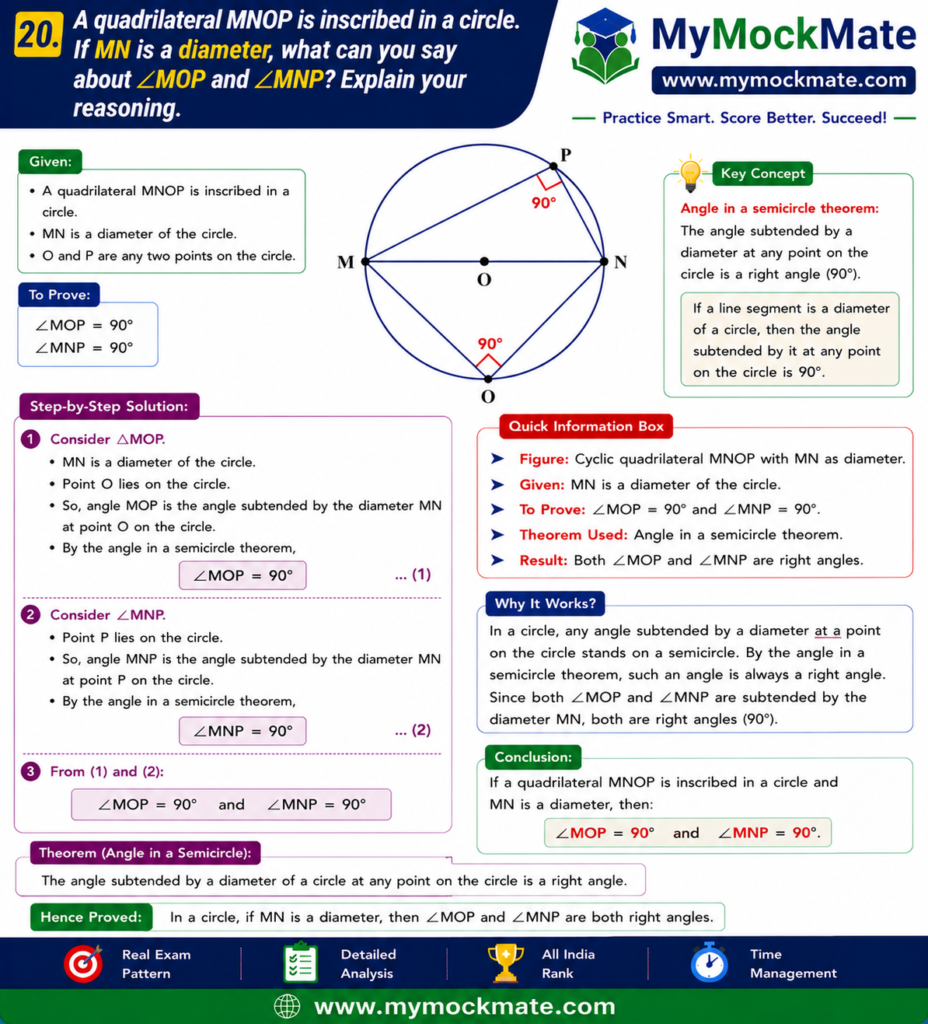
A quadrilateral MNOP is inscribed in a circle. If MN is a diameter, what can you say about ∠MOP and ∠MNP? Explain your reasoning.
Question 21
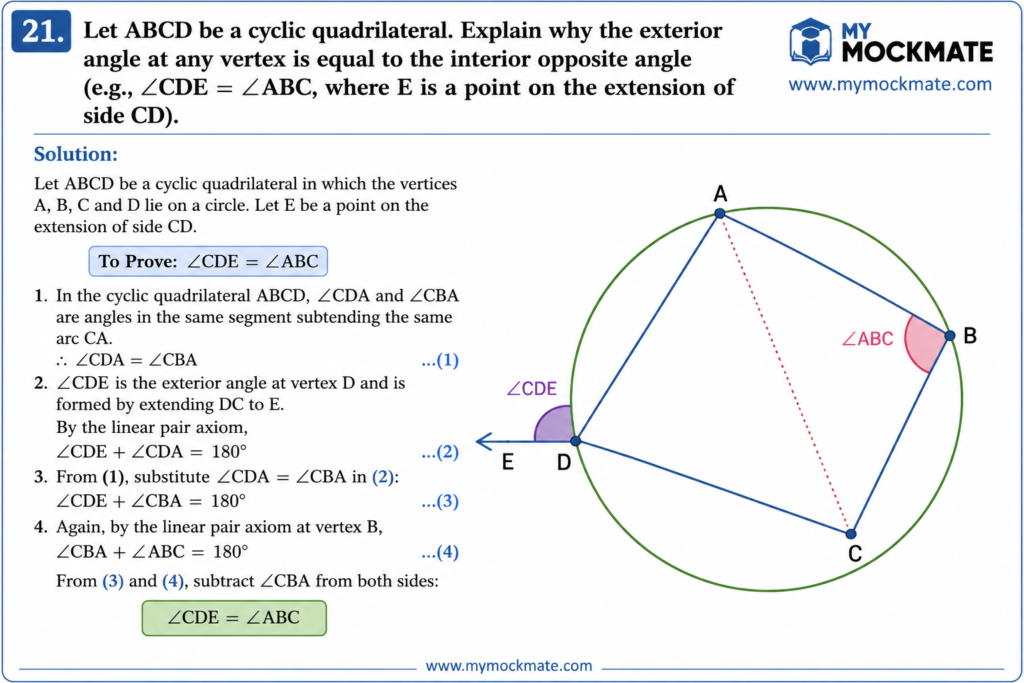
Let ABCD be a cyclic quadrilateral. Explain why the exterior angle at any vertex is equal to the interior opposite angle (e.g., ∠CDE = ∠ABC, where E is a point on the extension of side CD).
Question 22
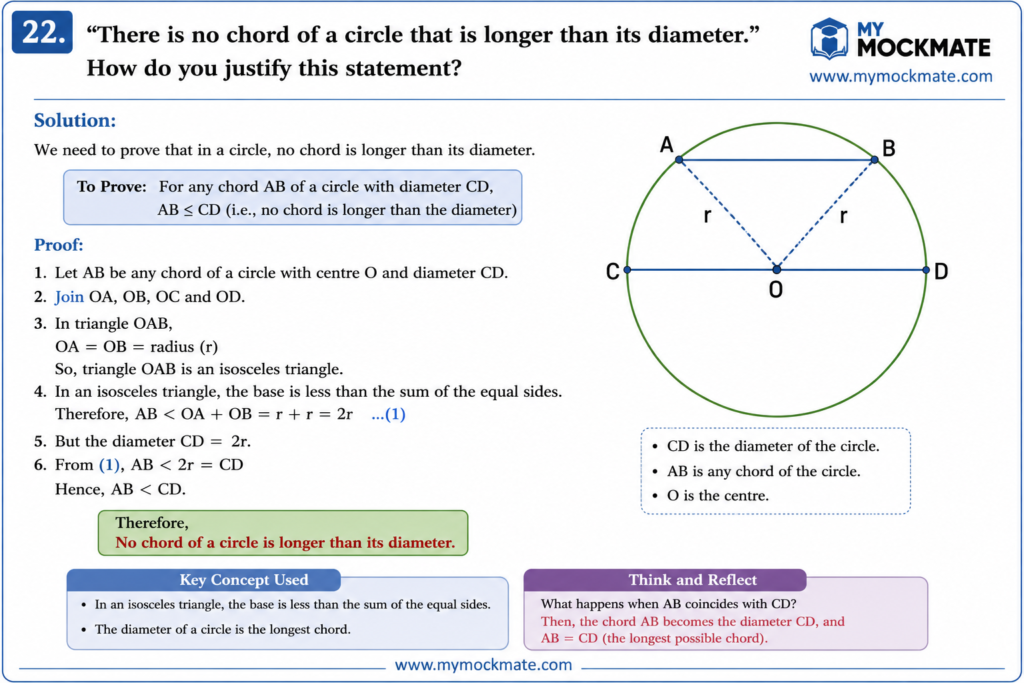
There is no chord of a circle that is longer than its diameter.” How do you justify this statement?
Question 23
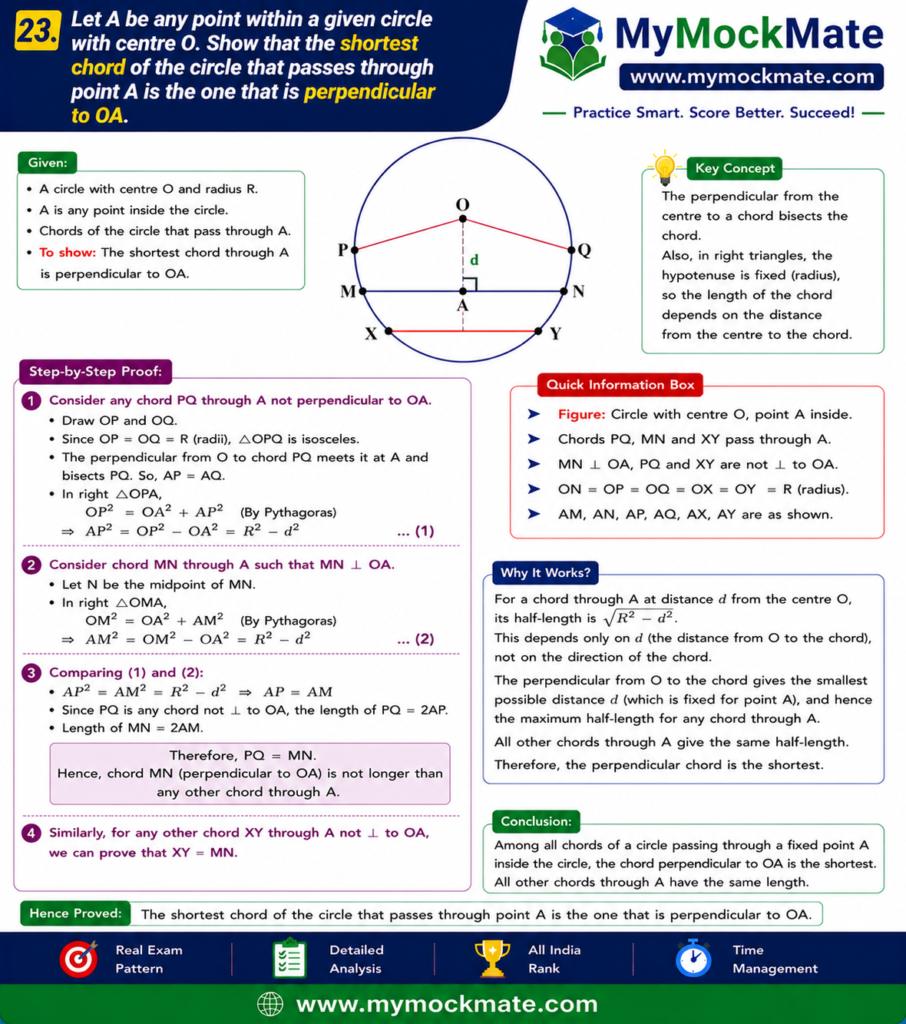
Let A be any point within a given circle with centre O. Show that the shortest chord of the circle that passes through point A is the one that is perpendicular to OA.
Question 24
How would you use the following figure to justify the statement that the angle in a semicircle is 90°?

Question 25
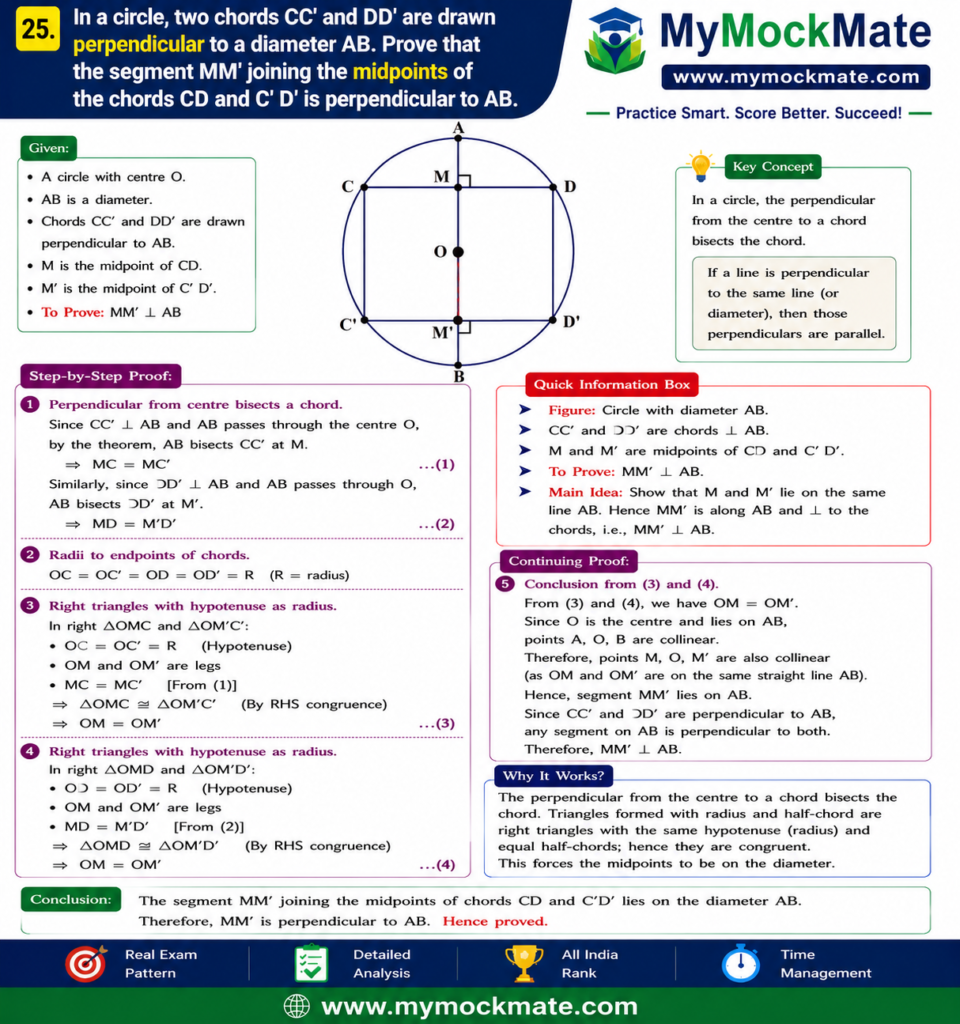
In a circle, two chords CC’ and DD’ are drawn perpendicular to a diameter AB. Prove that the segment MM’ joining the midpoints of the chords CD and C’ D’ is perpendicular to AB.
Question 26
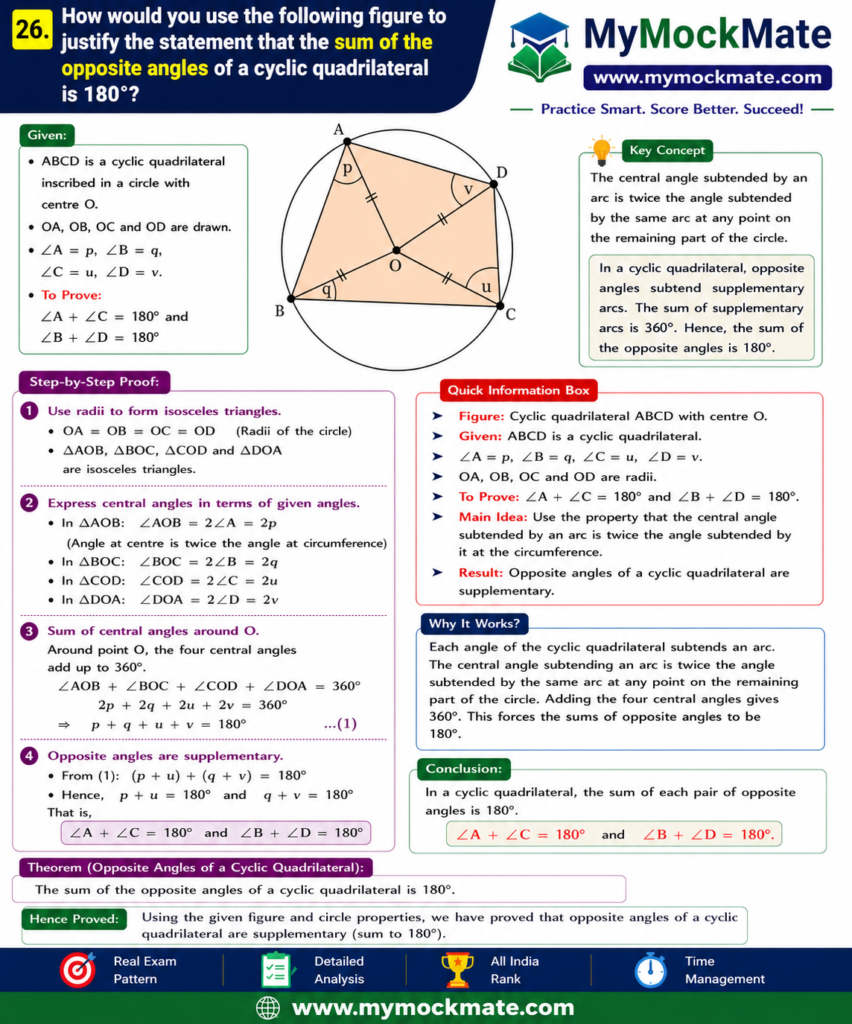
How would you use the following figure to justify the statement that the sum of the opposite angles of a cyclic quadrilateral is 180°?
Final Revision Notes
| Theorem | Result |
|---|---|
| Theorem 1 | Unique circle through three non-collinear points |
| Theorem 2 | Equal chords subtend equal angles |
| Theorem 3 | Equal central angles have equal chords |
| Theorem 4 | Line joining centre to midpoint of chord is perpendicular |
| Theorem 5 | Perpendicular from centre bisects chord |
| Theorem 6 | Equal chords are equidistant from centre |
| Theorem 7 | Equidistant chords are equal |
| Theorem 8 | Longer chord lies nearer the centre |
| Theorem 9 | Angle at centre = 2 × angle at circumference |
| Corollary | Diameter subtends a right angle |
Common Mistakes
❌ Forgetting that the angle at the centre is twice the angle at the circumference.
❌ Confusing chord and diameter.
❌ Using full chord instead of half-chord in calculations.
❌ Assuming all equal angles lie on the same side of a chord.
Exam Tips
✔ Learn all theorems in sequence.
✔ Draw neat labelled diagrams.
✔ Remember:
Diameter = Longest chord.
✔ Practice proof-based questions regularly.
Practice MCQs
1. The longest chord of a circle is:
A. Radius
B. Diameter
C. Arc
D. Tangent
Answer: B
2. Equal chords are:
A. Parallel
B. Equidistant from the centre
C. Perpendicular
D. Diameters
Answer: B
3. Angle subtended by a diameter is:
A. 45°
B. 90°
C. 180°
D. 60°
Answer: B
4. If an angle at the circumference is 30°, then the angle at the centre is:
A. 15°
B. 30°
C. 45°
D. 60°
Answer: D
Frequently Asked Questions (FAQs)
Q1. Can three collinear points lie on a circle?
No.
Q2. Which is the greatest chord?
Diameter.
Q3. What are concyclic points?
Points lying on the same circle.
Q4. Why are equal chords important?
Because they help determine equal distances and equal central angles.
Q5. Which theorem is most important in this chapter?
Angle at Centre = 2 × Angle at Circumference.
Chapter Summary
✅ Circle is the set of points equidistant from a fixed point.
✅ Diameter is the greatest chord.
✅ Equal chords are equidistant from the centre.
✅ Longer chords lie nearer the centre.
✅ Angles in the same segment are equal.
✅ Diameter subtends a right angle.
✅ Concyclic points lie on the same circle.
📚 Looking for complete NCERT Solutions and Exam Notes?
Visit www.mymockmate.com
✅ Complete NCERT Solutions
✅ Step-by-Step Explanations
✅ Practice MCQs and Worksheets
✅ Important Questions and Notes
✅ Chapter-wise Study Material for Class 9 Maths