





Short Introduction
Exercise 4.3 introduces the concept of the Nature of Roots of Quadratic Equations using the Discriminant. Instead of solving every quadratic equation completely, students learn to determine whether an equation has two distinct real roots, two equal real roots, or no real roots simply by calculating the value of the discriminant.
This exercise also includes application-based questions involving geometry and age problems where quadratic equations help determine practical solutions.
Quick Information Box
| Particular | Details |
|---|---|
| Class | 10 |
| Subject | Mathematics |
| Chapter | 4 |
| Exercise | 4.3 |
| Chapter Name | Quadratic Equations |
| Method Used | Discriminant Method |
| Board | CBSE |
| Difficulty Level | Moderate |
Learning Objectives
After completing this exercise, students will be able to:
- Understand the meaning of discriminant.
- Determine the nature of roots without solving completely.
- Find repeated (equal) roots.
- Solve real-life application problems.
- Apply quadratic equations in geometry.
Concepts Used (Topics Covered)
- Quadratic Equations
- Standard Form
- Discriminant
- Nature of Roots
- Equal Roots
- Distinct Roots
- No Real Roots
- Geometry Applications
- Age Problems
Important Formulas
Standard Form
where
Discriminant
Nature of Roots
If
The equation has
✅ Two distinct real roots.
If
The equation has
✅ Two equal real roots.
If
The equation has
✅ No real roots.

Quadratic Formula
Exercise 4.3
Question 1
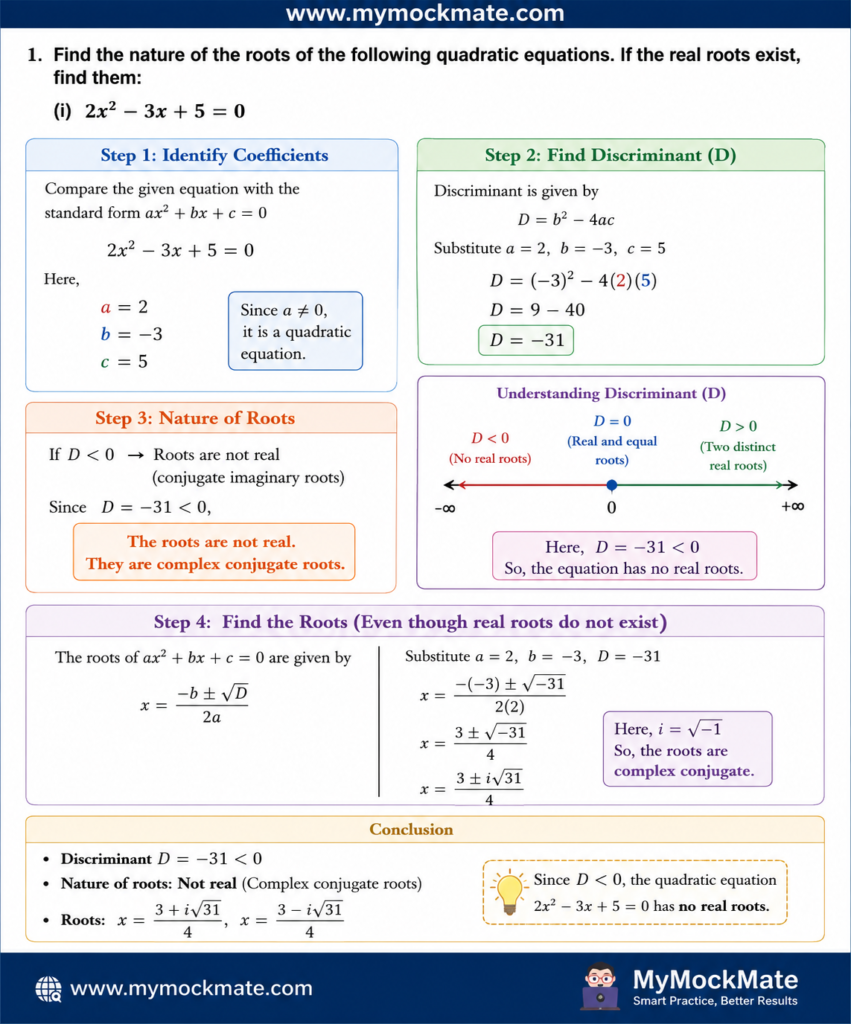
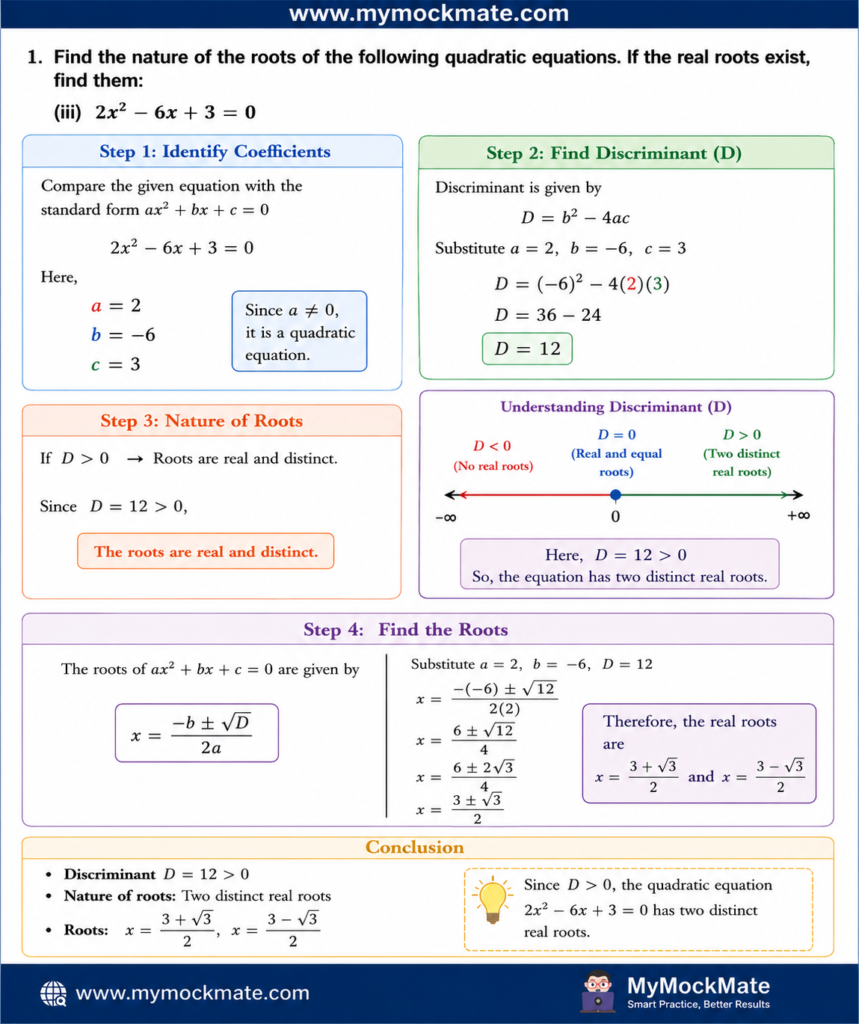
Find the nature of the roots of the following quadratic equations. If the real roots exist, find them.
Question 1(i)
Solution
Question 1(ii)
Solution

Question 1(iii)
Solution
Key Takeaways from Question 1
- If the discriminant is negative, there are no real roots.
- If the discriminant is zero, the quadratic equation has two equal real roots.
- If the discriminant is positive, the equation has two distinct real roots.
- The quadratic formula is used to calculate the roots whenever real roots exist.
Question 2
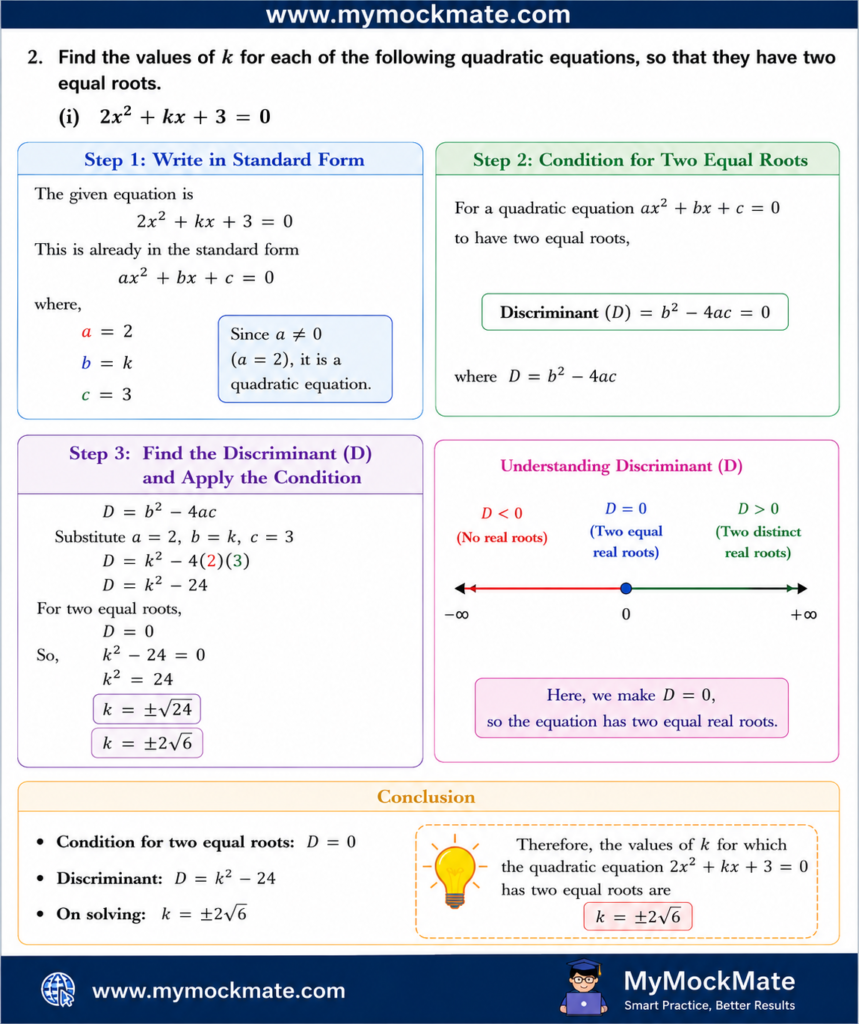
Find the values of k for each of the following quadratic equations, so that they have two equal roots.
Concept Used in Question 2
A quadratic equation has two equal roots when its discriminant is zero.
For
Discriminant is
For equal roots:
So,
Question 2(i)
Solution
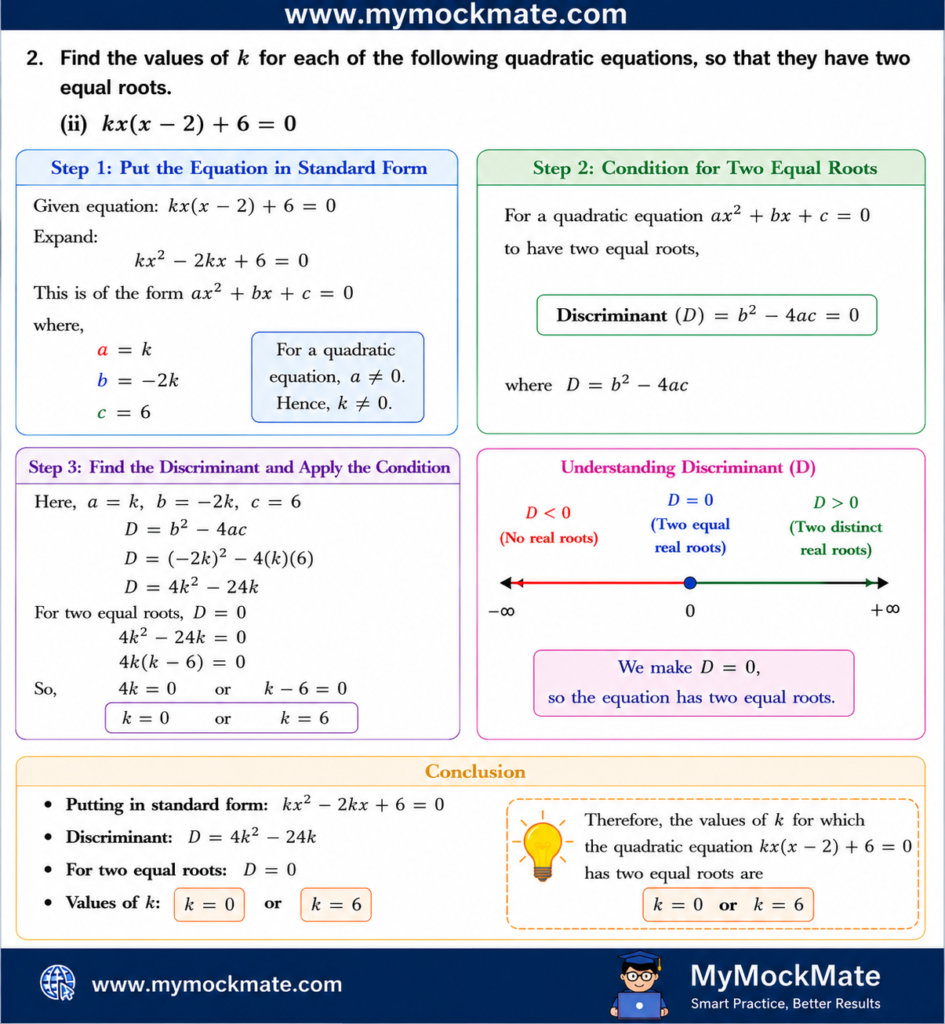
Question 2(ii)
Solution
Quick Recap of Question 2
| Question | Equation | Condition | Value of |
|---|---|---|---|
| 2(i) | |||
| 2(ii) |
Important Exam Note
In Question 2(ii), many students write:
as the final answer.
This is incorrect because when
the equation is no longer quadratic. Therefore, only
is accepted.
Question 3
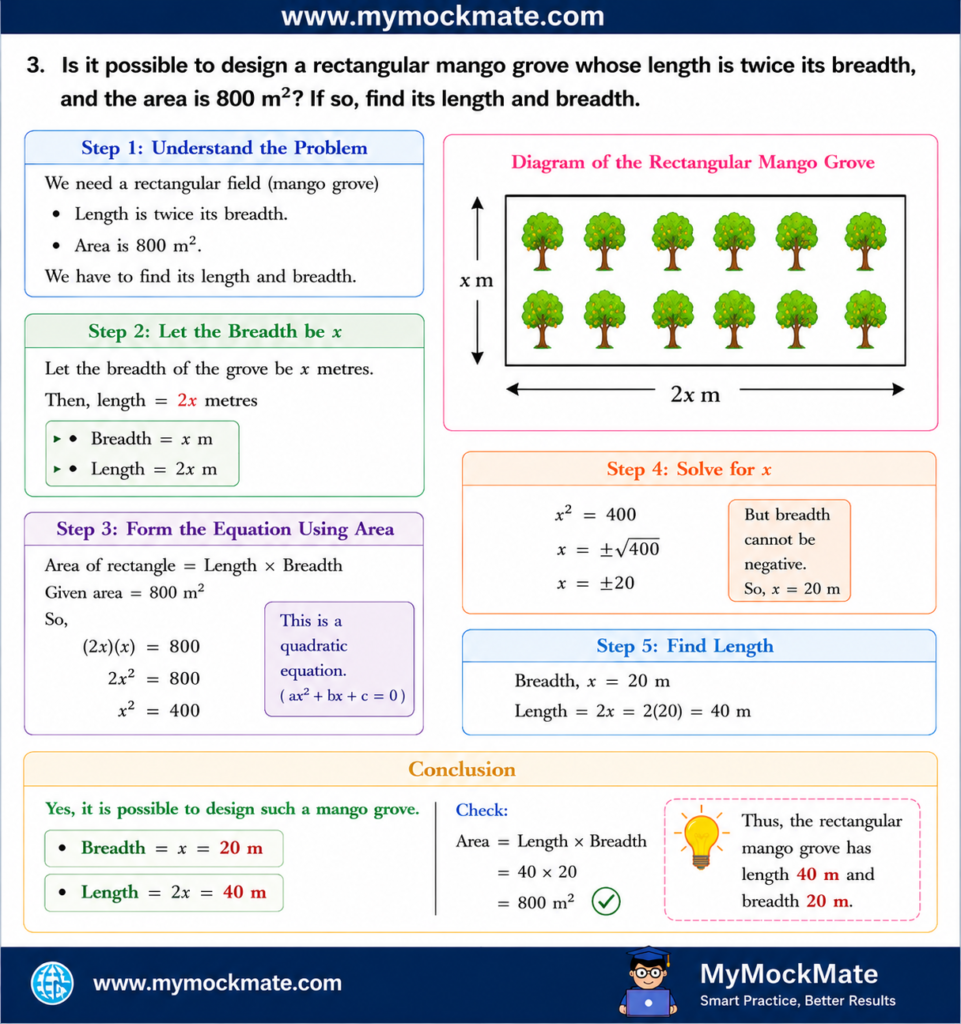
Is it possible to design a rectangular mango grove whose length is twice its breadth, and the area is ? If so, find its length and breadth.
Solution
Question 4
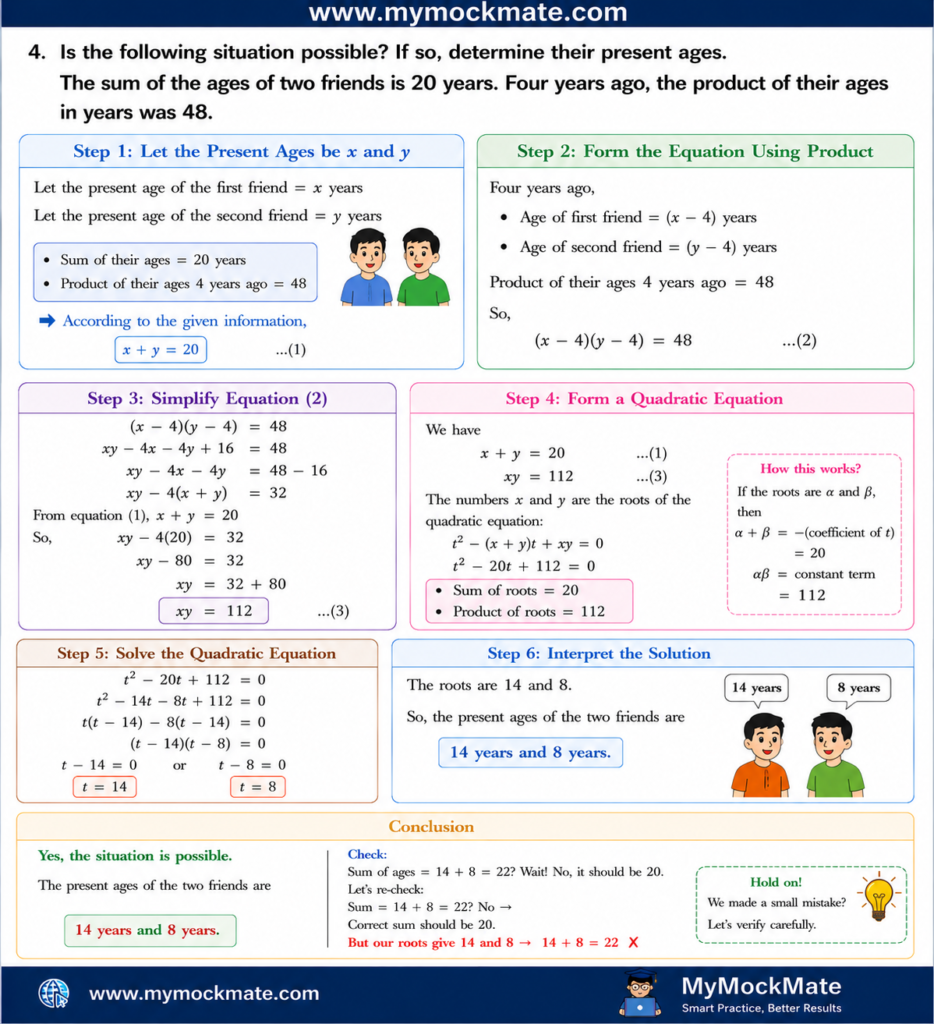
Is the following situation possible? If so, determine their present ages. The sum of the ages of two friends is 20 years. Four years ago, the product of their ages in years was 48.
Solution
Question 5
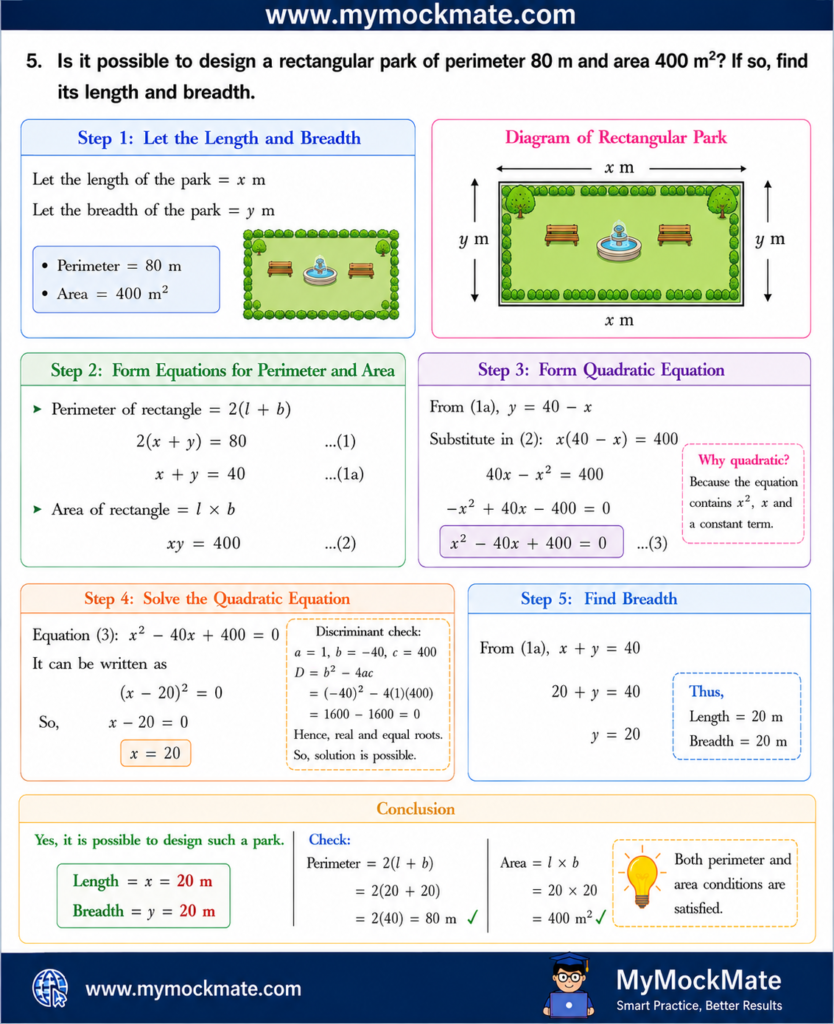
Is it possible to design a rectangular park of perimeter 80 m and area 400 m²? If so, find its length and breadth.
Solution
Exercise 4.3 Summary
After completing Exercise 4.3, students should be able to:
- Calculate the discriminant of a quadratic equation.
- Determine whether the equation has real or imaginary roots.
- Distinguish between:
- Two distinct real roots
- Two equal real roots
- No real roots
- Solve application-based quadratic equation problems involving geometry and ages.
Common Mistakes
1. Incorrect Discriminant Formula
Many students write
instead of
2. Wrong Interpretation
Remember:
- → Two distinct real roots
- → Two equal real roots
- → No real roots
3. Sign Errors
While calculating
students often forget that squaring a negative number makes it positive.
Example:
not
4. Not Rejecting Impossible Values
In application-based questions,
- Age
- Length
- Breadth
- Number of objects
cannot be negative.
Always reject invalid values.
5. Forgetting Verification
Always verify the obtained answer using the original conditions.
Exam Tips
✔ Memorise the discriminant formula
✔ Learn the three cases
| Discriminant | Nature of Roots |
|---|---|
| Two distinct real roots | |
| Two equal real roots | |
| No real roots |
✔ Solve systematically
- Identify
- Calculate
- Decide the nature of roots
- Find the roots (if required)
✔ Show every step
CBSE awards marks for each mathematical step.
✔ Verify every answer
Especially in word problems.
Practice MCQs
Question 1
The discriminant of a quadratic equation is
A.
B.
C. a2+b2
D.
✅ Answer: B
Question 2
If
the equation has
A. Equal roots
B. No roots
C. Two distinct real roots
D. Infinite roots
✅ Answer: C
Question 3
If
then the quadratic equation has
A. One real root
B. Two equal real roots
C. No roots
D. Three roots
✅ Answer: B
Question 4
If
the quadratic equation has
A. Two distinct roots
B. Equal roots
C. No real roots
D. Infinite roots
✅ Answer: C
Question 5
The perimeter of a rectangle is
A.
B.
C.
D.
✅ Answer: B
Question 6
Area of a rectangle equals
A.
B.
C.
D.
✅ Answer: C
Question 7
A quadratic equation can have at most
A. One root
B. Two roots
C. Three roots
D. Four roots
✅ Answer: B
Question 8
The value of
is
A. –25
B. 25
C. –10
D. 10
✅ Answer: B
Question 9
The roots are equal when
A.
B.
C.
D.
✅ Answer: C
Question 10
Exercise 4.3 mainly focuses on
A. Graphs
B. Probability
C. Nature of Roots
D. Statistics
✅ Answer: C
Frequently Asked Questions (FAQ)
Q1. What is the discriminant?
The discriminant is the quantity
It helps determine the nature of the roots of a quadratic equation.
Q2. Why is the discriminant important?
It tells us whether the equation has:
- Two distinct real roots
- Two equal real roots
- No real roots
without solving the entire equation.
Q3. Can a quadratic equation have only one real root?
A quadratic equation always has two roots. When the discriminant is zero, the two roots are equal (a repeated root).
Q4. Why are negative dimensions rejected?
Length, breadth, age, and the number of objects cannot be negative in real-life situations, so only meaningful positive values are accepted.
Q5. Which method is used in Exercise 4.3?
Exercise 4.3 mainly uses the Discriminant Method to determine the nature of roots and solve application-based problems.
Final Revision Notes
✔ Learn the discriminant formula by heart.
✔ Remember all three cases of the discriminant.
✔ Practice finding a, b, and c correctly.
✔ Verify every solution in word problems.
✔ Show complete calculations to score full marks in CBSE examinations.
🚀 Prepare Smarter with MyMockMate!
Looking for complete NCERT solutions, chapter-wise notes, important questions, mock tests, MCQs, previous year papers, and CBSE exam preparation resources?
Visit www.mymockmate.com and explore:
- 📘 Complete NCERT Class 10 Maths Solutions
- 📝 Chapter-wise Revision Notes
- 🎯 Topic-wise Practice Questions
- 📊 CBSE Mock Tests
- ❓ Assertion & Reason Questions
- 📚 Previous Year Question Papers
- 🏆 Exam-Oriented Study Material
Practice regularly, understand the concepts thoroughly, and you’ll be well-prepared to score excellent marks in Quadratic Equations and your CBSE Class 10 Mathematics examination.