


Introduction
Democracy is much more than a system of government—it is a way of ensuring that every citizen has a voice in shaping the future of a nation. India, the world’s largest democracy, demonstrates how people from different cultures, languages, religions, and backgrounds can participate together in governance through free and fair elections. This chapter explains the evolution of democratic ideas, the principles that make democracy successful, and the institutions that safeguard citizens’ rights.
In this solution guide, every answer is written in simple English with detailed explanations, real-life examples, revision tools, and exam-oriented tips. These solutions are specially prepared for CBSE students and competitive exam aspirants using www.mymockmate.com.
Quick Glossary
| Term | Meaning |
|---|---|
| Democracy | Government in which people elect their representatives |
| Constitution | The supreme law of a country |
| Sovereignty | Ultimate power rests with the people |
| Franchise | The right to vote |
| Republic | A country where the Head of State is elected |
| Legislature | Makes laws |
| Executive | Implements laws |
| Judiciary | Interprets laws and protects the Constitution |
Chapter Flowchart
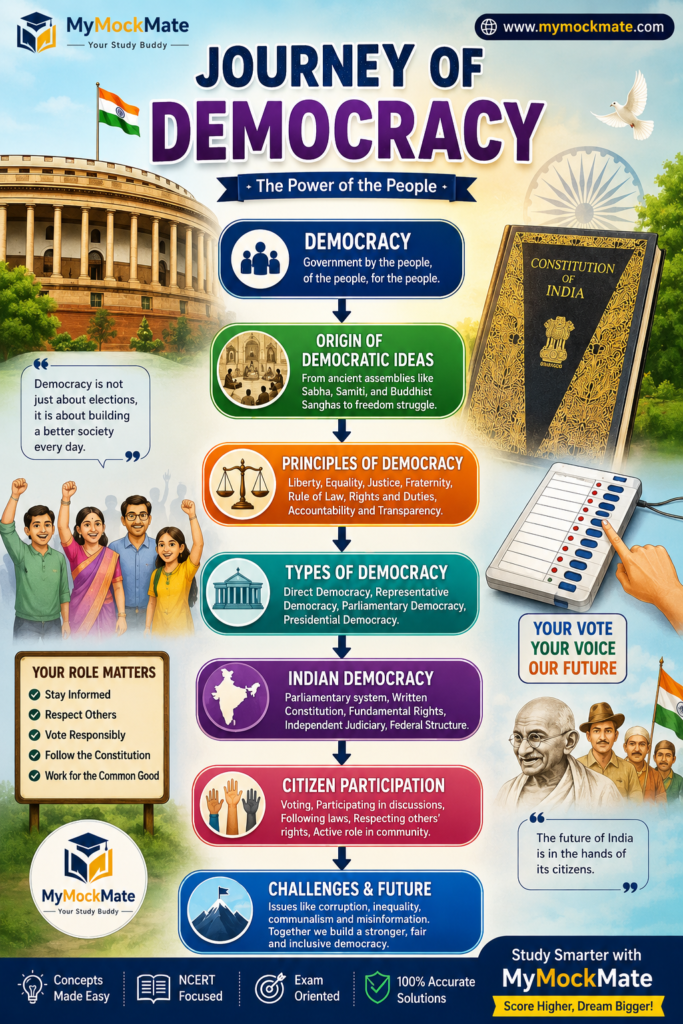
Image Suggestion:
Create a colorful infographic titled “Journey of Democracy” showing the above flowchart with Indian Parliament, Constitution, Voting Machine (EVM), and Citizens.
Question 1
NCERT Question
How has the idea of democracy evolved over time and shaped our understanding of it today?
Answer
The concept of democracy has developed gradually over thousands of years.
Step 1: Early Democratic Traditions
India has a rich democratic heritage. During the Vedic period, assemblies such as the Sabha, Samiti, and Vidhata encouraged discussion and collective decision-making. Early republican states (Ganas and Sanghas) also followed participatory methods instead of absolute monarchy.
Step 2: Influence of Ancient Institutions
Buddhist Sanghas practised democratic values by allowing members to debate issues, elect leaders, and vote on important decisions. These practices promoted equality and consensus.
Step 3: Freedom Movement
British colonial rule reduced people’s participation in governance. During India’s freedom struggle, democratic values such as liberty, equality, and justice became stronger as people demanded self-rule.
Step 4: Constitution of India
After independence, the Constituent Assembly drafted the Constitution, which established India as a democratic republic based on justice, liberty, equality, and fraternity. The Constitution guarantees Fundamental Rights and provides opportunities for every citizen to participate in governance.
Step 5: Modern Democracy
Today, democracy extends beyond elections. It includes:
- Free and fair elections
- Protection of Fundamental Rights
- Rule of Law
- Transparency
- Accountability
- Citizen participation
- Independent judiciary
- Freedom of expression
Final Answer
The idea of democracy has evolved from ancient systems of collective decision-making to a modern constitutional system that guarantees equality, justice, liberty, and citizen participation. Today, democracy is not only about electing governments but also about protecting people’s rights and ensuring responsible governance.
Real-Life Example
Every five years, Indian citizens vote to elect Members of Parliament. This peaceful transfer of power through elections demonstrates how democracy functions in everyday life.
Similarly, elections for School Student Councils encourage students to choose their representatives and understand democratic values from an early age.
Exam Tip
Mention these keywords:
- Vedic Assemblies
- Constituent Assembly
- Constitution of India
- Fundamental Rights
- Citizen Participation
These keywords help score better marks in CBSE descriptive answers.

Key Takeaway
Democracy has evolved from ancient participatory traditions to a modern constitutional system where the people remain the ultimate source of power.
Question 2
NCERT Question
What are the different forms of democracy, and how are they practised in India and other parts of the world?
Answer
Democracy is practised in different forms depending on how citizens participate in governance and how political power is organised. The chapter explains four major forms of democracy.
1. Direct Democracy
- Citizens directly participate in decision-making.
- Suitable for countries with a small population.
- Example: Switzerland.
2. Representative (Indirect) Democracy
- Citizens elect representatives to govern on their behalf.
- Most large countries follow this model.
- Example: India.
3. Parliamentary Democracy
- The executive is responsible to the legislature.
- The Prime Minister leads the government.
- Examples:
- India
- Canada
- United Kingdom
4. Presidential Democracy
- The President is both Head of State and Head of Government.
- The executive works independently of the legislature.
- Example:
- United States of America
Democracy in India
India follows a Representative Parliamentary Democracy because:
- Citizens elect Members of Parliament and State Legislatures.
- The Prime Minister heads the government.
- The President serves as the constitutional Head of State.
- The Constitution guarantees Fundamental Rights and democratic institutions.
Real-Life Example
During Lok Sabha Elections, citizens vote for Members of Parliament rather than directly choosing the Prime Minister. The elected majority party or coalition forms the government.
Exam Tip
Remember:
Direct = People Decide
Representative = Representatives Decide
Parliamentary = PM Leads
Presidential = President Leads
Key Takeaway
Different countries adopt different democratic systems, but all democratic systems aim to ensure people’s participation, accountability, and protection of rights.
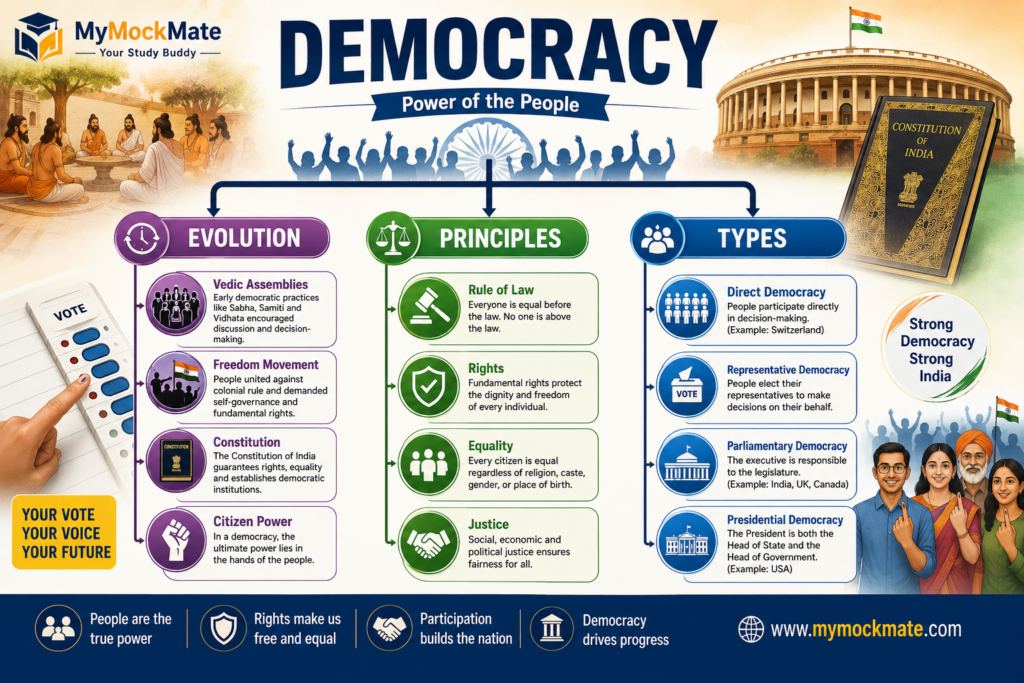
Chapter Mind Map
Revision Table
| Topic | Important Point |
|---|---|
| Democracy | Government by the people |
| Ancient India | Sabha, Samiti, Vidhata |
| Constitution | Adopted after Independence |
| India | Parliamentary Democracy |
| Switzerland | Direct Democracy |
| USA | Presidential Democracy |
Chapter Quiz
MCQs
1. Which country follows Direct Democracy?
A. India
B. USA
C. Switzerland ✅
D. Canada
2. India follows
A. Presidential Democracy
B. Parliamentary Democracy ✅
C. Dictatorship
D. Monarchy
True / False
- Democracy means rule by the people. ✅
- India follows Direct Democracy. ❌
Assertion–Reason
Assertion: India is the world’s largest democracy.
Reason: Indian citizens elect their representatives through free and fair elections.
Answer: Both Assertion and Reason are true, and the Reason correctly explains the Assertion.
🎯 Strengthen your Social Science preparation with chapter-wise NCERT Solutions, Mock Tests, PYQs, Mind Maps, and Revision Notes only on www.mymockmate.com. Practice consistently and score higher in CBSE examinations.