






Measuring Space: Perimeter and Area
Introduction
Perimeter means the total distance around the boundary of a shape. For a circle, the perimeter is called its circumference.
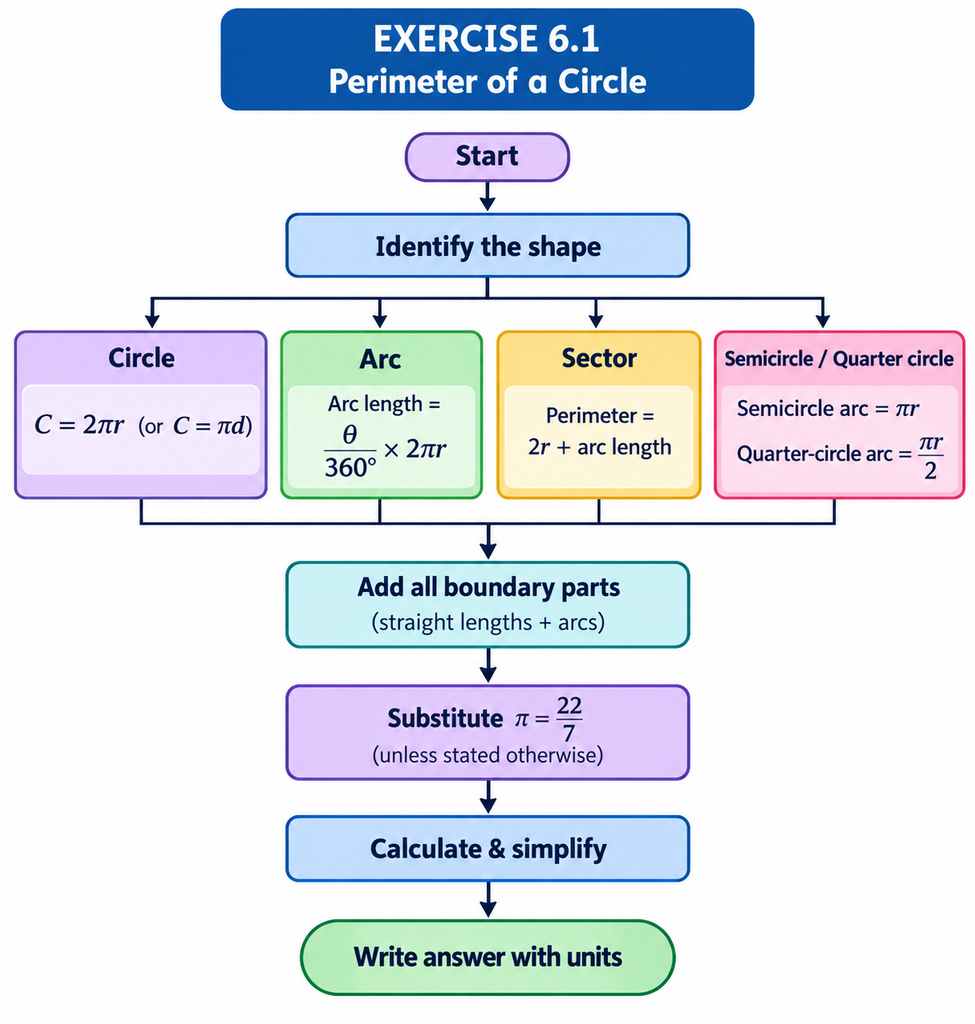
In Exercise 6.1, students apply the circumference formula, arc-length formula, properties of sectors and semicircles, and relationships between the perimeter and radius of circles. The textbook instructs us to use π ≈ 22/7 unless stated otherwise.
Key Formulas
- Circumference of a circle:
C = 2πr = πd - Length of an arc:
Arc length = (θ/360°) × 2πr - Perimeter of a sector:
Perimeter = 2r + arc length - Semicircle arc:
πr - Quarter-circle arc:
πr/2
Glossary
| Term | Meaning |
|---|---|
| Perimeter | Total length around the boundary of a closed shape |
| Circumference | Perimeter of a circle |
| Radius (r) | Distance from the centre of a circle to its boundary |
| Diameter (d) | A line segment passing through the centre and joining two points on a circle |
| Arc | A curved part of the circumference of a circle |
| Sector | A region bounded by two radii and an arc |
| Central Angle | The angle made by an arc at the centre of a circle |
| π (Pi) | The ratio of circumference to diameter of a circle; here π is approximated by 22/7 |
The chapter defines perimeter as the total length around a shape’s border and gives the circumference of a circle as 2πr.
Flowchart
Question
Question 1
The perimeter of a circle is 44 cm. What is its radius?
Solution
We know:
C = 2πr
Given:
C = 44 cm
Using π = 22/7:
44 = 2 × 22/7 × r
Therefore,
r = 44 × 7 / 44
r = 7 cm
Answer
The radius of the circle is 7 cm.
Question 2
Calculate the circumference, correct to 3 significant figures, for circles with the following radii.

(i) Radius = 7 cm
C = 2πr
= 2 × 22/7 × 7
= 44 cm
Answer: 44.0 cm
(ii) Radius = 10 cm
C = 2 × 22/7 × 10
= 440/7
= 62.857…
Correct to 3 significant figures:
Answer: 62.9 cm
(iii) Radius = 12 cm
C = 2 × 22/7 × 12
= 528/7
= 75.428…
Correct to 3 significant figures:
Answer: 75.4 cm
Final Answers
| Radius | Circumference |
|---|---|
| 7 cm | 44.0 cm |
| 10 cm | 62.9 cm |
| 12 cm | 75.4 cm |
Question 3
Find the length of the arc.
(i) r = 3.5 cm, θ = 60°
Formula:
Arc length = (θ/360°) × 2πr
Substitute:
= 60/360 × 2 × 22/7 × 3.5
Since 3.5 = 7/2:
= 1/6 × 22
= 11/3 cm
= 3.67 cm
Answer: 3.67 cm
(ii) r = 6.3 m, θ = 120°
Arc length
= 120/360 × 2 × 22/7 × 6.3
= 1/3 × 39.6
= 13.2 m
Answer: 13.2 m
Final Answers
| Radius | Central Angle | Arc Length |
|---|---|---|
| 3.5 cm | 60° | 3.67 cm |
| 6.3 m | 120° | 13.2 m |
Question 4
Find the perimeter of a sector of radius 14 cm and sector angle 75°.
The perimeter contains:
- Two radii
- One curved arc
Step 1: Find the arc length
Arc length
= 75/360 × 2 × 22/7 × 14
= 75/360 × 88
= 55/3 cm
= 18.33 cm
Step 2: Add the two radii
Two radii:
= 14 + 14
= 28 cm
Therefore,
Perimeter
= 28 + 18.33
= 46.33 cm
Answer
The perimeter of the sector is approximately 46.3 cm.
Question 5
Find the perimeter of each shape in Fig. 6.14. The exercise specifies that the arcs should be treated as quarter, half or three-quarter circles as appropriate.
(i)
The shape has two straight sections of 80 m each and two semicircular ends with diameter 60 m.
Straight portions:
80 + 80 = 160 m
The two semicircles together make one complete circle of diameter 60 m.
Circular part:
π × 60 = 60 × 22/7
= 188.57 m
Therefore,
P = 160 + 188.57
Answer: 348.57 m
(ii)
The outer semicircle has diameter 12 cm and the inner semicircle has diameter 8 cm.
The two straight portions together measure:
12 − 8 = 4 cm
The two semicircular arcs together have length equivalent to:
π(12/2) + π(8/2)
= 6π + 4π
= 10π
Therefore,
P = 4 + 10 × 22/7
= 35.43 cm
Answer: 35.43 cm
(iii)
The boundary consists of four semicircular arcs, each based on a side of length 10 cm.
Four semicircles together:
4 × (π × 10/2)
= 20π
= 20 × 22/7
Answer: 62.86 cm
(iv)
The boundary consists of three semicircular arcs, each with diameter 12 cm.
P = 3 × (π × 12/2)
= 18π
= 18 × 22/7
Answer: 56.57 cm
(v)
There are four semicircular arcs, each with diameter 14 cm.
P = 4 × (π × 14/2)
= 28π
= 28 × 22/7
Answer: 88 cm
(vi)
The outer semicircle has diameter 28 cm, while the three smaller semicircular arcs together have the same total diameter, 28 cm.
Thus, the total curved length is equivalent to one complete circle of diameter 28 cm.
P = π × 28
= 28 × 22/7
Answer: 88 cm
(vii)
The three straight dimensions shown form a 6–8–10 triangle. The boundary contains semicircles on all three sides.
Total perimeter:
= π/2 × (6 + 8 + 10)
= π/2 × 24
= 12π
= 12 × 22/7
Answer: 37.71 cm
(viii)
The large semicircle has diameter:
4 + 4 + 4 = 12 cm
The three smaller semicircles each have diameter 4 cm.
Large semicircle:
= π × 12/2
= 6π
Three smaller semicircles:
= 3 × π × 4/2
= 6π
Total:
= 12π
= 12 × 22/7
Answer: 37.71 cm
(ix)
The large semicircle has diameter:
10 + 10 = 20 cm
The two smaller semicircular arcs each have diameter 10 cm.
Total curved length:
= π × 20/2 + 2 × (π × 10/2)
= 10π + 10π
= 20π
= 20 × 22/7
Answer: 62.86 cm
Question 5 – Answer Table
| Figure | Perimeter |
|---|---|
| (i) | 348.57 m |
| (ii) | 35.43 cm |
| (iii) | 62.86 cm |
| (iv) | 56.57 cm |
| (v) | 88 cm |
| (vi) | 88 cm |
| (vii) | 37.71 cm |
| (viii) | 37.71 cm |
| (ix) | 62.86 cm |
The actual Fig. 6.14 diagrams and their dimensions are shown in the uploaded textbook pages.
Question 6
The diameter of a car tyre is 56 cm.
(i) Distance travelled in one revolution
One revolution covers one circumference.
C = πd
= 22/7 × 56
= 176 cm
Answer
The car travels 176 cm, or 1.76 m, in one revolution.
(ii) Revolutions in 10 km
Convert 10 km into centimetres:
10 km = 1,000,000 cm
Number of revolutions:
= Total distance ÷ Distance per revolution
= 1,000,000 ÷ 176
= 5681.818…
Answer
The tyre makes approximately 5,682 revolutions.
Question 7
Find the total perimeter of all the petals in each flower.
(i) Flower with a square of side 14 cm
Each petal is formed by two quarter-circle arcs.
Radius of each arc:
14/2 = 7 cm
Length of one quarter-circle:
= πr/2
= 7π/2
Each petal has two such arcs:
= 7π
There are four petals:
= 4 × 7π
= 28π
= 28 × 22/7
Answer: 88 cm
(ii) Flower with a regular hexagon of side 42 cm
The arcs have radius 42 cm and each petal is bounded by two arcs corresponding to 60°.
Length of one 60° arc:
= 60/360 × 2π × 42
= 14π
Each petal has two arcs:
= 28π
There are six petals:
= 6 × 28π
= 168π
= 168 × 22/7
Answer: 528 cm
The textbook identifies the centres of the arcs in Fig. 6.15A as the midpoints of the square’s sides and in Fig. 6.15B as the vertices of the hexagon.
Question 8
The ratio of the perimeters of two circles is 5 : 4. Find the ratio of their radii.
For any circle:
C = 2πr
Therefore, circumference is directly proportional to radius:
C ∝ r
So,
C₁ : C₂ = r₁ : r₂
Given:
C₁ : C₂ = 5 : 4
Therefore,
Answer: The ratio of their radii is 5 : 4.
Real Life Example
Running Tracks
The chapter introduces the idea of perimeter through athletics tracks. Runners in outer lanes start ahead of runners in inner lanes because the curved portions of the outer lanes have larger radii and therefore longer circumferences. The stagger compensates for this additional distance.
Car Tyres
A tyre’s circumference tells us how far a car travels in one complete revolution. For a tyre with diameter 56 cm:
Distance per revolution = πd = 176 cm
Thus, knowing the diameter of a tyre allows us to estimate the distance travelled and the number of wheel revolutions.
Mind Map

Revision Table
| Concept | Formula / Rule | Example |
|---|---|---|
| Circumference | 2πr | r = 7 cm → 44 cm |
| Circumference using diameter | πd | d = 56 cm → 176 cm |
| Semicircle arc | πr | r = 7 cm → 22 cm |
| Quarter-circle arc | πr/2 | r = 7 cm → 11 cm |
| Arc of angle θ | θ/360 × 2πr | θ = 60°, r = 3.5 cm → 3.67 cm |
| Sector perimeter | 2r + arc | r = 14 cm, θ = 75° → 46.3 cm |
| Perimeter ratio of circles | C₁ : C₂ = r₁ : r₂ | 5:4 → radii 5:4 |
| Wheel distance | Circumference × revolutions | 1 revolution of d = 56 cm → 176 cm |
Click For Class 9th Maths Exercise 6.2