NCERT Class 10 Maths Chapter 1 Exercise 1.1 Solutions | Real Numbers
Short Introduction
NCERT Class 10 Maths Chapter 1 (Real Numbers) Exercise 1.1 focuses on the Fundamental Theorem of Arithmetic, Prime Factorisation Method, HCF (Highest Common Factor) and LCM (Least Common Multiple). These concepts form the foundation for many higher mathematical topics. In this article, we provide detailed step-by-step solutions to all questions of Exercise 1.1 in an exam-oriented manner.
Quick Information Box
| Particular | Details |
|---|---|
| Class | 10 |
| Subject | Mathematics |
| Chapter | Real Numbers |
| Exercise | 1.1 |
| Board | CBSE / NCERT |
| Main Topics | Prime Factorisation, HCF, LCM |
| Difficulty Level | Easy to Moderate |
Concepts Used (Topics Covered)
✓ Prime Numbers
✓ Composite Numbers
✓ Prime Factorisation
✓ Fundamental Theorem of Arithmetic
✓ Highest Common Factor (HCF)
✓ Least Common Multiple (LCM)
✓ Verification of HCF × LCM = Product of Numbers
Important Formulas
1. Fundamental Theorem of Arithmetic
Every composite number can be expressed as a product of prime factors in a unique way.
2. HCF Formula
HCF = Product of the smallest powers of common prime factors.
3. LCM Formula
LCM = Product of the greatest powers of all prime factors involved.
4. Relationship
LCM × HCF = Product of the given two numbers
Question 1
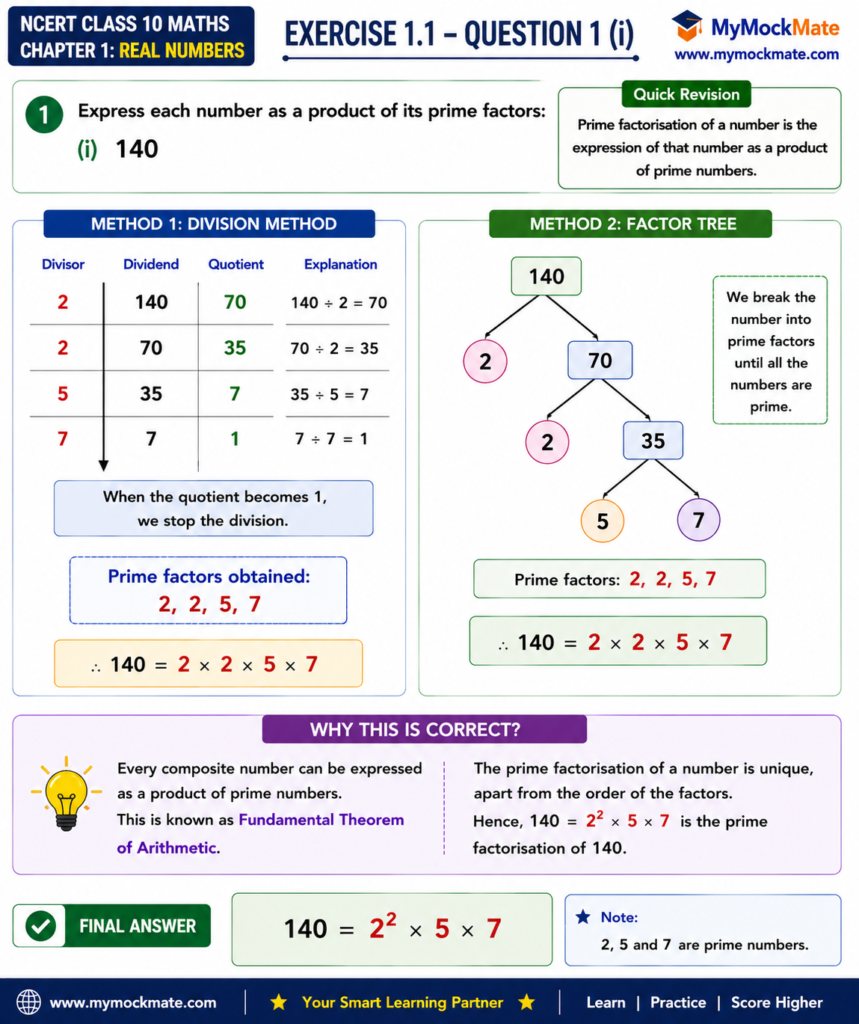
Express each number as a product of its prime factors.
(i) 140
Solution
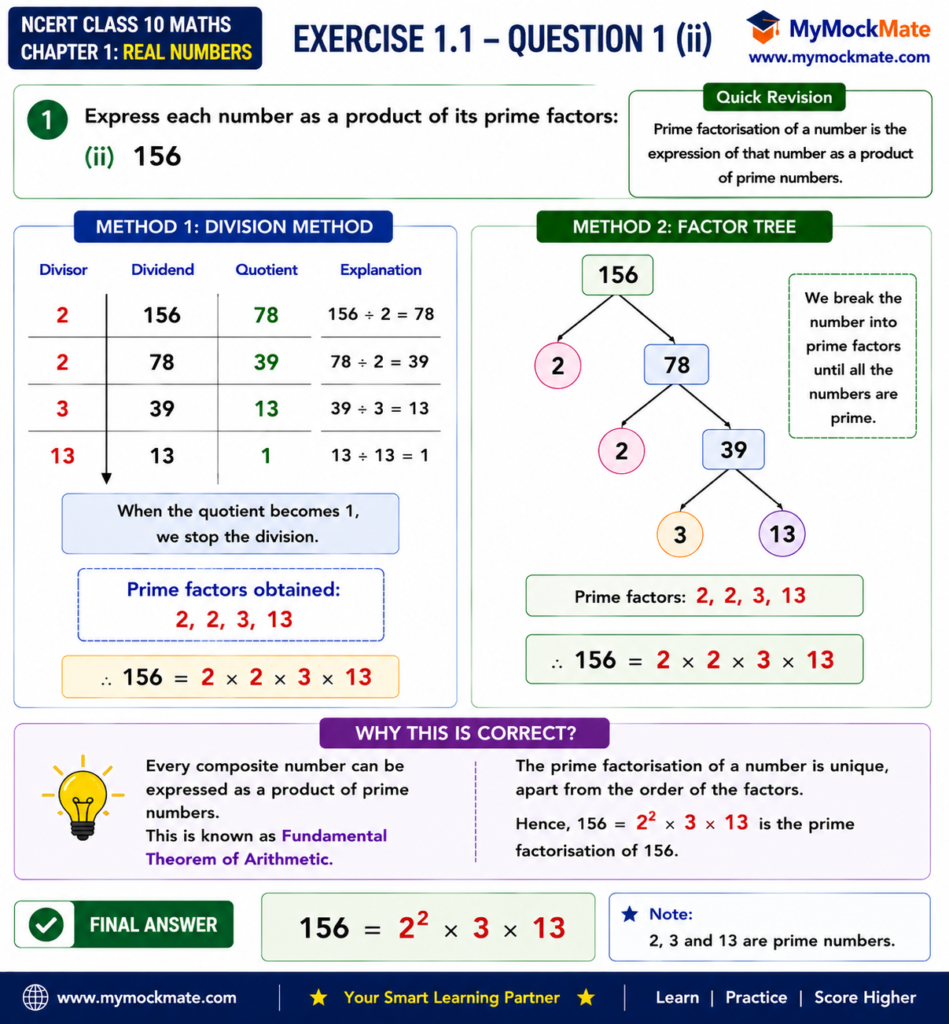
(ii) 156
Solution
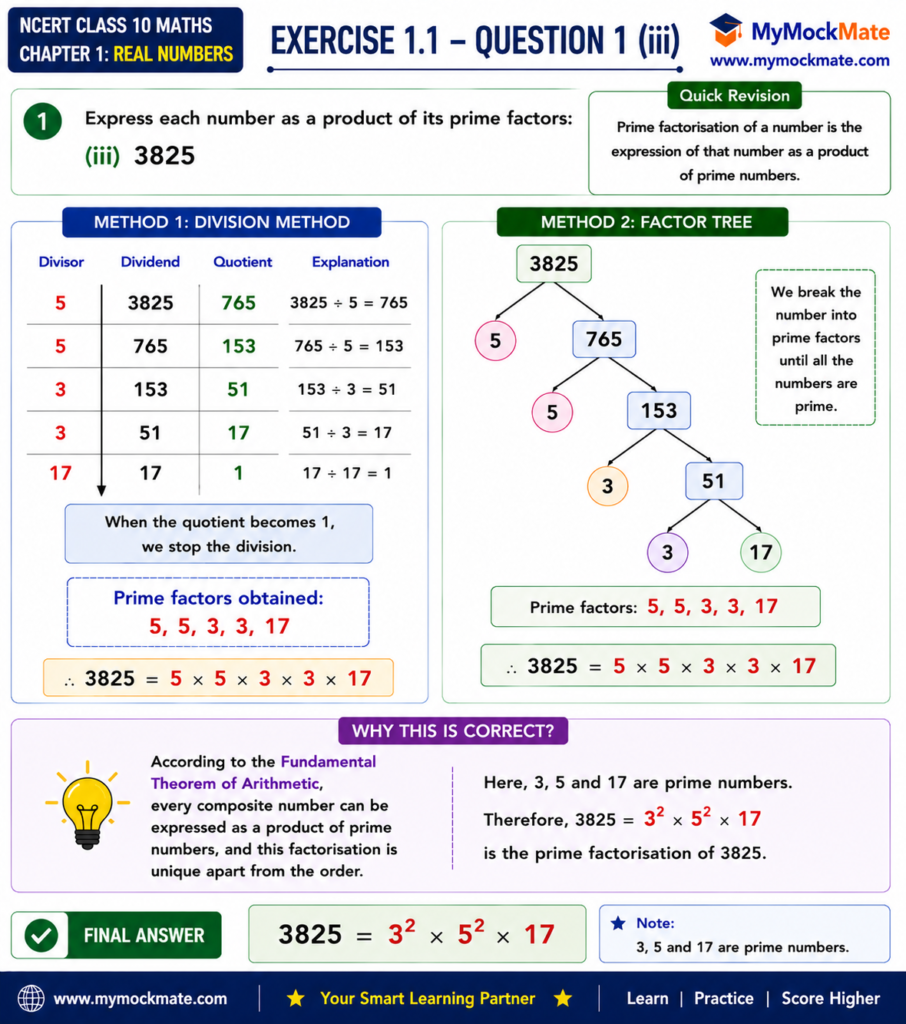
(iii) 3825
Solution
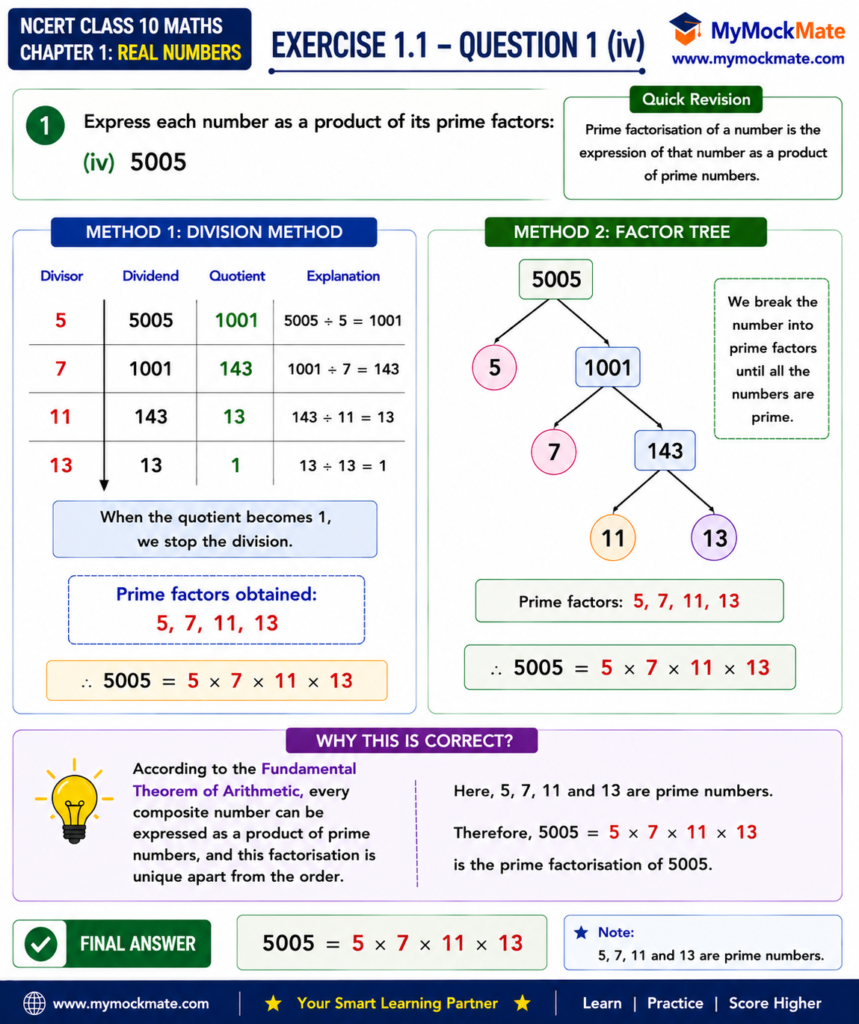
(iv) 5005
Solution
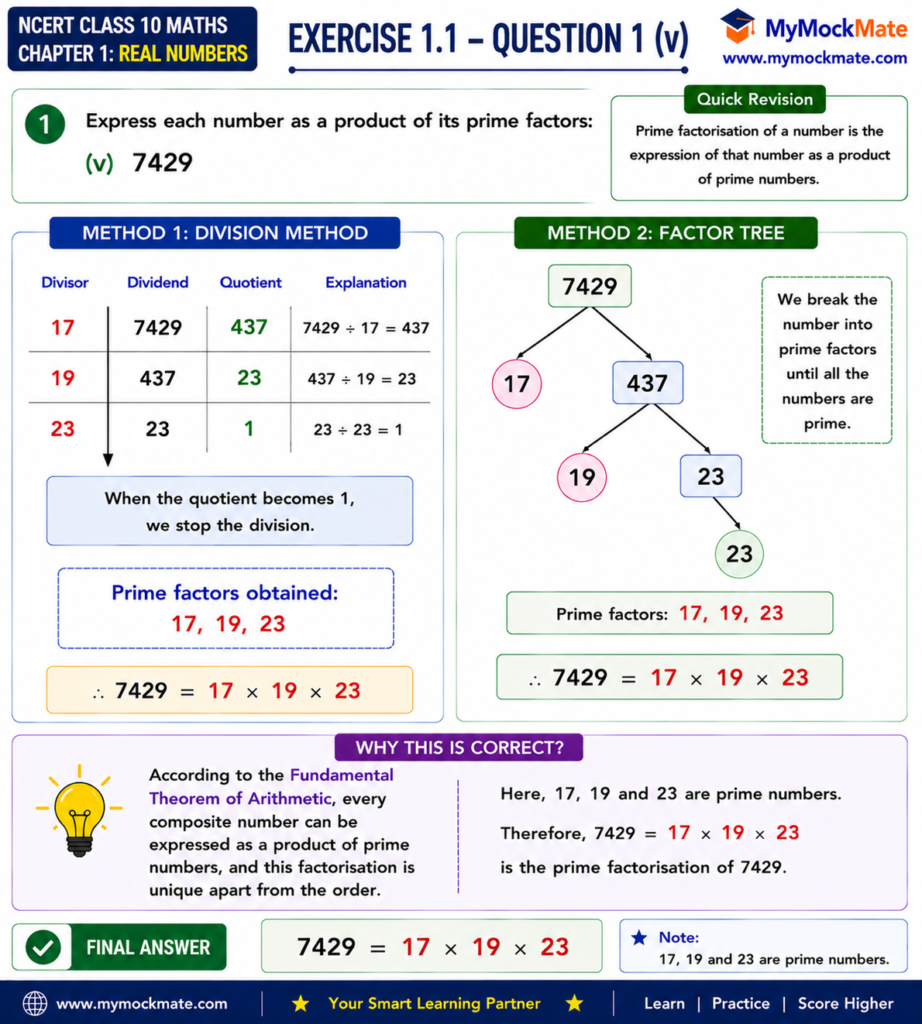
(v) 7429
Solution
Question 2
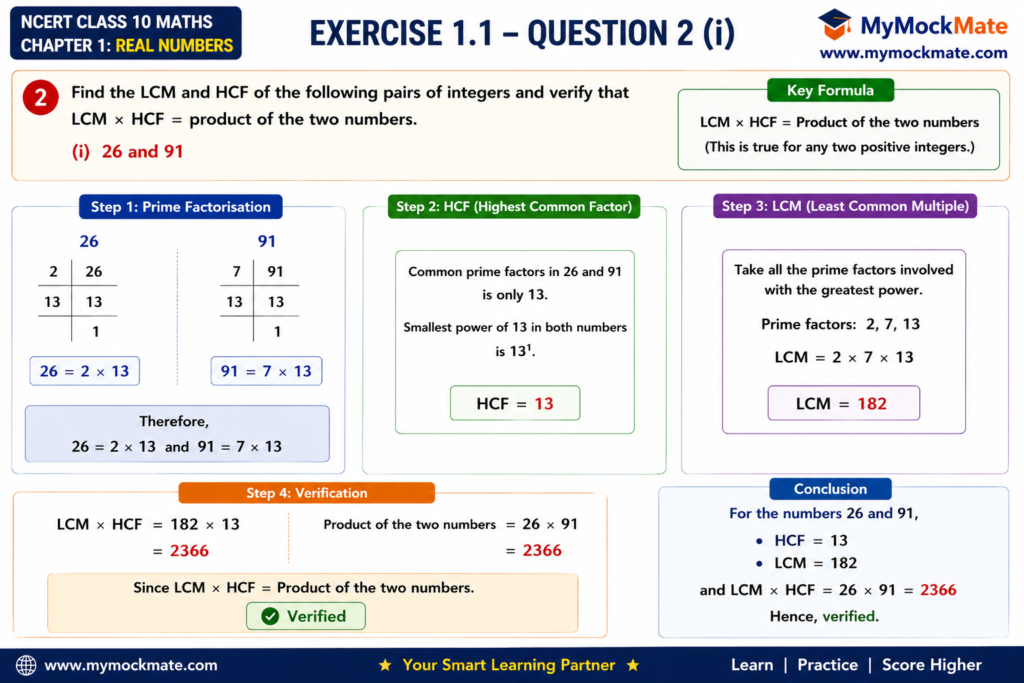
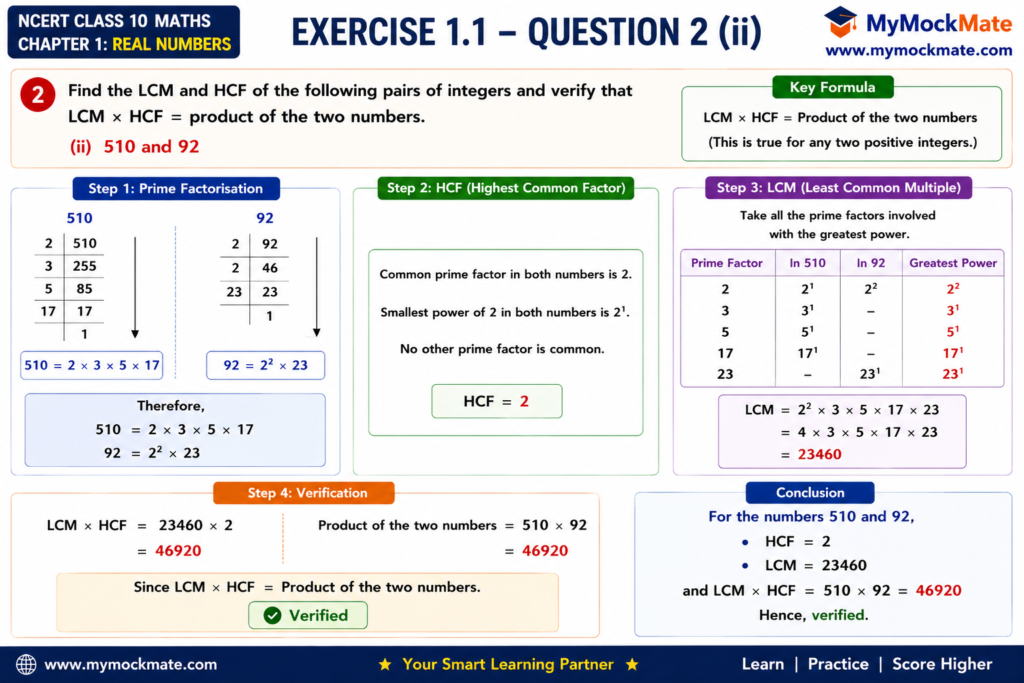
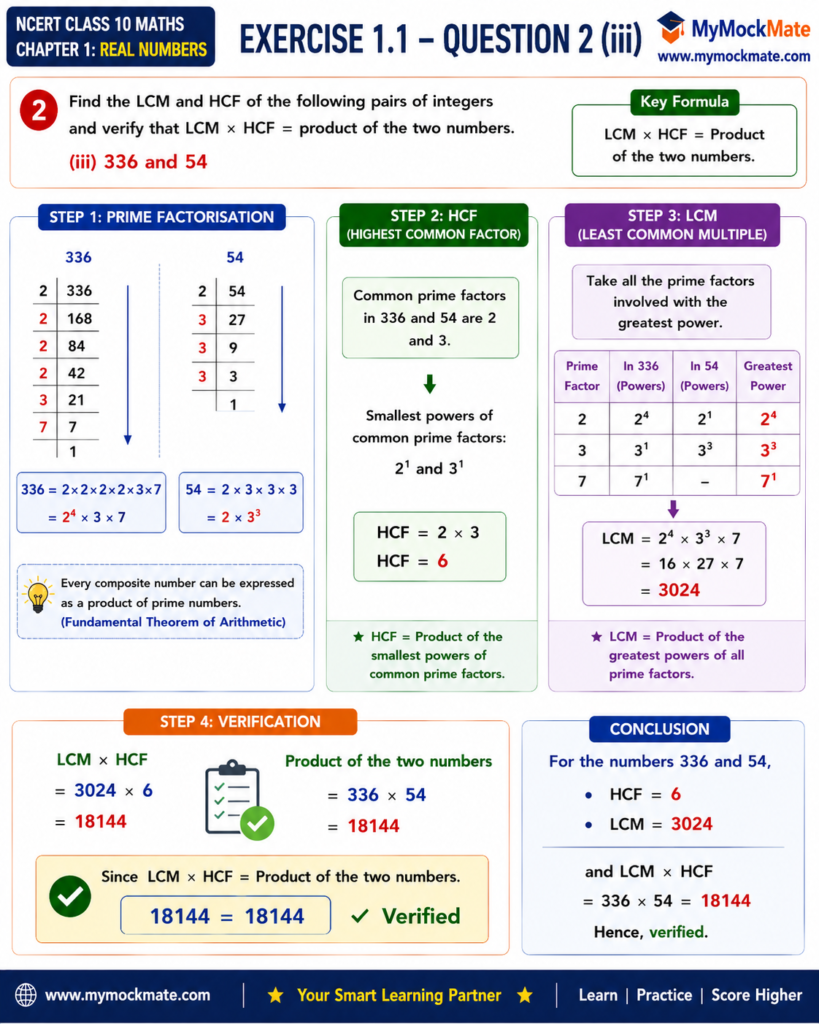
Find the LCM and HCF of the following pairs of integers and verify that:
LCM × HCF = Product of the two numbers
(i) 26 and 91
(ii) 510 and 92
(iii) 336 and 54
Question 3
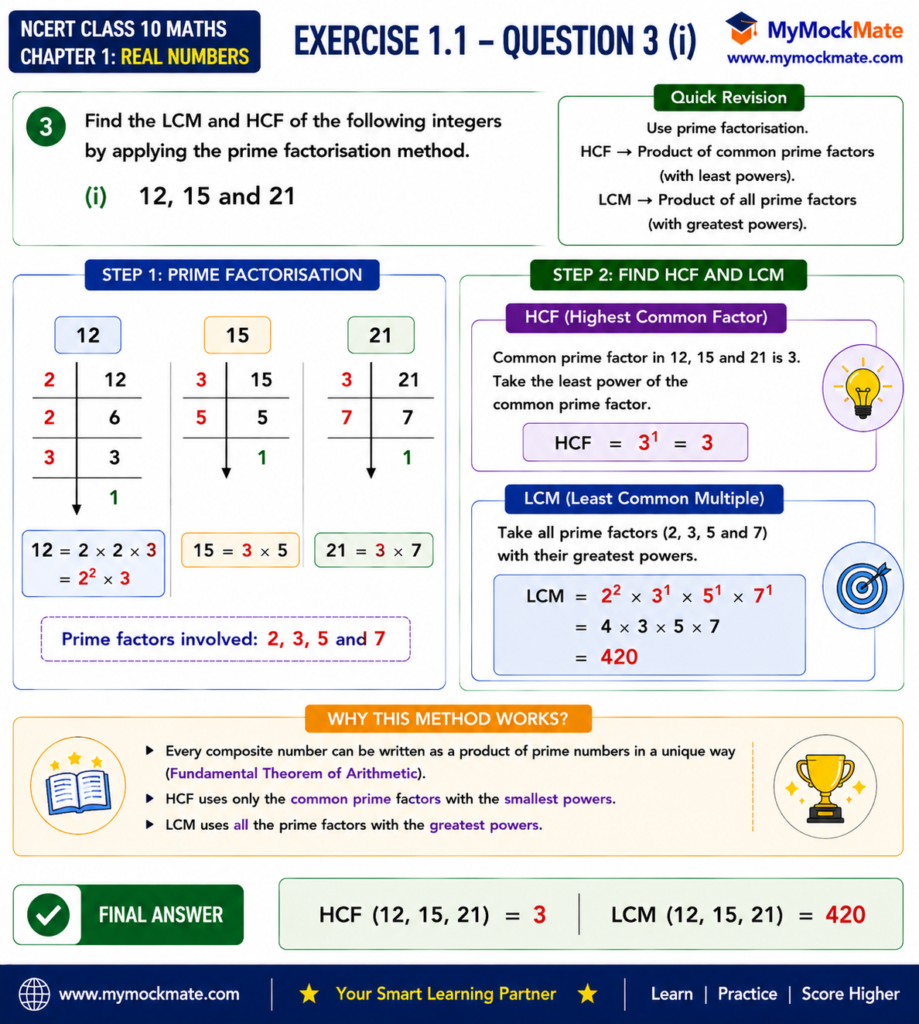
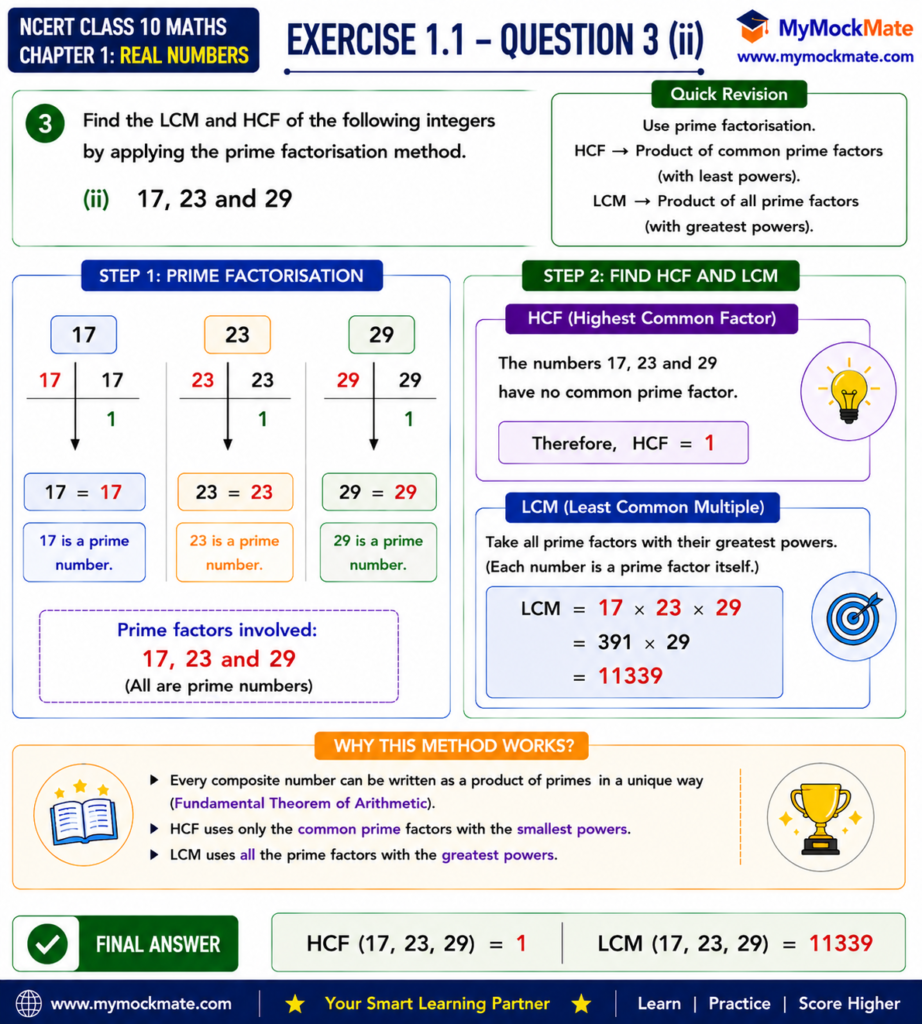
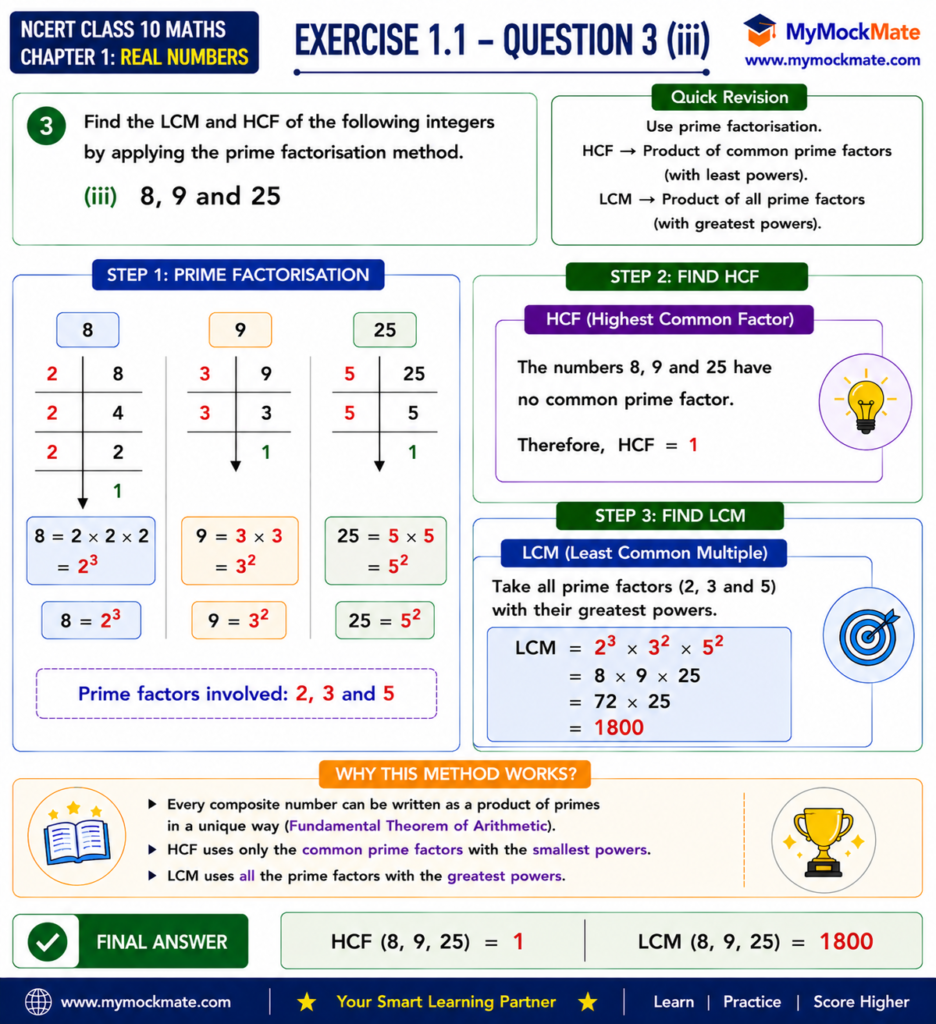
Find the LCM and HCF of the following integers by applying the prime factorisation method.
(i) 12, 15 and 21
(ii) 17, 23 and 29
(iii) 8, 9 and 25
Question 4
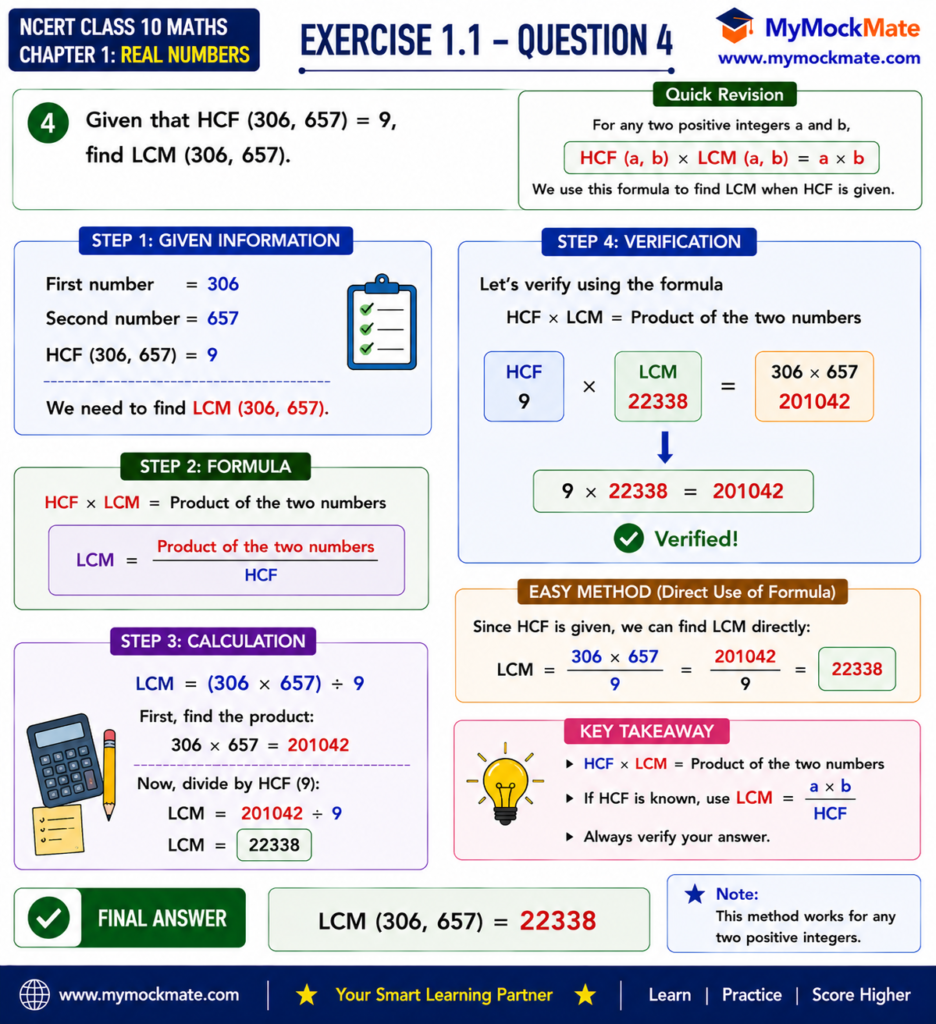
Given that HCF (306, 657) = 9, find LCM (306, 657).
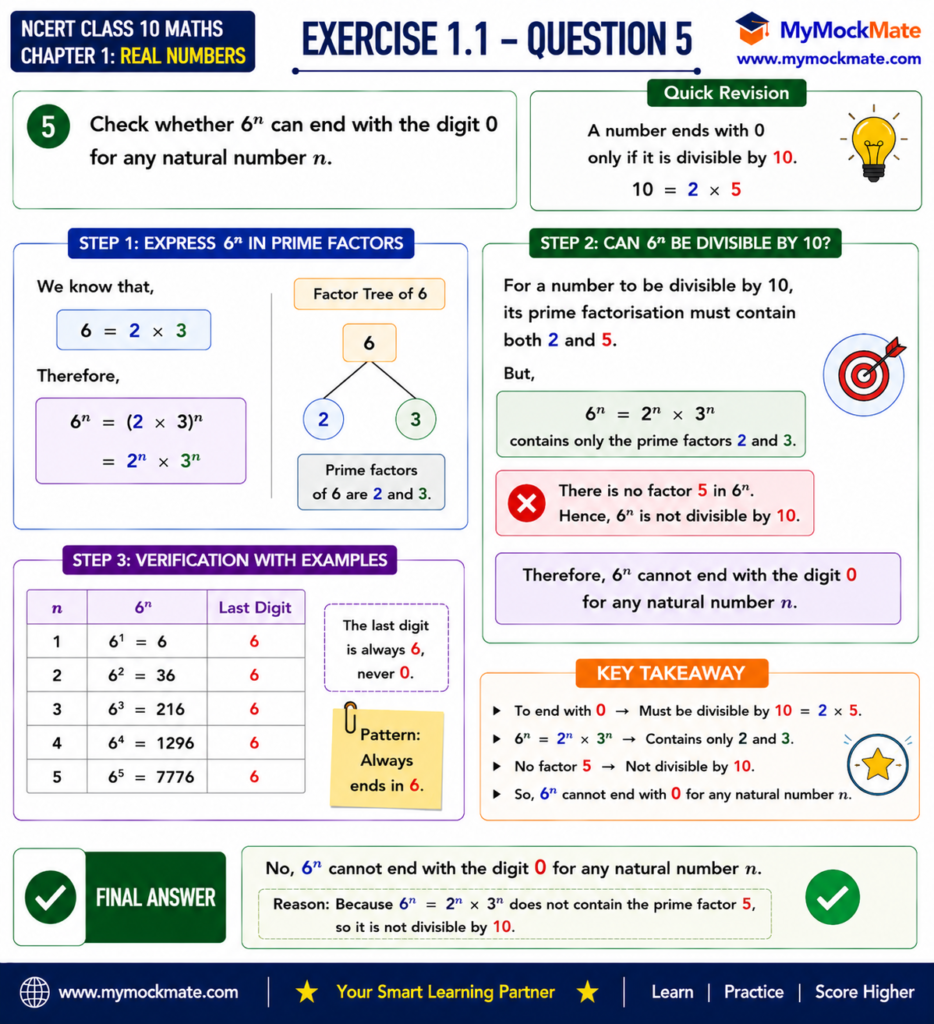
Question 5
Check whether 6ⁿ can end with the digit 0 for any natural number n.
Question 6
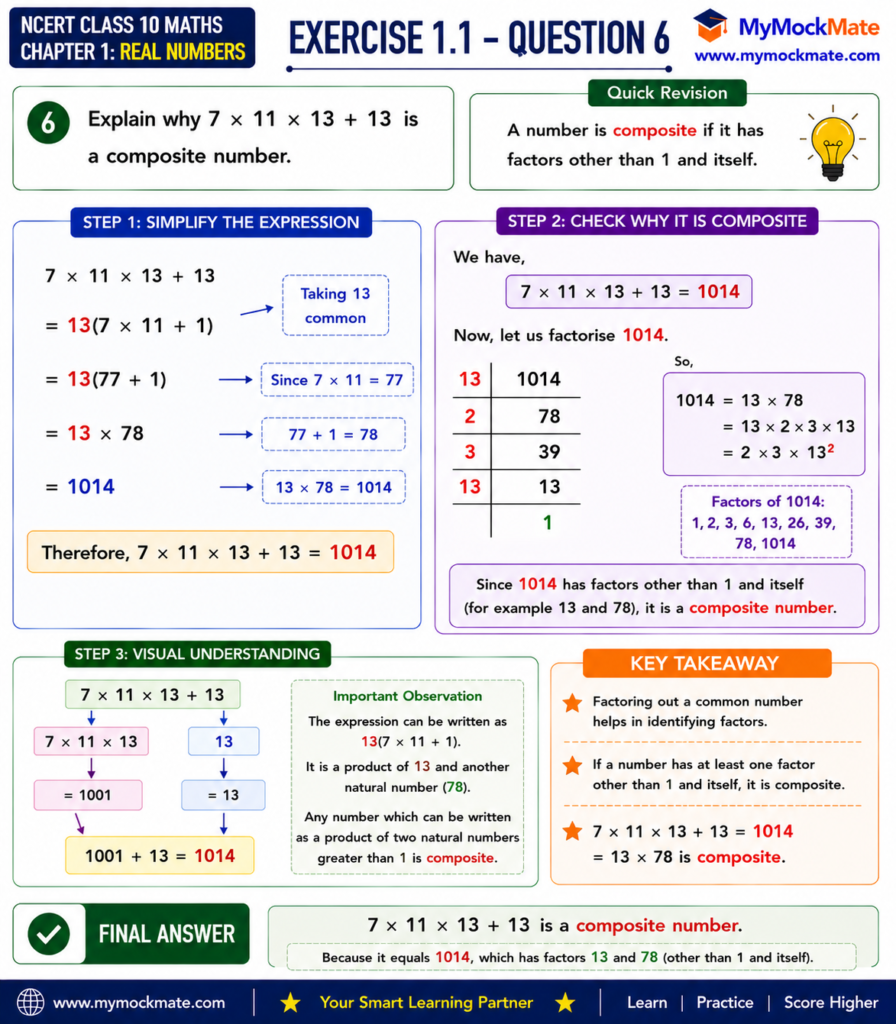
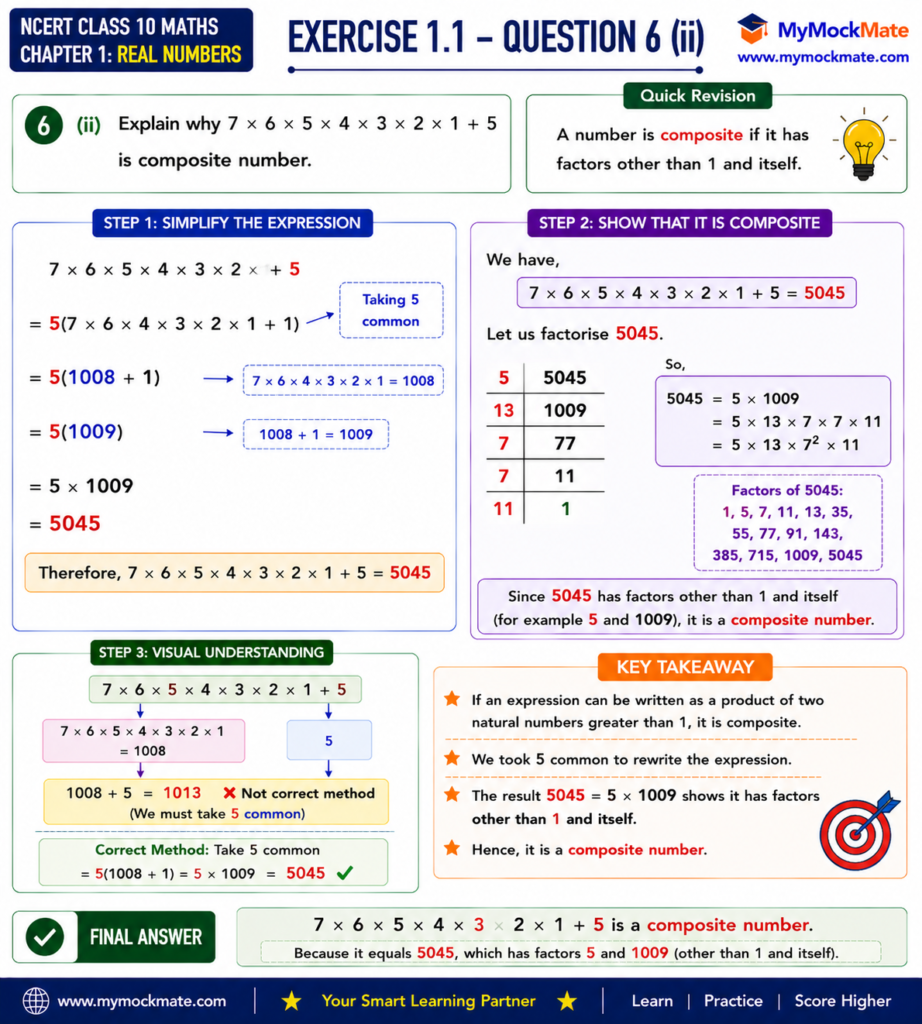
Explain why the following numbers are composite.
(i) 7 × 11 × 13 + 13
(ii) 7 × 6 × 5 × 4 × 3 × 2 × 1 + 5
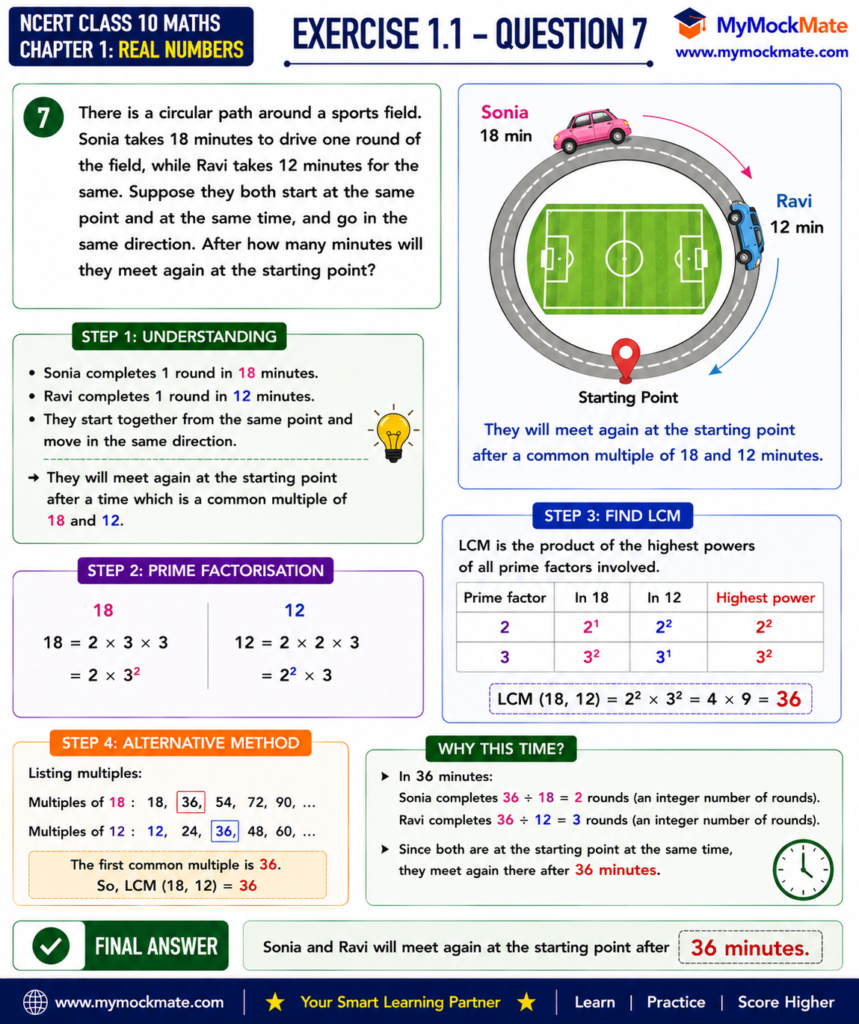
Question 7
There is a circular path around a sports field. Sonia takes 18 minutes to drive one round of the field, while Ravi takes 12 minutes for the same. Suppose they both start at the same point and at the same time, and go in the same direction. After how many minutes will they meet again at the starting point?
Common Mistakes
❌ Taking highest powers while finding HCF.
❌ Taking smallest powers while finding LCM.
❌ Forgetting to verify HCF × LCM relation.
❌ Missing a prime factor during factorisation.
❌ Arithmetic calculation mistakes.
Exam Tips
✅ Always write prime factorisation neatly.
✅ Use exponent form wherever possible.
✅ Verify answers in LCM-HCF questions.
✅ Show all calculation steps.
✅ Learn prime numbers up to 100.
Practice MCQs
1. Prime factorisation of 180 is:
A) 2² × 3² × 5 ✓
B) 2³ × 3² × 5
C) 2² × 3 × 5²
D) 2 × 3² × 5²
2. HCF of 24 and 36 is:
A) 6
B) 12 ✓
C) 18
D) 24
3. LCM of 12 and 18 is:
A) 24
B) 30
C) 36 ✓
D) 48
4. A number ending with 0 must contain factor:
A) 3
B) 7
C) 11
D) 5 ✓
5. HCF × LCM equals:
A) Sum of numbers
B) Difference
C) Product of numbers ✓
D) Quotient
FAQ Section
Q1. What is the Fundamental Theorem of Arithmetic?
Every composite number can be expressed uniquely as a product of prime factors.
Q2. What is HCF?
The Highest Common Factor is the greatest number that divides all given numbers exactly.
Q3. What is LCM?
The Least Common Multiple is the smallest common multiple of given numbers.
Q4. Which method is used in Exercise 1.1?
Prime Factorisation Method.
Q5. Is Exercise 1.1 important for boards?
Yes, HCF, LCM and Prime Factorisation are frequently asked in CBSE examinations.
📚 Looking for complete NCERT solutions, chapter-wise notes, mock tests and board exam preparation material?
👉 Visit www.mymockmate.com
✅ NCERT Solutions
✅ CBSE Notes
✅ Mock Tests
✅ Board Exam Practice Papers
✅ Previous Year Questions
MyMockMate – Your Smart Exam Preparation Partner!