NCERT Class 10 Maths Chapter 3 Exercise 3.1 Solutions | Pair of Linear Equations
Short Introduction
In this article, we provide complete and detailed solutions of NCERT Class 10 Maths Chapter 3 – Pair of Linear Equations in Two Variables, Exercise 3.1. The exercise is based on the graphical representation of linear equations and the conditions for consistent and inconsistent pairs of equations. All questions are solved step by step in simple language for CBSE and State Board students.
Quick Information Box
| Particular | Details |
|---|---|
| Class | 10 |
| Subject | Mathematics |
| Chapter | 3 |
| Chapter Name | Pair of Linear Equations in Two Variables |
| Exercise | 3.1 |
| Method Used | Graphical Method |
| Board | CBSE & State Boards |
| Difficulty Level | Easy to Moderate |
Concepts Used (Topics Covered)
✔ Pair of linear equations in two variables
✔ Graphical solution of linear equations
✔ Consistent and inconsistent equations
✔ Intersecting, parallel and coincident lines
✔ Comparing ratios:
- a₁/a₂
- b₁/b₂
- c₁/c₂
✔ Formation of linear equations from word problems.
Important Formulas
General Form of Linear Equation
ax + by + c = 0
Conditions of Solutions
- Unique Solution (Intersecting Lines)
a₁/a₂ ≠ b₁/b₂
- No Solution (Parallel Lines)
a₁/a₂ = b₁/b₂ ≠ c₁/c₂
- Infinitely Many Solutions (Coincident Lines)
a₁/a₂ = b₁/b₂ = c₁/c₂
Question 1 Form the pair of linear equations in the following problems, and find their solutions
graphically.
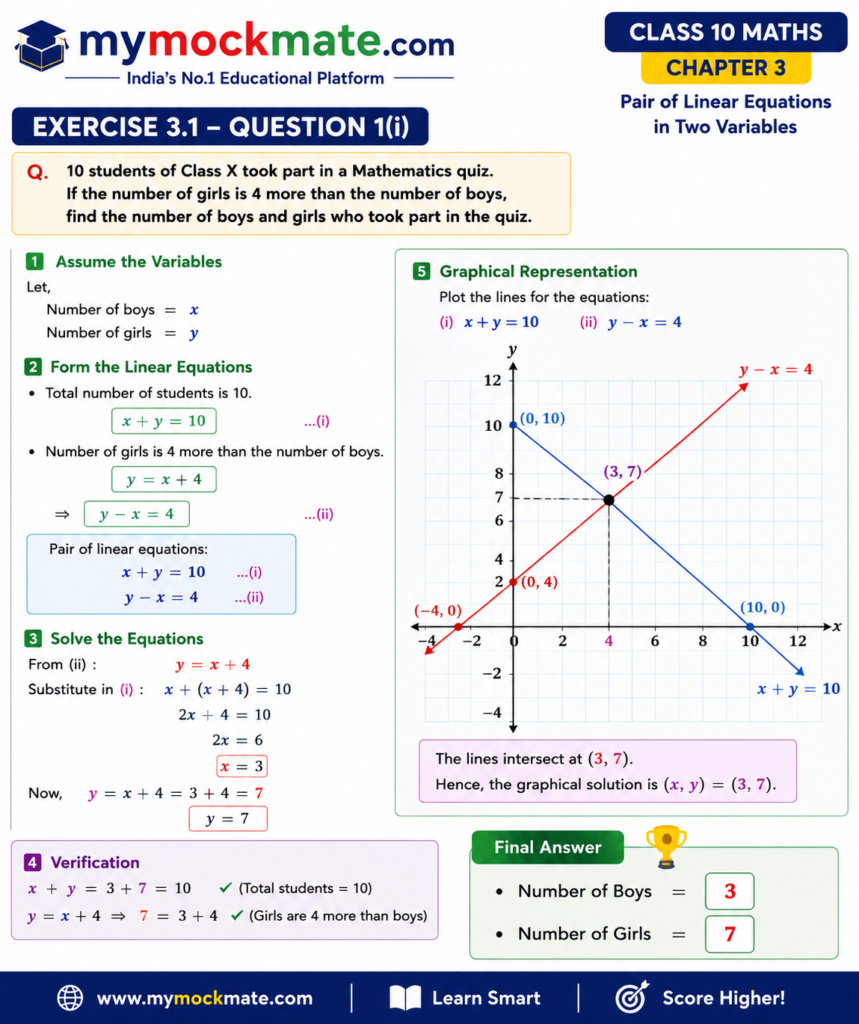
(i) 10 students of Class X took part in a Mathematics quiz. The number of girls is 4 more than the number of boys. Find the number of boys and girls.
Solution
Question 1 (ii)
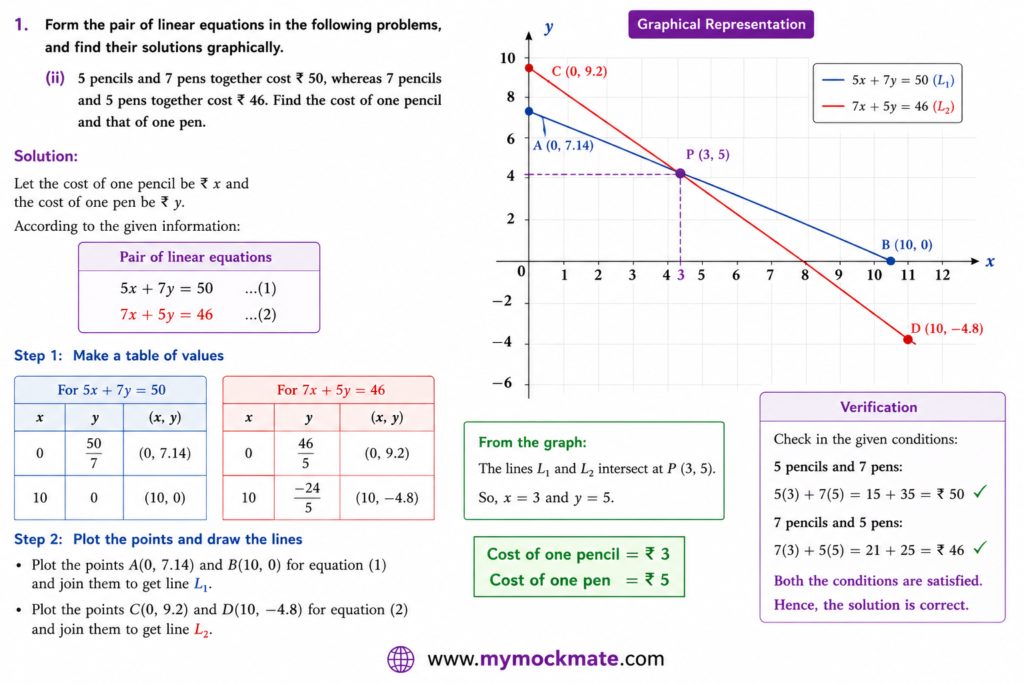
5 pencils and 7 pens together cost 50, whereas 7 pencils and 5 pens together cost 46. Find the cost of one pencil and that of one pen.
Solution
Question 2
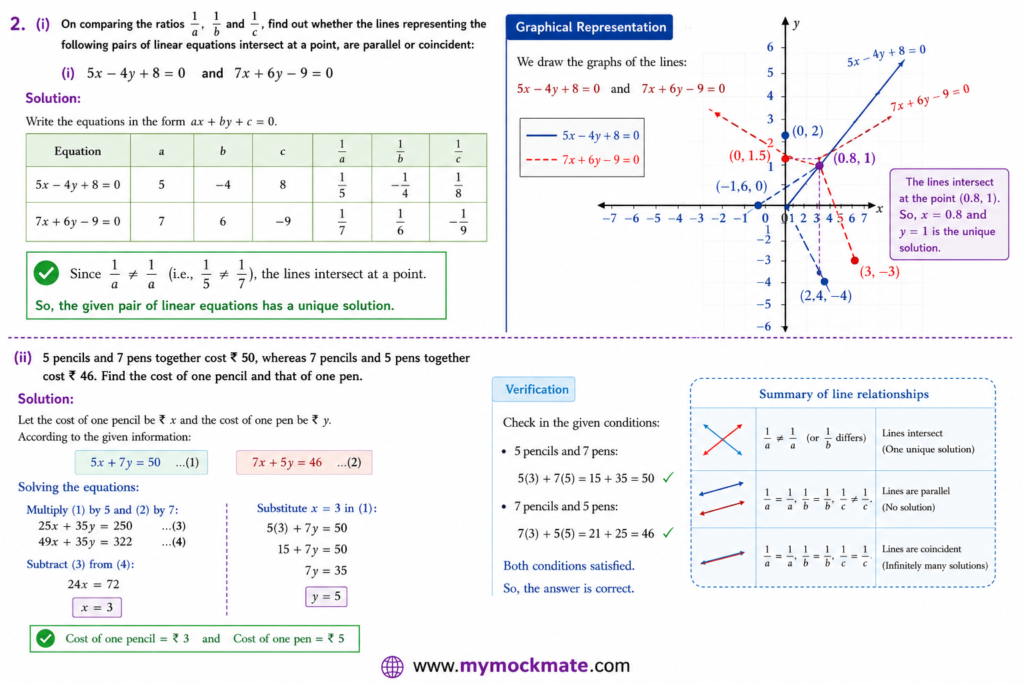
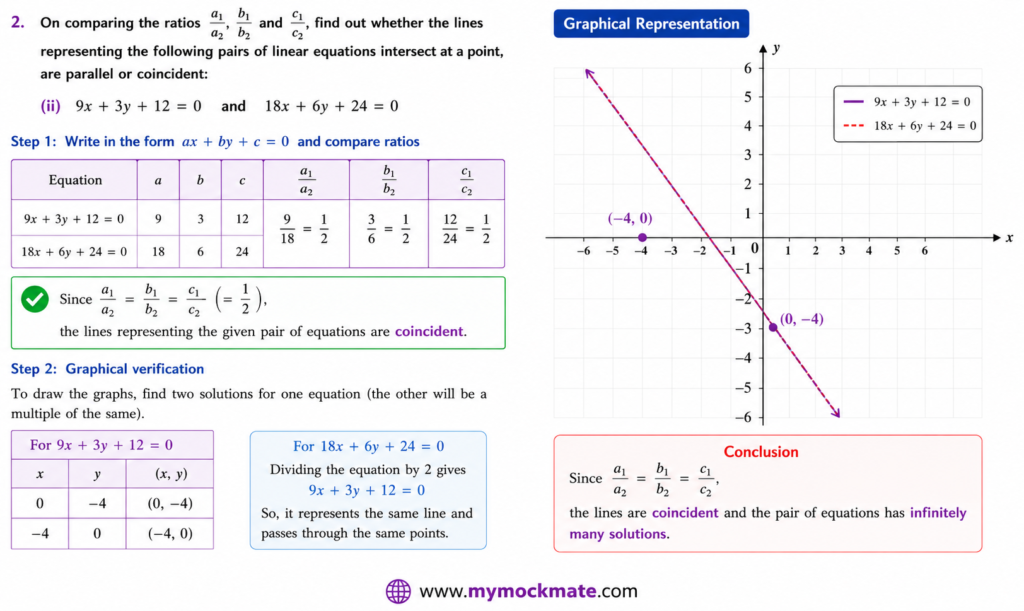
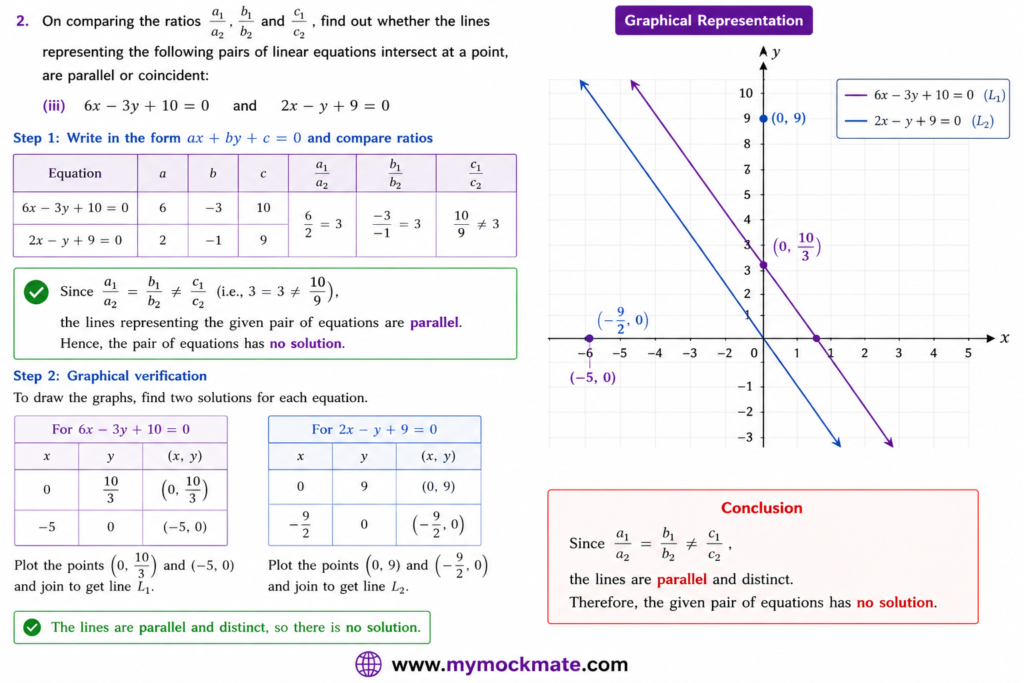
On comparing the ratios a1/a2, b1/b2 and c1/c2 , find out whether the lines representing the following pairs of linear equations intersect at a point, are parallel or coincident:
(i)
5x−4y+8=0
7x+6y−9=0
(ii)
9x+3y+12=0
18x+6y+24=0
(iii)
6x−3y+10=0
2x−y+9=0
Question 3
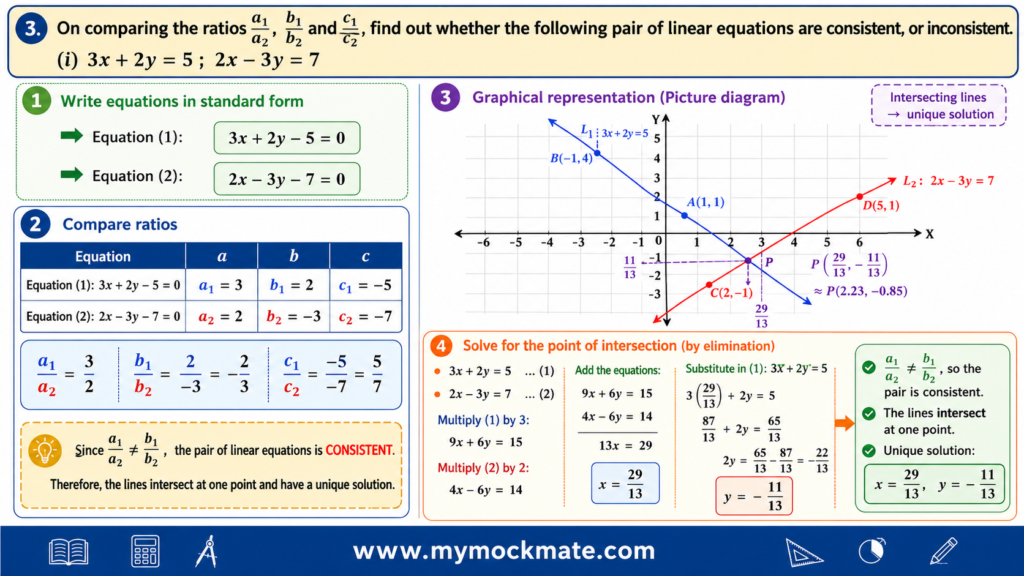
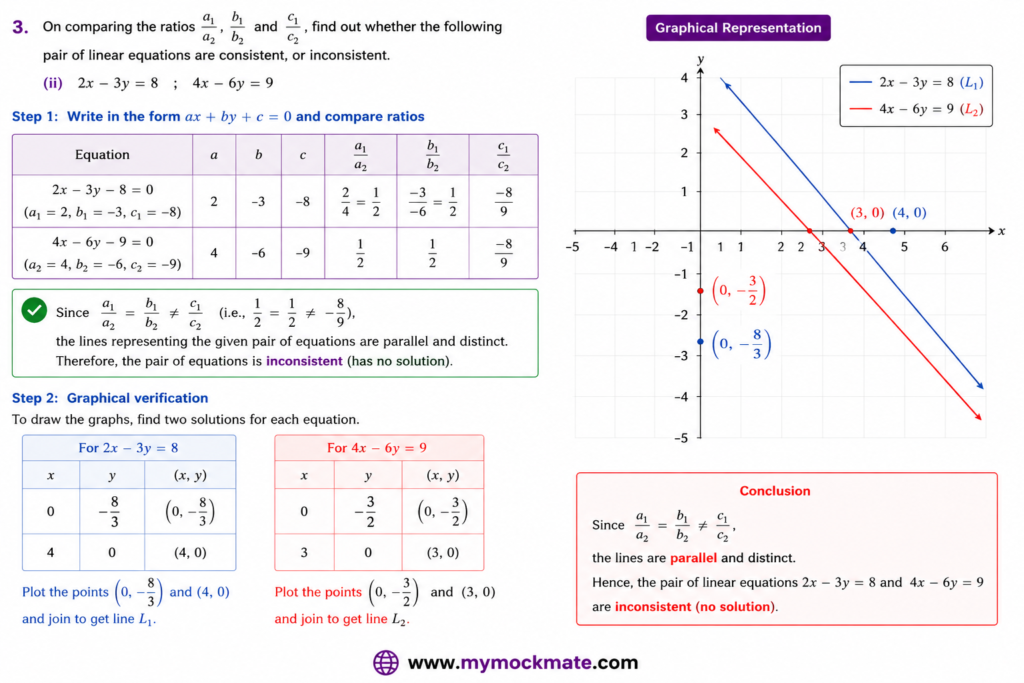
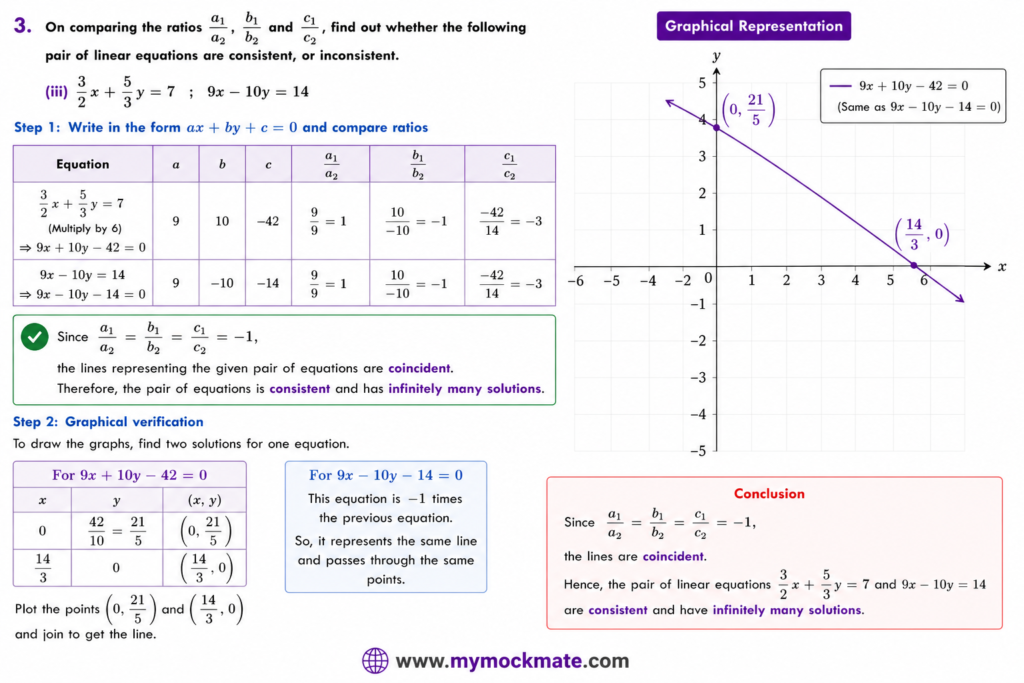
On comparing the ratios a1/a2, b1/b2 and c1/c2 , find out whether the lines representing the following pairs of linear equations intersect at a point, are coincident or inconsistent.
(i)
3x+2y=5
2x−3y=7
(ii)
2x−3y=8
4x−6y=9
(iii)
3x/2 +5y/3 =7
9x−10y=14
(iv)
5x−3y=11
−10x+6y=−22
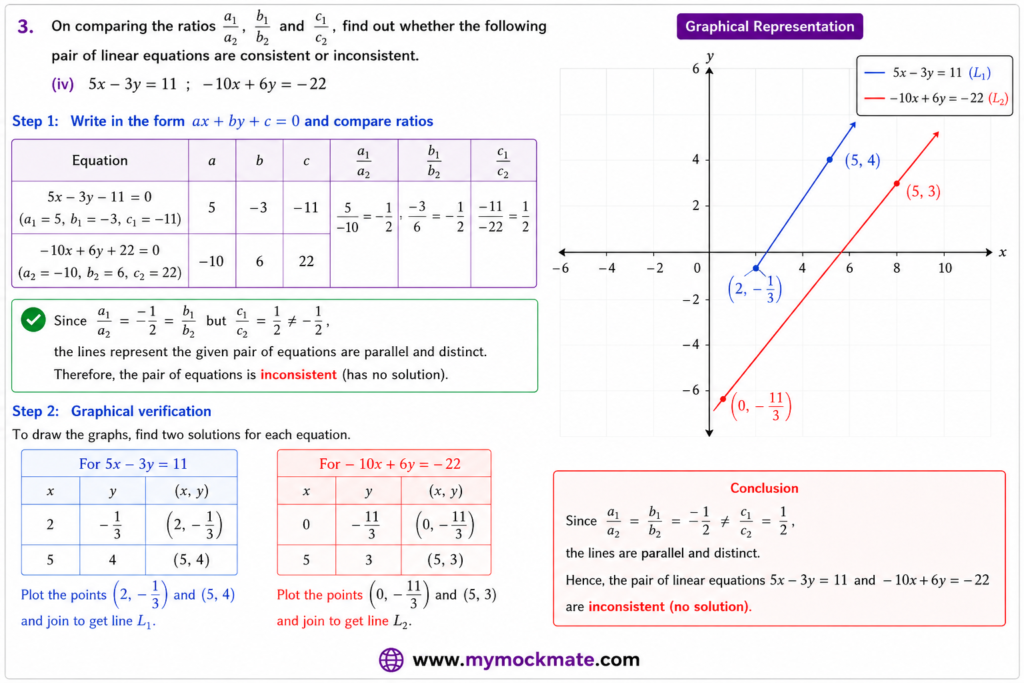
(v)
(4x/3)+2y=8
2x+3y=12
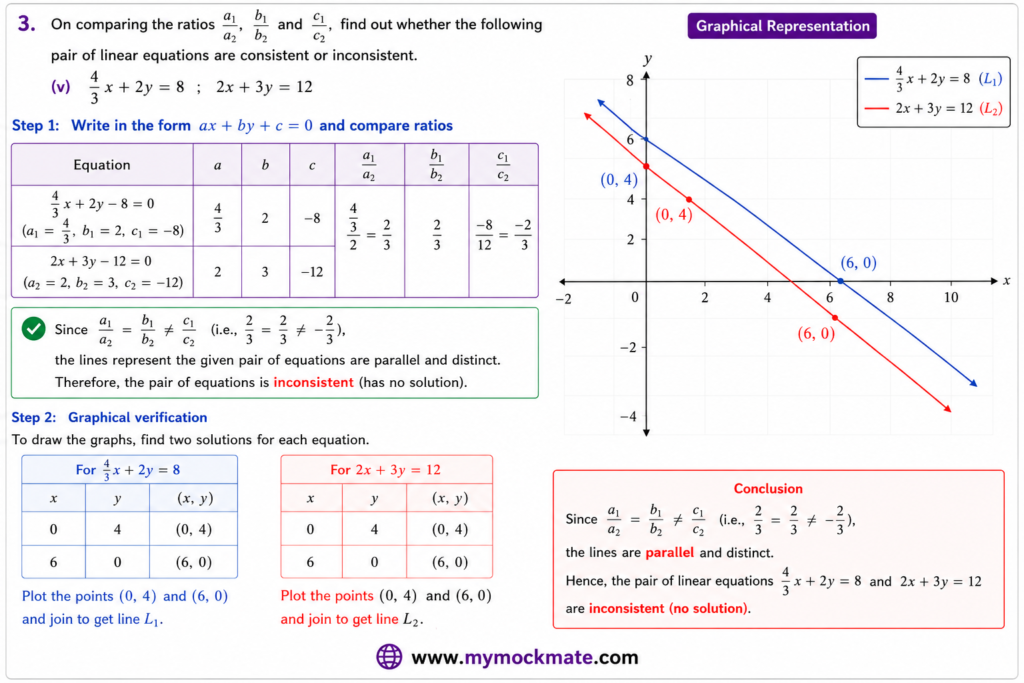
Question 4
Which of the following pairs of linear equations are consistent/inconsistent? If consistent, obtain the solution graphically:
(i)
x+y=5
2x+2y=10
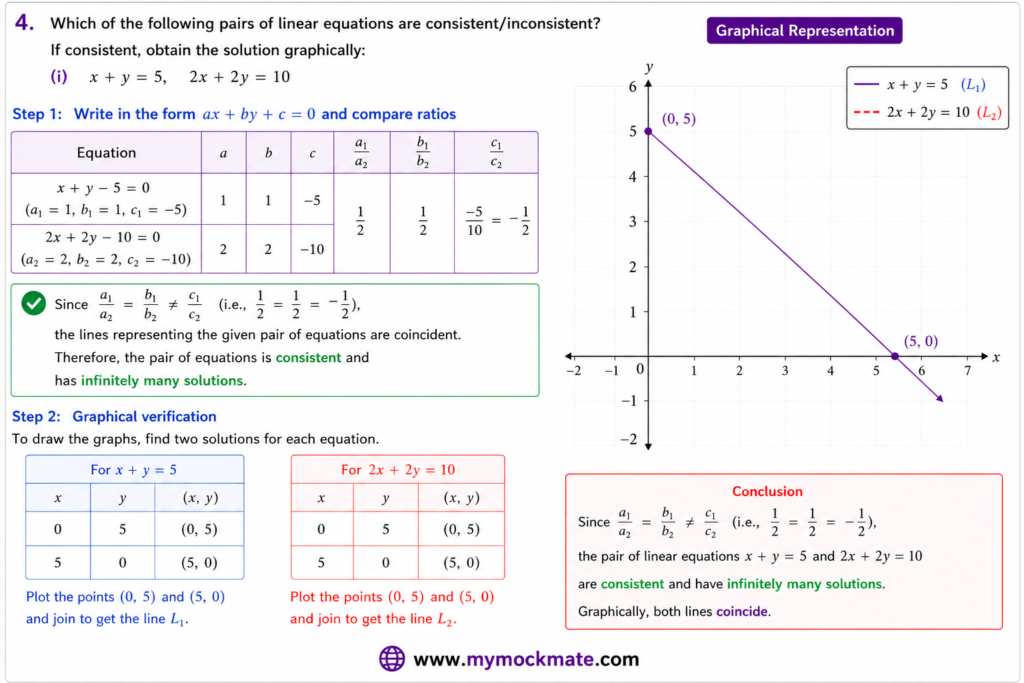
(ii)
x−y=8
3x−3y=16
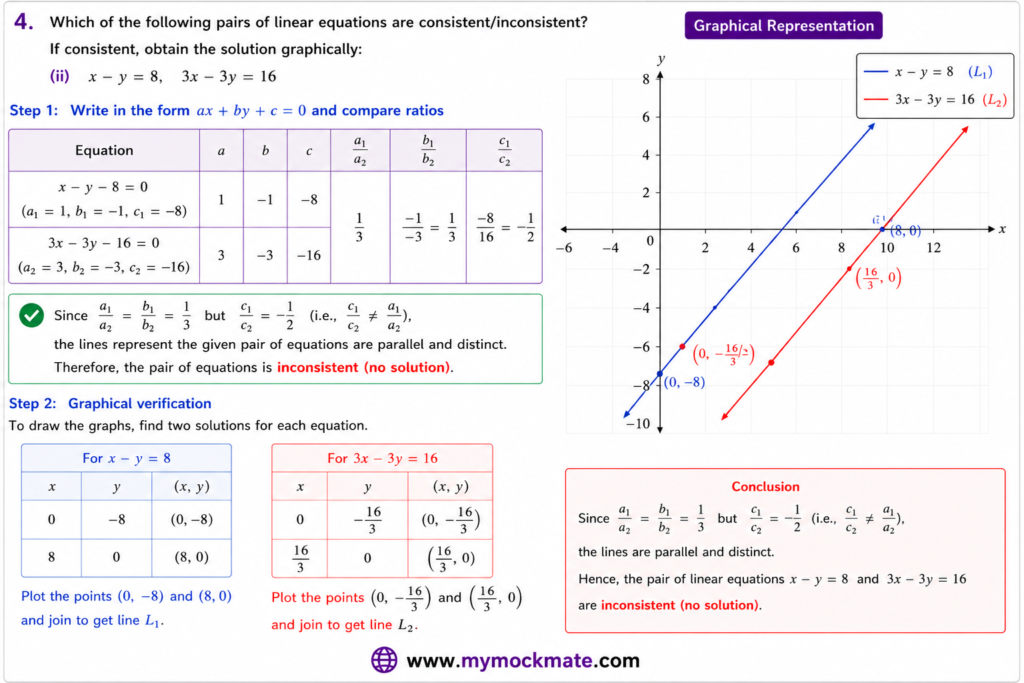
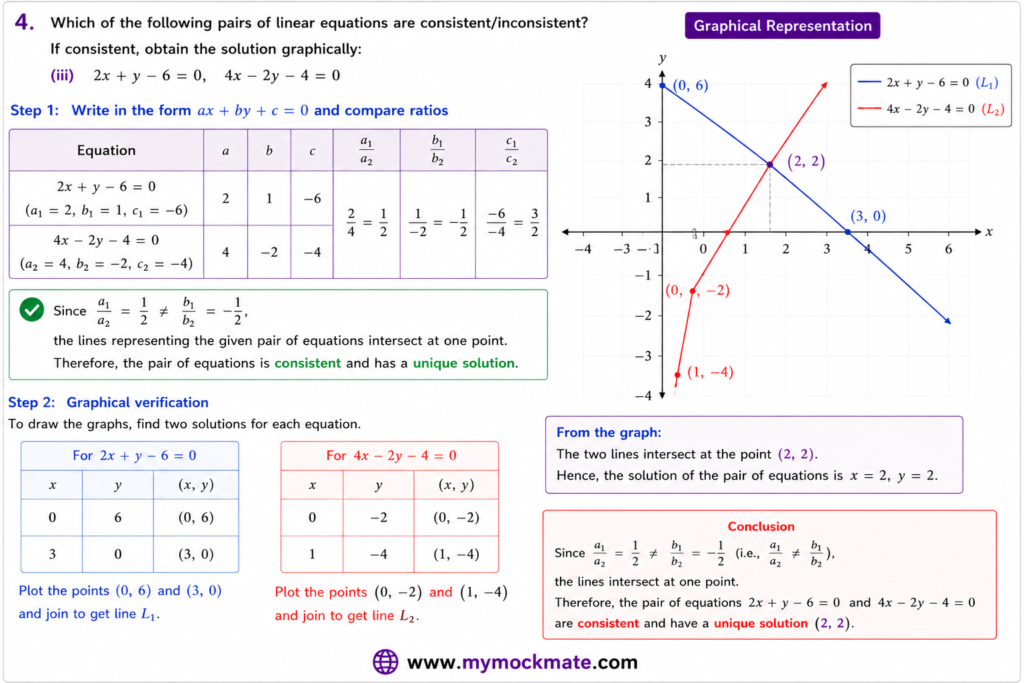
(iii)
2x+y−6=0
4x−2y−4=0
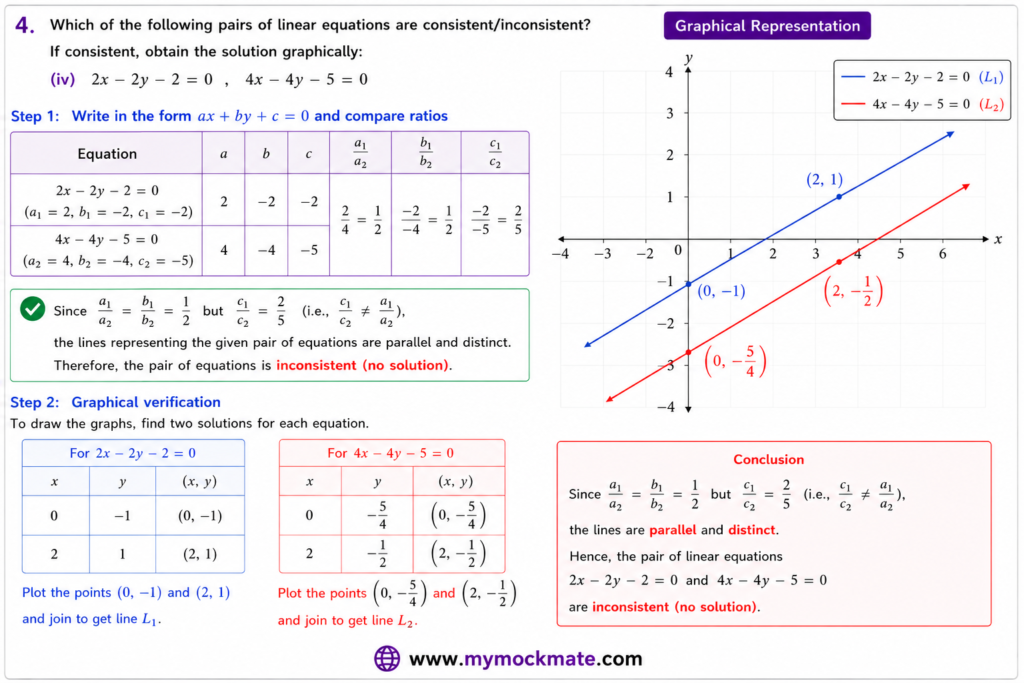
(iv)
2x−2y−2=0
4x−4y−5=0
Question 5
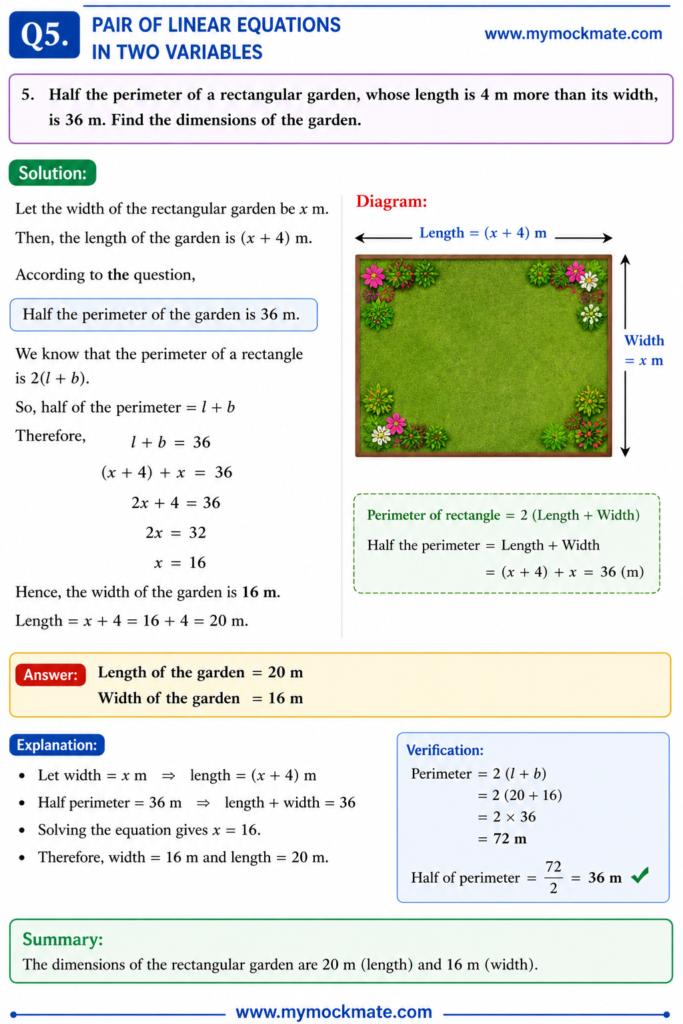
Half the perimeter of a rectangular garden, whose length is 4 m more than its width, is 36 m. Find the dimensions of the garden.
Solution
Question 6
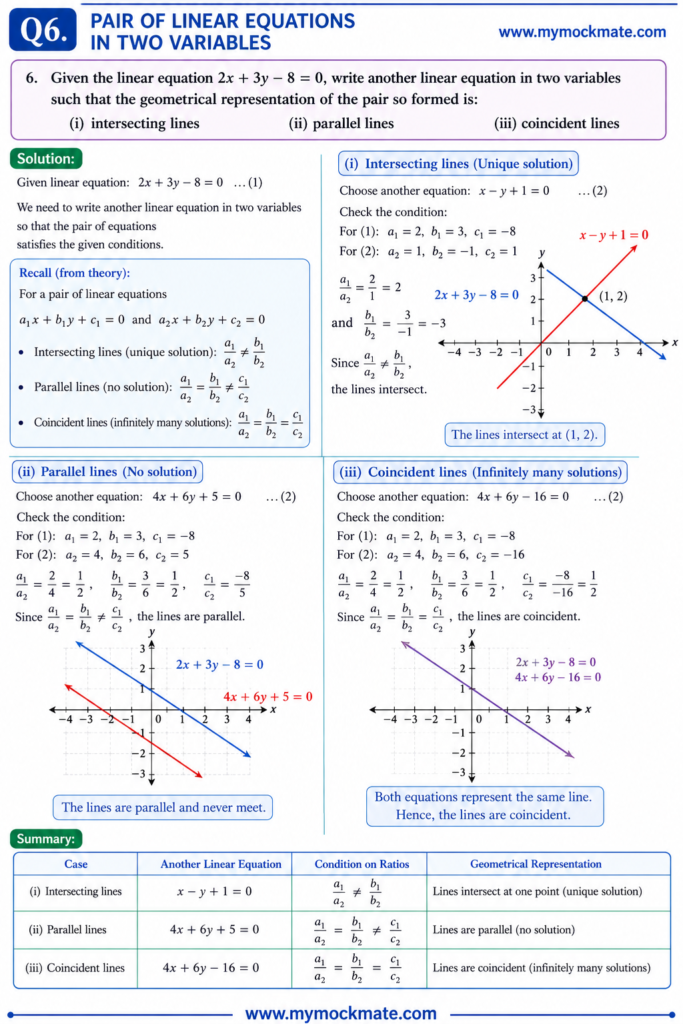
Given the linear equation 2x + 3y – 8 = 0, write another linear equation in two variables such that the geometrical representation of the pair so formed is:
(i) intersecting lines. (ii) parallel lines (iii) coincident lines
Question 7
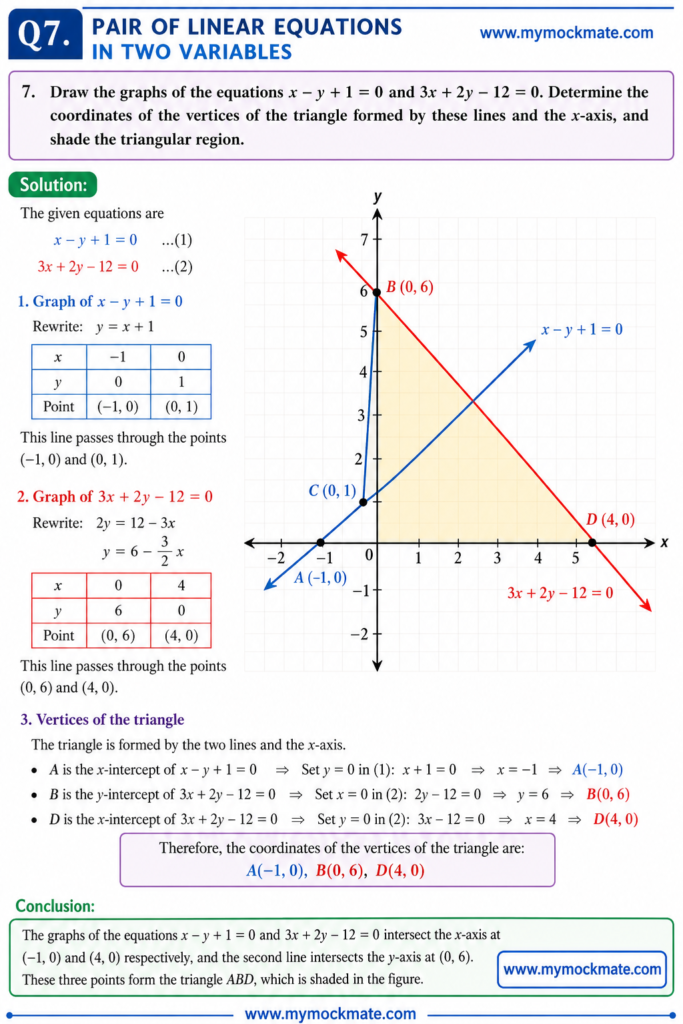
Draw the graphs of the equations x – y + 1 = 0 and 3x + 2y – 12 = 0. Determine the coordinates of the vertices of the triangle formed by these lines and the x-axis, and shade the triangular region.
Common Mistakes
❌ Comparing ratios incorrectly.
❌ Using wrong sign of c.
❌ Confusing parallel and coincident lines.
❌ Making mistakes while forming equations from word problems.
Exam Tips
✅ Learn all three conditions of ratios.
✅ Practice graph plotting.
✅ Draw proper tables while solving graphically.
✅ Write final answers with units.
Practice MCQs
1. If a₁/a₂ ≠ b₁/b₂, then the equations have:
A. No solution
B. Infinite solutions
C. Unique solution
D. None
Answer: C
2. Coincident lines have:
A. One solution
B. Infinite solutions
C. No solution
D. Two solutions
Answer: B
3. Parallel lines are:
A. Consistent
B. Inconsistent
C. Dependent
D. None
Answer: B
4. Intersecting lines are:
A. Consistent
B. Inconsistent
C. Dependent
D. None
Answer: A
Frequently Asked Questions (FAQs)
Q1. What is a pair of linear equations?
Two linear equations containing the same variables are called a pair of linear equations.
Q2. When do equations have infinitely many solutions?
When
a₁/a₂ = b₁/b₂ = c₁/c₂
Q3. What are inconsistent equations?
Equations having no common solution.
Q4. Which method is used in Exercise 3.1?
Mainly graphical method and comparison of ratios.
📚 For more NCERT Solutions, Important Questions, Notes, Mock Tests and Board Exam Preparation Materials, visit:
🚀 Practice smarter and score higher with MyMockMate!