NCERT Class 10 Maths Exercise 4.1 Solutions | Quadratic Equations
Short Introduction
Exercise 4.1 introduces students to Quadratic Equations, one of the most important topics in Class 10 Mathematics. In this exercise, students learn how to:
- Identify whether an equation is quadratic.
- Convert equations into standard form.
- Represent practical situations mathematically using quadratic equations.
This exercise develops algebraic thinking and prepares students for solving quadratic equations in the next exercises.
Quick Information Box
| Particular | Details |
|---|---|
| Chapter | 4 |
| Chapter Name | Quadratic Equations |
| Exercise | 4.1 |
| Board | CBSE |
| Class | 10 |
| Topic | Identifying Quadratic Equations & Forming Equations |
| Difficulty Level | Easy to Moderate |
Concepts Used (Topics Covered)
- Definition of Quadratic Equation
- Standard Form of Quadratic Equation
- Degree of Polynomial
- Expanding Algebraic Expressions
- Simplifying Equations
- Word Problems
- Mathematical Modelling
Important Formulas
Standard Form
Degree of Quadratic Equation
Highest power of variable = 2
Area of Rectangle
Distance Formula
Consecutive Numbers
If first number is
then second number is
Exercise 4.1 Solutions
Question 1
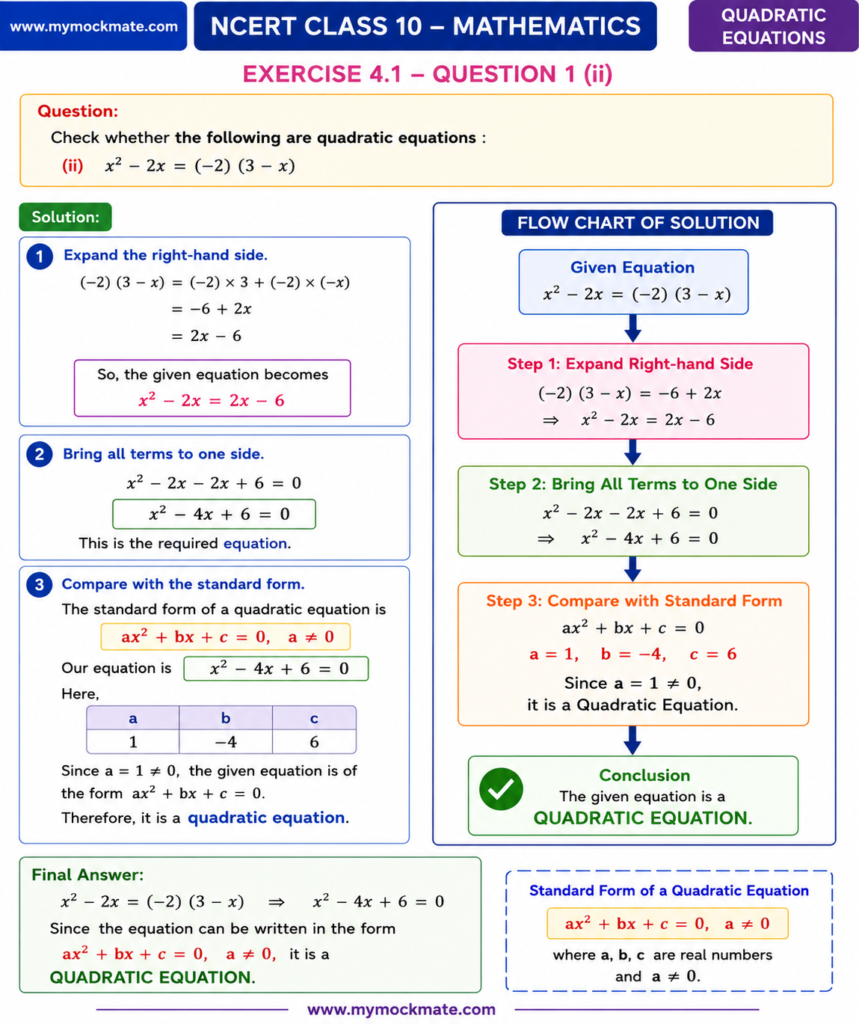
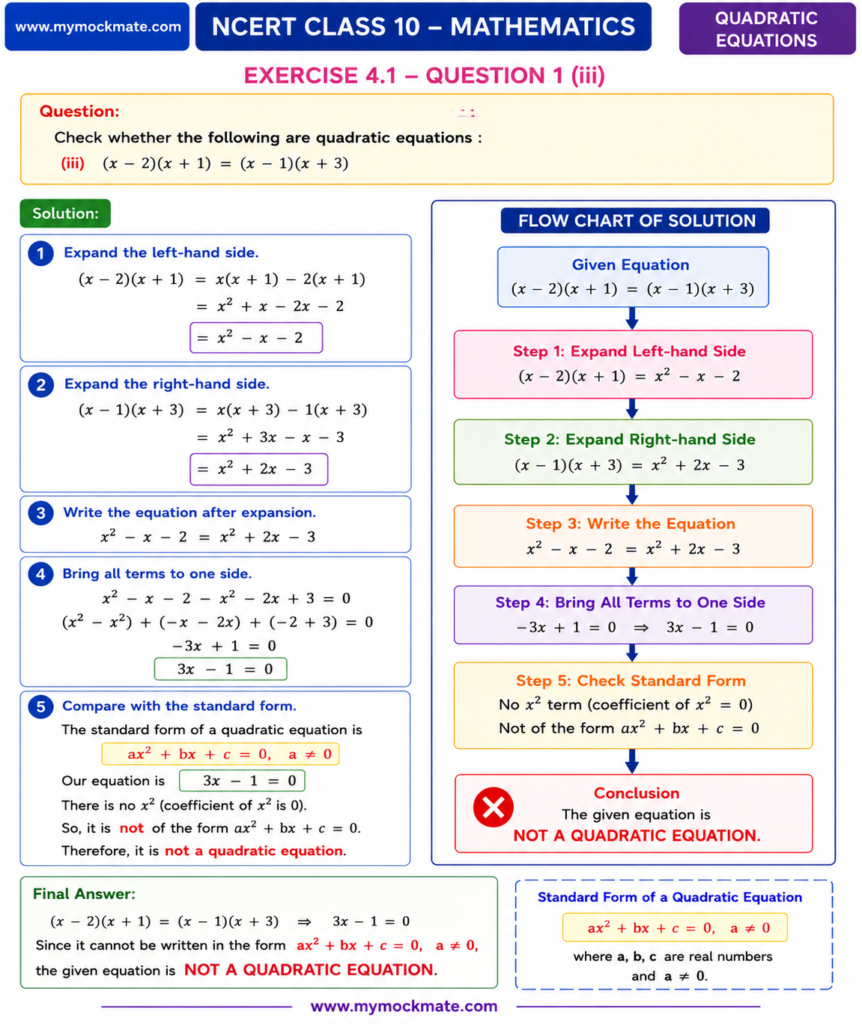
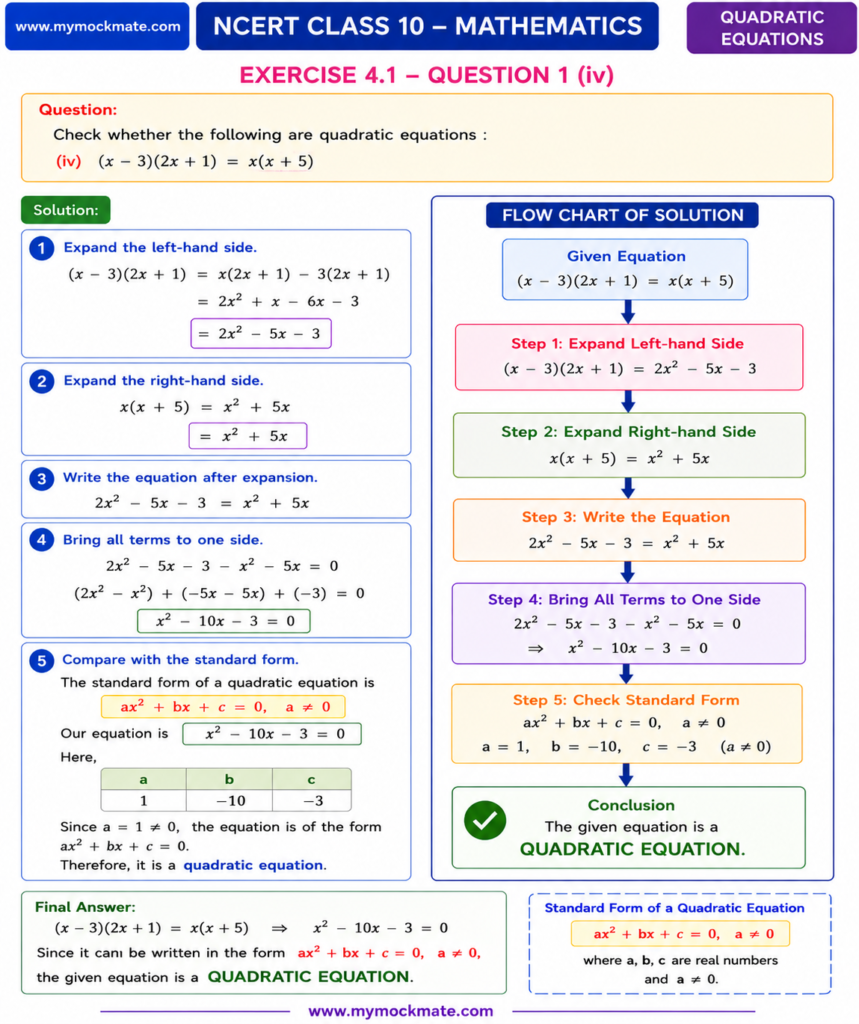
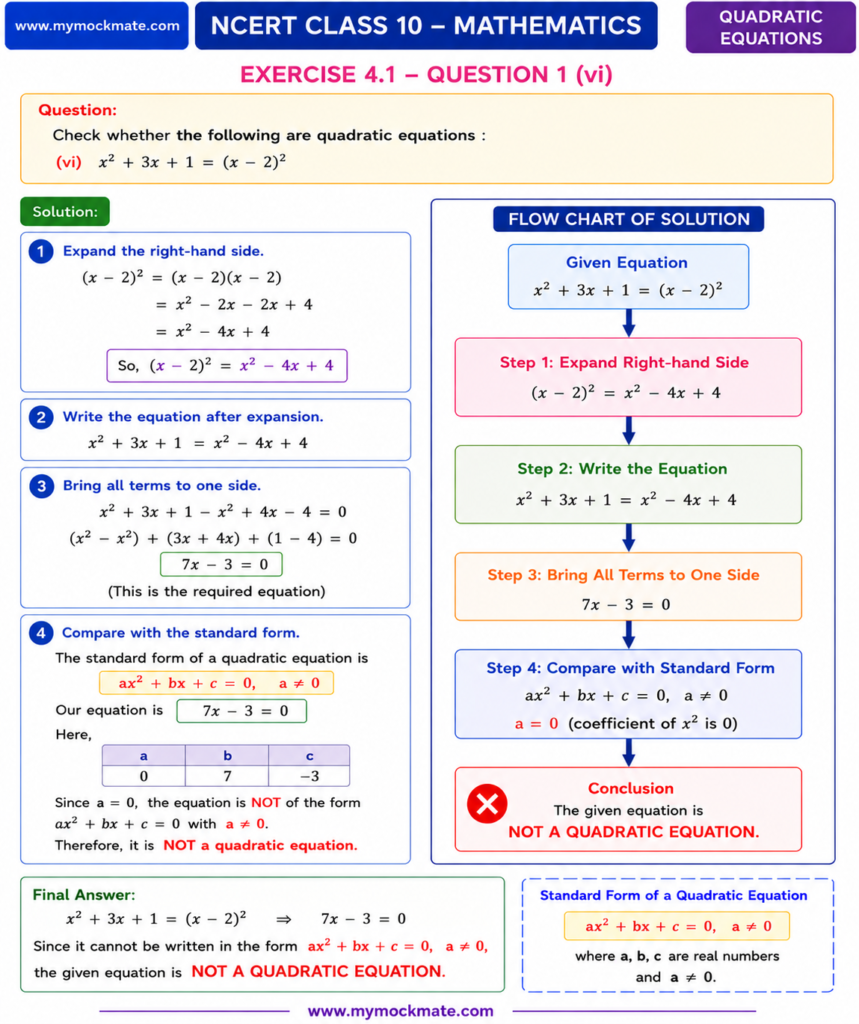
Check whether the following are quadratic equations.
(i)
Solution

(ii)
(iii)
(iv)
(v)

(vi)
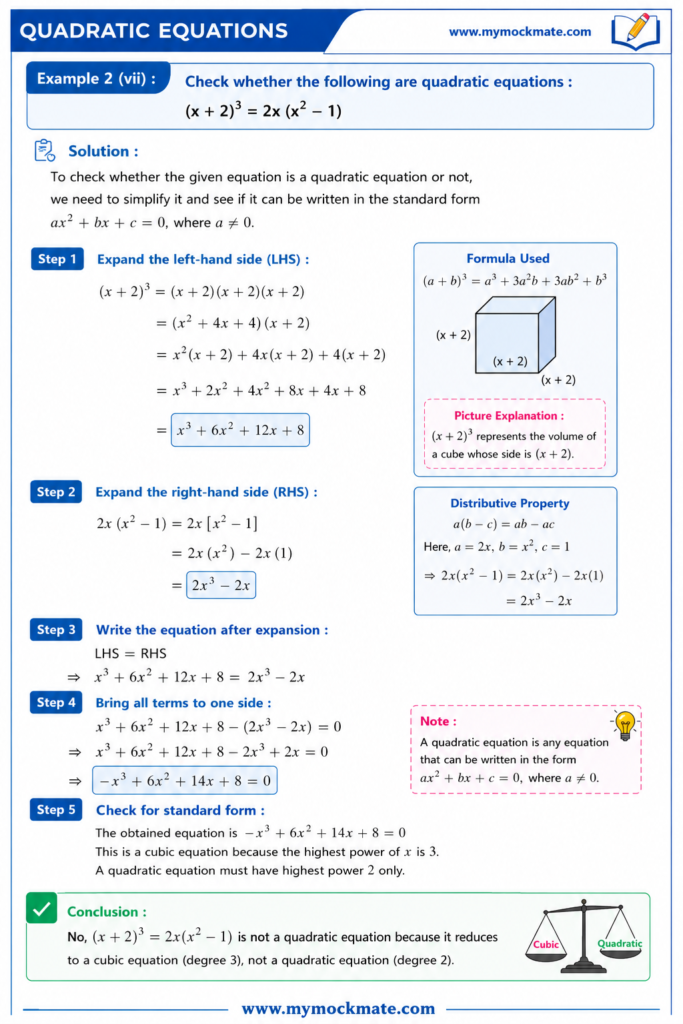
(vii)
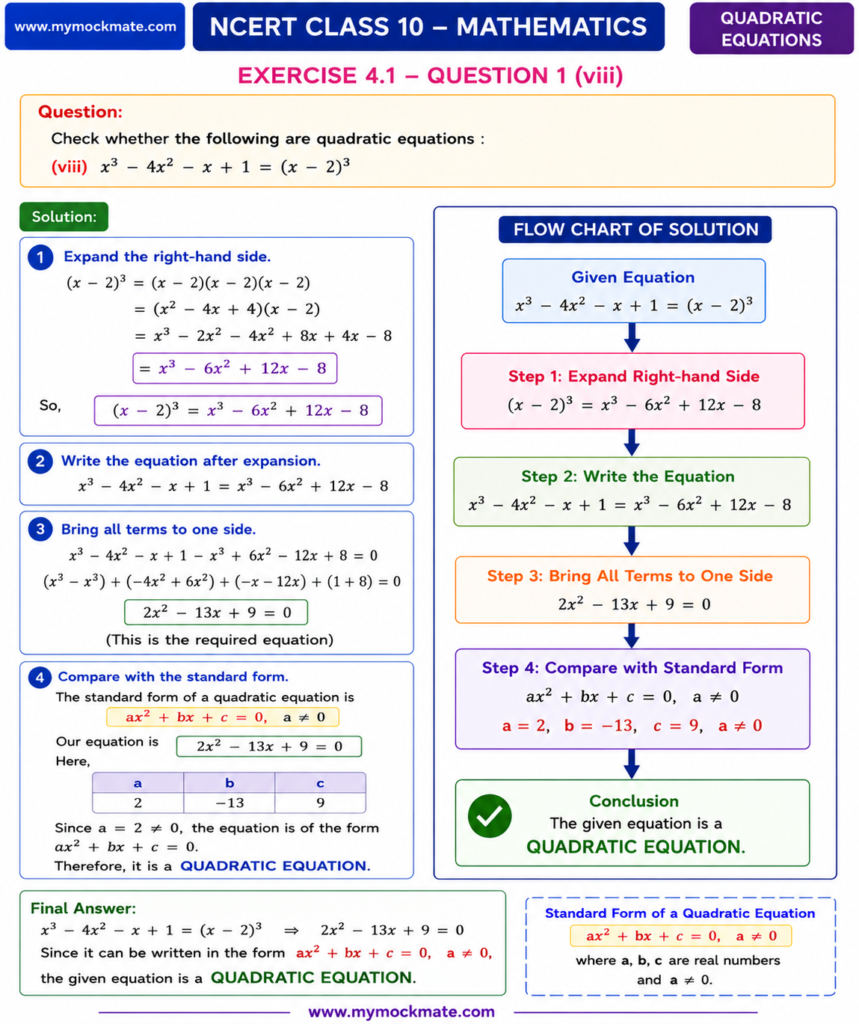
(viii)
Question 2
Represent the following situations in the form of quadratic equations.
(i) The area of a rectangular plot is 528 m2. The length of the plot (in metres) is one more than twice its breadth. We need to find the length and breadth of the plot.
Solution

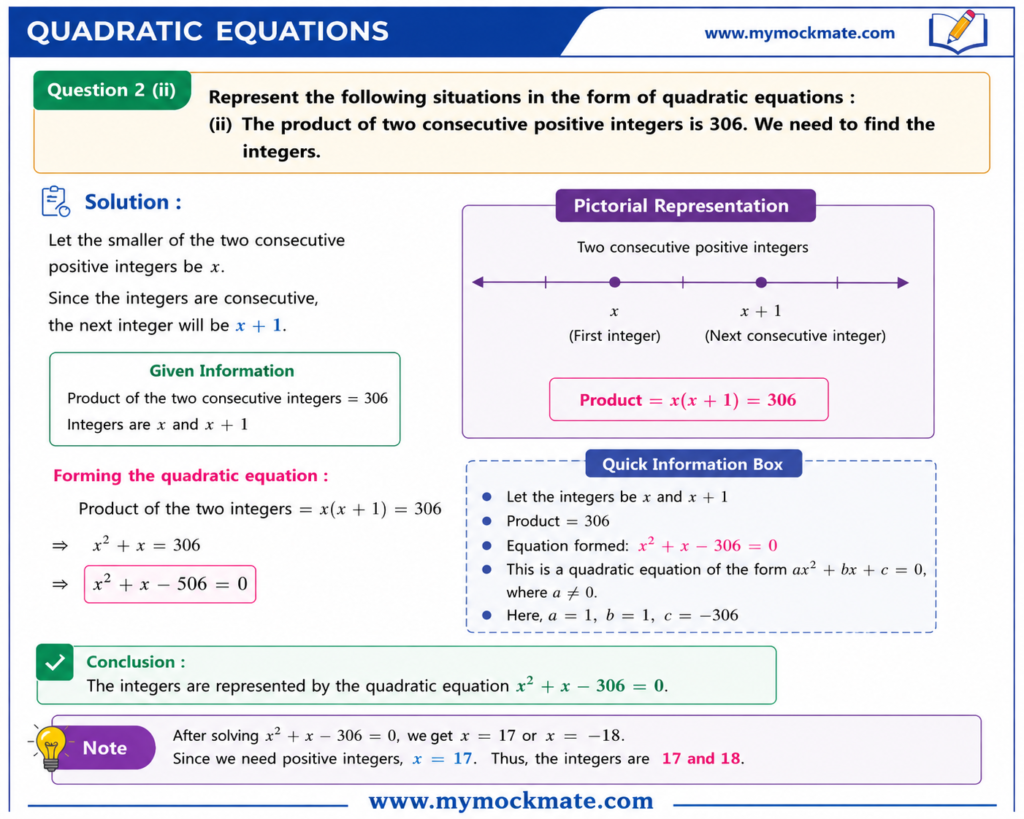
(ii) The product of two consecutive positive integers is 306. We need to find the integers.
Solution
(iii) Rohan’s mother is 26 years older than him. The product of their ages (in years) 3 years from now will be 360. We would like to find Rohan’s present age.
Solution

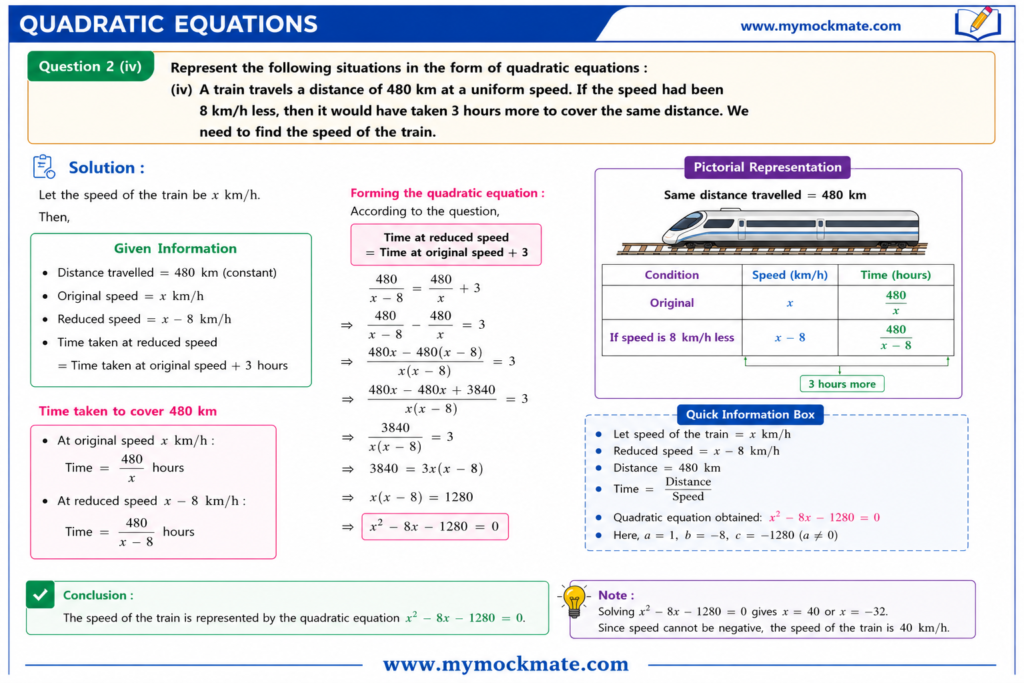
(iv) (iv) A train travels a distance of 480 km at a uniform speed. If the speed had been 8 km/h less, then it would have taken 3 hours more to cover the same distance. We need to find the speed of the train.
Solution
Common Mistakes
- Forgetting to convert the equation into standard form.
- Not expanding brackets correctly.
- Assuming every equation containing x2 is quadratic without simplification.
- Missing sign changes while shifting terms.
- Writing incorrect expressions in word problems.
Exam Tips
- Always simplify the equation first.
- Check the highest power after simplification.
- Ensure the coefficient of x2 is not zero.
- For word problems, define the variable clearly before forming the equation.
- Write the final quadratic equation in standard form.
Practice MCQs
1. A quadratic equation has degree
A. 1
B. 2
C. 3
D. 4
✅ Answer: B
2. Which is the standard form?
A. ax+b=0
B. ax2+bx+c=0
C. x3+x=0
D. x+2=3
✅ Answer: B
3. Which is NOT a quadratic equation?
A. x2+5=0
B. 2×2+3x=1
C. x3+x=0
D. 4×2−9=0
✅ Answer: C
4. Highest power in a quadratic equation is
A. 1
B. 2
C. 4
D. 5
✅ Answer: B
Frequently Asked Questions (FAQ)
Q1. What is a quadratic equation?
A quadratic equation is an equation of degree 2 and is written in the form:
Q2. Why should equations be simplified first?
Some equations may appear quadratic or non-quadratic until simplified. Simplification helps identify the correct degree.
Q3. Can a quadratic equation have only one solution?
Yes. It can have two equal real roots when the discriminant is zero.
Q4. What is the standard form?
Q5. Which chapter follows Exercise 4.1?
Exercise 4.2, where students solve quadratic equations using factorisation.
📘 Found these Exercise 4.1 solutions helpful?
Explore more NCERT Class 10 Maths Solutions, detailed explanations, chapter-wise notes, MCQs, previous year questions, and exam preparation resources only at www.mymockmate.com. Learn smarter, practice better, and score higher in your CBSE examinations.