NCERT Class 10 Maths Exercise 4.2 Solutions | Factorisation Method
Short Introduction
Exercise 4.2 introduces one of the easiest and most powerful methods of solving quadratic equations—the Factorisation Method. In this exercise, students learn how to split the middle term, factorise quadratic expressions, and apply the Zero Product Property to obtain the roots of quadratic equations. The exercise also includes real-life word problems involving ages, distances, geometry, and production costs.
Quick Information Box
| Particular | Details |
|---|---|
| Class | 10 |
| Subject | Mathematics |
| Chapter | 4 |
| Chapter Name | Quadratic Equations |
| Exercise | 4.2 |
| Board | CBSE |
| Method Used | Factorisation |
| Difficulty Level | Moderate |
Learning Objectives
After completing this exercise, students will be able to:
- Solve quadratic equations using factorisation.
- Apply Zero Product Property.
- Verify obtained roots.
- Solve application-based word problems.
- Improve algebraic manipulation skills.
Concepts Used (Topics Covered)
- Quadratic Equations
- Standard Form
- Factorisation
- Splitting Middle Term
- Zero Product Property
- Verification of Roots
- Word Problems
- Algebraic Expressions
Important Formulas
Standard Form
Zero Product Property
If
then
or
Sum of Consecutive Numbers
If first number is
then second number is
Area of Rectangle
Distance Formula
Exercise 4.2
Question 1
Find the roots of the following quadratic equations by factorisation.
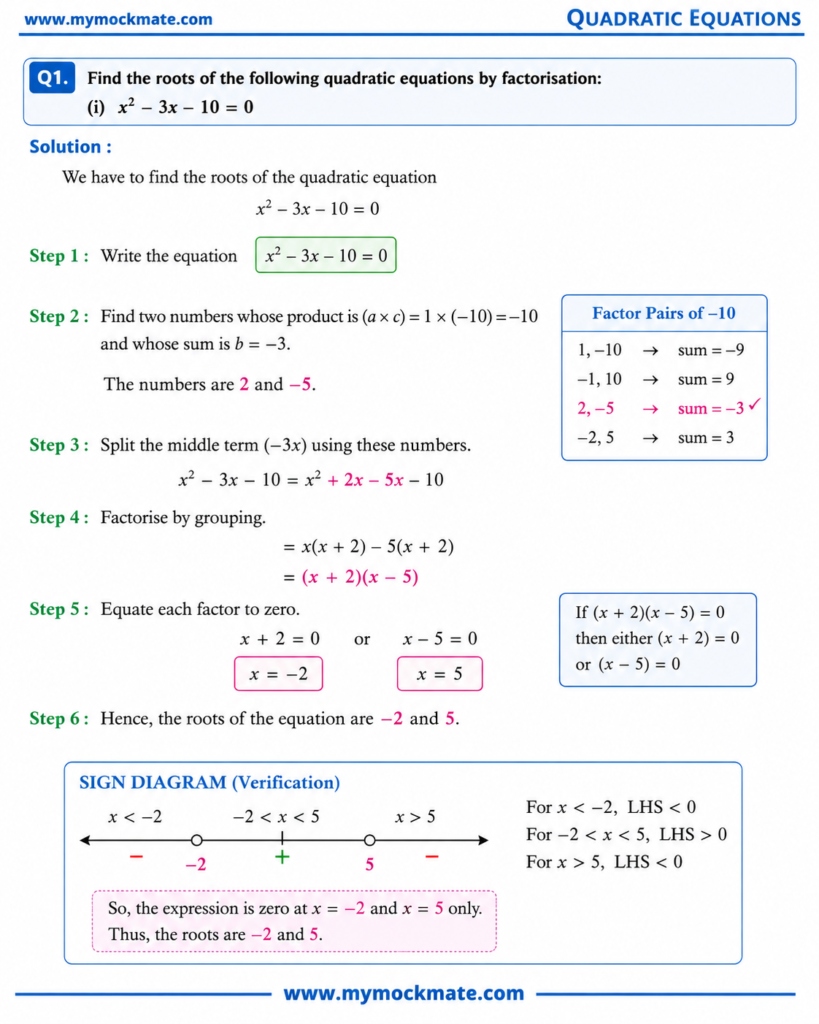
Question 1(i)
Solution
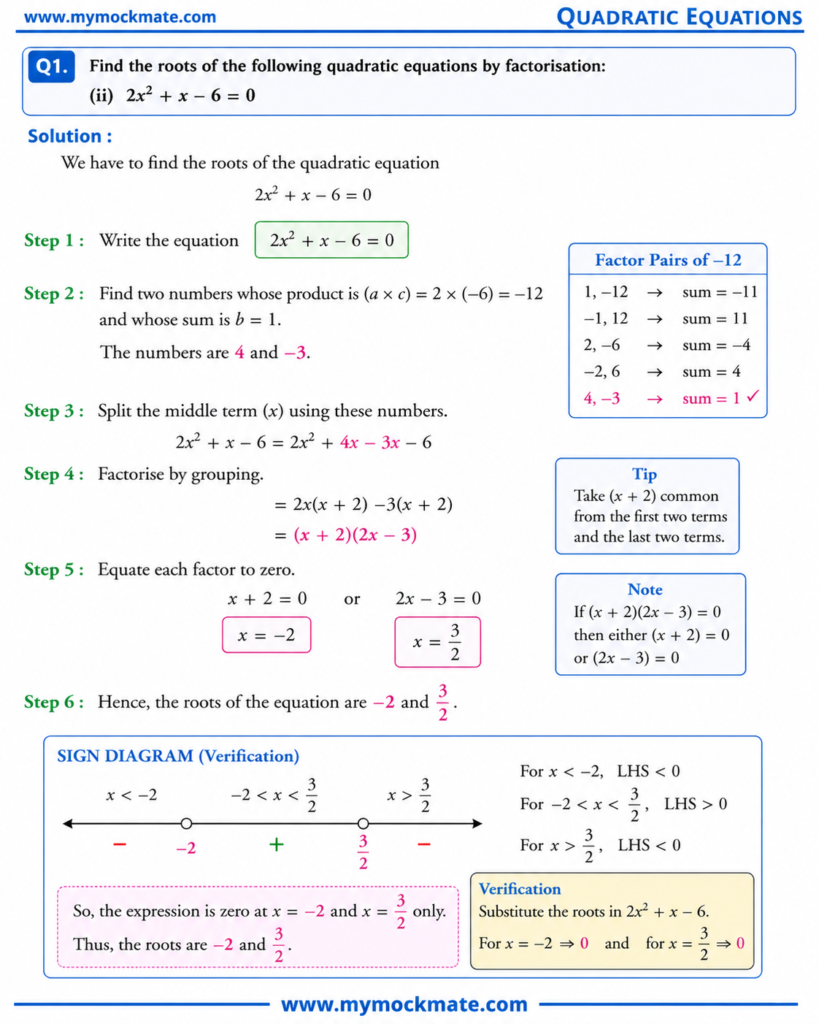
Question 1(ii)
Solution
Question 1(iii)
Solution

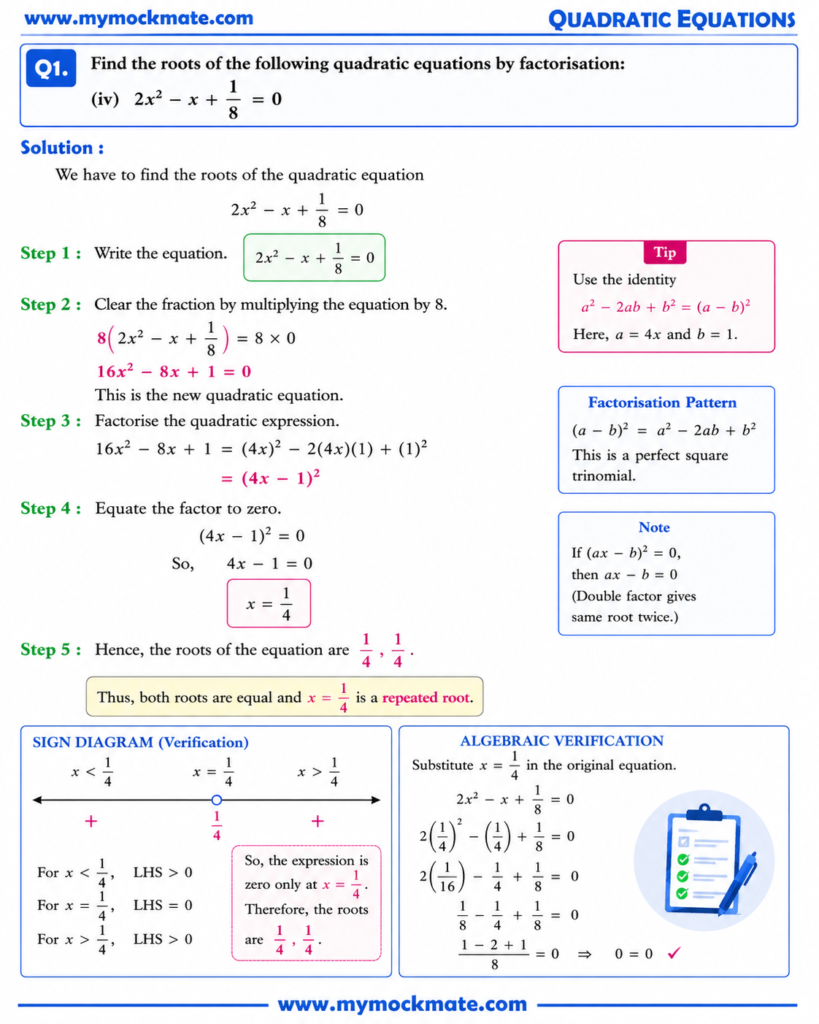
Question 1(iv)
Solution
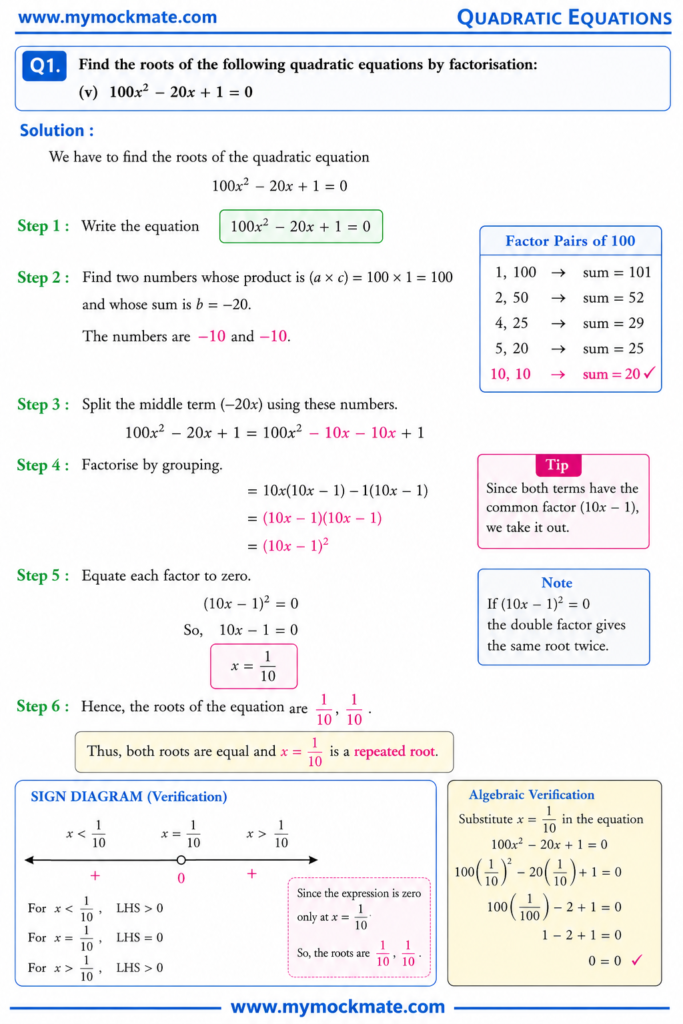
Question 1(v)
Solution
Question 2
Solve the problems given in Example 1.
Example 1 has two problems:
- John and Jivanti together have 45 marbles. Both lost 5 marbles each. The product of the marbles left with them is 124.
- A cottage industry produces toys. The cost of each toy is ₹55 minus the number of toys produced. Total production cost is ₹750.
Question 2(i)
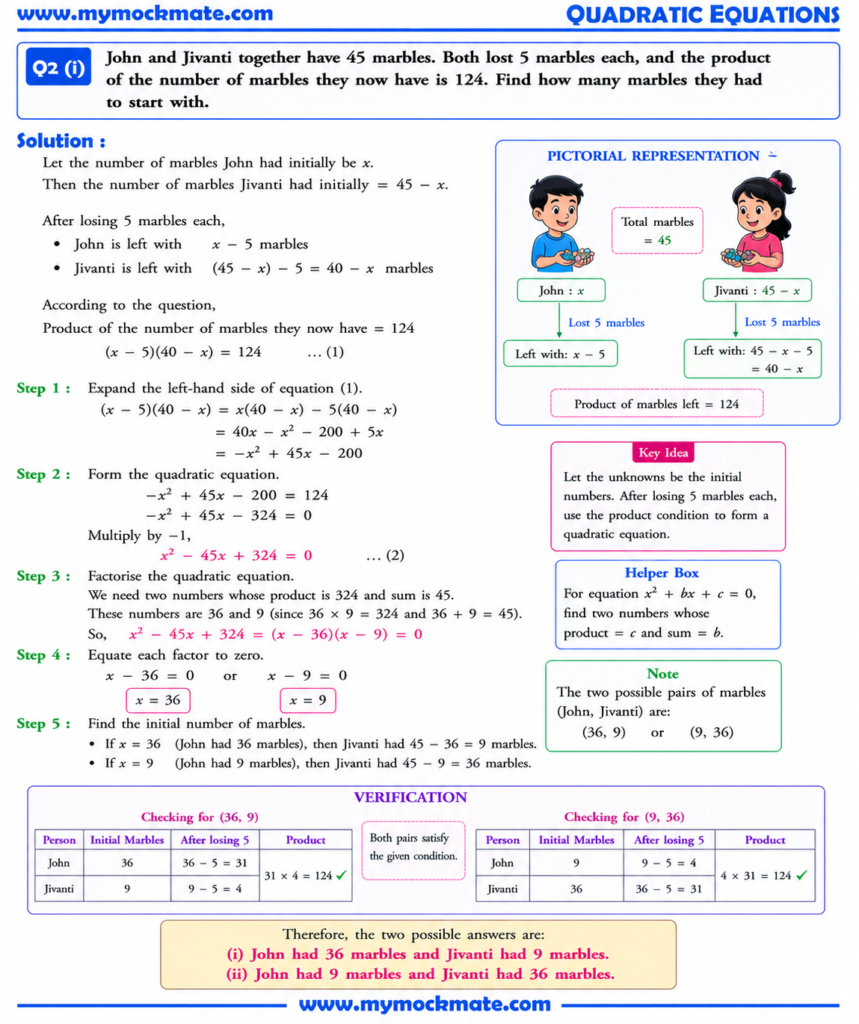
John and Jivanti together have 45 marbles. Both lost 5 marbles each, and the product of the number of marbles they now have is 124. Find how many marbles they had to start with.
Solution
Question 2(ii)
A cottage industry produces a certain number of toys in a day. The cost of production of each toy was found to be ₹55 minus the number of toys produced in a day. On a particular day, the total cost of production was ₹750. Find the number of toys produced on that day.
Solution

Question 3
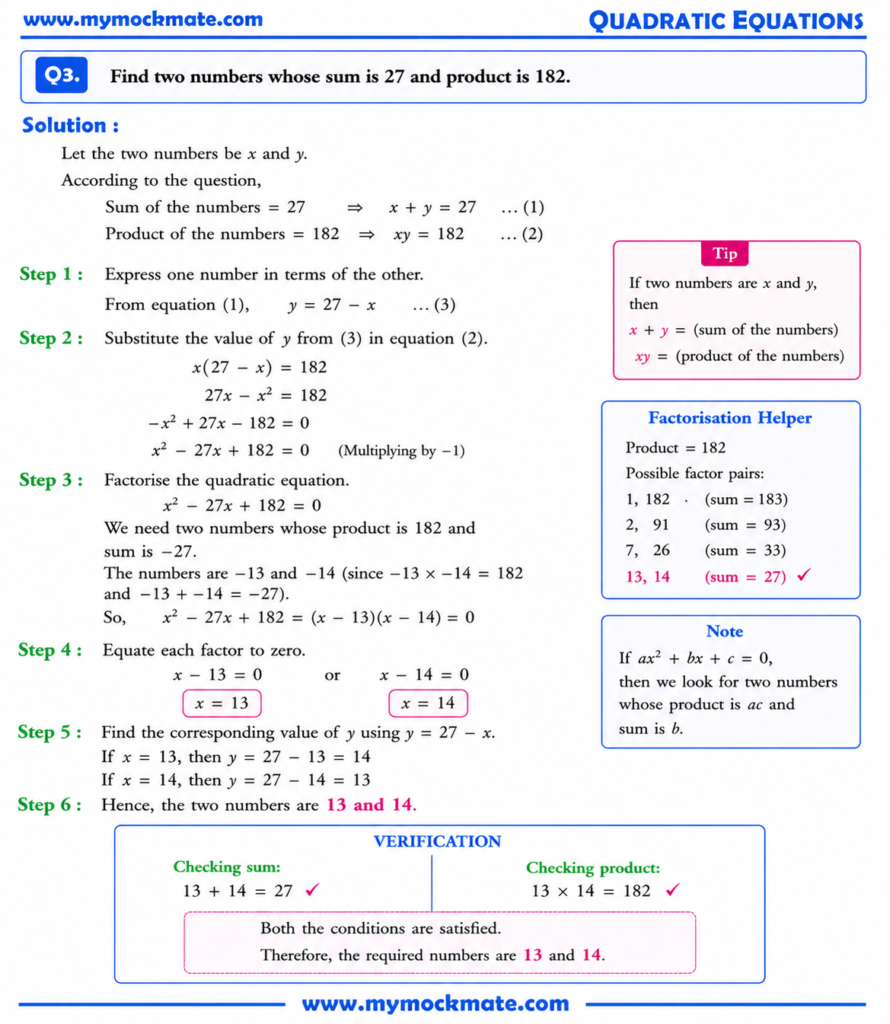
Find two numbers whose sum is 27 and product is 182.
Solution
Question 4
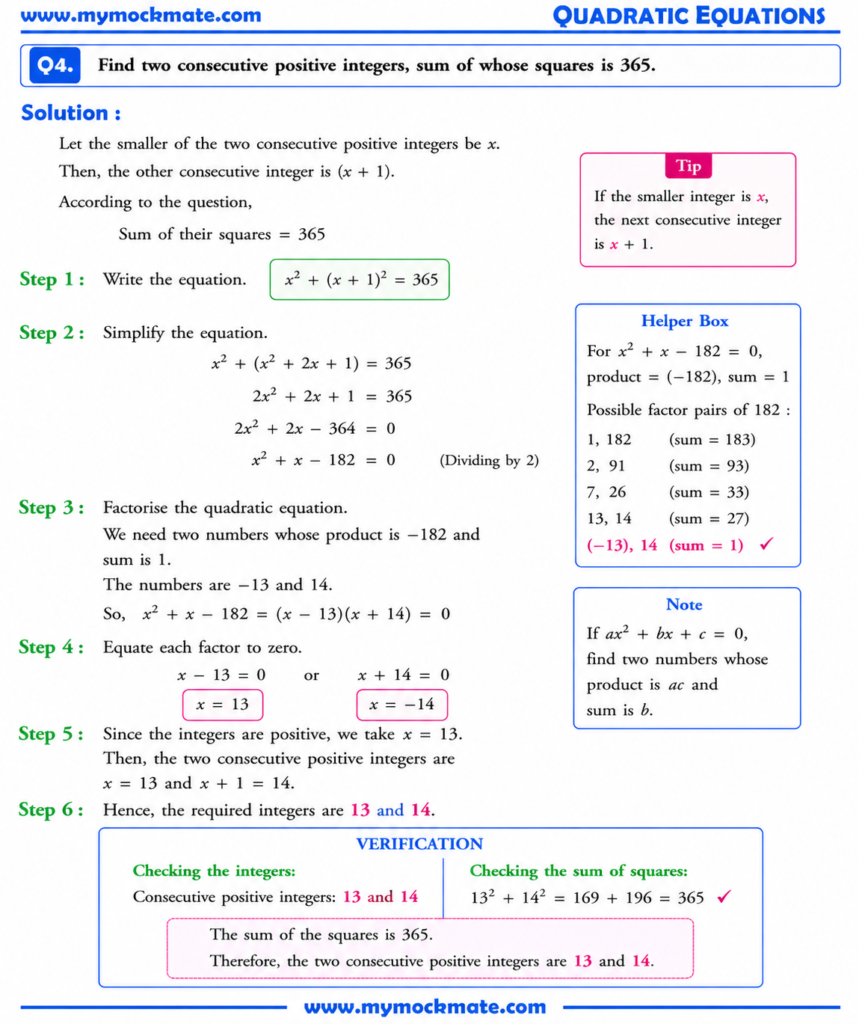
Find two consecutive positive integers, sum of whose squares is 365.
Solution
Question 5
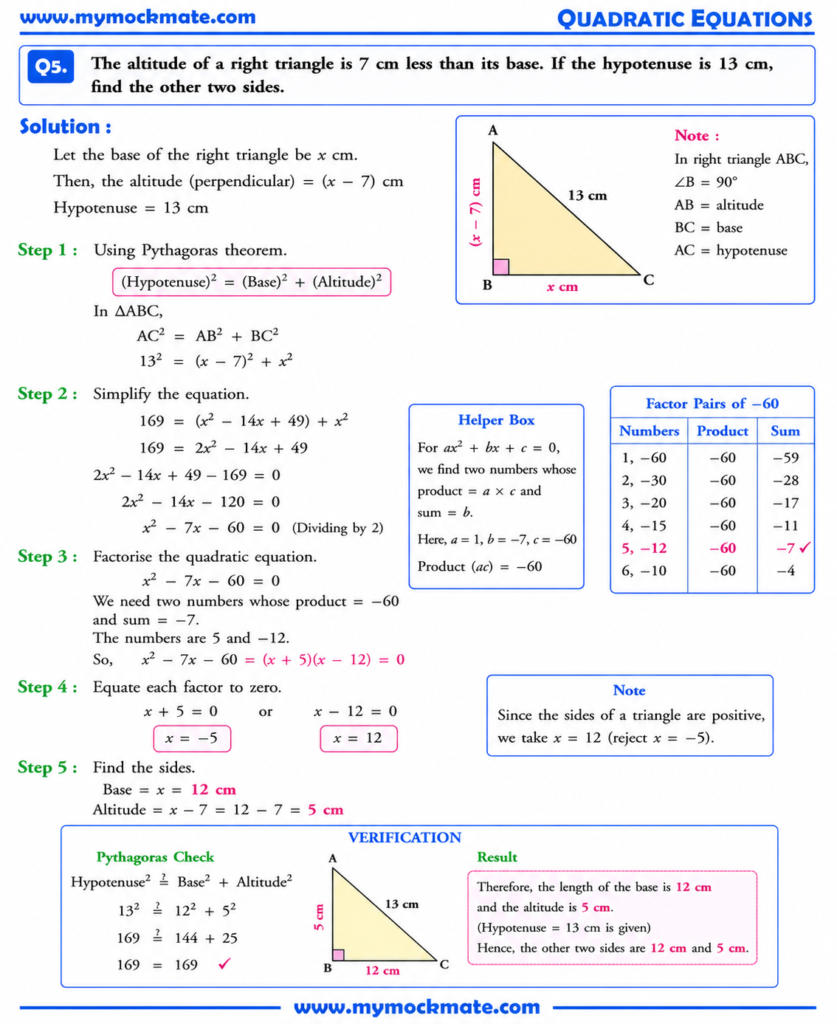
The altitude of a right triangle is 7 cm less than its base. If the hypotenuse is 13 cm, find the other two sides.
Solution
Question 6
A cottage industry produces a certain number of pottery articles in a day. It was observed on a particular day that the cost of production of each article (in rupees) was ₹3 more than twice the number of articles produced on that day. If the total cost of production on that day was ₹90, find:
- The number of articles produced.
- The cost of each article.
Solution

Exercise 4.2 Summary
After completing Exercise 4.2, students should be able to:
- Solve quadratic equations using factorisation.
- Split the middle term correctly.
- Apply the Zero Product Property.
- Verify the obtained roots.
- Solve real-life application problems based on quadratic equations.
- Choose only meaningful (positive) solutions in practical problems.
Common Mistakes
Many students lose marks due to small calculation errors. Avoid these common mistakes:
1. Incorrect Middle-Term Splitting
Choose numbers whose:
- Product = a×c
- Sum = coefficient of x
2. Forgetting Standard Form
Always write the equation as
before factorising.
3. Sign Errors
Most mistakes occur while transferring terms from one side of the equation to the other.
Always recheck the signs.
4. Wrong Common Factor
While grouping terms, ensure both groups have the same common binomial.
5. Ignoring Verification
Always substitute the obtained roots into the original equation.
6. Accepting Negative Measurements
In word problems involving:
- Age
- Distance
- Length
- Breadth
- Number of objects
Reject negative answers because they have no practical meaning.
Exam Tips
✔ Learn tables up to 30.
Factorisation becomes much faster.
✔ Memorise perfect squares
Examples
These frequently appear in quadratic equations.
✔ Write every algebraic step
CBSE awards step-wise marks.
✔ Verify every answer
Substitute each root into the original equation.
✔ Practice daily
Quadratic equations improve only through regular practice.
Practice MCQs
Question 1
Which method is used in Exercise 4.2?
A. Graph Method
B. Elimination Method
C. Factorisation Method
D. Matrix Method
✅ Answer: C
Question 2
The Zero Product Property states that ifAB=0
then
A. A=0 only
B. B=0 only
C. Either A=0 or B=0
D. None
✅ Answer: C
Question 3
The roots of
are
A. 5,2
B. -5,-2
C. 5,-2
D. 2,-5
✅ Answer: C
Question 4
The equation
has
A. One repeated root
B. Two distinct roots
C. No real roots
D. Three roots
✅ Answer: A
Question 5
Which property is used after factorisation?
A. Midpoint Theorem
B. Pythagoras Theorem
C. Zero Product Property
D. Euclid Division Lemma
✅ Answer: C
Question 6
The quadratic equation
has roots
A. 12 and 15
B. 13 and 14
C. 10 and 17
D. 11 and 16
✅ Answer: B
Question 7
A quadratic equation has maximum
A. 1 root
B. 2 roots
C. 3 roots
D. 4 roots
✅ Answer: B
Question 8
Which chapter introduces solving quadratic equations by factorisation?
A. Pair of Linear Equations
B. Quadratic Equations
C. Triangles
D. Probability
✅ Answer: B
Question 9
Before factorisation, every quadratic equation should be written in:
A. Expanded Form
B. Standard Form
C. Simplified Form
D. Graphical Form
✅ Answer: B
Question 10
The roots obtained should always be:
A. Memorised
B. Verified
C. Rounded
D. Ignored
✅ Answer: B
Frequently Asked Questions (FAQ)
Q1. What is the factorisation method?
It is a method of solving quadratic equations by expressing the quadratic polynomial as the product of two linear factors and then applying the Zero Product Property.
Q2. What is the Zero Product Property?
If
then
or
Q3. Why do we verify roots?
Verification ensures that the obtained values satisfy the original equation and helps avoid calculation mistakes.
Q4. Can a quadratic equation have equal roots?
Yes. If both factors are identical, the equation has two equal (repeated) roots.
Q5. Why are negative answers rejected in some word problems?
Quantities such as age, length, speed, distance, and the number of objects cannot be negative in real-life situations, so only meaningful positive solutions are accepted.
Q6. Which method is used in Exercise 4.2?
Exercise 4.2 focuses on solving quadratic equations using the factorisation method before introducing the quadratic formula in later sections.
Final Revision Tips
- ✔ Convert every equation into standard form.
- ✔ Split the middle term carefully.
- ✔ Factorise correctly.
- ✔ Apply the Zero Product Property.
- ✔ Verify both roots.
- ✔ Reject invalid negative values in application-based questions.
🎯 Practice More, Score More with MyMockMate!
Master NCERT Class 10 Maths Chapter 4 – Quadratic Equations through detailed chapter-wise solutions, concept notes, MCQs, assertion–reason questions, previous year questions, mock tests, and exam-oriented study material.
📘 Visit www.mymockmate.com for:
- Complete NCERT Solutions
- Chapter-wise Notes
- CBSE Mock Tests
- Important Questions
- Practice Worksheets
- Previous Year Papers
- Exam Preparation Resources
Keep practicing consistently, verify every solution, and you’ll build strong confidence in solving quadratic equations for your CBSE exams.