NCERT Class 12 Biology Chapter 1 Solutions: Sexual Reproduction in Flowering Plants
Short Introduction
Reproduction is an essential process that ensures the continuity of life on Earth. In flowering plants (angiosperms), sexual reproduction involves the formation of male and female gametes, pollination, fertilisation, and seed formation. This chapter explains the structure of flowers, pollination mechanisms, double fertilisation, seed development, apomixis, and polyembryony.
Quick Information Box
| Particular | Details |
|---|---|
| Class | 12 |
| Subject | Biology |
| Chapter | 1 |
| Chapter Name | Sexual Reproduction in Flowering Plants |
| Board | CBSE/NCERT |
| Important Topics | Pollination, Fertilisation, Embryo Sac, Seed Formation |
| Exam Weightage | High |
Concepts Used (Topics Covered)
- Structure of Flower
- Microsporogenesis
- Megasporogenesis
- Pollination
- Double Fertilisation
- Endosperm Development
- Embryo Development
- Seed and Fruit Formation
- Apomixis
- Polyembryony
Important Definitions
Pollination
Transfer of pollen grains from anther to stigma.
Fertilisation
Fusion of male and female gametes.
Double Fertilisation
Fusion of one male gamete with egg and another with polar nuclei.
Apomixis
Seed formation without fertilisation.
Polyembryony
Formation of more than one embryo in a seed.
Important Diagrams to Practice
✔ Structure of Anther
✔ Structure of Ovule
✔ Mature Embryo Sac
✔ Pollen Germination
✔ Double Fertilisation
✔ Structure of Dicot Seed
✔ Structure of Monocot Seed
Important Points for Examination
- Angiosperms exhibit double fertilisation.
- Endosperm is usually triploid (3n).
- Synergids contain filiform apparatus.
- Pollen grain exine is made of sporopollenin.
- Embryo sac is 7-celled and 8-nucleate.
NCERT Exercise Solutions
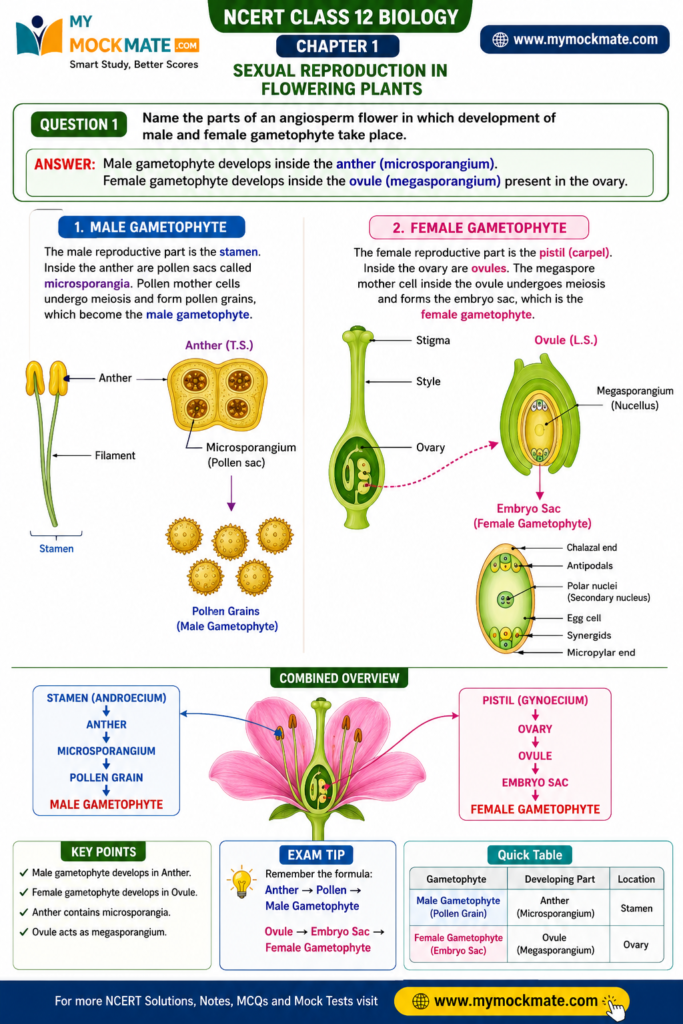
Q1. Name the parts of an angiosperm flower in which development of male and female gametophyte takes place.
Solution
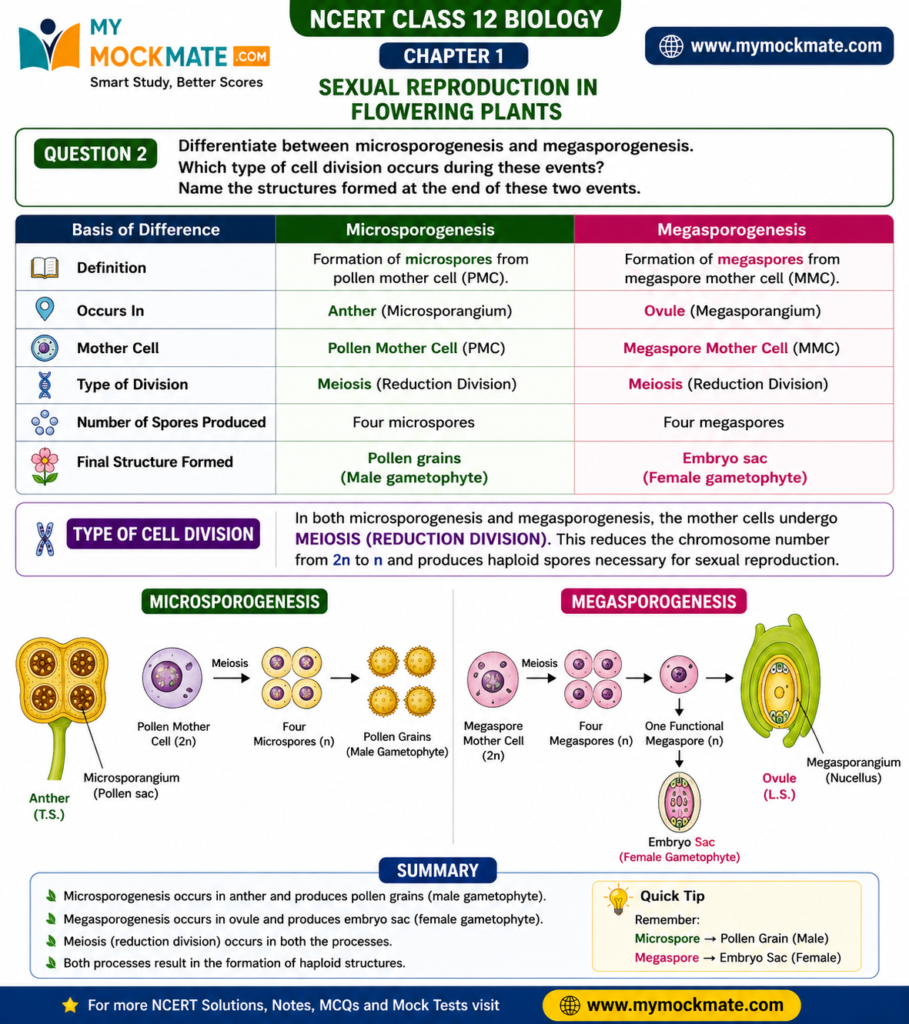
Q2. Differentiate between microsporogenesis and megasporogenesis. Which type of cell division occurs during these events? Name the structures formed at the end of these two events.
Solution
Q3. Arrange the following terms in correct sequence:
Pollen grain, Sporogenous tissue, Microspore tetrad, Pollen mother cell.
Solution
Correct sequence:
Sporogenous tissue → Pollen mother cell → Microspore tetrad → Pollen grain
Q4. What is meant by monosporic development of female gametophyte?
Solution
When only one of the four megaspores formed during meiosis remains functional and develops into the embryo sac, it is called monosporic development.
Q5. What are chasmogamous flowers?
Solution
Flowers that open and expose their reproductive organs are called chasmogamous flowers.
Examples
- Hibiscus
- Rose
- Mustard
Q6. What are cleistogamous flowers? Mention one advantage.
Solution
Flowers that do not open and remain closed are called cleistogamous flowers.
Examples
- Viola
- Oxalis
- Commelina
Advantage
They ensure self-pollination and guaranteed seed formation.
Q7. Differentiate between geitonogamy and xenogamy.
Solution
| Geitonogamy | Xenogamy |
|---|---|
| Pollen transferred to another flower of same plant | Pollen transferred to flower of different plant |
| Genetically similar | Genetically different |
| Requires pollinating agent | Requires pollinating agent |
| Similar to self-pollination | True cross-pollination |
Q8. Why does pollen grain possess tough exine?
Solution
The exine protects pollen grains against:
- High temperature
- Desiccation
- Enzymatic degradation
- Mechanical injury
It is made up of sporopollenin, the most resistant organic substance.
Q9. What is pollen viability?
Solution
The period during which pollen grains remain capable of fertilisation is called pollen viability.
Q10. Why are wind-pollinated flowers not brightly coloured?
Solution
Wind-pollinated flowers do not need to attract insects or animals. Therefore, they are:
- Small
- Dull coloured
- Odourless
- Nectarless
Q11. Explain double fertilisation.
Solution
Step 1
One male gamete fuses with egg.
This forms:
Zygote (2n)
This process is called:
Syngamy
Step 2
Second male gamete fuses with:
- Two polar nuclei
This forms:
Primary Endosperm Nucleus (3n)
This process is called:
Triple Fusion
Since two fertilisation events occur, it is called:
Double Fertilisation.
Q12. What is triple fusion?
Solution
Fusion of one male gamete with two polar nuclei to form triploid primary endosperm nucleus is called triple fusion.
Q13. What is apomixis?
Solution
Formation of seeds without fertilisation is called apomixis.
Importance
- Produces genetically identical plants.
- Useful in hybrid seed production.
Q14. Define polyembryony.
Solution
Formation of more than one embryo inside a single seed is called polyembryony.
Example
Citrus.
Q15. Why does endosperm develop before embryo?
Solution
Endosperm provides nourishment to the developing embryo.
Hence, it develops first.
Q16. Why are apple and cashew called false fruits?
Solution
Because besides ovary, other floral parts also contribute to fruit formation.
Hence, they are called false fruits.
Q17. Why is coconut water liquid?
Solution
Coconut water is free nuclear endosperm.
Q18. What is emasculation?
Solution
Removal of anthers from bisexual flowers before maturity is called emasculation.
It prevents self-pollination.
Common Mistakes Made by Students
❌ Writing embryo sac as 8-celled.
❌ Confusing geitonogamy with xenogamy.
❌ Forgetting that endosperm is triploid.
❌ Writing syngamy as triple fusion.
❌ Confusing apomixis with parthenogenesis.
Exam Tips
✔ Draw labelled diagrams.
✔ Remember:
Embryo Sac = 7-celled, 8-nucleate.
✔ Double Fertilisation = Syngamy + Triple Fusion.
✔ Learn examples of pollination.
✔ Practice flow charts.
Practice MCQs
1. Exine is made up of:
(a) Cellulose
(b) Pectin
(c) Sporopollenin
(d) Lignin
Answer: (c)
2. Embryo sac is:
(a) 7-celled, 8-nucleate
(b) 8-celled, 8-nucleate
(c) 7-celled, 7-nucleate
(d) 8-celled, 7-nucleate
Answer: (a)
3. Triple fusion produces:
(a) Zygote
(b) Embryo
(c) Endosperm nucleus
(d) Seed
Answer: (c)
4. Example of polyembryony:
(a) Mango
(b) Citrus
(c) Wheat
(d) Rose
Answer: (b)
Frequently Asked Questions (FAQ)
Q1. Why is double fertilisation unique to angiosperms?
Because two fertilisation events occur simultaneously.
Q2. What is the ploidy of endosperm?
Triploid (3n).
Q3. Which cell guides pollen tube?
Synergids.
Q4. What is the function of filiform apparatus?
Guides pollen tube towards egg apparatus.
Q5. What is the function of endosperm?
Provides nutrition to embryo.
Conclusion
Sexual reproduction in flowering plants ensures genetic variation and continuity of species. Understanding pollination, fertilisation and seed formation is essential for scoring high marks in CBSE Board examinations.
CTA (Call To Action)
📚 For more NCERT Solutions, Notes, MCQs, Mock Tests and Board Exam Preparation Material, visit:
🚀 Learn Smart. Practice More. Score Better.