NCERT Class 9 Maths End-of-Chapter (The World of Numbers) Solutions
Short Introduction
The End-of-Chapter Exercises of Chapter 3 “The World of Numbers” help students strengthen their understanding of rational numbers, irrational numbers, decimal expansions, and number line representation. In this article, we provide detailed step-by-step solutions for Questions 1 to 6 in a simple and exam-oriented manner.
Quick Information Box
Chapter: The World of Numbers
Class: Grade 9 Mathematics
Exercise: End-of-Chapter Exercises (Part 1)
Questions Covered: Q.1 to Q.6
Main Topics:
- Terminating and Repeating Decimals
- Irrational Numbers
- Conversion of Decimals into Fractions
- Number Line Representation
- Rational Numbers Between Two Numbers
Concepts Used (Topics Covered)
- Rational Numbers
- Irrational Numbers
- Decimal Expansion
- Long Division Method
- Fraction Conversion
- Number Line Representation
- Finding Rational Numbers Between Two Numbers
Important Formulas
1. Rational Number
A number of the form:
p/q, where q ≠ 0
2. Terminating Decimal Test
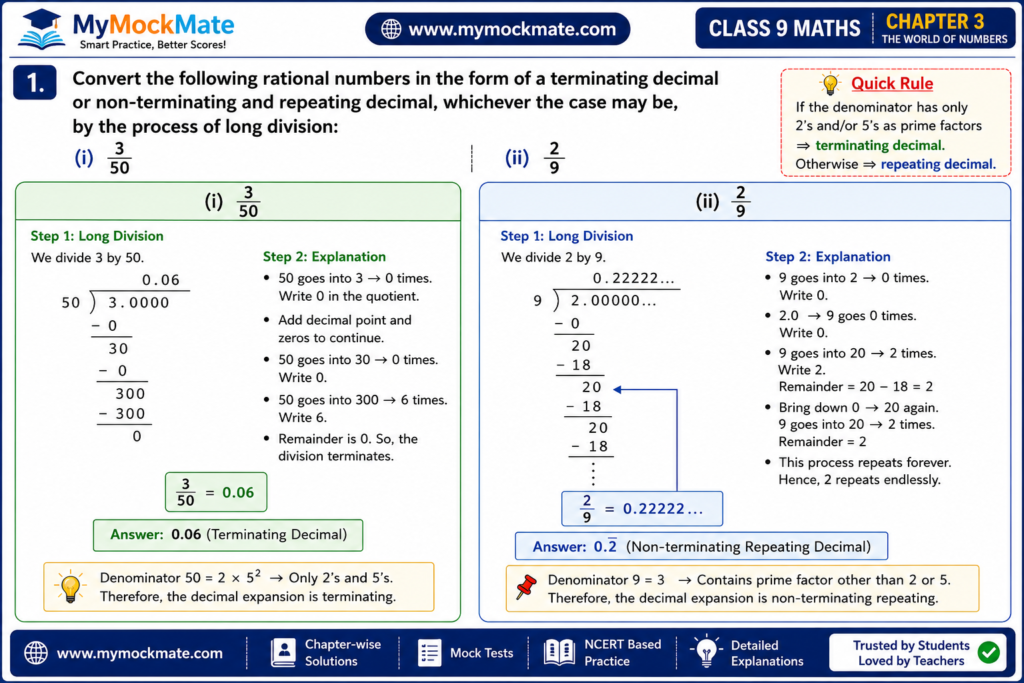
If the denominator (in lowest form) contains only prime factors 2 and/or 5, then the decimal expansion terminates.
3. Repeating Decimal Test
If the denominator contains any prime factor other than 2 or 5, the decimal expansion is non-terminating repeating.
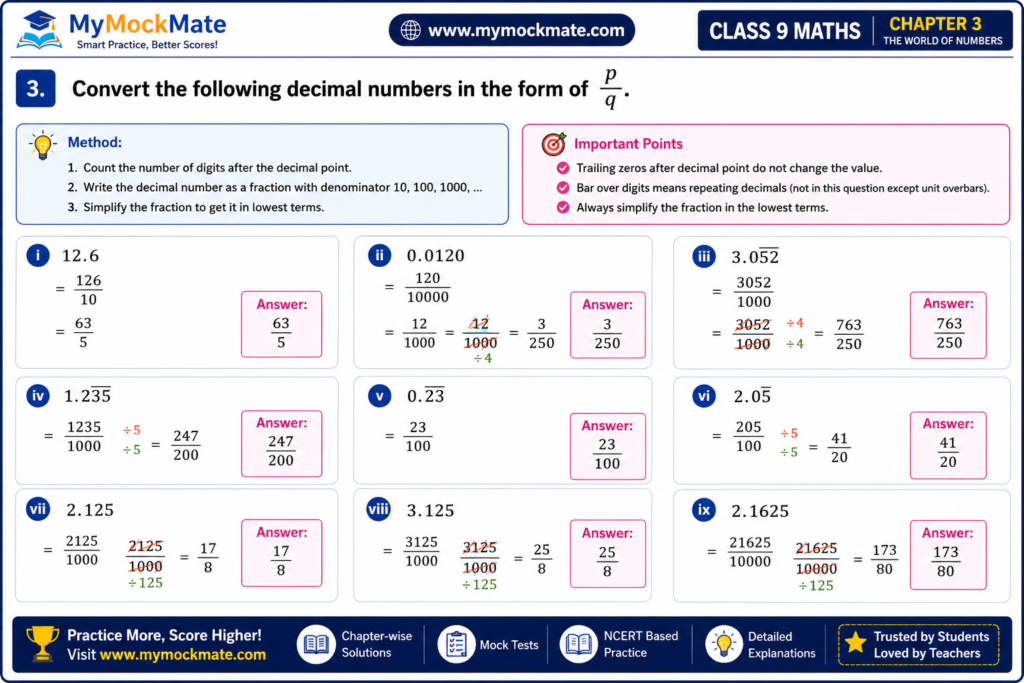
4. Converting Decimal into Fraction
Decimal × 10ⁿ / 10ⁿ
where n = number of decimal places.
Question 1
Convert the following rational numbers into terminating or non-terminating repeating decimals by long division:
Solution
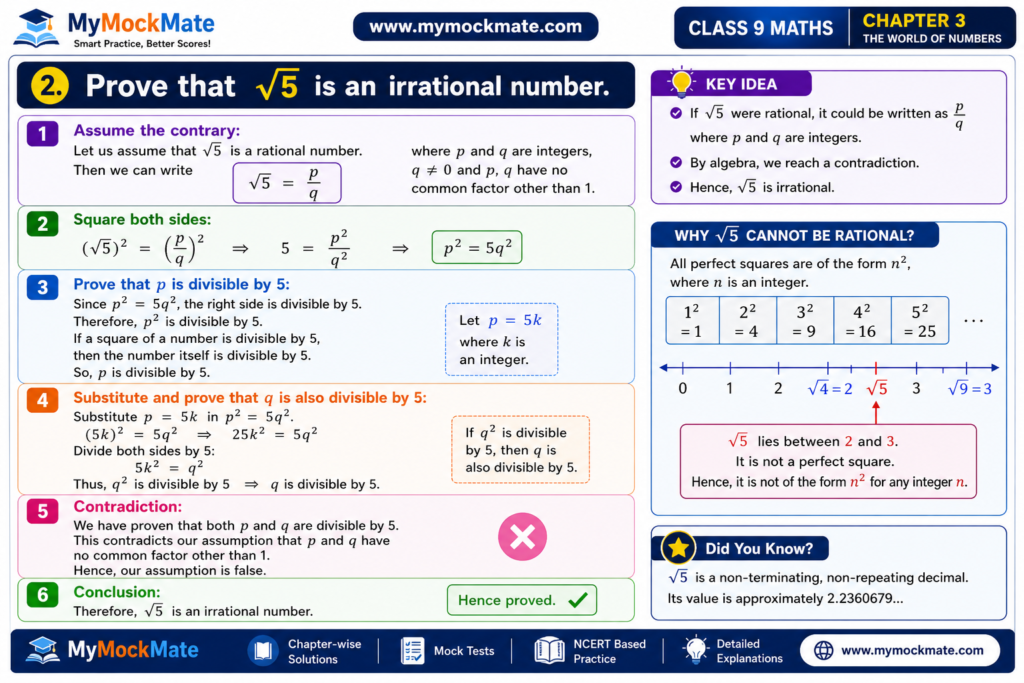
Question 2
Prove that √5 is an irrational number.
Solution
Question 3
Convert the following decimal numbers into p/q form.
Question 4
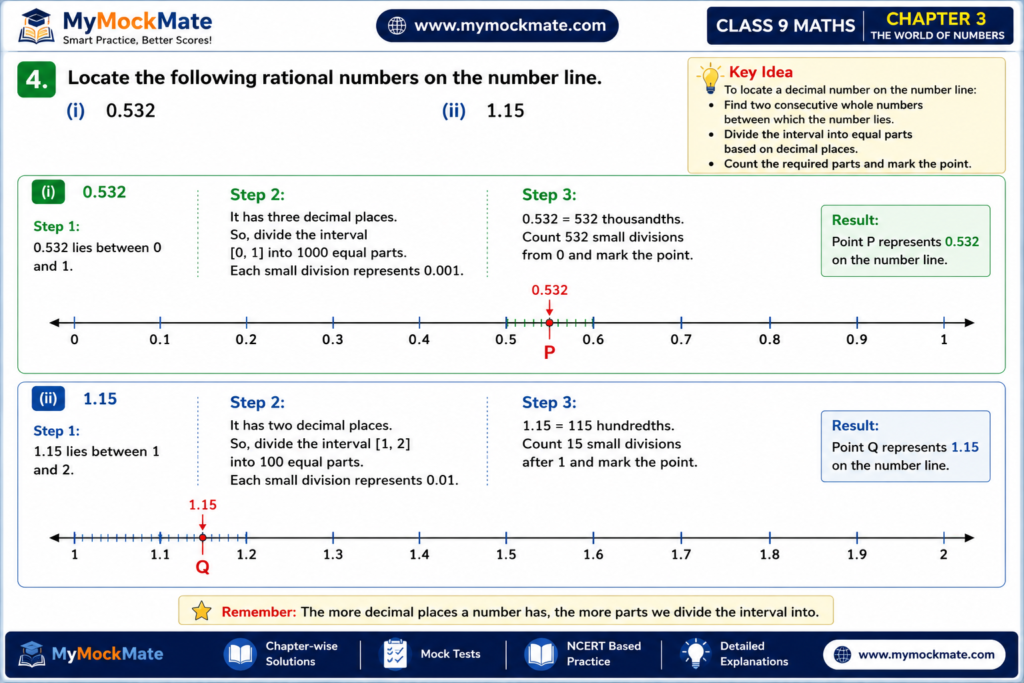
Locate the following rational numbers on the number line.
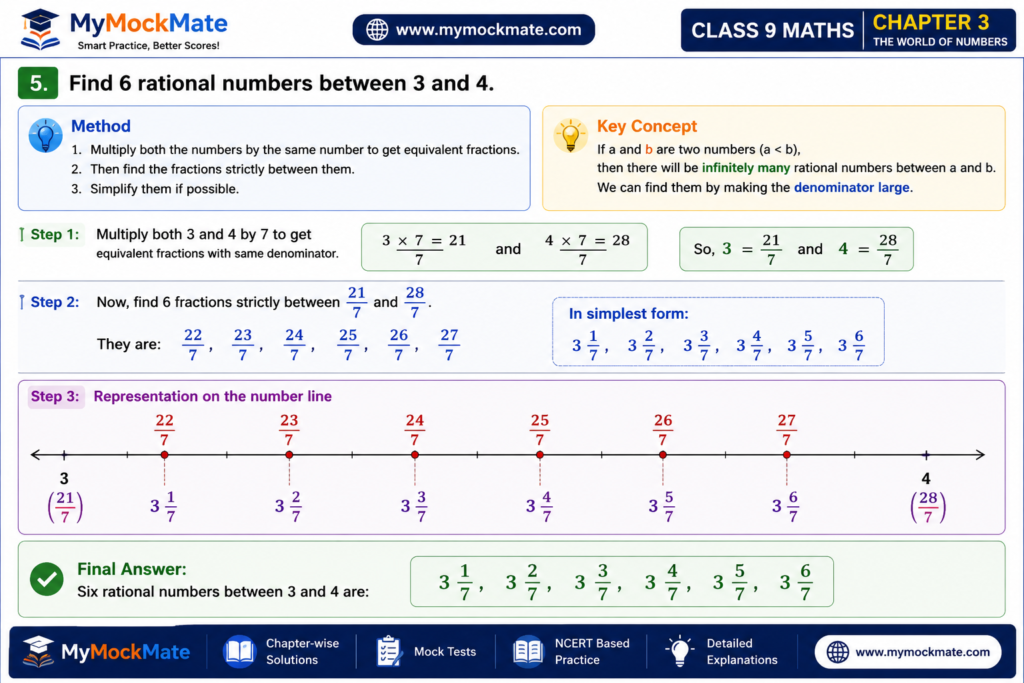
Question 5
Find six rational numbers between 3 and 4.
Solution
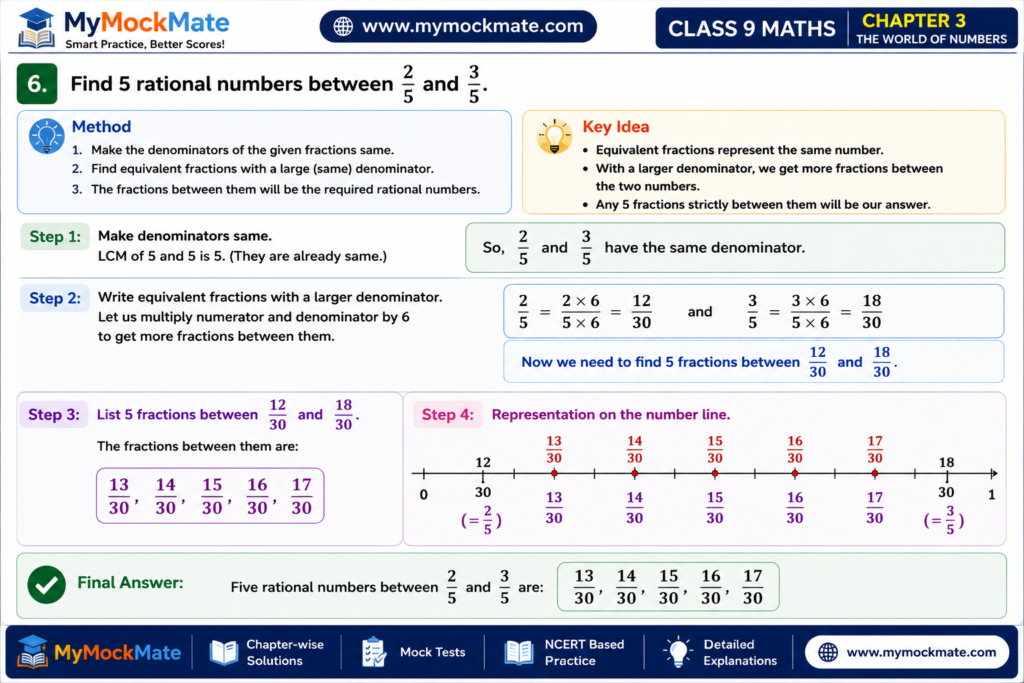
Question 6
Find five rational numbers between 2/5 and 3/5.
Solution
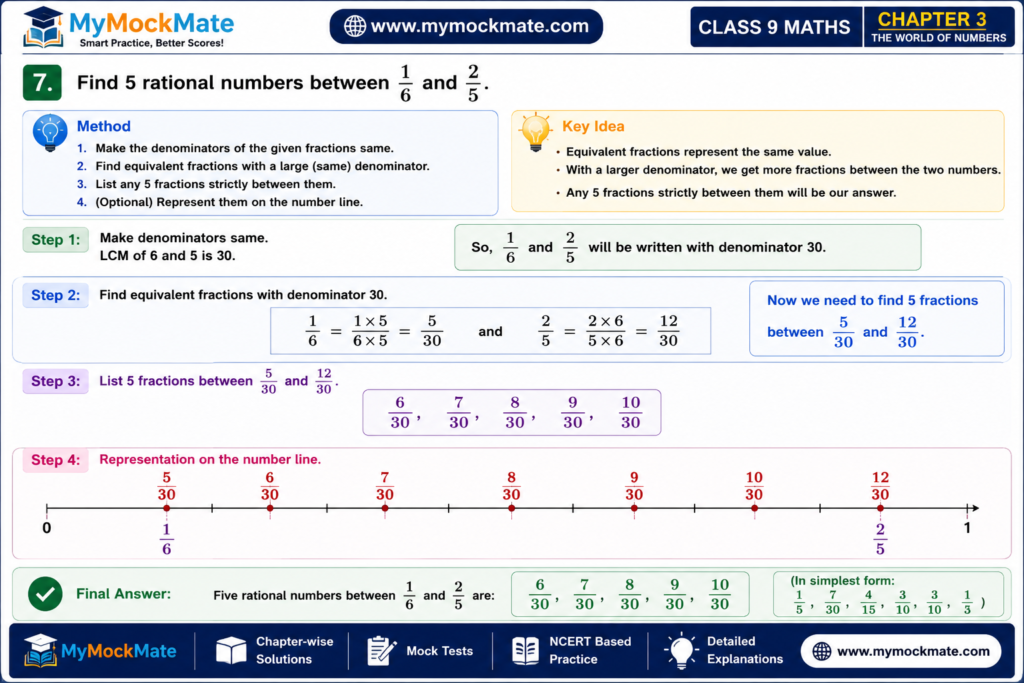
Question 7
Find 5 rational numbers between1/6 and 2/5 .
Solution :
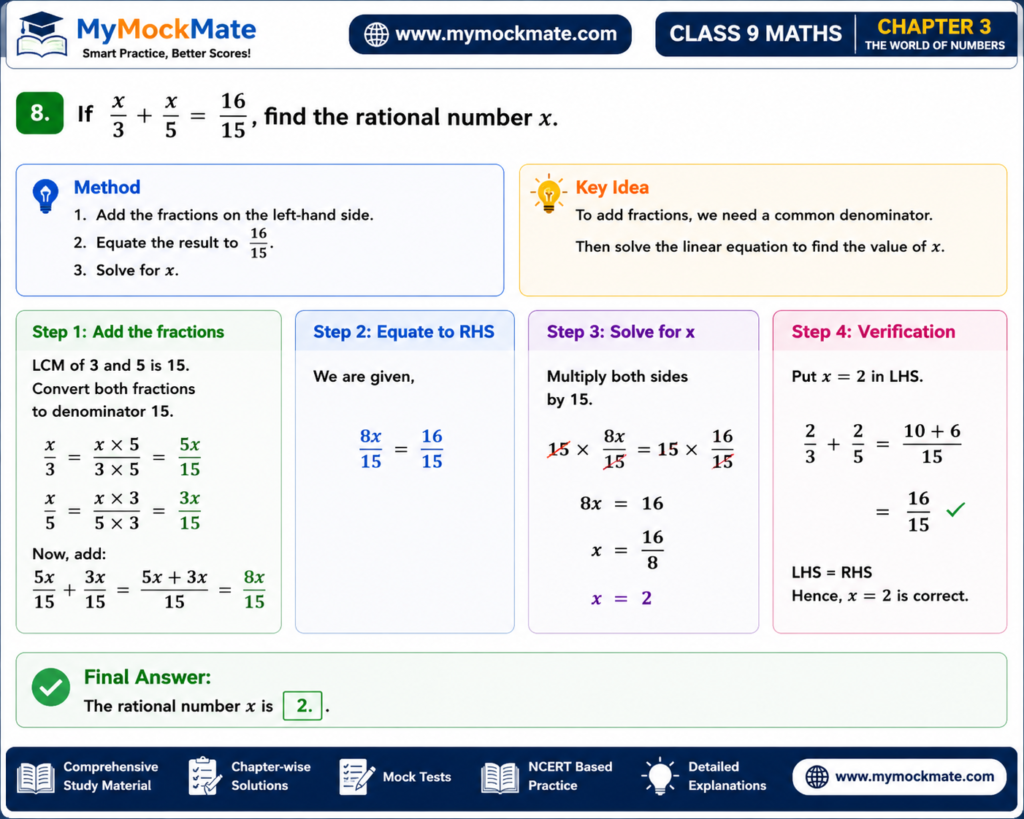
Question 8

Question 9
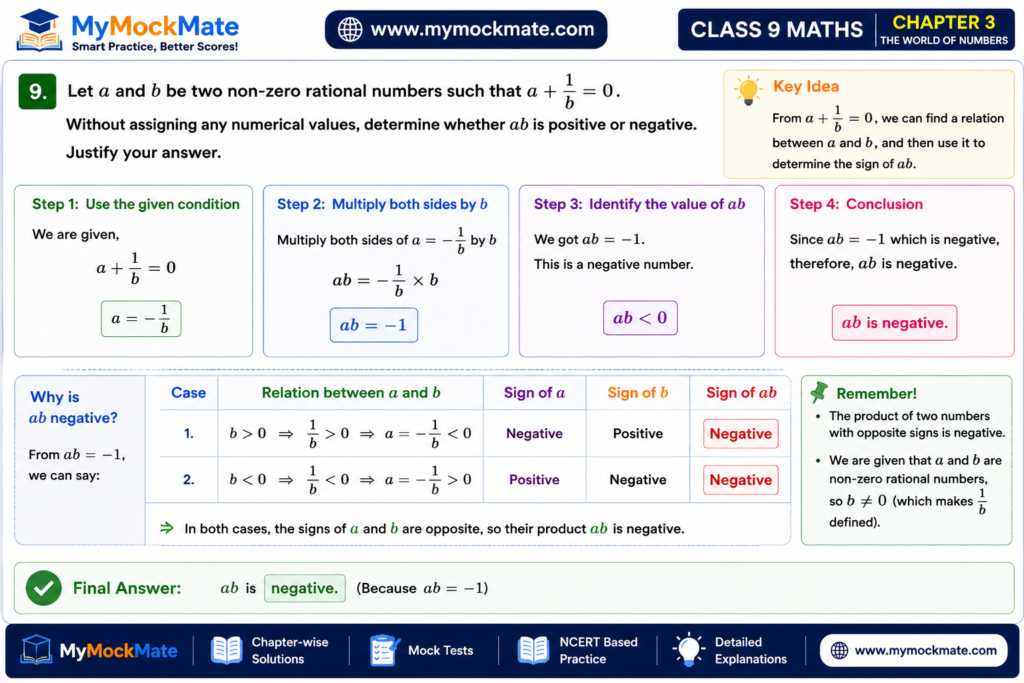
Let a and b be two non-zero rational numbers such that a + (1/ b) = 0. Without assigning any numerical values, determine whether ab is positive or negative. Justify your answer
Question 10
Question 11

Question 12

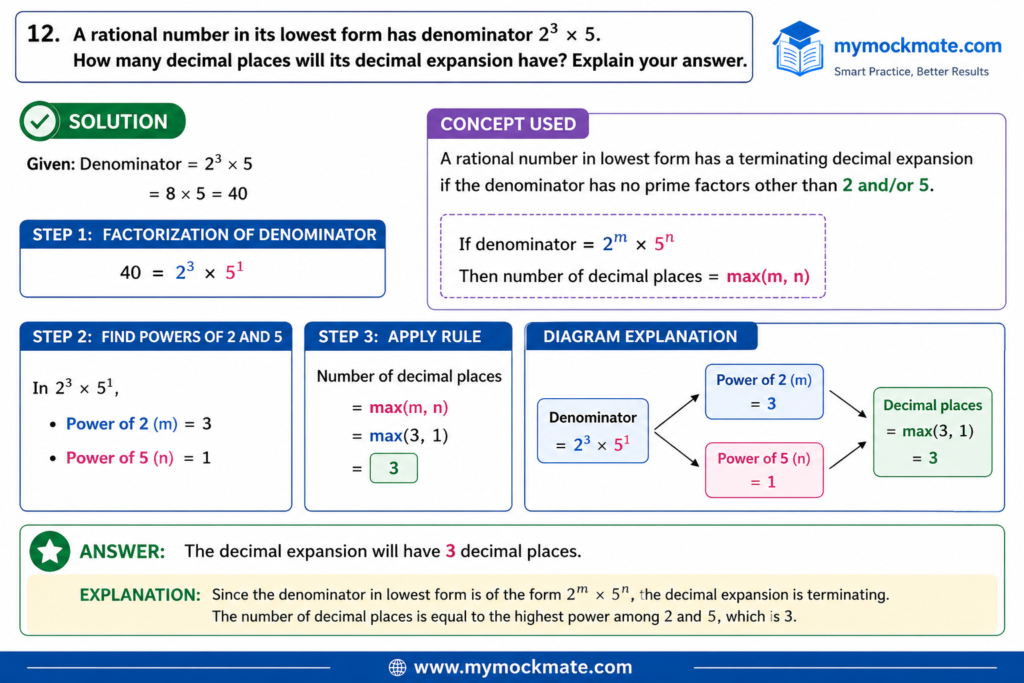
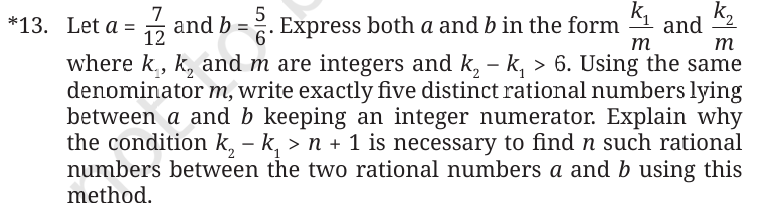
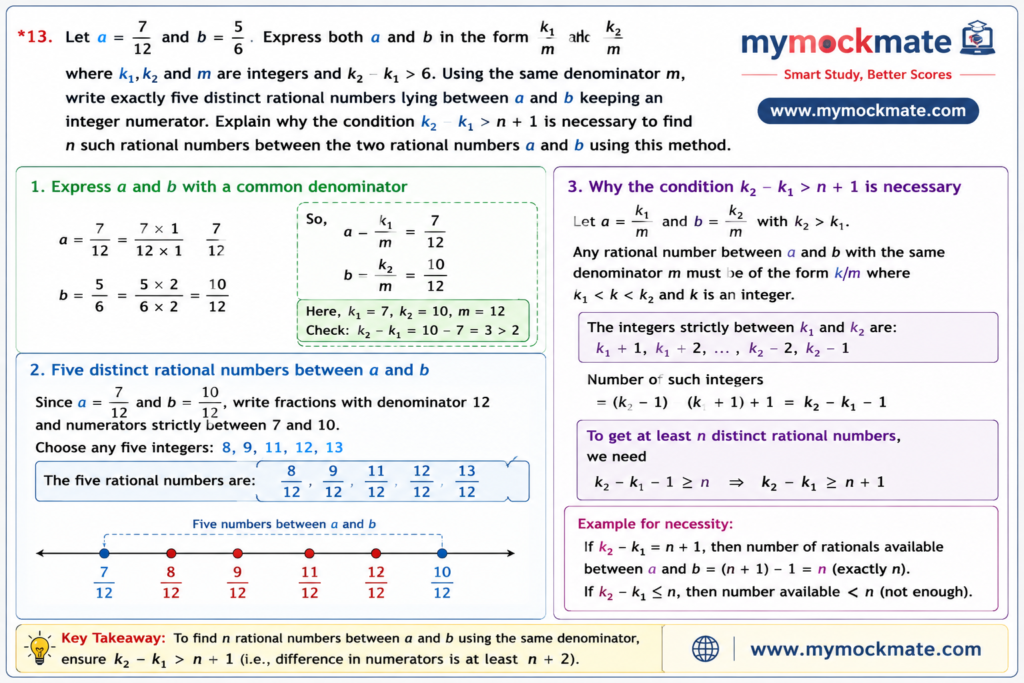
Question 13
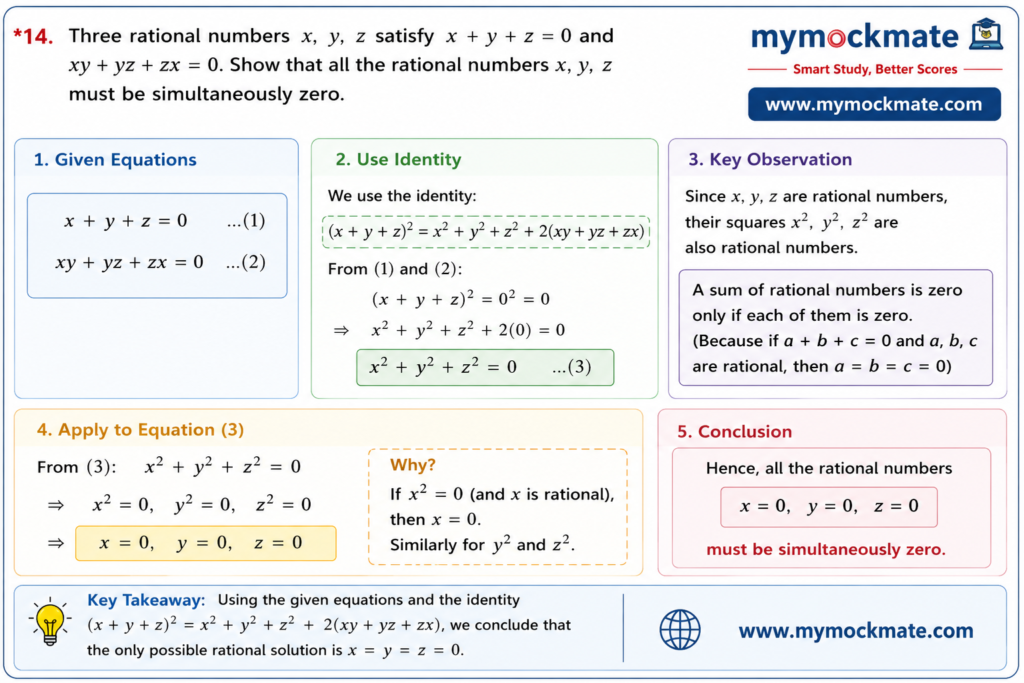
Question 14

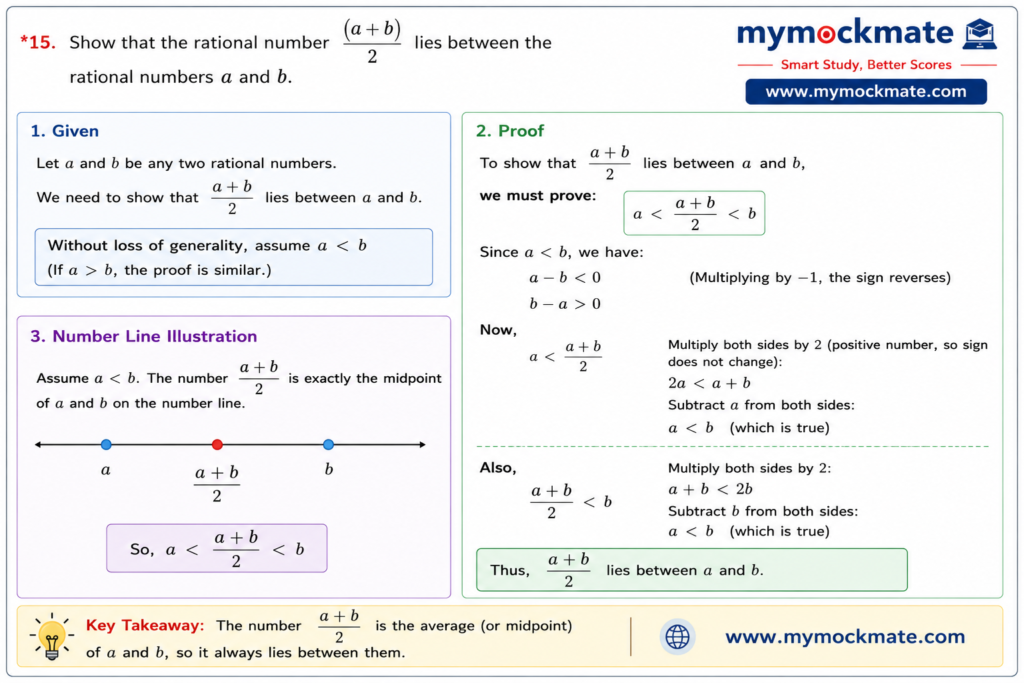
Question 15

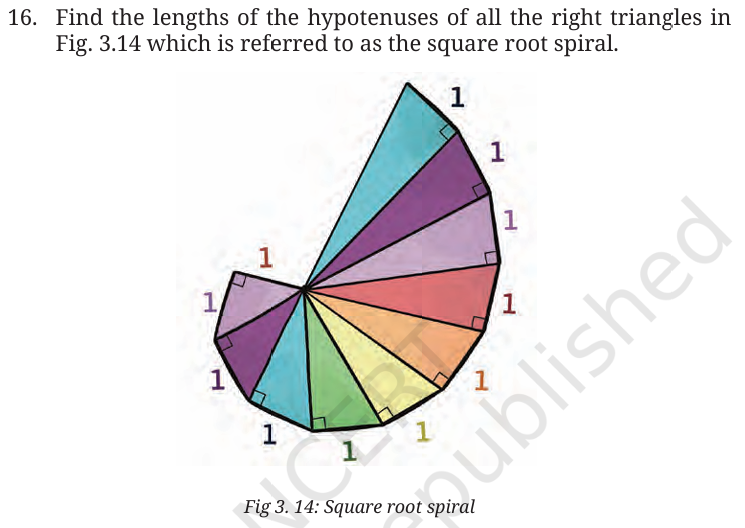
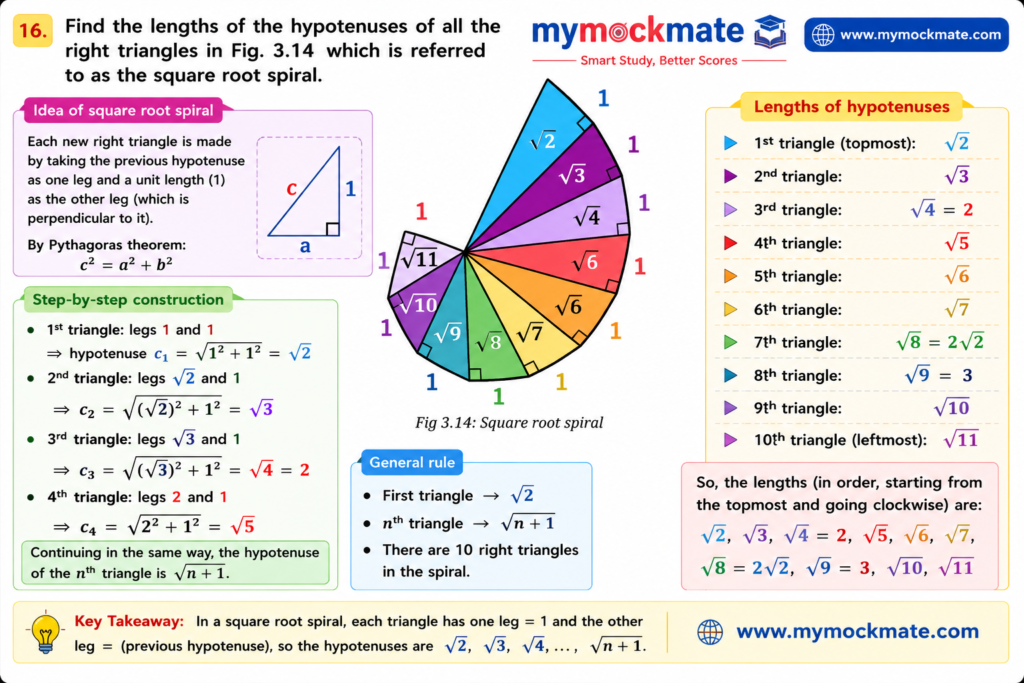
Question 16
Common Mistakes
- Forgetting to simplify fractions.
- Confusing repeating decimals with irrational numbers.
- Writing √5 as a rational number.
- Incorrect placement of decimals on the number line.
- Missing the lowest form while converting decimals into fractions.
Exam Tips
✅ Reduce every fraction to its simplest form.
✅ Check denominator factors before deciding whether a decimal terminates.
✅ Use proof by contradiction for irrationality proofs.
✅ Draw neat number lines with equal intervals.
✅ For finding rational numbers between two fractions, first make their denominators equal.
Practice MCQs
1. Which of the following is a terminating decimal?
A. 2/9
B. 3/50
C. 5/12
D. 7/18
Answer: B
2. √5 is:
A. Natural
B. Rational
C. Irrational
D. Integer
Answer: C
3. 2.125 in fraction form is:
A. 15/8
B. 17/8
C. 19/8
D. 21/8
Answer: B
4. 3.3 lies between:
A. 2 and 3
B. 3 and 4
C. 4 and 5
D. 1 and 2
Answer: B
5. Which is a rational number between 2/5 and 3/5?
A. 13/30
B. 19/30
C. 1/5
D. 4/5
Answer: A
FAQ Section
Q1. What is a rational number?
A number that can be written as p/q, where q ≠ 0.
Q2. What is an irrational number?
A number that cannot be expressed as p/q.
Q3. Is every terminating decimal rational?
Yes.
Q4. Can a repeating decimal be rational?
Yes. Every repeating decimal is rational.
Q5. Why is √5 irrational?
Because assuming it to be rational leads to a contradiction.
Want complete Chapter-wise NCERT Solutions, Mock Tests, Practice Questions, and Exam Preparation Resources?
Visit www.mymockmate.com and boost your preparation with expertly designed study materials and All India Mock Tests.