NCERT Class 9 Maths Exercise 2.6 Solutions – Visualizing Linear Relationships
Short Intro
Exercise 2.6 introduces students to the graphical representation of linear equations. In this exercise, students learn how to draw straight-line graphs, identify slopes, compare parallel lines, and understand the role of coefficients in equations of the form (y=ax+b). These step-by-step solutions simplify graph plotting and linear relationship concepts for Class 9 learners.
Quick Information Box
| Topic | Details |
|---|---|
| Chapter | Introduction to Linear Polynomials |
| Exercise | Exercise 2.6 |
| Subject | Mathematics |
| Class | Grade 9 |
| Main Concepts | Graphs of Linear Equations |
| Difficulty Level | Moderate |
| Useful For | School Exams & Foundation Maths |
Concepts Used (Topics Covered)
- Linear Relationships
- Straight Line Graphs
- Coordinate Geometry
- Slope of a Line
- y-Intercept
- Parallel Lines
- Positive and Negative Slopes
- Graph Plotting
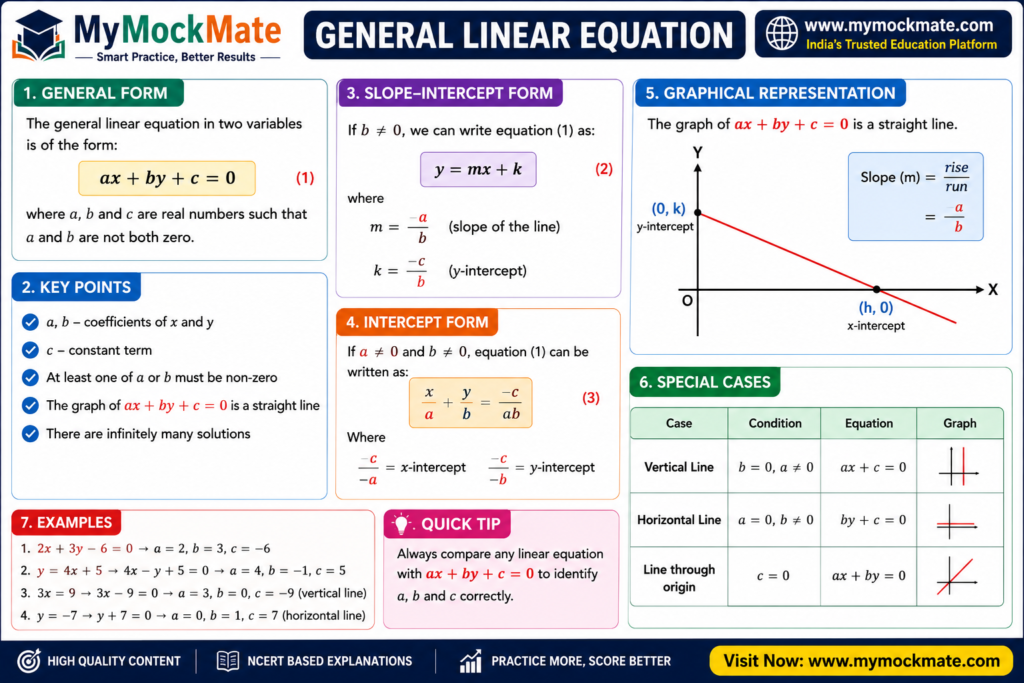
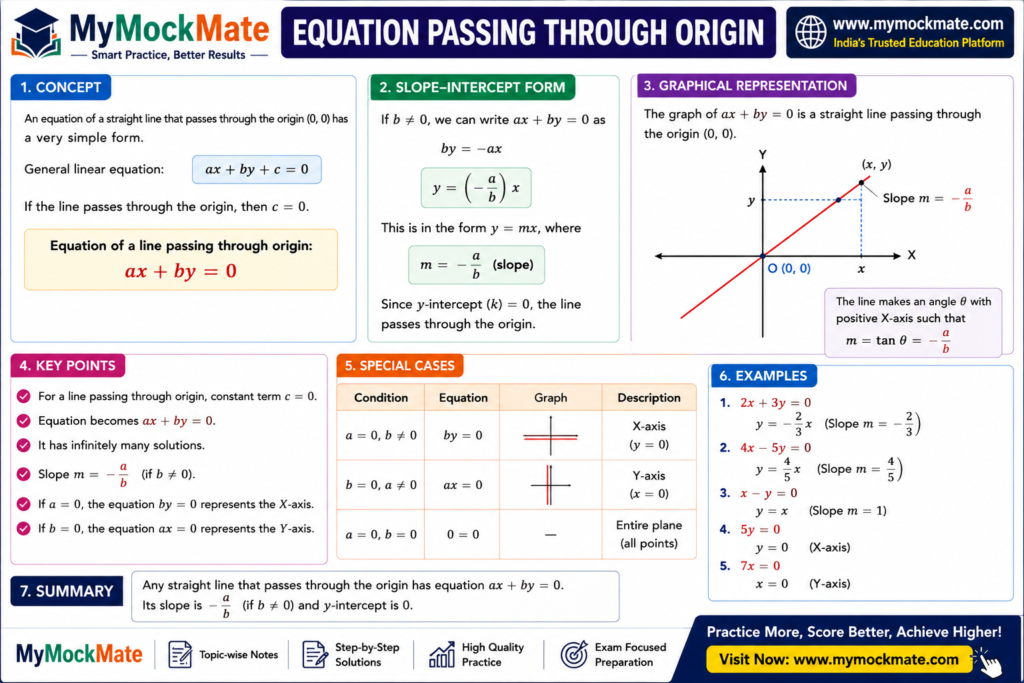
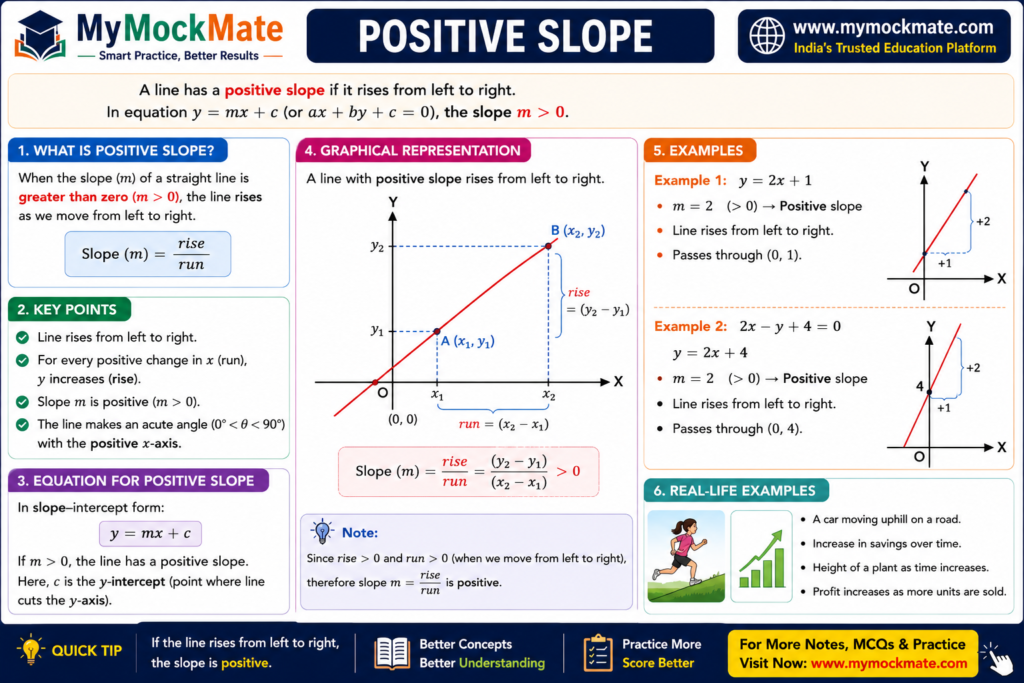
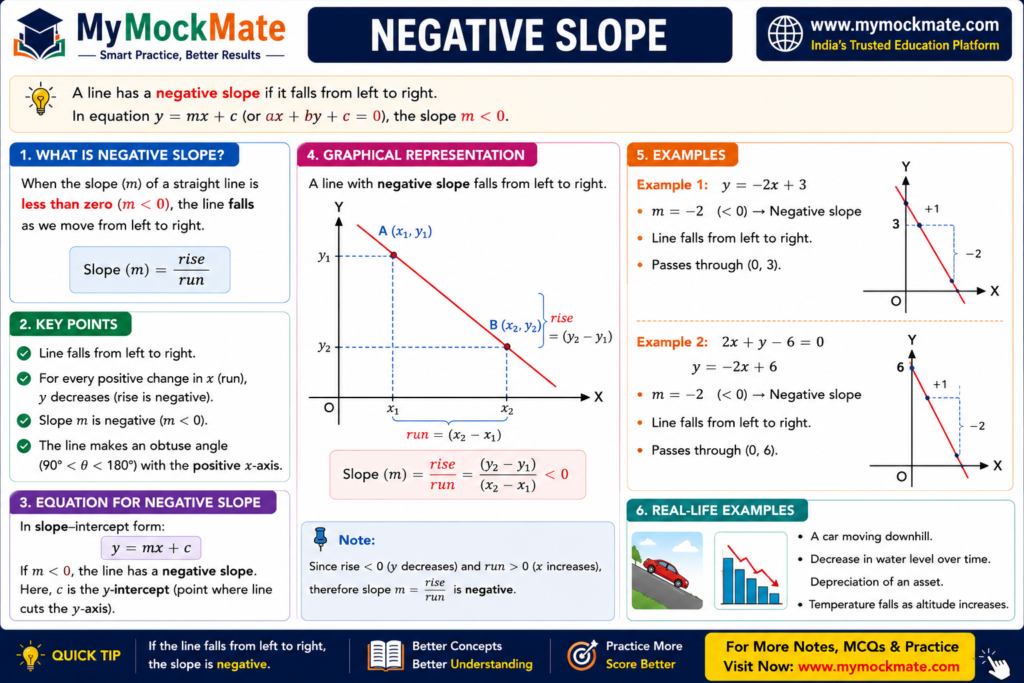
Important Formulas
General Linear Equation
Equation Passing Through Origin
Positive Slope
Negative Slope
Questions & Step-by-Step Solutions
Question 1
Draw the graphs of the following sets of lines. In each case, reflect
on the role of ‘a’ and ‘b’.
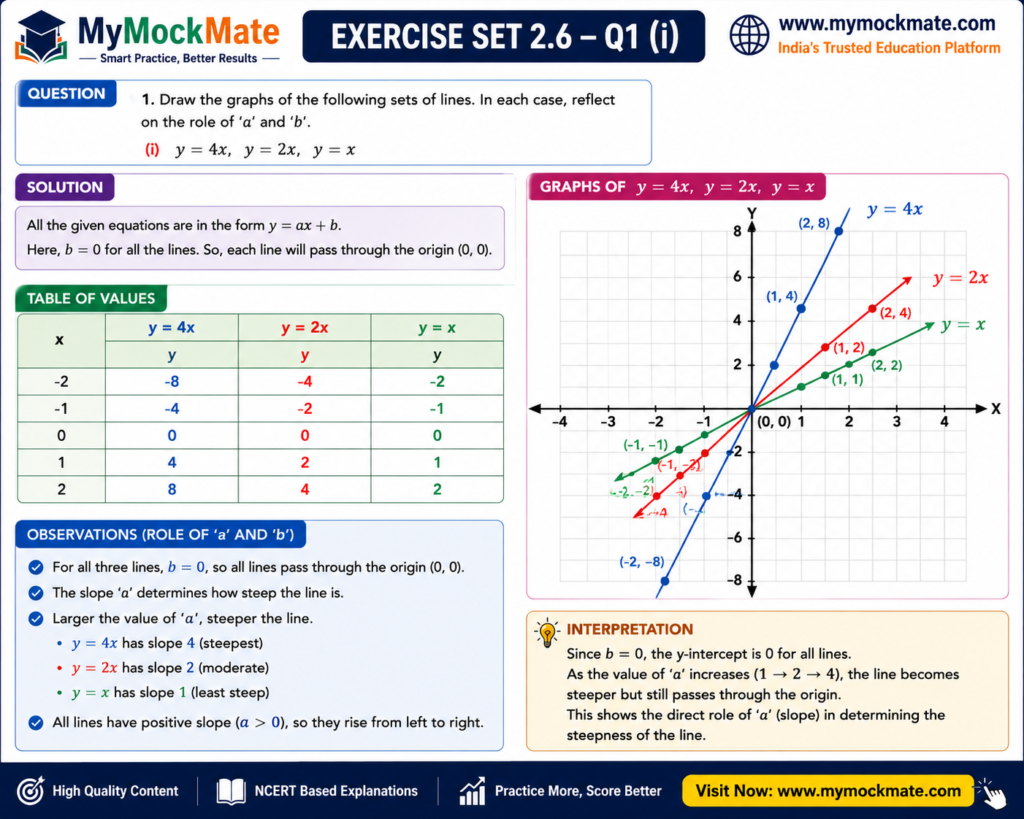
(i) y = 4x, y = 2x, y = x
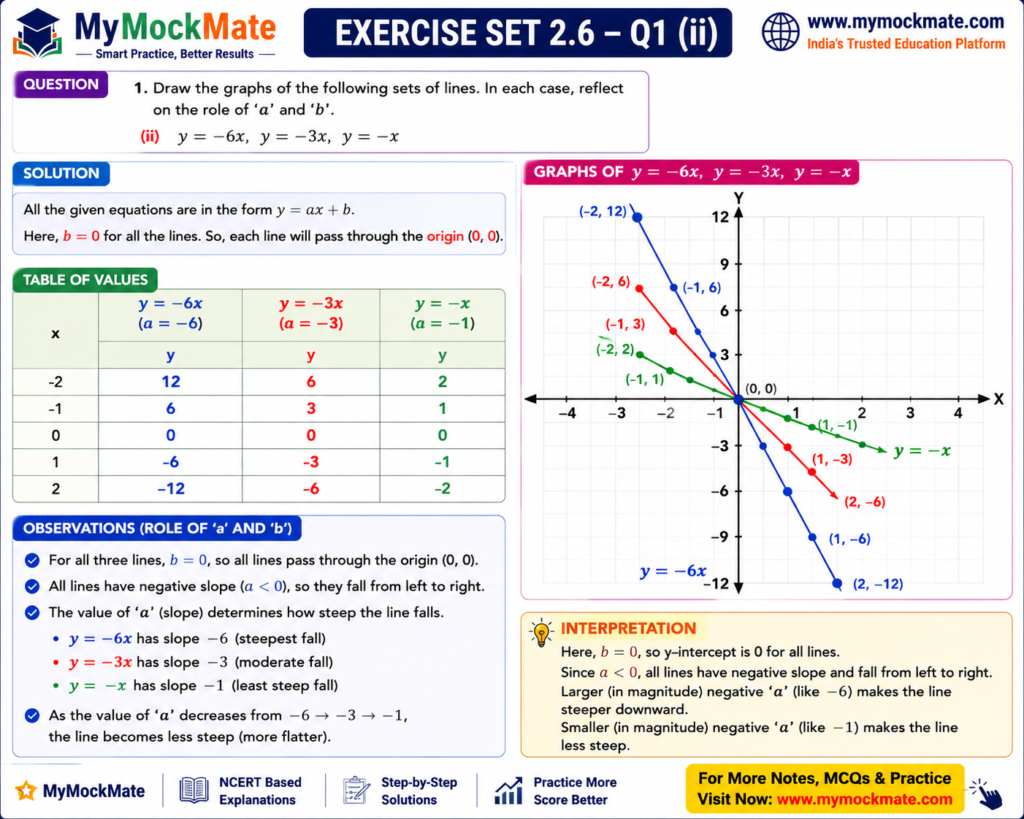
(ii) y = – 6x, y = – 3x, y = – x
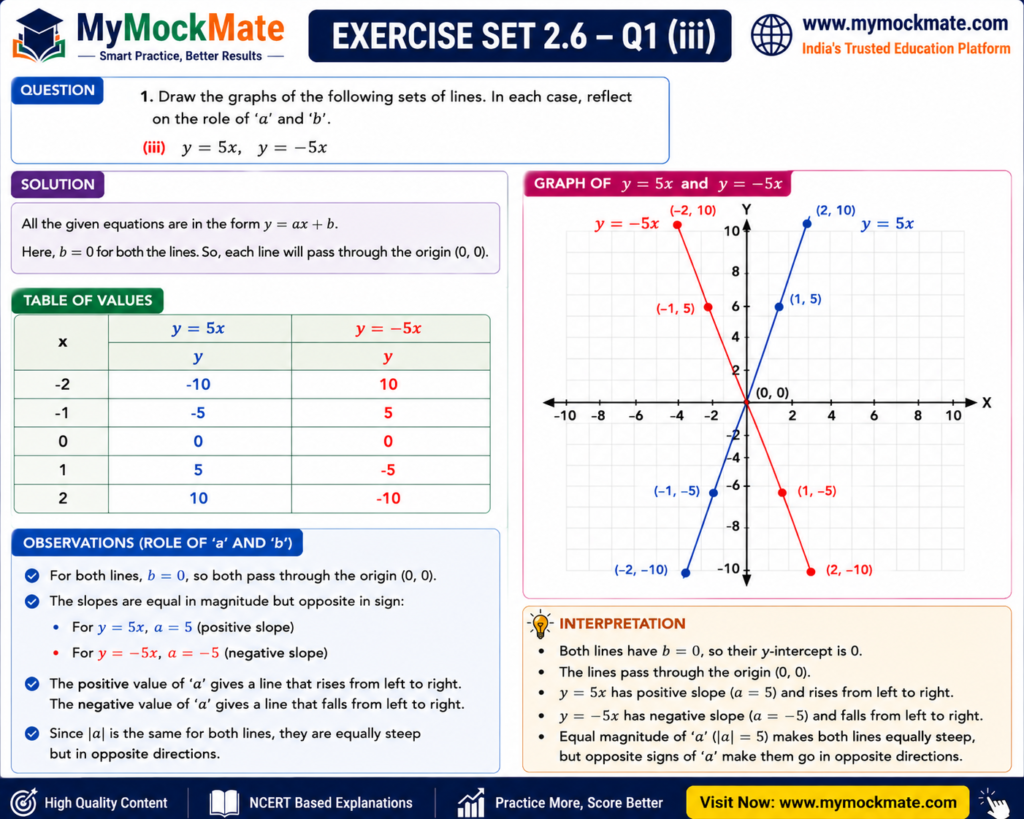
(iii) y = 5x, y = –5x
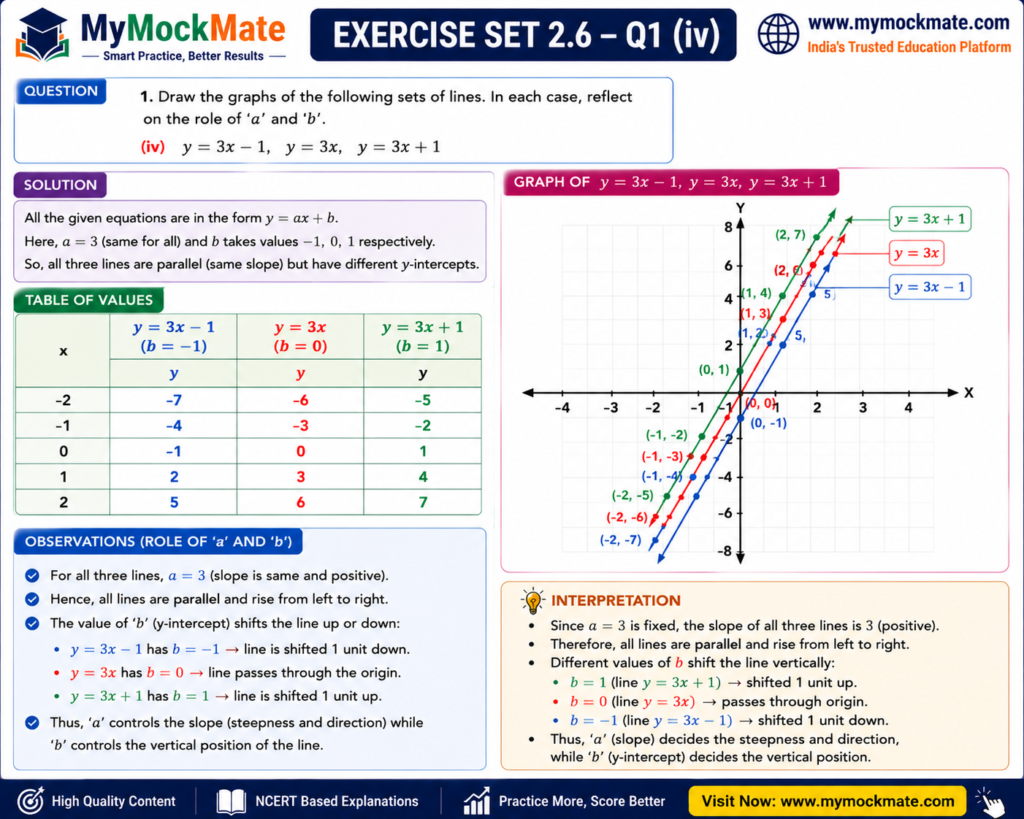
(iv) y = 3x – 1, y = 3x, y = 3x + 1
(v) y = –2x – 3, y = –2x, y = 2x + 3
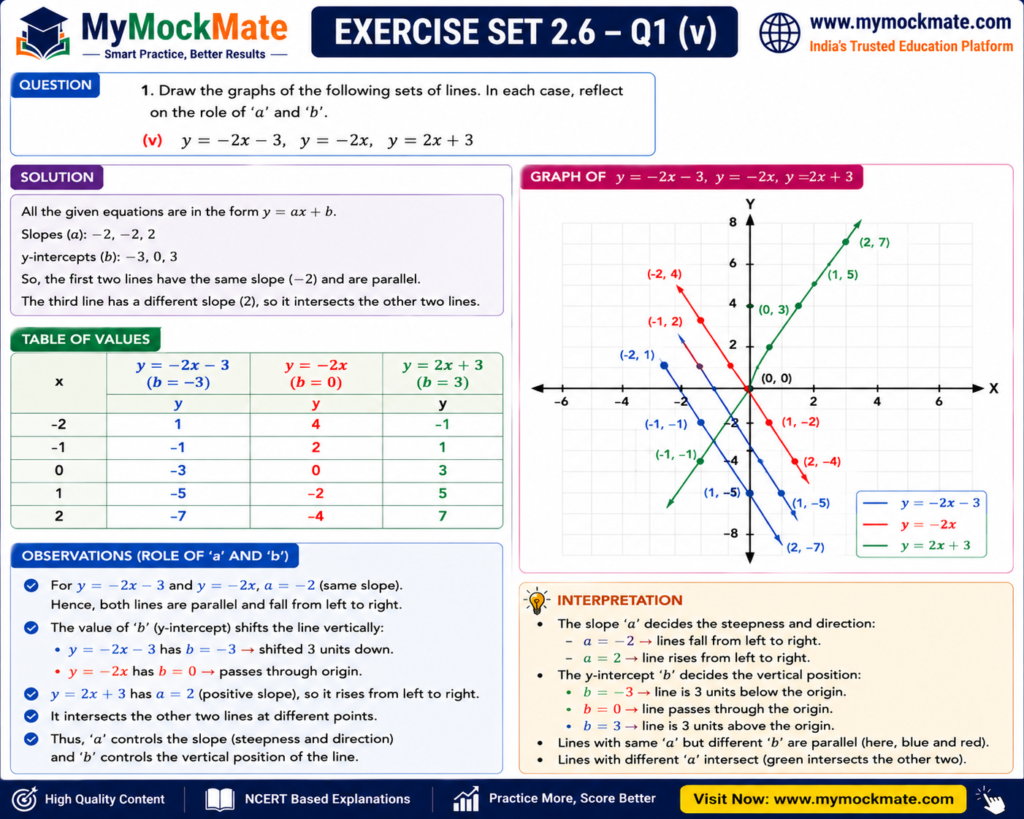
Final Understanding
Role of (a)
- Determines slope or steepness.
- Positive (a) → upward line.
- Negative (a) → downward line.
Role of (b)
- Determines y-intercept.
- Changes vertical position of graph.
- Same slope but different (b) gives parallel lines.
Common Mistakes
❌ Plotting incorrect coordinates
❌ Confusing slope with y-intercept
❌ Using wrong sign for negative slopes
❌ Joining points inaccurately
Exam Tips
✔ Always make coordinate table first
✔ Plot at least two correct points
✔ Use ruler for straight lines
✔ Remember: same slope ⇒ parallel lines
Practice MCQs
1. Which equation passes through origin?
A) (y=2x+1)
B) (y=3x)
C) (y=x-5)
D) (y=4x+2)
Answer
✅ B) (y=3x)
2. Which line has negative slope?
A) (y=5x)
B) (y=2x+1)
C) (y=-3x)
D) (y=x)
Answer
✅ C) (y=-3x)
3. Parallel lines have:
A) Same intercept
B) Same slope
C) Same equation
D) Same coordinates
Answer
✅ B) Same slope
4. In y=ax+b, b represents:
A) slope
B) coefficient
C) y-intercept
D) x-coordinate
Answer
✅ C) y-intercept
FAQ Section
Q1. What is a linear graph?
A straight-line graph representing a linear equation is called a linear graph.
Q2. What is slope?
Slope measures the steepness of a line.
Q3. What is y-intercept?
It is the point where the graph cuts the y-axis.
Q4. When are two lines parallel?
Two lines are parallel when their slopes are equal.
Q5. Why do some graphs pass through origin?
Graphs pass through origin when y-intercept is zero.
Practice more graph-based Maths questions, chapter-wise solutions, MCQs, and mock tests on MyMockMate and improve your Class 9 Mathematics preparation with smart learning resources!