NCERT Class 9 Maths Exercise 3.3 Solutions – Rational Numbers
Short Introduction
Exercise 3.3 focuses on the properties and operations of Rational Numbers. In this exercise, students learn how to verify equivalent rational numbers and perform addition, subtraction, multiplication, and division of fractions. Understanding these concepts is essential for mastering higher-level algebra and number systems.
Quick Information Box
| Topic | Details |
|---|---|
| Chapter | The World of Numbers |
| Exercise | 3.3 |
| Class | Grade 9 |
| Subject | Mathematics |
| Main Concepts | Rational Numbers, Equivalent Fractions, Arithmetic Operations |
| Difficulty Level | Easy to Moderate |
Concepts Used (Topics Covered)
✔ Rational Numbers
✔ Equivalent Fractions
✔ Equality of Rational Numbers
✔ Addition of Rational Numbers
✔ Subtraction of Rational Numbers
✔ Multiplication of Rational Numbers
✔ Division of Rational Numbers
✔ Lowest Common Multiple (LCM)
✔ Simplification of Fractions
Important Formulas
1. Equality of Rational Numbers
Two rational numbers are equal if:
a/b = c/d
when
ad = bc
2. Addition
a/b + c/d = (ad + bc)/bd
3. Subtraction
a/b − c/d = (ad − bc)/bd
4. Multiplication
a/b × c/d = ac/bd
5. Division
a/b ÷ c/d = a/b × d/c
(c ≠ 0)
Exercise 3.3 Solutions
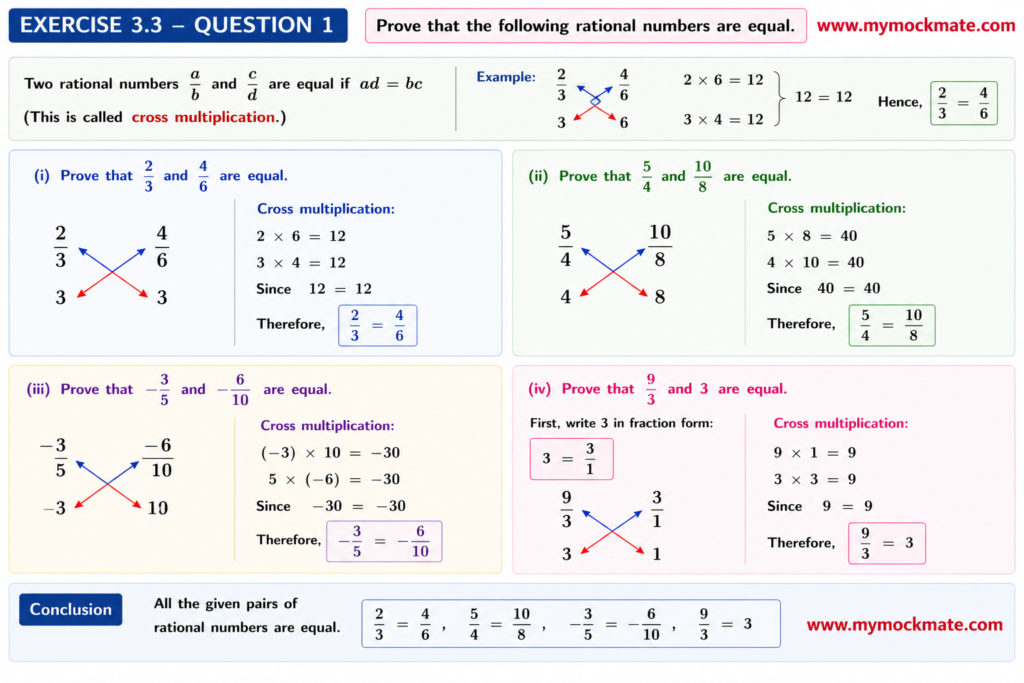
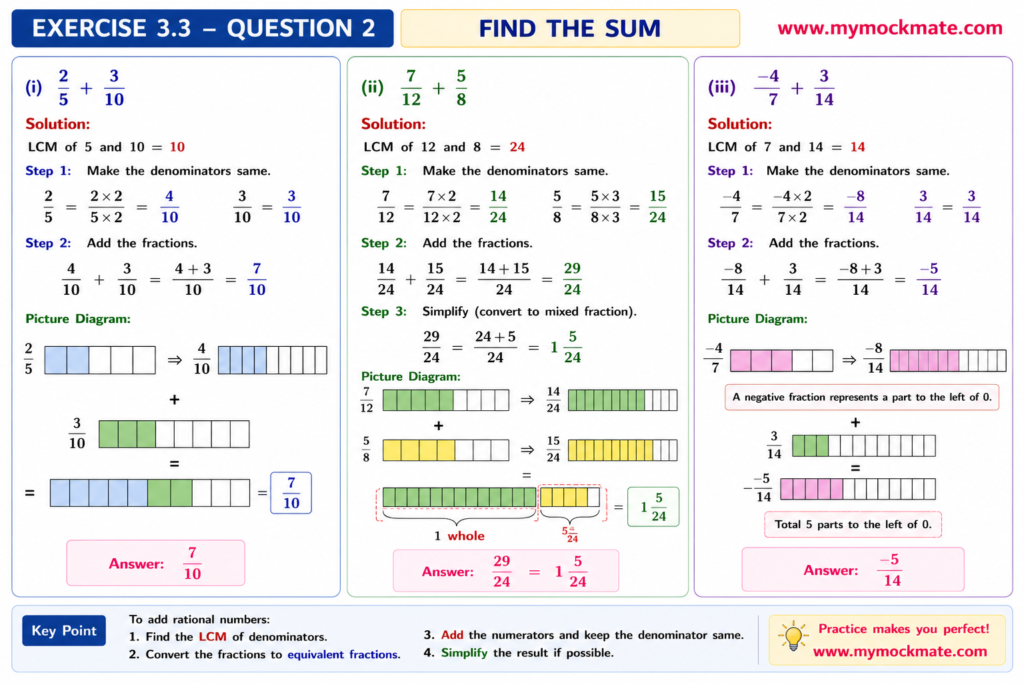
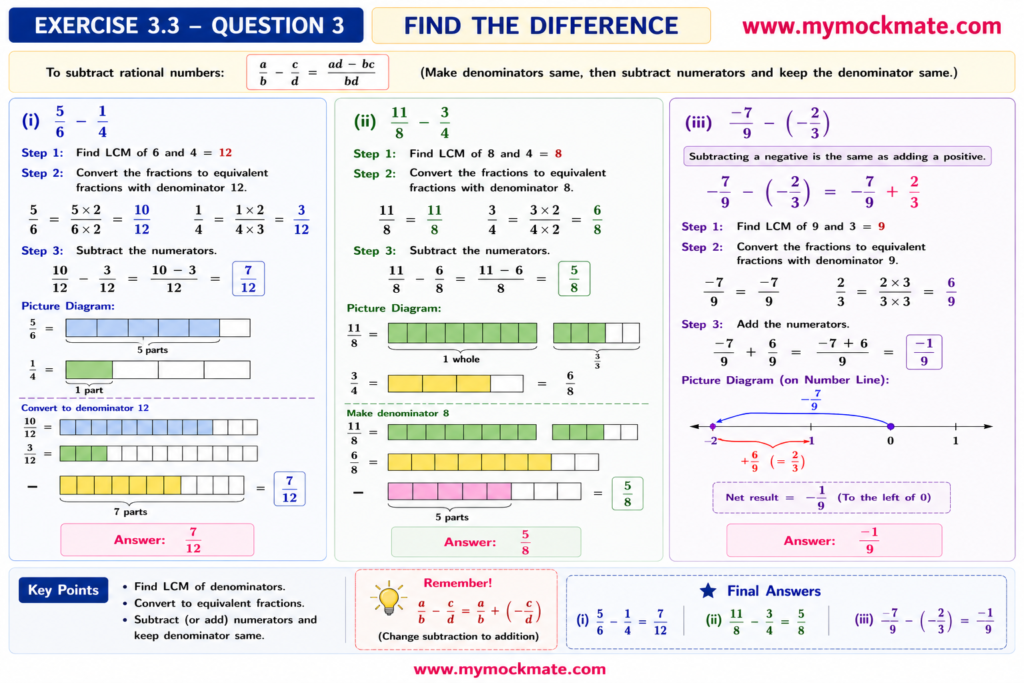
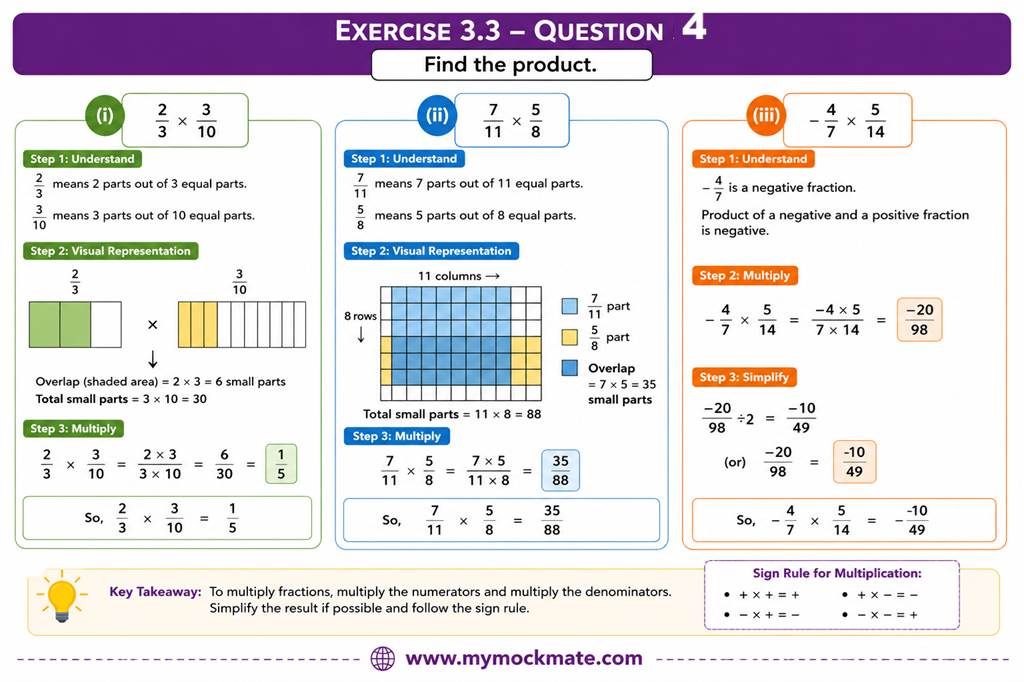
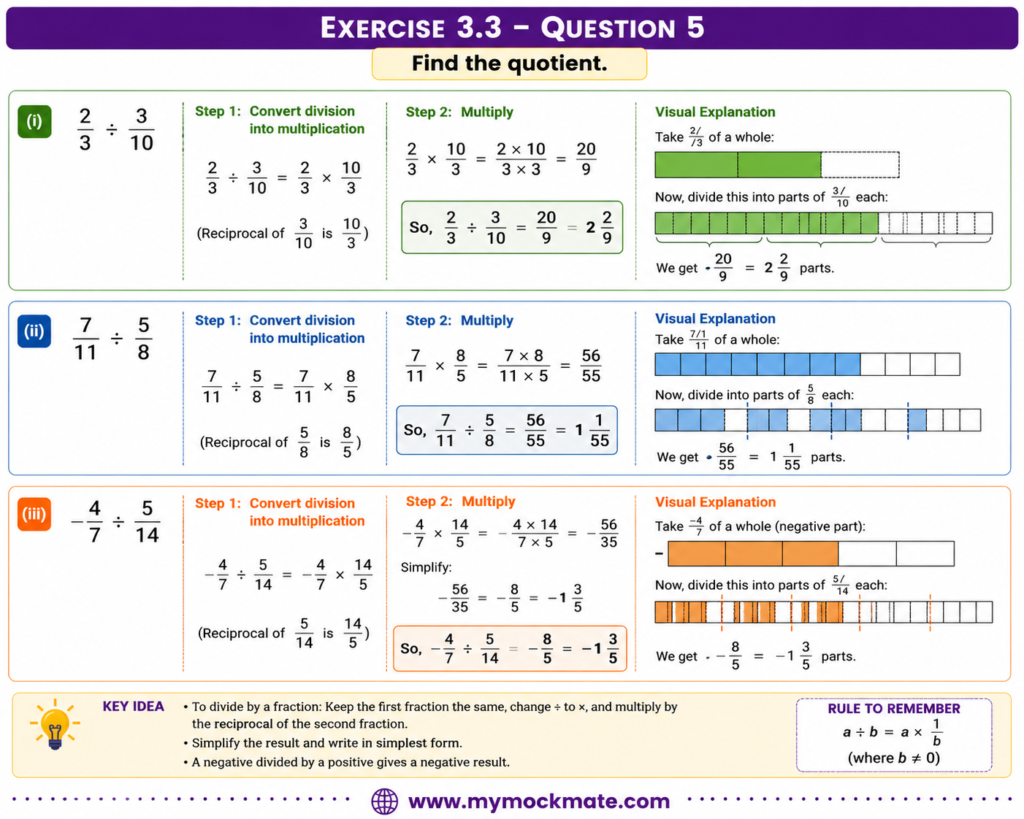
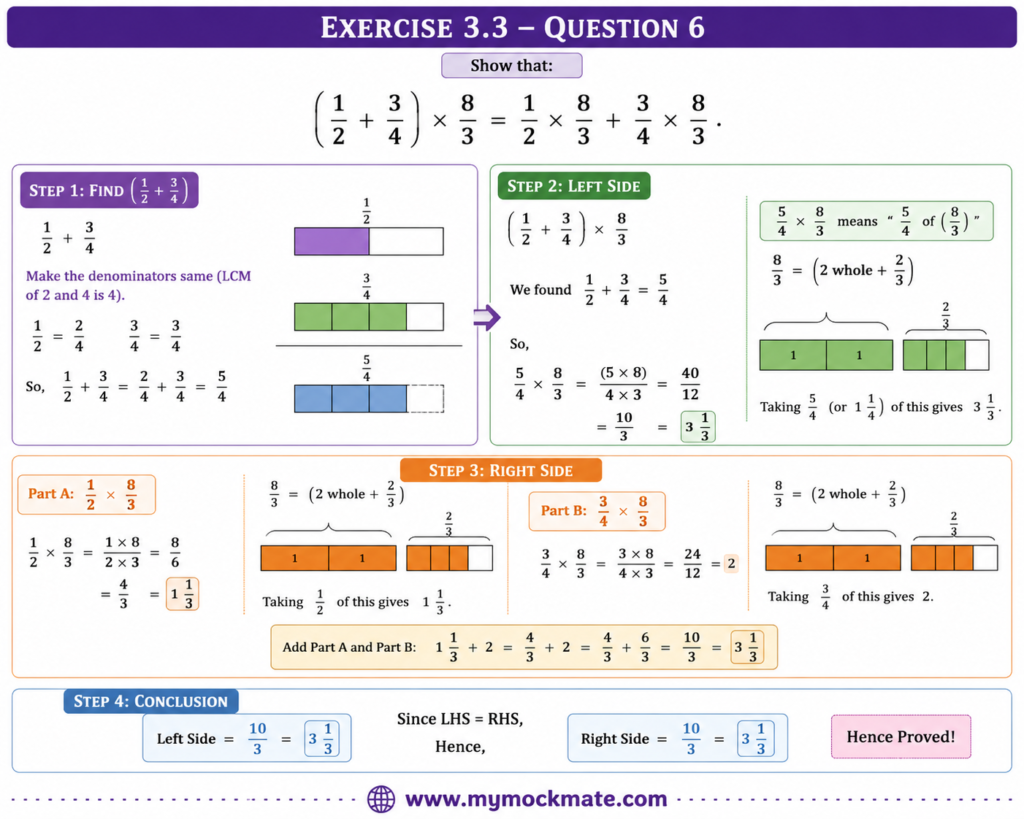
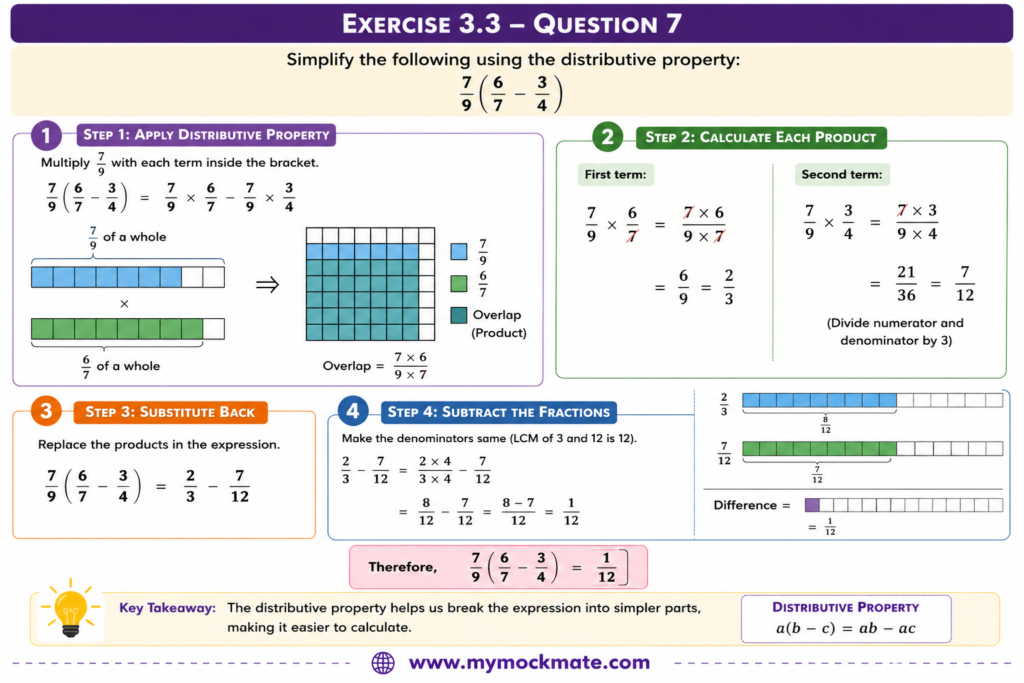
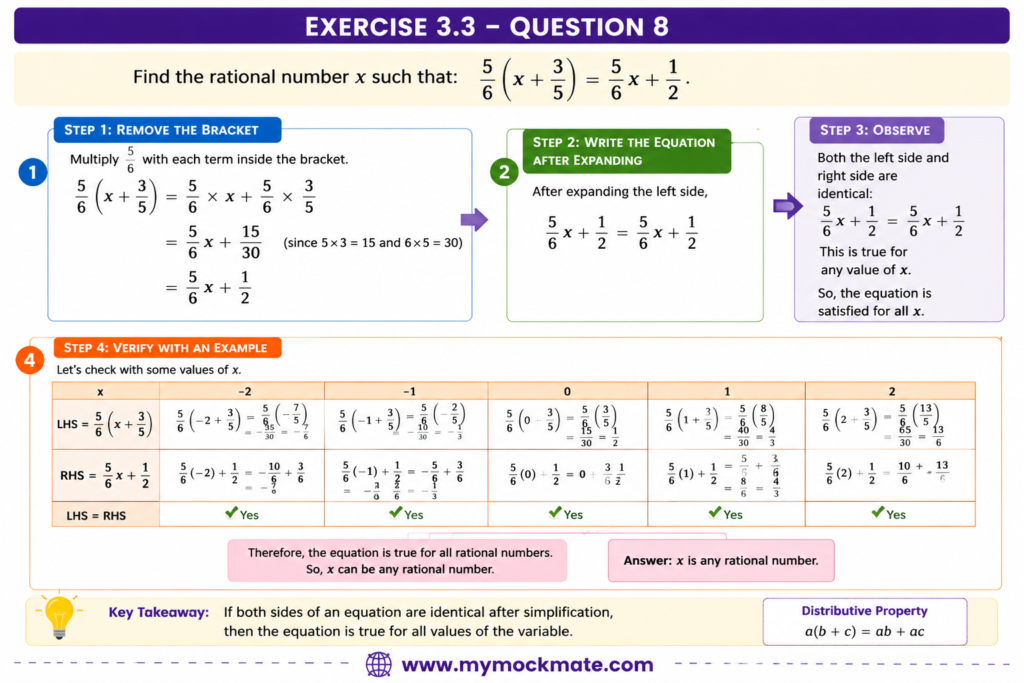
Common Mistakes
- Forgetting to simplify the final fraction to its lowest form.
- Adding or subtracting numerators directly when denominators are different.
- Multiplying fractions without reducing common factors first.
- Dividing fractions without taking the reciprocal of the second fraction.
- Ignoring negative signs while performing operations.
- Using incorrect LCM while adding or subtracting rational numbers.
- Cancelling terms across addition or subtraction signs, which is not allowed.
- Making arithmetic errors while applying the distributive property.
- Forgetting that a negative divided by a positive gives a negative result.
- Not checking whether both sides are equal while proving identities.
Exam Tips
✅ Always write fractions in simplest form.
✅ While adding or subtracting fractions, first make denominators equal.
✅ Remember:
✅ For negative fractions:
- Positive × Negative = Negative
- Negative × Negative = Positive
✅ Use cross multiplication to check equality of rational numbers.
✅ Apply distributive property carefully:
✅ Show every step clearly to avoid losing marks.
Practice MCQs
1. Which of the following is equivalent to ?
A)
B)
C)
D)
Answer: B
2. Find:
A)
B)
C)
D)
Answer: B
3. Find:
A)
B)
C)
D) Both A and B
Answer: D
4. Find:
A)
B)
C)
D)
Answer: B
5. The reciprocal of is:
A)
B)
C)
D) 1
Answer: A
6. Which property is used in:
A) Commutative Property
B) Associative Property
C) Distributive Property
D) Closure Property
Answer: C
7. The value of:
is:
A)
B)
C)
D) Both B and C
Answer: D
8. Rational numbers are closed under:
A) Addition
B) Subtraction
C) Multiplication
D) All of these
Answer: D
9. The reciprocal method is used in:
A) Addition
B) Subtraction
C) Multiplication
D) Division
Answer: D
10. The simplified form of 6020 is:
A)
B)
C)
D)
Answer: B
Frequently Asked Questions (FAQ)
Q1. What is a rational number?
A rational number is any number that can be expressed in the form , where p and q are integers and .
Q2. How do we add two rational numbers?
Make the denominators equal, add the numerators, and simplify the answer.
Q3. How do we subtract rational numbers?
Convert the fractions to equivalent fractions with the same denominator and then subtract the numerators.
Q4. How do we multiply rational numbers?
Multiply numerator by numerator and denominator by denominator.
Q5. How do we divide rational numbers?
Keep the first fraction unchanged, change division into multiplication, and take the reciprocal of the second fraction.
Q6. Why can’t a rational number have denominator zero?
Division by zero is undefined in mathematics.
Q7. What is the reciprocal of a fraction?
For , the reciprocal is , provided .
Q8. What is the distributive property?
It states that:
and
Q9. Are rational numbers closed under multiplication?
Yes. The product of two rational numbers is always a rational number.
Q10. Why should fractions be simplified?
Simplified fractions are easier to understand and are generally required in examinations.
Master Rational Numbers with MyMockMate!
Practice more chapter-wise questions, detailed solutions, mock tests, and exam-oriented explanations at:
✔ Chapter-wise Practice Sets
✔ Step-by-Step Solutions
✔ Visual Learning with Diagrams
✔ Exam Preparation Resources
✔ Mock Tests & Performance Analysis
Visit www.mymockmate.com today and make Mathematics easier, smarter, and more enjoyable! 🚀📚