NCERT Class 9 Maths Exercise 3.4 Solutions | Rational Numbers
Short Introduction
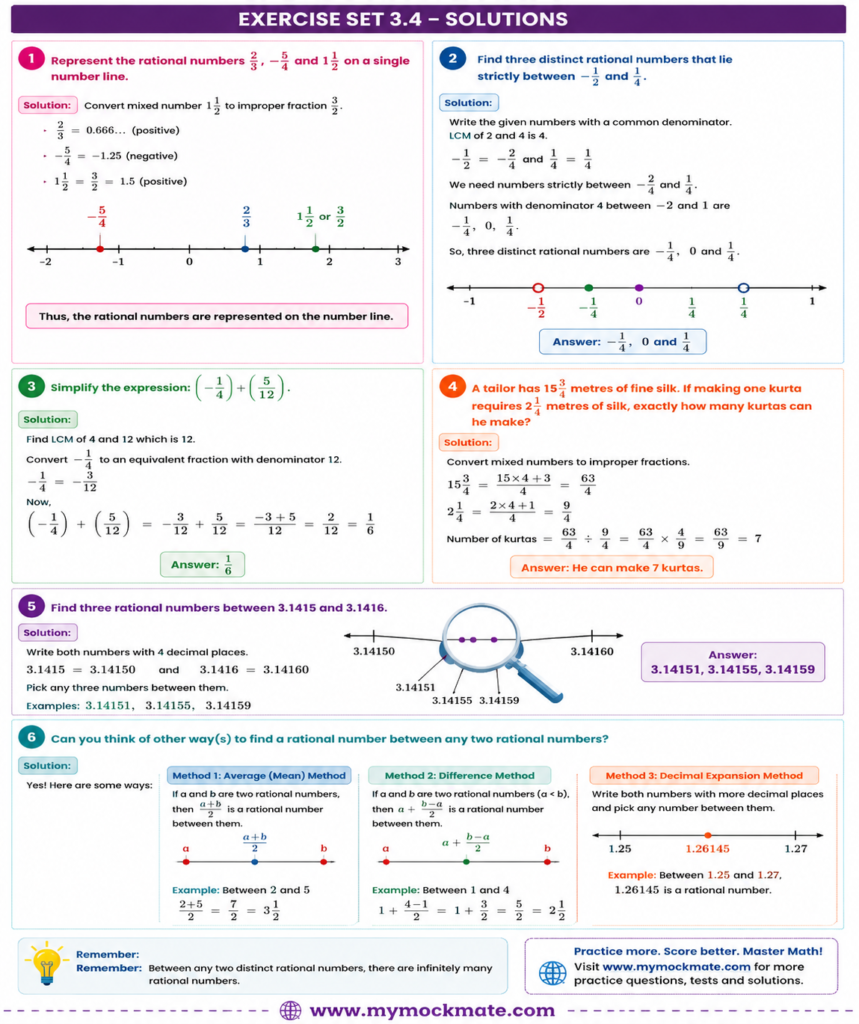
Exercise 3.4 focuses on the representation of rational numbers on the number line, finding rational numbers between given numbers, operations involving rational numbers, and understanding the density property of rational numbers. These concepts help students visualize rational numbers and strengthen their understanding of fractions and number systems.
The detailed solutions provided by www.mymockmate.com explain every question step-by-step, making learning simple and exam-oriented.
Quick Information Box
| Particular | Details |
|---|---|
| Chapter | The World of Numbers |
| Exercise | 3.4 |
| Topic | Rational Numbers on Number Line |
| Grade | 9 |
| Subject | Mathematics |
| Difficulty Level | Easy to Moderate |
| Key Skills | Number Line Representation, Rational Numbers, Fractions |
Concepts Used (Topics Covered)
- Representation of Rational Numbers on a Number Line
- Positive and Negative Rational Numbers
- Mixed Fractions and Improper Fractions
- Finding Rational Numbers Between Two Numbers
- Density Property of Rational Numbers
- Decimal Representation of Rational Numbers
- Mean (Average) Method
- Ordering Rational Numbers
- Comparing Rational Numbers
- Rational Numbers Between Decimals
Important Formulas
1. Rational Number
A rational number is any number that can be written in the form:
where:
- p = Integer (numerator)
- q = Integer (denominator)
- q ≠ 0
2. Mixed Fraction to Improper Fraction
To convert a Mixed Fraction into an Improper Fraction, use the formula:
Formula
Where:
c = Denominator
a = Whole Number
b = Numerator
3. Average of Two Rational Numbers
To find a rational number between two rational numbers a and b, take their average.
Formula
This average is always a rational number and lies between and .
This always lies between a and b.
4. Decimal Comparison Method
Convert both numbers into decimals with more decimal places and choose numbers lying between them.
5. Representation on Number Line
Divide the interval into denominator number of equal parts and count numerator parts.
Common Mistakes
- Forgetting to convert mixed fractions into improper fractions.
- Marking rational numbers incorrectly on the number line.
- Choosing boundary numbers instead of numbers strictly between them.
- Incorrectly comparing negative rational numbers.
- Writing repeating rational numbers as distinct values.
- Ignoring the sign of negative fractions.
- Selecting numbers equal to endpoints.
- Making errors while converting decimals.
- Not simplifying fractions before plotting.
- Confusing numerator and denominator positions.
Exam Tips
✅ Always convert mixed fractions into improper fractions before plotting.
✅ For negative rational numbers, move left from zero.
✅ Use LCM to compare fractions easily.
✅ Remember that infinitely many rational numbers exist between any two rational numbers.
✅ Use the average method whenever you need one rational number between two numbers.
✅ Draw neat and properly labelled number lines.
✅ Write rational numbers in simplest form.
✅ While working with decimals, add extra decimal places to create more numbers between them.
Practice MCQs
1. Which rational number lies between 0 and 1?
A) 2
B) −1
C) 1/2
D) 3
Answer: C
2. The rational number 3/4 lies between:
A) 1 and 2
B) 0 and 1
C) −1 and 0
D) 2 and 3
Answer: B
3. Which of the following is equal to 1½?
A) 2/3
B) 5/2
C) 3/2
D) 4/3
Answer: C
4. A rational number between 1 and 2 is:
A) 3/2
B) 5
C) 0
D) −1
Answer: A
5. Which number lies between 3.1415 and 3.1416?
A) 3.1420
B) 3.14155
C) 3.1417
D) 3.1425
Answer: B
6. The average of 1/2 and 1 is:
A) 1/4
B) 2/3
C) 3/4
D) 5/4
Answer: C
7. Rational numbers are:
A) Finite
B) Infinite
C) Only Positive
D) Only Negative
Answer: B
8. Which is an improper fraction?
A) 2/5
B) 3/7
C) 9/4
D) 1/3
Answer: C
9. Between any two rational numbers there are:
A) No rational numbers
B) One rational number
C) Two rational numbers
D) Infinitely many rational numbers
Answer: D
10. The number −5/4 lies between:
A) 0 and 1
B) −2 and −1
C) −1 and 0
D) 1 and 2
Answer: B
Frequently Asked Questions (FAQ)
Q1. What is a rational number?
A rational number is any number that can be written in the form p/q where q ≠ 0.
Q2. How do we represent a rational number on a number line?
Divide the interval into equal parts according to the denominator and move according to the numerator.
Q3. What is a mixed fraction?
A mixed fraction contains a whole number and a proper fraction.
Example:
1½
Q4. How can we find a rational number between two rational numbers?
Use the average formula:
A rational number between
is
Q5. Are there infinitely many rational numbers between two rational numbers?
Yes, infinitely many rational numbers exist between any two rational numbers.
Q6. Why do we use improper fractions on the number line?
Improper fractions are easier to locate accurately.
Q7. What is the density property of rational numbers?
Between any two rational numbers, infinitely many rational numbers exist.
Q8. Can decimals be rational numbers?
Yes. Terminating and repeating decimals are rational numbers.
Q9. How do we compare rational numbers?
Convert them into equivalent fractions with the same denominator or into decimals.
Q10. Is every integer a rational number?
Yes.
Practice More with MyMockMate!
Looking for detailed NCERT solutions, chapter-wise question banks, mock tests, and exam preparation resources?
👉 Visit www.mymockmate.com
✔ Step-by-Step Solutions
✔ Visual Explanations with Diagrams
✔ Chapter-wise Practice Questions
✔ Mock Tests with Performance Analysis
✔ Exam-Oriented Learning Resources
Join thousands of students and make Mathematics easier with www.mymockmate.com!