NCERT Class 9 Maths Exercise 5.3 Solutions
Short Introduction
Exercise 5.3 of Chapter 5, I’m Up and Down, and Round and Round, focuses on an important property of chords and circles. Students learn that the perpendicular drawn from the centre of a circle to a chord bisects the chord and apply this theorem to solve geometry problems involving isosceles triangles and parallel chords.
Quick Information Box
| Particular | Details |
|---|---|
| Class | 9 |
| Subject | Mathematics |
| Chapter | 5 – I’m Up and Down, and Round and Round |
| Exercise | 5.3 |
| Main Topic | Midpoints and Perpendicular Bisectors of Chords |
| Difficulty Level | Moderate |
| Key Concepts | Circle Theorems, Congruence, Pythagoras Theorem |
Concepts Used (Topics Covered)
- Radius and Chord of a Circle
- Perpendicular from Centre to Chord
- Converse of Theorem 4
- Isosceles Triangle
- Congruent Triangles
- Pythagoras Theorem
- Distance of Chords from the Centre
Important Formulas and Theorems
Theorem 4
The line joining the centre of a circle and the midpoint of a chord is perpendicular to the chord.
Theorem 5
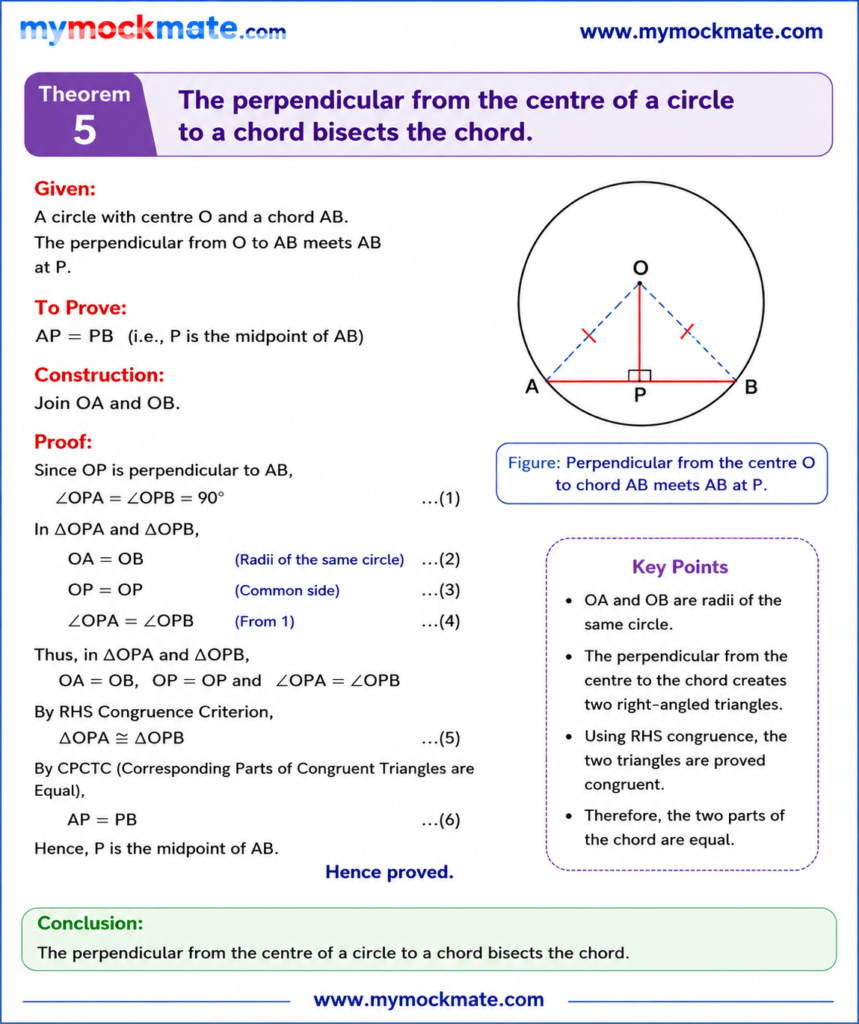
The perpendicular from the centre of a circle to a chord bisects the chord.
Pythagoras Theorem
Exercise 5.3 Solutions
Question 1
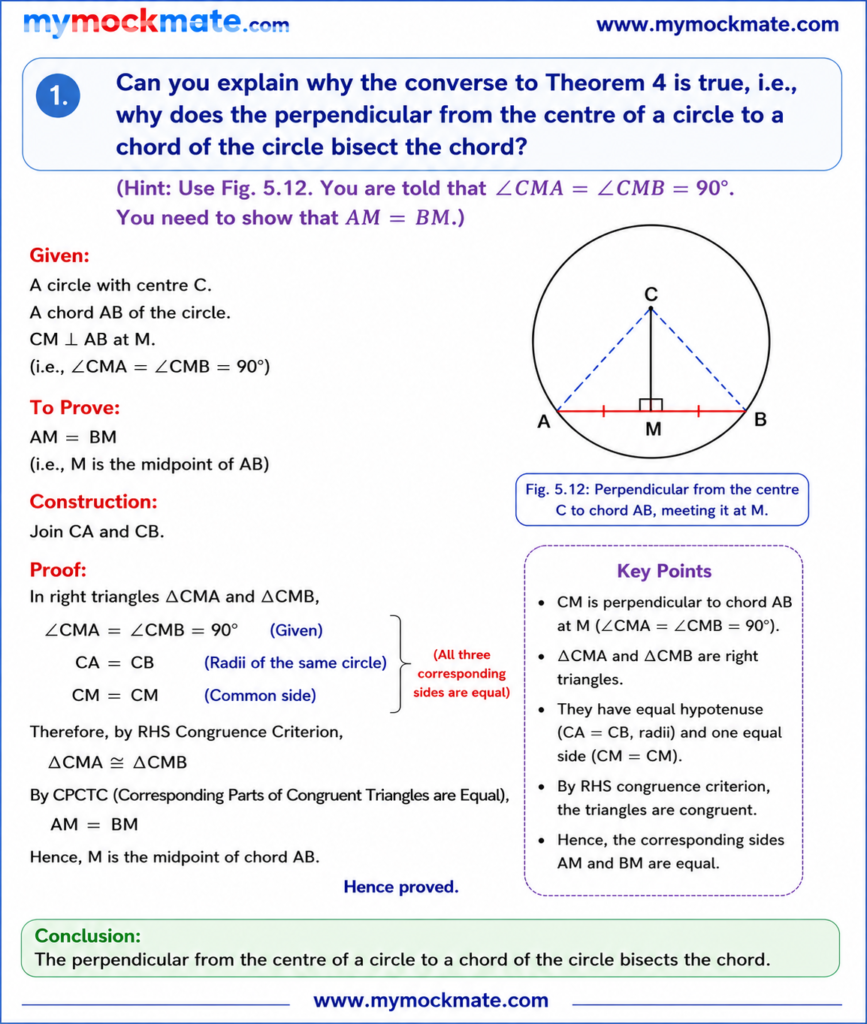
Can you explain why the converse to Theorem 4 is true, i.e., why does the perpendicular from the centre of a circle to a chord of the circle bisect the chord?
Solution
Question 2
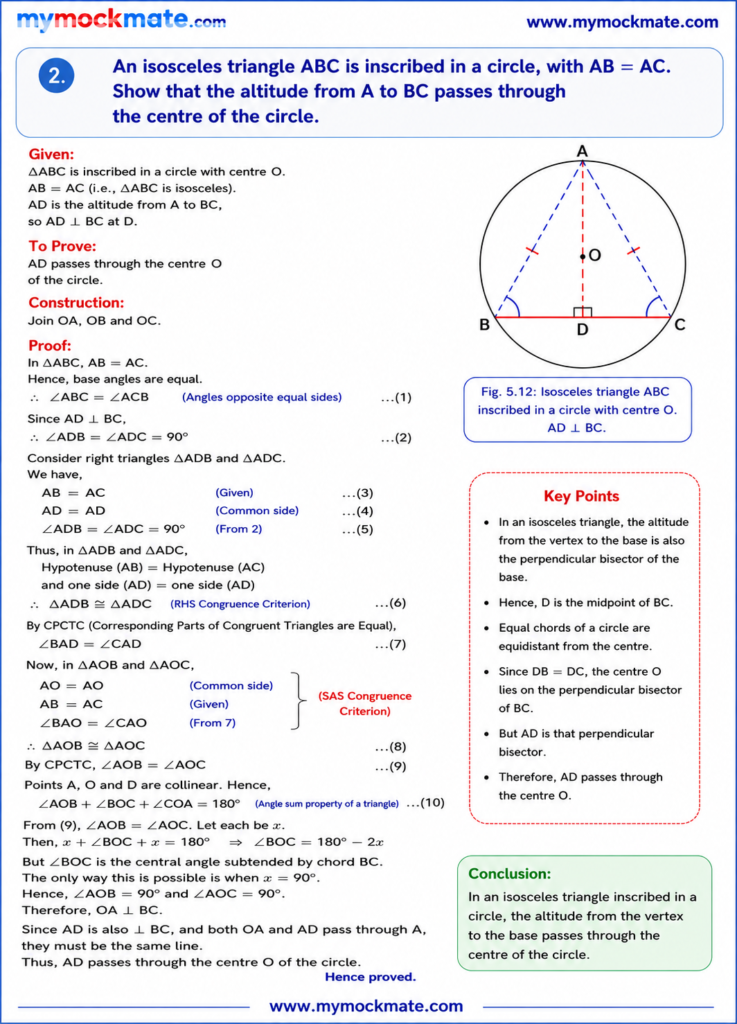
An isosceles triangle ABC is inscribed in a circle, with AB = AC. Show that the altitude from A to BC passes through the centre of the circle.
Solution
Question 3
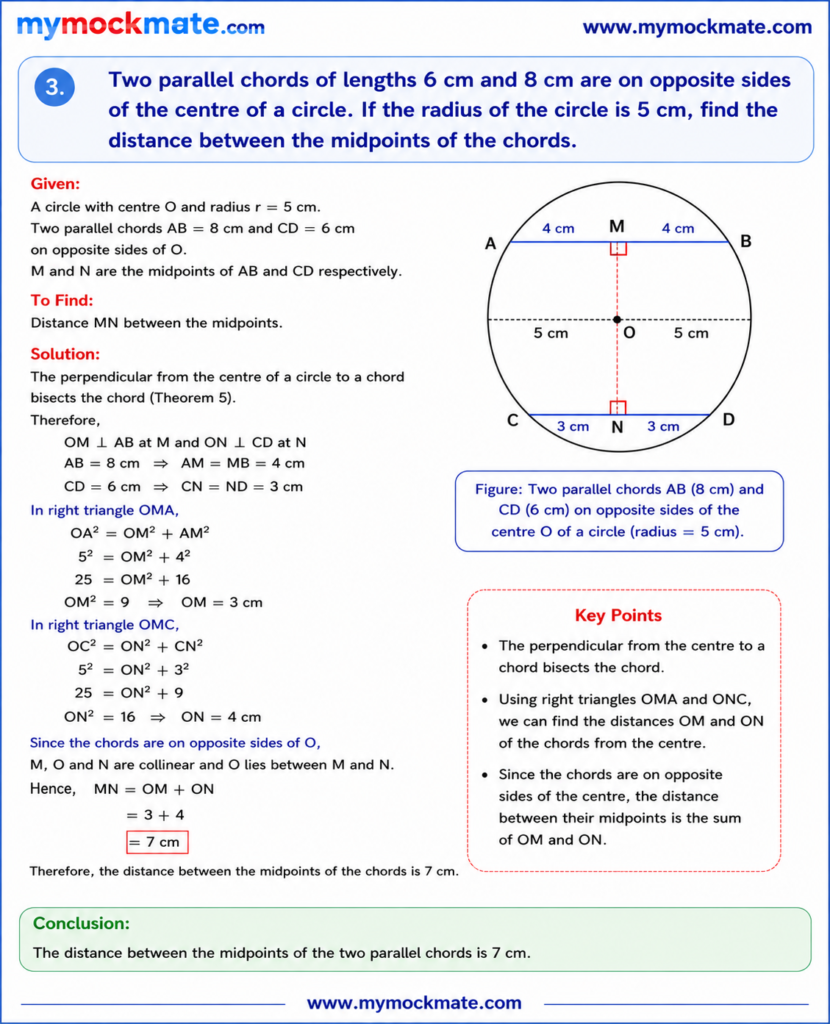
Two parallel chords of lengths 6 cm and 8 cm are on opposite sides of the centre of a circle. If the radius of the circle is 5 cm, find the distance between the midpoints of the chords.
Solution
Final Answers
| Question | Answer |
|---|---|
| 1 | Perpendicular from centre bisects the chord |
| 2 | Altitude from A passes through the centre of the circle |
| 3 | Distance between the midpoints = 7 cm |
Common Mistakes
❌ Forgetting that radii are equal.
❌ Using SSS instead of RHS in Question 1.
❌ Taking half of the chord incorrectly in Question 3.
❌ Subtracting distances instead of adding them when chords lie on opposite sides of the centre.
Exam Tips
✔ Draw neat labelled diagrams.
✔ Remember:
Perpendicular from centre → chord bisected
Perpendicular bisector of chord → passes through centre
✔ Learn both Theorem 4 and Theorem 5 together.
✔ Always mention the congruence criterion used.
Practice MCQs
1. The perpendicular from the centre to a chord:
A. Doubles the chord
B. Bisects the chord
C. Is parallel to the chord
D. None of these
Answer: B
2. The radius of a circle is 13 cm and half of a chord is 5 cm. Distance of the chord from the centre is:
A. 8 cm
B. 10 cm
C. 12 cm
D. 15 cm
Answer:
Answer: C
3. In an isosceles triangle, the altitude from the vertex also:
A. Bisects the base
B. Bisects an angle
C. Is perpendicular to the base
D. All of these
Answer: D
Frequently Asked Questions (FAQs)
Q1. Does every perpendicular from the centre bisect the chord?
Yes.
Q2. Does every line through the centre bisect the chord?
No, only the perpendicular line does.
Q3. Why is RHS congruence used in Question 1?
Because the triangles are right-angled and have equal hypotenuse and one common side.
Q4. Why are distances added in Question 3?
Because the chords lie on opposite sides of the centre.
Key Takeaways
✅ Perpendicular from centre to chord bisects the chord.
✅ Perpendicular bisector of a chord always passes through the centre.
✅ Equal radii and Pythagoras Theorem are extremely important in circle problems.
📚 Want more NCERT Solutions and Chapter-wise Notes?
Visit www.mymockmate.com
✔ Complete NCERT Solutions
✔ Detailed Step-by-Step Explanations
✔ Practice MCQs
✔ Exam Notes and Worksheets
✔ Chapter-wise Important Questions for Class 9 Maths