NCERT Class 9 Maths Exercise 5.4 Solutions
Short Introduction
Exercise 5.4 of Chapter 5, I’m Up and Down, and Round and Round, introduces an important theorem of circles:
Equal chords of a circle are equidistant from the centre, and chords equidistant from the centre are equal.
The exercise uses the Baudhāyana–Pythagoras Theorem and congruence of triangles to establish these properties.
Quick Information Box
| Particular | Details |
|---|---|
| Class | 9 |
| Subject | Mathematics |
| Chapter | 5 – I’m Up and Down, and Round and Round |
| Exercise | 5.4 |
| Main Topic | Distance of Chords from Centre |
| Difficulty Level | Moderate |
| Important Theorems | Theorem 6 and Theorem 7 |
Concepts Used (Topics Covered)
- Equal Chords of a Circle
- Distance of Chords from Centre
- Perpendicular from Centre to Chord
- Midpoint of a Chord
- Baudhāyana–Pythagoras Theorem
- Congruent Triangles
Important Formulas and Theorems
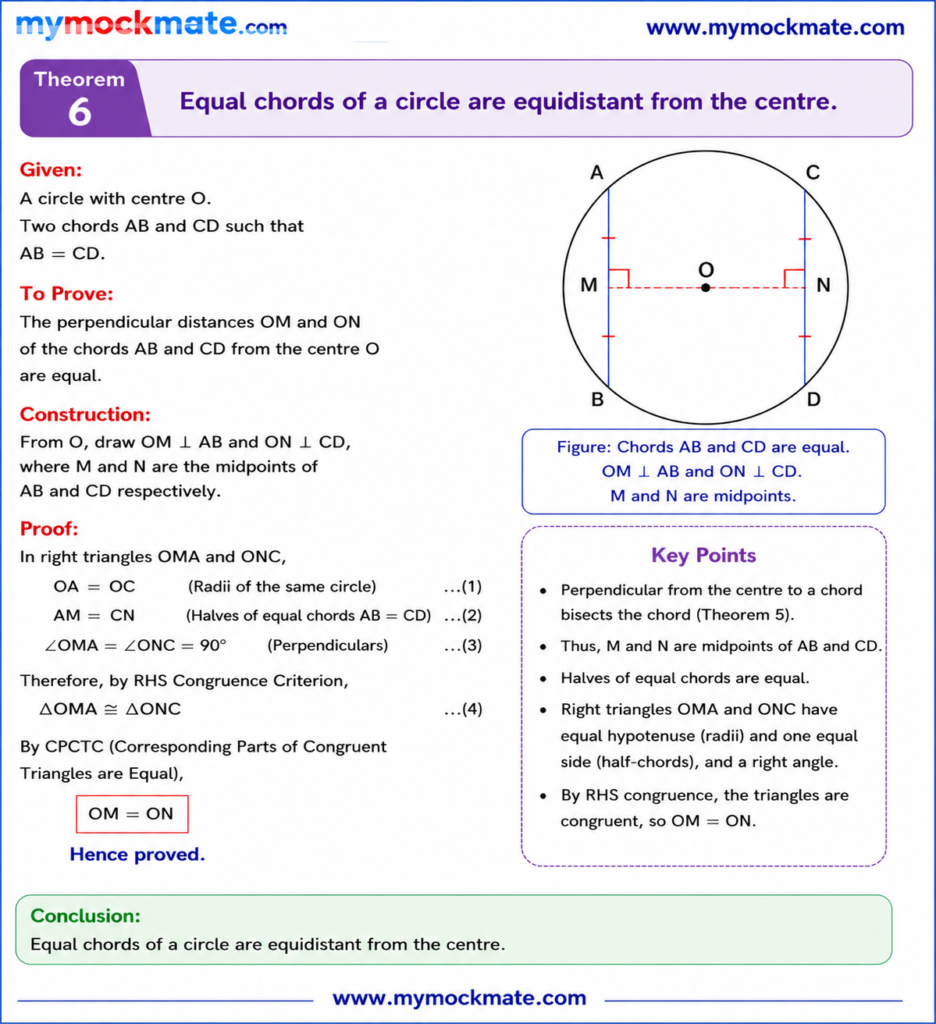
Theorem 6
Equal chords of a circle are equidistant from the centre.
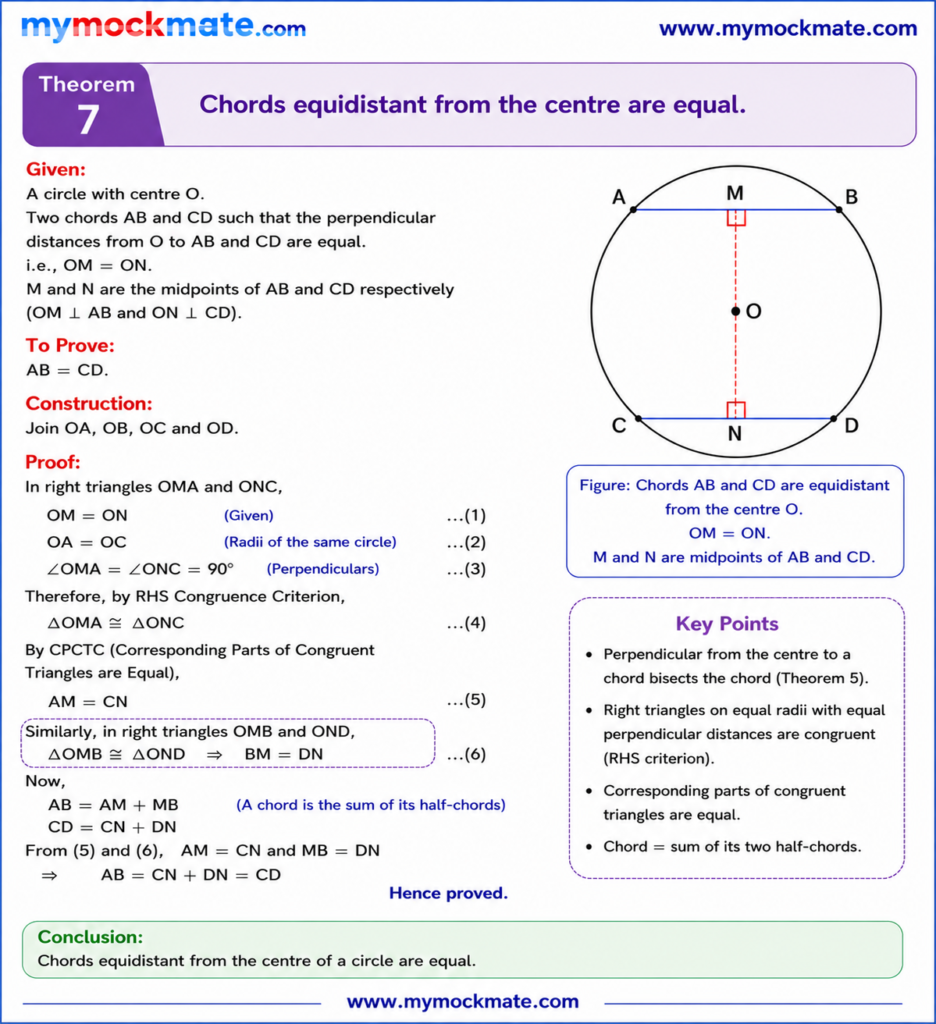
Theorem 7
Chords equidistant from the centre are equal.
Exercise 5.4 Solutions
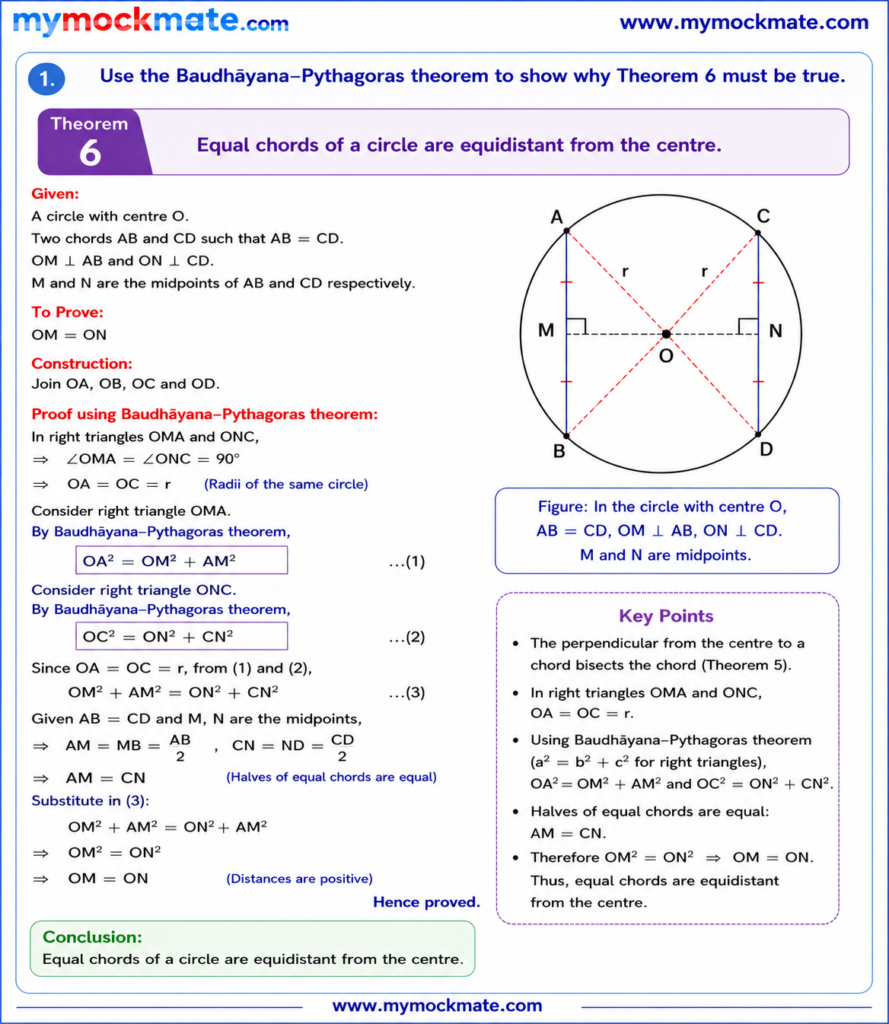
Question 1
Use the Baudhāyana–Pythagoras theorem to show why Theorem 6 must be true.
Solution
Question 2
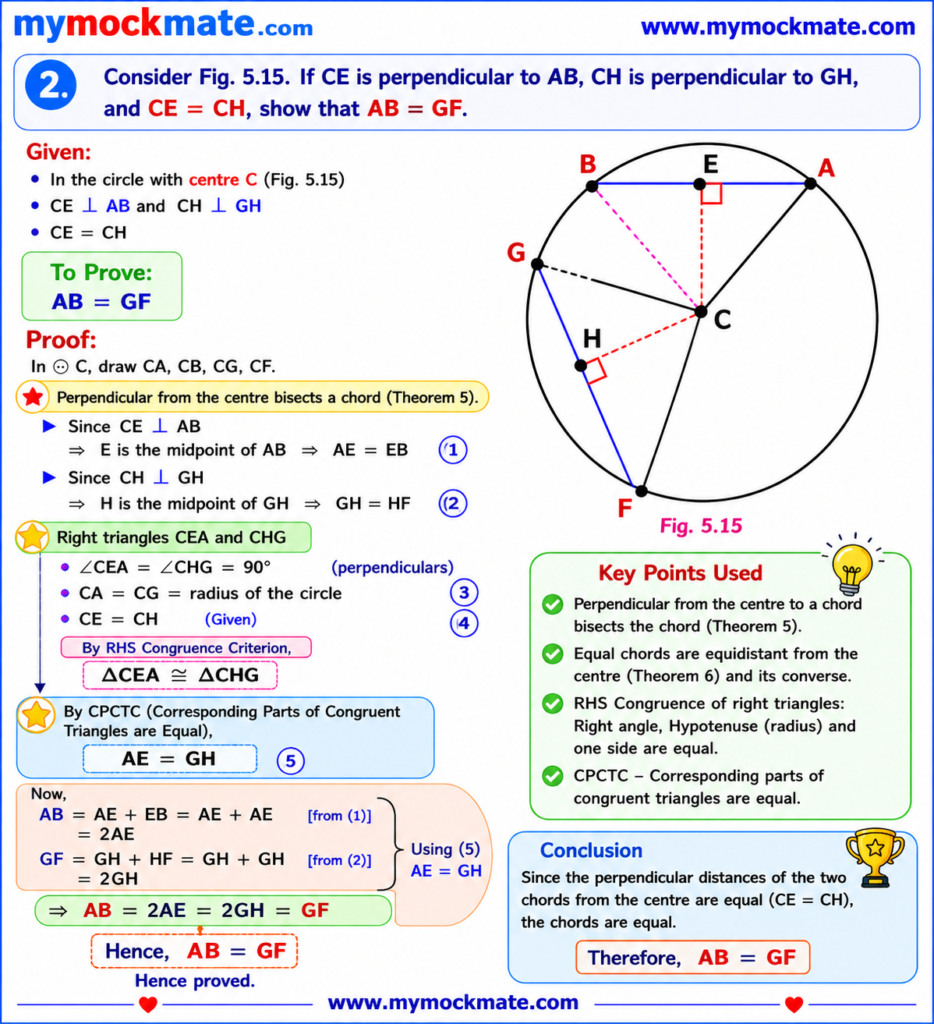
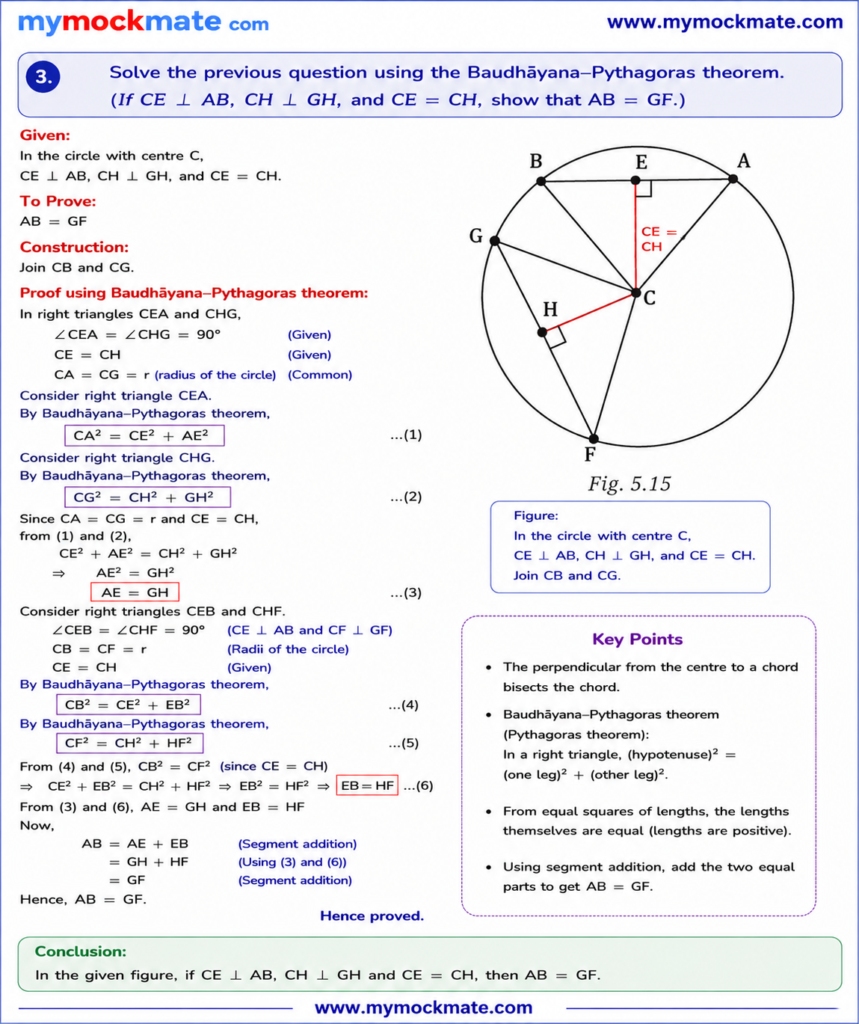
If CE is perpendicular to AB, CH is perpendicular to GF and CE = CH, show that AB = GF.
Solution
Question 3
Solve the previous question using the Baudhāyana–Pythagoras theorem.
Solution
Final Answers
| Question | Answer |
|---|---|
| 1 | Equal chords are equidistant from the centre. |
| 2 | AB = GF |
| 3 | AB = GF |
Common Mistakes
❌ Forgetting that perpendicular from the centre bisects the chord.
❌ Using full chord lengths instead of half-chord lengths.
❌ Not mentioning that all radii of a circle are equal.
❌ Writing CE = CH directly without proof.
Exam Tips
✔ Remember these two important results:
Equal Chords ⇒ Equal Distance from Centre
Equal Distance from Centre ⇒ Equal Chords
✔ Draw a labelled figure.
✔ Use Pythagoras Theorem carefully.
✔ Mention reasons in every step.
Practice MCQs
1. Equal chords of a circle are:
A. Parallel
B. Equidistant from the centre
C. Perpendicular
D. Diameters
Answer: B
2. Chords equidistant from the centre are:
A. Equal
B. Parallel
C. Diameters
D. Unequal
Answer: A
3. The perpendicular from the centre to a chord:
A. Doubles the chord
B. Bisects the chord
C. Is parallel to the chord
D. None of these
Answer: B
4. If two equal chords are 5 cm from the centre, then:
A. Their distances are unequal
B. Their distances are 5 cm
C. They are diameters
D. None of these
Answer: B
Frequently Asked Questions (FAQs)
Q1. What is the distance of a chord from the centre?
It is the length of the perpendicular drawn from the centre to the chord.
Q2. Do equal chords always have equal distances from the centre?
Yes.
Q3. Are chords equidistant from the centre always equal?
Yes.
Q4. Which theorem is used in Exercise 5.4?
Baudhāyana–Pythagoras Theorem and properties of equal radii.
Key Takeaways
✅ Equal chords are equidistant from the centre.
✅ Chords equidistant from the centre are equal.
✅ The perpendicular from the centre bisects a chord.
✅ Pythagoras Theorem plays an important role in circle geometry.
📚 Looking for more NCERT Solutions and Notes?
Visit www.mymockmate.com
✅ Complete NCERT Solutions
✅ Chapter-wise Notes
✅ Step-by-Step Explanations
✅ Practice Questions and MCQs
✅ Important Questions for Exams