NCERT Class 9 Science Atomic Foundations of Matter Solutions
Short Intro
This chapter introduces the atomic nature of matter and explains how atoms combine to form molecules and compounds. Students learn important laws of chemistry, chemical bonding, writing chemical formulae, ionic and covalent compounds, and molecular mass through solved examples and numerical problems.
Quick Information Box
| Topic | Details |
|---|---|
| Chapter | Atomic Foundations of Matter |
| Class | Grade 9 |
| Subject | Science |
| Main Topics | Chemical Bonding, Atoms, Molecules |
| Important Laws | Conservation of Mass, Constant Proportions |
| Key Bond Types | Ionic Bond and Covalent Bond |
Concepts Used (Topics Covered)
- Law of Conservation of Mass
- Law of Constant Proportions
- Dalton’s Atomic Theory
- Molecules and Chemical Bonds
- Covalent Bond Formation
- Ionic Bond Formation
- Cations and Anions
- Writing Chemical Formulae
- Properties of Ionic and Covalent Compounds
- Molecular Mass
- Formula Unit Mass
Important Formulas
- Mass of Reactants = Mass of Products
- Number of Neutrons
= Mass Number − Atomic Number - Molecular Mass
= Sum of Atomic Masses of All Atoms - Formula Unit Mass
= Sum of Atomic Masses in Ionic Compound - Chemical Formula by Criss-cross Method
Questions & Step-by-step Solutions with Explanation
Think It Over
1. Water can be obtained from various sources. Are all these samples of water chemically identical?

2. Oxygen is sometimes represented as O and sometimes as O2 . What is the difference between these symbols?

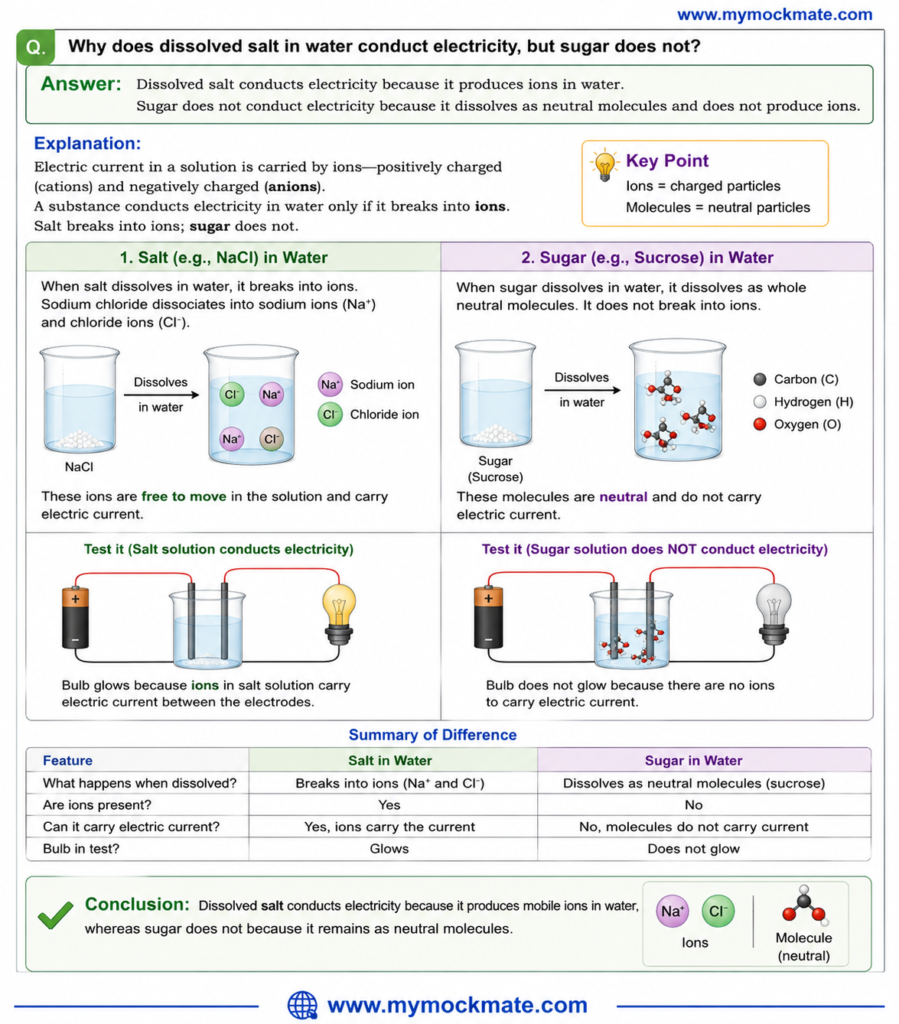
3. Why does dissolved salt in water conduct electricity, but sugar does not?
Pause and Ponder
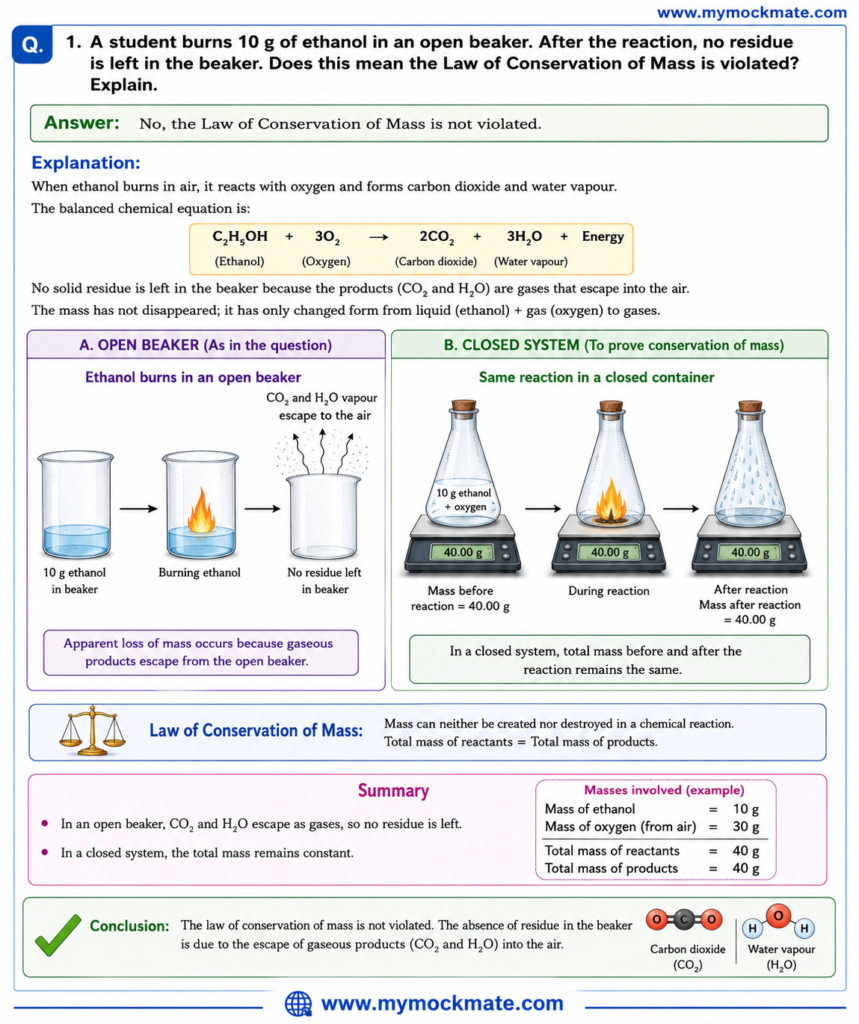
1. A student burns 10 g of ethanol in an open beaker. After the reaction, no residue is left in the beaker. Does this mean the Law of Conservation of Mass is violated? Explain.
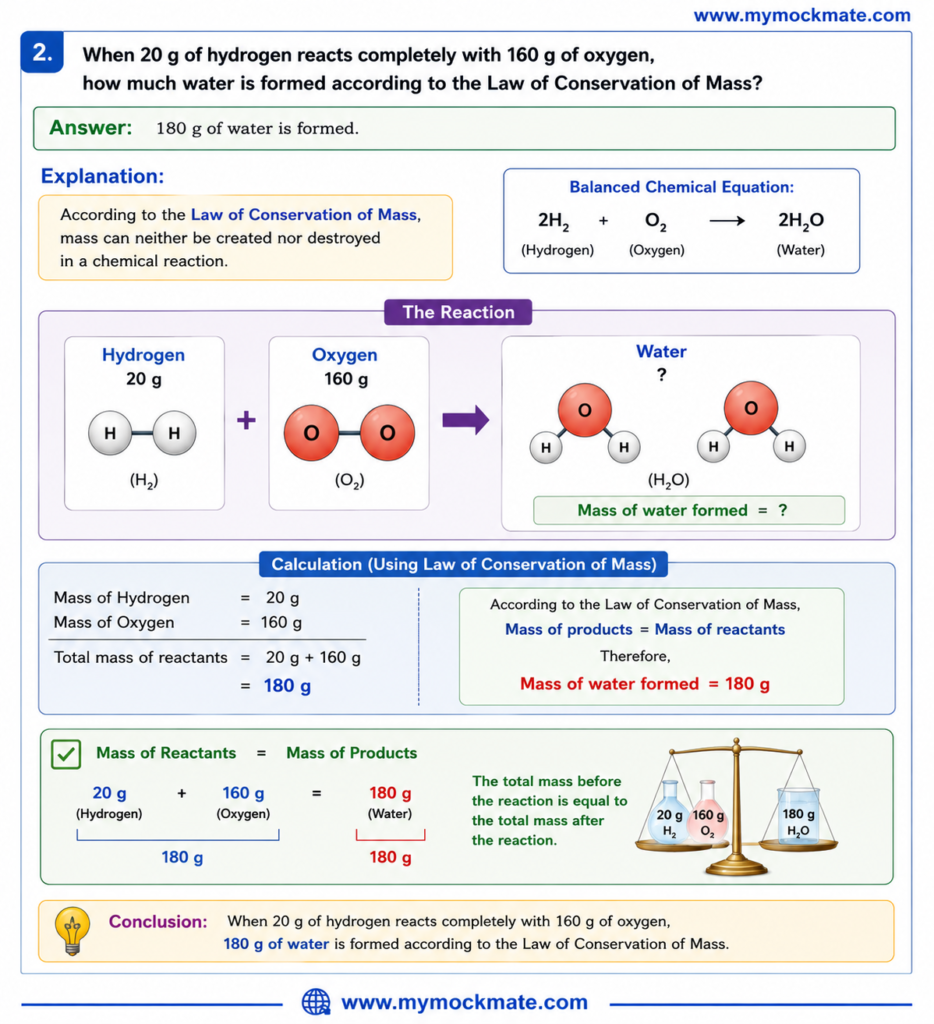
2. When 20 g of hydrogen reacts completely with 160 g of oxygen, how much water is formed
according to the Law of Conservation of Mass?
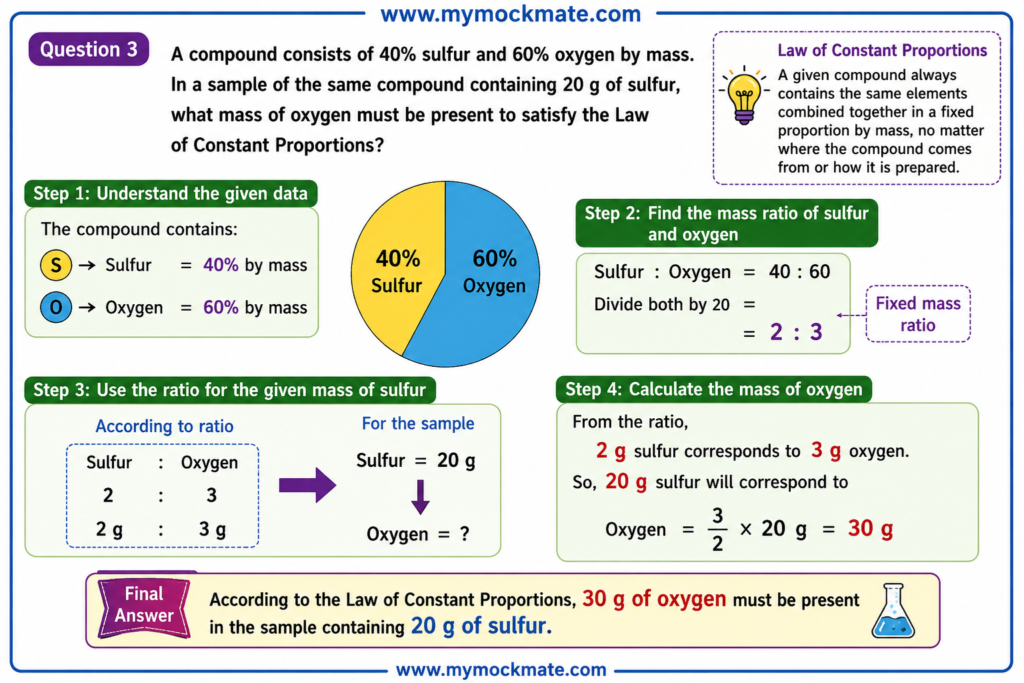
3. A compound consists of 40% sulfur and 60% oxygen by mass. In a sample of the same compound containing 20 g of sulfur, what mass of oxygen must be present to satisfy the Law
of Constant Proportions?
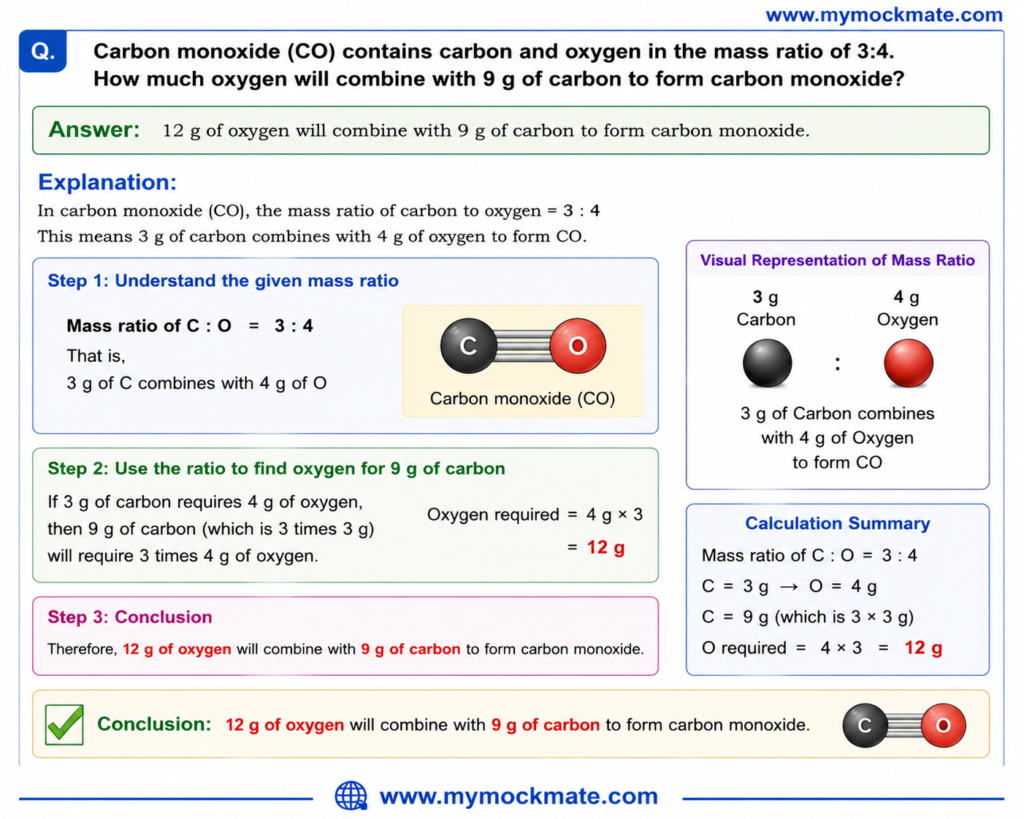
4. Carbon monoxide (CO) contains carbon and oxygen in the mass ratio of 3:4. How much
oxygen will combine with 9 g of carbon to form carbon monoxide?
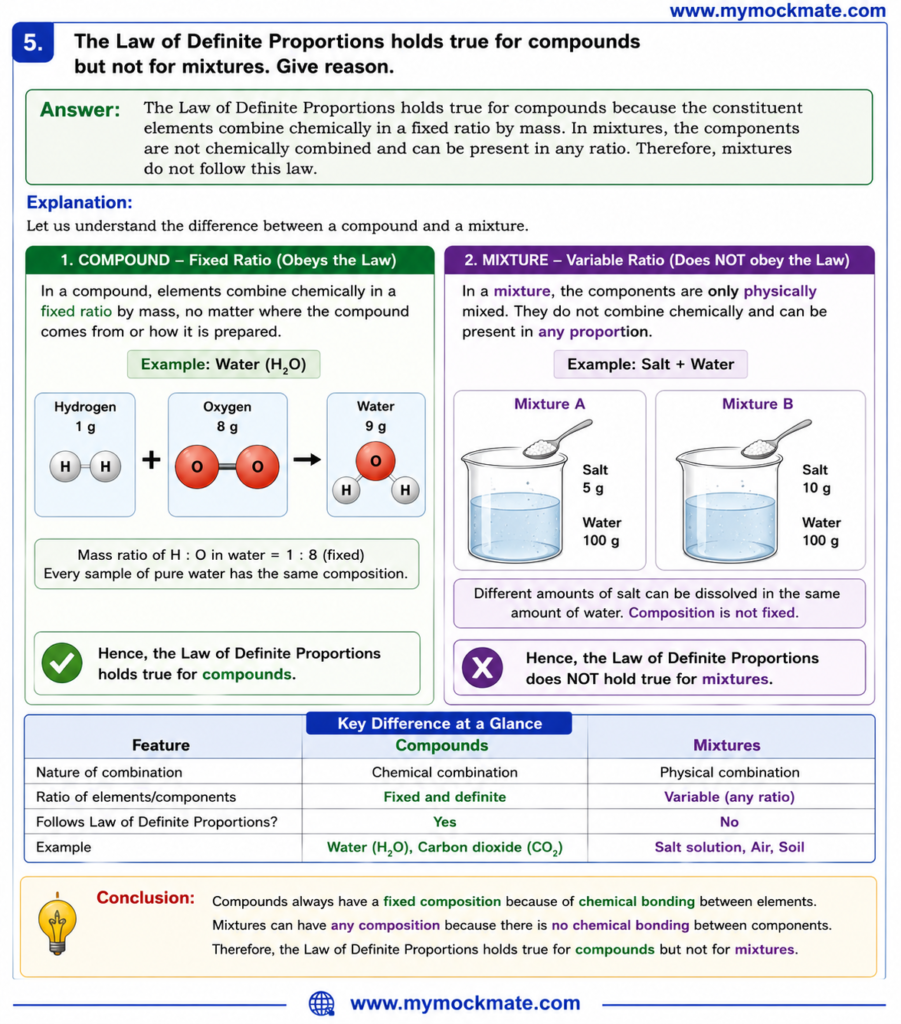
5. The Law of Definite Proportions holds true for compounds but not for mixtures. Give reason.
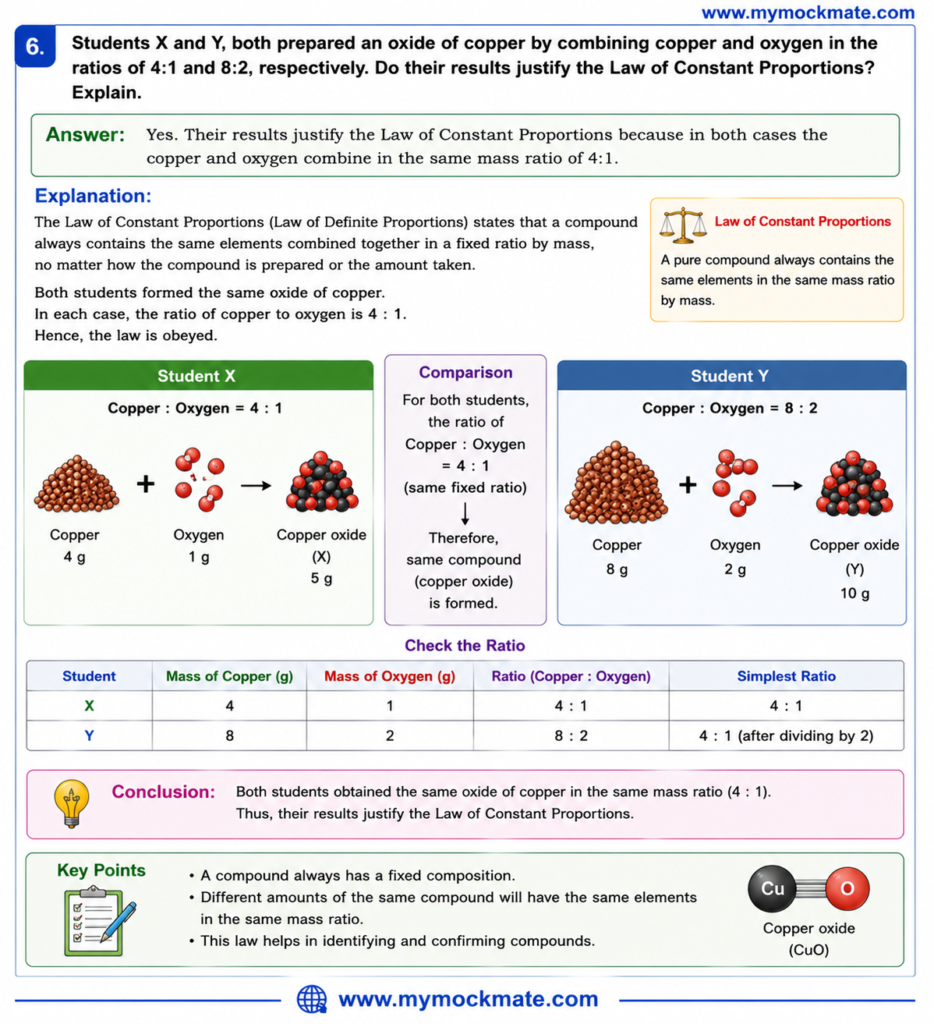
6. Students X and Y, both prepared an oxide of copper by combining copper and oxygen in the
ratios of 4:1 and 8:2, respectively. Do their results justify the Law of Constant Proportions?
Explain.
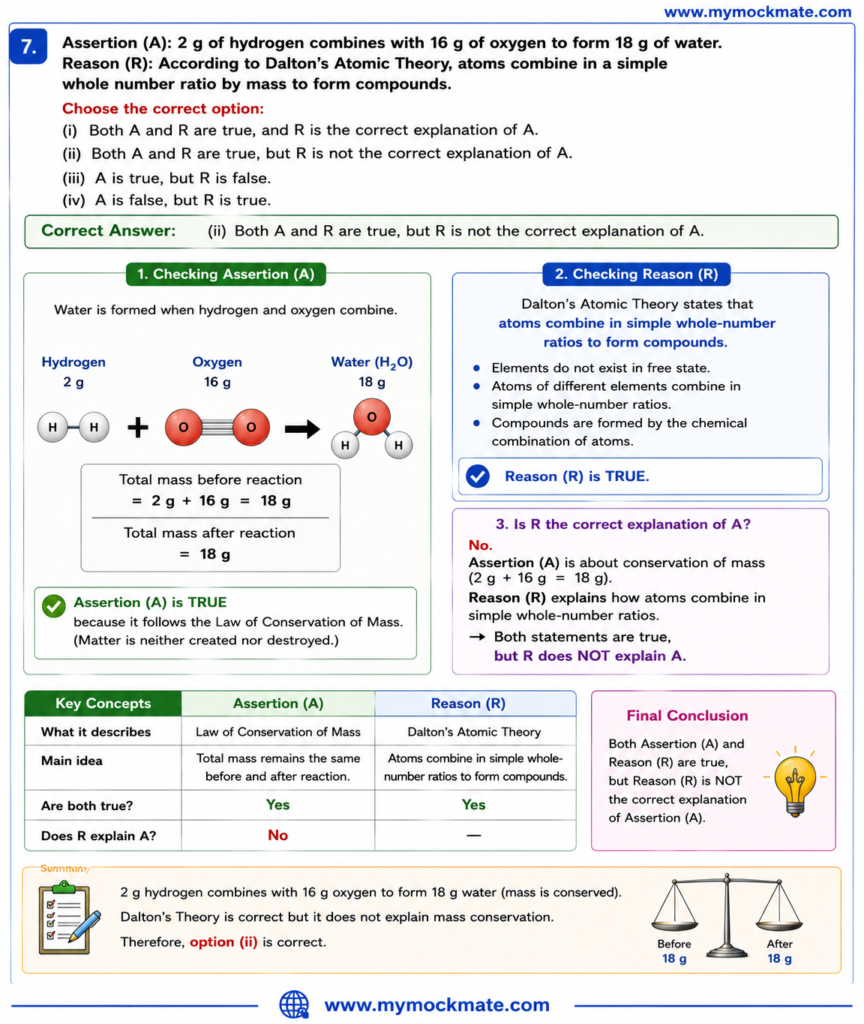
7. Assertion (A): 2 g of hydrogen combines with 16 g of oxygen to form 18 g of water.
Reason (R): According to Dalton’s Atomic Theory, atoms combine in a simple whole number
ratio by mass to form compounds.
Choose the correct option:
(i) Both A and R are true, and R is the correct explanation of A.
(ii) Both A and R are true, but R is not the correct explanation of A.
(iii) A is true, but R is false.
(iv) A is false, but R is true.
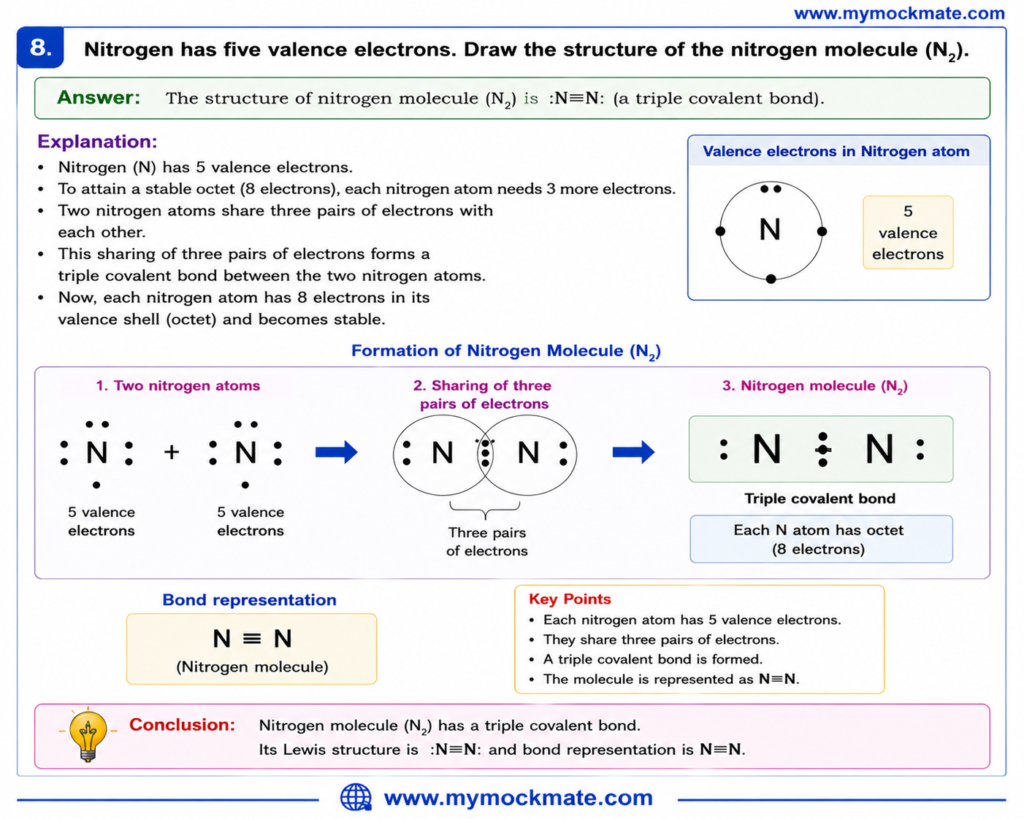
8. Nitrogen has five valence electrons. Draw the structure of the nitrogen molecule (N2).
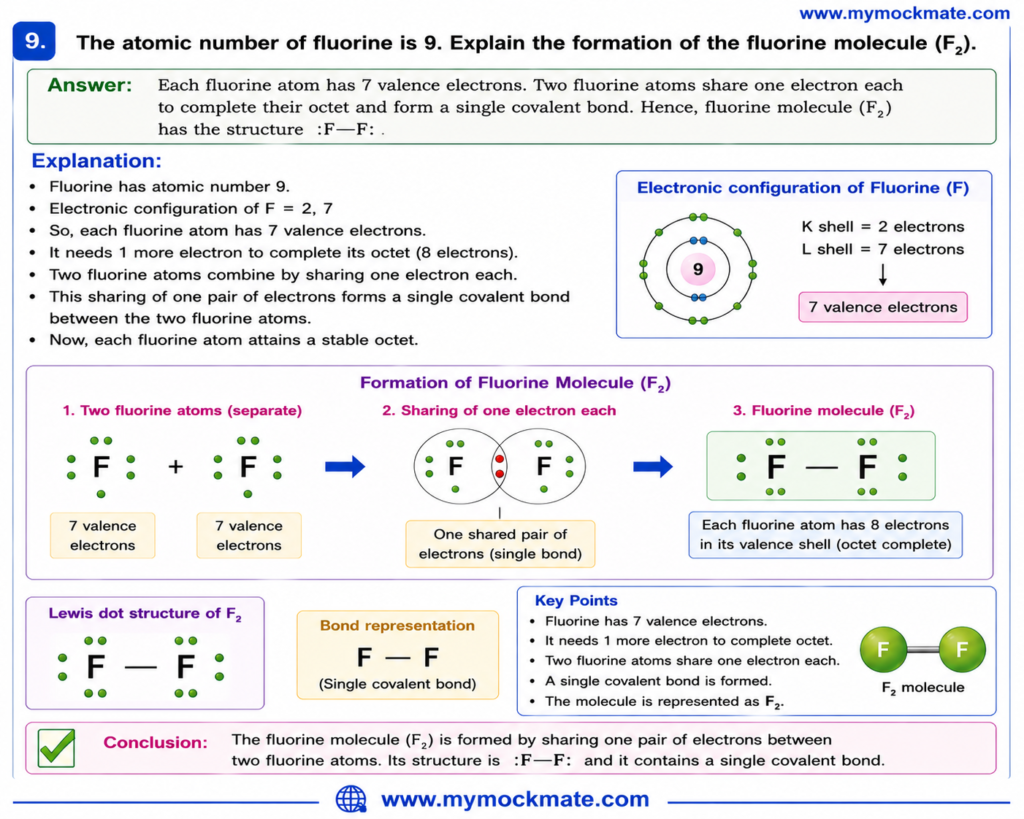
9. The atomic number of fluorine is 9. Explain the formation of the fluorine molecule (F2).
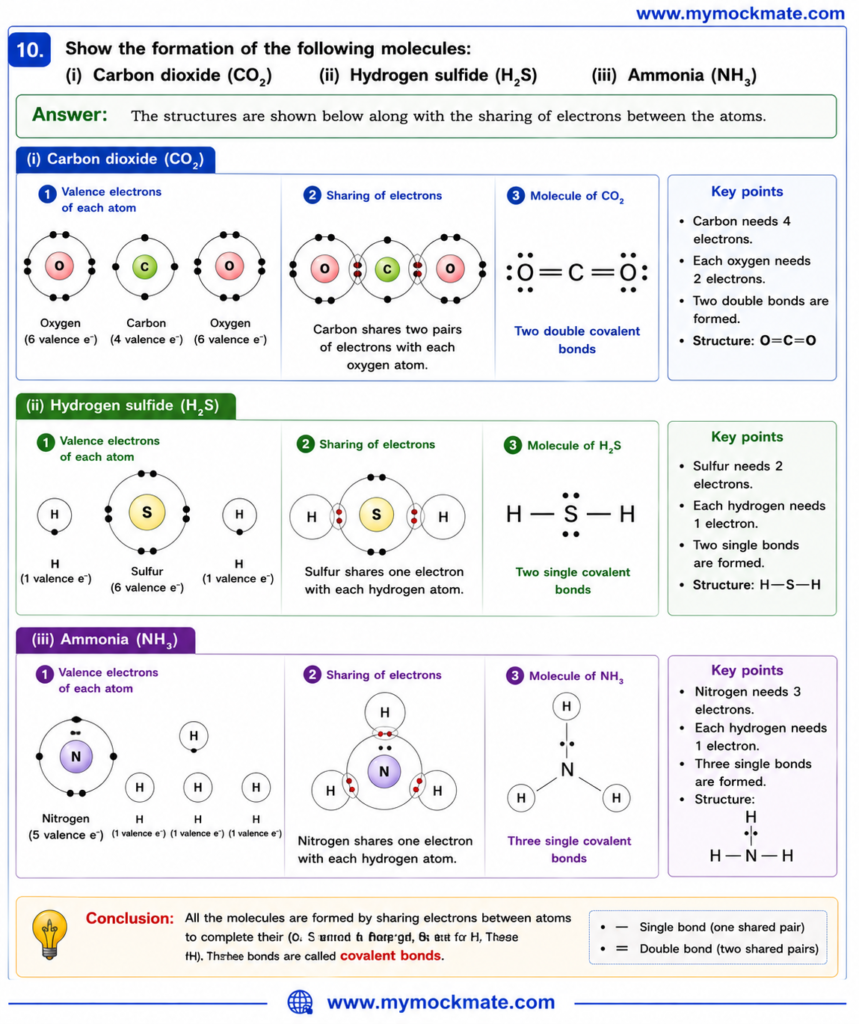
10. Show the formation of the following molecules:
(i) Carbon dioxide (CO2)
(ii) Hydrogen sulfide (H2S)
(iii) Ammonia (NH3)
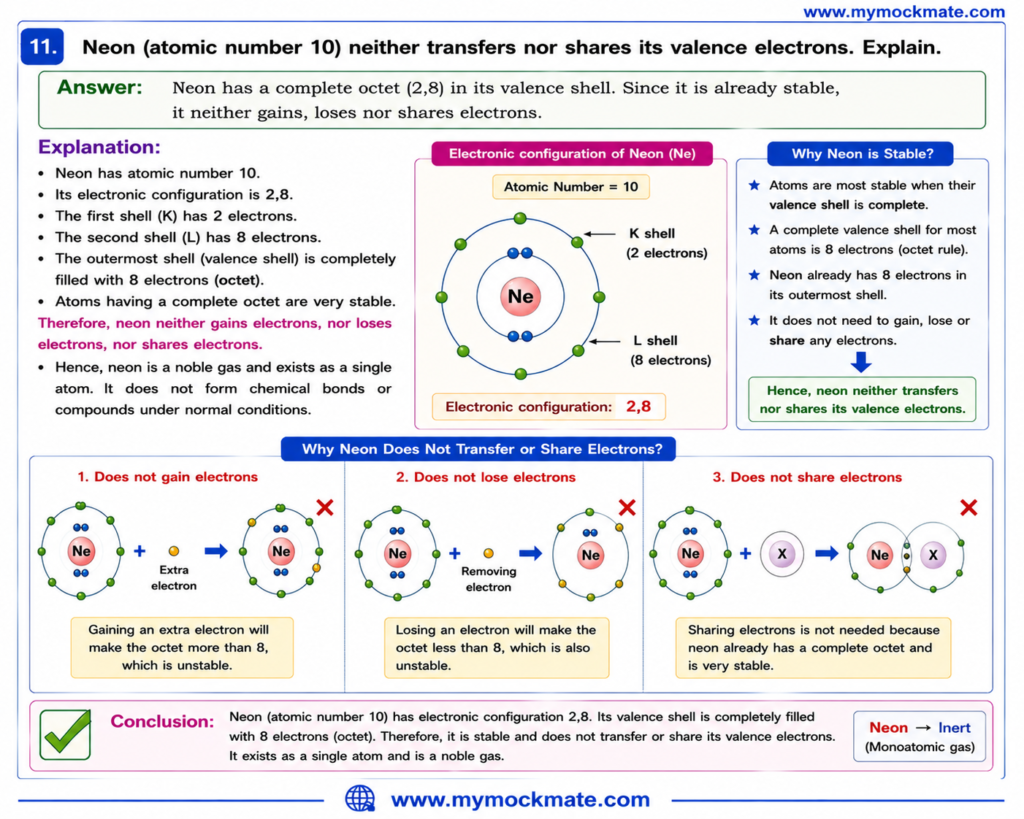
11. Neon (atomic number 10) neither transfers nor shares its valence electrons. Explain.
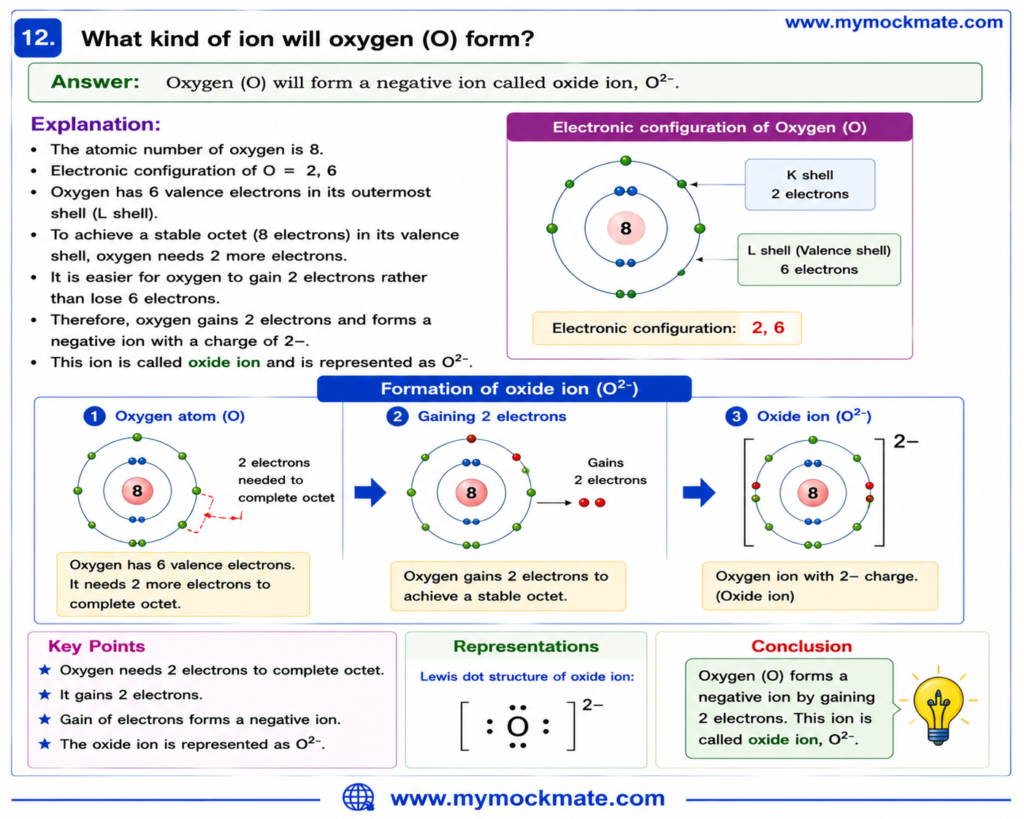
12. What kind of ion will oxygen (O) form?
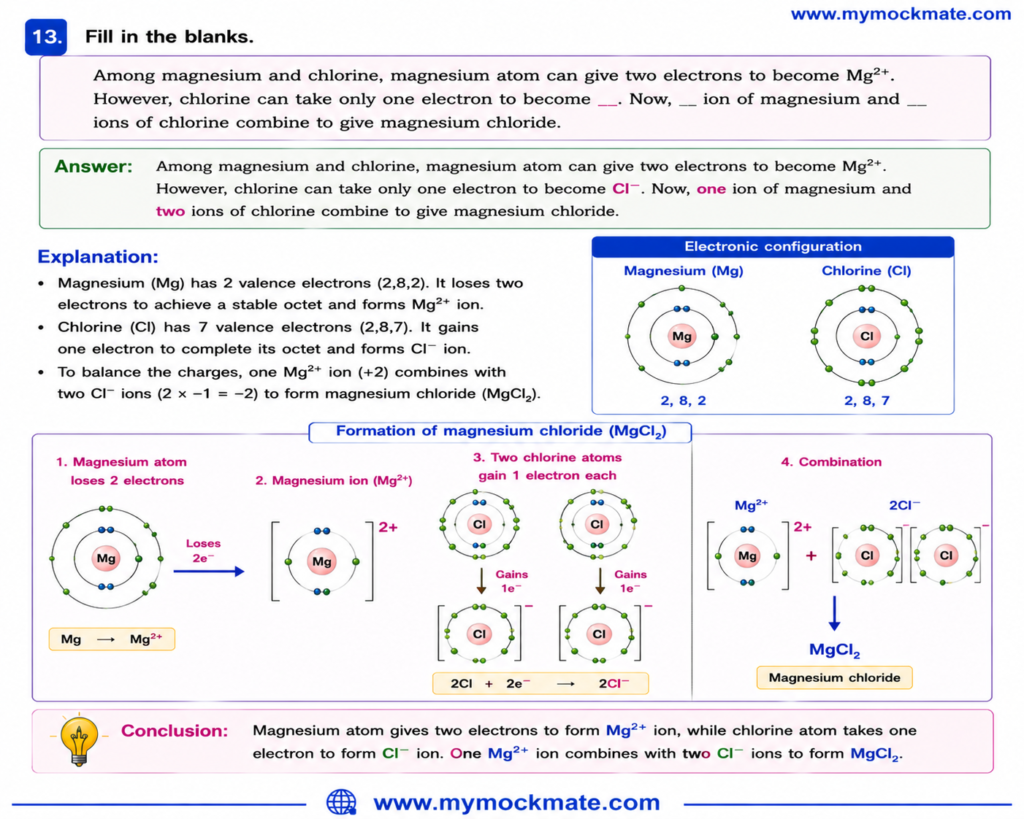
13. Fill in the blanks.
Among magnesium and chlorine, magnesium atom can give two electrons to become Mg2+. However, chlorine can take only one electron to become _______. Now, ______ ion of magnesium and _______ ions of chlorine combine to give magnesium chloride.
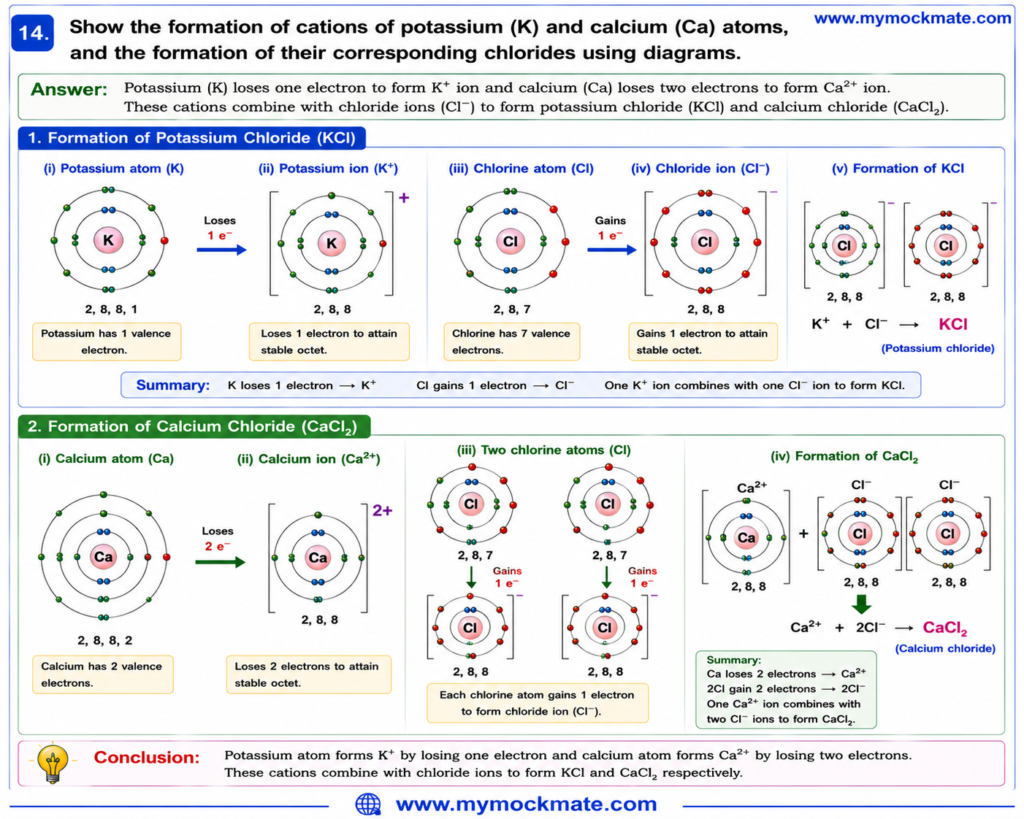
14. Show the formation of cations of potassium (K) and calcium (Ca) atoms, and the formation of their corresponding chlorides using diagrams.
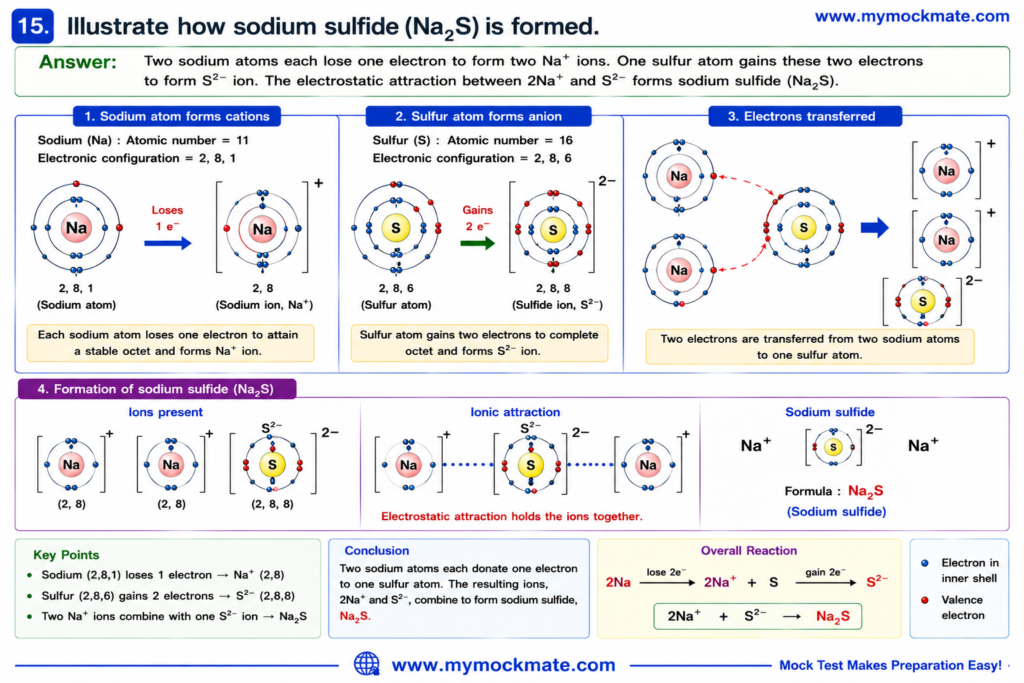
15. Illustrate how sodium sulfide (Na2S) is formed.
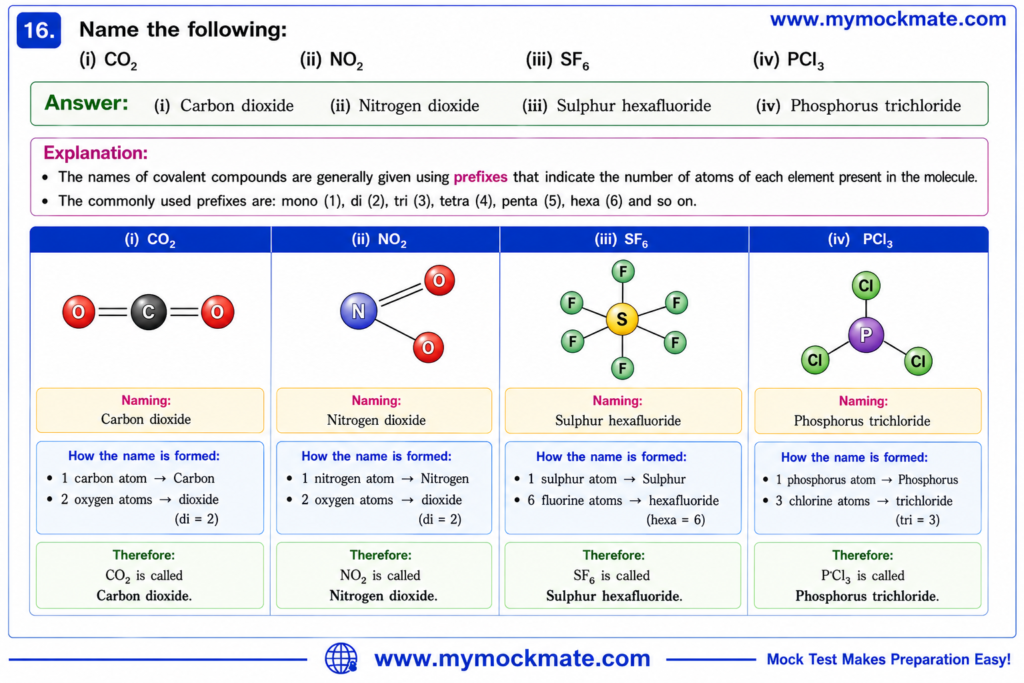
16. Name the following:
(i) CO2
(ii) NO2
(iii) SF6
(iv) PCl3
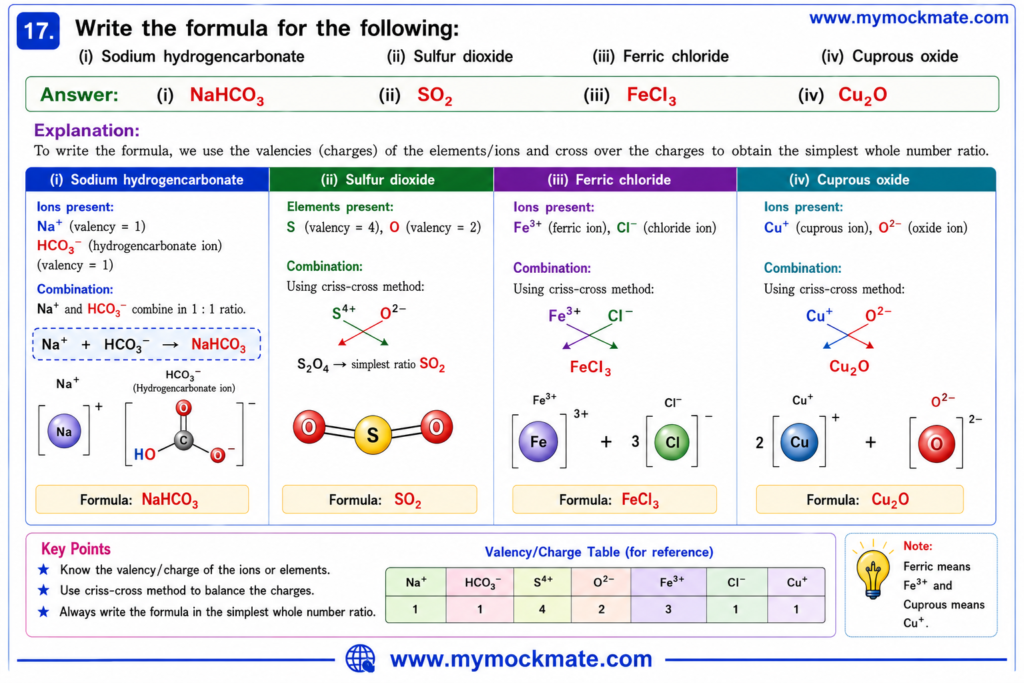
17. Write the formula for the following:
(i) Sodium hydrogencarbonate
(ii) Sulfur dioxide
(iii) Ferric chloride
(iv) Cuprous oxide
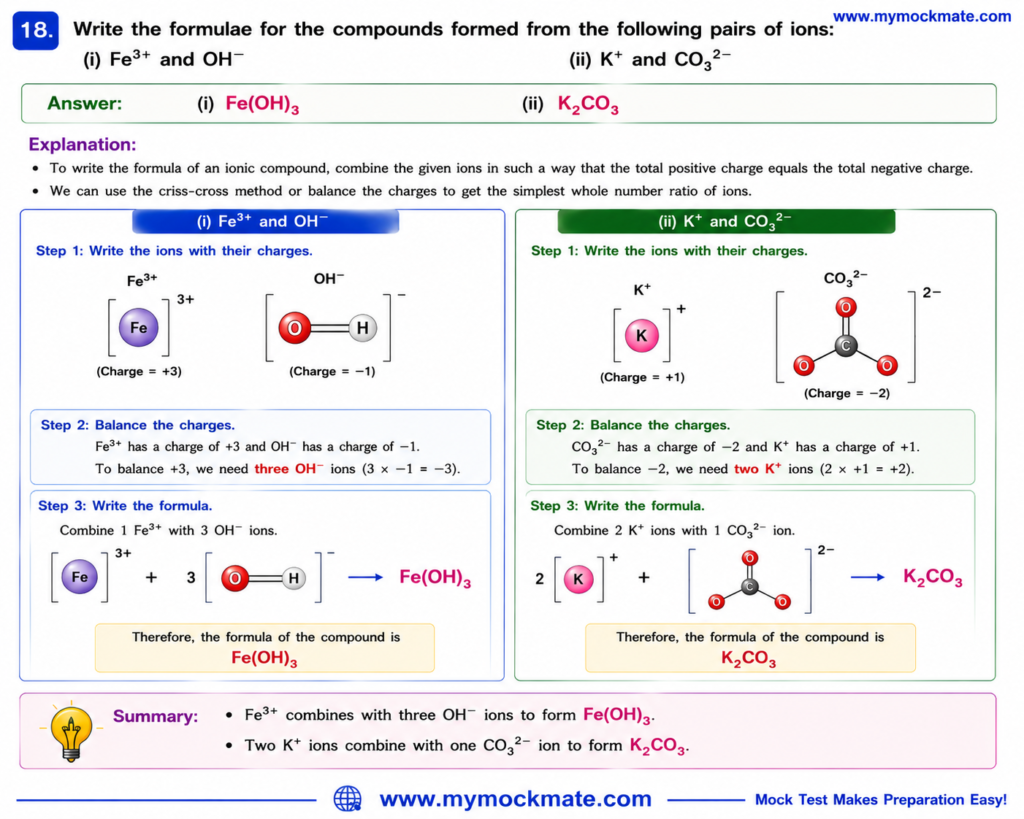
18. Write the formulae for the compounds formed from the following pairs of ions:
(i) Fe3+ and OH‒
(ii) K+ and CO32-
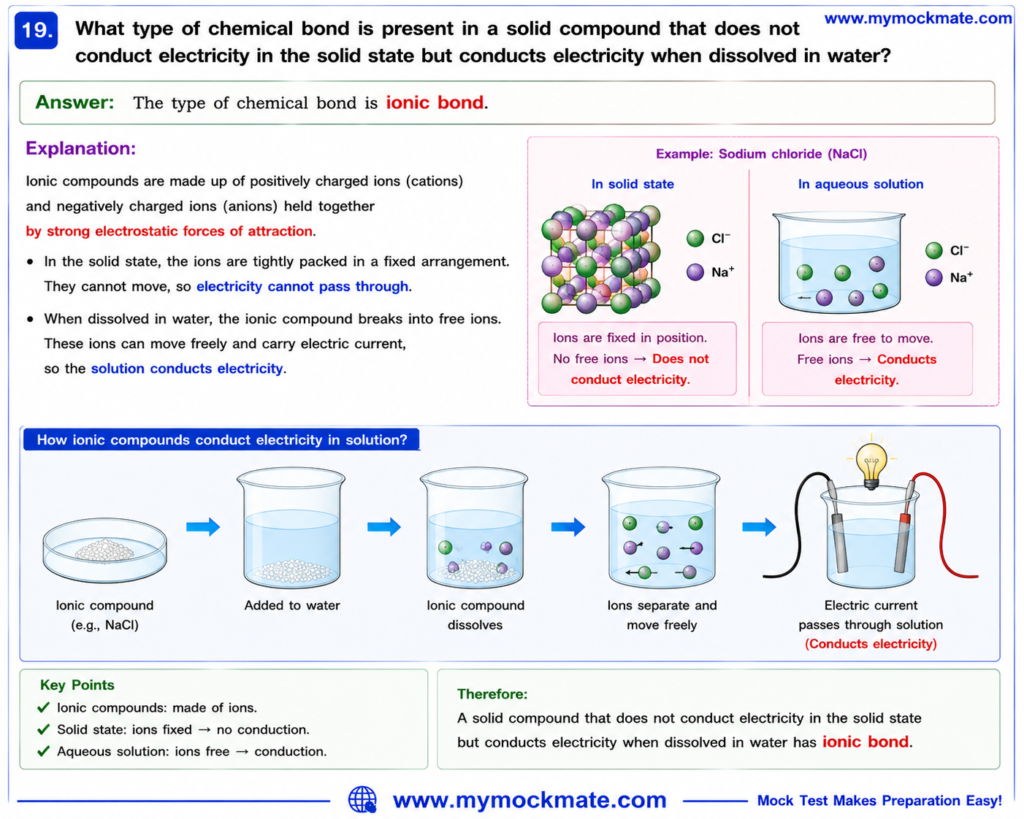
19. What type of chemical bond is present in a solid compound that does not conduct electricity in the solid state but conducts electricity when dissolved in water?
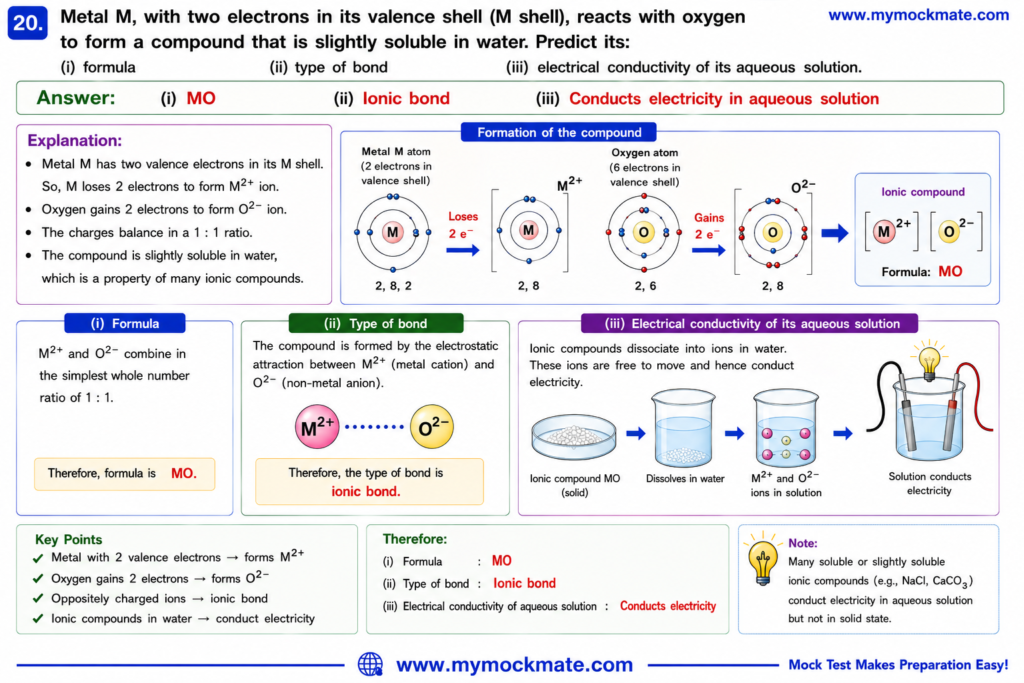
20. Metal M, with two electrons in its valence shell (M shell), reacts with oxygen to form a compound that is slightly soluble in water. Predict its:
(i) formula
(ii) type of bond
(iii) electrical conductivity of its aqueous solution.
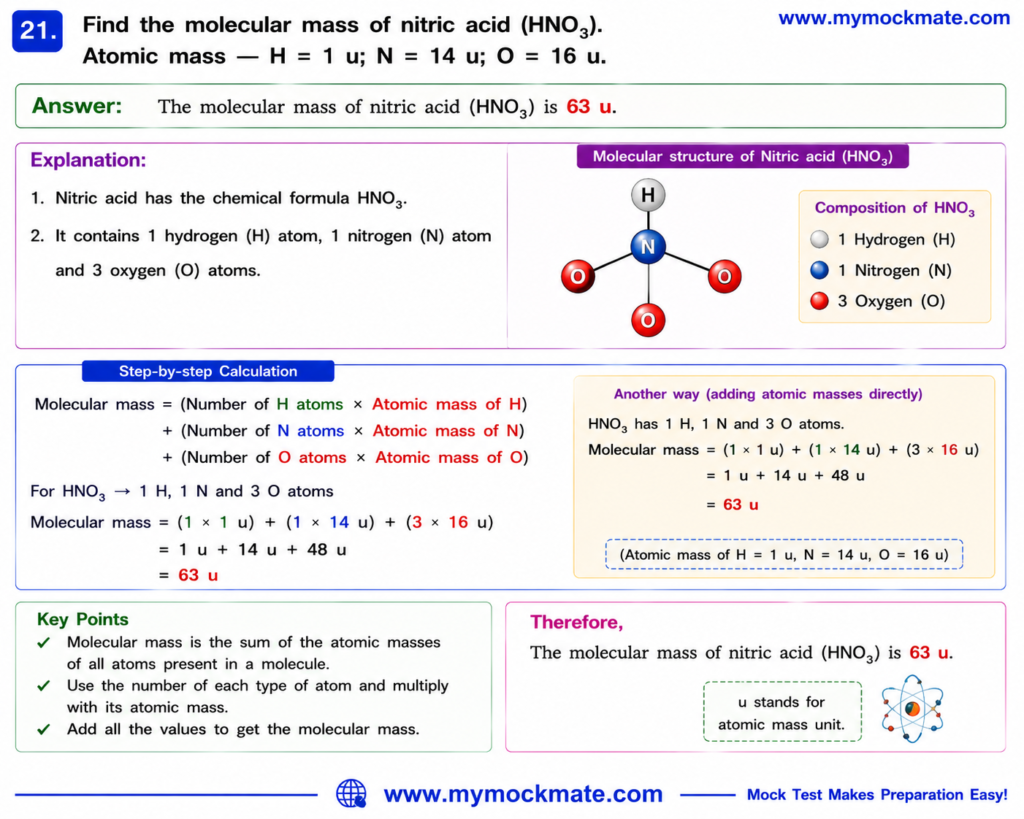
21. Find the molecular mass of nitric acid (HNO3).
Atomic mass — H = 1 u; N = 14 u; O = 16 u.
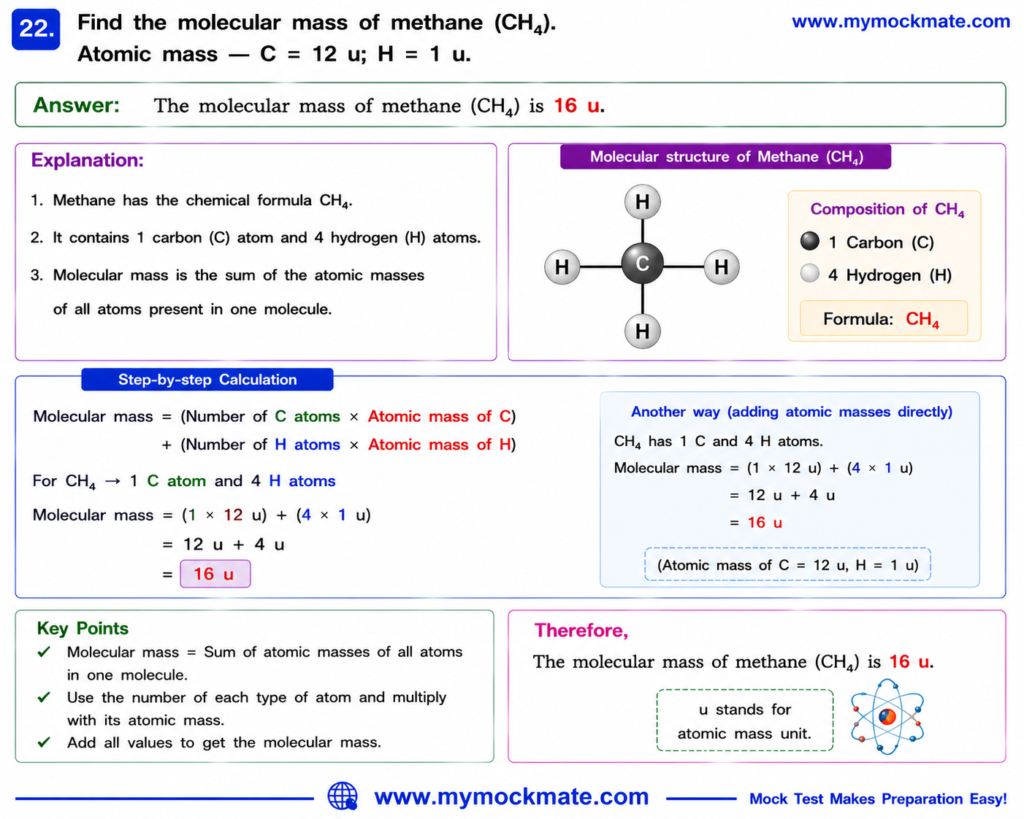
22. Find the molecular mass of methane (CH4).
Atomic mass — C = 12 u; H = 1 u.
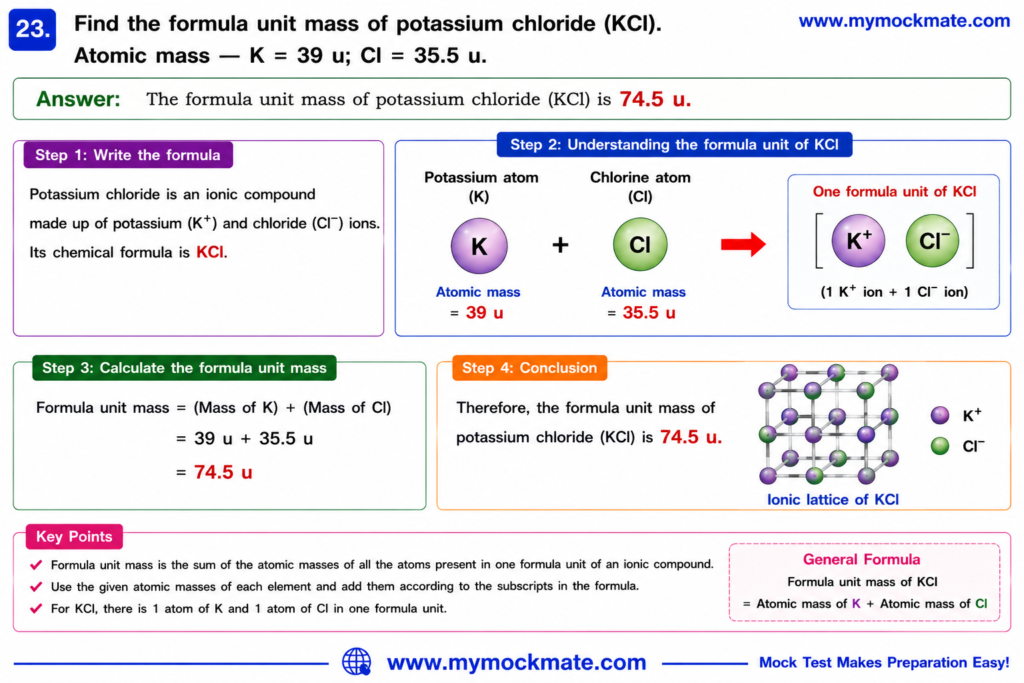
23. Find the formula unit mass of potassium chloride (KCl).
Atomic mass — K = 39 u; Cl = 35.5 u.
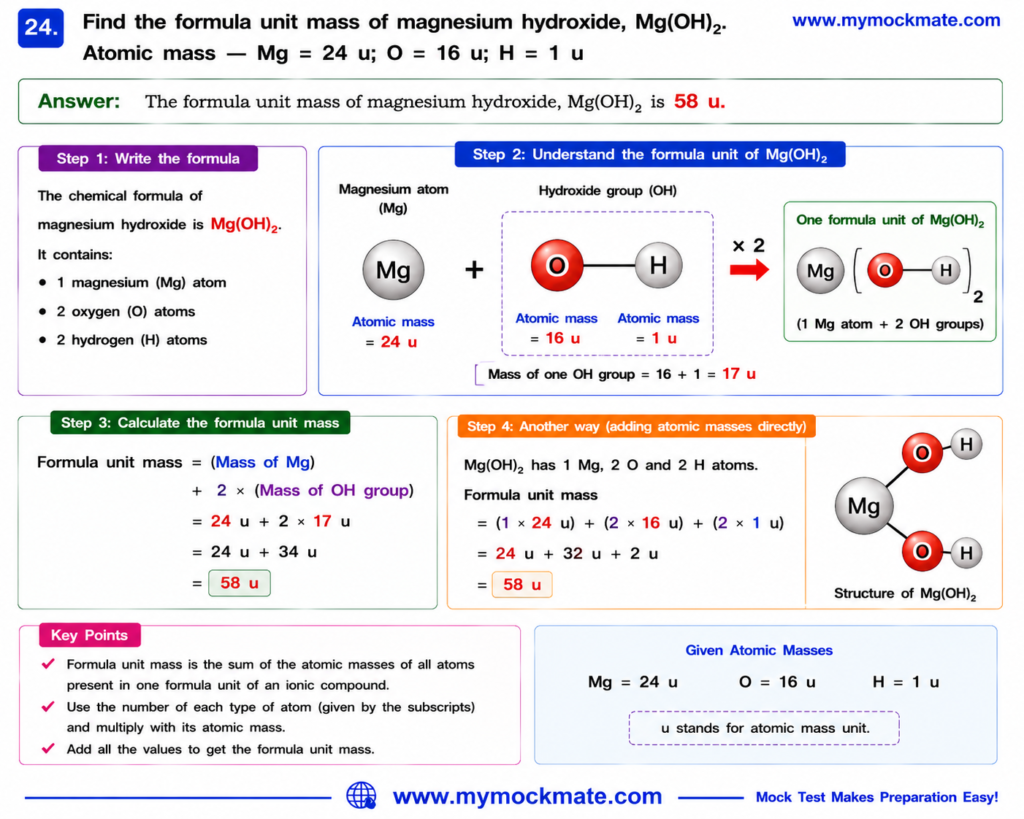
24. Find the formula unit mass of magnesium hydroxide, Mg(OH)2.
Atomic mass — Mg = 24 u; O = 16 u; H = 1 u
Revise, Reflect, Refine
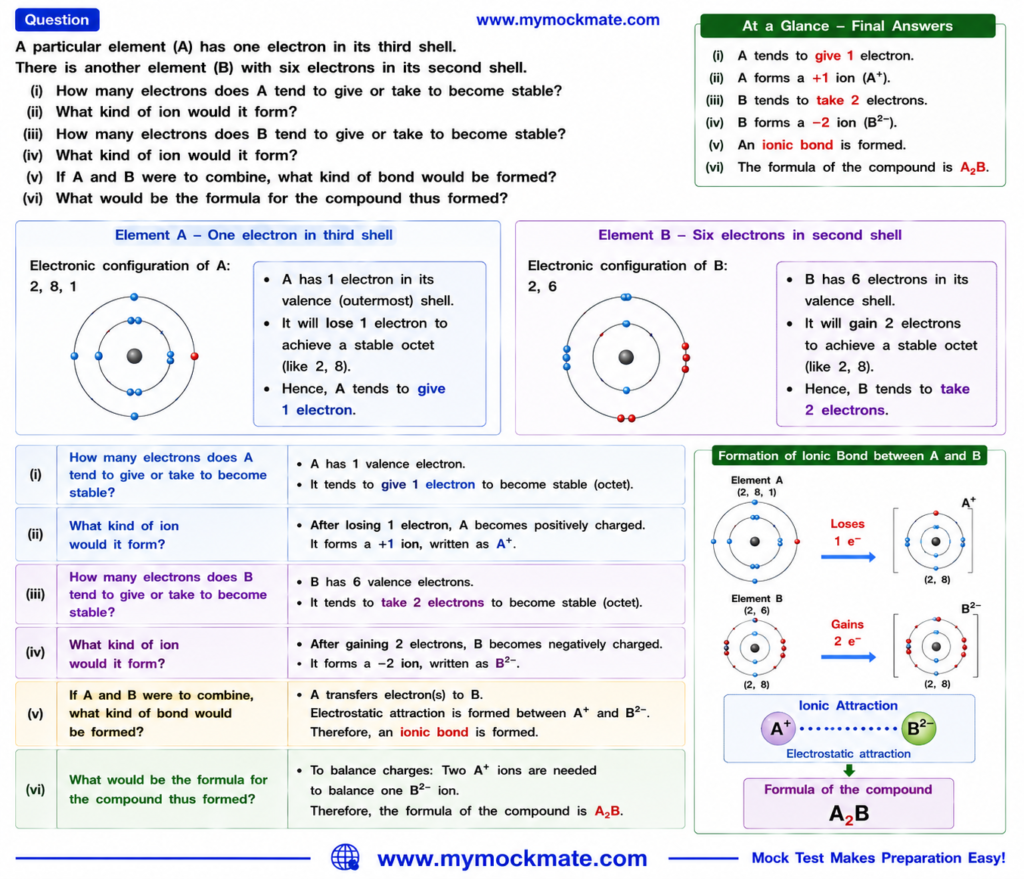
1. A particular element (A) has one electron in its third shell. There is another element (B) with six electrons in its second shell.
(i) How many electrons does A tend to give or take to become stable?
(ii) What kind of ion would it form?
(iii) How many electrons does B tend to give or take to become stable?
(iv) What kind of ion would it form?
(v) If A and B were to combine, what kind of bond would be formed?
(vi) What would be the formula for the compound thus formed?
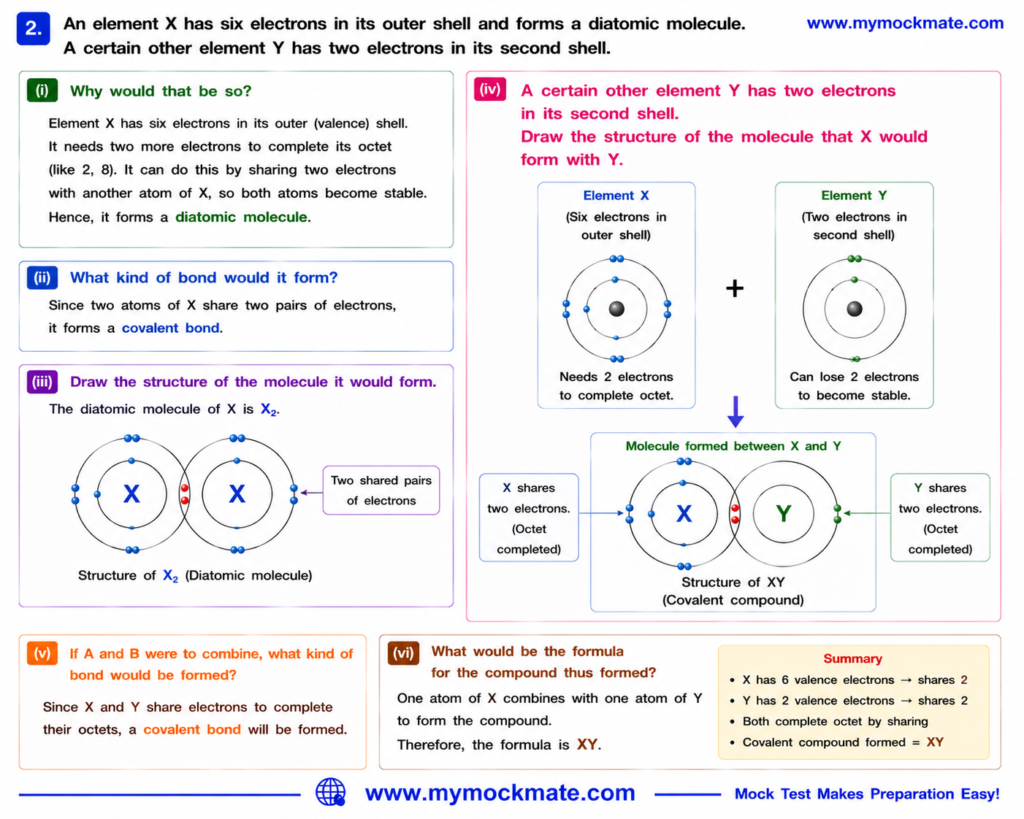
2. An element X has six electrons in its outer shell and forms a diatomic molecule.
(i) Why would that be so?
(ii) What kind of bond would it form?
(iii) Draw the structure of the molecule it would form.
(iv) A certain other element Y has two electrons in its second shell.
Draw the structure of the molecule that X would form with Y.
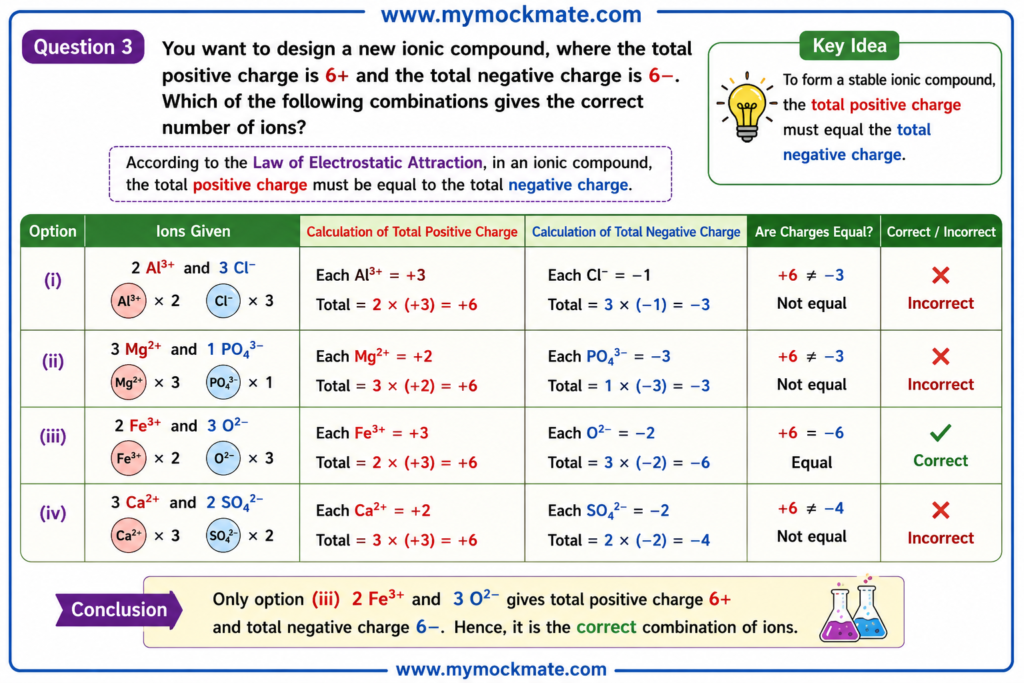
3. You want to design a new ionic compound, where the total positive charge is 6+ and the total negative charge is 6 –. Which of the following combinations gives the correct number of ions?
(i) 2 Al3+ and 3 Cl–
(ii) 3 Mg2+ and 1 PO43-
(iii) 2 Fe3+ and 3 O2-
(iv) 3 Ca2+ and 2 SO42-
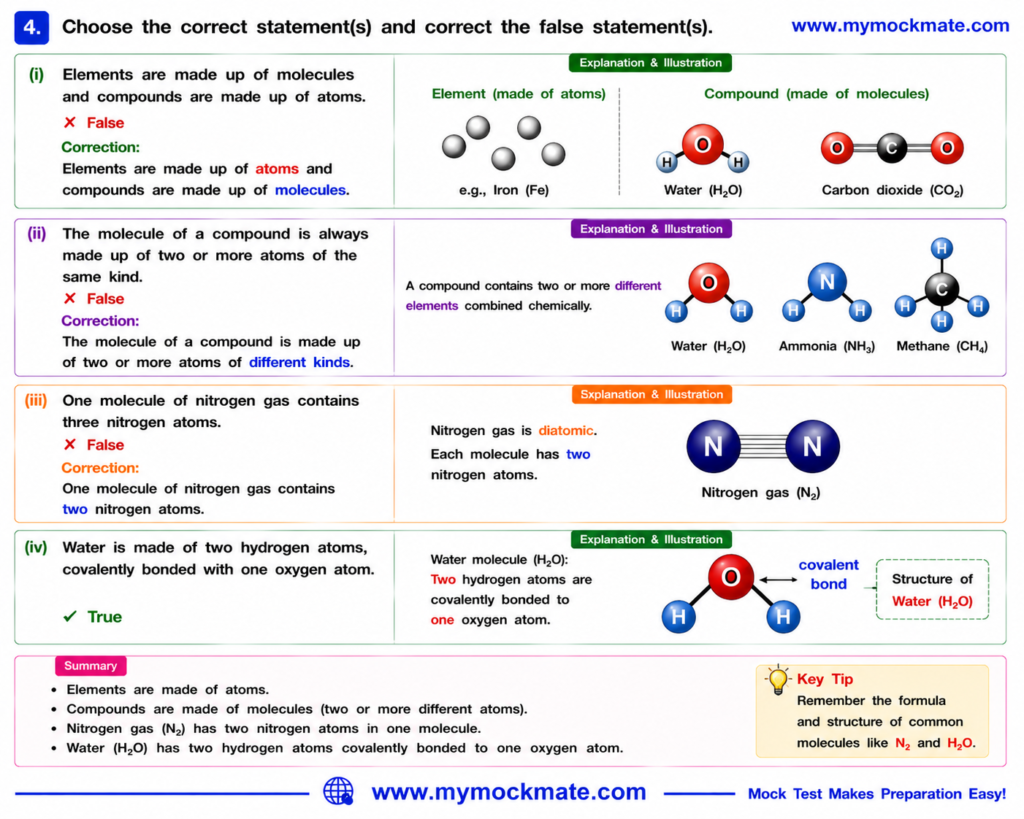
4. Choose the correct statement(s) and correct the false statement(s).
(i) Elements are made up of molecules and compounds are made up of atoms.
(ii) The molecule of a compound is always made up of two or more atoms of the same kind.
(iii) One molecule of nitrogen gas contains three nitrogen atoms.
(iv) Water is made of two hydrogen atoms, covalently bonded with one oxygen atom.
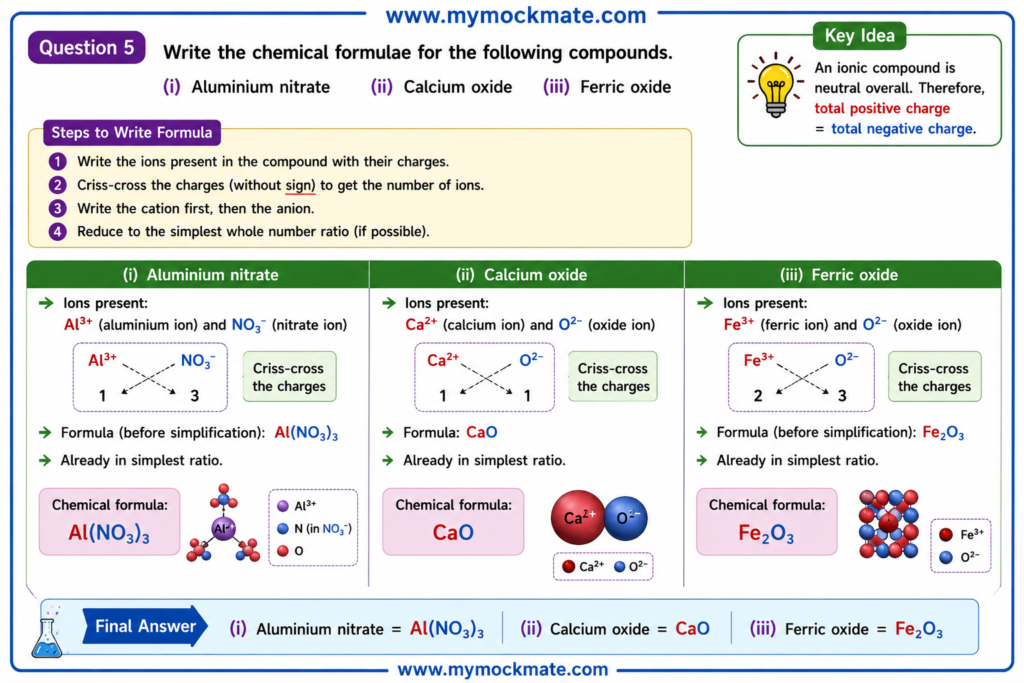
5. Write the chemical formulae for the following compounds.
(i) Aluminium nitrate (ii) Calcium oxide (iii) Ferric oxide
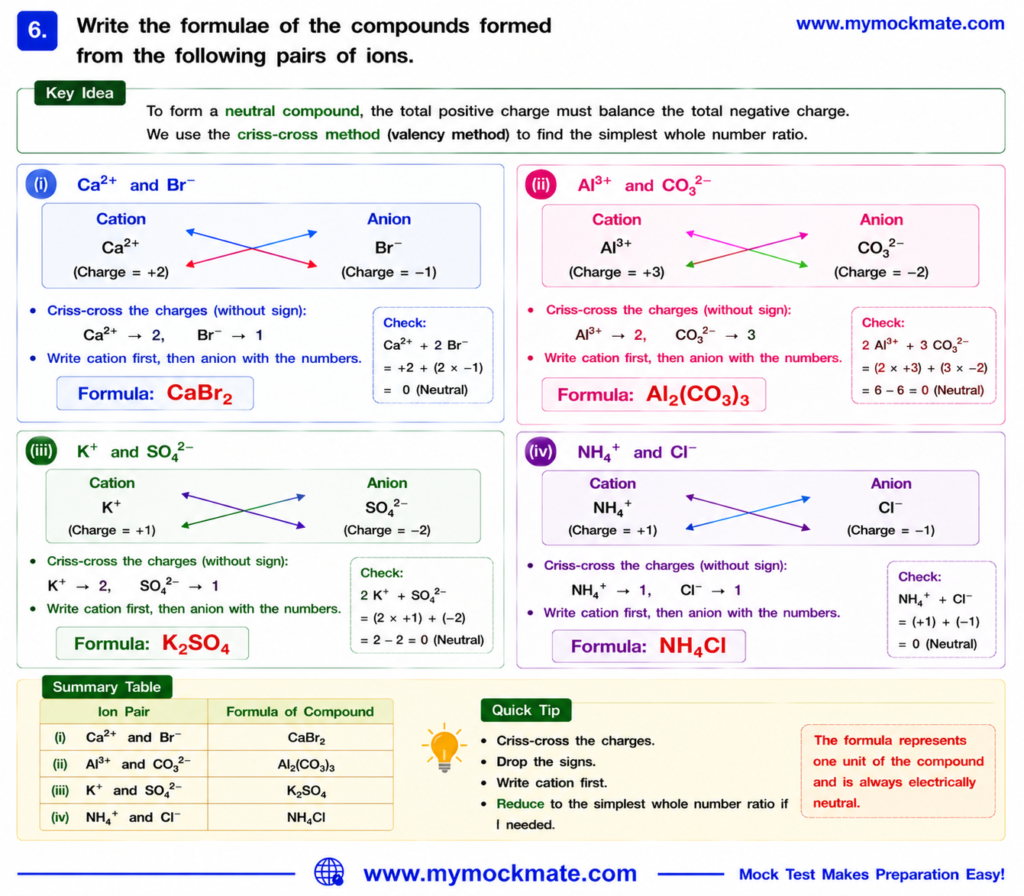
6. Write the formulae of the compounds formed from the following pairs of ions.
(i) Ca2+ and Br–
(ii) Al3+ and CO32-
(iii) K+ and SO42-
(iv) NH4+ and Cl–
7. Which of the following, in Fig. 9.18, correctly represents Cl– ion (Atomic number of chlorine = 17).

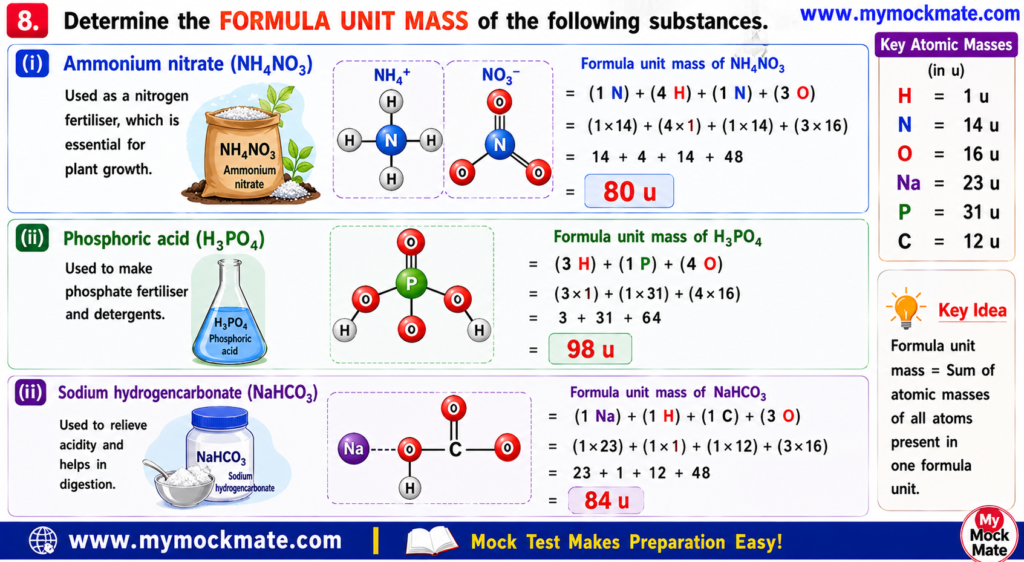
8. Determine the formula unit mass of the following substances.
(i) Ammonium nitrate (NH4NO3), used as a nitrogen fertiliser, which is essential for plant growth.
(ii) Phosphoric acid (H3PO4), used to make phosphate fertiliser and detergents.
(iii) Sodium hydrogencarbonate (NaHCO3), used to relieve acidity and helps in digestion.
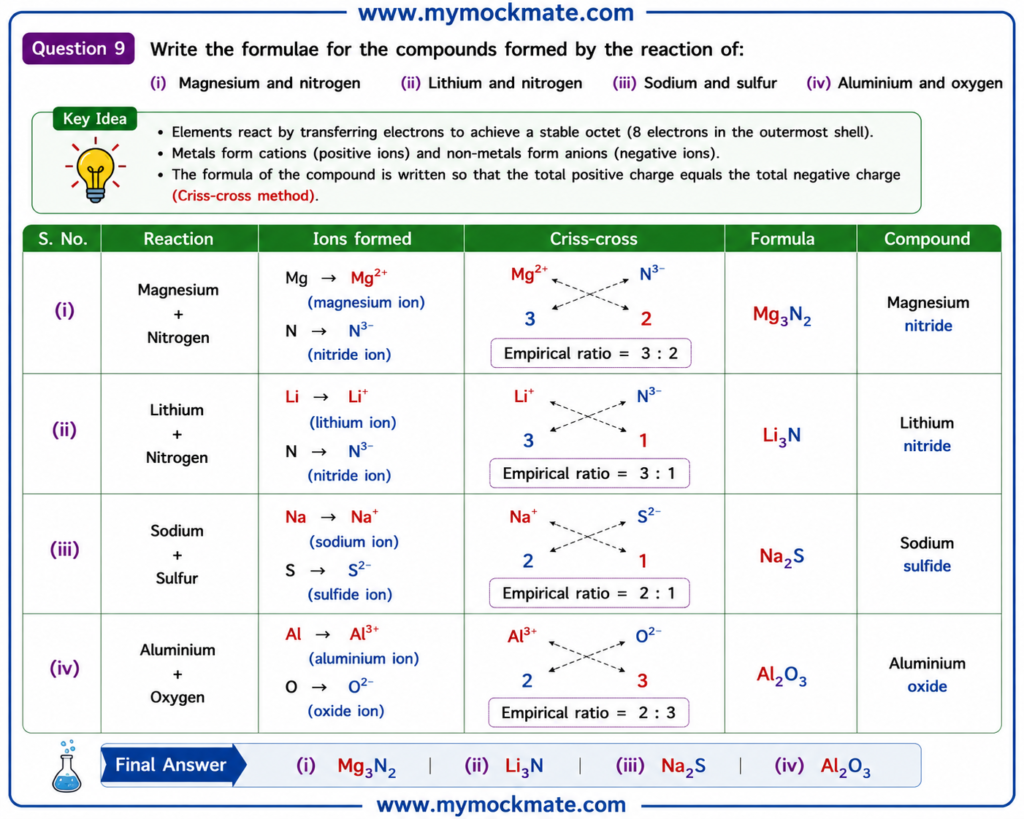
9. Write the formulae for the compounds formed by the reaction of:
(i) Magnesium and nitrogen (ii) Lithium and nitrogen
(iii) Sodium and sulfur (iv) Aluminium and oxygen
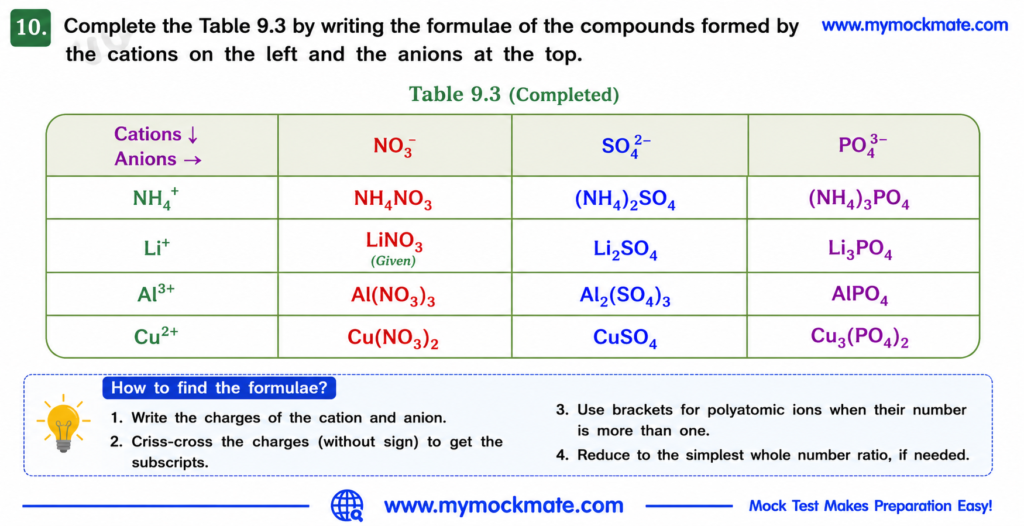
10. Complete the Table 9.3 by writing the formulae of the compounds formed by the cations on the left and the anions at the top. LiNO3 is given as an example.
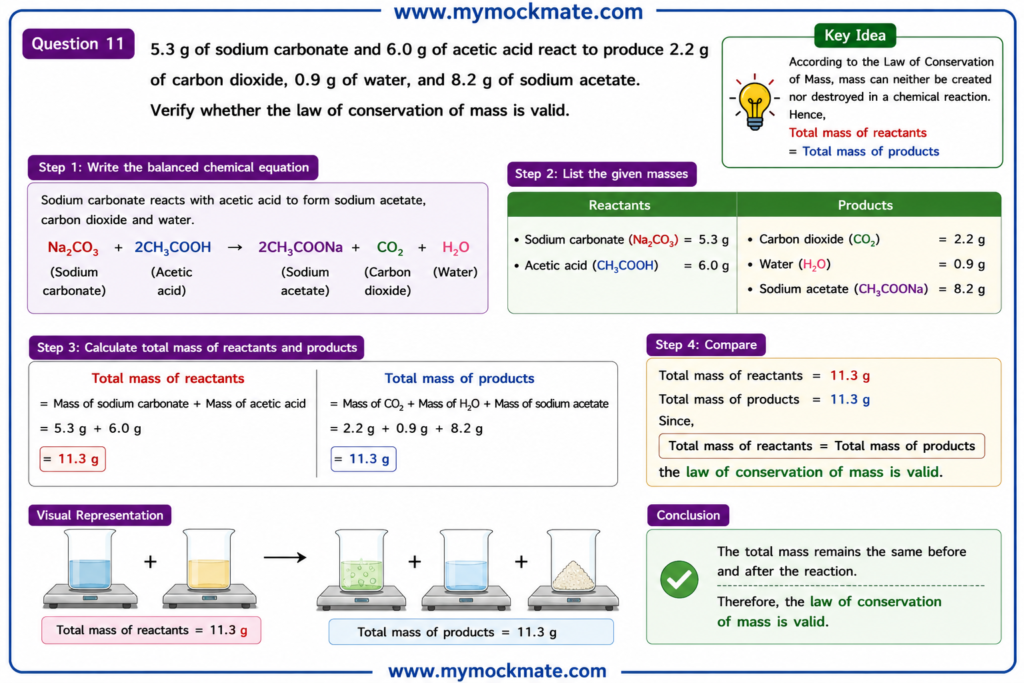
11. 5.3 g of sodium carbonate and 6.0 g of acetic acid react to produce 2.2 g of carbon dioxide, 0.9 g of water, and 8.2 g of sodium acetate. Verify whether the law of conservation of mass is valid.
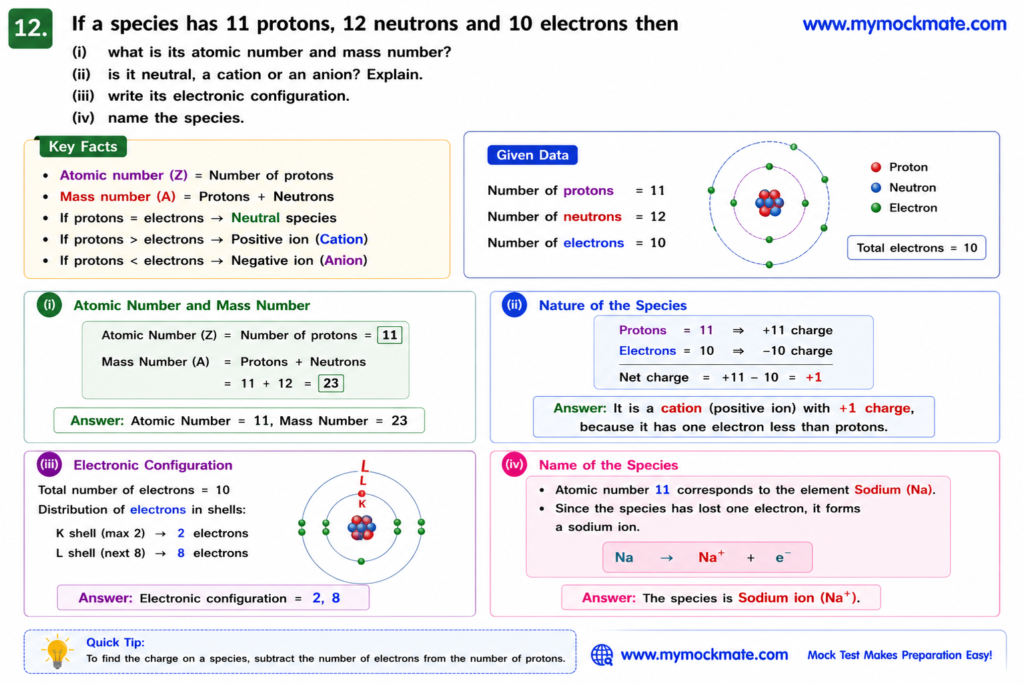
12. If a species has 11 protons, 12 neutrons and 10 electrons then
(i) what is its atomic number and mass number?
(ii) is it neutral, a cation or an anion? Explain.
(iii) write its electronic configuration.
(iv) name the species.
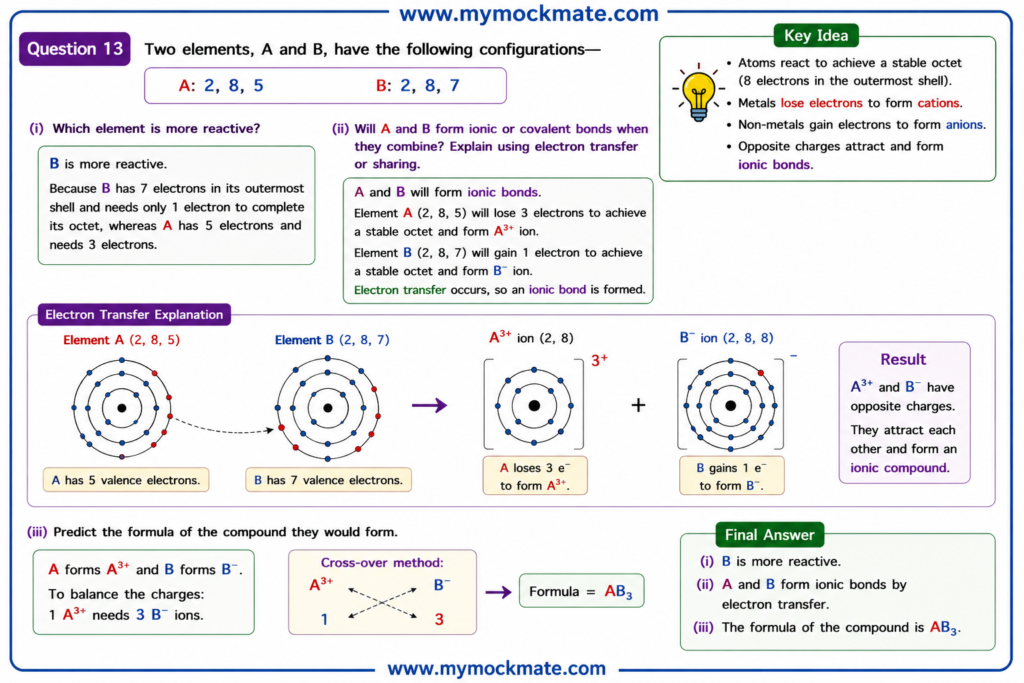
13. Two elements, A and B, have the following configurations —
A: 2, 8, 5 B: 2, 8, 7
(i) Which element is more reactive?
(ii) Will A and B form ionic or covalent bonds when they combine? Explain using electron transfer or sharing.
(iii) Predict the formula of the compound they would form.
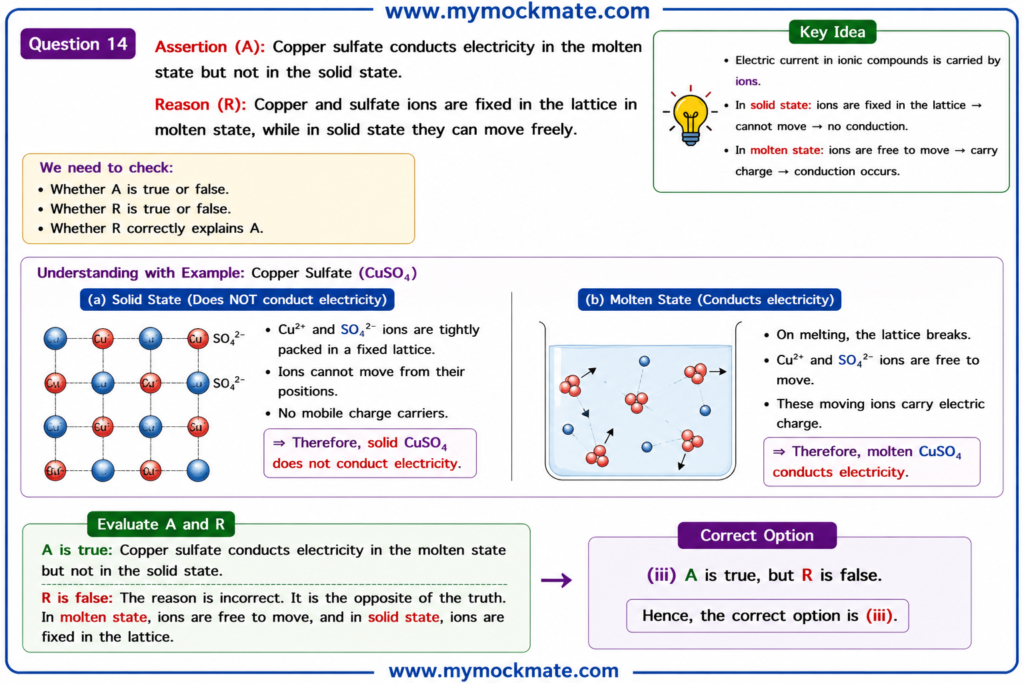
14. Assertion (A): Copper sulfate conducts electricity in the molten state but not in the solid state.
Reason (R): Copper and sulfate ions are fixed in the lattice in molten state, while in solid state they can move freely.
Choose the correct option:
(i) Both A and R are true, and R is the correct explanation of A.
(ii) Both A and R are true, but R is not the correct explanation of A.
(iii) A is true, but R is false.
(iv) A is false, but R is true.
15. The species 27Al, 80Br– and 201Hg2+ have 13, 35 and 80 protons, respectively. How many electrons and neutrons do they have?

The Quest Continues
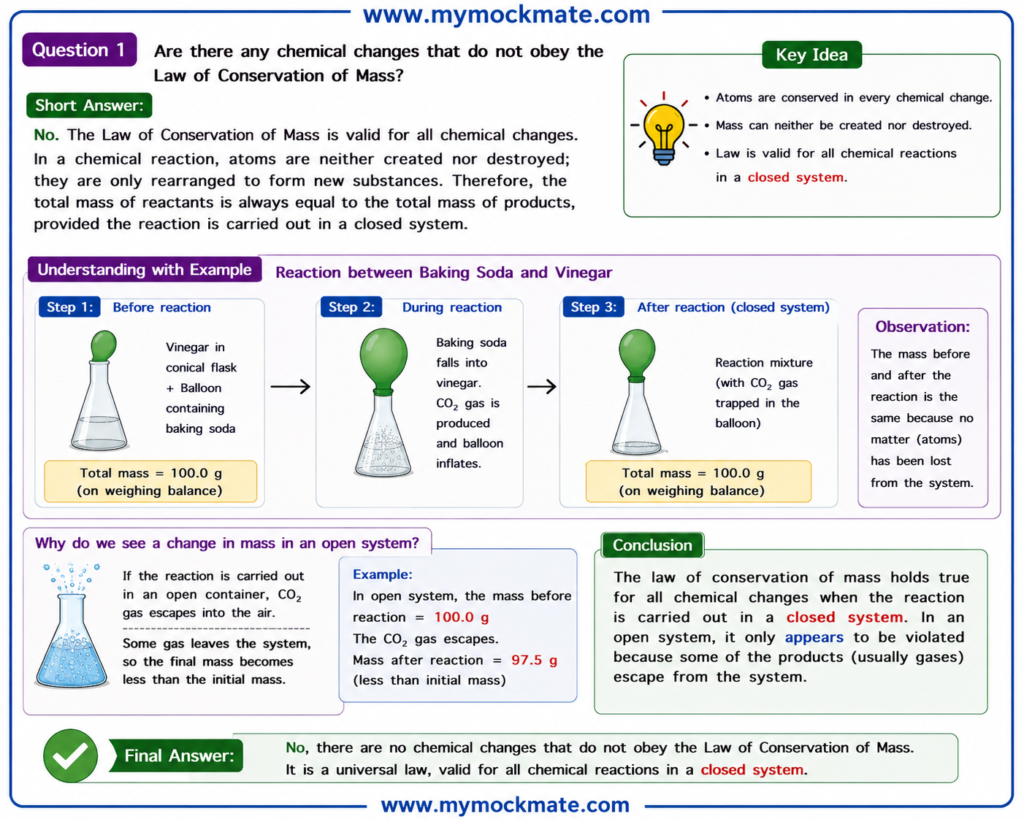
1. Are there any chemical changes that do not obey the Law of Conservation of Mass?
Common Mistakes
- Confusing ionic and covalent bonds
- Writing wrong electronic configurations
- Forgetting brackets in polyatomic ions
- Ignoring charge balancing while writing formulae
- Incorrect molecular mass calculations
Exam Tips
- Learn valencies of common ions.
- Practice criss-cross method regularly.
- Remember definitions of cation and anion.
- Draw bonding diagrams neatly.
- Revise important laws carefully.
Practice MCQs
1. Which bond is formed by sharing electrons?
A. Ionic Bond
B. Covalent Bond
C. Metallic Bond
D. Hydrogen Bond
Answer:
B. Covalent Bond
2. Which particle is positively charged?
A. Electron
B. Neutron
C. Proton
D. Atom
Answer:
C. Proton
3. Formula of magnesium oxide:
A. Mg₂O
B. MgO₂
C. MgO
D. Mg₂O₂
Answer:
C. MgO
4. Compound conducting electricity in aqueous solution is generally:
A. Covalent
B. Ionic
C. Organic
D. Neutral
Answer:
B. Ionic
5. Molecular mass of water:
A. 16 u
B. 17 u
C. 18 u
D. 20 u
Answer:
C. 18 u
FAQ Section
Q1. What is a covalent bond?
A bond formed by sharing electrons between atoms.
Q2. What is an ionic bond?
A bond formed due to transfer of electrons and electrostatic attraction between ions.
Q3. Why do ionic compounds conduct electricity in water?
Because ions become free to move in solution.
Q4. What is molecular mass?
Sum of atomic masses of all atoms in a molecule.
Q5. What is formula unit mass?
Mass of simplest ratio of ions in an ionic compound.
Master Chemistry concepts with detailed notes, solved questions, MCQs, quizzes, and mock tests only on www.mymockmate.com and improve your exam performance today!