NCERT Class 9 Science Chapter 1 Exploration : Entering the World of Secondary Science Questions and Answers
Short Introduction
Science is not only about facts and formulas; it is a way of understanding the world through observation, experimentation, logical thinking, and evidence. Chapter 1, “Exploration: Entering the World of Secondary Science”, introduces students to scientific models, laws, theories, predictions, estimation, and interdisciplinary learning.
This page provides detailed, easy-to-understand, step-by-step solutions to all examples, activities, and thinking questions from the chapter.
Quick Information Box
| Particular | Details |
|---|---|
| Subject | Science |
| Class | 9 |
| Chapter | 1 |
| Chapter Name | Exploration: Entering the World of Secondary Science |
| Board | NCERT / CBSE |
| Difficulty Level | Easy |
| Resource | www.mymockmate.com |
Concepts Used (Topics Covered)
- Scientific Models
- Importance of Assumptions
- Scientific Language and Symbols
- SI Units
- Laws, Theories and Principles
- Scientific Predictions
- Estimation Techniques
- Interdisciplinary Nature of Science
- Evidence-based Reasoning
Important Formulas
1. Time Calculation
Time = Distance ÷ Speed
2. Number of Minutes in One Day
60 × 24 = 1440 minutes
3. Estimation Formula
Estimated Quantity = Number of Events × Average Value
4. Balloon Method for Air Estimation
Total Air = Number of Breaths × Volume per Breath
Pause and Ponder
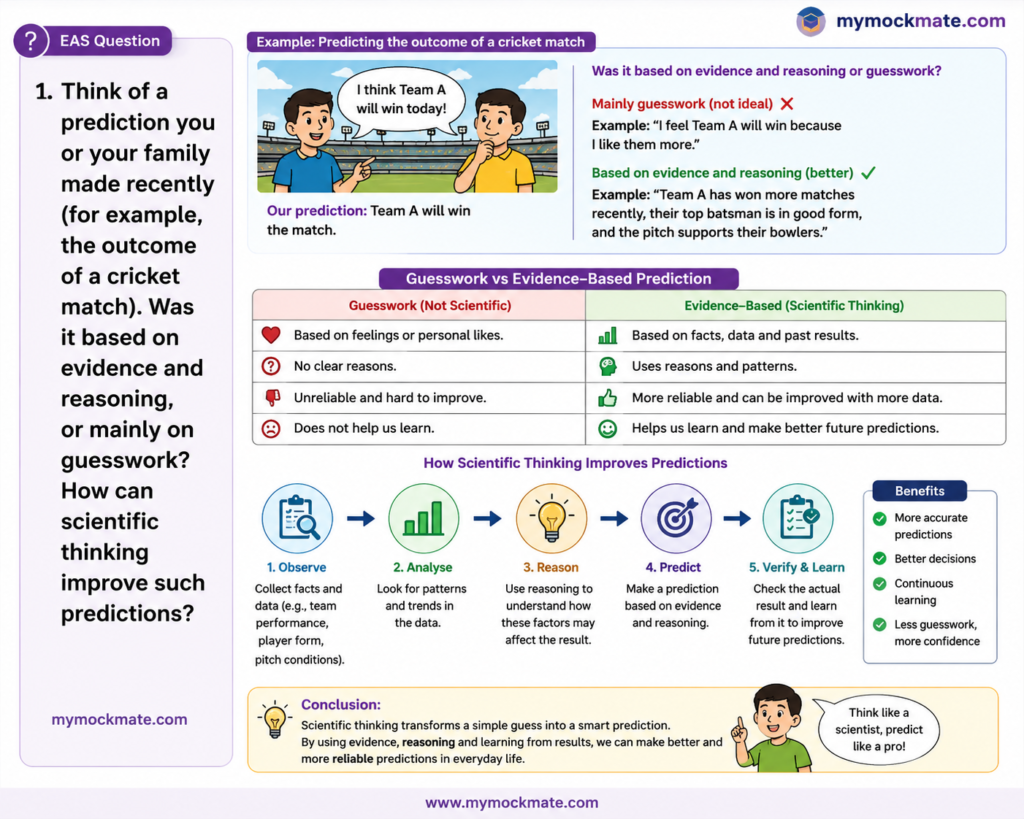
- Think of a prediction you or your family made recently (for example, the outcome of a cricket match). Was it based on
evidence and reasoning, or mainly on guesswork? How can scientific thinking improve such predictions?
- Describe one situation where an approximate answer is good enough, and one where you would need a very exact value.

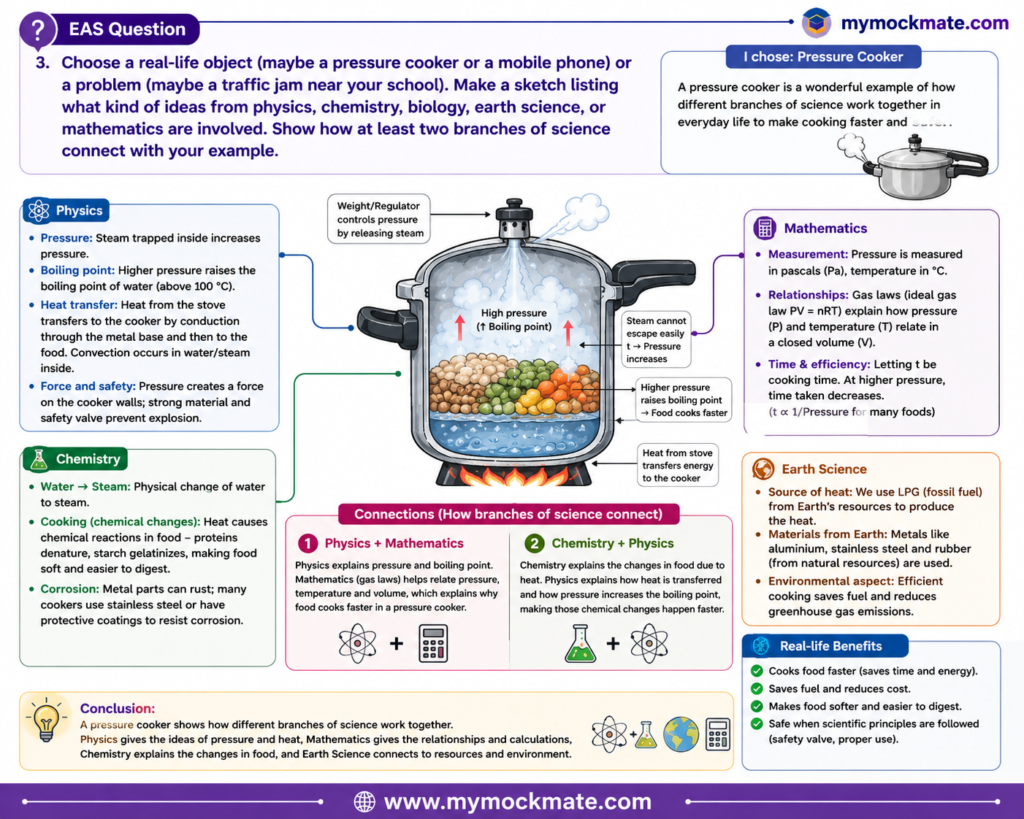
- Choose a real-life object (maybe a pressure cooker or a mobile phone) or a problem (maybe a traffic jam near your school). Make a sketch listing what kind of ideas from physics, chemistry, biology, earth science, or mathematics are involved. Show how at least two branches of science connect with your example
Questions & Step-by-Step Solutions
Example 1.1 : A Cricket Shot
Question
Think of a cricket ball being hit for a six. What details should be included in a simple scientific model, and what details can be ignored?
Solution
Step 1: Identify the Objective
The main objective is to know whether the ball will cross the boundary without touching the ground.
Step 2: Important Factors
- Mass of the ball
- Initial speed
- Direction of hit
- Angle of projection
These directly affect the motion.
Step 3: Less Important Factors
- Colour of the ball
- Brand of the bat
- Grass on the field
- Stitching details
- Minor air resistance effects
These have very little influence in a simple model.
Final Answer
A simple scientific model includes only the factors that significantly affect the outcome. Unnecessary details are ignored to simplify calculations and improve understanding.
Activity 1.1 : Let Us Model
Question
While riding a bicycle from school to home, what details should be included and what can be ignored?
Solution
Important Details
- Distance between school and home
- Average speed
- Traffic conditions
- Road slope
Details that can be ignored
- Bicycle colour
- Dress of the rider
- Brand of the bicycle
- Weather if normal
Why ignore some details?
Ignoring unnecessary information makes the model easier to analyse while still giving accurate results.
Example 1.2 : How Do We Check Predictions?
Question
Varsha says, “It will rain because the clouds look dark.” What scientific questions can Meghna ask?
Solution
A scientific prediction must be based on measurable observations.
Possible questions:
- What is today’s humidity?
- What was the humidity during the last rainfall?
- Is atmospheric pressure decreasing?
- What is the wind direction?
- Is the temperature falling?
Final Answer
Scientific predictions require measurable evidence rather than personal opinion.
Common Mistakes
- Confusing theory with a guess.
- Memorising formulas without understanding concepts.
- Ignoring SI units.
- Giving opinion-based instead of evidence-based answers.
- Treating estimation as exact calculation.
Exam Tips
✅ Write answers in points.
✅ Mention scientific reasoning.
✅ Use examples wherever possible.
✅ Highlight keywords like “evidence”, “model”, “prediction”, “estimation”.
✅ Draw simple diagrams if required.
Practice MCQs
Q1. Science uses models because:
A. Reality is simple
B. Reality is complex
C. Models are always exact
D. Scientists prefer guessing
Answer: B
Q2. A scientific theory is:
A. A random guess
B. An untested idea
C. An evidence-based explanation
D. A belief
Answer: C
Q3. SI units help to:
A. Increase confusion
B. Standardize measurements
C. Eliminate mathematics
D. Reduce observations
Answer: B
Q4. Approximation is useful because:
A. It avoids thinking
B. It provides reasonable estimates
C. It replaces experiments
D. It is always exact
Answer: B
FAQ Section
Q1. What is a scientific model?
A simplified representation of a real-world system.
Q2. Why are SI units important?
They provide universal standards for measurements.
Q3. What is the difference between a law and a theory?
A law describes patterns, while a theory explains them.
Q4. Why is estimation important?
It helps check whether an answer is reasonable.
Q5. Can scientific theories change?
Yes, when new evidence becomes available.
Looking for more Class 9 Science solutions and chapter-wise practice questions?
Visit www.mymockmate.com for detailed explanations, mock tests, MCQs, and exam preparation resources.