NCERT Class 9th English How I Taught My Grandmother to Read Question Answers
Short Intro
The chapter “How I Taught My Grandmother to Read” by Sudha Murty is an inspiring story that highlights the importance of education, determination, and lifelong learning. The chapter beautifully presents the emotional bond between a granddaughter and her grandmother while conveying the message that learning has no age limit.
This detailed solution guide is specially prepared for students to upload directly on MyMockMate portal in Unicode format. It includes all important question answers, grammar exercises, MCQs, explanations, FAQs, and exam tips.
Quick Information Box
| Topic | Details |
|---|---|
| Chapter Name | How I Taught My Grandmother to Read |
| Author | Sudha Murty |
| Subject | English |
| Theme | Importance of Education |
| Main Message | Learning has no age barrier |
| Literary Form | Short Story |
| Key Characters | Grandmother (Krishtakka), Narrator |
Concepts Used (Topics Covered)
- Reading Comprehension
- Character Analysis
- Theme of Education
- Grammar Exercises
- Vocabulary Development
- Idioms & Binomials
- Past Perfect Tense
- Critical Reflection
- Poetic Appreciation
- Value-Based Learning
Important Formulas / Grammar Rules
Past Perfect Tense Structure
Subject+had+V3+Object
Example:
- She had completed her homework before dinner.
Questions & Step-by-Step Solutions with Explanation
Reflect and Respond Answers
Q1. Why is it important to learn how to read and write?
Answer:
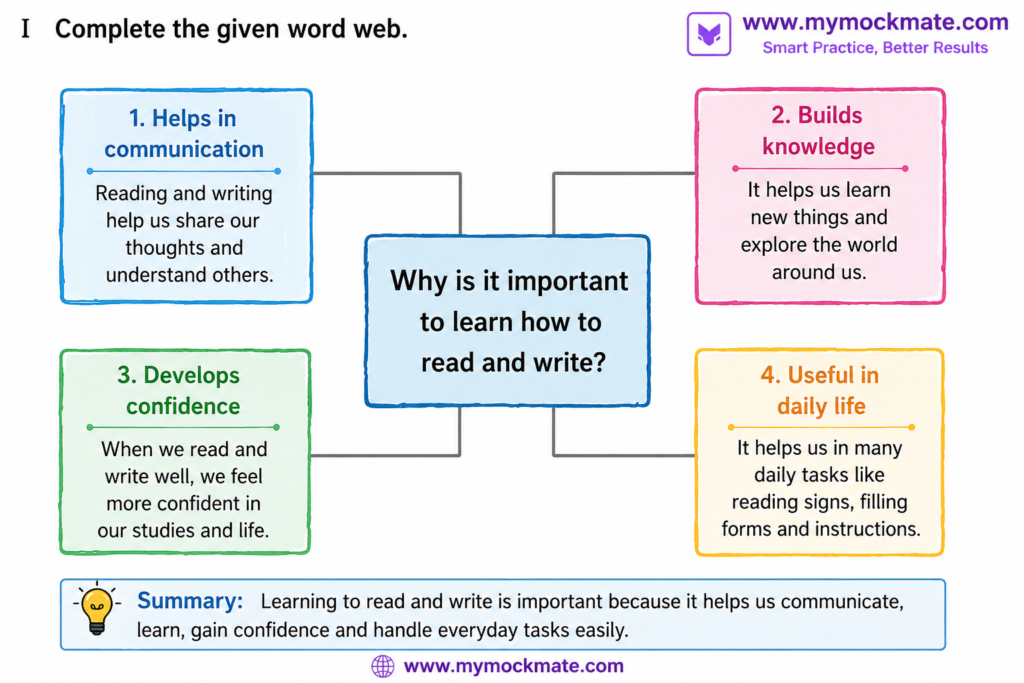
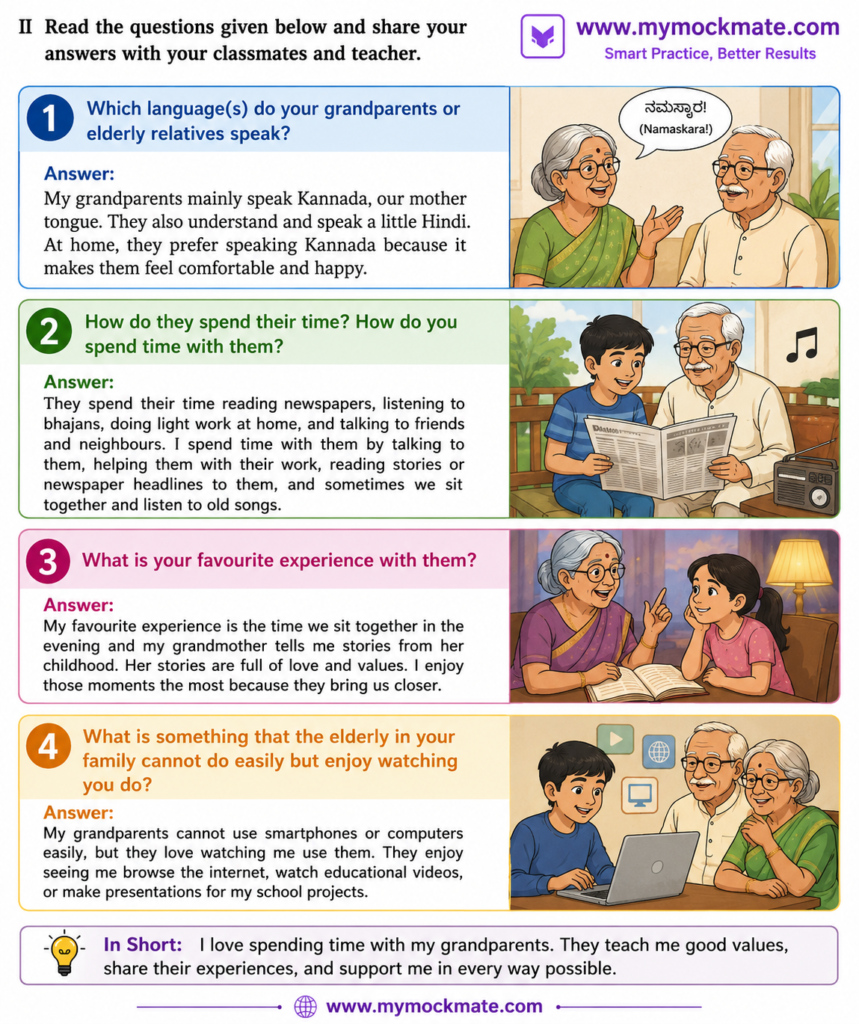
II Read the questions given below and share your answers with your classmates and teacher.
- Which language(s) do your grandparents or elderly relatives speak?
- How do they spend their time? How do you spend time with them?
- What is your favourite experience with them?
- What is something that the elderly in your family cannot do easily but enjoy watching you do?
III Read the following passage. Match the highlighted words with their meanings given in the box below.

Check Your Understanding – Part I
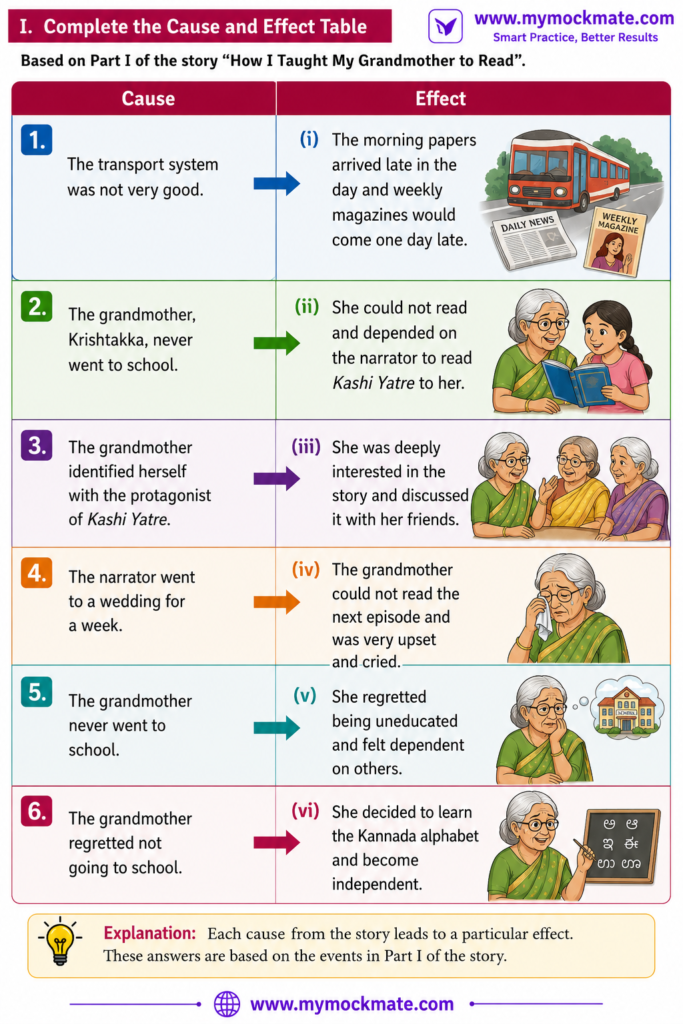
1. Complete the cause and effect table given below based on Part I of the story. Share your answers with your classmates and teacher.
2. Do you think the narrator expected to see her grandmother in tears when she returned to the village? If yes, why? If no, why not?
Answer:

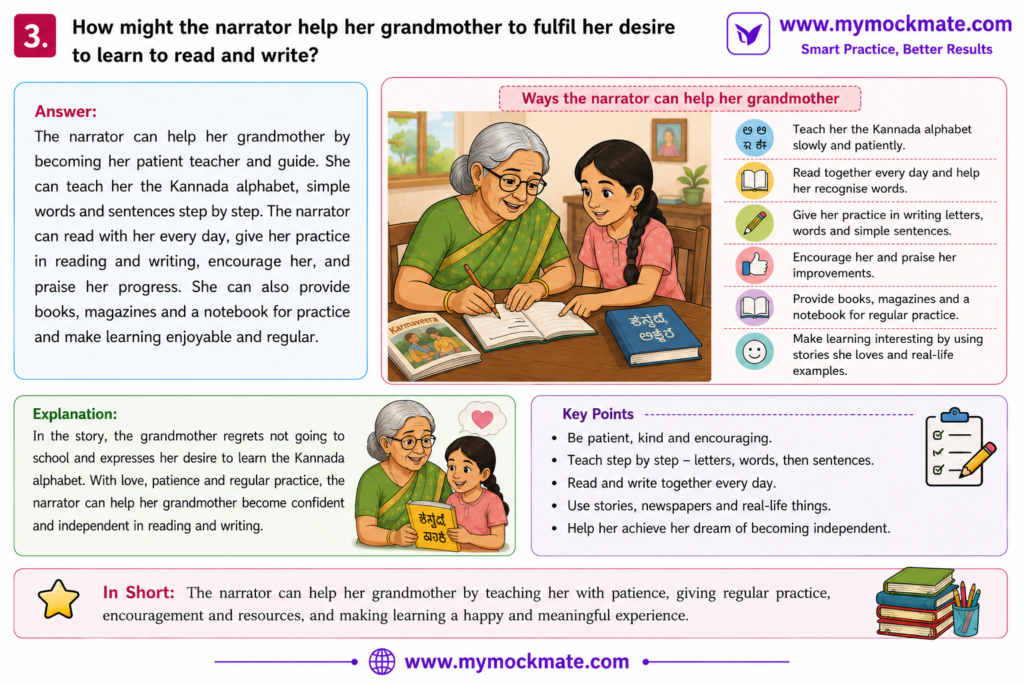
3. How might the narrator help her grandmother to fulfil her desire to learn to read and write?
Answer:
Check Your Understanding
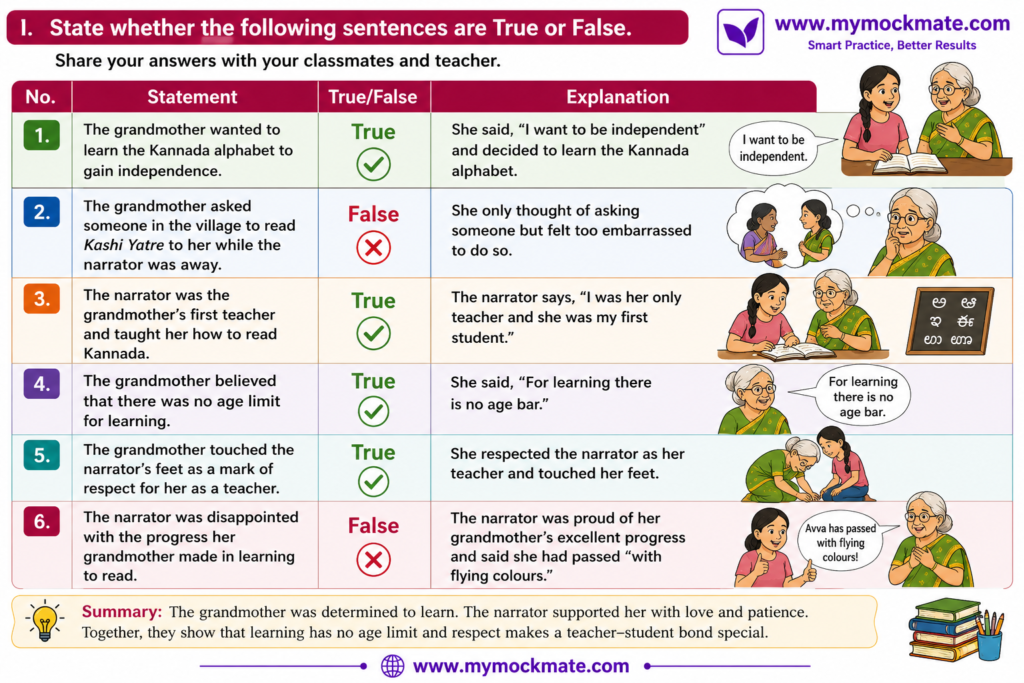
1. State whether the following sentences are true or false.
Critical Reflection
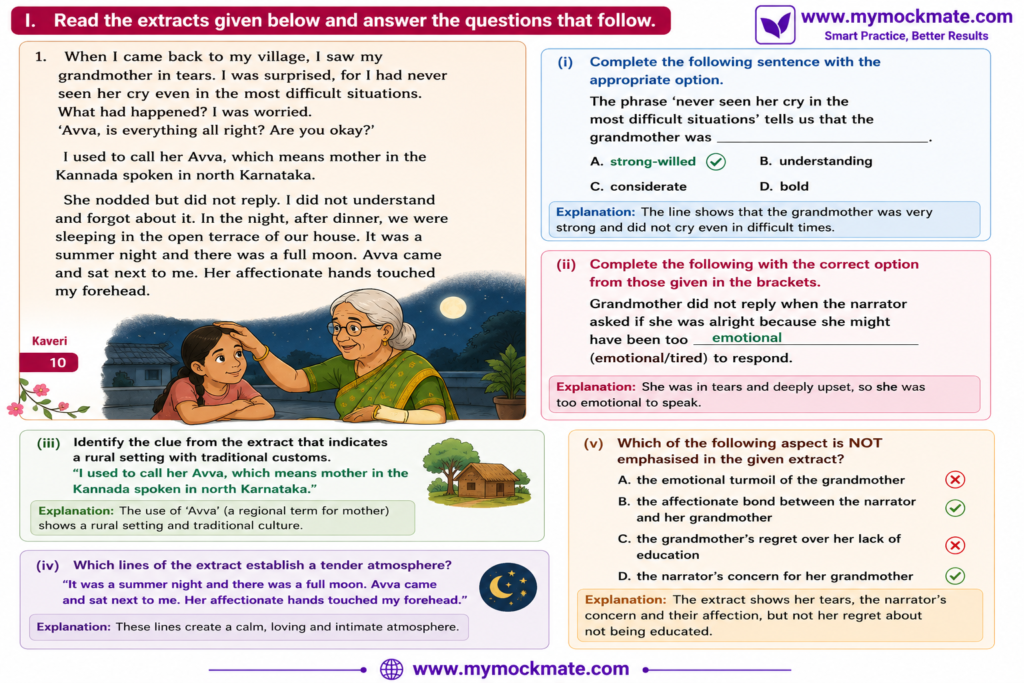
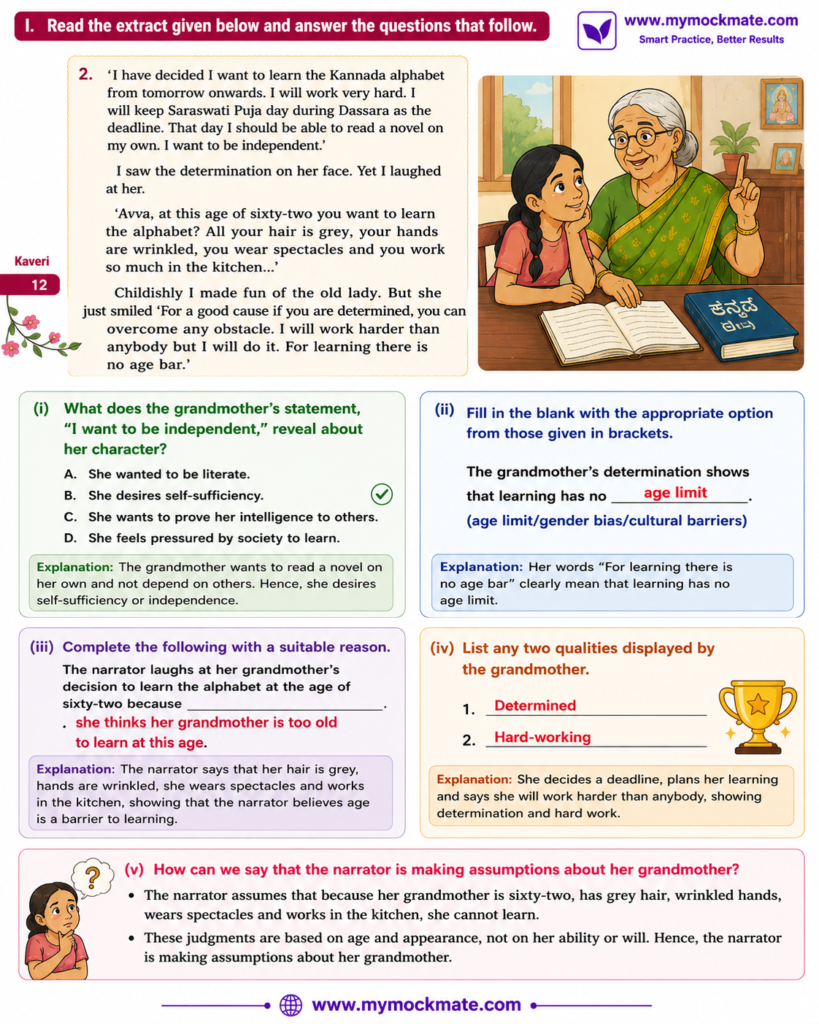
I. Read the extracts given below and answer the questions that follow.
II. Answer the following questions
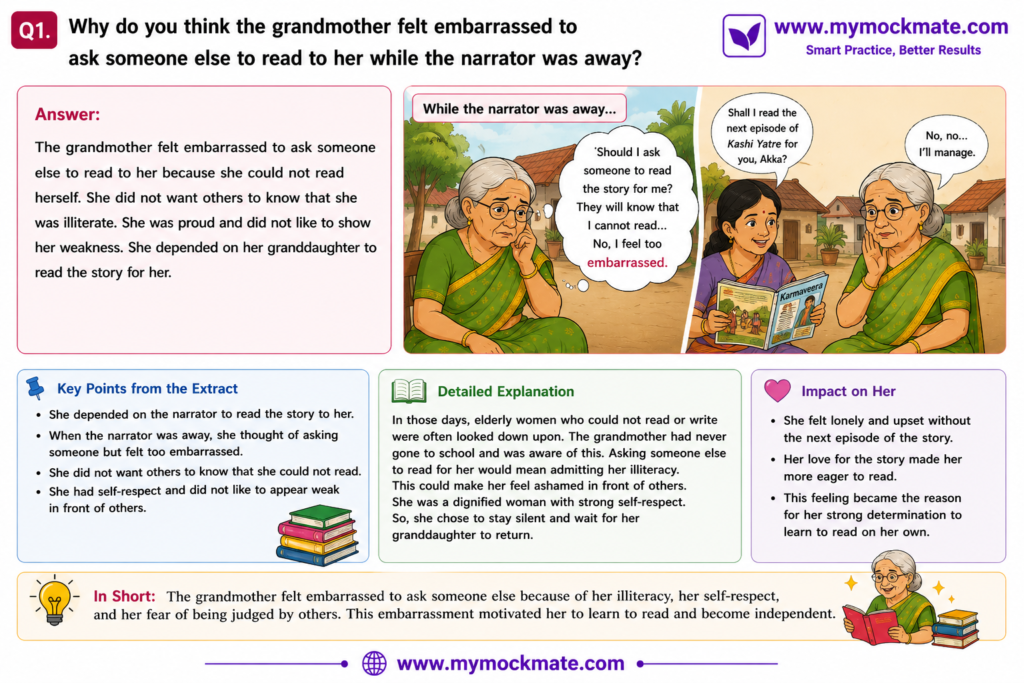
Q1. Why do you think the grandmother felt embarrassed to ask someone else to read to her while the narrator was away?
Answer:
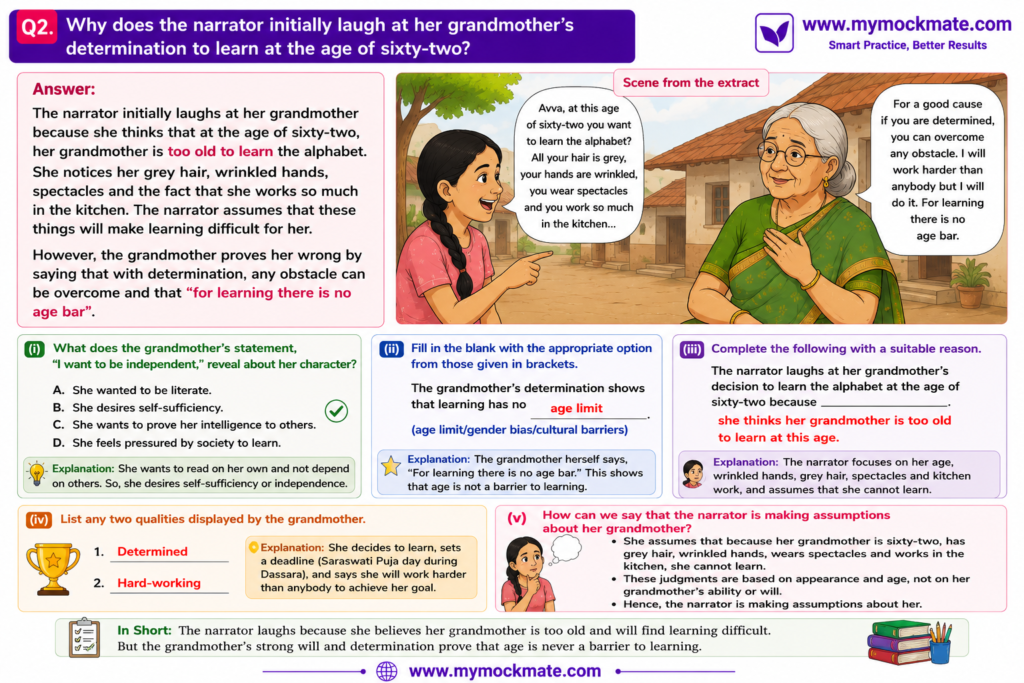
Q2. Why does the narrator initially laugh at her grandmother’s determination to learn at the age of sixty-two?
Answer:
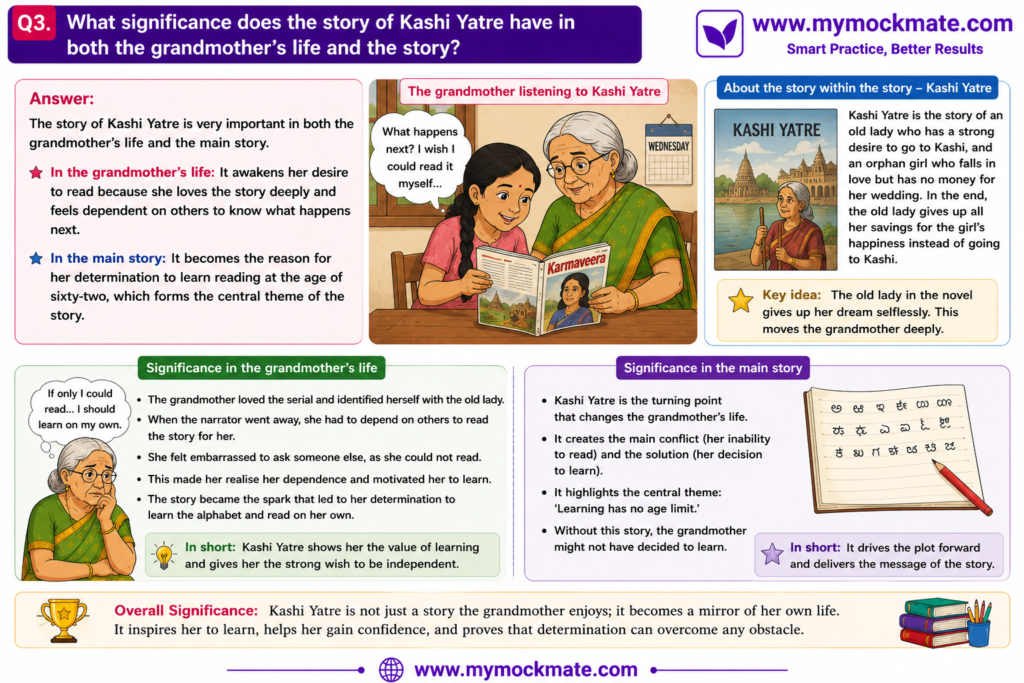
Q3. What significance does the story of Kashi Yatre have in both the grandmother’s life and the story?
Answer:
Q4. What does the grandmother’s desire to learn the Kannada alphabet reflect about her?
Answer:

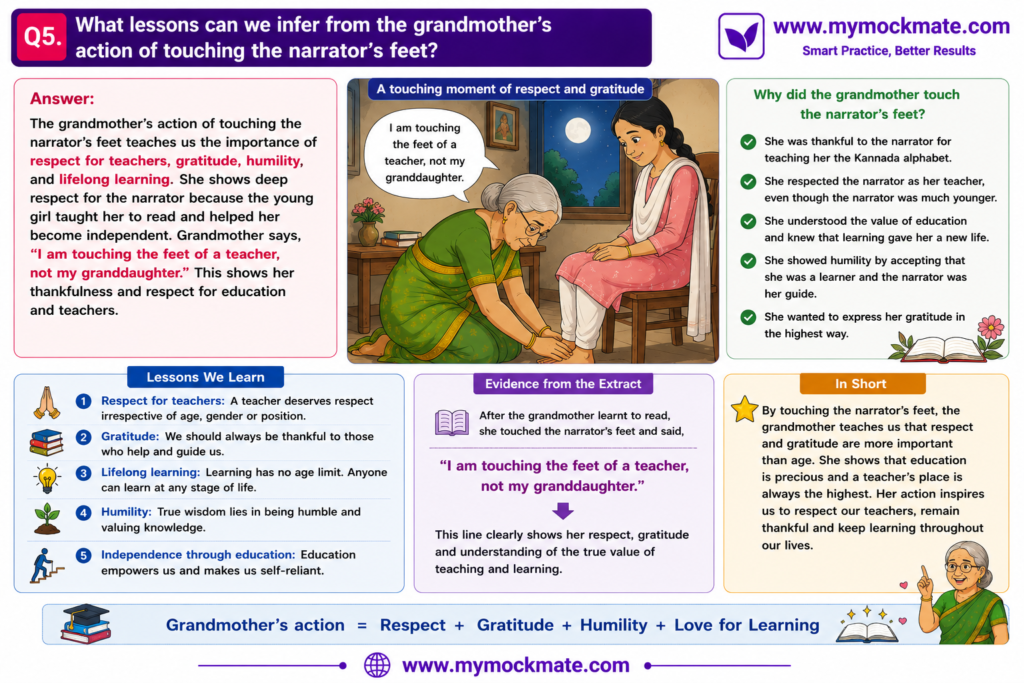
Q5. Lessons from touching narrator’s feet
Answer:
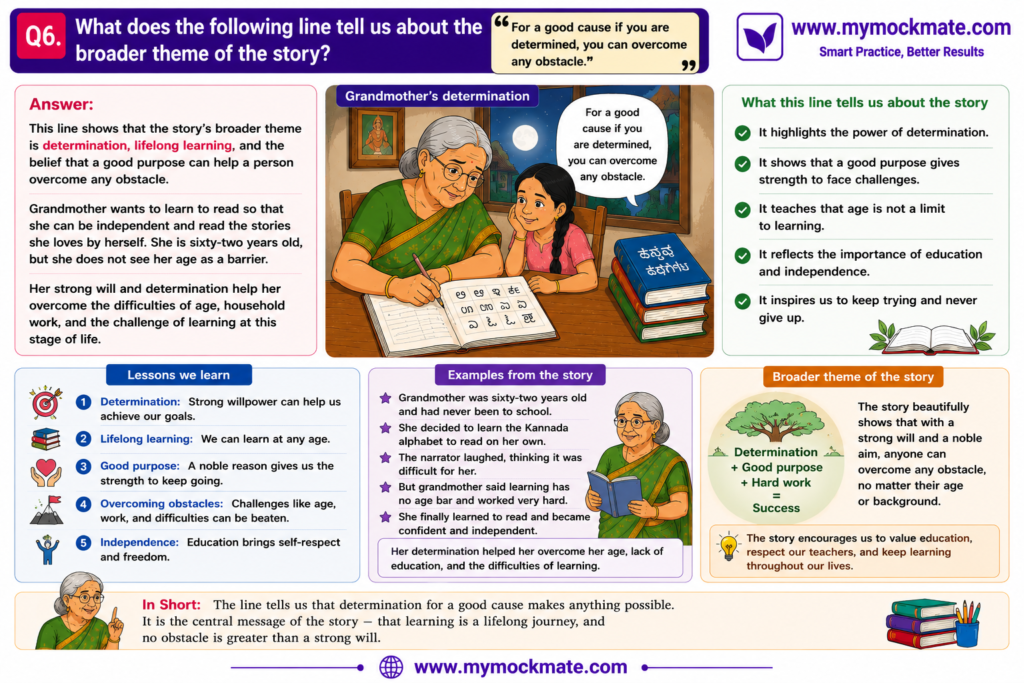
Q6. What does the following line tell us about the broader theme of the story?
‘For a good cause if you are determined, you can overcome any obstacle.’
Answer:
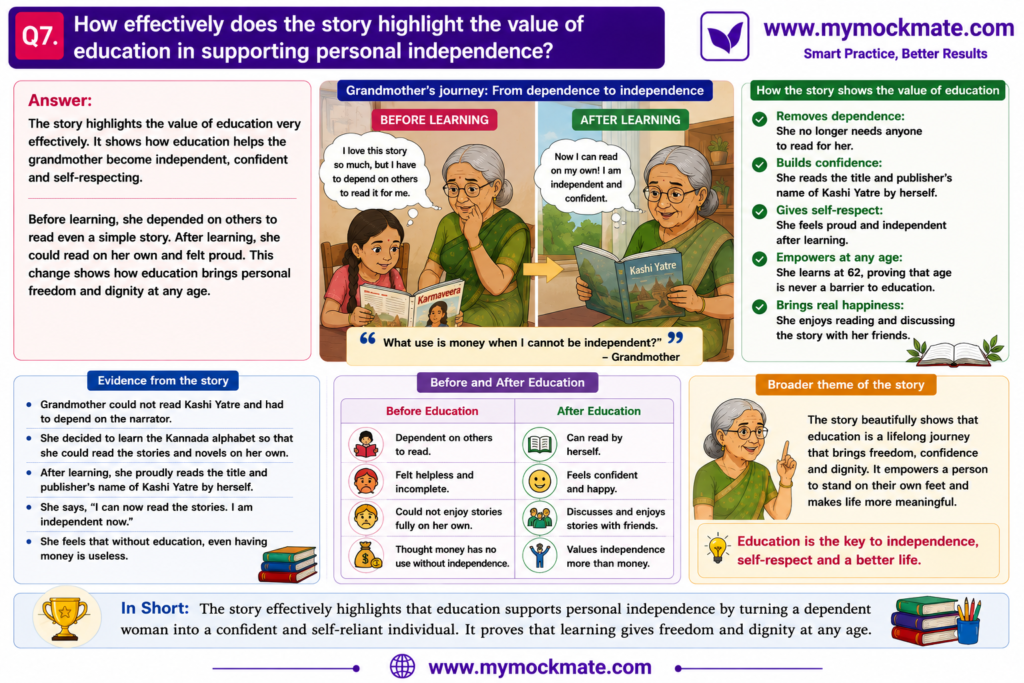
Q7. How effectively does the story highlight the value of education in supporting personal independence?
Answer:
Vocabulary and Structures in Context
I. The expression ‘hide and seek’ is used in the text. This is called a binomial.
Binomials are expressions consisting of two words, usually linked by a conjunction like ‘and’ or ‘or’, that are commonly used together in a fixed order. For example: odds and ends, right or wrong. Match the binomials in Column 1 with their meanings in Column 2.

II. Read the following words from the text given below.
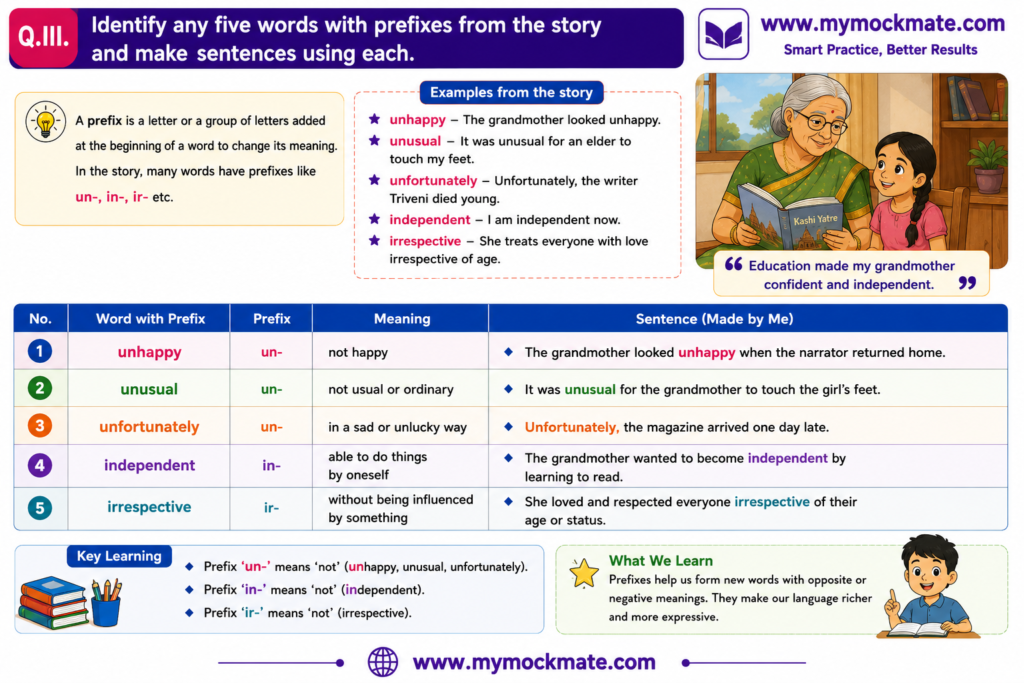
unhappy irrespective unusual
unfortunately independent
These words are made by adding suitable prefixes (‘un’, ‘ir’, and ‘in’) to give an opposite or negative meaning to
the words.
Now, make words by adding the suitable prefixes given in the box to the words from the text in Column 1. Write
the prefixed words in Column 2. One example has been done for you.
un in im
dis mis extra

III. Identify any five words with prefixes from the story and make sentences using each.
IV. In the sentence, “I knew, then, that my student had passed with flying colours”, the phrase “passed with flying colours” is an idiom. It means outstanding performance.
Now, match the idioms related to ‘learning’ given in Column 1 with their meanings in Column 2. You may refer to a dictionary.

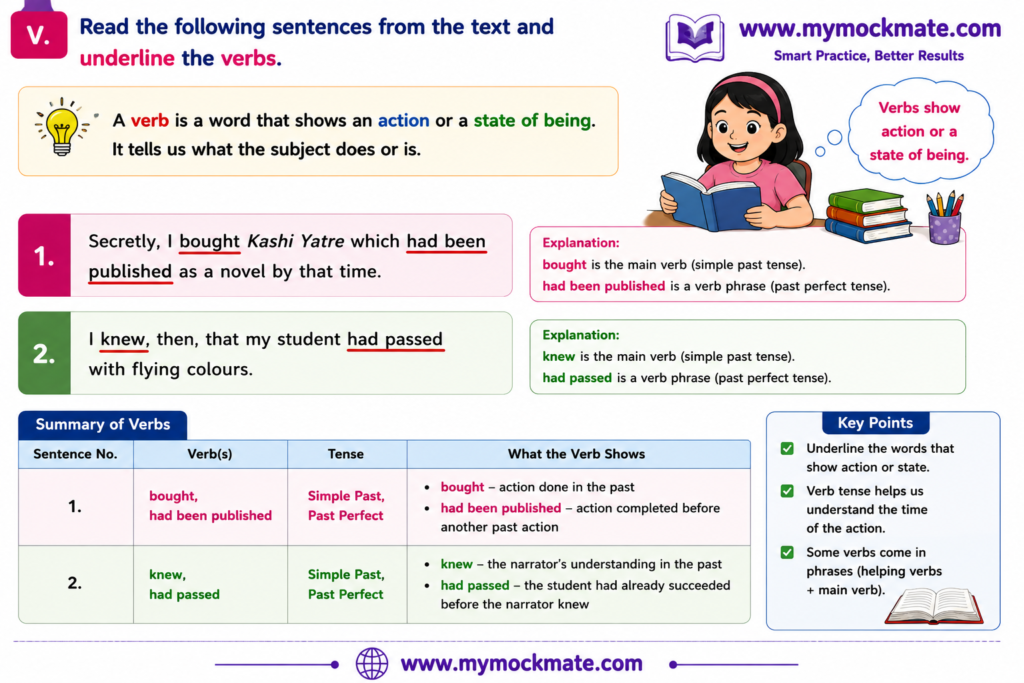
V. Read the following sentences from the text and underline the verbs.
- Secretly, I bought Kashi Yatre which had been published as a novel by that time.
- I knew, then, that my student had passed with flying colours.
Grammar Exercise Solutions
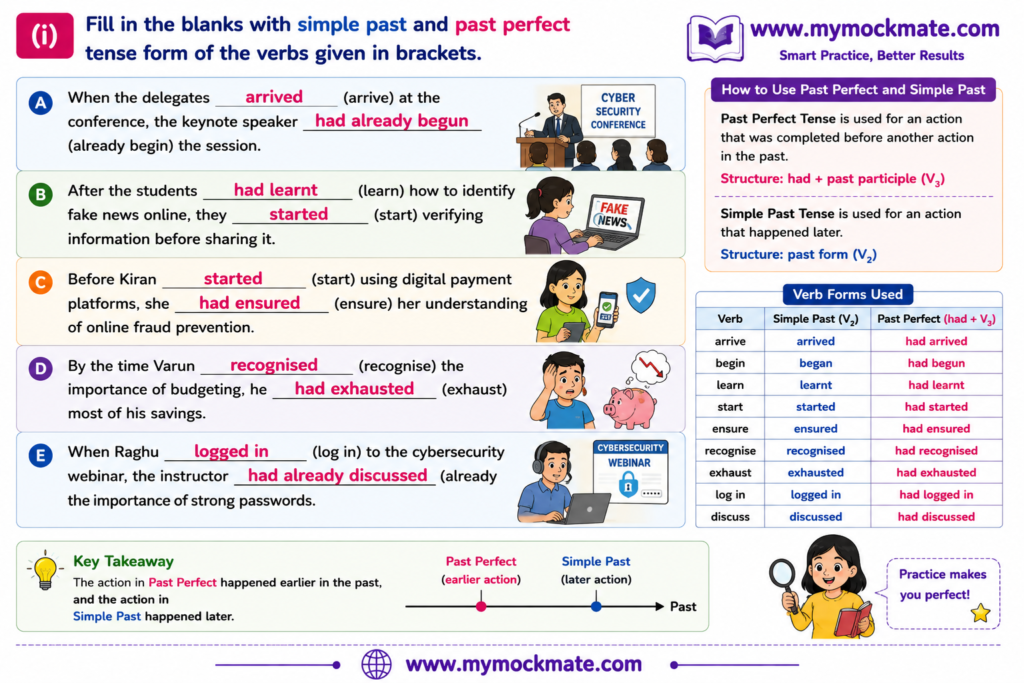
(i) Fill in the blanks with simple past and past perfect tense form of the verbs given in brackets.
(ii) Fill in the blanks with the correct form of verbs given in brackets.

Listen and Respond

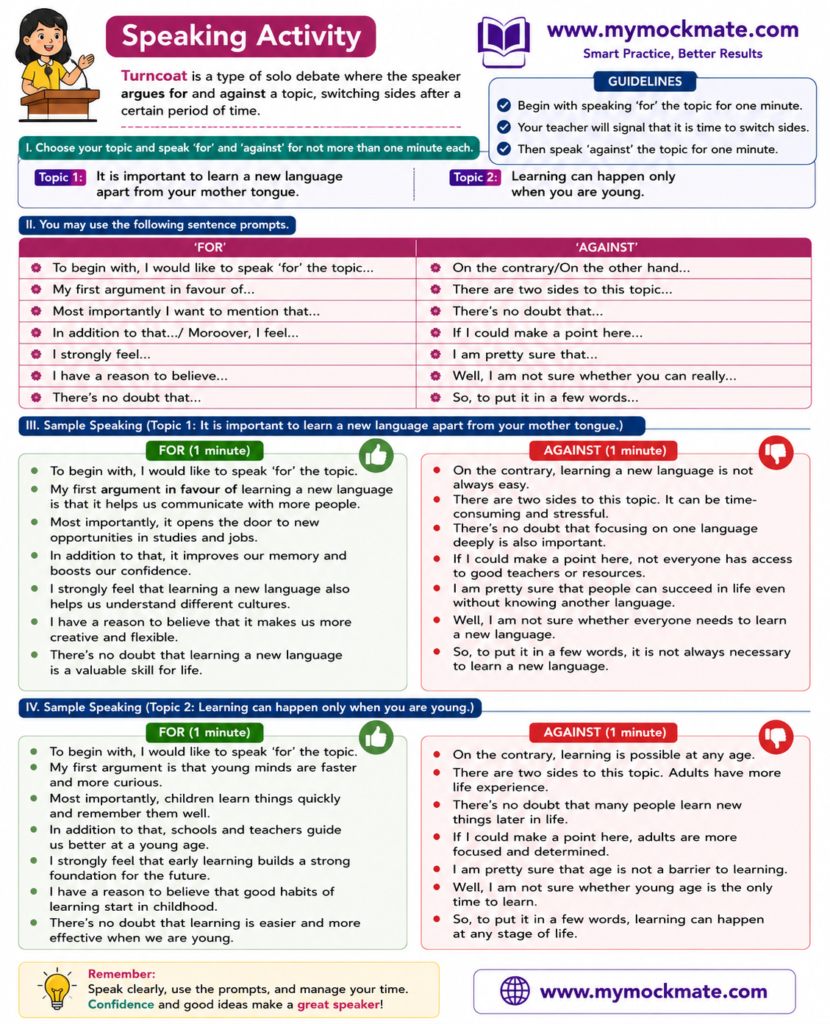
Speaking Activity
Writing Task

Bharat Our Land Solutions
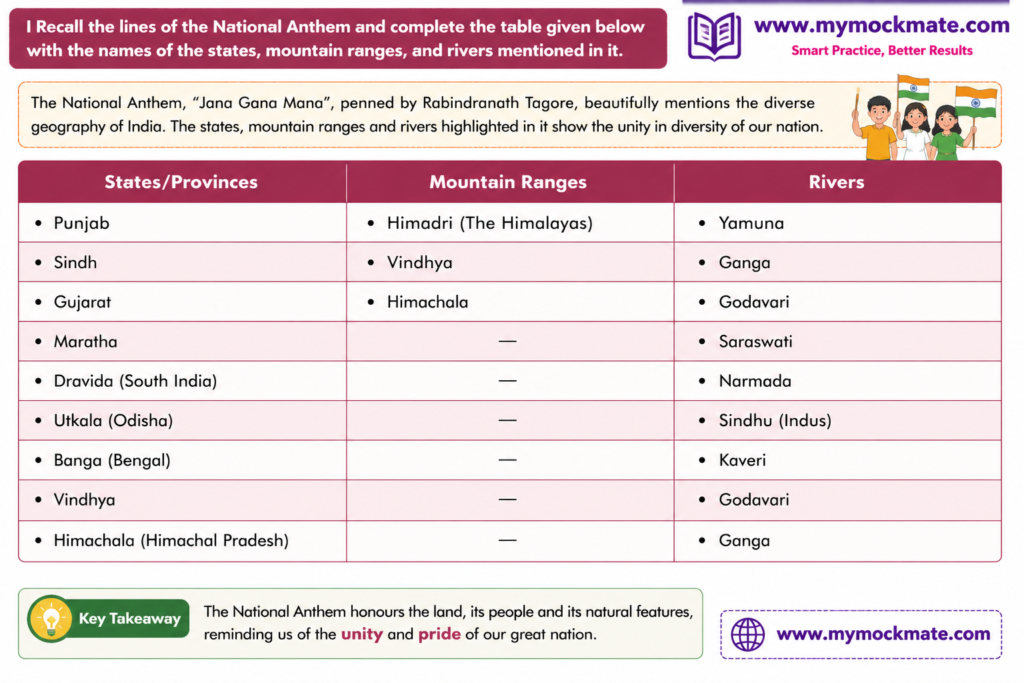
I. Recall the lines of the National Anthem and complete the table given below with the names of the states, mountain ranges, and rivers mentioned in it.
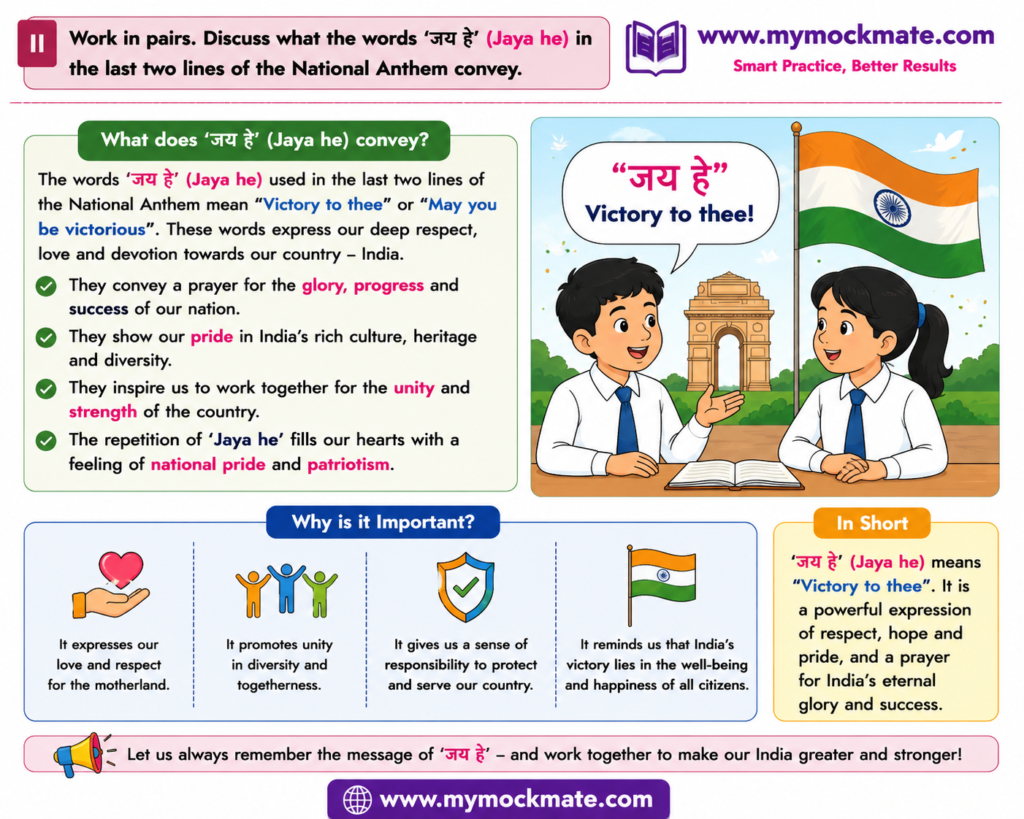
II. Work in pairs. Discuss what the words ‘जय हे ’ (Jaya he) in the last two lines of the National Anthem convey.
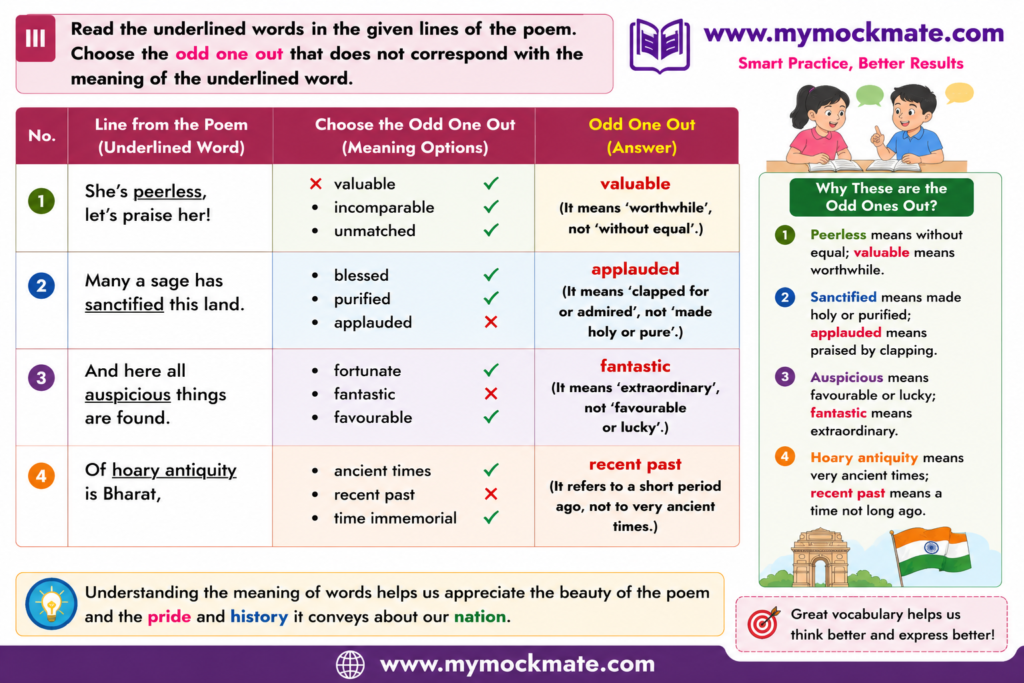
III. Read the underlined words in the given lines of the poem. Choose the odd one out that does not correspond
with the meaning of the underlined word.
Poem Features
| Feature | Answer |
|---|---|
| Mood | Patriotic |
| Tone | Admiring |
| Rhyme Scheme | Free Verse |
| Personification | “Generous Ganga” |
Symbolism Matching
| Symbol | Meaning |
|---|---|
| Himavant | strength |
| Ganga | purity |
| Upanishads | spiritual legacy |
| warriors & sages | courage & wisdom |
| Brahma-knowledge | enlightenment |
| sunny golden land | richness |
Critical Reflection – Poem
Q1. “Mighty” refers to:
Strength of Himavant.
Q2. Question marks are used to:
✅ Emphasise a point.
Q3. Why generous Ganga?
Because it provides water and supports life.
Q4. Why graceful river movement?
Because of its smooth and beautiful flow.
Q5. Upanishads are:
✅ unmatched
Common Mistakes Students Make
- Writing incomplete answers
- Ignoring grammar rules
- Confusing past perfect tense
- Not understanding theme deeply
- Memorising without explanation
Exam Tips
✅ Read the chapter carefully twice
✅ Learn difficult vocabulary
✅ Practice grammar exercises daily
✅ Focus on theme-based questions
✅ Revise idioms and prefixes
Practice MCQs
1. Who wrote “How I Taught My Grandmother to Read”?
A. Ruskin Bond
B. Sudha Murty
C. R.K. Narayan
D. Tagore
✅ Answer: B
2. Why did grandmother want to learn reading?
A. For money
B. For entertainment
C. For independence
D. For job
✅ Answer: C
3. Which novel was grandmother listening to?
A. Malgudi Days
B. Kashi Yatre
C. Gitanjali
D. Discovery of India
✅ Answer: B
4. What message does story give?
A. Age limits learning
B. Money is important
C. Learning has no age barrier
D. Villages are backward
✅ Answer: C
5. Who touched narrator’s feet?
A. Teacher
B. Mother
C. Grandmother
D. Friend
✅ Answer: C
FAQ Section
Q1. What is the main theme of the chapter?
The importance of education and lifelong learning.
Q2. Why did grandmother cry?
Because she could not read the story herself.
Q3. What inspired grandmother to study?
Her desire for independence.
Q4. What lesson do students learn from this story?
Determination and education can change lives.
Q5. Why is the narrator important?
She becomes the grandmother’s teacher.
Q6. What is the significance of Dassara in story?
Grandmother set it as her learning deadline.
Q7. What type of story is this?
Inspirational autobiographical story.
Q8. Why is education important?
Education gives confidence, dignity, and independence.
📚 Looking for more detailed chapter solutions, mock tests, grammar practice, and exam preparation resources?
Visit MyMockMate today and boost your learning with high-quality educational content, instant practice tests, and smart preparation tools for school and competitive exams.