NCERT Grade 9 Economics Chapter 8: Problem of Choice Solutions (Part 1)
Quick Facts
Chapter Name
Building Blocks in Economics: The Problem of Choice
Subject
Social Science (Economics)
Grade
NCERT Grade 9
Main Theme
Economics explains how individuals, businesses, and governments make choices because resources are limited but human wants are unlimited. Every choice involves giving up another alternative, known as Opportunity Cost.
Important Points
✔ Human wants are unlimited.
✔ Resources are scarce.
✔ Every economic decision involves a choice.
✔ Opportunity Cost is the value of the next best alternative sacrificed.
✔ Economics helps in efficient use of scarce resources.
✔ Producers, consumers, enterprises and governments all make economic decisions.
Story
The Story of Riya’s ₹500
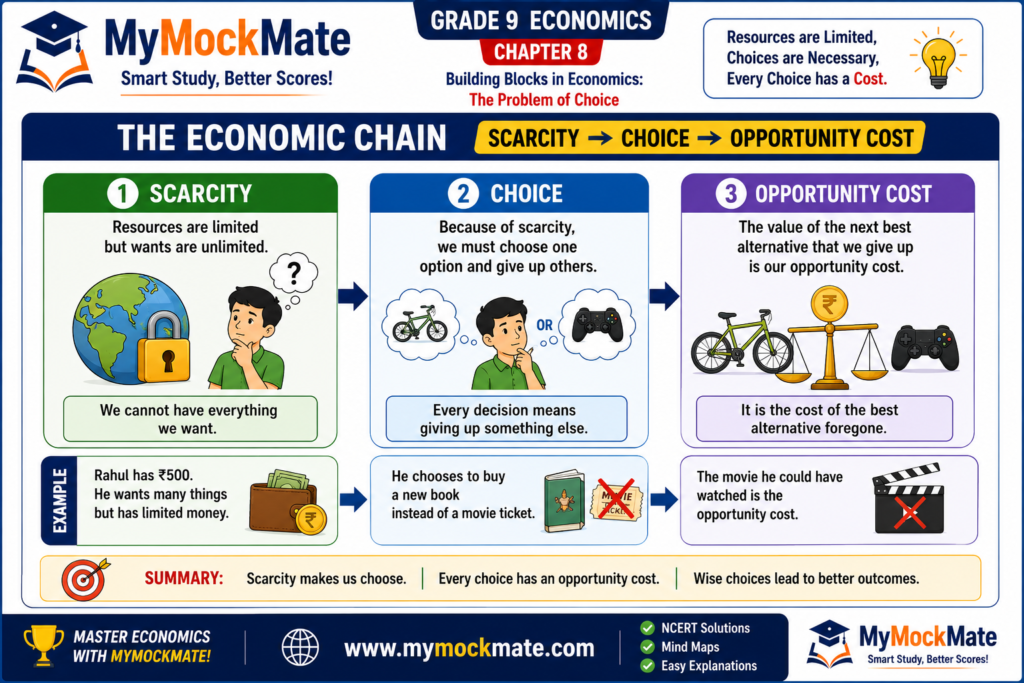
Riya received ₹500 from her parents as a reward for scoring good marks.
She wanted to buy
- A Novel
- Bluetooth Earphones
- A School Bag
- Save Money
But she had only ₹500.
After thinking carefully, she bought the school bag because her old bag was torn.
She postponed buying the earphones.
Here,
Choice Made
➡ Buy School Bag
Opportunity Cost
➡ Bluetooth Earphones
This simple situation explains one of the most important ideas in Economics—
Whenever we choose one option, we sacrifice another option.
That sacrificed option is called Opportunity Cost.
Key Terms
| Term | Meaning |
|---|---|
| Economics | Study of how limited resources satisfy unlimited wants |
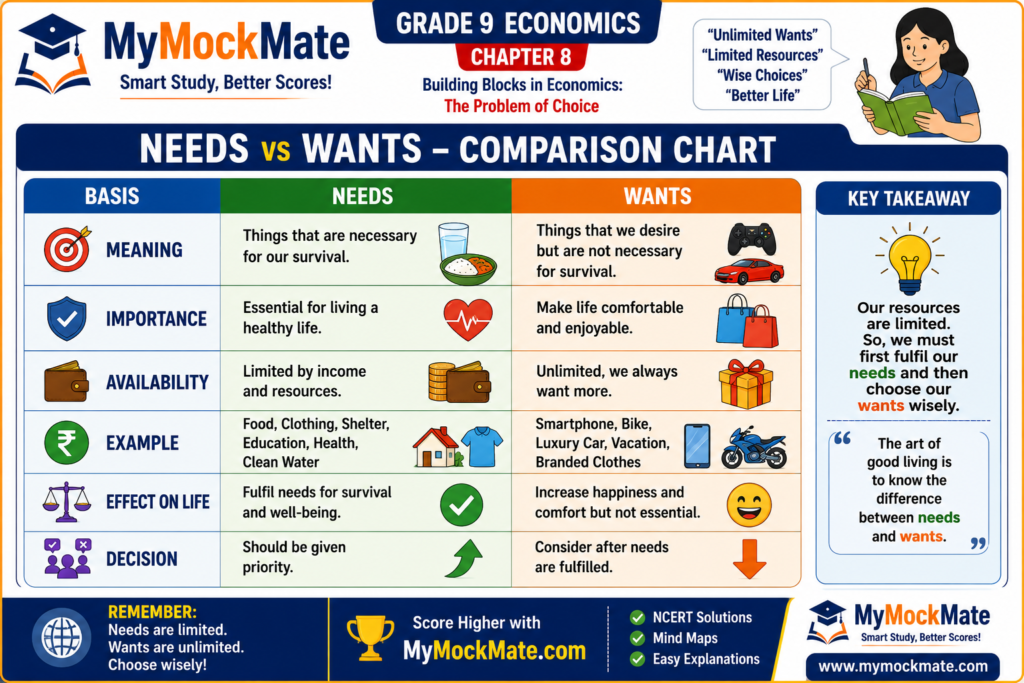
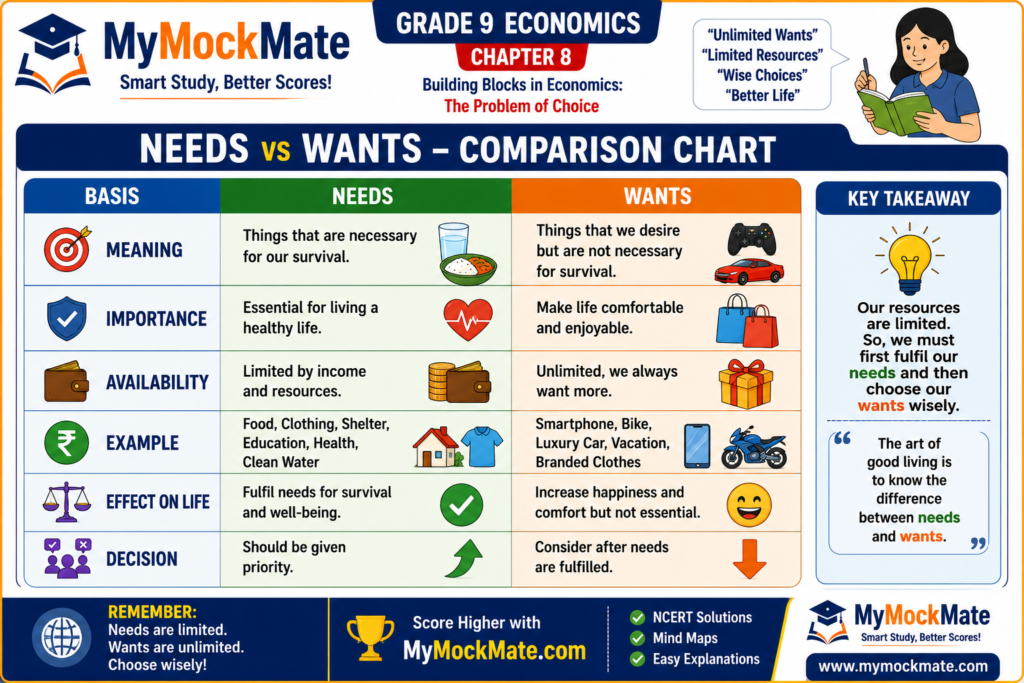
| Need | Something essential for survival |
| Want | Something desirable but not necessary |
| Scarcity | Limited availability of resources |
| Choice | Selecting one alternative from many |
| Opportunity Cost | Value of the next best alternative given up |
| Resource | Anything used to produce goods and services |
| Market | Place where buying and selling takes place |
| Economy | System of production, consumption and distribution |
| Producer | Person or firm producing goods |
| Consumer | Person using goods and services |
| Enterprise | Organization producing goods or services |
These definitions align with the chapter’s explanations of needs, wants, resources, markets, economic entities and opportunity cost.
Memory Tricks
1. Four Factors of Production
LLCT
L → Land
L → Labour
C → Capital
T → Technology
Easy to remember
LLCT = Let’s Learn Cleverly Together
2. Unlimited Wants
Remember
N → Need
W → Want
Needs first
Wants later
3. Economics Formula
Questions & Step-by-Step Solutions
Question 1
Why do you think people’s wants keep changing over time? How does this affect production in an economy? Why cannot all our wants be satisfied?
Step 1: Understanding Human Wants
Human wants are unlimited.
As people grow older, earn more income, learn about new products, or experience changes in lifestyle and technology, their wants also change.
For example
Child
↓
Toy
Teenager
↓
Laptop
Adult
↓
Car
Senior Citizen
↓
Healthcare
Thus, wants are never fixed.
Step 2: Why Wants Keep Changing
Several factors influence changing wants.
Income
Higher income increases purchasing power.
Example
A family buying a motorcycle may later wish to buy a car.
Technology
New inventions create new wants.
Example
Earlier
DVD Player
Now
Smart TV
Fashion
Changing fashion trends create new demands.
Example
Clothing styles change every season.
Education
Education increases awareness about better products and services.
Lifestyle
Urban lifestyles create demand for modern gadgets, fitness equipment and online services.
Step 3: Effect on Production
Because consumer wants keep changing,
Producers must
✔ Produce new goods
✔ Improve quality
✔ Introduce innovation
✔ Study market demand
✔ Use better technology
Example
When smartphones became popular,
many companies stopped producing keypad phones.
Thus production changes according to consumer demand.
Step 4: Why Cannot All Wants Be Satisfied?
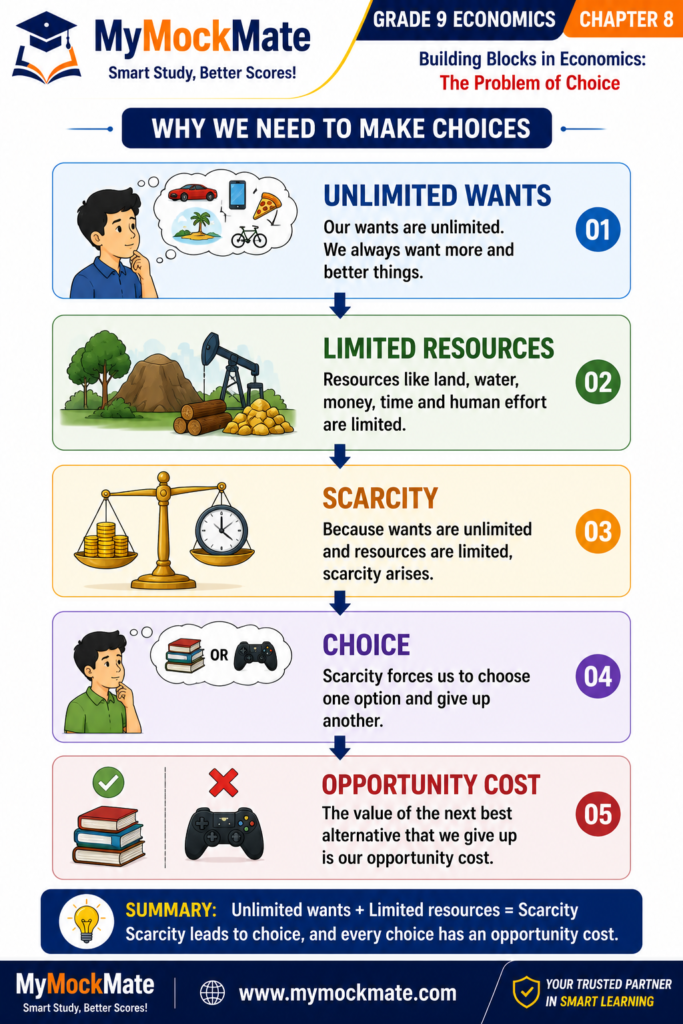
Resources are limited.
Examples include
- Land
- Labour
- Capital
- Water
- Minerals
- Time
Since resources are scarce, it is impossible to satisfy unlimited human wants completely.
People must therefore make choices and accept an opportunity cost.
Flowchart
Final Answer
People’s wants change because of changes in income, technology, education, fashion and lifestyle. These changing wants encourage producers to manufacture new and better products. However, since resources such as land, labour, capital and time are limited, it is impossible to satisfy every human want. Therefore, every individual, business and government must make choices while using available resources. This reflects the chapter’s core idea that unlimited wants must be managed through efficient use of limited resources.
Question 2
‘Human wants are unlimited and keep changing.’ How do you think this constant desire for more creates pressure on the environment? Can the fulfilment of wants and the extraction of resources be balanced?
Step 1: Understanding the Problem
People continuously demand
- More food
- More clothes
- More vehicles
- Bigger houses
- More electronic gadgets
To satisfy these wants,
industries extract more natural resources.
Step 2: Environmental Pressure
Excessive production leads to
Deforestation
Trees are cut for industries and housing.
Water Depletion
Factories and agriculture consume huge quantities of water.
Air Pollution
Factories and vehicles release harmful gases.
Soil Degradation
Overuse of fertilizers and mining damage fertile land.
Climate Change
Burning fossil fuels increases greenhouse gases.
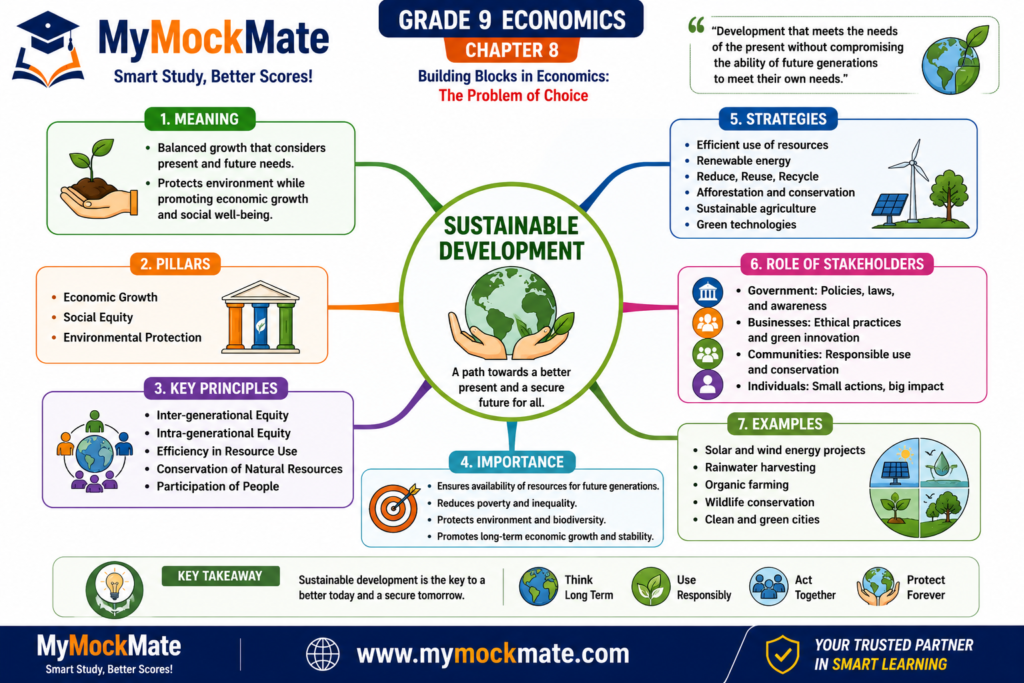
Step 3: Can Balance Be Achieved?
Yes.
Sustainable development allows present needs to be met without harming future generations.
This can be achieved through
✔ Recycling
✔ Renewable Energy
✔ Rainwater Harvesting
✔ Sustainable Farming
✔ Forest Conservation
✔ Public Transport
✔ Responsible Consumption
Example
Instead of buying a new mobile phone every year,
people can
- repair it,
- recycle old devices,
- use products for longer periods.
This reduces pressure on natural resources.
Final Answer
Unlimited wants increase the demand for natural resources, leading to deforestation, pollution, depletion of water and climate change. However, the fulfilment of wants and the extraction of resources can be balanced through sustainable development, responsible consumption, recycling and efficient resource management. Such choices help protect the environment while meeting human needs.
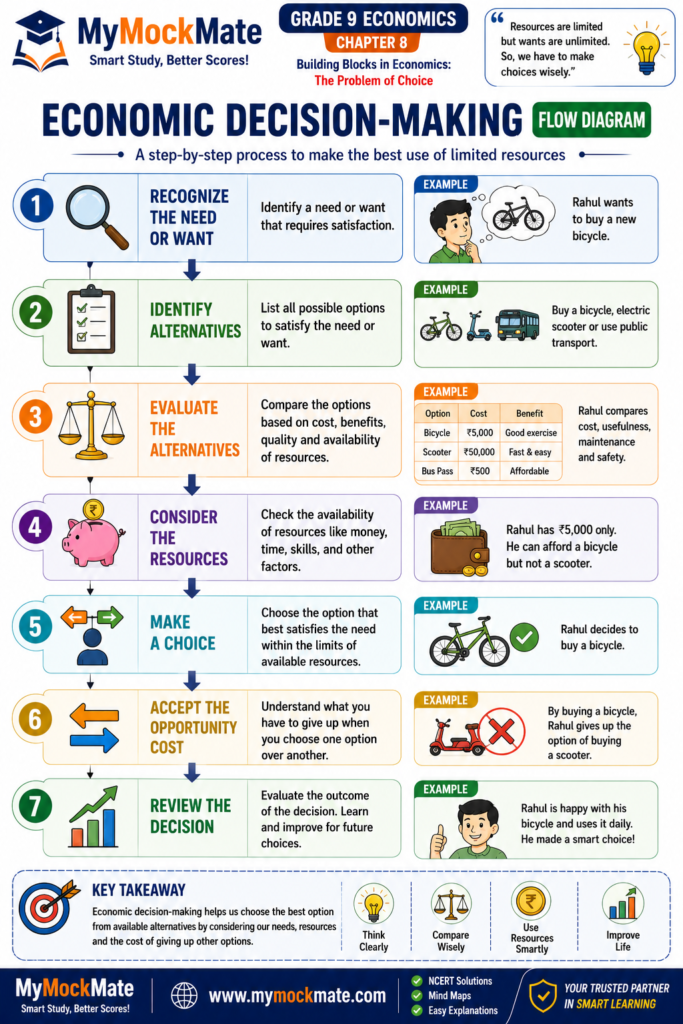
Economic Decision-Making Flow Diagram
📘 Master Economics with MyMockMate
Prepare smarter with www.mymockmate.com!
✅ Complete NCERT Chapter-wise Solutions
✅ Detailed Step-by-Step Answers
✅ Interactive Mock Tests
✅ Chapter Notes & Mind Maps
✅ Practice MCQs & Case Studies
✅ Exam-Oriented Revision Material
👉 Visit: www.mymockmate.com