NCERT Class 12 Maths Exercise 3.1 Solutions – Matrices Guide
Short Intro
Chapter 3 of Class 12 Mathematics (Matrices) focuses on the foundational concepts of arrays. Exercise 3.1 is designed to clear up core ideas regarding the order, elements, construction, and equality of matrices. This comprehensive guide provides step-by-step solutions for all 10 problems in the exercise to help students ace their board and competitive examinations.
Quick Information Box
| Key Metric | Details |
| Board / Syllabus | NCERT / CBSE / State Boards (Class 12) |
| Chapter Name | Chapter 3: Matrices |
| Exercise | Exercise 3.1 |
| Total Questions | 10 (Short answer, long answer, and MCQs) |
| Core Topics | Order of Matrix, Element Identification, Matrix Construction, Equality of Matrices |
Concepts Used (Topics Covered)
To solve this exercise seamlessly, you need to understand the following primary definitions:
- Definition of Matrix: An ordered rectangular array of numbers or functions.
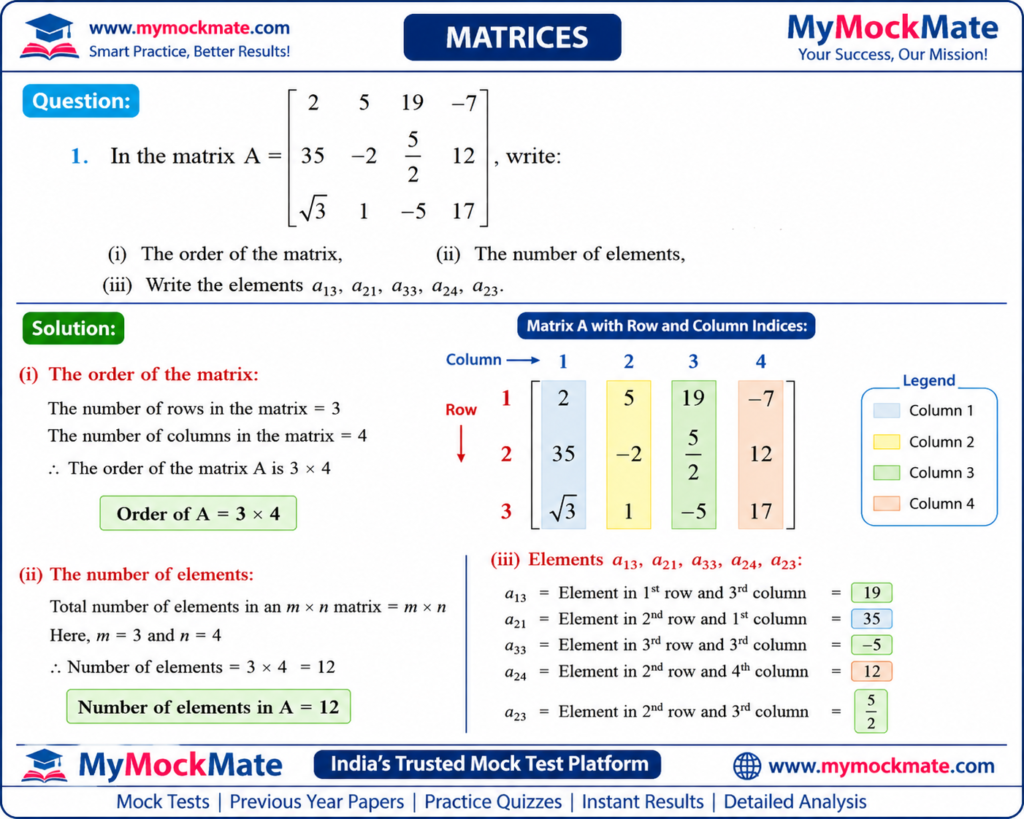
- Order of a Matrix: A matrix having m rows and n columns is said to be of order m×n.
- Number of Elements: An m×n matrix contains exactly mn elements.
- Construction of Matrices: Creating matrix structures using a specified element-generation formula aij.
- Equality of Matrices: Two matrices are equal if they share the exact same order and their corresponding elements are identical.
Important Formulas
- Matrix representation: A=[aij]m×n
- Total number of elements = Rows (m)×Columns (n)=mn
- Condition for Equality: If A=[aij] and B=[bij] are equal, then:
- Order of A=Order of B
- aij=bij (for all i,j)
- Condition for Square Matrix: Number of rows = Number of columns (m=n).
Questions & Step-by-Step Solutions
Question 1
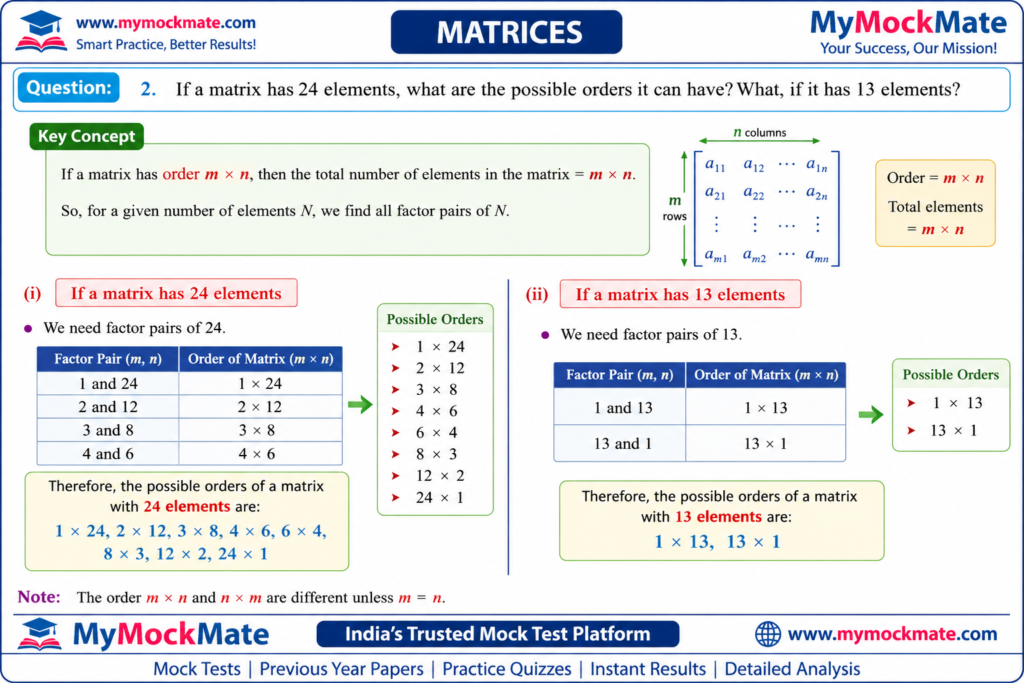
Question 2
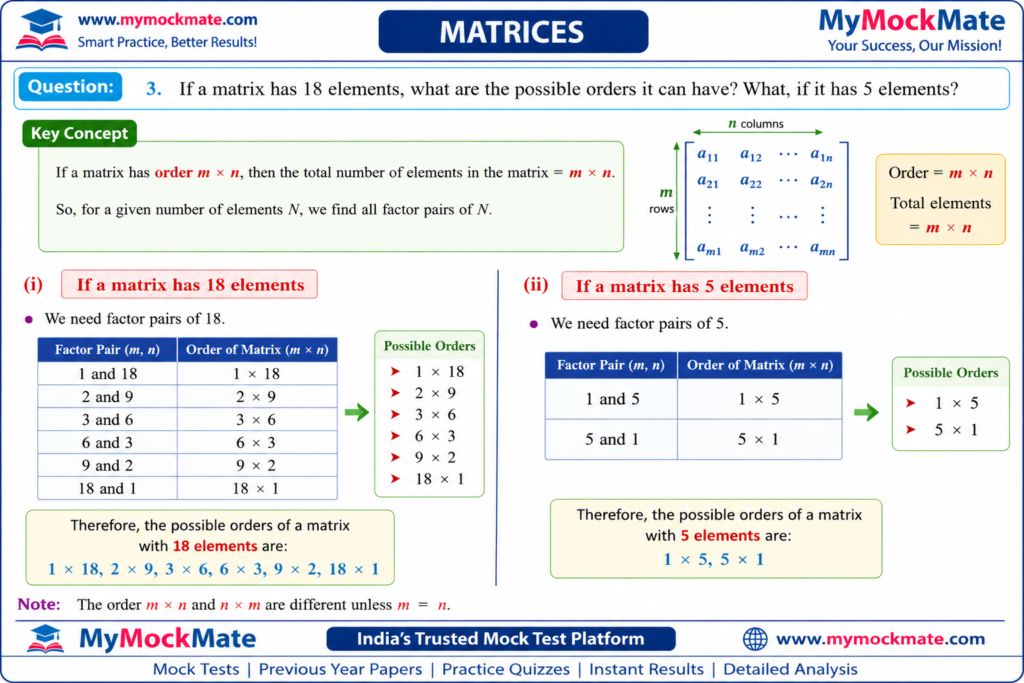
Question 3
Question 4
Construct a 2×2 matrix, A=[aij], whose elements are given by:
(i)

(ii)
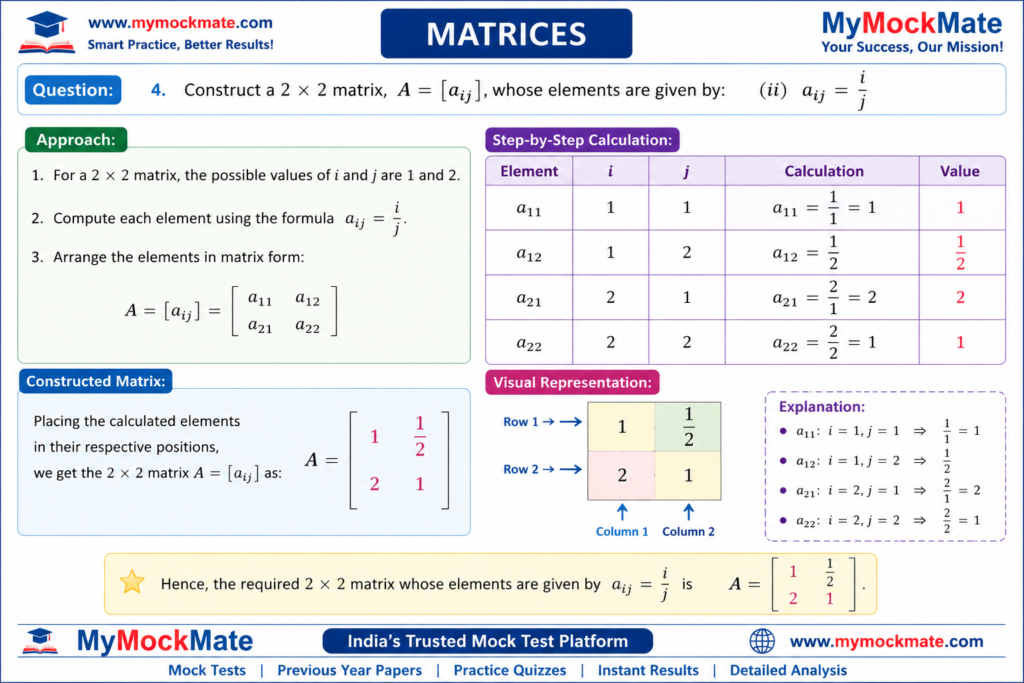
(iii)

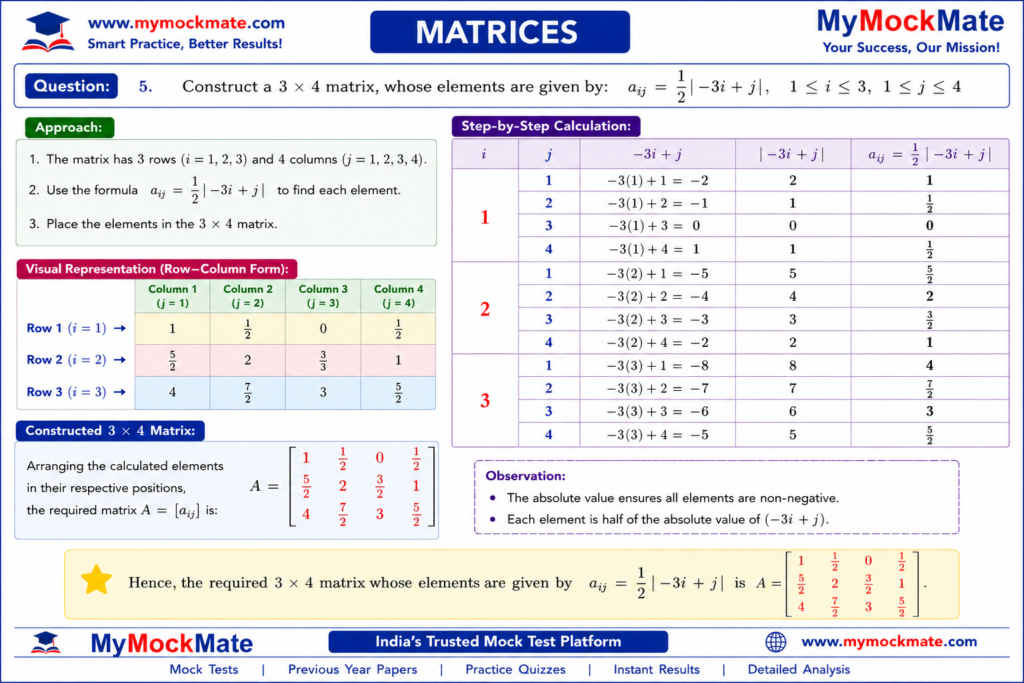
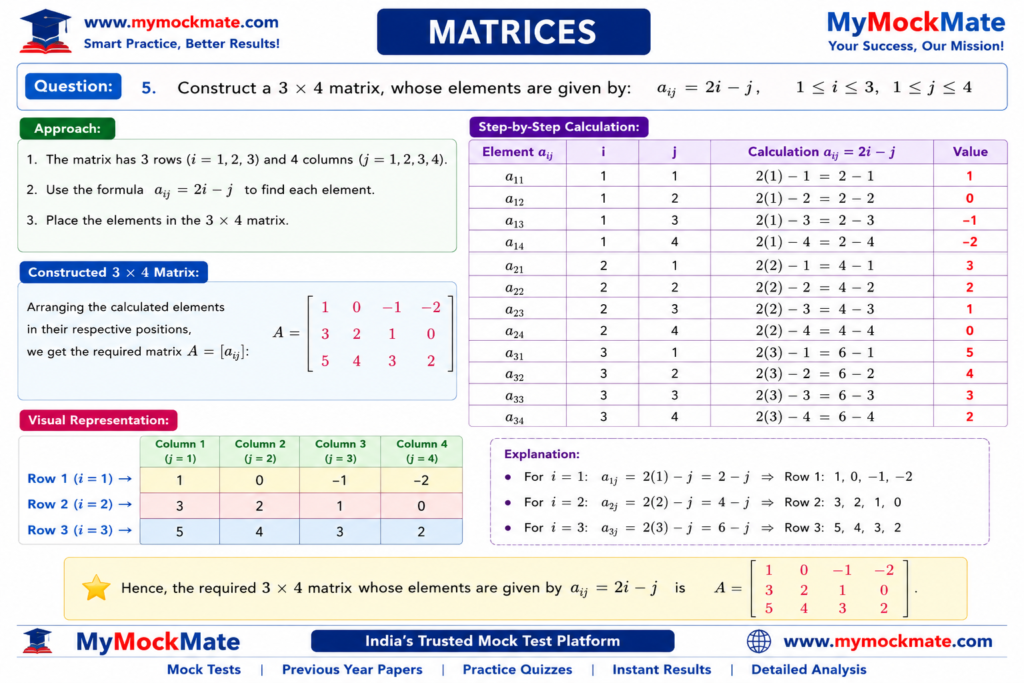
Question 5
Construct a 3×4 matrix, whose elements are given by:
(i)
(ii)
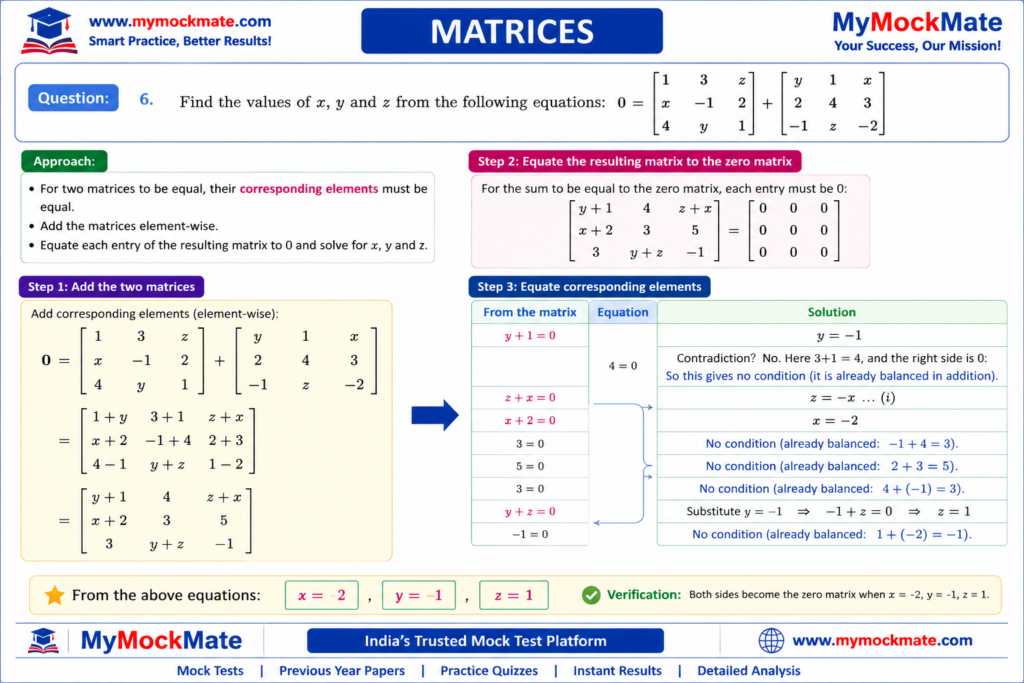
Question 6
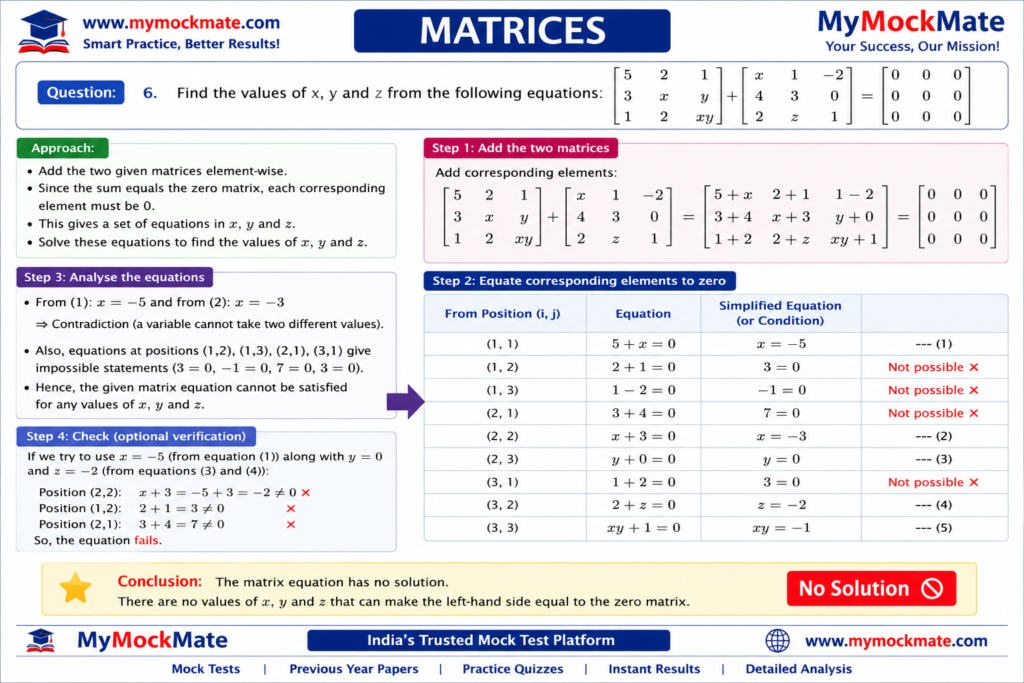
Find the values of x, y and z from the following equations:
(i)
(ii)
(iii)

Question 7
Find the value of a, b, c and d from the equation:
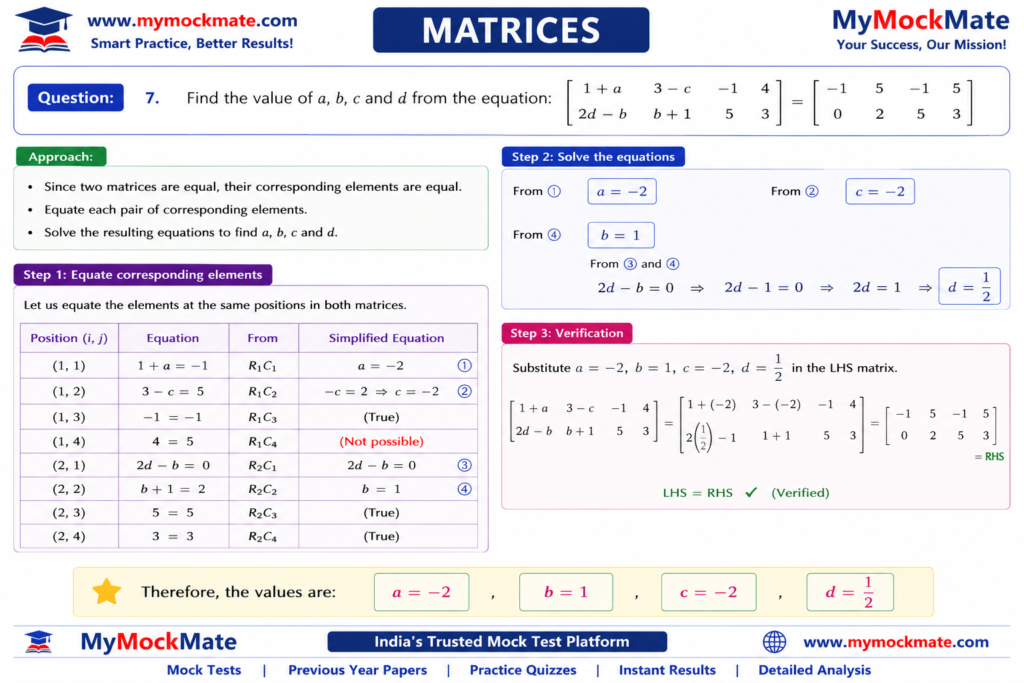
Question 8
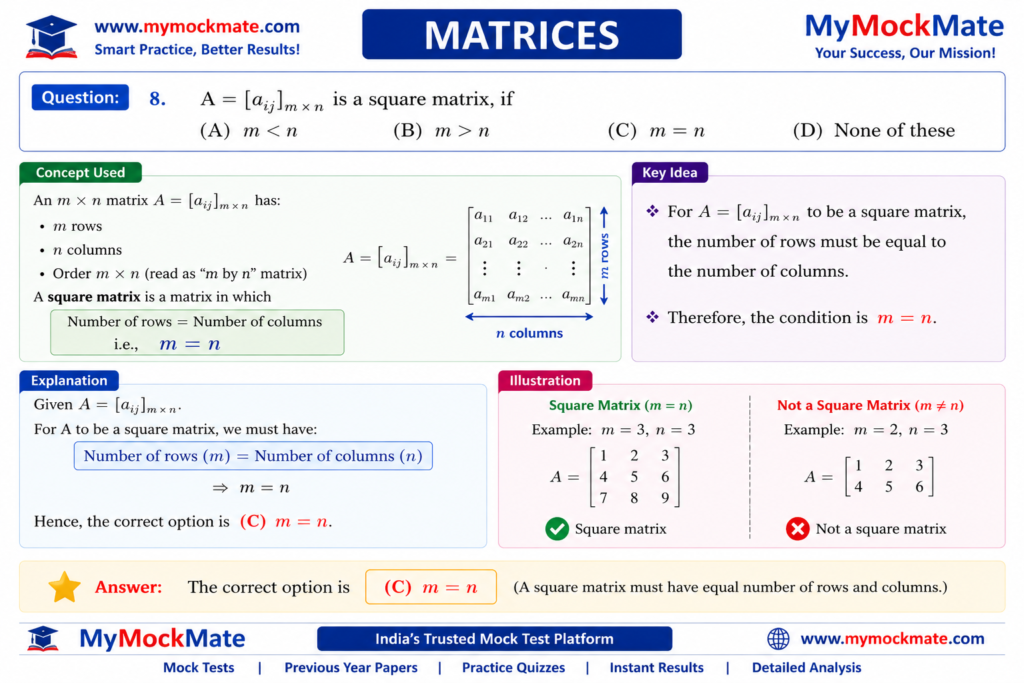
Question 9
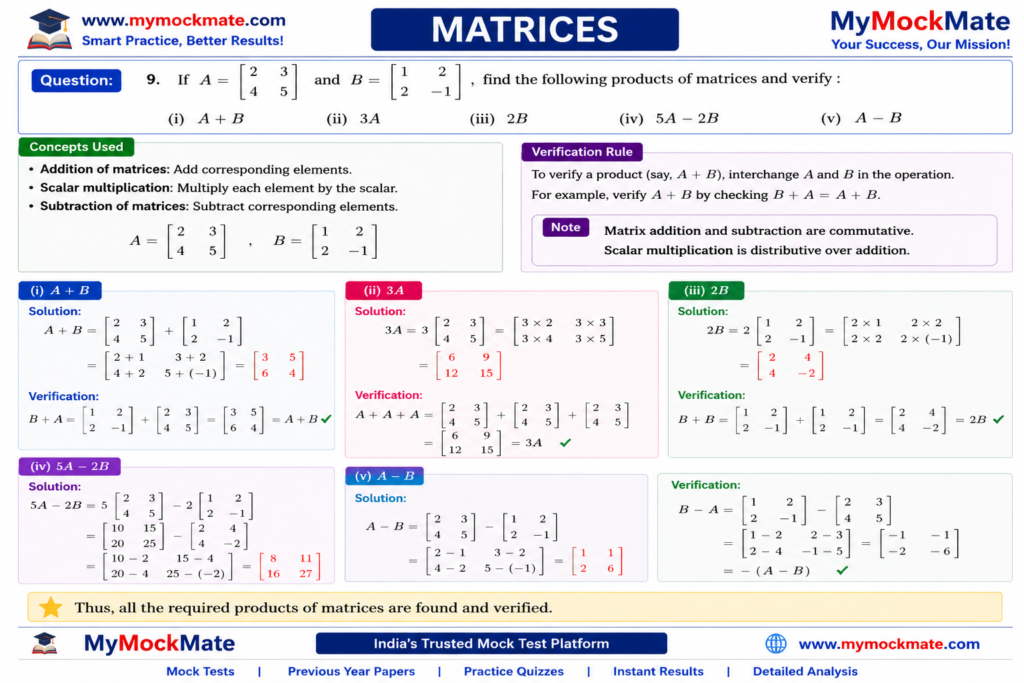
Question 10

Common Mistakes
Students often understand the basic definition of a matrix but lose marks because of small errors involving indices, signs, fractions, or corresponding positions. The following mistakes should be avoided.
1. Writing the order in reverse
For a matrix,
For example, a matrix having 3 rows and 4 columns is a matrix, not a matrix.
A simple memory rule is:
2. Confusing aij with aji
The element means:
Therefore,
in general.
For example, if
then
whereas
3. Forgetting that the number of elements is mn
For an matrix:
For example:
and
4. Missing reverse factor pairs
If a matrix has 24 elements, students sometimes write only:
and forget:
Because matrix order is an ordered pair,
unless
5. Using the wrong range of i and j
For a matrix:
and
A common mistake is to use and .
6. Ignoring modulus signs
In Question 5(i),
The modulus is essential. A negative value inside the modulus becomes positive.
For example,
Do not write −.
7. Comparing the wrong elements in equal matrices
If
then only elements in exactly the same positions are compared.
For example,
gives:
Do not compare with 2 or with 5.
8. Solving only some of the equations
In equality-of-matrices questions, all corresponding equations must be satisfied simultaneously.
For example, in Question 9:
gives
Also,
gives
But then:
is satisfied, while
would require
Since the values of x conflict, the matrices cannot be equal. Therefore, the correct option is (B) Not possible to find.
9. Using addition instead of multiplication principle
For a matrix whose entries can be either 0 or 1:
and each position has:
Therefore:
not
Exam Tips
For Exercise 3.1, the following strategies can improve speed and accuracy.
Tip 1: Draw a small row-column locator
Whenever a question asks for mentally read:
For example:
Tip 2: Use factor pairs for order questions
If the number of elements is , find all positive integer pairs satisfying:
For 18:
Then include reverse orders:
Tip 3: Make an i-j substitution table
For constructing a matrix from , prepare a table:
| Element | i | j |
|---|---|---|
| 1 | 1 | |
| 1 | 2 | |
| 2 | 1 | |
| 2 | 2 |
For larger matrices, calculate row by row.
Tip 4: Check the final matrix order
After constructing a matrix, count:
- 3 horizontal rows
- 4 entries in each row
This quick check prevents incomplete matrices.
Tip 5: In matrix equality, write equations position-wise
Use the pattern:
This prevents skipping equations.
Tip 6: Remember the square matrix condition
For
the matrix is square only when:
Tip 7: Use kmn for counting matrices
If a matrix has order , it contains positions.
If every entry has choices, then:
For entries 0 or 1:
Thus, for a matrix:
Practice MCQs
MCQ 1
A matrix has 4 rows and 7 columns. Its order is:
(A)
(B)
(C)
(D)
Answer: (B)
Explanation: Matrix order is written as rows × columns.
MCQ 2
How many elements are present in a matrix?
(A) 8
(B) 15
(C) 53
(D) 2
Answer: (B) 15
MCQ 3
If a matrix contains 17 elements, which of the following can be its order?
(A)
(B)
(C) Both A and B
(D)
Answer: (C) Both A and B
Since 17 is prime, its only factor pair is:
MCQ 4
In the matrix
the value of is:
(A) 2
(B) 5
(C) 8
(D) 9
Answer: (C) 8
The element in row 2 and column 3 is 8.
MCQ 5
A matrix is square when:
(A)
(B)
(C)
(D)
Answer: (C)
MCQ 6
If
then is:
(A) 5
(B) 6
(C) 1
(D) 23
Answer: (A) 5
MCQ 7
If
then is:
(A) 1
(B) 4
(C) 8
(D) -4
Answer: (B) 4
MCQ 8
If
then:
(A)
(B)
(C)
(D) None
Answer: (A)
MCQ 9
The number of possible matrices whose entries are either 0 or 1 is:
(A) 4
(B) 8
(C) 16
(D) 32
Answer: (C) 16
A matrix has 4 entries:
MCQ 10
The number of possible matrices with each entry selected from is:
(A) 18
(B) 64
(C) 243
(D) 729
Answer: (D) 729
There are:
positions and 3 choices per position.
Therefore:
FAQ Section
1. What is a matrix?
A matrix is a rectangular arrangement of numbers or mathematical expressions organised into rows and columns.
For example:
is a matrix of order .
2. How is the order of a matrix determined?
The order is:
If a matrix has 3 rows and 4 columns, its order is:
3. How many elements are there in an matrix?
The number of elements is:
For example, a matrix has:
elements.
4. What does represent?
The notation represents the element in:
Thus,
is the element in the third row and second column.
5. Can matrices of different orders be equal?
No. For two matrices to be equal:
- Their orders must be the same.
- Their corresponding elements must be equal.
Both conditions are compulsory.
6. What are the possible orders of a matrix having 24 elements?
Since:
the possible orders are:
and their reverse orders:
7. Why does a matrix with 13 elements have only two possible orders?
Because 13 is a prime number.
Its only positive factorisation is:
Therefore, the possible orders are:
and
8. What is a square matrix?
A matrix with an equal number of rows and columns is called a square matrix.
Thus:
is square when:
Examples include:
9. How do we construct a matrix when is given?
Follow these steps:
- Write the general form of the required matrix.
- Identify the possible values of and .
- Substitute each pair into the given formula.
- Calculate every element carefully.
- Arrange the results in their correct row-column positions.
For example, for a matrix:
10. Why is Question 9 answered as “Not possible to find”?
The matrices in Question 9 produce inconsistent requirements for x.
From the first corresponding elements:
so:
However, from the bottom-right corresponding elements:
which gives:
The same variable cannot simultaneously have both values. Hence, no values of x and y can make the two matrices equal.
Therefore:Option (B): Not possible to find
11. How many matrices can be formed using only 0 and 1?
A matrix contains:
entries.
Each entry has two choices:
Therefore:
Hence:
different matrices can be formed.
12. What is the most important concept in Exercise 3.1?
The most important concepts are:
- order of a matrix,
- number and location of elements,
- notation aij,
- construction of matrices using formulas,
- equality of matrices,
- square matrix condition, and
- multiplication principle for counting matrices.
Students who are comfortable with these concepts will find later topics such as matrix addition, multiplication, transpose, and inverse easier to understand.
CTA – Start Practising with MyMockMate
Understanding matrices becomes easier when concepts are followed by regular question practice. After completing NCERT Exercise 3.1, students should attempt additional MCQs, formula-based matrix construction problems, matrix equality questions, and timed chapter tests.
Visit www.mymockmate.com to strengthen your Class 12 Mathematics preparation with structured practice, mock tests, previous-year questions, practice quizzes, instant results, and detailed performance analysis.
MyMockMate – Smart Practice, Better Results!