





Short Intro
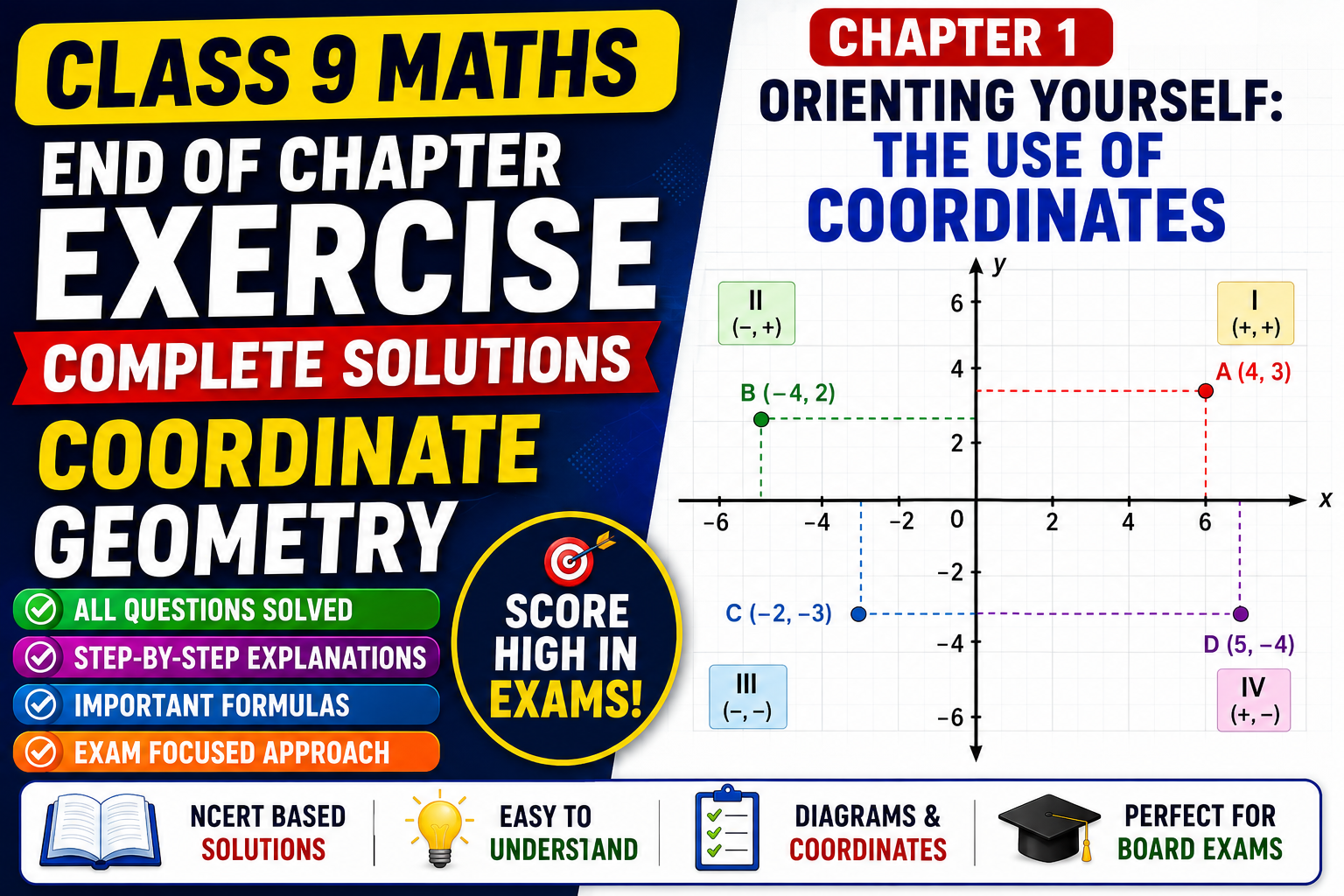
In this post, students can find complete step-by-step solutions for Class 9 Maths Chapter 1 End-of-Chapter Exercises – Coordinate Geometry. All questions are solved in simple and exam-oriented language based on the latest NCERT syllabus. This chapter helps students understand coordinates, quadrants, plotting points, midpoint concepts, and distance between points in the Cartesian plane.
Quick Information Box
| Item | Details |
|---|---|
| Board | NCERT / CBSE |
| Class | 9 |
| Subject | Maths |
| Chapter | Coordinate Geometry |
| Exercise Type | End-of-Chapter Exercise |
| Main Topics | Coordinates, Distance, Midpoint |
Concepts Used (Topics Covered)
- Cartesian Plane
- Coordinates of Points
- Quadrants
- Distance Formula
- Midpoint Formula
- Reflection in Axes
- Collinearity of Points
- Coordinate Geometry Applications
The chapter introduces the coordinate plane, quadrants, and methods to locate and measure distances between points.
Important Formulas
Distance Formula
Midpoint Formula
A = (-6, -1) B = (6, 7) M = (0, 3)
Coordinates of Origin
(0, 0)Questions & Step-by-step Solutions
Question 1
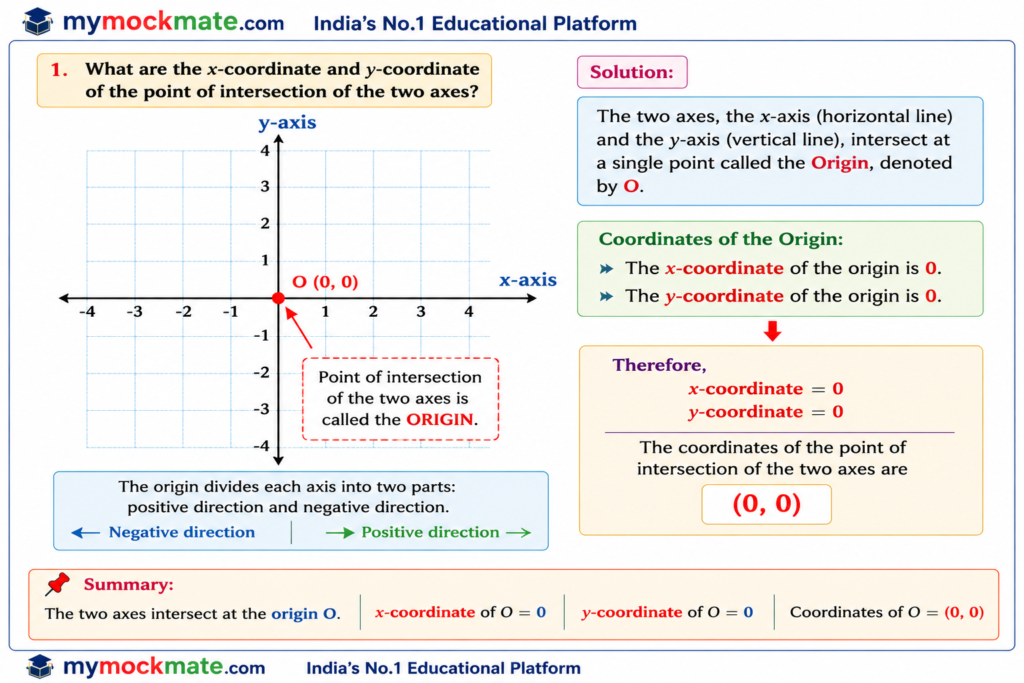
What are the x-coordinate and y-coordinate of the point of intersection of the two axes?
Solution
Question 2
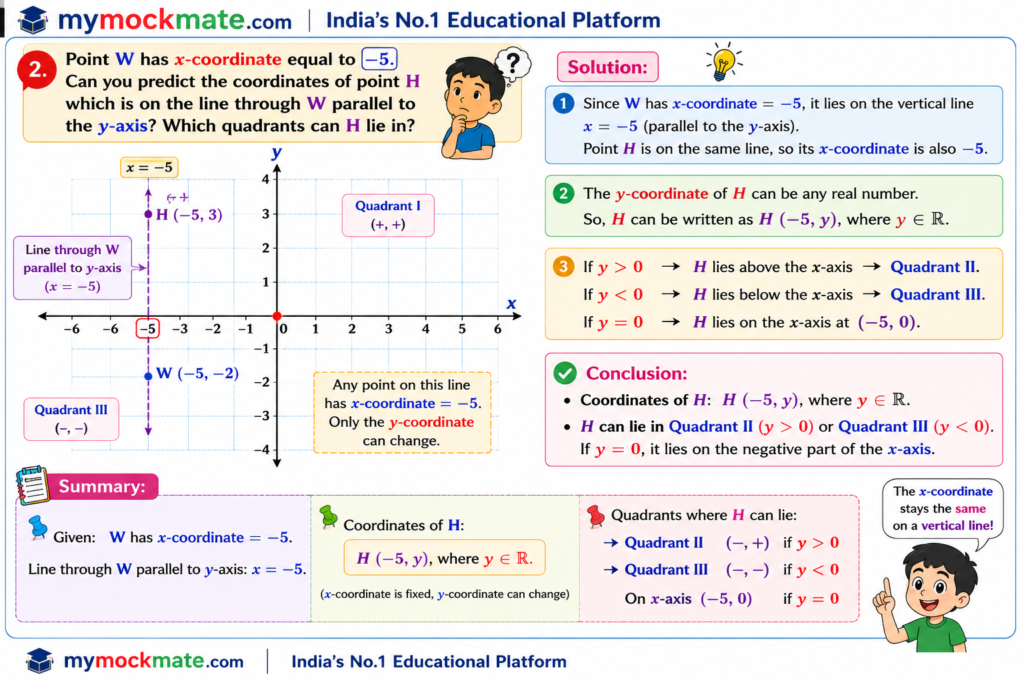
Point W has x-coordinate equal to – 5. Can you predict the coordinates of point H which is on the line through W parallel to the y-axis? Which quadrants can H lie in?
Solution
Question 3
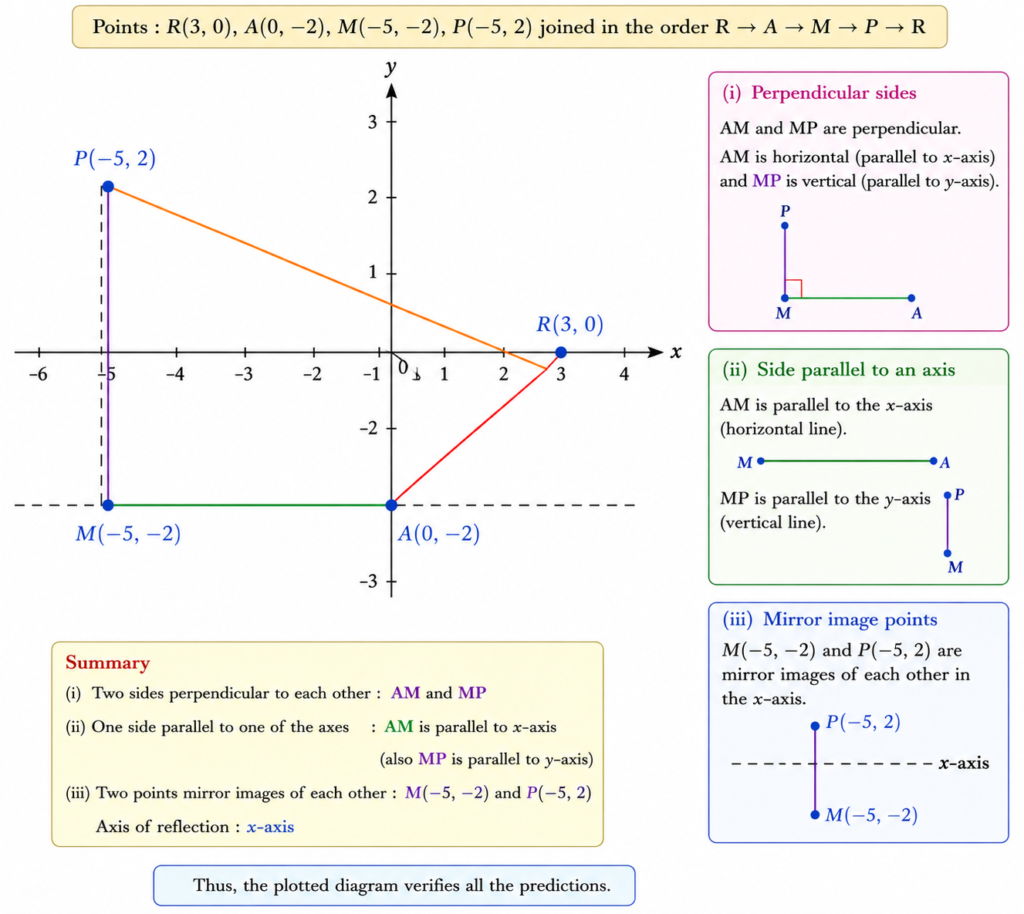
Consider the points R (3, 0), A (0, – 2), M (– 5, – 2) and P (– 5, 2). If
they are joined in the same order, predict:
(i) Two sides of RAMP that are perpendicular to each other.
(ii) One side of RAMP that is parallel to one of the axes.
(iii) Two points that are mirror images of each other in one axis.
Which axis will this be?
Now plot the points and verify your predictions
Solution
Question 4
Plot point Z (5, – 6) on the Cartesian plane. Construct a right-angled
triangle IZN and find the lengths of the three sides.
(Comment: Answers may differ from person to person.)
Solution
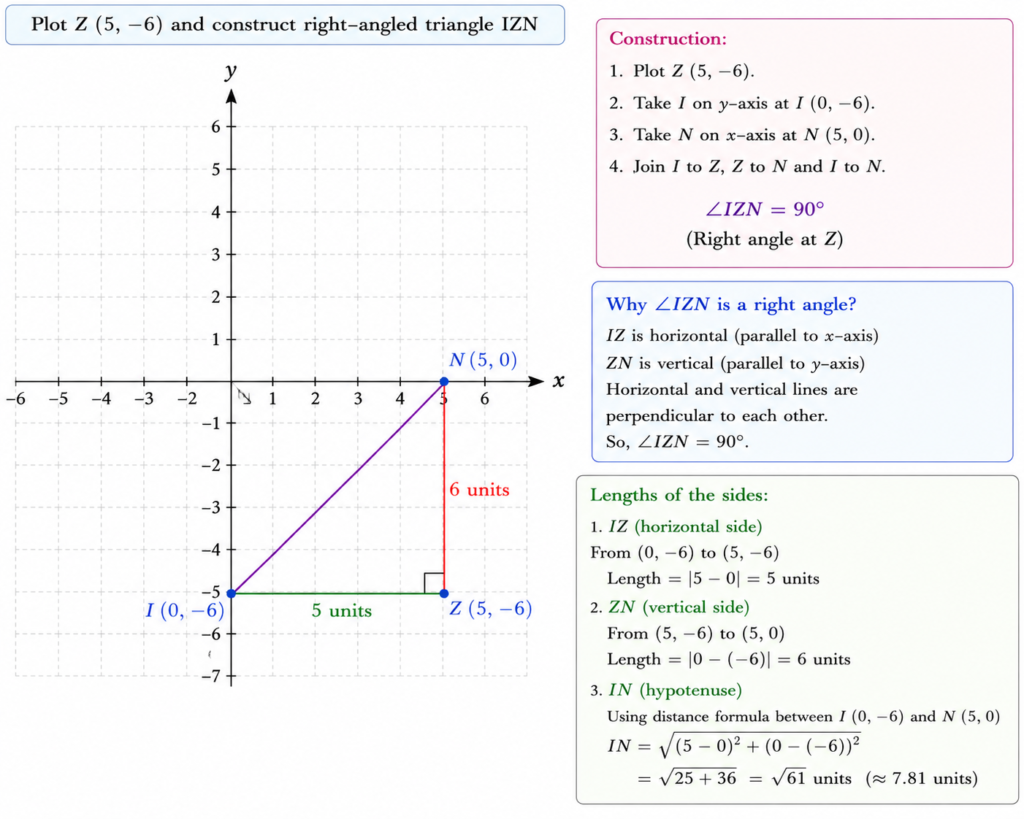
Comment: Answers May Differ from Person to Person
This question gives only one point, Z(5, –6). The positions of points I and N are not fixed.
Therefore, different students may choose different points I and N to construct a right-angled triangle IZN with Z as one of its vertices.
As a result:
- The shape and size of the triangle may vary.
- The lengths of the sides may be different.
- More than one correct answer is possible.
The only requirement is that IZN must be a right-angled triangle and Z(5, –6) must be one of its vertices.
Hence, the note “Answers may differ from person to person” means that different valid constructions can lead to different side lengths, and all such answers are acceptable if the triangle is right-angled.
Question 5
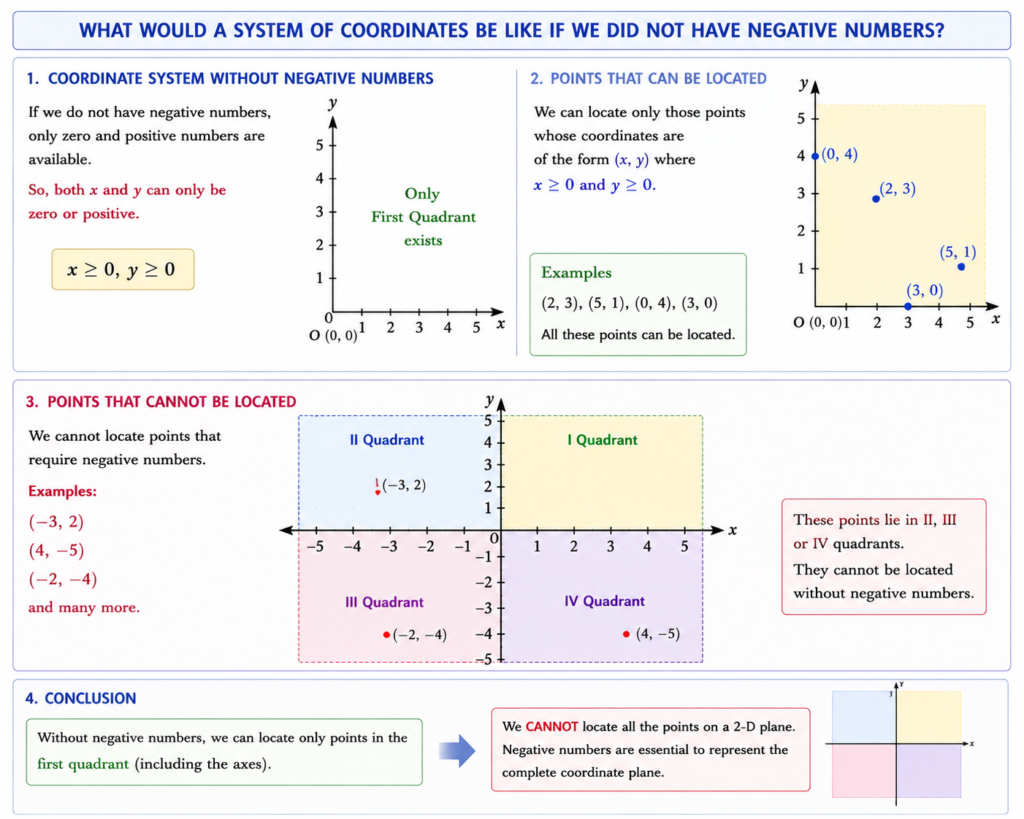
What would a system of coordinates be like if we did not have
negative numbers? Would this system allow us to locate all the
points on a 2-D plane?
Solution
Question 6
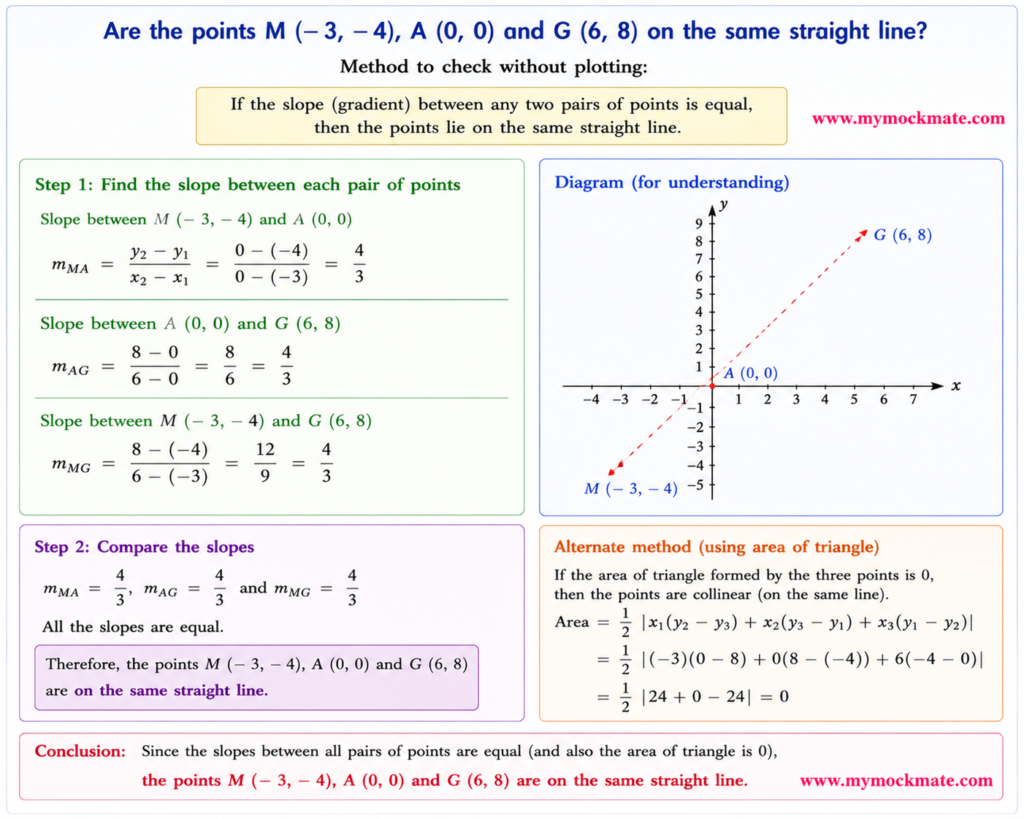
Are the points M (– 3, – 4), A (0, 0) and G (6, 8) on the same straight
line? Suggest a method to check this without plotting and joining
the points.
Solution
Question 7
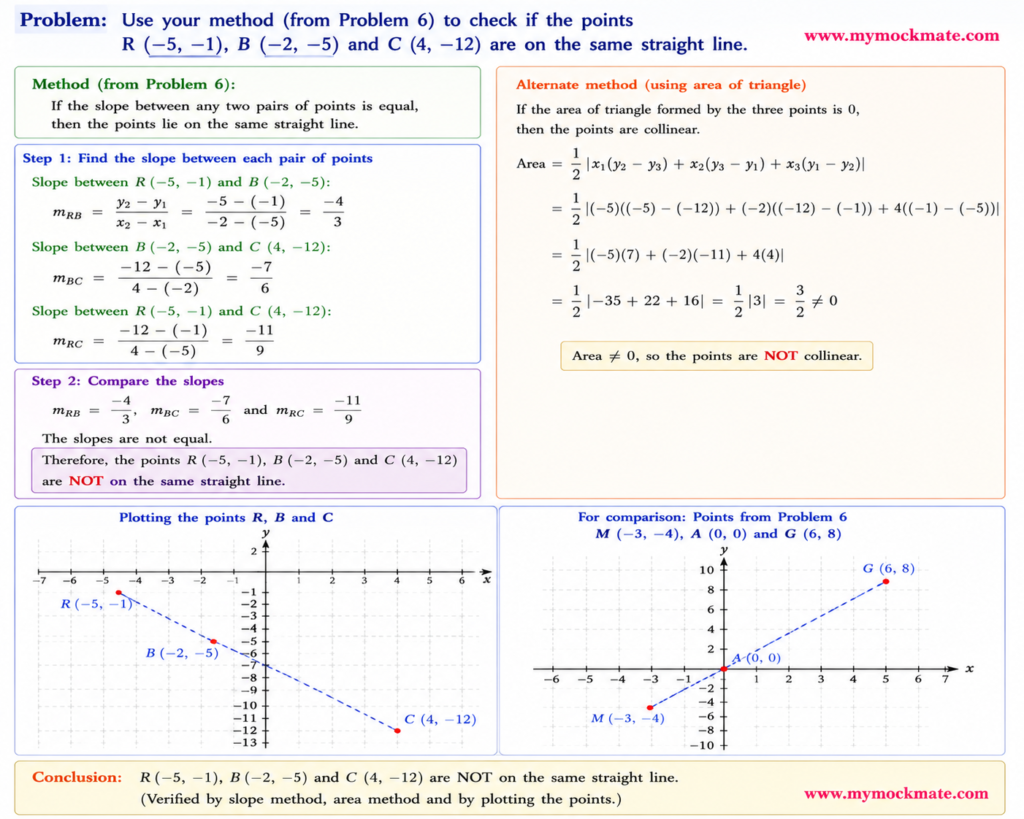
Use your method (from Problem 6) to check if the points
R (– 5, – 1), B (– 2, – 5) and C (4, – 12) are on the same straight line.
Now plot both sets of points and check your answers.
Solution
Question 8
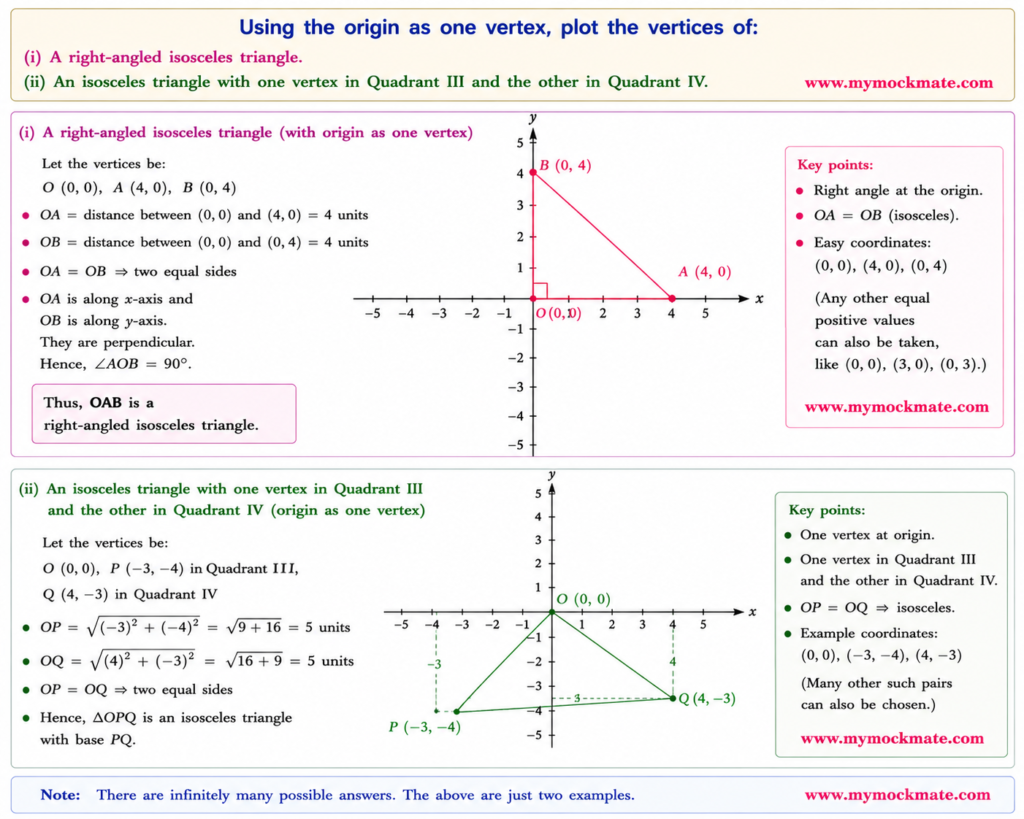
Using the origin as one vertex, plot the vertices of:
(i) A right-angled isosceles triangle.
(ii) An isosceles triangle with one vertex in Quadrant III and the other in Quadrant IV
Solution
Question 9
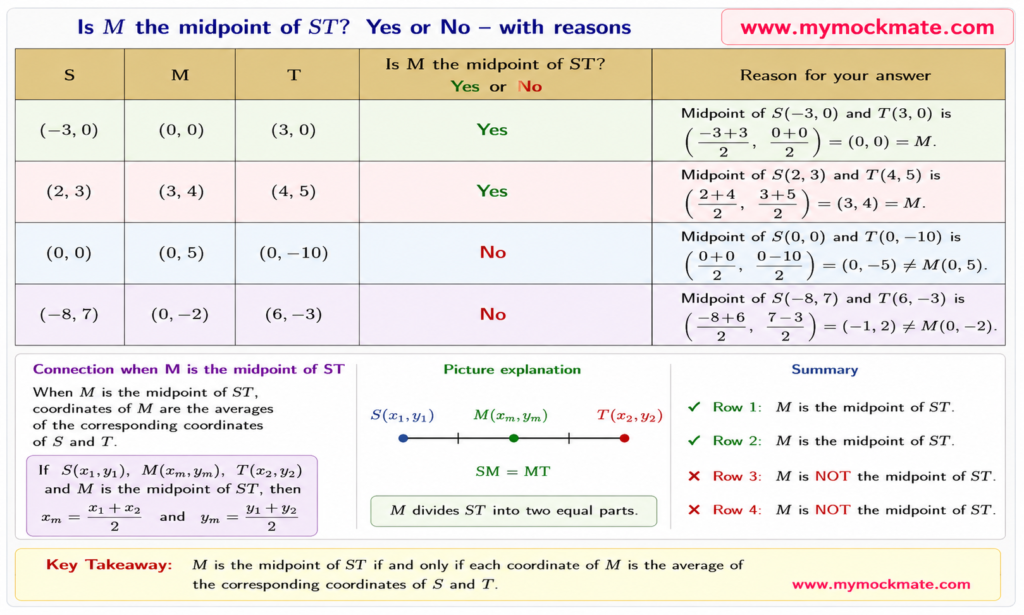
The following table shows the coordinates of points S, M and T. In each case, state whether M is the midpoint of segment ST. Justify your answer.
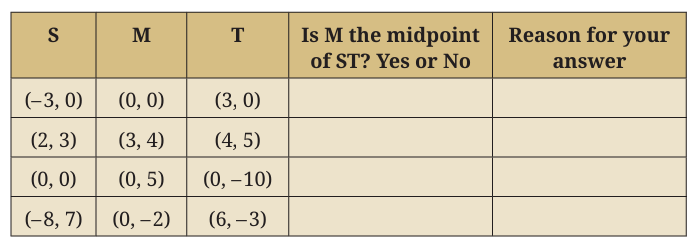
When M is the mid-point of ST, can you find any connection between the coordinates of M, S and T?
Solution
Question 10
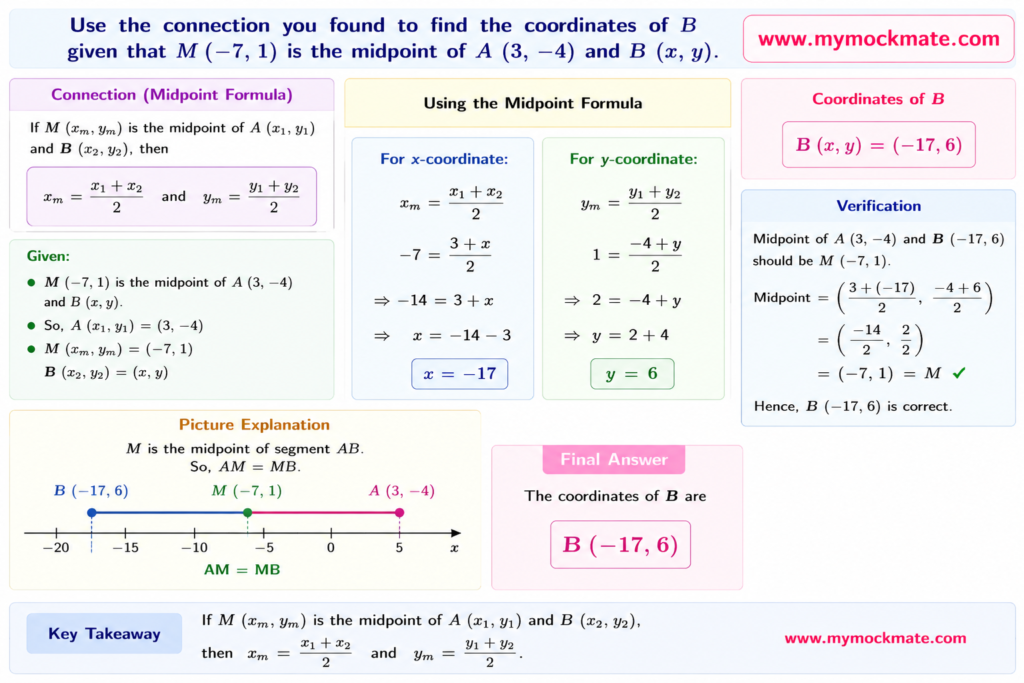
Use the connection you found to find the coordinates of B given
that M (–7, 1) is the midpoint of A (3, – 4) and B (x, y).
Question 11
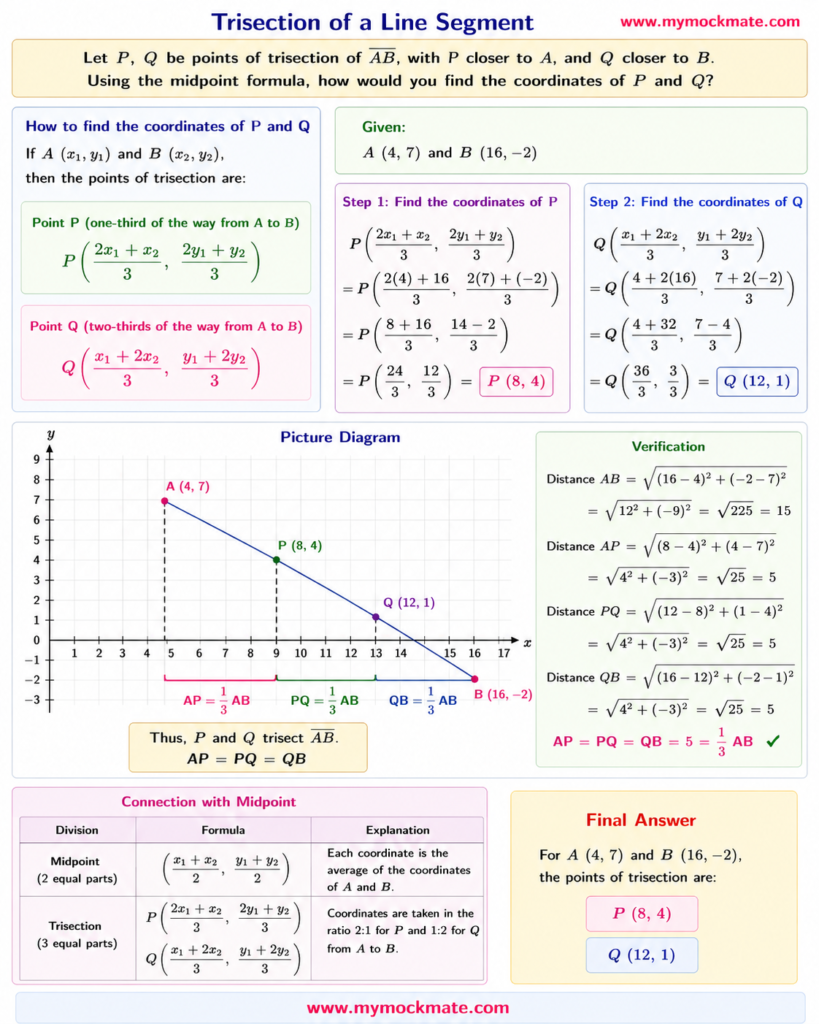
Let P, Q be points of trisection of AB, with P closer to A, and Q closer to B. Using your knowledge of how to find the coordinates of the midpoint of a segment, how would you find the coordinates of P and Q? Do this for the case when the points are A (4, 7) and B (16, –2).
Question 12
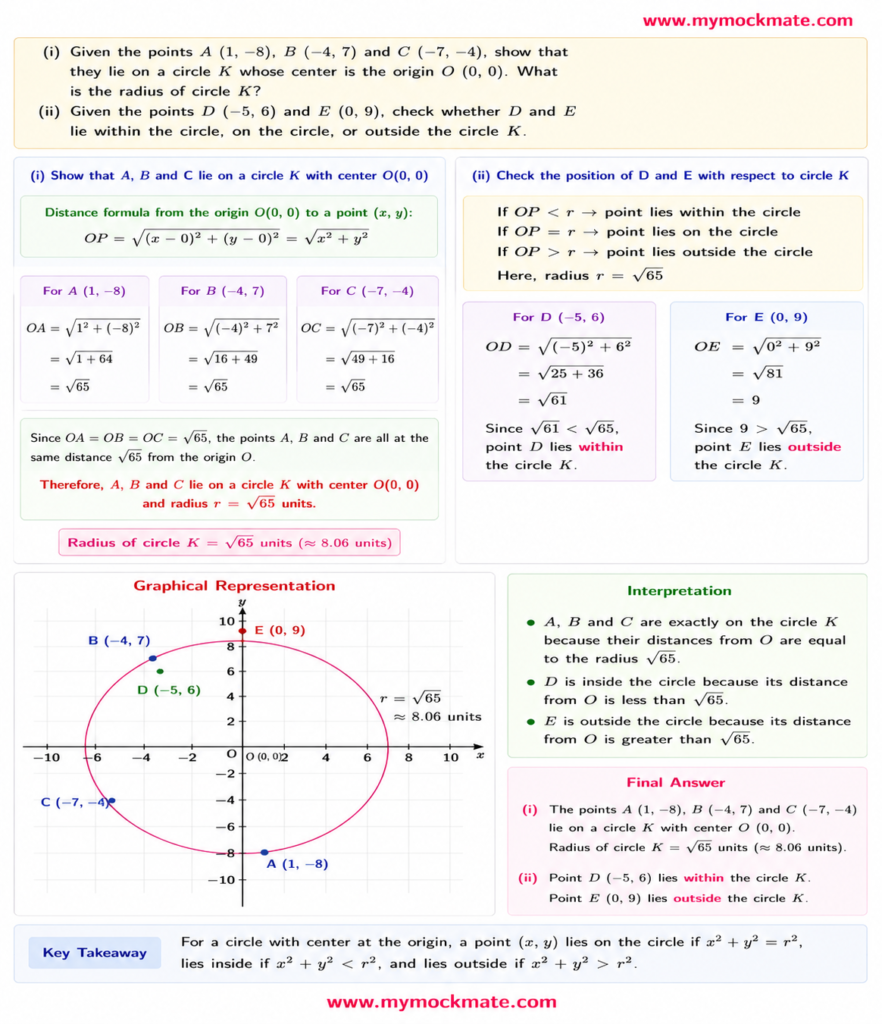
(i) Given the points A (1, – 8), B (– 4, 7) and C (–7, – 4), show that they lie on a circle K whose center is the origin O (0, 0). What is the radius of circle K?
(ii) Given the points D (– 5, 6) and E (0, 9), check whether D and E
lie within the circle, on the circle, or outside the circle K.
Solution
Question 13
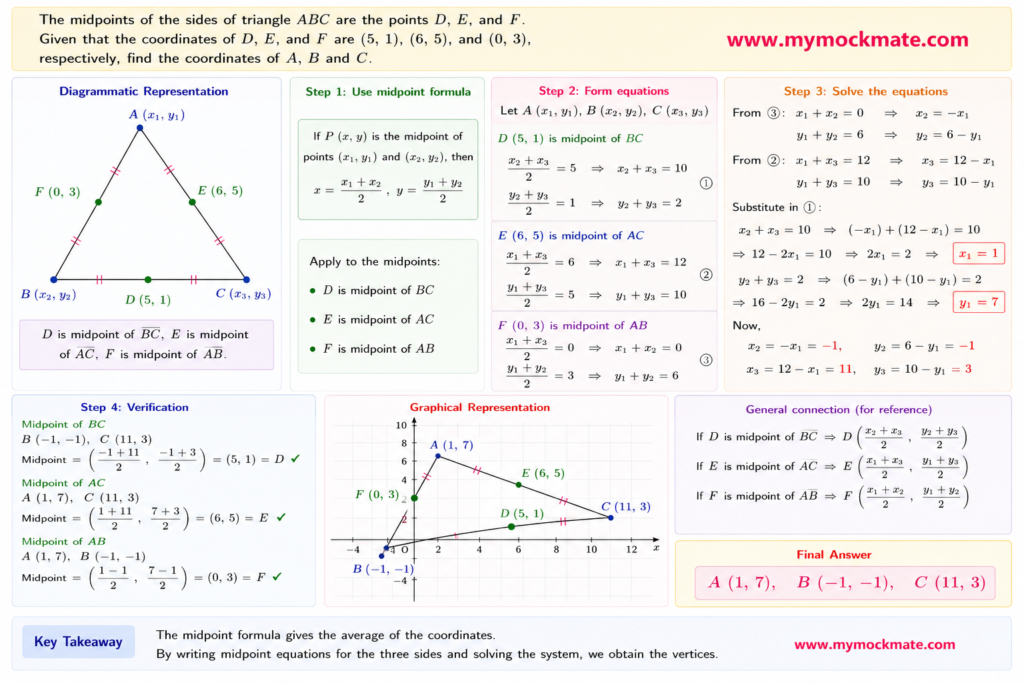
The midpoints of the sides of triangle ABC are the points D, E, and F. Given that the coordinates of D, E, and F are (5, 1), (6, 5), and (0, 3), respectively, find the coordinates of A, B and C.
Question 14
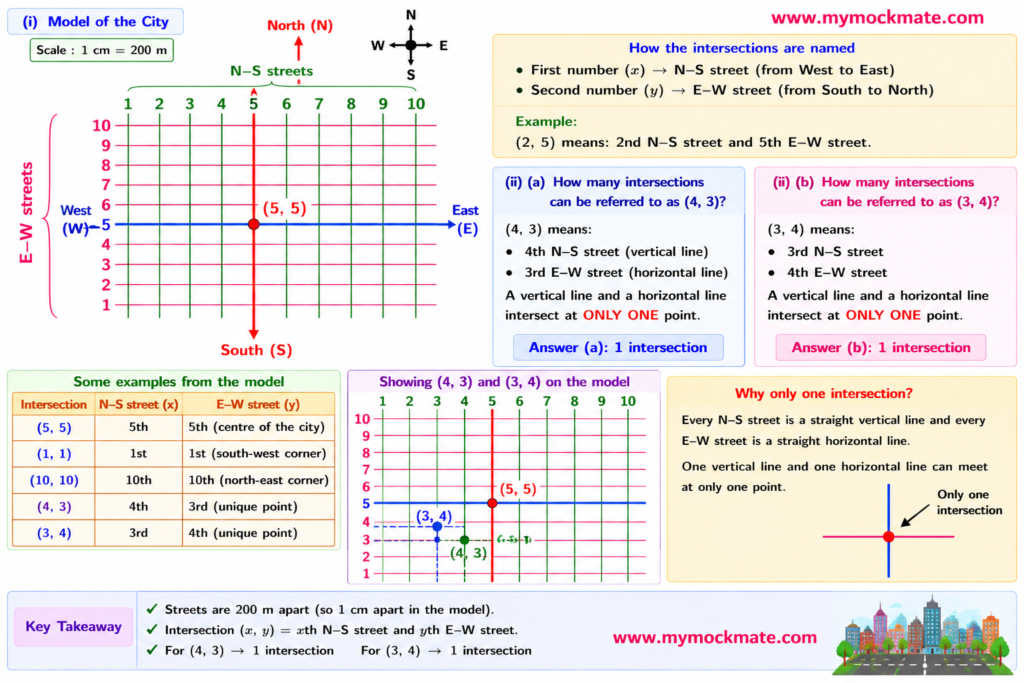
A city has two main roads which cross each other at the centre of the city. These two roads are along the North–South (N–S) direction and East–West (E–W) direction. All the other streets of the city run parallel to these roads and are 200 m apart. There are 10 streets in each direction.
(i) Using 1 cm = 200 m, draw a model of the city in your notebook. Represent the roads/streets by single lines.
(ii) There are street intersections in the model. Each street intersection is formed by two streets — one running in the N–S direction and another in the E–W direction. Each street intersection is referred to in the following manner: If the second street running in the N–S direction and 5th street in the E–W direction meet at some crossing, then we call this street intersection (2, 5). Using this convention, find:
(a) how many street intersections can be referred to as (4, 3).
(b) how many street intersections can be referred to as (3, 4)
Solution
Question 15
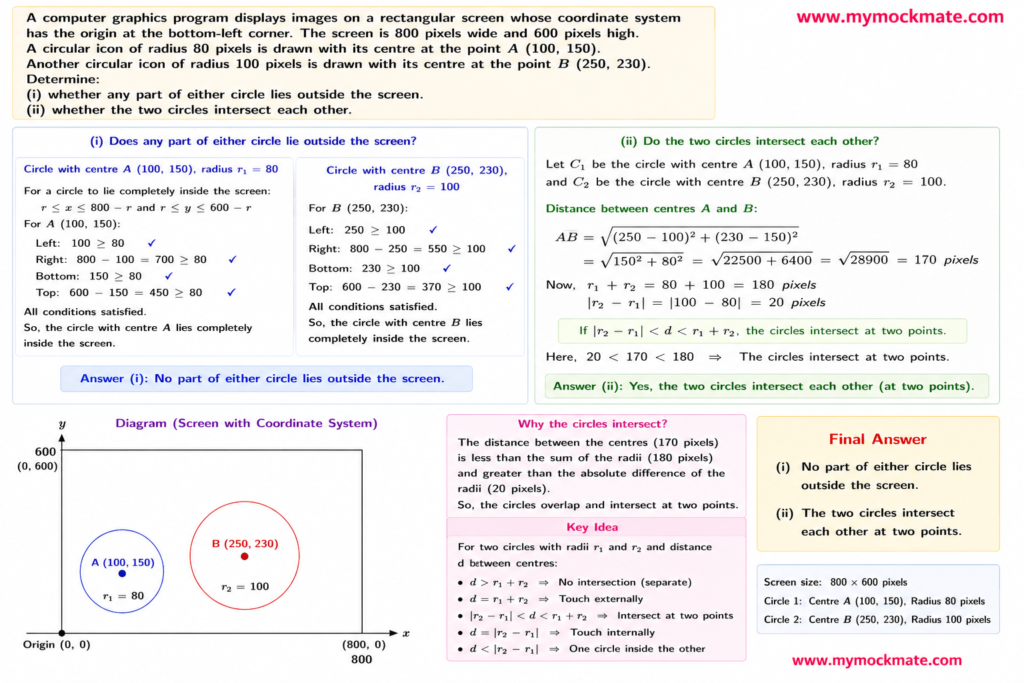
A computer graphics program displays images on a rectangular screen whose coordinate system has the origin at the bottom-left corner. The screen is 800 pixels wide and 600 pixels high. A circular icon of radius 80 pixels is drawn with its centre at the point A (100, 150). Another circular icon of radius 100 pixels is drawn with its centre at the point B (250, 230). Determine:
(i) whether any part of either circle lies outside the screen.
(ii) whether the two circles intersect each other
Solution
Question 16
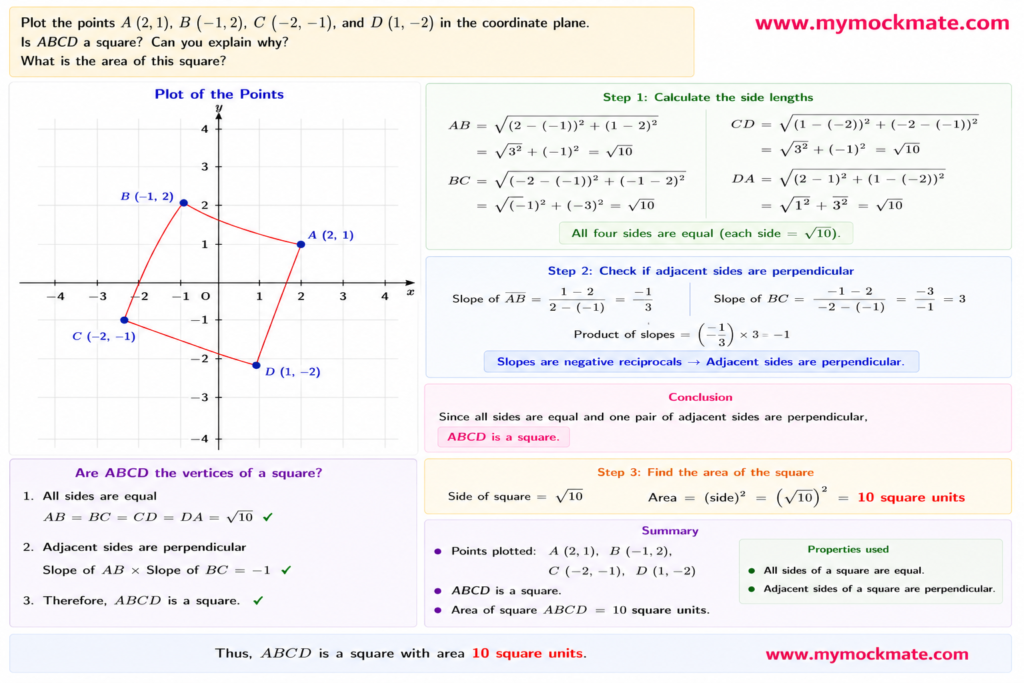
Plot the points A (2, 1), B (–1, 2), C (–2, –1), and D (1, –2) in the coordinate plane. Is ABCD a square? Can you explain why? What is the area of this square?
Common Mistakes
- Writing coordinates in wrong order
- Forgetting negative signs
- Incorrect midpoint calculations
- Mistakes in distance formula
- Wrong quadrant identification
Exam Tips
- Learn quadrant signs carefully.
- Practice graph plotting daily.
- Always simplify square roots properly.
- Use graph paper neatly.
Practice MCQs
MCQ 1
Coordinates of origin are:
A. (1,0)
B. (0,1)
C. (0,0)
D. (1,1)
Answer:
C. (0,0)MCQ 2
Point (−3, 5) lies in:
A. Quadrant I
B. Quadrant II
C. Quadrant III
D. Quadrant IV

Answer:
B. Quadrant IIMCQ 3
Distance between points is found using:
A. Midpoint Formula
B. Distance Formula
C. Area Formula
D. Ratio Formula
Answer:
B. Distance FormulaFAQ Section
What is the Cartesian plane?
The plane formed by x-axis and y-axis is called Cartesian plane.
What are coordinates of origin?
(0, 0)What is midpoint formula?
A = (-6, -1)B = (6, 7) M = (0, 3)
Why is Coordinate Geometry important?
It is used in mathematics, engineering, maps, graphics, and navigation.
📘 Improve Your Maths Preparation with MyMockMate!
✅ Practice Chapter-wise Mock Tests
✅ Solve Important MCQs
✅ Download Notes PDF
✅ Get Instant Performance Analysis
✅ Prepare Smarter for Board Exams
Start learning now on MyMockMate


Super answer and it was excellent 👌🏻💯
Thank You.