




Short Intro
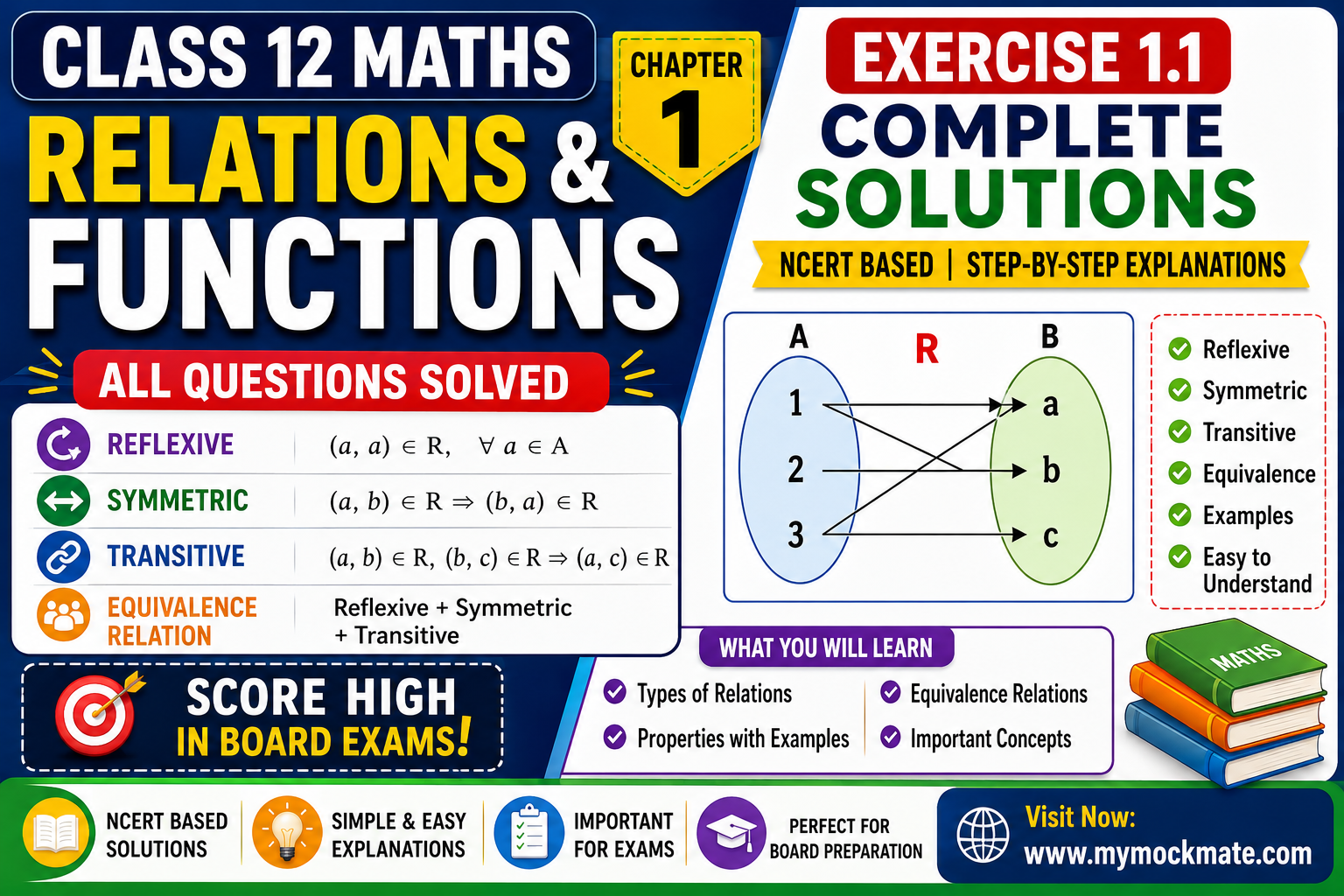
In this post, students can find complete step-by-step solutions for Class 12 Maths Chapter 1 Exercise 1.1 – Relations and Functions based on the latest NCERT syllabus. This exercise covers reflexive, symmetric, transitive, and equivalence relations in a simple and exam-oriented format.
Quick Information Box
| Item | Details |
|---|---|
| Board | NCERT / CBSE |
| Class | 12 |
| Subject | Mathematics |
| Chapter | Relations and Functions |
| Exercise | 1.1 |
| Main Topics | Relations & Equivalence Relations |
Concepts Used (Topics Covered)
- Reflexive Relation
- Symmetric Relation
- Transitive Relation
- Equivalence Relation
- Universal Relation
- Empty Relation
- Equivalence Classes
The chapter explains different types of relations and equivalence relations.
Important Formulas
Reflexive Relation
(a, a) ∈ R for every a ∈ ASymmetric Relation
(a, b) ∈ R ⇒ (b, a) ∈ RTransitive Relation
(a, b) ∈ R and (b, c) ∈ R ⇒ (a, c) ∈ REquivalence Relation
A relation which is reflexive, symmetric and transitive.Questions & Step-by-step Solutions
Question 1
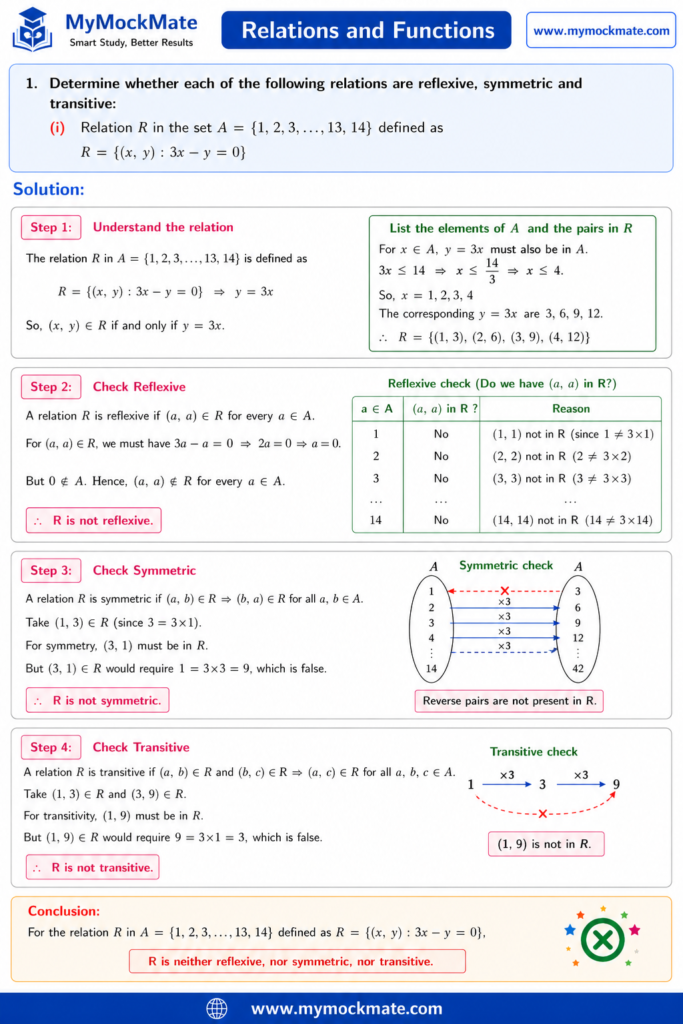
Determine whether the following relations are reflexive, symmetric and transitive.
(i) Relation R in A = {1, 2, 3, …, 14} defined by:
R = {(x, y) : 3x − y = 0}Solution
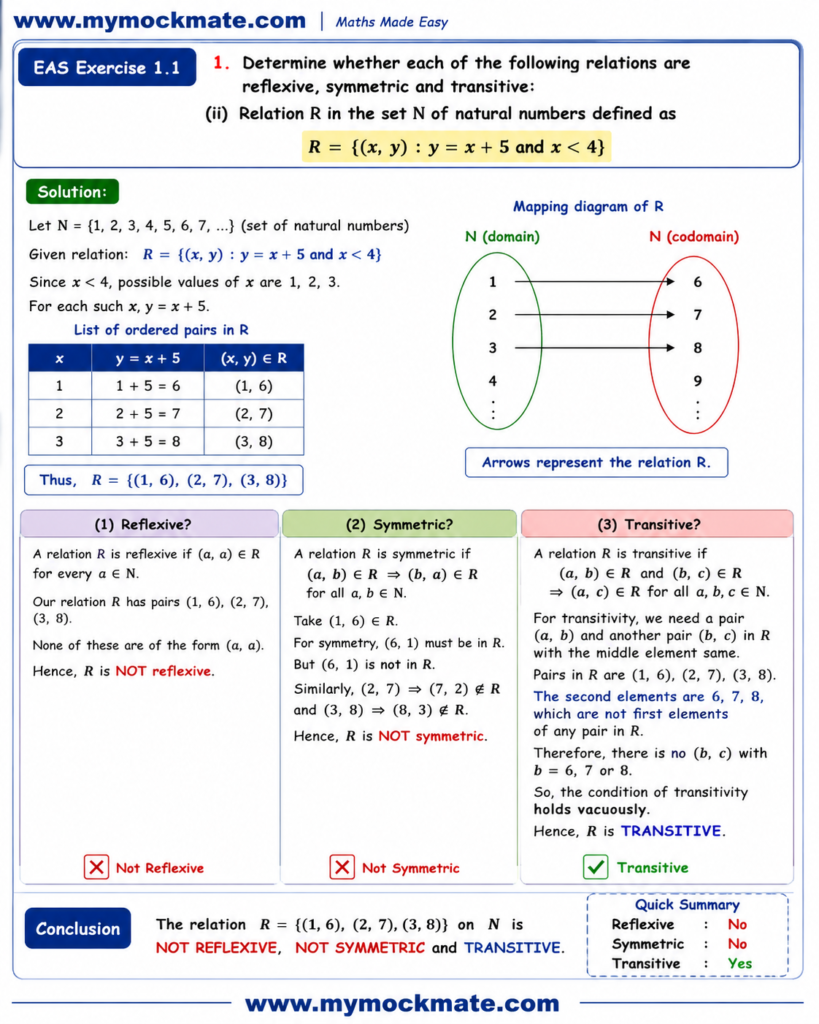
(ii) Relation R in the set N of natural numbers defined as
R = {(x, y) : y = x + 5 and x < 4}Solution
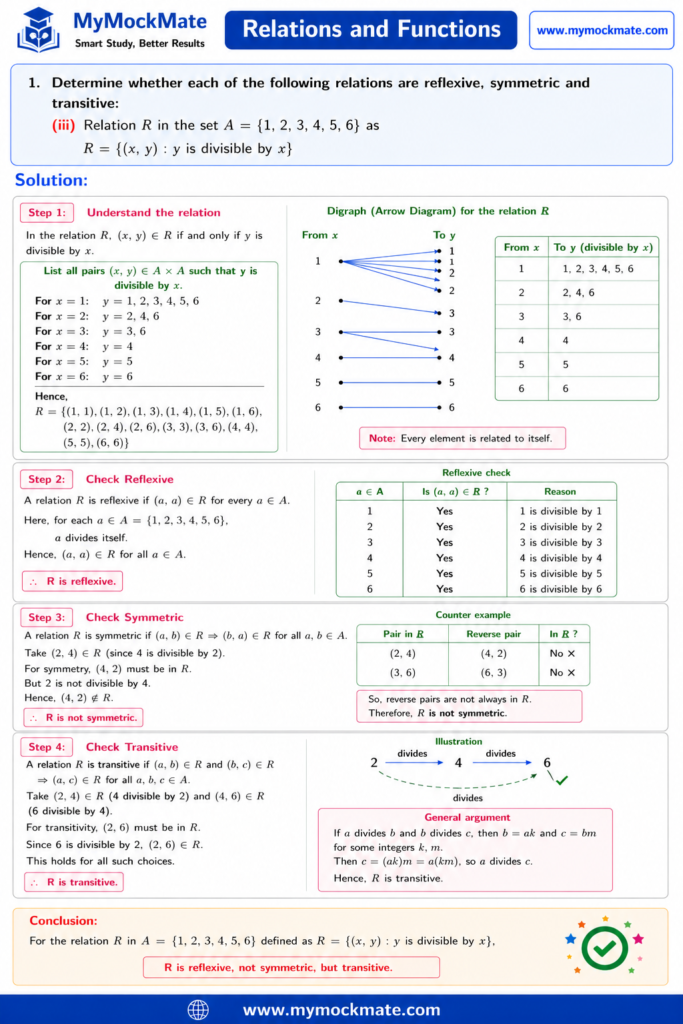
(iii) Relation R in the set A = {1, 2, 3, 4, 5, 6} as
R = {(x, y) : y is divisible by x}Solution
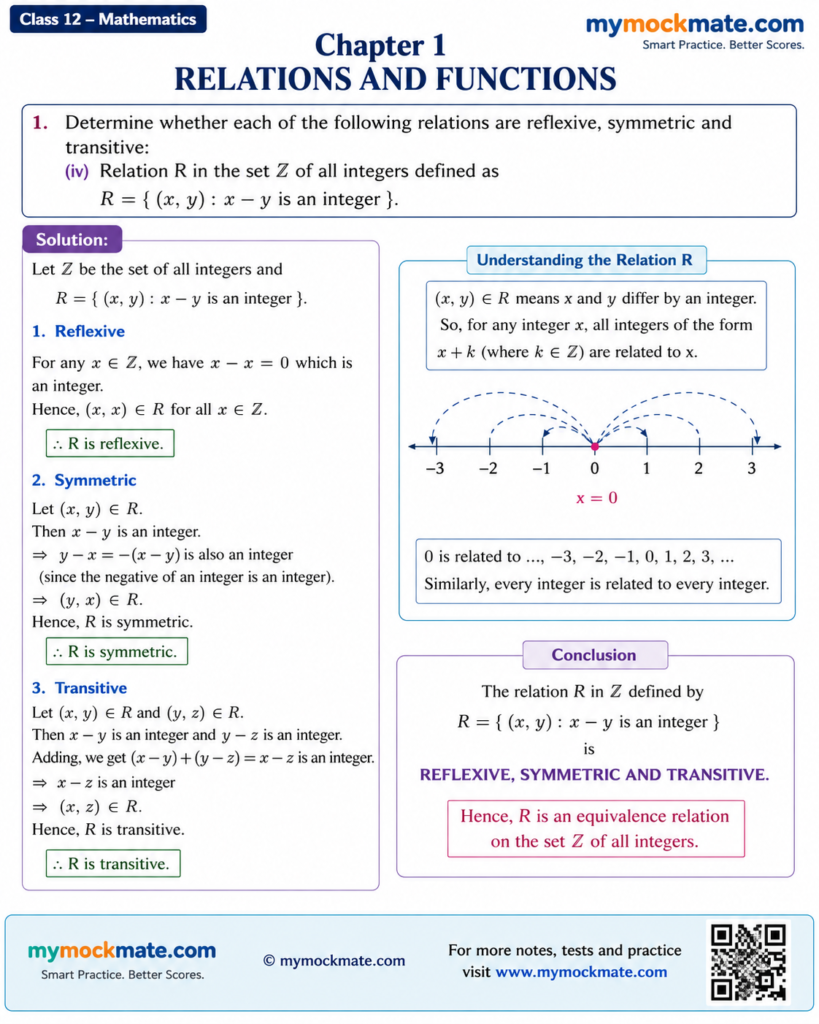
(iv) Relation R in the set Z of all integers defined as
R = {(x, y) : x − y is an integer}Solution
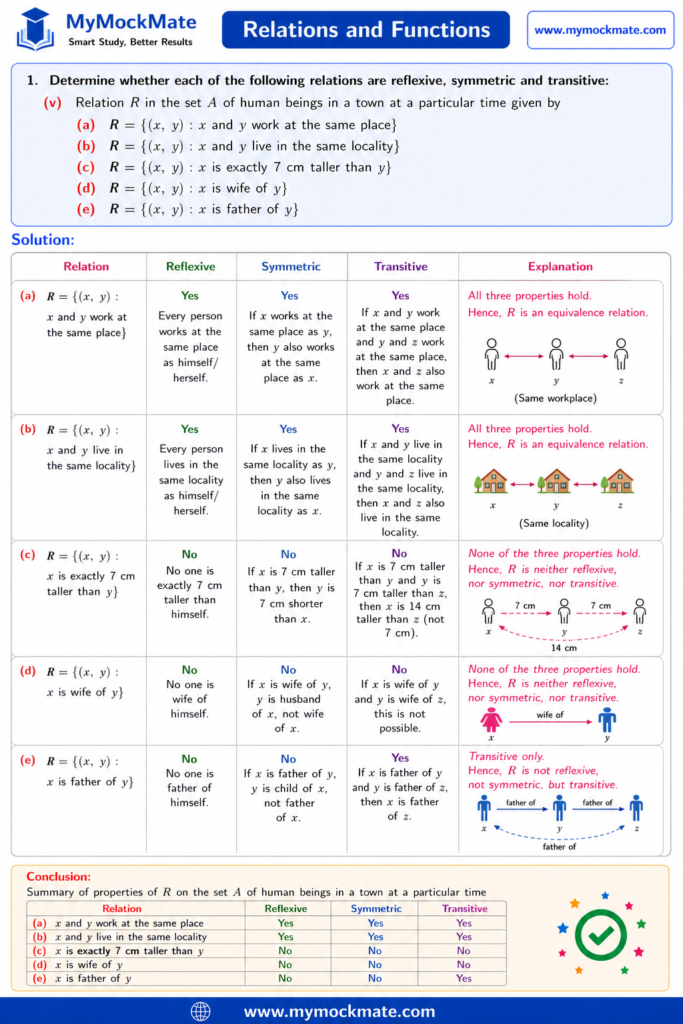
(v) Relation R in the set A of human beings in a town at a particular time given by
(a) R = {(x, y) : x and y work at the same place}
(b) R = {(x, y) : x and y live in the same locality}
(c) R = {(x, y) : x is exactly 7 cm taller than y}
(d) R = {(x, y) : x is wife of y}
(e) R = {(x, y) : x is father of y}
Question 2
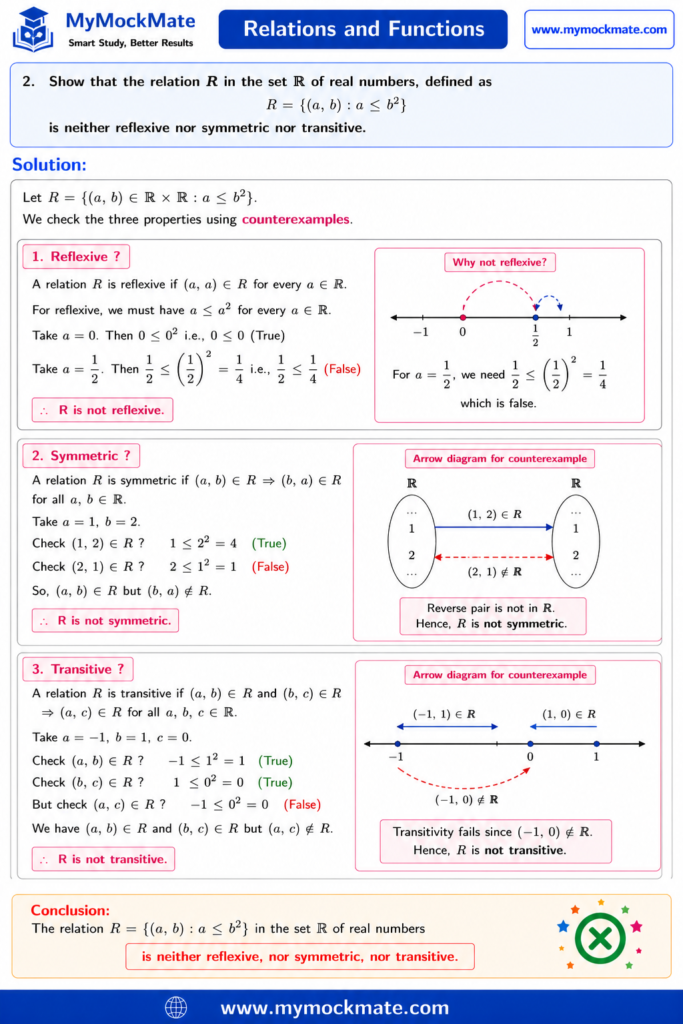
Show that the relation R in the set R of real numbers, defined as
R = {(a, b) : a ≤ b2} is neither reflexive nor symmetric nor transitive.
Solution
Question 3
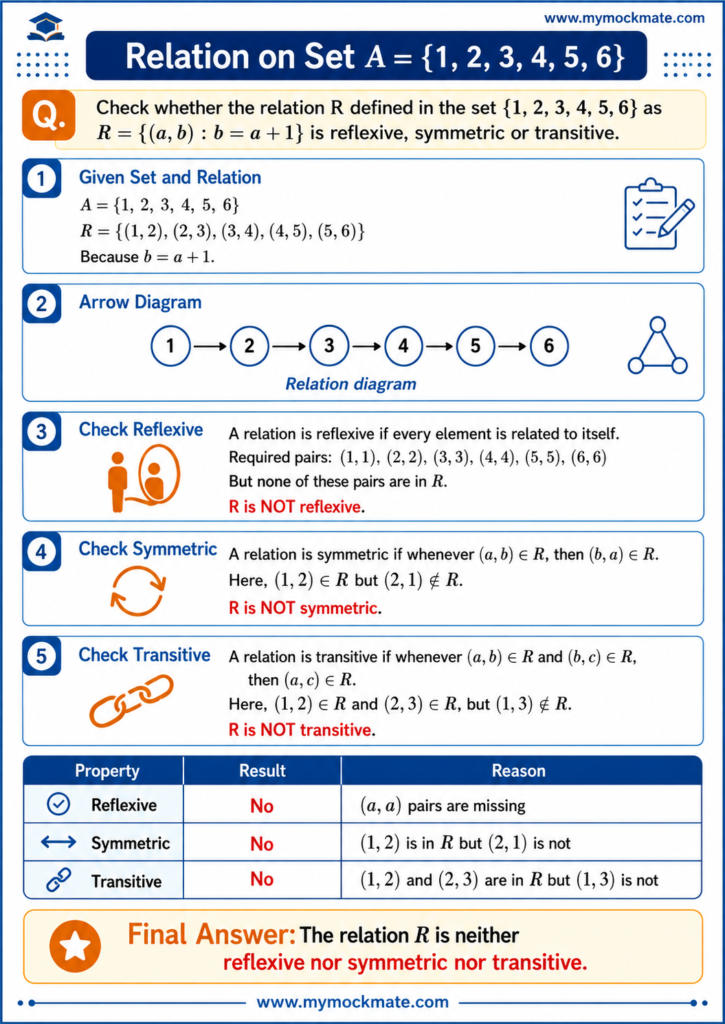
Check whether the relation R defined in the set {1, 2, 3, 4, 5, 6} as R = {(a, b) : b = a + 1} is reflexive, symmetric or transitive.
Solution
Question 4
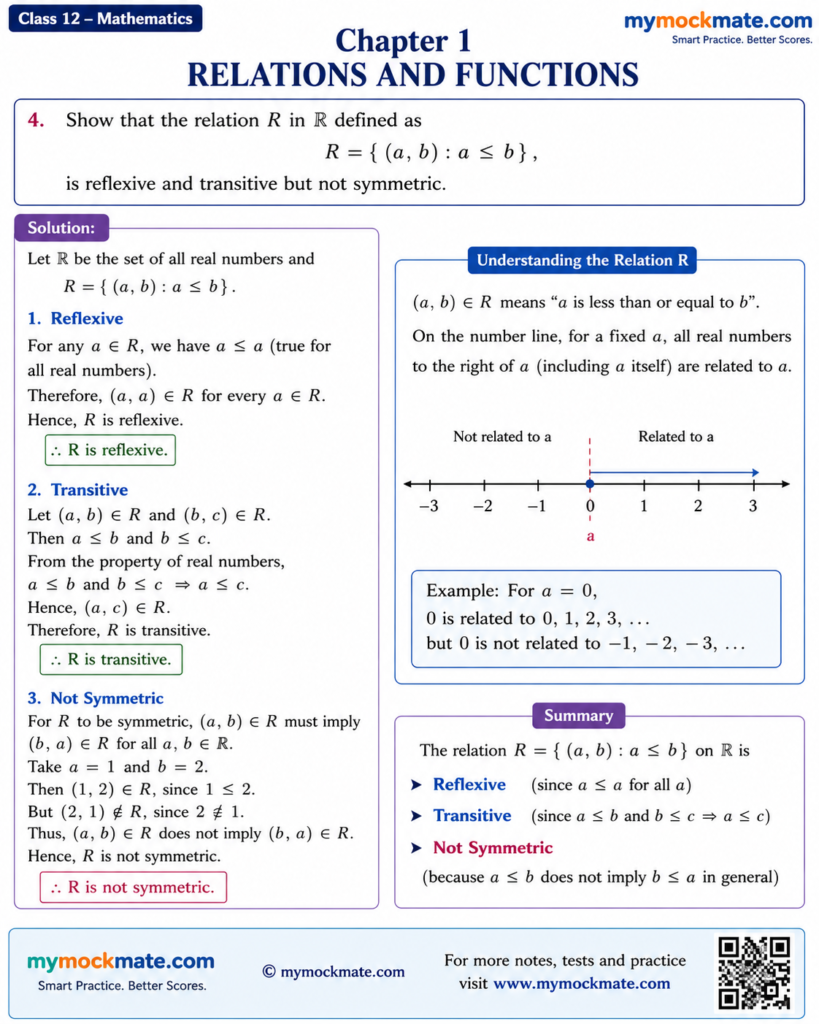
Show that the relation R in R defined as R = {(a, b) : a ≤ b}, is reflexive and transitive but not symmetric.
Solution
Question 5
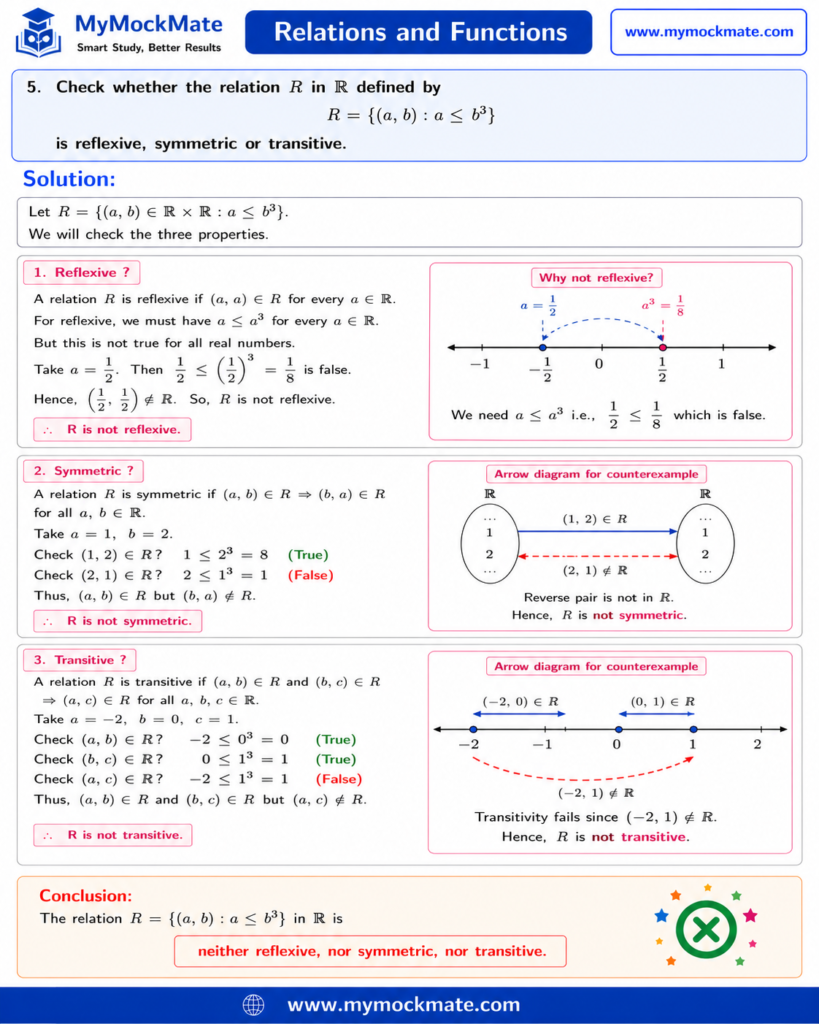
Check whether the relation R in R defined by R = {(a, b) : a ≤ b3} is reflexive,
symmetric or transitive.
Solution
Question 6
Show that the relation R in the set {1, 2, 3} given by R = {(1, 2), (2, 1)} is
symmetric but neither reflexive nor transitive.
Solution
Question 7
Show that the relation R in the set A of all the books in a library of a college,
given by R = {(x, y) : x and y have same number of pages} is an equivalence
relation.
Solution
Question 8
Show that the relation R in the set A = {1, 2, 3, 4, 5} given by
R = {(a, b) : |a – b| is even}, is an equivalence relation. Show that all the
elements of {1, 3, 5} are related to each other and all the elements of {2, 4} are
related to each other. But no element of {1, 3, 5} is related to any element of {2, 4}.
Solution
Question 9
Show that each of the relation R in the set A = {x ∈ Z : 0 ≤ x ≤ 12}, given by
(i) R = {(a, b) : |a – b| is a multiple of 4}
(ii) R = {(a, b) : a = b} is an equivalence relation. Find the set of all elements related to 1 in each case.
Solution
Question 10
Give an example of a relation. Which is
(i) Symmetric but neither reflexive nor transitive.
(ii) Transitive but neither reflexive nor symmetric.
(iii) Reflexive and symmetric but not transitive.
(iv) Reflexive and transitive but not symmetric.
(v) Symmetric and transitive but not reflexive.
Solution
Question 11
Show that the relation R in the set A of points in a plane given by R = {(P, Q) : distance of the point P from the origin is same as the distance of the point Q from the origin}, is an equivalence relation. Further, show that the set of all points related to a point P ≠ (0, 0) is the circle passing through P with origin as centre.
Solution
Common Mistakes
- Confusing symmetric with transitive relation
- Forgetting ordered pair direction
- Missing counterexamples
- Incorrectly assuming every relation is reflexive
Exam Tips
- Always test all three properties separately.
- Use counterexamples to disprove properties.
- Write proper mathematical statements.
- Learn definitions thoroughly.
Practice MCQs
MCQ 1
A relation which is reflexive, symmetric and transitive is called:
A. Universal relation
B. Empty relation
C. Equivalence relation
D. Identity relation
Answer:
C. Equivalence relationMCQ 2
If (a,b) ∈ R implies (b,a) ∈ R, then relation is:
A. Reflexive
B. Symmetric
C. Transitive
D. Universal
Answer:
B. SymmetricMCQ 3
Relation:
a ≤ bis:
A. Symmetric
B. Reflexive only
C. Reflexive and transitive
D. None
Answer:
C. Reflexive and transitiveFAQ Section
What is a reflexive relation?
A relation where:
(a,a) ∈ R for every a ∈ AWhat is symmetric relation?
If:
(a,b) ∈ R ⇒ (b,a) ∈ RWhat is transitive relation?
If:

(a,b) ∈ R and (b,c) ∈ Rthen:
(a,c) ∈ RWhat is equivalence relation?
A relation which is reflexive, symmetric and transitive.
CTA (Call To Action)
📘 Prepare Smarter with MyMockMate!
✅ Chapter-wise NCERT Solutions
✅ Important MCQs & Notes
✅ Online Mock Tests
✅ Instant Result & Analysis
✅ CBSE Board Preparation Support
Start learning now on MyMockMate