




Short Introduction
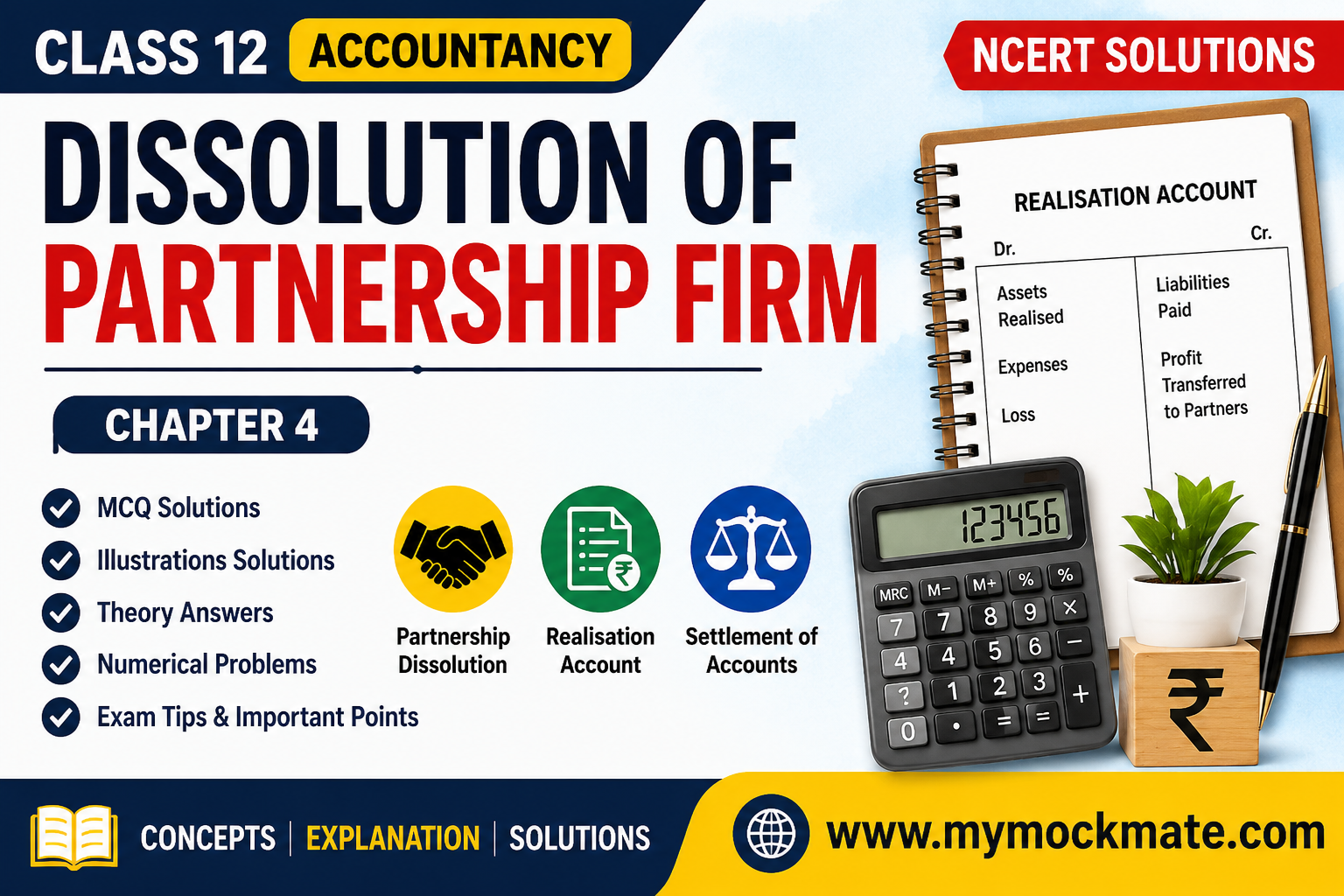
Dissolution of Partnership Firm refers to the complete closure of a partnership business. During dissolution, all assets are realized, liabilities are paid, and the remaining balance is distributed among partners according to their agreed profit-sharing ratio. This chapter explains the legal provisions, accounting treatment, and preparation of Realisation Account at the time of dissolution.
Quick Information Box
Chapter: Dissolution of Partnership Firm
Class: 12
Subject: Accountancy
Book: NCERT Accountancy Part-I
Topic Covered:
• Dissolution of Partnership
• Dissolution of Firm
• Realisation Account
• Settlement of Accounts
• Distribution of Assets and Liabilities
Concepts Used (Topics Covered)
• Meaning of Dissolution
• Difference between Dissolution of Partnership and Dissolution of Firm
• Modes of Dissolution
• Settlement of Claims
• Realisation Account
• Treatment of Assets and Liabilities
• Distribution of Profit and Loss on Realisation
Important Formulas
- Profit on Realisation
Profit on Realisation = Credit Side of Realisation Account − Debit Side of Realisation Account
- Loss on Realisation
Loss on Realisation = Debit Side of Realisation Account − Credit Side of Realisation Account
- Distribution of Realisation Profit/Loss
Partners’ Share = Profit or Loss × Profit Sharing Ratio
Question 1

Statement:
Dissolution of a partnership is different from dissolution of a firm.
Answer: True
Explanation:
Dissolution of partnership means change in relationship among partners due to admission, retirement or death. The business may continue.
Dissolution of a firm means complete closure of business and termination of partnership.
Question 2
Statement:
A partnership is dissolved when there is a death of a partner.
Answer: True
Explanation:
Death of a partner ends the existing partnership agreement and therefore dissolves the partnership relationship.
Question 3
Statement:
A firm is dissolved when all partners give consent to it.
Answer: True
Explanation:
A firm may be dissolved by agreement when all partners mutually agree to dissolve the firm.
Question 4
Statement:
A firm is compulsorily dissolved when a partner decides to retire.
Answer: False
Explanation:
Retirement causes dissolution of partnership but not necessarily dissolution of the firm.
Question 5
Statement:
Dissolution of a firm necessarily involves dissolution of partnership.
Answer: True
Explanation:
When a firm is dissolved, partnership automatically comes to an end.
Question 6
Statement:
A firm is compulsorily dissolved when all partners or all except one partner become insolvent.
Answer: True
Explanation:
Under the Partnership Act, the firm cannot continue if all partners or all except one become insolvent.
Question 7
Statement:
Court can order a firm to be dissolved when a partner becomes insane.
Answer: True
Explanation:
Permanent insanity of a partner is a valid ground for dissolution by court order.
Question 8
Statement:
Dissolution of partnership cannot take place without intervention of the court.
Answer: False
Explanation:
Partnership can be dissolved through mutual agreement without court intervention.
- Confusing dissolution of partnership with dissolution of firm.
- Treating retirement as compulsory dissolution.
- Ignoring legal provisions of Partnership Act, 1932.
- Assuming court intervention is always required.
• Learn all modes of dissolution.
• Remember the distinction table between partnership dissolution and firm dissolution.
• Revise provisions of Section 39 and Section 48.
• Frequently asked theory question in CBSE Board Exams.
- Which of the following leads to dissolution of partnership?
A. Admission of Partner
B. Retirement of Partner
C. Death of Partner
D. All of These
Answer: D
- Dissolution of firm means:
A. Change in ratio
B. Admission
C. Closure of business
D. Retirement
Answer: C
- Which Act governs partnership firms in India?
A. Companies Act
B. Partnership Act 1932
C. GST Act
D. Income Tax Act
Answer: B
- Which of the following is a ground for dissolution by court?
A. Insanity of Partner
B. Misconduct
C. Continuous Losses
D. All of These
Answer: D
- Dissolution of firm always results in:
A. Admission
B. Retirement
C. Dissolution of Partnership
D. None
Answer: C
Q1. What is dissolution of partnership?
Answer:
It refers to the termination of existing relationship among partners while business may continue.
Q2. What is dissolution of a firm?
Answer:
It refers to complete closure of business and termination of partnership relations.
Q3. Which section defines dissolution of firm?
Answer:
Section 39 of the Indian Partnership Act, 1932.
Q4. Is death of a partner dissolution of firm?
Answer:
Not necessarily. It dissolves partnership but the firm may continue.
Q5. Is court order compulsory for dissolution?
Answer:
No. Mutual agreement can also dissolve a firm.
Prepare Accountancy smarter with detailed NCERT solutions, chapter notes, MCQs, important formulas and board exam resources only on www.mymockmate.com.