




Short Introduction
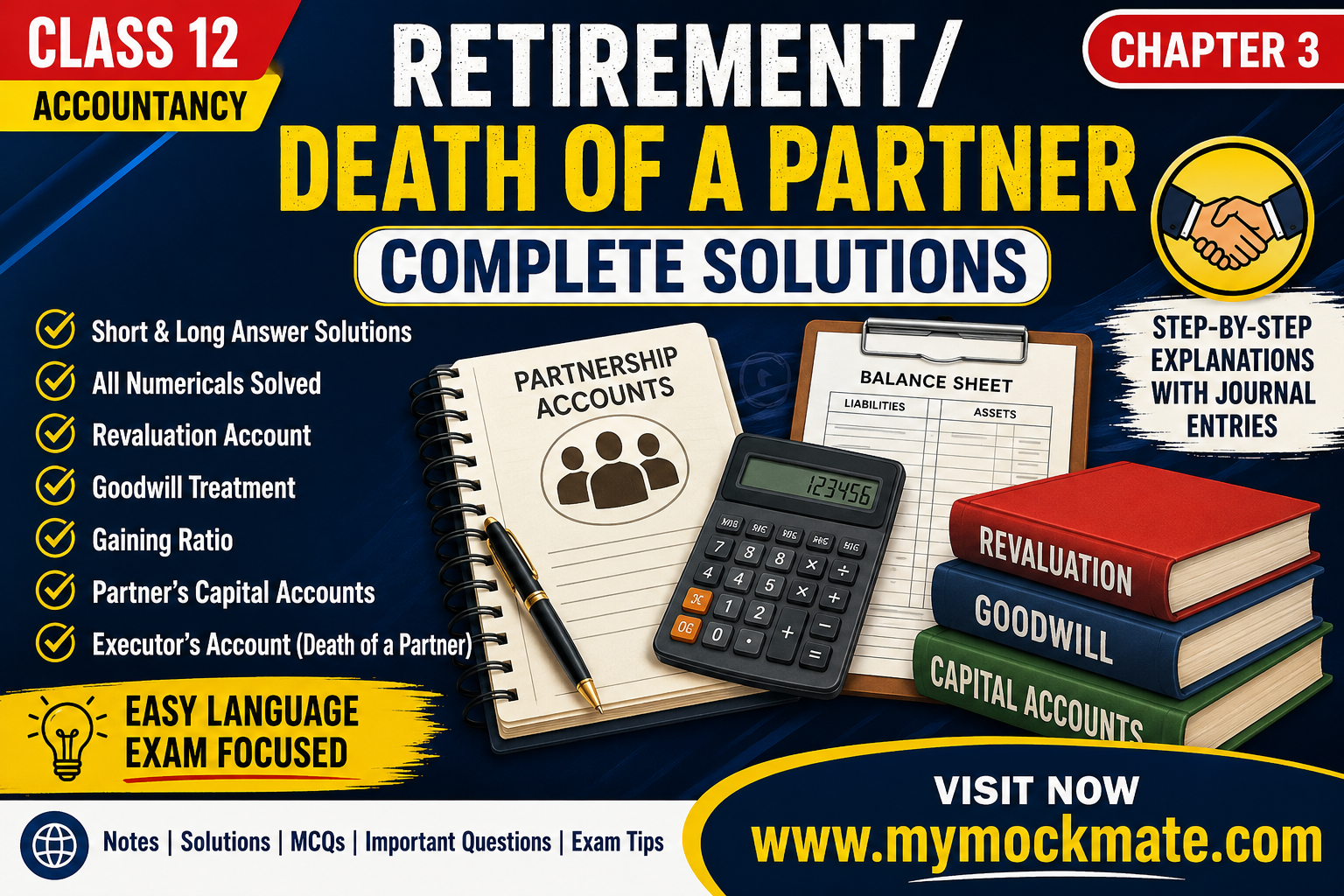
This chapter explains the accounting treatment when a partner retires or dies in a partnership firm. It covers calculation of the new profit sharing ratio, gaining ratio, goodwill adjustment, revaluation of assets and liabilities, distribution of reserves, settlement of the retiring or deceased partner’s claim, and preparation of relevant accounts.
Quick Information Box
- Chapter Name: Retirement/Death of a Partner
- Class: 12
- Subject: Accountancy
- Main Topics: New Profit Sharing Ratio, Gaining Ratio, Goodwill, Revaluation, Reserves, Partner’s Capital and Loan Accounts
- Important Accounts Prepared: Revaluation Account, Partners’ Capital Accounts, Retiring Partner’s Loan Account, Deceased Partner’s Executor’s Account
Concepts Used (Topics Covered)
- Meaning of retirement and death of a partner
- Calculation of new profit sharing ratio
- Calculation of gaining ratio
- Treatment of goodwill
- Hidden goodwill
- Revaluation of assets and liabilities
- Distribution of accumulated profits and losses
- Adjustment of partner’s capitals
- Settlement of retiring partner’s amount
- Calculation of deceased partner’s share of profit up to the date of death
Important Formulas
- New Share = Old Share + Acquired Share
- Gaining Share = New Share − Old Share
- Share of Goodwill = Goodwill of Firm × Partner’s Share
- Deceased Partner’s Share of Profit = Last Year’s Profit × Time Ratio × Partner’s Share
- Average Profit = Total Profit of Past Years ÷ Number of Years
- Interest on Capital = Capital × Rate × Time ÷ 100
Questions & Step-by-Step Solutions
Q1. What are the different ways in which a partner can retire from the firm?
Solution
A partner can retire from a partnership firm in the following ways:
- Retirement by Mutual Agreement: All partners agree to the retirement of a partner according to the terms of the partnership deed.
- Retirement by Notice: In a partnership at will, a partner may retire by giving written notice to the other partners.
- Retirement by Expiry of Partnership Term: In a partnership for a fixed period, a partner may retire when the agreed period ends.
- Retirement under Special Circumstances: A partner may retire due to illness, old age, personal reasons, or as per a court order.
Final Answer
A partner can retire by mutual agreement, by notice, by expiry of the partnership term, or under special circumstances such as illness or court order.
Q2. Write the various matters that need adjustment at the time of retirement of a partner.
Solution
The following adjustments are required at the time of retirement of a partner:
- New Profit Sharing Ratio and Gaining Ratio: The remaining partners’ future profit sharing ratio is calculated, and the ratio in which they gain the retiring partner’s share is determined.
- Goodwill Adjustment: The retiring partner is compensated for his share of goodwill by the gaining partners.
- Revaluation of Assets and Liabilities: Assets and liabilities are revalued to reflect their current market values.
- Unrecorded Assets and Liabilities: Any unrecorded assets or liabilities are brought into the books.
- Distribution of Reserves and Accumulated Losses: General reserves, profit and loss balance, and other accumulated items are transferred to partners’ capital accounts in the old ratio.
- Adjustment of Partner’s Capitals: Remaining partners may adjust their capitals according to the new profit sharing ratio.
- Settlement of Retiring Partner’s Claim: The amount due to the retiring partner is paid immediately or transferred to a loan account.
- Share of Profit up to Date of Retirement: The retiring partner is entitled to his share of profit up to the date of retirement.
Final Answer
The adjustments include goodwill, revaluation, reserves, unrecorded items, new profit sharing ratio, capital adjustment, settlement of claim, and share of profit up to retirement.
Q3. Distinguish between Sacrificing Ratio and Gaining Ratio.
| Basis | Sacrificing Ratio | Gaining Ratio |
|---|---|---|
| Meaning | Ratio in which existing partners sacrifice their share of profit. | Ratio in which continuing partners gain the outgoing partner’s share. |
| Effect on Share | Partner’s profit share decreases. | Partner’s profit share increases. |
| Formula | Old Share − New Share | New Share − Old Share |
| When Calculated | At the time of admission of a new partner. | At the time of retirement or death of a partner. |
| Compensation | New partner compensates sacrificing partners. | Gaining partners compensate the retiring/deceased partner. |
Final Answer
Sacrificing ratio is used during admission when partners give up a part of their share, while gaining ratio is used during retirement or death when continuing partners gain the outgoing partner’s share.
Q4. Why do firms revalue assets and reassess liabilities on retirement or death of a partner?
Solution
Firms revalue assets and reassess liabilities to ensure that the retiring or deceased partner receives a fair settlement. The reasons are:
- Fair Valuation: Assets may appreciate or depreciate, and liabilities may change in value over time.
- Correct Capital Balance: Revaluation ensures that the capital accounts reflect the current worth of the firm.
- Equitable Settlement: The outgoing partner should receive his rightful share in the increase or decrease in the value of assets and liabilities.
- True Financial Position: It presents the correct financial position of the reconstituted firm after retirement or death.
- Adjustment of Unrecorded Items: Any unrecorded assets or liabilities are recognized before settlement.
Final Answer
Revaluation is done to determine the current value of assets and liabilities, ensure fair settlement to the outgoing partner, and present the true financial position of the reconstituted firm.
Q5. Explain the treatment of goodwill at the time of retirement of a partner.
Solution
At the time of retirement, the retiring partner is entitled to his share of goodwill because goodwill has been built by the efforts of all partners.
Treatment of Goodwill
1. When Goodwill Does Not Appear in the Books
The retiring partner’s share of goodwill is adjusted through the capital accounts of the gaining partners.
Journal Entry
2. When Goodwill Already Appears in the Books
The existing goodwill is first written off among all partners in the old profit sharing ratio. Then the retiring partner’s share of goodwill is adjusted through the gaining partners’ capital accounts.
3. Hidden Goodwill
If the retiring partner is paid more than the balance due in his capital account after adjustments, the excess amount is treated as his share of goodwill.
Important Point
The gaining partners compensate the retiring partner in their gaining ratio because they benefit from acquiring his share of future profits.
Final Answer
The retiring partner’s share of goodwill is compensated by the gaining partners through their capital accounts, either by adjusting goodwill directly or by writing off existing goodwill first.
Common Mistakes
- Using old ratio instead of gaining ratio for goodwill adjustment.
- Ignoring revaluation before calculating retiring partner’s claim.
- Not transferring reserves and accumulated losses to capital accounts.
- Incorrect calculation of deceased partner’s share of profit for the intervening period.
- Forgetting to adjust capitals according to the new profit sharing ratio.
Exam Tips
- Always calculate new profit sharing ratio before goodwill adjustment.
- Use gaining ratio for compensating the retiring or deceased partner.
- Prepare Revaluation Account before Partners’ Capital Accounts.
- Transfer reserves and losses in the old profit sharing ratio.
- In death cases, remember to calculate share of profit up to the date of death.
Practice MCQs
1. The ratio in which continuing partners acquire the retiring partner’s share is called:
- (a) Sacrificing ratio
- (b) Gaining ratio
- (c) Capital ratio
- (d) Debt-equity ratio
Answer
(b) Gaining ratio

2. At the time of retirement, reserves are transferred to partners’ capital accounts in:
- (a) New ratio
- (b) Gaining ratio
- (c) Old ratio
- (d) Equal ratio
Answer
(c) Old ratio
3. If goodwill already appears in the books, it is first:
- (a) Added to assets
- (b) Written off among all partners
- (c) Ignored
- (d) Transferred to reserve
Answer
(b) Written off among all partners
FAQ Section
Q1. What is a new profit sharing ratio?
It is the ratio in which the remaining partners share future profits after the retirement or death of a partner.
Q2. Why is goodwill adjusted on retirement?
Goodwill is adjusted because the retiring partner is entitled to his share of the goodwill earned by the firm.
Q3. What is hidden goodwill?
Hidden goodwill is the excess amount paid to the retiring partner over the balance due in his capital account after adjustments.
Q4. How are reserves treated on retirement?
Reserves are transferred to all partners’ capital accounts in their old profit sharing ratio.
Q5. What happens if the firm cannot pay the retiring partner immediately?
The amount due is transferred to the Retiring Partner’s Loan Account and paid later with or without interest as agreed.
For more Class 12 Accountancy solutions, chapter-wise notes, numericals, and exam-oriented study material, visit www.mymockmate.com and boost your board exam preparation.