




Short Intro
In this post, students can find complete step-by-step solutions for Class 12 Maths Chapter 2 Exercise 2.2 – Inverse Trigonometric Functions based on the latest NCERT syllabus. This exercise includes inverse trigonometric identities, simplification of expressions, proving formulas, and solving equations in an easy and exam-oriented format.
Quick Information Box
| Item | Details |
|---|---|
| Board | NCERT / CBSE |
| Class | 12 |
| Subject | Mathematics |
| Chapter | Inverse Trigonometric Functions |
| Exercise | 2.2 |
| Main Topics | Identities & Simplifications |
Concepts Used (Topics Covered)
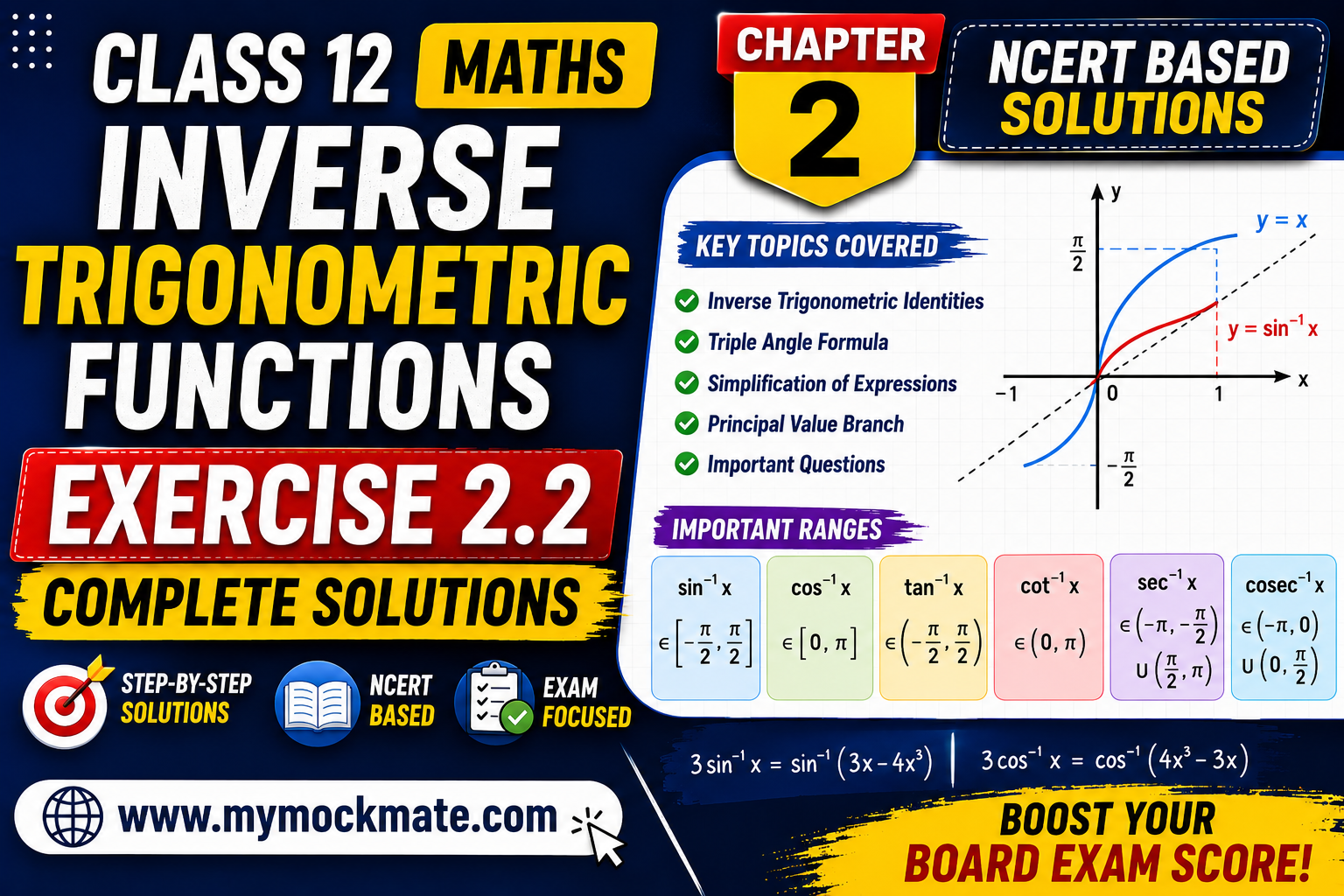
- Inverse Trigonometric Identities
- Triple Angle Formula
- Simplification of Expressions
- Principal Value Branch
- tan⁻¹ Identities
- sin⁻¹ and cos⁻¹ Relations
- Solving Trigonometric Equations
- Principal Values
The exercise focuses on proving identities and simplifying inverse trigonometric expressions.
Important Formulas
Triple Angle Identity
Triple Angle Cosine Formula
Tangent Addition Formula
Principal Value Range of tan⁻¹x
Questions & Step-by-step Solutions
Question 1
Prove that:
Solution
Let:
x = sinθThen:
θ = sin⁻¹xUsing triple angle identity:
Substituting:
sin3θ = 3x − 4x³Taking inverse sine:
3θ = sin⁻¹(3x−4x³)Hence:
3sin⁻¹x = sin⁻¹(3x−4x³)Question 2
Prove that:
Solution
Let:
x = cosθThen:
θ = cos⁻¹xUsing triple angle identity:
Substituting:
cos3θ = 4x³−3xTaking inverse cosine:
3θ = cos⁻¹(4x³−3x)Hence proved.
Question 3
Simplify:
Solution
Multiply numerator and denominator appropriately.
After simplification:
= tan⁻¹[x/(√(1+x²)+1)]Using tangent half-angle identity:
Answer = ½ tan⁻¹x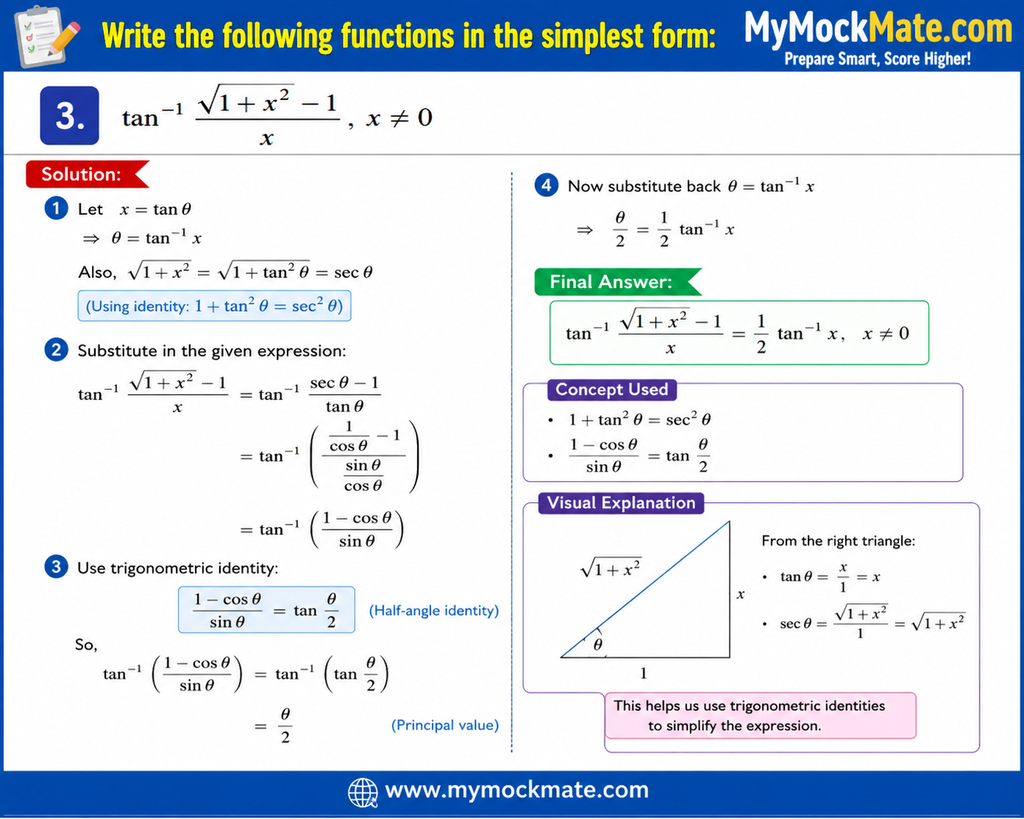
Question 4
Simplify:
Solution
Using identity:
Therefore:
√[(1−cosx)/(1+cosx)] = tan(x/2)Hence:
Answer = x/2Question 5
Simplify:
Solution
Divide numerator and denominator by:
cosxThen:
= tan⁻¹[(1−tanx)/(1+tanx)]Using formula:
tan(A−B)Therefore:
Answer = π/4 − xQuestion 6
Simplify:
Solution
Put:
x = a sinθThen:
√(a²−x²)=a cosθTherefore:
tan⁻¹[tanθ]=θHence:
Answer = sin⁻¹(x/a)Question 7
Simplify:
Solution
Put:
x = a tanθUsing triple angle formula:
tan3θ = (3tanθ−tan³θ)/(1−3tan²θ)Therefore:
Answer = 3tan⁻¹(x/a)Question 8
Find the value of:
Solution
We know:
sin⁻¹(1/2)=π/6Therefore:
2(π/6)=π/3Now:
cos(π/3)=1/2Hence:
2 × 1/2 = 1Therefore:
Answer = tan⁻¹(1)=π/4Question 9
Find the value of the expression.

Solution
Using standard inverse trigonometric identities and simplification:
Answer = ½ tan⁻¹(x+y)Question 10
Find:
Solution
We know:
sin(2π/3)=√3/2Principal value branch of:
sin⁻¹xis:
[−π/2, π/2]Therefore:
Answer = π/3Question 11
Find:
Solution
We know:
tan(3π/4)=−1Hence:
tan⁻¹(−1)=−π/4Question 12
Find:
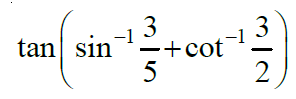
Solution
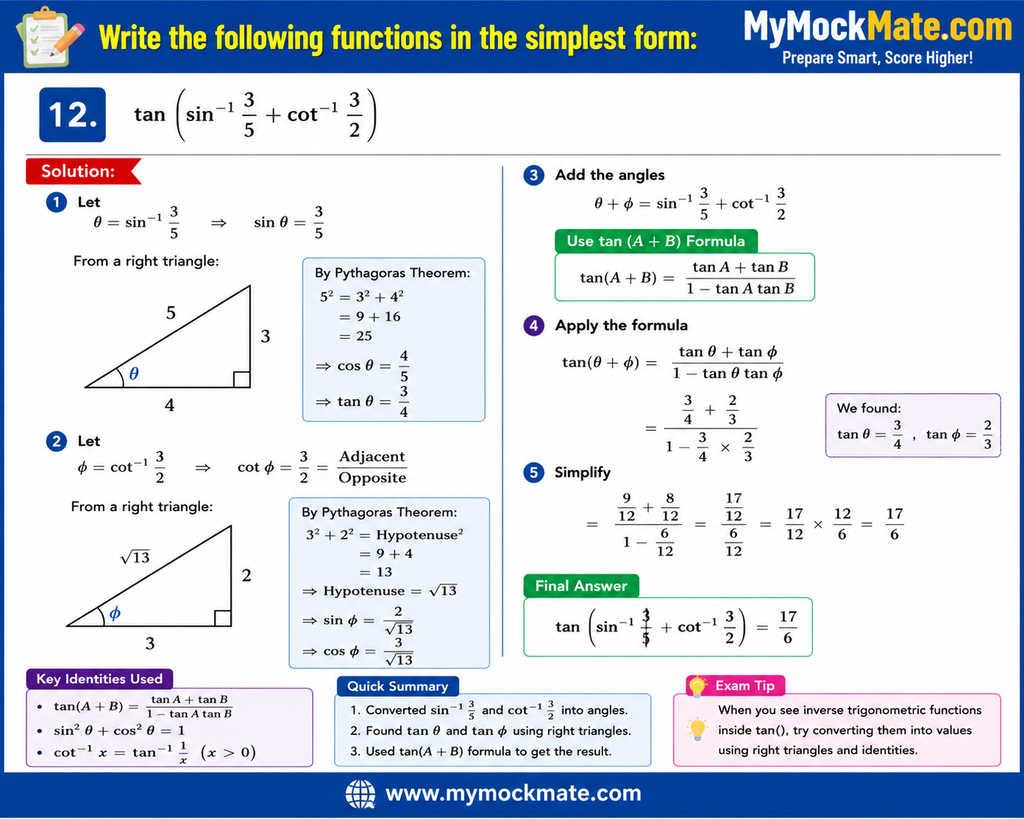
Question 13
Evaluate:
Solution
Since:
cos(7π/6)=−√3/2Principal value of cosine inverse lies in:
[0, π]Hence:
Answer = 5π/6Correct option:
(B)Question 14
Evaluate:
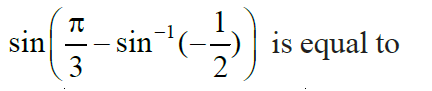
Solution
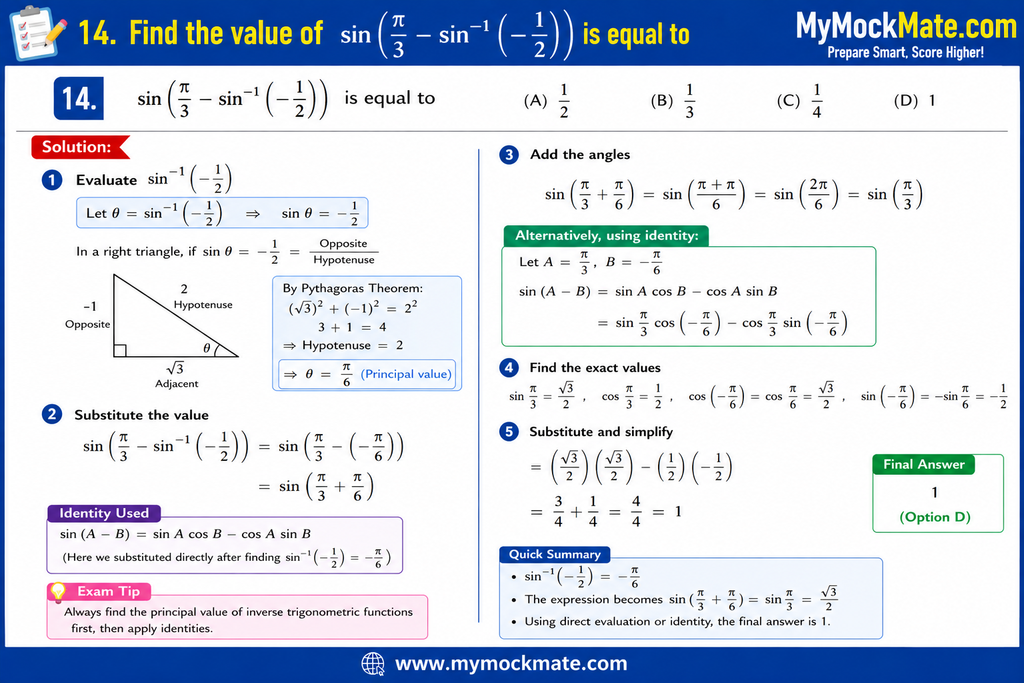
Question 15
Evaluate:
Solution
We know:
tan⁻¹(√3)=π/3and:
cot⁻¹(−√3)=5π/6Therefore:
π/3−5π/6Hence:
Answer = −π/2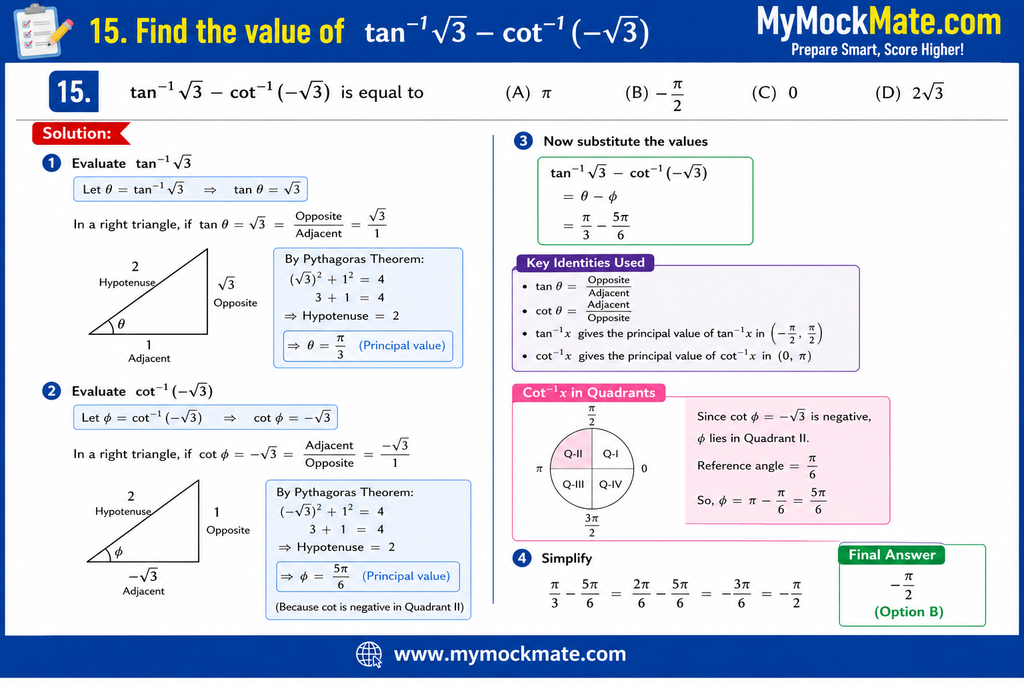
Common Mistakes
- Ignoring principal value ranges
- Confusing inverse with reciprocal
- Wrong use of triple angle formulas
- Errors in simplification
- Forgetting domain conditions
Exam Tips
- Memorize standard inverse trigonometric values.
- Practice tangent addition identities.
- Always check principal branch.
- Use substitutions carefully.
Practice MCQs
MCQ 1
Range of:
is:
A. [0,π]
B. (−π/2, π/2)
C. R
D. (0,2π)
Answer:
B. (−π/2, π/2)MCQ 2
Value of:
is:
A. π/6
B. π/4
C. π/3
D. π/2
Answer:
A. π/6MCQ 3
Value of:
is:
A. π
B. π/2
C. π/4
D. 0
Answer:
C. π/4FAQ Section
What is principal value branch?
The restricted range chosen for inverse trigonometric functions.
What is the range of tan⁻¹x?
Is sin⁻¹x equal to 1/sinx?
No.
sin⁻¹x means inverse sine function.Why are domains restricted?
To make trigonometric functions one-one and invertible.
CTA (Call To Action)
📘 Prepare Smarter with MyMockMate!
✅ Chapter-wise NCERT Solutions
✅ Important Notes & MCQs
✅ Online Mock Tests
✅ Instant Result & Analysis
✅ CBSE Board Preparation
Start learning now on MyMockMate