



Short Intro
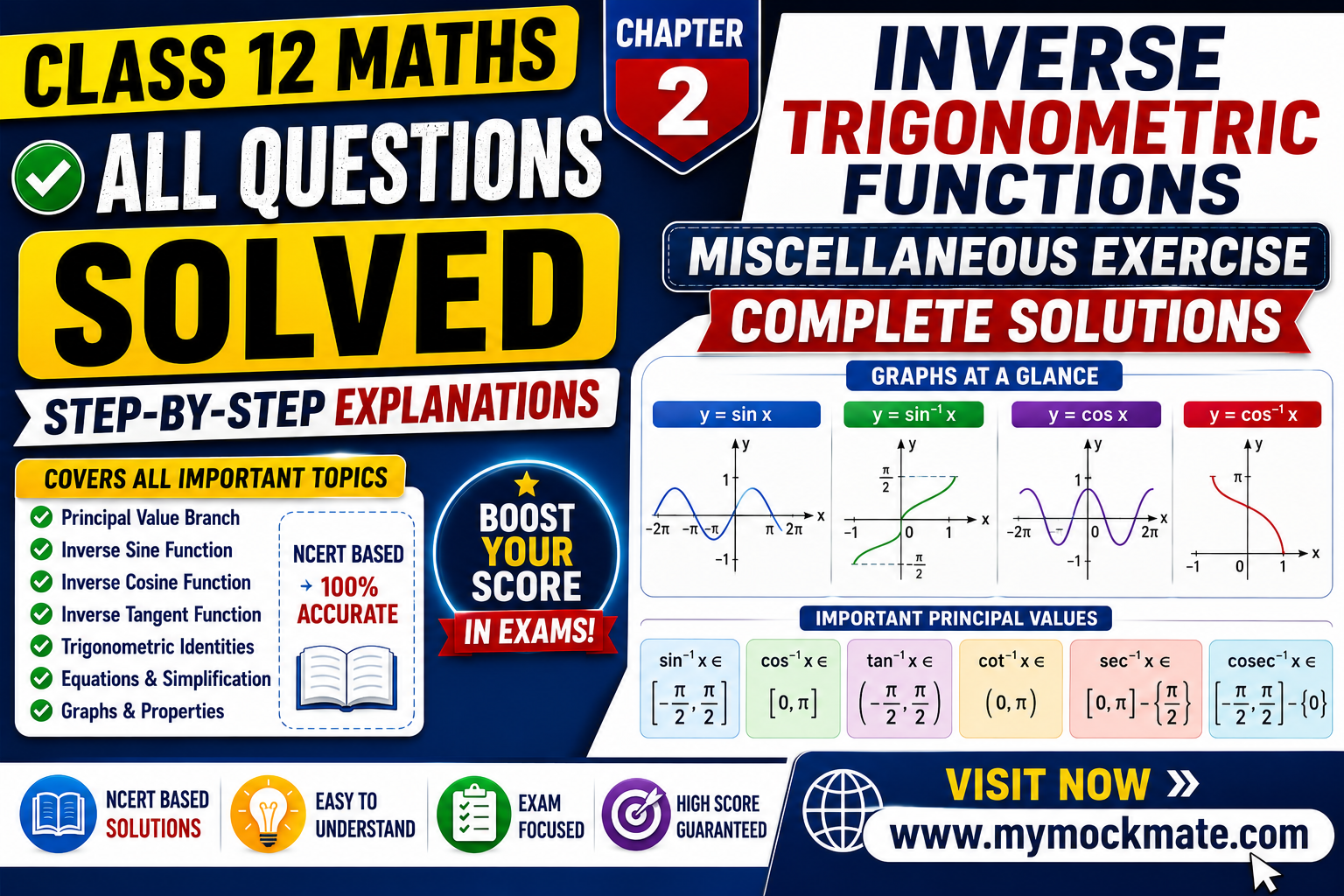
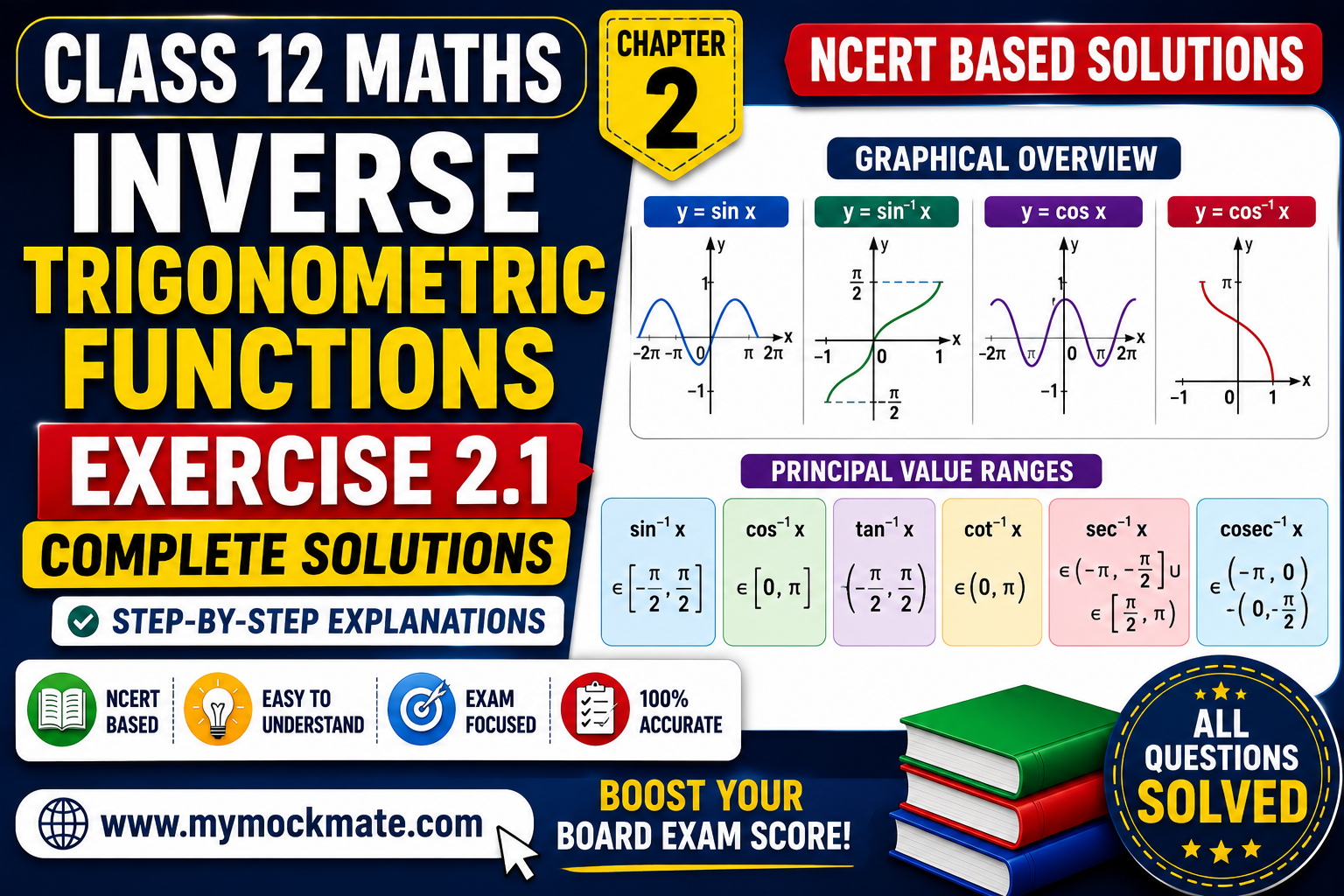
In this post, students can find complete step-by-step solutions for Class 12 Maths Chapter 2 Exercise 2.1 – Inverse Trigonometric Functions based on the latest NCERT syllabus. This exercise covers principal values, domains and ranges of inverse trigonometric functions, and evaluation of inverse trigonometric expressions in a simple and exam-oriented format.
Quick Information Box
| Item | Details |
|---|---|
| Board | NCERT / CBSE |
| Class | 12 |
| Subject | Mathematics |
| Chapter | Inverse Trigonometric Functions |
| Exercise | 2.1 |
| Main Topics | Principal Values |
Concepts Used (Topics Covered)
- Principal Value Branch
- Inverse Sine Function
- Inverse Cosine Function
- Inverse Tangent Function
- Inverse Cotangent Function
- Inverse Secant Function
- Inverse Cosecant Function
- Domain & Range of Inverse Trigonometric Functions
The chapter explains principal value branches of inverse trigonometric functions.
Important Formulas
Principal Value Range of sin⁻¹x
Principal Value Range of cos⁻¹x
Principal Value Range of tan⁻¹x
Principal Value Range of cot⁻¹x
Questions & Step-by-step Solutions
Question 1
Find:
Solution
We know:
sin(−π/6)=−1/2Principal value range of:
sin⁻¹xis:
[−π/2, π/2]Therefore:
Answer = −π/6Question 2
Find:
Solution
We know:

cos(π/6)=√3/2Principal value range of:
cos⁻¹xis:
[0, π]Therefore:
Answer = π/6Question 3
Find:
Solution
We know:
cosec(π/6)=2Therefore:
Answer = π/6Question 4
Find:
Solution
We know:
tan(−π/3)=−√3Therefore:
Answer = −π/3Question 5
Find:
Solution
We know:
cos(2π/3)=−1/2Since principal value range of cosine inverse is:
[0, π]Therefore:
Answer = 2π/3Question 6
Find:
Solution
We know:
tan(−π/4)=−1Therefore:
Answer = −π/4Question 7
Find:
Solution
We know:
sec(5π/6)=−2/√3Therefore:
Answer = 5π/6Question 8
Find:
Solution
We know:
cot(π/6)=√3Therefore:
Answer = π/6Question 9
Find:
Solution
We know:
cos(3π/4)=−1/√2Therefore:
Answer = 3π/4Question 10
Find:
Solution
We know:
cosec(−π/4)=−√2Therefore:
Answer = −π/4Question 11
Find the value of:
Solution
Using standard values:
tan⁻¹(1)=π/4cos⁻¹(−1/2)=2π/3sin⁻¹(−1/2)=−π/6Adding:
π/4 + 2π/3 − π/6LCM = 12
= 3π/12 + 8π/12 − 2π/12Therefore:
Answer = 3π/4Question 12
Find:
Solution
Using standard values:
cos⁻¹(1/2)=π/3sin⁻¹(1/2)=π/6Hence:
π/3 + 2(π/6)= π/3 + π/3Therefore:
Answer = 2π/3Question 13
If:
then:
Solution
Range of:
sin⁻¹xis:
[−π/2, π/2]Therefore correct option is:
(B)Question 14
Evaluate:
Solution
We know:
tan⁻¹(√3)=π/3and:
sec⁻¹(−2)=2π/3Therefore:
π/3 − 2π/3Hence:
Answer = −π/3Correct option:
(B)Common Mistakes
- Ignoring principal value ranges
- Confusing sin⁻¹x with 1/sinx
- Using wrong quadrant values
- Forgetting domain restrictions
- Wrong sign in inverse functions
Exam Tips
- Memorize standard inverse trigonometric values.
- Always check principal value branch.
- Use unit circle for quick answers.
- Practice simplification regularly.
Practice MCQs
MCQ 1
Principal value range of:
is:
A. [−π/2, π/2]
B. [0, π]
C. R
D. (−π, π)
Answer:
B. [0, π]MCQ 2
Value of:
is:
A. π
B. π/2
C. π/4
D. 0
Answer:
C. π/4MCQ 3
Value of:
is:
A. π/6
B. −π/6
C. 5π/6
D. −5π/6
Answer:
B. −π/6FAQ Section
What is principal value?
The value lying in the principal branch of inverse trigonometric function.
What is the range of sin⁻¹x?
Is sin⁻¹x equal to 1/sinx?
No.
sin⁻¹x means inverse sine function.What is the range of tan⁻¹x?
CTA (Call To Action)
📘 Prepare Smarter with MyMockMate!
✅ Chapter-wise NCERT Solutions
✅ Important Notes & MCQs
✅ Online Mock Tests
✅ Instant Result & Analysis
✅ CBSE Board Preparation
Start learning now on MyMockMate