


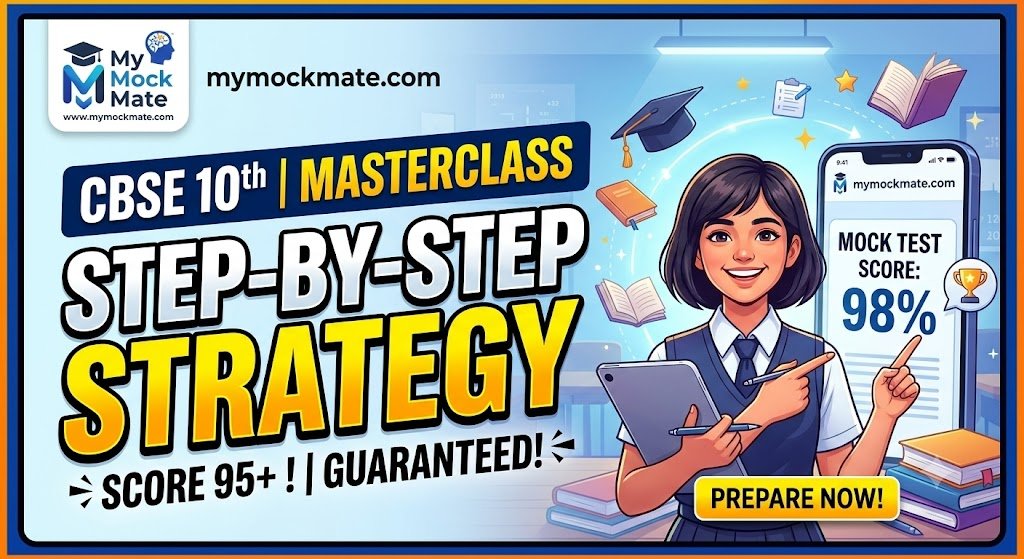

Step-by-Step Preparation Strategy for CBSE 10th: The Ultimate Guide to Scoring 95+
The CBSE Class 10 Board Examination is the first major milestone in a student’s academic journey. It sets the foundation for your future streams (Science, Commerce, or Arts) and builds the discipline required for higher competitive exams like NEET, JEE, or CUET. However, the transition to Class 10 can often feel overwhelming due to the vast syllabus, deep concepts, and the pressure of a centralized board evaluation.
To ace this exam with a 95+ score, hard work alone isn’t enough; you need a structured, strategic, and smart preparation blueprint. In this comprehensive guide, we will break down the ideal step-by-step CBSE Class 10 preparation strategy and highlight how leveraging modern digital tools like mymockmate.com can supercharge your performance.
Step 1: Decode the Syllabus and Exam Pattern
Before diving into your textbooks, you must map out your territory. Every year, CBSE releases the official curriculum, deleted topics, and marking schemes.
- Download the Official Syllabus: Never rely blindly on old reference books or random internet blogs. Visit the official CBSE academic website and download the latest syllabus for Mathematics, Science, Social Science, English, and Hindi/regional languages.
- Analyze the Marking Scheme: Understand which chapters carry the maximum weightage. For example, in Mathematics, Calculus/Algebra might hold a bigger chunk of marks than smaller chapters. Prioritize high-weightage topics during your first phase of study.
- Know the Question Types: The modern CBSE pattern highly emphasizes Competency-Based Questions, Case-Based Studies, Assertion-Reasoning, and Multiple Choice Questions (MCQs). Moving away from rote memorization to conceptual clarity is mandatory.
Step 2: Establish a Realistic and Balanced Study Timetable
A strategy without a schedule is just a wish. A well-tailored timetable reduces anxiety and ensures consistency.
- Avoid Extremes: Do not create an unrealistic routine of studying 12 hours a day from day one. Start with 3 to 4 hours of focused, high-intensity study and gradually increase it.
- The Interleaving Technique: Instead of studying Physics all day, mix it up. Spend 2 hours on Mathematics (problem-solving) and 1.5 hours on a theory-heavy subject like History or Biology. This keeps your brain active and prevents burnout.
- Allocate Dedicated Slots for Weak Subjects: If Geometry or Chemical Reactions scare you, schedule them during your most alert hours (usually early morning).
- Buffer Days: Always leave Sundays or the last two days of the month open for revision and backlog clearance.
Step 3: Master the Core Textbooks (NCERT is King)
Ninety percent of the CBSE Board exam is directly derived from the NCERT textbooks.
- Line-by-Line Reading: For subjects like Science and Social Science, read every single line of the NCERT text. Pay close attention to definitions, diagrams, footnotes, and exemplar problems.
- Solve In-Text Questions: Do not skip the “Blue Questions” or end-of-chapter exercises in your NCERT books. Many board exam questions are lifted directly from these sections.
- Make Crisp Notes: While reading, synthesize the information into short summaries, flowcharts, and bullet points. Writing while reading aids muscle memory and provides an invaluable resource for last-minute revisions.
Step 4: Shift from Rote Learning to Conceptual Application
As mentioned earlier, CBSE is rapidly moving away from traditional theoretical questions to application-based scenarios.
- Science: Understand the practical applications of concepts like Ohm’s Law, Refraction of Light, and Carbon Compounds. Try to visualize laboratory experiments.
- Mathematics: Don’t just memorize formulas. Understand how a formula is derived. If you know the underlying logic of the Section Formula or Trigonometric Identities, twisting the question won’t confuse you.
- Social Science: Connect historical events in a chronological storyline. For Geography and Economics, relate the concepts to real-world infrastructure and financial systems.
Step 5: Integrate Regular Testing with MyMockMate.com
This is where many toppers differentiate themselves from average students. Reading and revising cover only 50% of your preparation. The remaining 50% depends entirely on your ability to perform under exam-room pressure. This is where mymockmate.com becomes your ultimate preparation partner.
Why Online Mock Tests are Critical for CBSE 10th
Sitting in a quiet room for 3 hours and writing a paper requires mental stamina. Taking regular online chapter-wise tests and full-length mock examinations provides immediate feedback on your retention levels.
How to Use MyMockMate.com Effectively:
- Chapter-Wise Testing: Once you finish a chapter—say, Quadratic Equations in Math or Life Processes in Science—head over to mymockmate.com and take a dedicated chapter test. This ensures that your fundamentals for that specific topic are completely solid before you move on.
- Simulating the Real Board Exam: As you approach the mid-term and pre-board seasons, start attempting full-length, 3-hour mock tests on mymockmate.com. These tests are designed strictly based on the latest CBSE guidelines, matching the exact difficulty level, question distribution, and time constraints of the final board exam.
- Advanced Analytics for Weakness Tracking: The platform provides comprehensive performance tracking. It identifies whether you are losing marks due to silly calculation errors, lack of conceptual depth, or poor time management. This allows you to pivot and fix your weaknesses instantly rather than discovering them on the day of the actual exam.
Step 6: Mastering Language Subjects and Answers Presentation
Students often spend all their time on Science and Math, ignoring English and their second language. Remember, every subject carries equal weightage toward your final percentage aggregate.
- English and Languages: Practice the Reading Comprehension section regularly to improve reading speed. Master the specific formats for formal letters, analytical paragraphs, and notices.
- The Art of Answer Presentation: Examiners read hundreds of copies. Make their job easy.
- Use bullet points instead of long, boring paragraphs.
- Underline key terms, definitions, and final values (in Math).
- Draw neat, labeled diagrams wherever applicable in Science (e.g., Ray diagrams, digestive system) using a sharp pencil.
Step 7: The Revision Loop and Analytics-Driven Adjustments
Human memory decays rapidly without periodic reinforcement. Your preparation loop must follow this cycle: Learn → Test on MyMockMate.com → Analyze Mistakes → Revise → Retest.
- The Spaced Repetition Method: Instead of cramming a chapter once and looking at it 3 months later during exams, revise it at increasing intervals (Day 1, Day 7, Day 30).
- Maintain an Error Log: Whenever you get a question wrong on mymockmate.com, write it down in a dedicated “Error Notebook” along with its correct solution and the underlying concept. Review this notebook every single weekend.
Subject-Wise Tactical Blueprint
Mathematics
- Daily Practice: Spend at least 1 to 1.5 hours solving math problems daily.
- Formula Sheet: Create a single chart containing all formulas for Surface Areas and Volumes, Trigonometry, and Coordinate Geometry, and paste it on your study wall.
- Time Management: Practice sections in reverse order if you find long-answer questions time-consuming. Check your section-wise speed using metrics on mymockmate.com.
Science
- Physics: Focus heavily on numerical practices from Light and Electricity. Master circuit diagrams and lens/mirror formulas.
- Chemistry: Memorize chemical equations along with the color changes of precipitates and reactants. Balance equations properly.
- Biology: Practice diagrams cleanly. Focus on terms, functions, and comparative processes (like aerobic vs. anaerobic respiration).
Social Science
- History: Create timelines for the Rise of Nationalism in Europe and Nationalism in India.
- Geography & Civics: Focus on map work. Practice map pinpointing regularly.
- Keywords: Write answers using core textbook terminology (e.g., using terms like “secularism,” “federalism,” or “topography” instead of generic words).
Conclusion: Consistency Trumps Intensity
Cracking the CBSE Class 10 board exam with an exceptional percentage is not about studying 18 hours a day in the final month. It is about a disciplined, day-by-day execution of a smart study plan. Read your NCERT thoroughly, make concise notes, present your answers elegantly, and continuously validate your learning with the premium testing environment at mymockmate.com.
Equipped with the right strategy and the precise analytical tracking of MyMockMate, you are fully prepared to transform your academic goals into reality. Start testing today, track your growth, and watch your board exam scores skyrocket!
Frequently Asked Questions (FAQs)
Q1. When is the ideal time to start solving full-length mock tests for CBSE Class 10?
Ans: You should ideally start solving comprehensive, full-length mock tests around November or December, after finishing at least 80–90% of your core syllabus. However, chapter-wise testing on platforms like mymockmate.com should be done throughout the year as soon as you finish individual topics in school.
Q2. Is NCERT enough to get a 95+ score in the CBSE 10th Board Exam?
Ans: Yes, NCERT is the definitive baseline. For theory-based subjects like Social Science, English, and Biology, NCERT is completely sufficient. For practicing varied problems in Mathematics and Physics numericals, you can supplement NCERT with Exemplar books and structured mock question banks available on mymockmate.com.
Q3. How does mymockmate.com help me perform better than offline test series?
Ans: Mymockmate.com provides instant feedback, deep performance insights, and time-tracking analytics that offline test papers cannot offer. It accurately highlights your precision levels, average time spent per question, and conceptual blind spots, giving you a clear mathematical roadmap to improve your scores.

Q4. How should I handle competency-based and case-study questions?
Ans: These questions test your practical understanding rather than your memorization skills. The best way to master them is to understand the real-life logic behind every topic and practice an extensive array of case-study model papers. Mymockmate.com features dedicated competency modules curated specifically to align with the latest shifting trends of CBSE parameters.
Q5. How many hours should a Class 10 student study daily?
Ans: Consistency matters more than hours. A focused self-study session of 3 to 4 hours daily (excluding school or coaching classes) is perfectly adequate to achieve top ranks, provided the time is utilized efficiently without distractions.




It’s great that you are getting thoughts from this paragraph
as well as from our argument made at this place.