




Short Introduction
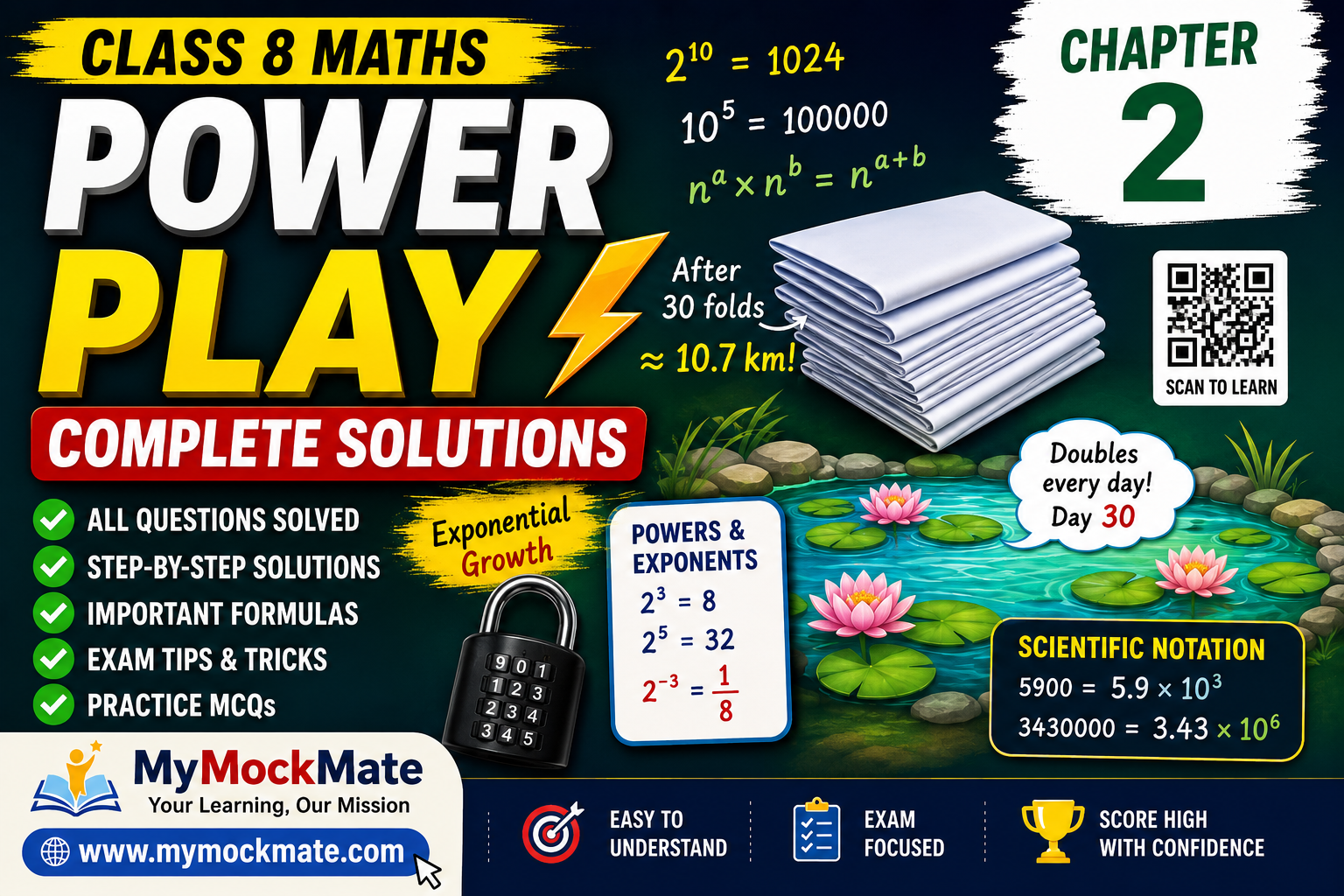
The chapter “Power Play” introduces students to the fascinating world of exponents, exponential growth, scientific notation, powers of 10, and large numbers. Through interesting real-life examples like folding paper, magical ponds, password combinations, and huge world statistics, students learn how powers simplify calculations and help represent extremely large or small numbers.
Quick Information Box
| Particular | Details |
|---|---|
| Chapter Name | Power Play |
| Class | Grade 8 |
| Subject | Mathematics |
| Main Topics | Exponents, Powers, Scientific Notation |
| Difficulty Level | Moderate |
| Important For | School Exams, Olympiads |
| Skills Developed | Logical Thinking, Estimation, Number Sense |
Concepts Used (Topics Covered)
- Exponential Growth
- Exponential Notation
- Laws of Exponents
- Negative Exponents
- Powers of 10
- Scientific Notation
- Large Numbers
- Linear vs Exponential Growth
- Estimation & Approximation
- Real-life Applications of Powers
Important Formulas
Exponential Form
Product Rule
Quotient Rule
Power of a Power
Negative Exponent
Scientific Notation
Questions & Step-by-Step Solutions
2.1 Experiencing the Power Play
Q1. What happens to the thickness after every fold?
Solution
The thickness doubles after every fold.
Initial thickness = 0.001 cm
After first fold:
After second fold:
Final Answer
The thickness becomes double after every fold.
Q2. What is the thickness after 30 folds?
Solution
Using exponential growth:

Approximate value:
≈ 10.7 km
Final Answer
The thickness after 30 folds is about 10.7 km.
Q3. Why is this called exponential growth?
Solution
The quantity increases by repeated multiplication instead of repeated addition.
After every fold:
×2 growth occurs.
Final Answer
This is called exponential growth because the thickness multiplies repeatedly.
2.2 Exponential Notation and Operations
Q4. Express the following in exponential form
(i) 6 × 6 × 6 × 6
Solution
Answer
6⁴
(ii) y × y
Answer
y²
(iii) b × b × b × b
Answer
b⁴
(iv) 5 × 5 × 7 × 7 × 7
Answer
5² × 7³
Q5. Express 648 in exponential prime factor form
Solution
Prime factorisation:
648 = 2 × 2 × 2 × 3 × 3 × 3 × 3
Final Answer
2³ × 3⁴
Q6. Find the value of:
(i)
= 2 × 1000
= 2000
Answer
2000
(ii)
= 49 × 8
= 392
Answer
392
The Stones that Shine
Q7. How many diamonds were there?
Solution
Each level multiplies by 3.
Total diamonds:
= 2187
Final Answer
2187 diamonds.
Laws of Exponents
Q8. Simplify:
(i)
Using product law:
Final Answer
p¹⁰
Q9. Write 2¹⁰ as power of power
Solution
Also,
Final Answer
(2⁵)² and (2²)⁵
Magical Pond
Q10. If pond becomes full on 30th day, when was it half full?
Solution
Since the lotuses double every day:
Half full = one day earlier.
Final Answer
29th day.
Q11. Compute:
Solution
Using:
= (2 × 5)⁵
= 10⁵
Final Answer
10⁵
How Many Combinations
Q12. How many passwords are possible in a 5-digit lock?
Solution
Each slot has 10 choices.
Total combinations:
= 100000
Final Answer
1,00,000 passwords.
2.3 The Other Side of Powers
Q13. Find:
Solution
Using quotient rule:
= 2
Final Answer
2
Q14. What is:
Solution
Any non-zero number raised to zero is 1.
Final Answer
1
Q15. Find:
Solution
Using negative exponent rule:
= 1/64
Final Answer
1/64
2.4 Powers of 10
Q16. Write 47561 using powers of 10
Solution
(4 × 10⁴) + (7 × 10³) + (5 × 10²) + (6 × 10¹) + (1 × 10⁰)
Scientific Notation
Q17. Express 5900 in scientific notation
Solution
Final Answer
5.9 × 10³
Q18. Express 34,30,000 in standard form
Solution
Final Answer
3.43 × 10⁶
Large Numbers
Q19. Estimated population of ants
Solution
Final Answer
2 × 10¹⁶ ants globally.
Common Mistakes
- Confusing multiplication with powers
- Forgetting exponent rules
- Writing incorrect scientific notation
- Ignoring negative exponent meaning
- Wrong prime factorisation
Exam Tips
- Memorise exponent laws carefully
- Practice scientific notation daily
- Revise powers of 10 frequently
- Solve estimation-based questions
- Learn real-life applications of exponents
Practice MCQs
1. What is 2⁵?
A. 10
B. 25
C. 32
D. 64
Answer
C. 32
2. Which is equal to 10⁵?
A. 1000
B. 10000
C. 100000
D. 1000000
Answer
C. 100000
3. Simplify:
A. 3⁶
B. 9⁶
C. 3⁸
D. 6³
Answer
A. 3⁶
FAQ Section
Q1. What is exponential growth?
Growth that happens through repeated multiplication.
Q2. What is scientific notation?
A method of writing large numbers using powers of 10.
Q3. What is the value of any number raised to zero?
1
Q4. What is a negative exponent?
It represents reciprocal values.
Q5. What is the formula for multiplying powers?
📘 Get complete NCERT Solutions, Mock Tests, Practice Questions, and Exam Preparation Resources at:
🚀 Practice smarter with All India Mock Tests and Instant Results.