




Short Introduction
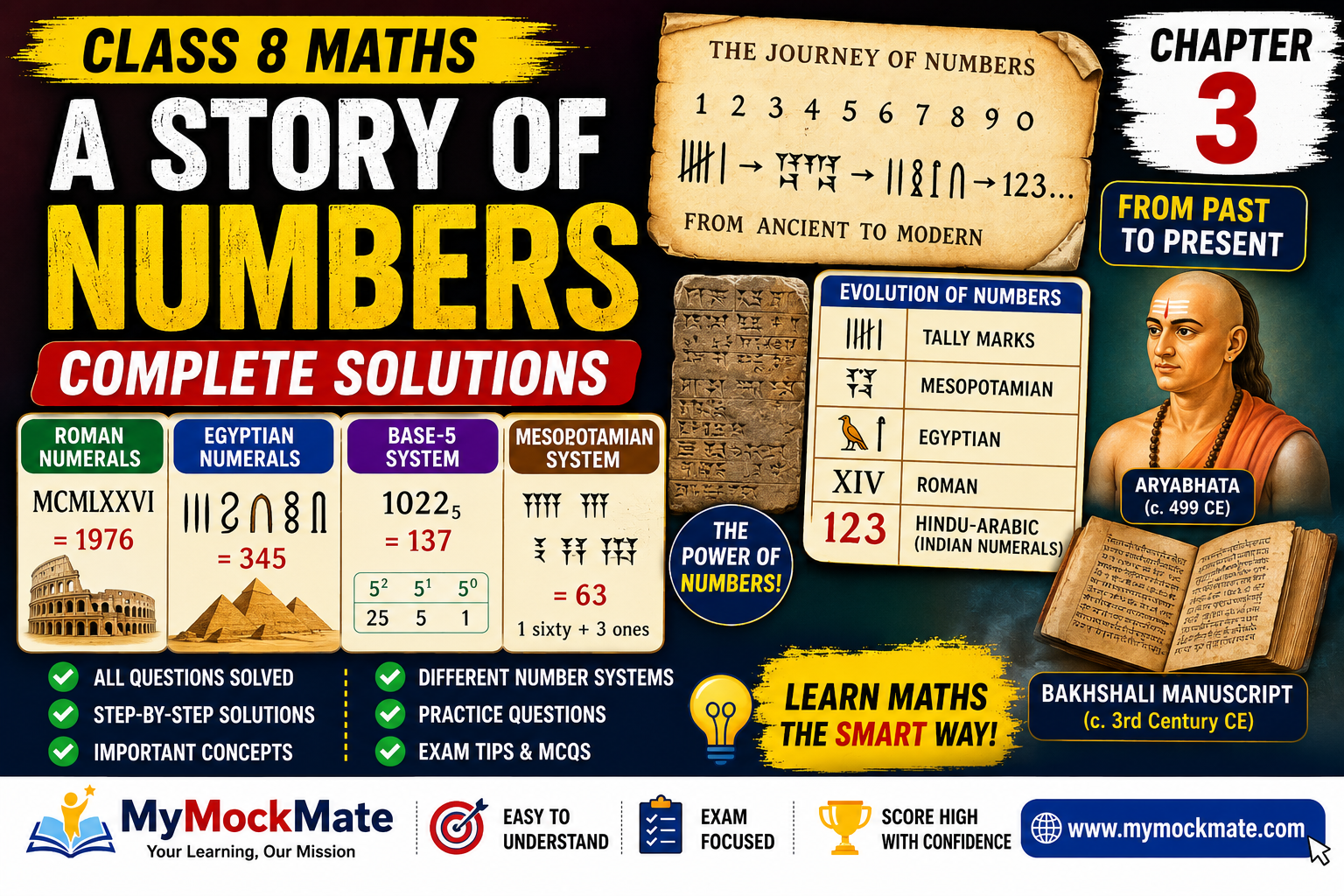
The chapter “A Story of Numbers” explains the fascinating history and evolution of number systems from ancient civilizations to the modern Hindu-Arabic number system. Students learn about Roman numerals, Egyptian numerals, Mesopotamian systems, place value systems, bases, and the importance of zero in mathematics.
Quick Information Box
| Particular | Details |
|---|---|
| Chapter Name | A Story of Numbers |
| Class | Grade 8 |
| Subject | Mathematics |
| Main Topics | Number Systems, Roman Numerals, Bases |
| Difficulty Level | Moderate |
| Important For | School Exams, Olympiads |
| Key Skills | Logical Thinking, Number Representation |
Concepts Used (Topics Covered)
- Evolution of Numbers
- Hindu-Arabic Numerals
- Roman Numerals
- Egyptian Number System
- Mesopotamian Number System
- Base Number Systems
- Decimal System
- Place Value System
- Tally Marks
- Landmark Numbers
- Powers of Numbers
- Placeholder Symbol (Zero)
Important Formulas
Powers in Base System
Decimal Place Value
Base-n Landmark Numbers
Questions & Step-by-Step Solutions
Figure It Out – Page 54
Q1. Give methods for adding, subtracting, multiplying and dividing using sticks.
Solution
Addition
Combine both groups of sticks together.
Subtraction
Remove sticks of the smaller group from the larger group.
Multiplication
Create repeated groups.
Example:
3 × 4 means 4 sticks repeated 3 times.
Division
Distribute sticks equally into groups.
Final Answer
Arithmetic can be performed by grouping and separating sticks systematically.
Q2. Extend the letter-based number system.
Solution
After z:
- aa = 27
- ab = 28
- ac = 29
and so on.

Final Answer
Using combinations of letters extends the counting system infinitely.
Q3. Make your own number system.
Solution
Example:
| Number | Symbol |
|---|---|
| 1 | ● |
| 2 | ●● |
| 3 | ▲ |
| 4 | ▲● |
Final Answer
Students may create their own symbols and rules.
Figure It Out – Page 59
Q1. Represent the following in Roman numerals
(i) 1222
Solution
1222 = 1000 + 100 + 100 + 10 + 10 + 1 + 1
Roman numeral:
MCCXXII
Final Answer
MCCXXII
(ii) 2999
Solution
2999 = 2000 + 900 + 90 + 9
Roman numeral:
MMCMXCIX
Final Answer
MMCMXCIX
(iii) 302
Solution
302 = 300 + 2
Roman numeral:
CCCII
Final Answer
CCCII
(iv) 715
Solution
715 = 700 + 10 + 5
Roman numeral:
DCCXV
Final Answer
DCCXV
Figure It Out – Page 60
Q1. Why do Pacific island people use different number sequences for different objects?
Solution
Different objects may be grouped differently for easier counting and cultural practices.
Final Answer
Different counting systems improve convenience for specific objects.
Q2. Evaluate in Gumulgal System
(i)
(ukasar-ukasar-ukasar-ukasar-urapon)
+
(ukasar-ukasar-ukasar-urapon)
Solution
9 + 7 = 16
Final Answer
Equivalent to 16.
(ii)
9 − 6
Final Answer
3
(iii)
9 × 4
Final Answer
36
(iv)
16 ÷ 4
Final Answer
4
Q3. Features of Hindu Number System
Solution
- Uses place value
- Uses only 10 symbols
- Includes zero
- Easy arithmetic operations
Final Answer
The Hindu number system is highly efficient and flexible.
Figure It Out – Page 62
Q1. Represent in Egyptian System
(i) 10458
Solution
10458 = 10000 + 400 + 50 + 8
Represent using Egyptian symbols.
(ii) 1023
1023 = 1000 + 20 + 3
(iii) 2660
2660 = 2000 + 600 + 60
(iv) 784
784 = 700 + 80 + 4
(v) 1111
1111 = 1000 + 100 + 10 + 1
(vi) 70707
70707 = 70000 + 700 + 7
Figure It Out – Page 63
Q1. Write numbers in Base-5 System
(i) 15
Solution
Final Answer
30₅
(ii) 50
Final Answer
200₅
(iii) 137
Final Answer
1022₅
Q2. Can every number be represented?
Solution
Yes. Any number can be expressed using powers of 5.
Final Answer
Yes, all numbers can be represented.
Q3. Landmark numbers in Base-7
Solution
Final Answer
1, 7, 49, 343, 2401 …
Figure It Out – Page 65
Q1. Add Egyptian Numerals
Solution
Group similar symbols together.
Whenever 10 similar symbols occur, replace them with the next higher symbol.
Final Answer
Egyptian addition is based on regrouping symbols.
Q2. Add Base-5 Numerals
Solution
Whenever 5 similar symbols occur, regroup into next landmark number.
Final Answer
Addition works similarly to carrying in decimal system.
Figure It Out – Page 69
Q1. Can a symbol appear 10 or more times?
Solution
No.
10 repeated symbols are replaced by the next higher symbol.
Final Answer
No, regrouping prevents repetition beyond 9.
Q2. Create Base-4 System
Solution
Landmark numbers:
Representations:
| Decimal | Base-4 |
|---|---|
| 1 | 1 |
| 2 | 2 |
| 3 | 3 |
| 4 | 10 |
| 5 | 11 |
Q3. Rule for multiplying by 5 in Base-5
Solution
Appending zero shifts to next power.
Example:
Final Answer
Add one zero at the end.
Figure It Out – Page 73
Q1. Represent in Mesopotamian System
(i) 63
Final Answer
1 sixty and 3 ones.
(ii) 132
Final Answer
2 sixties and 12 ones.
(iii) 200
Final Answer
3 sixties and 20 ones.
(iv) 60
Final Answer
1 sixty.
(v) 3605
Final Answer
1 three-thousand-six-hundred and 5 ones.
Common Mistakes
- Confusing Roman numerals with Hindu numerals
- Forgetting regrouping rules in base systems
- Wrong place value interpretation
- Ignoring zero as placeholder
- Incorrect base conversions
Exam Tips
- Memorise Roman numeral symbols
- Practice base conversions regularly
- Understand landmark numbers clearly
- Learn place value carefully
- Revise ancient number systems visually
Practice MCQs
1. Which symbol represents 100 in Roman numerals?
A. X
B. L
C. C
D. D
Answer
C. C
2. Which civilization developed the decimal system?
A. Roman
B. Egyptian
C. Indian
D. Greek
Answer
C. Indian
3. Which number system uses place value?
A. Roman
B. Tally Marks
C. Hindu-Arabic
D. Stick System
Answer
C. Hindu-Arabic
FAQ Section
Q1. What is a positional number system?
A number system where digit position determines value.
Q2. Why is zero important?
It acts as a placeholder in place value systems.
Q3. What are Roman numerals?
Ancient numerals used in Rome using symbols like I, V, X, L, C, D, M.
Q4. What is a base-n system?
A system based on powers of n.
Q5. What is the decimal system?
A base-10 number system.
CTA (Call To Action)
📘 Get complete NCERT Solutions, Mock Tests, Practice Questions, and Exam Preparation Resources at:
🚀 Practice smarter with All India Mock Tests and Instant Results.