






Short Intro
This chapter explains how sound is produced, propagated, reflected, and perceived by humans. Students will learn about sound waves, compressions and rarefactions, wavelength, frequency, amplitude, echo, reverberation, ultrasonic waves, sonar, and practical applications of sound in daily life.
Quick Information Box
| Topic | Details |
|---|---|
| Chapter Name | Sound Waves: Characteristics and Applications |
| Class | Grade 9 |
| Subject | Science |
| Wave Type | Longitudinal Mechanical Wave |
| Audible Range | 20 Hz to 20 kHz |
| Speed of Sound in Air | Approximately 340 m/s |
Concepts Used (Topics Covered)
- Production of Sound
- Propagation of Sound
- Longitudinal Waves
- Compression and Rarefaction
- Mechanical Waves
- Wavelength, Frequency and Time Period
- Amplitude and Loudness
- Speed of Sound
- Echo and Reverberation
- Reflection of Sound
- Ultrasonic and Infrasonic Waves
- Sonar and Echolocation
Important Formulas
- Frequency
ν = Number of Oscillations / Time - Time Period
T = 1 / ν - Speed of Sound
v = νλ - Distance Formula
Distance = Speed × Time - Echo Distance
Distance = (v × t)/2
Questions & Step-by-step Solutions with Explanation
Think It Over
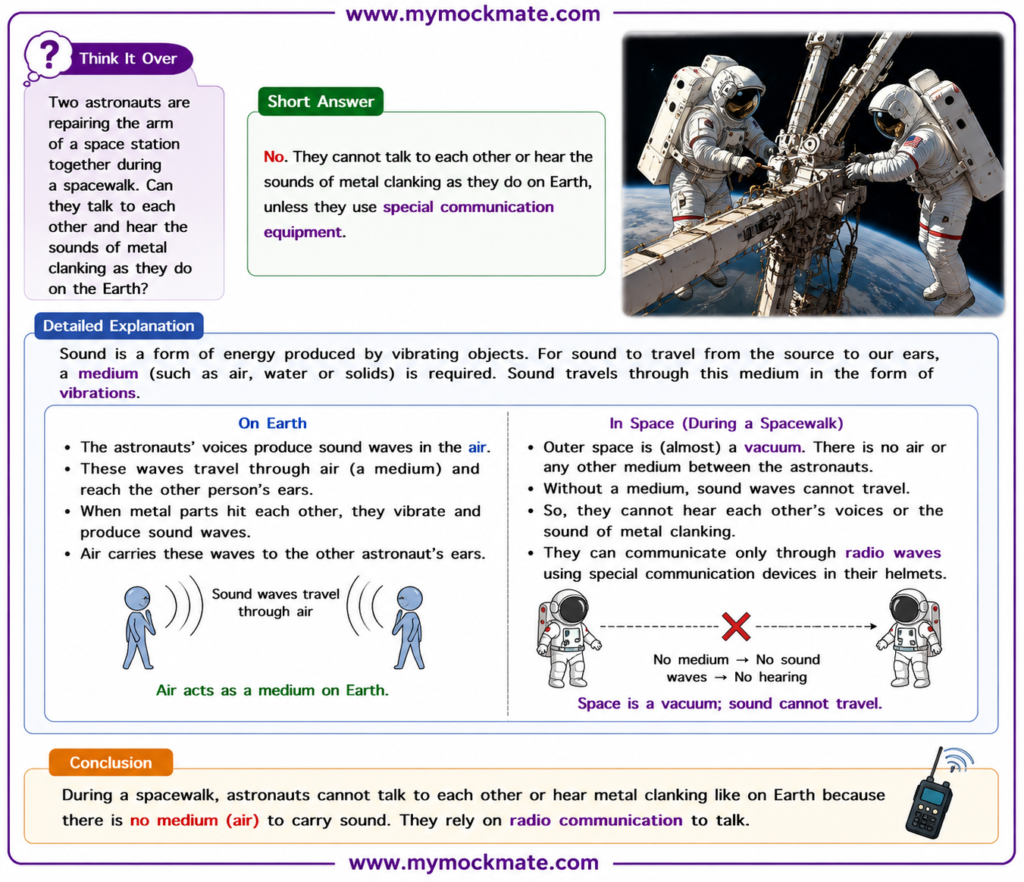
1. Two astronauts are repairing the arm of a space station together during a spacewalk. Can they talk to each other and hear the sounds of metal clanking as they do on the Earth?
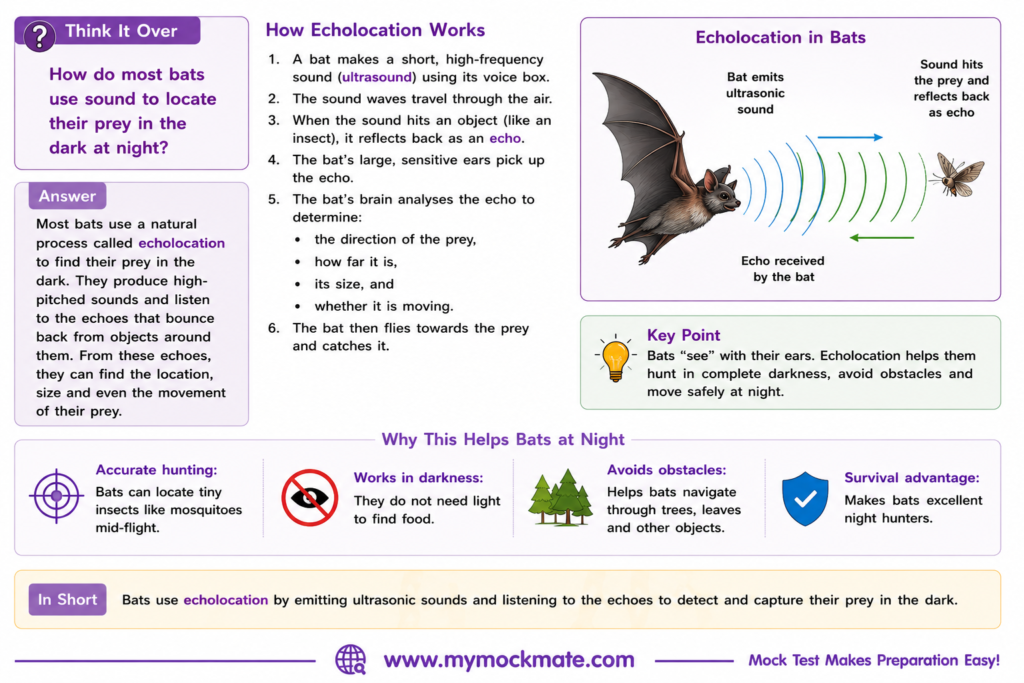
2. How do most bats use sound to locate their prey in the dark at night?
Pause and Ponder
1. Explore various ways of producing sound.

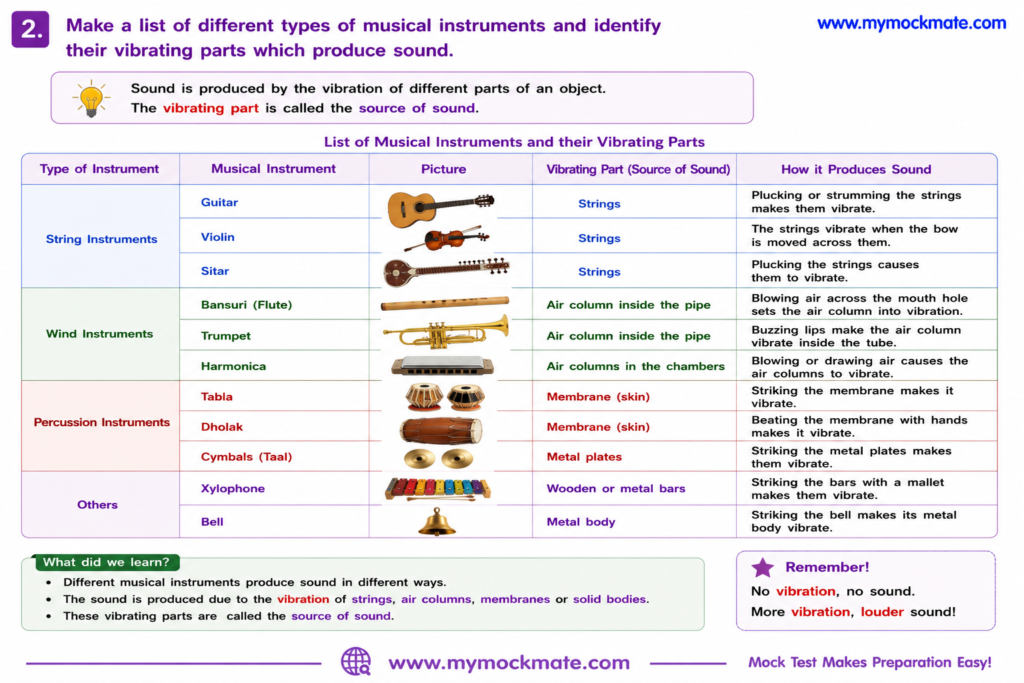
2. Make a list of different types of musical instruments and identify their vibrating parts which produce sound.
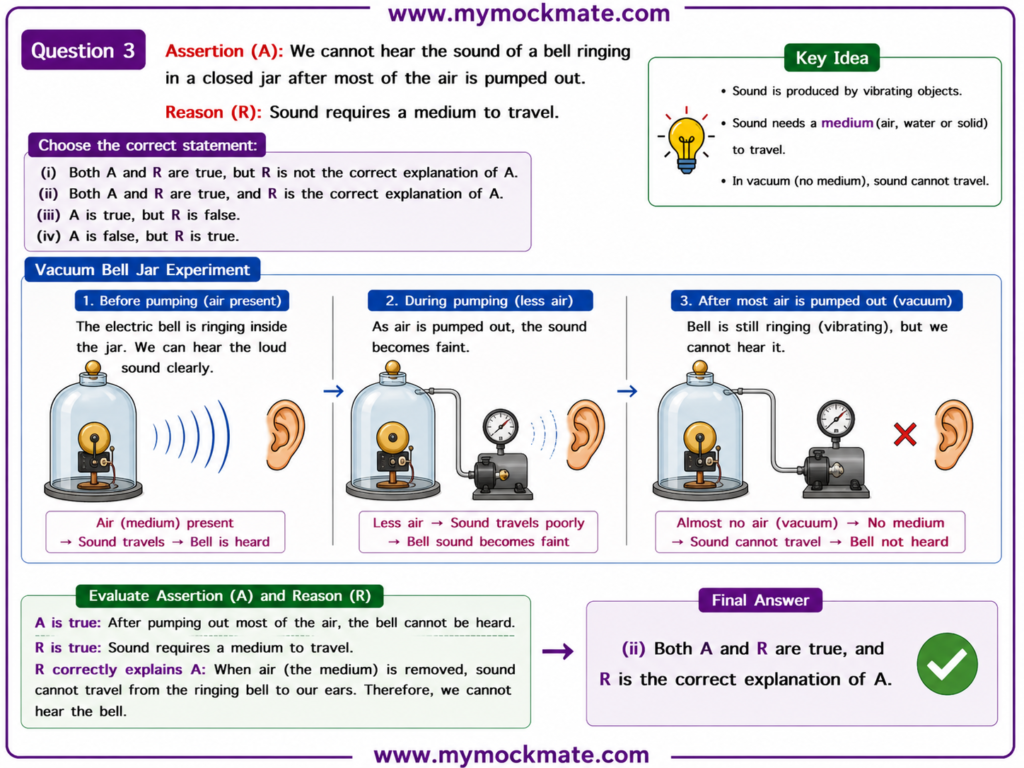
3. Assertion (A): We cannot hear the sound of a bell ringing in a closed jar after most of the air is pumped out.
Reason (R): Sound requires a medium to travel.
Choose the correct statement:
(i) Both A and R are true, but R is not the correct explanation of A.
(ii) Both A and R are true, and R is the correct explanation of A.
(iii) A is true, but R is false.
(iv) A is false, but R is true.
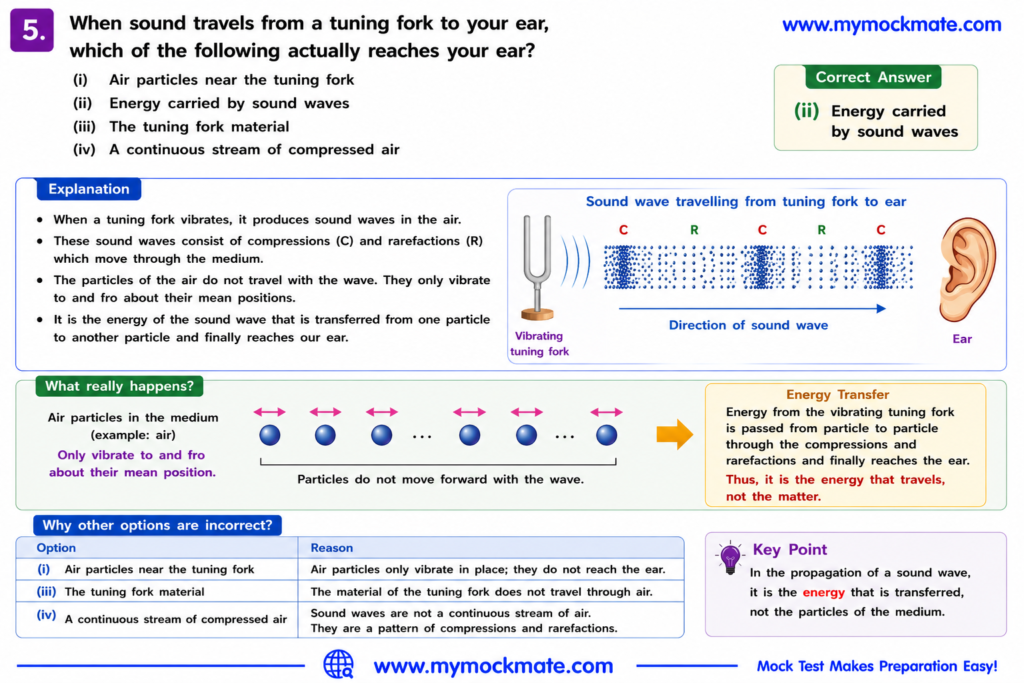
4. Assertion (A): Compressions and rarefactions move through the medium.
Reason (R): Individual particles of the medium continuously move forward with the wave.
Choose the correct statement:
(i) Both A and R are true, but R is not the correct explanation of A.
(ii) Both A and R are true, and R is the correct explanation of A.
(iii) A is true, but R is false.
(iv) A is false, but R is true.
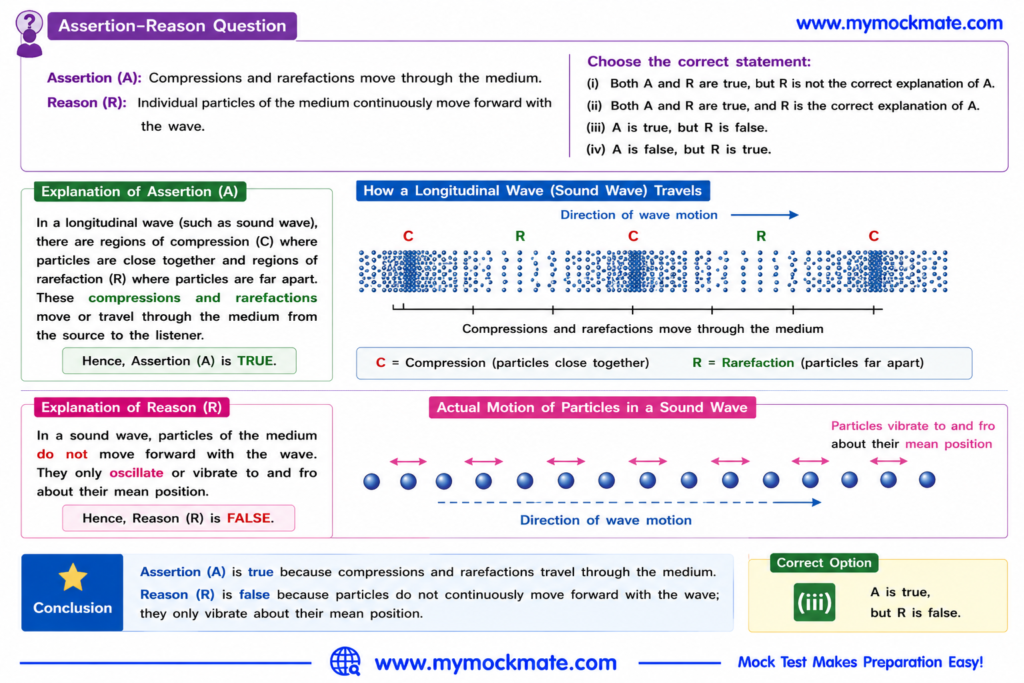
5. When sound travels from a tuning fork to your ear, which of the following actually reaches your ear?
(i) Air particles near the tuning fork
(ii) Energy carried by sound waves
(iii) The tuning fork material
(iv) A continuous stream of compressed air
6. The variation of density of the medium for two sound waves is shown in Fig. 10.17 (a)
and (b). Label compression and rarefaction by C and R on it. In the graph given in Fig. 10.17
(c) and (d), label the axes and draw the curves corresponding to Fig. 10.17 (a) and (b).

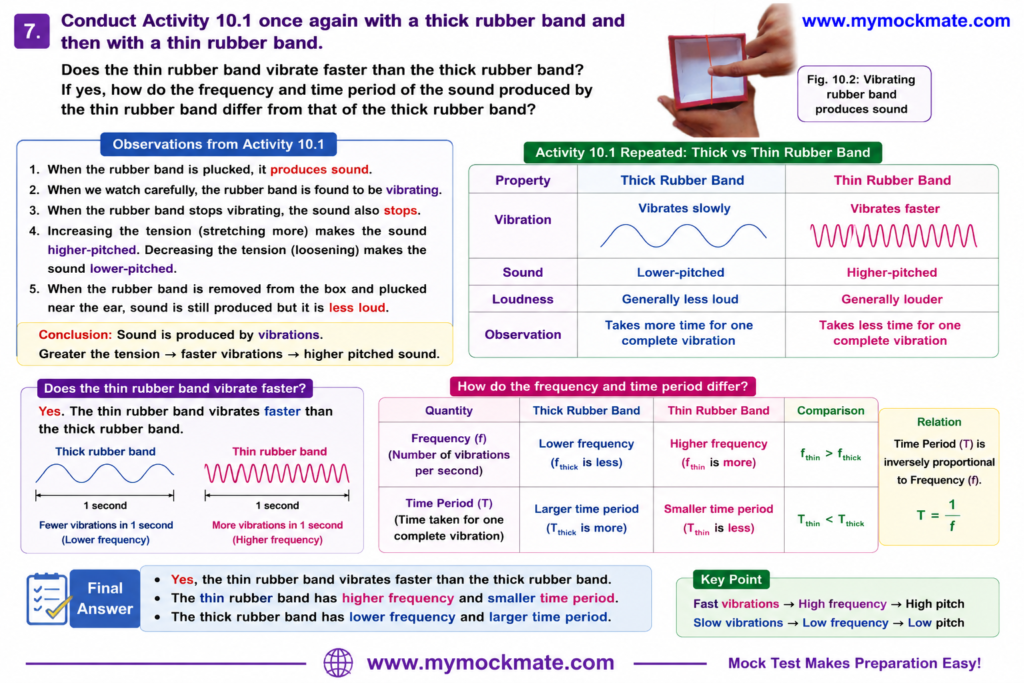
7. Conduct Activity 10.1 (Take a cardboard box with one side open and a rubber band. Stretch the rubber band across the open side of the box (Fig. 10.2). Holding the box steady with one hand, pluck the rubber band with a finger. Do you hear any sound? Pluck the rubber band again and watch it carefully. Is it vibrating? Wait till the rubber band stops vibrating. Do you still hear the sound? Change the tension in the rubber band by stretching it more or loosening it slightly and plucking it each time. Does the sound change? What changes do you notice? Remove the rubber band from the box. Stretch it between two fingers and pluck it near your ear. Is the sound still produced? Is it as loud as before?) once again with a thick rubber band and then with a thin rubber band. Does the thin rubber band vibrate faster than the thick rubber band? If yes, how do the frequency and time period of the sound produced by the thin rubber band differ from that of the thick rubber band?
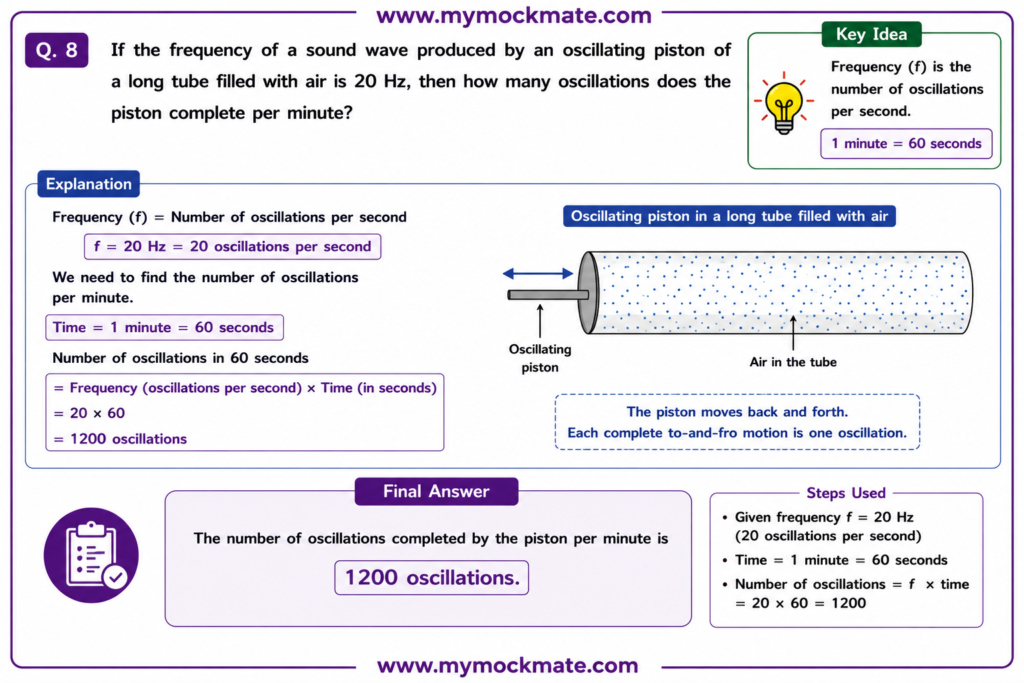
8. If the frequency of a sound wave produced by an oscillating piston of a long tube filled with air is 20 Hz, then how many oscillations does the piston complete per minute?
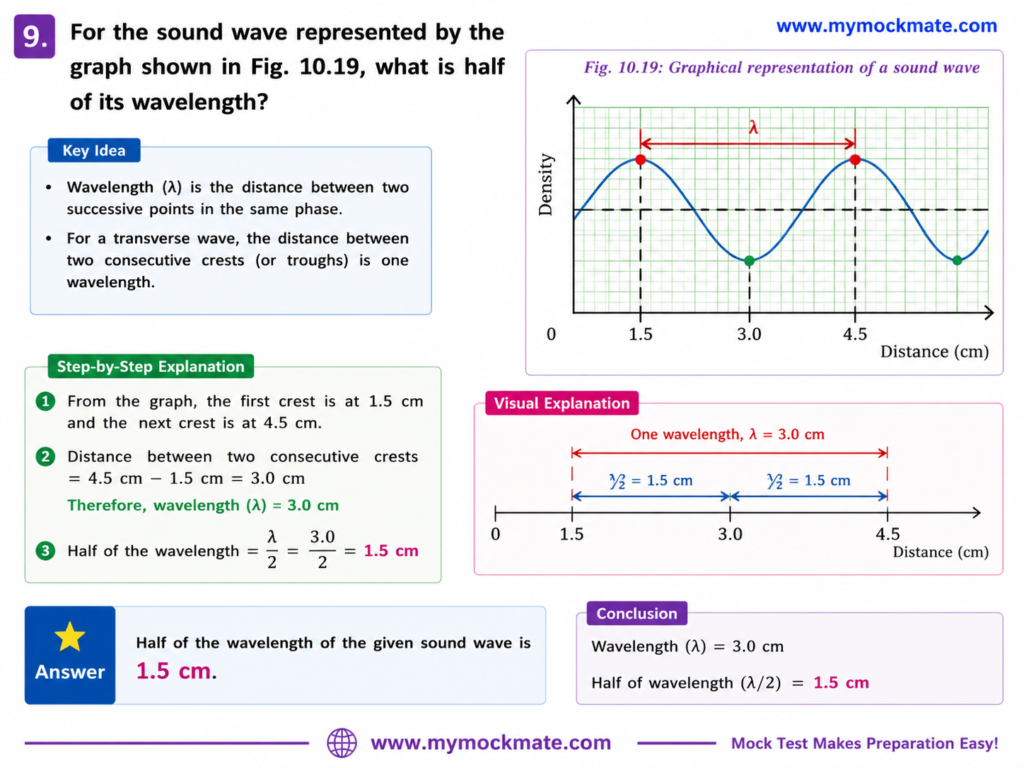
9. For the sound wave represented by the graph shown in Fig. 10.19, what is half of its wavelength?
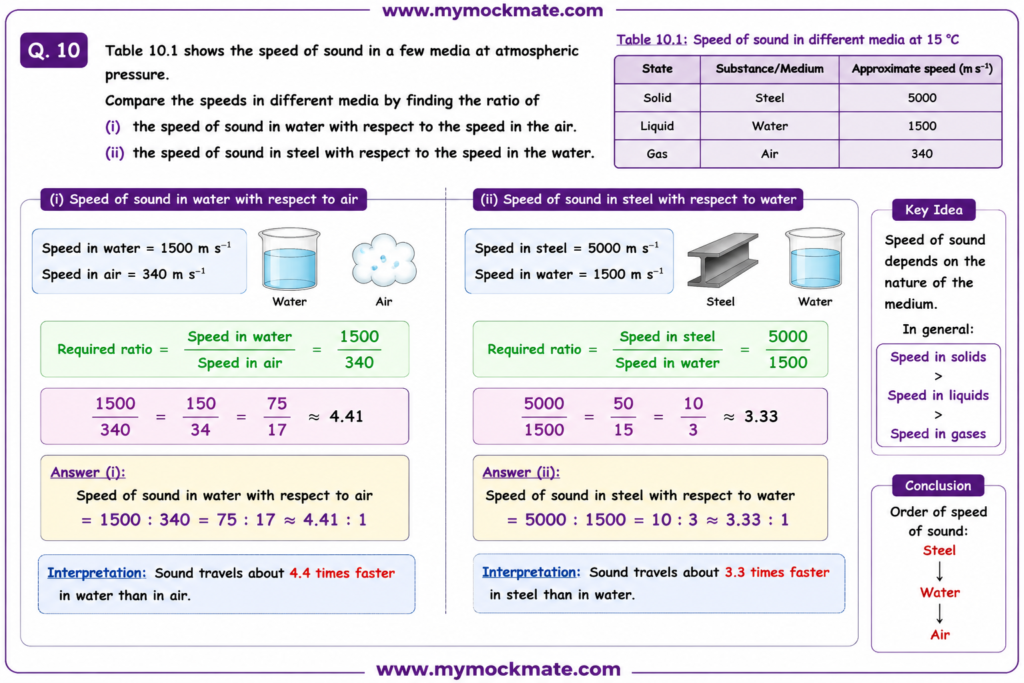
10. Table 10.1 shows the speed of sound in a few media at atmospheric pressure. Compare the speeds in different media by finding the ratio of
(i) the speed of sound in water with respect to the speed in the air.
(ii) the speed of sound in steel with respect to the speed in the water.
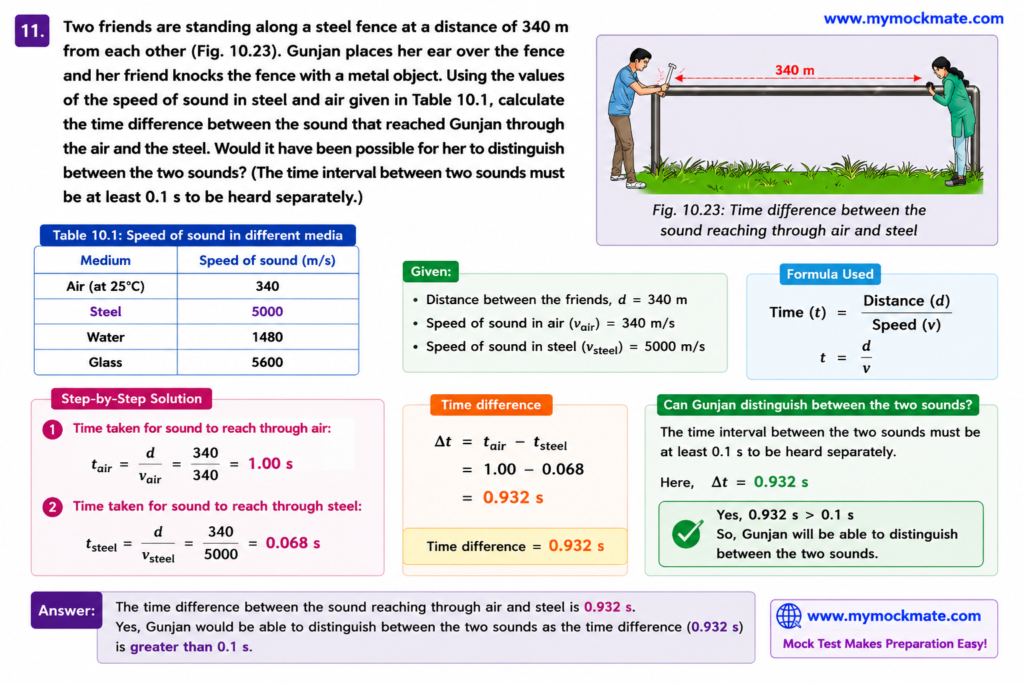
11. Two friends are standing along a steel fence at a distance of 340 m from each other (Fig. 10.23). Gunjan places her ear over the fence and her friend knocks the fence with a metal object. Using the values of the speed of sound in steel and air given in Table 10.1, calculate
the time difference between the sound that reached Gunjan through the air and the steel. Would it have been possible for her to distinguish between the two sounds? (The time interval between two sounds must be at least 0.1 s to be heard separately.)
12. An experiment is being set up that requires echoes to arrive at least 0.2 s after the mission of sound. What minimum distance should a reflecting surface be placed at? Assume the speed of sound to be 343 m s–1.

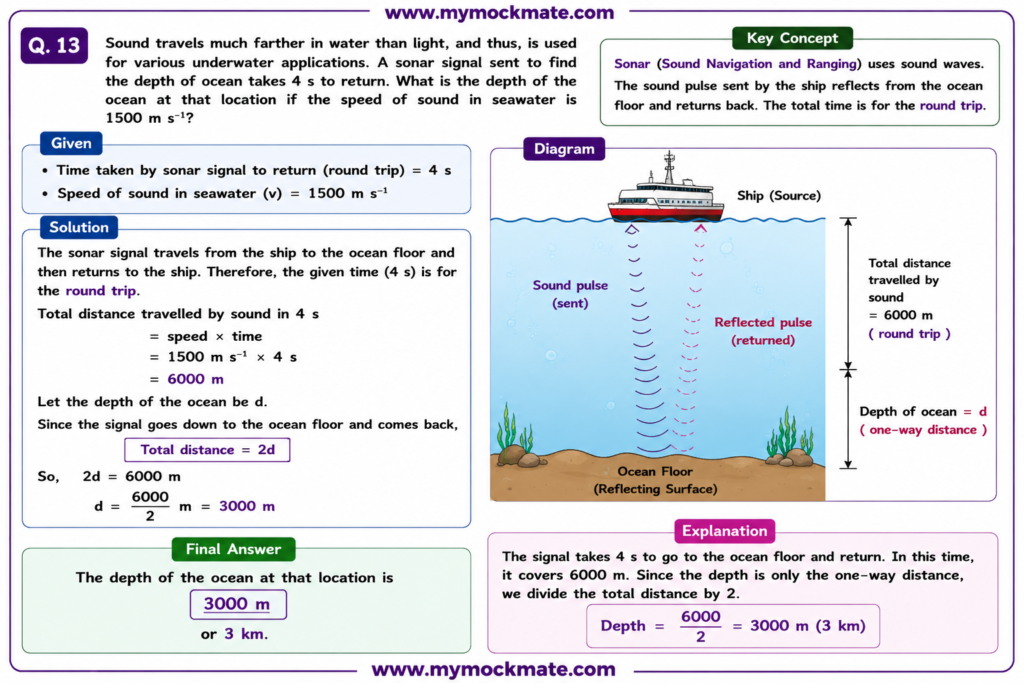
13. Sound travels much farther in water than light, and thus, is used for various underwater applications. A sonar signal sent to find the depth of ocean takes 4 s to return. What is the depth of the ocean at that location if the speed of sound in seawater is 1500 m s–1?
Revise, Reflect, Refine
1. Which observation best supports the idea that sound is a mechanical wave?
(i) Sound shows reflection
(ii) Sound needs a medium to propagate
(iii) Sound has frequency
(iv) Sound carries energy

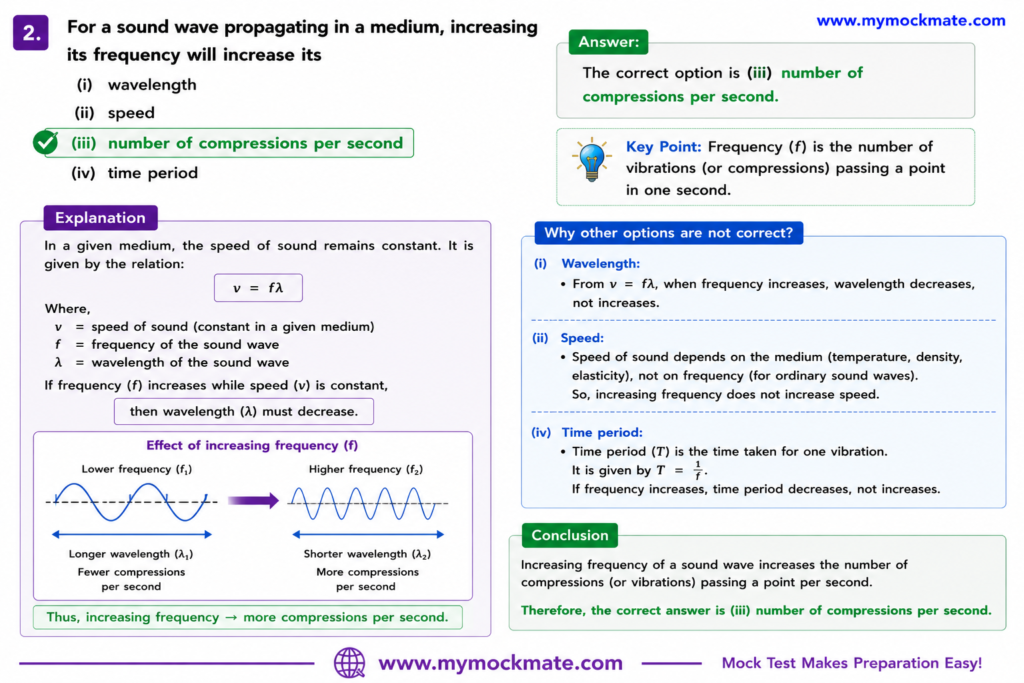
2. For a sound wave propagating in a medium, increasing its frequency will increase its
(i) wavelength, (ii) speed, (iii) number of compressions per second, (iv) time period
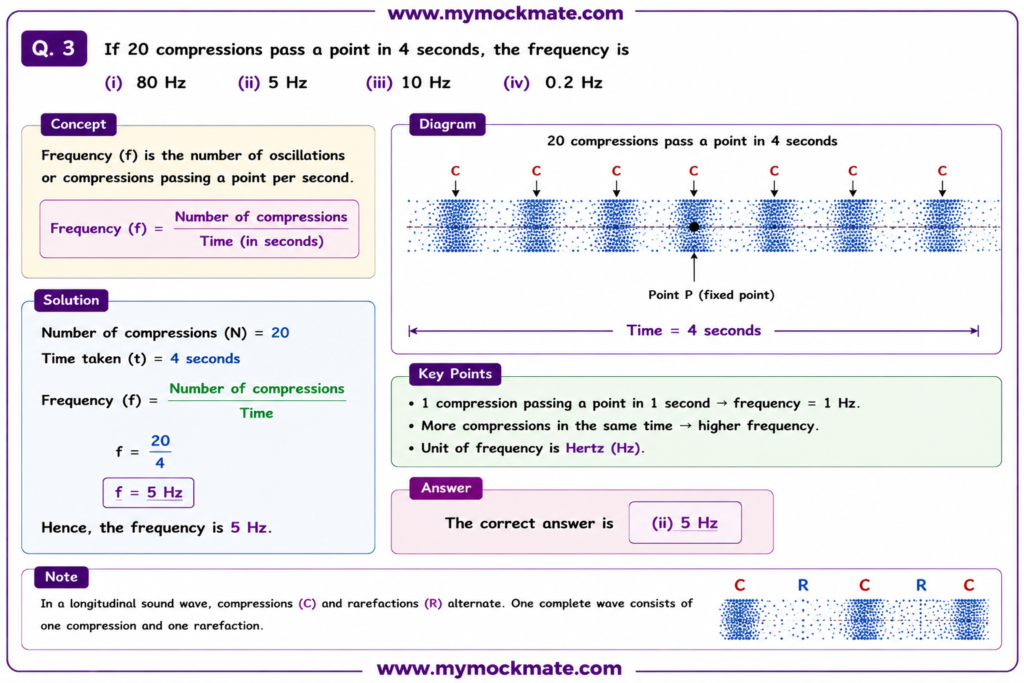
3. If 20 compressions pass a point in 4 seconds, the frequency is
(i) 80 Hz
(ii) 5 Hz
(iii) 10 Hz
(iv) 0.2 Hz
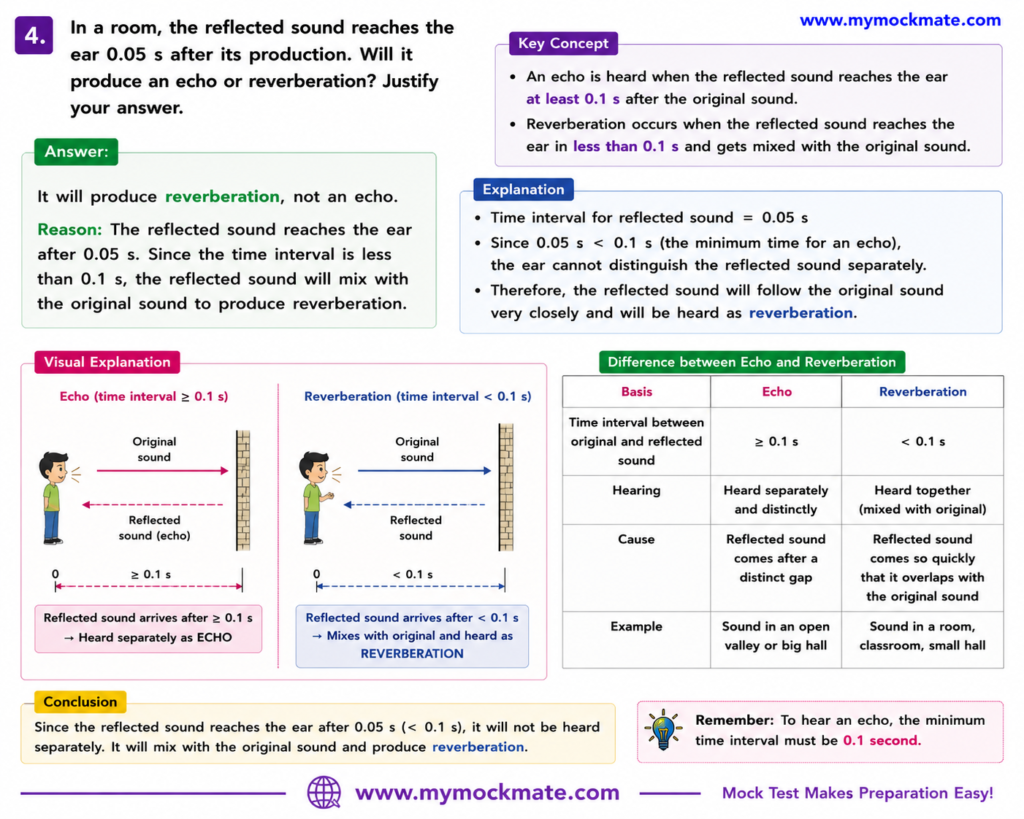
4. In a room, the reflected sound reaches the ear 0.05 s after its production. Will it produce an echo or reverberation? Justify your answer.
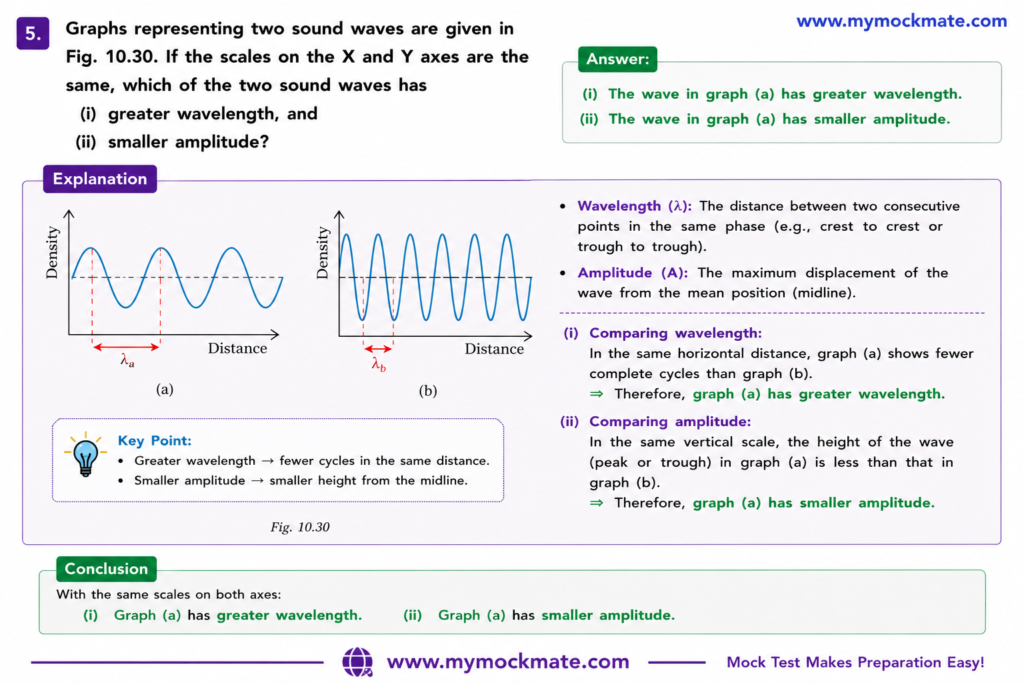
5. Graphs representing two sound waves are given in Fig. 10.30. If the scales on the X and Y axes of the two graphs are the same, which of the two sound waves has (i) greater wavelength, and (ii) smaller amplitude?
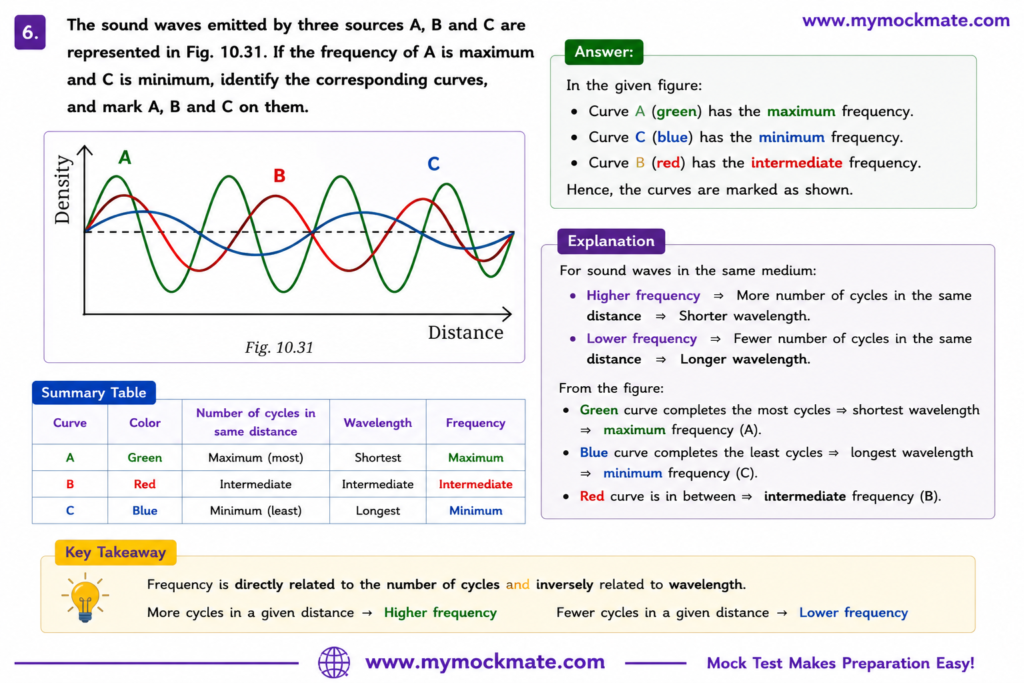
6. The sound waves emitted by three sources A, B and C are represented in Fig. 10.31. If the frequency of A is maximum and C is minimum, identify the corresponding curves, and mark A, B and C on them.
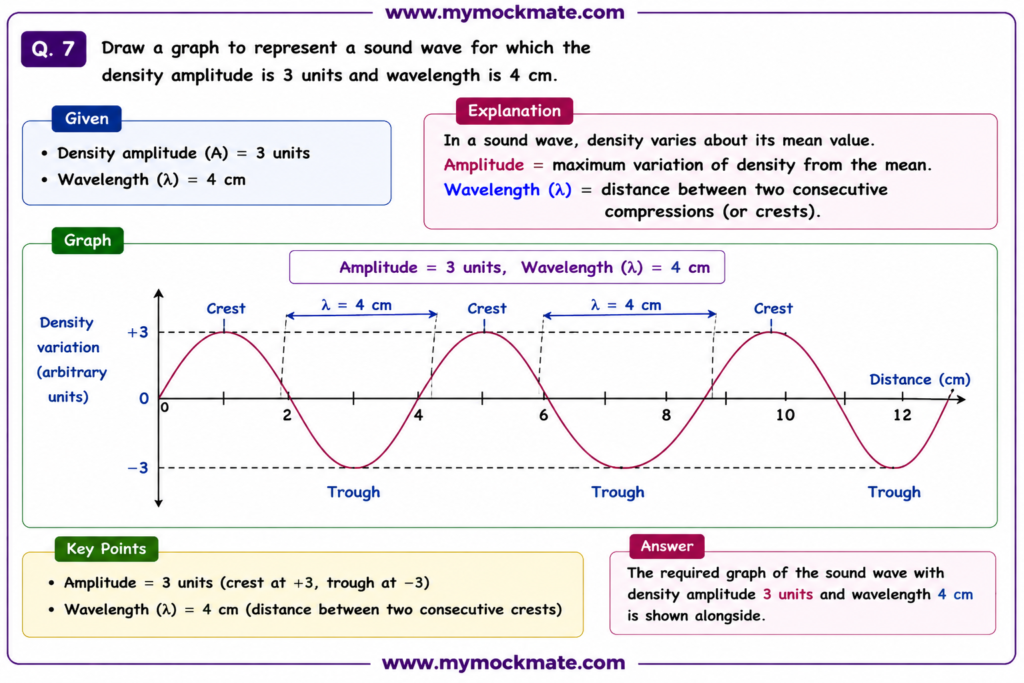
7. Draw a graph to represent a sound wave for which the density amplitude is 3 units and wavelength is 4 cm.
8. In a movie, while showing the explosion of a spacecraft in space, a flash of light is shown along with sound at the same time. What are the errors in this depiction?

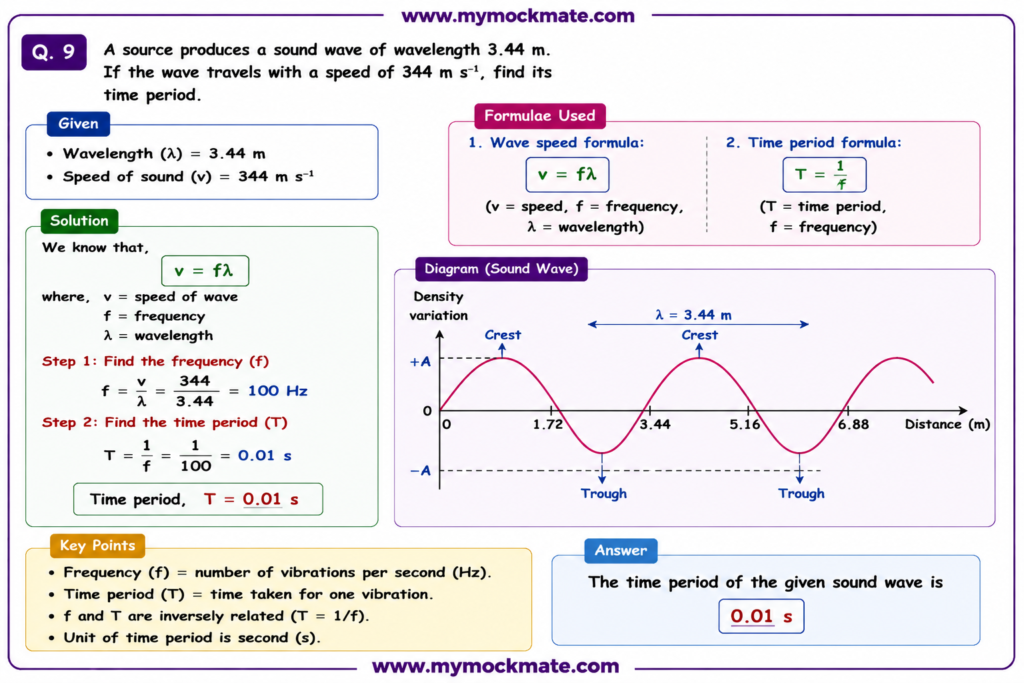
9. A source produces a sound wave of wavelength 3.44 m. If the wave travels with a speed of 344 m s–1 find its time period.
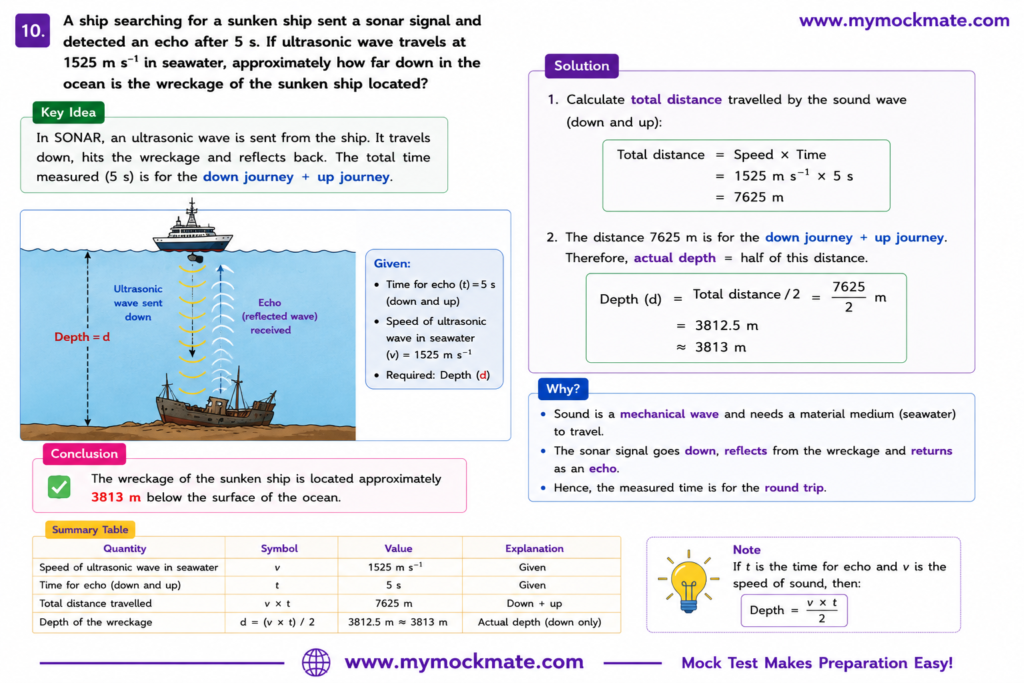
10. A ship searching for a sunken ship sent a sonar signal and detected an echo after 5 s. If ultrasonic wave travels at 1525 m s–1 in seawater, approximately how far down in the ocean is the wreckage of the sunken ship located?
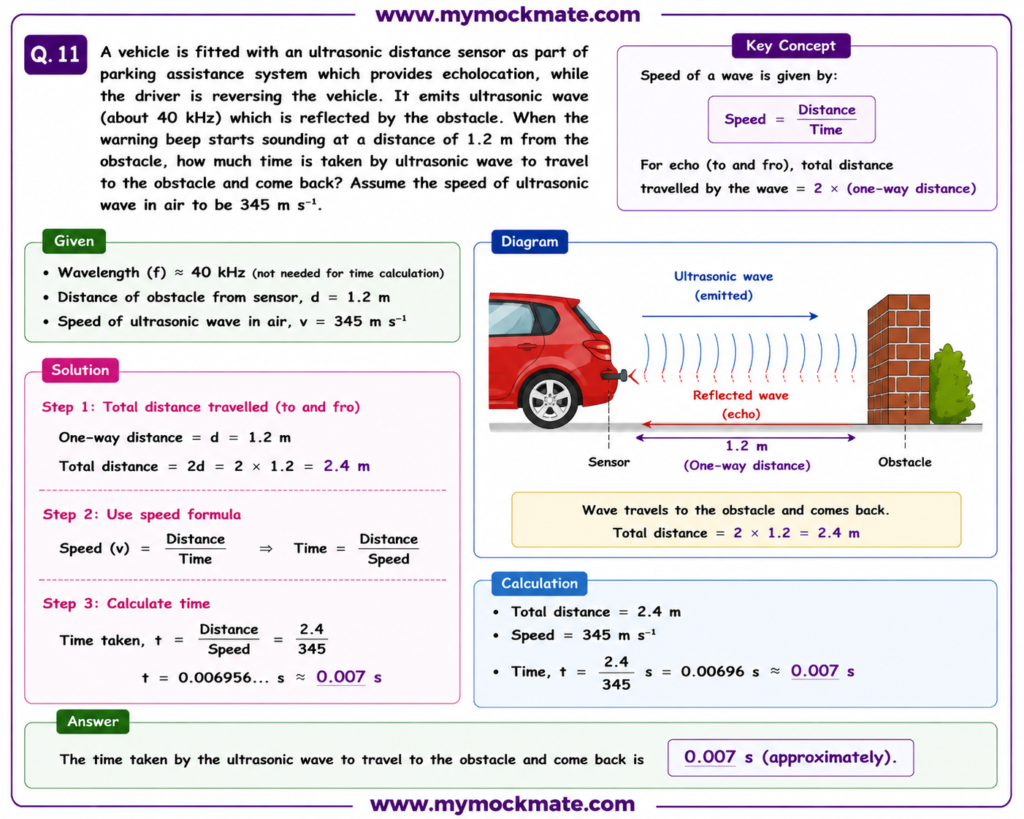
11. A vehicle is fitted with an ultrasonic distance sensor as part of parking assistance system which provides echolocation, while the driver is reversing the vehicle. It emits ultrasonic wave (about 40 kHz) which is reflected by the obstacle. When the warning beep starts sounding at a distance of 1.2 m from the obstacle, how much time is taken by ultrasonic wave to travel to the obstacle and come back? Assume the speed of ultrasonic wave in air to be 345 m s–1.
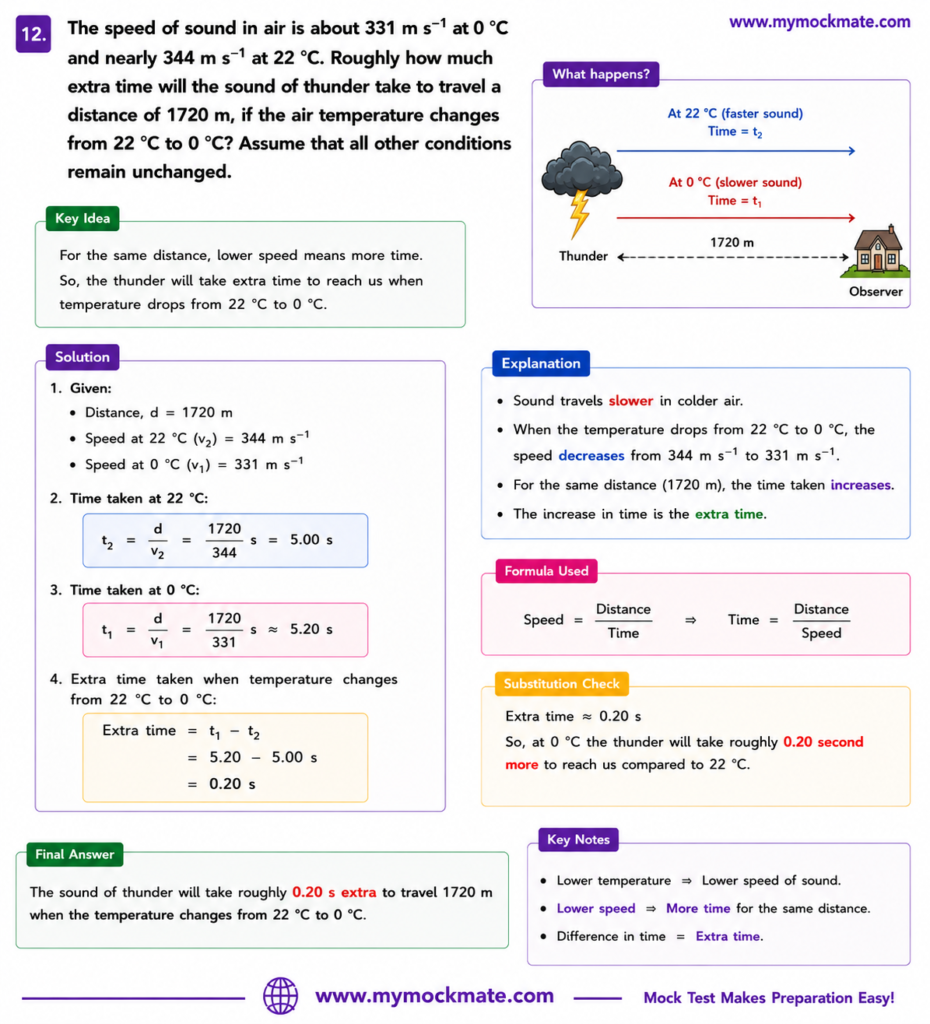
12. The speed of sound in air is about 331 m s–1 at 0 ºC and nearly 344 m s–1 at 22 ºC. Roughly how much extra time will the sound of thunder take to travel a distance of 1720 m, if the air temperature changes from 22 ºC to 0 ºC? Assume that all other conditions remain unchanged.
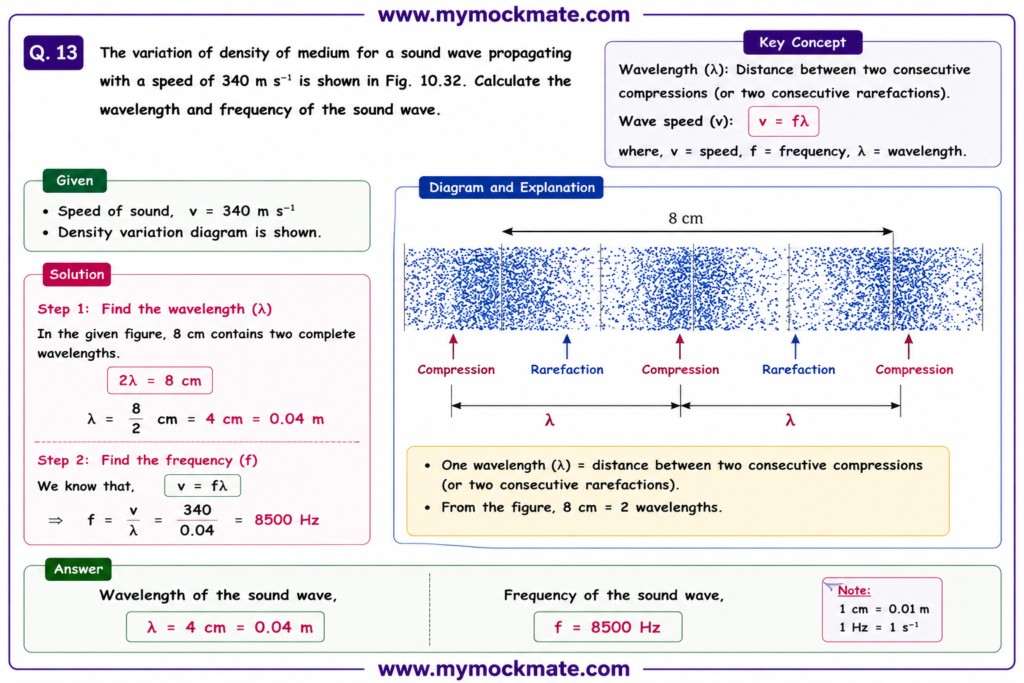
13. The variation of density of medium for a sound wave propagating with a speed of 340 m s–1 is shown in Fig. 10.32. Calculate the wavelength and frequency of the sound wave
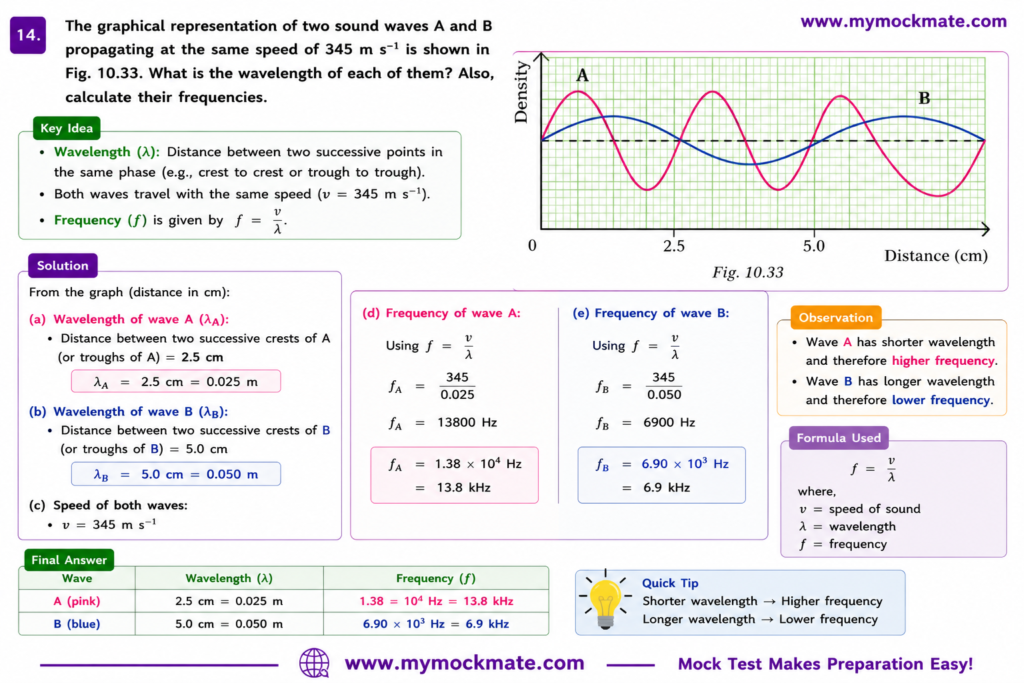
14. The graphical representation of two sound waves A and B propagating at the same speed of 345 m s–1 is shown in Fig. 10.33. What is the wavelength of each of them? Also, calculate their frequencies.
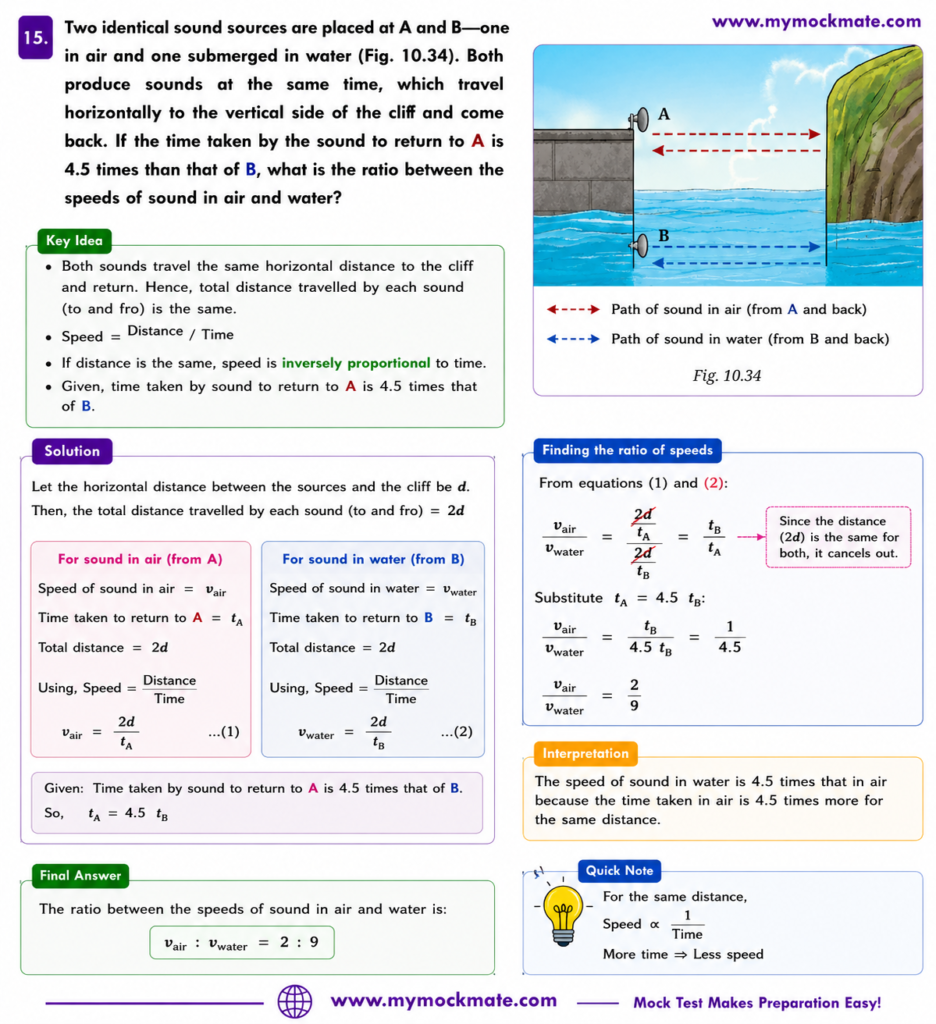
15. Two identical sound sources are placed at A and B — one in air and one submerged in water (Fig. 10.34). Both produce sounds at the same time, which travel horizontally to the vertical side of the cliff and come back. If the time taken by the sound to return to A is 4.5 times than that of B, what is the ratio between the speeds of sound in air and water?
Common Mistakes
- Confusing loudness with intensity
- Using wrong units for wavelength
- Forgetting echo distance is half distance travelled
- Mixing frequency and time period
- Assuming particles travel with sound wave
Exam Tips
- Learn all sound formulas carefully.
- Practice numerical problems regularly.
- Remember audible range values.
- Draw labelled wave diagrams neatly.
- Always convert cm into m before calculations.
Practice MCQs
1. Sound waves are:
A. Transverse waves
B. Longitudinal waves
C. Electromagnetic waves
D. Stationary waves
Answer:
B. Longitudinal waves
2. SI unit of frequency:
A. Joule
B. Newton
C. Hertz
D. Pascal
Answer:
C. Hertz
3. Human audible range:
A. 2 Hz – 200 Hz
B. 20 Hz – 20 kHz
C. 200 Hz – 2 MHz
D. 100 Hz – 1000 Hz
Answer:
B. 20 Hz – 20 kHz
4. Sound cannot travel through:
A. Air
B. Water
C. Steel
D. Vacuum
Answer:
D. Vacuum
5. Instrument used in underwater detection:
A. Radar
B. Sonar
C. Microscope
D. Periscope
Answer:
B. Sonar
FAQ Section
Q1. Why is sound called a mechanical wave?
Because it requires a material medium to travel.
Q2. What is wavelength?
Distance between two consecutive compressions or rarefactions.
Q3. What is frequency?
Number of oscillations per second.
Q4. Why do we hear echo?
Due to reflection of sound from distant surfaces.
Q5. What are ultrasonic waves?
Sound waves having frequency above 20 kHz.
Master Science with chapter-wise notes, detailed solutions, MCQs, quizzes, and mock tests only on www.mymockmate.com and boost your exam preparation today!