




Short Introduction
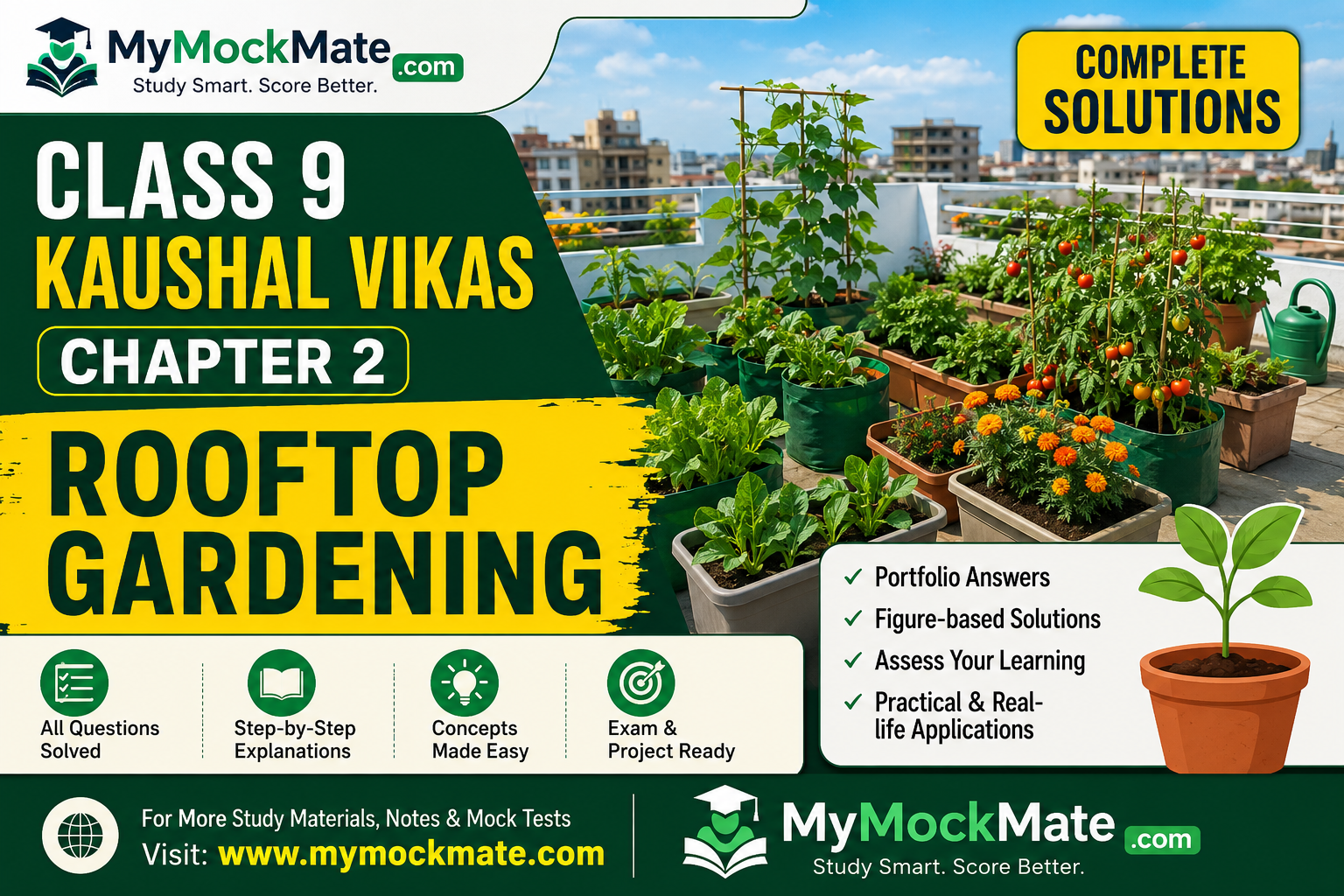
Rooftop gardening is a practical method of converting unused roofs and terraces into productive green spaces. Vegetables, herbs, fruits and flowers can be grown in pots, grow bags, recycled containers or specially prepared beds. A well-designed rooftop garden can provide fresh produce, reduce heat around buildings, improve air quality and help people connect with nature.
This complete solution guide covers the portfolio activities, figure-based questions and all eight Assess Your Learning questions from Chapter 2. The chapter itself covers garden planning, material and tool selection, potting mixtures, germination testing, irrigation, plant protection, harvesting, storage and packaging.
Quick Information Box
| Particular | Details |
|---|---|
| Chapter | Chapter 2 – Rooftop Gardening |
| Class | Grade 9 |
| Subject Area | Kaushal Vikas / Skill Education |
| Main Skill | Planning and managing a rooftop garden |
| Suitable Garden Locations | Rooftop, terrace and balcony |
| Recommended Direct Sunlight | About 5–6 hours for sun-loving plants |
| Ideal Potting Mix pH | Approximately 6.5–7.0 |
| Basic Potting Mix | Cocopeat/Perlite/Vermiculite + Compost + Soil |
| Suggested Ratio | 1:1:1 |
| Major Safety Concern | Roof load, drainage and waterproofing |
| Important Practical Tests | Germination percentage and WHC |
| Core Skills | Planning, budgeting, growing, monitoring, harvesting and storage |
The chapter explains that rooftop gardening requires decisions about plant life cycle, sunlight, water needs, investment, growing medium, container weight, usefulness of produce and available space.
Concepts Used – Topics Covered
The major concepts covered in this chapter include rooftop garden planning and scoping, preparation of a process chart, site observation, garden layout, structural safety, roof load management, sunlight and shade planning, drainage and waterproofing, wind protection, selection of containers, tools and safety equipment, Bill of Materials preparation, potting mixture preparation, pH adjustment, seed germination testing, Water Holding Capacity calculation, careful irrigation, integrated pest management, weed management, harvesting, packaging and storage.
Important Formulas
1. Total Permissible Roof Load
Total Permissible Load = Area of Roof × Safe Load per Square Metre
Example:
Area = 4 m × 3 m = 12 m²
Safe load capacity = 150 kg/m²
Therefore:
Total permissible load = 12 × 150 = 1,800 kg
If the estimated garden load is 1,200 kg, then:
Safety margin = 1,800 – 1,200 = 600 kg
Therefore, the proposed garden load is within the stated limit in the chapter caselet.
2. Germination Percentage
Germination Percentage = (Number of Seeds Germinated ÷ Total Number of Seeds Sown) × 100
Example:

If 40 seeds are sown and 34 germinate:
= (34 ÷ 40) × 100
= 85%
3. Water Holding Capacity
WHC (%) = [(Wet Weight – Dry Weight) ÷ Dry Weight] × 100
Example:
Dry weight = 105 g
Wet weight = 130 g
WHC = [(130 – 105) ÷ 105] × 100
= approximately 24%
4. Labour Cost
Labour Cost = Time × Hourly Rate × Frequency
The chapter’s sample Bill of Materials illustrates cost estimation for containers, hose pipe, bamboo structures and recurring labour.
Questions and Step-by-Step Solutions
Portfolio Question 1: Which plants will you grow? Justify your choice.
Answer
I would grow spinach, coriander, tomato, chilli and marigold in my rooftop garden.
Step-by-Step Justification
Step 1: Consider the available space.
A rooftop garden usually has limited space, so compact plants and crops that grow well in containers are suitable.
Step 2: Consider usefulness.
Spinach and coriander provide fresh leafy vegetables and herbs. Tomatoes and chillies are regularly used in household cooking. Marigolds improve the appearance of the garden and can be used for decoration.
Step 3: Consider crop duration.
Short-duration crops are suitable for school rooftop projects because students can observe sowing, growth and harvesting within a manageable period.
Step 4: Consider different light zones.
Leafy vegetables and herbs can be placed in partially shaded sections, while tomatoes and similar sun-loving plants can be placed in open sunny areas.
Step 5: Consider diversity.
Growing different plant types makes the garden useful for food, learning, observation and decoration.
Conclusion
The final choice of plants should always be adjusted according to local climate, season, available sunlight and water supply.
Portfolio Activity: Site Visit Observations and Process Chart
A suitable observation record can include the following:
| Observation Point | Sample Observation |
|---|---|
| Process followed | Planning, container preparation, sowing, irrigation, pest control and harvesting |
| Materials | Grow bags, pots, compost, cocopeat, soil, seeds and bamboo |
| Tools | Hand trowel, pruning scissors, watering can and buckets |
| Safety | Gloves, proper storage of sharp tools and safe lifting methods |
| Schedule | Daily observation, need-based watering and weekly pest inspection |
| Quality criteria | Healthy seedlings, good drainage and pest-free produce |
| Technology | Weather apps, sunlight measurement apps and digital plant records |
| Main challenges | Heat, strong winds, pests and waterlogging |
| Solutions | Shade nets, wind barriers, organic sprays and drainage holes |
Sample Process Chart
| Task | Suggested Time | Responsibility |
|---|---|---|
| Garden layout | Week 1 | Planning team |
| Potting mixture | Week 1 | Soil team |
| Germination test | Week 1–3 | Seed team |
| Sowing/transplanting | Week 3 | Planting team |
| Irrigation and weeding | Regular | Maintenance team |
| Pest monitoring | Weekly | Plant protection team |
| Growth recording | Weekly | Documentation team |
| Harvesting | Crop dependent | Harvest team |
| Packaging | After harvest | Packaging team |
The textbook specifically asks students to observe work processes, tools and materials, safety protocols, schedules, quality criteria and technology use during a site visit.
Portfolio Question: Draw and label a rooftop garden layout and explain pot placement.
Model Answer
A suitable rooftop garden layout should contain a sunny zone, partial-shade zone, heavy-container zone, light-pot zone, walking path, water source, drainage path, compost area and trellis zone.
Reasons for Placement
Heavy pots should be placed only after checking structural safety and should preferably be positioned over structurally stronger areas identified by a qualified expert. Light pots can be placed in suitable central or accessible zones. Sun-loving plants should receive sufficient direct sunlight, while herbs and leafy vegetables may use partially shaded spaces. Climbers should be located near lightweight trellises. Pots should not block walking routes, drainage outlets or access to the water source.
The chapter emphasizes space, sunlight, structural load, water management, shade and wind protection as key layout considerations.
Check Your Understanding – Figure-Based Questions
Question 1. Why do you think some pots are placed in Area B? Give examples of such plants from your geographical region.
Answer
Area B is the shade zone shown in the rooftop layout. Therefore, plants that do not require continuous strong direct sunlight can be placed there.
Suitable examples may include:
- Coriander
- Mint
- Spinach
- Fenugreek
- Lettuce
Explanation
These plants can grow under comparatively lower light conditions than sun-loving fruiting crops. A shade zone also protects tender plants from intense afternoon heat and reduces rapid moisture loss.
Question 2. Can the pots placed in Area C be placed in Area E? Why or why not?
Answer
They should not be shifted automatically without checking their weight and the roof’s structural design.
In the figure, Area C contains heavy pots, while Area E is used mainly for lighter containers. Heavy pots create a greater concentrated load. Therefore, they should be placed only where the roof structure can safely support them.
Conclusion
The correct decision depends on:
- structural capacity of the roof,
- position of beams or other load-bearing elements,
- weight of the wet potting mixture,
- weight of the container and mature plant.
Question 3. If the number of plants increases, which area should be expanded first and why?
Answer
Area E should generally be expanded first, provided sufficient walking and maintenance space is preserved.
Explanation
Area E contains light pots. Increasing the number of lightweight containers is generally easier because they are more manageable and distribute less load than heavy containers. However, expansion should not obstruct pathways, drainage or maintenance access.
Question 4. Does the layout have enough space? Suggest another possible layout.
Answer
Yes, the shown layout appears to provide separate zones for shade, sunlight, different pot weights, stairs and water access. However, another efficient layout can be created by placing containers along the perimeter, keeping a clear central pathway, using vertical racks for herbs and installing trellises along one safe side for climbers.
This alternative improves vertical-space utilisation while maintaining access for irrigation, inspection and harvesting.
Portfolio Question: Prepare a Bill of Materials for Your Rooftop Garden
Sample Answer
| Item | Quantity | Estimated Cost | Purpose |
|---|---|---|---|
| Grow bags | 10 | ₹500 | Growing vegetables |
| Recycled buckets | 5 | ₹0 | Reused containers |
| Seeds | 5 packets | ₹250 | Sowing |
| Cocopeat | 10 kg | ₹300 | Lightweight growing medium |
| Compost | 20 kg | ₹300 | Nutrient supply |
| Soil | As required | ₹0–200 | Potting mix |
| Watering can | 1 | ₹250 | Irrigation |
| Hand trowel | 1 | ₹200 | Soil work |
| Pruning scissors | 1 | ₹250 | Plant maintenance |
| Bamboo/trellis | As required | ₹400 | Support for climbers |
| Approximate Total | — | ₹2,450–₹2,650 | — |
The actual cost will vary by locality and the availability of recycled or donated materials. A BoM helps estimate costs, reduce waste and organize the project before work begins.
Assess Your Learning – Complete Solutions
The chapter’s final assessment contains eight questions covering containers, potting mixtures, drainage, spinach packaging, crop selection, recycling, reflection and real-life application.
Question 1. Grow Bags and Clay Pots
(i) List one advantage and one disadvantage of each container.
Grow Bags
Advantage: Grow bags are lightweight, flexible and easy to move.
Disadvantage: They may dry out faster and may have a shorter usable life than durable clay containers.
Clay Pots
Advantage: Clay is porous, so it allows air movement and helps create a healthier root environment.
Disadvantage: Clay pots are heavier and can break if dropped or handled carelessly.
(ii) Which would you recommend for a school rooftop garden and why?
I would generally recommend grow bags, especially where roof-load reduction and easy movement are important.
Reasoning
- They are lighter than clay pots.
- Students can move them more easily.
- They are available in different sizes.
- Their arrangement can be changed as the garden develops.
- Lower container weight helps reduce the total rooftop load.
However, the final decision should follow the building’s structural assessment and school safety plan.
Question 2. Why is Mix A better than Mix B?
Mix A: Soil + Compost + Cocopeat
Mix B: Soil only
Answer
Mix A is better because its components perform different functions.
Step-by-Step Explanation
Step 1: Role of soil
Soil provides minerals and support to plant roots.
Step 2: Role of compost
Compost supplies organic matter and nutrients.
Step 3: Role of cocopeat
Cocopeat helps keep the growing medium lighter and improves its physical structure and moisture management.
Step 4: Problem with soil alone
Ordinary soil can become compact and heavy, particularly after watering.
Step 5: Effect on roots
Compaction reduces aeration, while poor drainage may cause waterlogging and root problems.
Conclusion
Mix A offers a better combination of nutrients, aeration, moisture management and lower weight. Therefore, it is more suitable for container gardening on rooftops.
Question 3. Tomato plants turned yellow despite regular watering. The pots were waterlogged because drainage holes were blocked.
(i) What went wrong?
The problem was poor drainage and waterlogging.
Although the students watered regularly, excess water could not escape because the drainage holes were blocked. The root zone remained saturated, reducing the oxygen available to roots. Damaged roots cannot absorb nutrients efficiently, which can contribute to yellowing and poor plant health.
(ii) Suggest two preventive measures.
Measure 1: Inspect and clean drainage holes regularly.
Measure 2: Use a loose, well-draining potting mixture rather than dense soil alone.
Additional good practices include avoiding unnecessary watering and keeping drainage paths unobstructed.
Question 4. Spinach packed in damp cloth stayed fresher than spinach packed in plastic bags.
(i) Why did spinach in damp cloth stay fresh longer?
Spinach is a leafy vegetable that loses water quickly after harvesting. A damp cloth helps reduce moisture loss while avoiding the highly enclosed conditions that can occur in an unsuitable sealed plastic bag.
(ii) What lesson does this give about packaging?
Packaging must match the needs of the produce. Good packaging should:
- reduce moisture loss,
- protect against physical damage,
- allow suitable air circulation,
- avoid harmful moisture accumulation,
- help maintain freshness.
Therefore, the same packaging method should not be used blindly for every crop.
Question 5. The school receives 15 six-inch pots and seeds of spinach, tomato and marigold.
(i) Which plants will you select?
For small six-inch pots, I would give priority to spinach and marigold, subject to the exact cultivar and local conditions. Tomatoes usually require substantially larger containers as they mature.
A practical distribution could be:
- 8 pots for spinach
- 7 pots for marigold
Tomato seedlings can be germinated separately and later transplanted into suitably larger containers if available.
(ii) Justify your choice.
Agro-climatic conditions:
The crops should be planted only in a suitable local season. Spinach generally performs better in suitable cooler conditions, while marigold varieties can be selected according to local seasonal recommendations.
Usefulness:
Spinach provides edible leaves, while marigold provides decorative flowers and adds diversity to the garden.
Life cycle:
Both can provide observable results within a school project period when planted in the appropriate season.
Water requirement:
Spinach needs regular moisture, while marigold should be watered according to need without keeping the medium waterlogged.
Conclusion
The best answer is not simply to plant every seed in every pot. Crop choice must consider container size, local climate, usefulness, duration and water availability.
Question 6. A family wants to start rooftop gardening at low cost.
(i) Suggest two recycled materials for containers.
Two suitable examples are:
- Old plastic buckets with drainage holes.
- Used food-grade containers or suitable sturdy tubs with proper drainage.
Other possibilities include reusable wooden crates lined appropriately for gardening, depending on material safety and durability.
(ii) How does recycling support the environment?
Recycling helps by extending the useful life of materials, reducing waste sent to disposal sites and decreasing the demand for newly manufactured containers. It can also lower the cost of starting a rooftop garden.
Care must be taken not to use containers that previously stored hazardous chemicals.
Question 7. Which task did you enjoy most and least? What went well, what did not, and what would you change?
Model Reflective Answer
I enjoyed the seed germination test the most because I could observe how seeds changed into seedlings and calculate germination percentage using actual data.
I enjoyed manual weeding the least because it required patience and careful work to avoid disturbing the roots of the main plant.
The germination activity went well because the seeds were counted carefully, planted at suitable depth and watered gently. One difficulty was uneven germination in a few sections of the tray. This may have resulted from uneven moisture or differences in planting depth.
Next time, I would:
- maintain more uniform sowing depth,
- label each seed batch,
- monitor moisture daily,
- record observations on fixed dates,
- compare germination results across different seed samples.
This would make the activity more systematic and scientifically useful.
Question 8. Give examples of applying this learning in real life.
Answer
The learning from rooftop gardening can be applied in real life in many ways.
I can create a small kitchen garden on a terrace or balcony and grow herbs and vegetables for household use. I can reuse suitable containers instead of purchasing every pot. Before starting, I can estimate costs through a Bill of Materials and select plants according to sunlight, water availability and season.
I can also test seed germination before large-scale sowing, use lightweight potting mixtures, calculate approximate water requirements, inspect plants for pest symptoms, use suitable preventive measures, remove weeds carefully and harvest produce at the proper maturity stage.
The same knowledge can also be used in schools, community gardens and urban greening projects. Rooftop gardening teaches resource management, teamwork, observation, budgeting, environmental responsibility and basic entrepreneurship.
Common Mistakes to Avoid
- Using ordinary heavy soil alone in every pot.
- Starting a rooftop garden without checking structural safety.
- Blocking roof drainage outlets with pots or materials.
- Overwatering plants on a fixed schedule without checking moisture.
- Ignoring blocked drainage holes.
- Placing all plants in identical light conditions.
- Keeping heavy containers in structurally unsuitable areas.
- Using containers without drainage holes.
- Pulling weeds carelessly and leaving their roots behind.
- Harvesting leafy vegetables during extreme daytime heat.
- Using inappropriate packaging for fresh produce.
- Handling pruning tools carelessly.
- Ignoring strong wind exposure on rooftops.
- Failing to keep observation and growth records.
Exam Tips
For case-based questions, identify the actual cause before suggesting a remedy. For example, regular watering does not prove that a plant needs more water; yellow leaves combined with blocked drainage indicate a waterlogging problem.
In calculation questions, write the formula first, substitute values clearly and include the correct unit. In crop-selection questions, justify your answer using container size, local climate, usefulness, life cycle, sunlight and water needs. For reflective questions, write a realistic personal response with four parts: what you enjoyed, what was difficult, what worked and what you would improve.
Practice MCQs
1. Which material helps create a lightweight growing medium?
(a) Cement
(b) Cocopeat
(c) Stone chips only
(d) Metal powder
Answer: (b) Cocopeat
2. Why are drainage holes necessary in pots?
(a) To increase container weight
(b) To allow excess water to escape
(c) To prevent sunlight
(d) To stop plant growth
Answer: (b) To allow excess water to escape
3. The formula for germination percentage is:
(a) Germinated seeds × Total seeds
(b) Total seeds ÷ Germinated seeds
(c) Germinated seeds ÷ Total seeds × 100
(d) Total seeds × 100
Answer: (c)
4. Which tool is suitable for cutting dry stems?
(a) Watering can
(b) Pruning scissors
(c) Tray
(d) Grow bag
Answer: (b) Pruning scissors
5. Which is a major rooftop-gardening safety concern?
(a) Colour of the pot
(b) Roof load capacity
(c) Name of the plant
(d) Shape of leaves
Answer: (b) Roof load capacity
6. Waterlogging mainly harms roots by reducing:
(a) oxygen availability
(b) pot colour
(c) sunlight outside the pot
(d) seed size
Answer: (a) oxygen availability
7. A Bill of Materials is mainly used for:
(a) predicting rainfall
(b) estimating materials and costs
(c) identifying insects only
(d) measuring plant height only
Answer: (b) estimating materials and costs
8. Which is an example of physical pest management?
(a) Removing infected leaves manually
(b) Ignoring insects
(c) Blocking drainage holes
(d) Increasing roof load
Answer: (a) Removing infected leaves manually
9. Why should produce be harvested at the correct stage of maturity?
(a) To reduce quality
(b) To improve quality and shelf life
(c) To increase container weight
(d) To stop irrigation permanently
Answer: (b) To improve quality and shelf life
10. Which practice can help suppress weeds?
(a) Mulching
(b) Blocking drainage
(c) Breaking healthy roots
(d) Overwatering
Answer: (a) Mulching
FAQ Section
1. What is rooftop gardening?
Rooftop gardening is the practice of growing plants on roofs, terraces or similar urban spaces using containers, grow bags or prepared growing systems.
2. Why is rooftop gardening useful?
It can provide fresh produce, make productive use of unused space, add greenery and help reduce heat around buildings.
3. Why is soil alone often unsuitable for rooftop containers?
Soil alone may become heavy and compact after watering. A suitable potting mixture can improve aeration and drainage while reducing weight.
4. What is the purpose of a germination test?
A germination test estimates the percentage of seeds capable of producing seedlings under the test conditions.
5. What is Water Holding Capacity?
Water Holding Capacity is a measure of how much water a growing medium can retain after saturation and drainage, expressed relative to its dry weight under the chapter’s method.
6. Why is roof safety important?
Pots, wet growing media, water and structures add load to the roof. Structural suitability must be confirmed before developing a substantial rooftop garden.
7. Why should different plants be placed in different zones?
Plants differ in sunlight, shade, water and support requirements. Zoning helps provide suitable conditions and makes maintenance easier.
8. What is integrated pest management?
It is a combined approach that may use physical, biological and appropriate chemical measures to reduce pest damage.
9. Why is timely harvesting important?
Harvesting at the correct maturity and suitable time helps maintain quality, taste and shelf life.
10. Can recycled containers be used?
Yes, suitable safe containers can be reused after cleaning and adding adequate drainage. Containers that previously held hazardous substances should not be used for growing food.
Continue Learning with MyMockMate
Strengthen your Class 9 preparation with chapter-wise notes, practical activity solutions, competency-based questions, MCQs and detailed explanations on MyMockMate.
Use these solutions not only for writing answers but also for understanding the complete rooftop-gardening workflow—from planning and budgeting to germination, irrigation, pest management, harvesting and sustainable use of resources.