



Short Intro
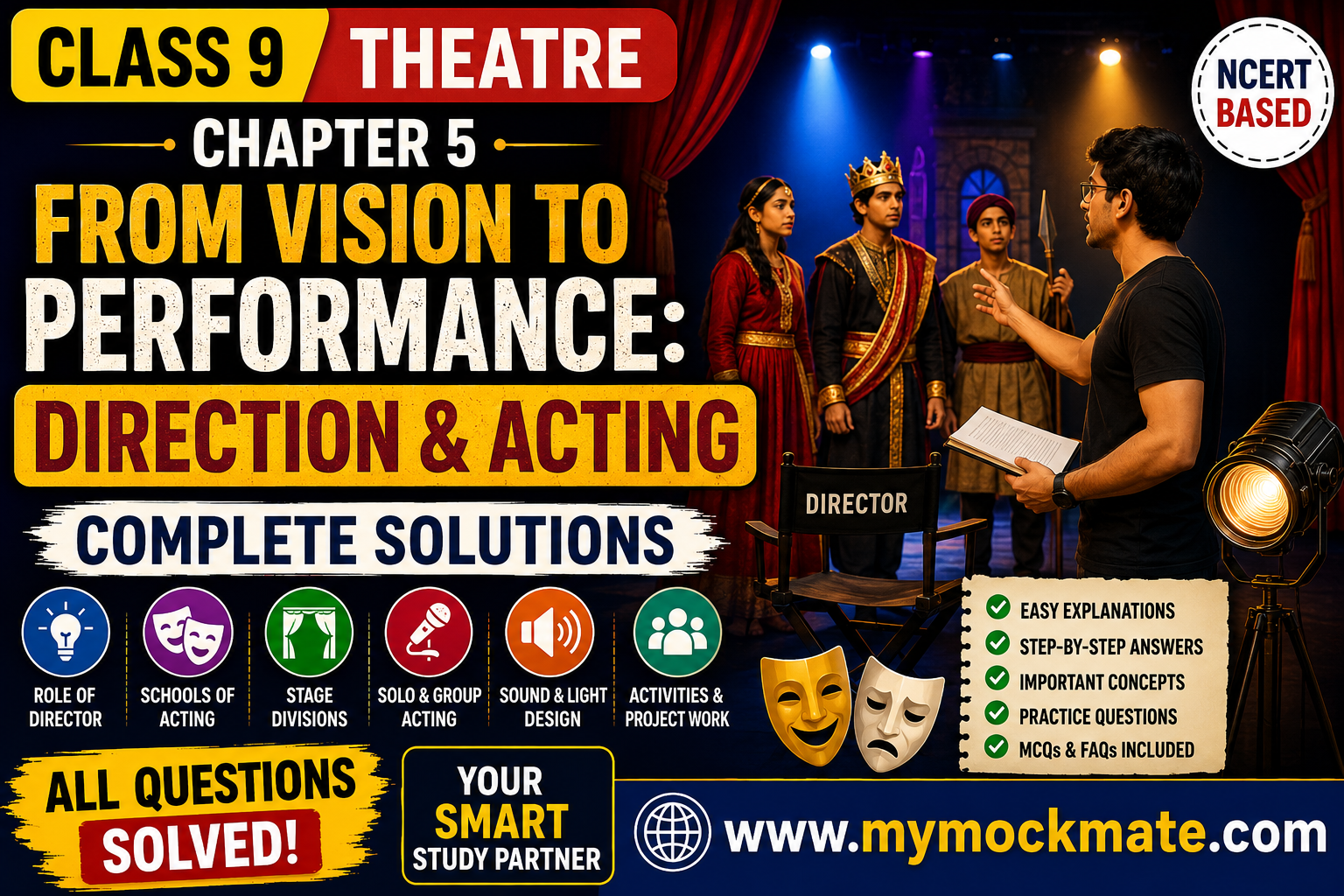
This chapter explains the important roles of directors and actors in theatre. Students learn about stage divisions, blocking, acting methods, visualisation, group dynamics, and different styles of direction. These solutions provide easy explanations, examples, MCQs, FAQs, and exam-oriented answers for complete understanding.
Quick Information Box
| Topic | Details |
|---|---|
| Chapter Name | From Vision to Performance: Direction and Acting |
| Subject | Theatre |
| Class | 9 |
| Main Focus | Direction and Acting Techniques |
| Important Concepts | Blocking, Stage Divisions, Acting Schools |
| Learning Goal | Creative Performance and Theatre Management |
Concepts Used (Topics Covered)
- Role of the Director
- Script Work
- Scene Building
- Blocking
- Stage Divisions
- Stage Balance and Composition
- Movement on Stage
- Styles of Direction
- Schools of Acting
- Solo Acting
- Group Acting
- Ensemble Performance
- Nāṭyaśāstra
- Method Acting
- Epic Theatre
- Poor Theatre
Important Formulas / Key Terms
- Blocking = Planned movement on stage
- Upstage = Area far from audience
- Downstage = Area near audience
- Ensemble = Group performance harmony
- Āṅgika = Body language expression
- Vāchika = Voice and speech expression
Questions & Step-by-Step Solutions
Q1. What are the different styles of direction? Which style would you choose and why?
Solution
Different Styles of Direction
- Realistic Direction
- Abstract or Symbolic Direction
- Devised Theatre
- Script-Based Direction
- Collaborative Direction
My Preferred Style
I would choose Realistic Direction because:
- It feels natural and believable.
- The audience can connect emotionally with characters.
- Real-life situations become easy to understand.
- It creates strong emotional impact.
Explanation
Different directing styles create different audience experiences. Realistic theatre helps viewers relate to everyday emotions and situations.
Q2. What are the nine stage divisions? Where would characters stand in Chhatrapati Shivaji Maharaj’s court scene?
Solution
Nine Stage Divisions
- Upstage Left
- Upstage Centre
- Upstage Right
- Stage Left
- Centre Stage
- Stage Right
- Downstage Left
- Downstage Centre
- Downstage Right
Character Placement
| Character | Stage Position |
|---|---|
| Chhatrapati Shivaji Maharaj | Centre Stage |
| Famous Poet | Downstage Centre |
| Royal Guards | Stage Left and Stage Right |
| In-house Poets | Upstage Left and Upstage Right |
Explanation
The king is placed at the centre because it is the most important position. Guards stand at the sides for protection and balance.
Q3. Which global schools of acting have you learnt? Which appeals to you most?
Solution
Global Schools of Acting
- Stanislavsky Method Acting
- Lee Strasberg’s Method Acting
- Bertolt Brecht’s Epic Theatre
- Jerzy Grotowski’s Poor Theatre
- Stella Adler’s Technique
Most Appealing Style
Stanislavsky Method Acting appeals to me the most because:
- It focuses on emotional truth.
- Actors connect deeply with characters.
- Performances become realistic and powerful.
Explanation
Method acting helps actors perform naturally by imagining real emotions and situations.
Q4. Improvise the notebook shop scene with two people and with 5–6 people. What differences did you notice?
Solution
Scene with Two People
- Focus remains on the main conversation.
- Emotions are more personal.
- Audience attention stays on both actors.
Scene with 5–6 People
- Scene becomes more realistic and lively.
- Background reactions improve atmosphere.
- Group coordination becomes important.
Differences Observed
| Two-Person Scene | Group Scene |
|---|---|
| Simple interaction | More dynamic interaction |
| Easier focus | Requires coordination |
| Emotional depth | Realistic environment |
Explanation
Solo and group performances create different stage energy and audience experiences.
Q5. Which departments work together in theatre? In what order would you work as a director?
Solution
Departments in Theatre
- Script Department
- Direction Team
- Acting Team
- Costume Department
- Set Design Department
- Lighting Department
- Sound Department
- Props Department
- Makeup Department
Order of Work
- Script Reading
- Visualisation and Planning
- Blocking and Rehearsals
- Set and Costume Planning
- Sound and Lighting Design
- Technical Rehearsals
- Final Performance
Explanation
Theatre requires coordination between all departments for smooth and effective performance.
Q6. Match the following.
| Indian Name | Description |
|---|---|
| i. Āṅgika | c. Body language |
| ii. Bhūta-kola | d. A divine folk tradition of Karnataka |
| iii. Gaura-līlā | a. Performance in Manipur |
| iv. Āhārya | b. Costume, jewellery, set, and props |
Explanation
These terms belong to Indian theatre traditions and performance styles.
Common Mistakes
- Confusing stage divisions
- Forgetting acting school names
- Ignoring stage balance and blocking
- Writing incomplete explanations
- Mixing solo acting with group acting concepts
Exam Tips
- Learn all stage divisions carefully.
- Remember the meaning of āṅgika and vāchika.
- Practice theatre terminology regularly.
- Use tables and diagrams for stage-related answers.
- Revise important acting schools and directors.
Practice MCQs
1. What is blocking in theatre?
A. Costume design
B. Planning stage movement
C. Lighting control
D. Writing dialogue
Answer:
B. Planning stage movement
2. Which stage area is closest to the audience?
A. Upstage
B. Stage Left
C. Downstage
D. Centre Stage
Answer:
C. Downstage
3. Who introduced Epic Theatre?
A. Stanislavsky
B. Stella Adler
C. Bertolt Brecht
D. Grotowski
Answer:
C. Bertolt Brecht

4. Which acting style focuses on emotional truth?
A. Poor Theatre
B. Method Acting
C. Mime
D. Puppetry
Answer:
B. Method Acting
5. What does Āṅgika refer to?
A. Costume
B. Music
C. Body language
D. Dialogue
Answer:
C. Body language
FAQ Section
Q1. What is the role of a theatre director?
A theatre director plans and manages actors, movement, lights, sound, costumes, and overall performance.
Q2. What is stage blocking?
Blocking means planning the movement and positions of actors on stage.
Q3. What is ensemble acting?
Ensemble acting means group acting where all performers work together harmoniously.
Q4. What is Method Acting?
Method Acting is a style where actors use emotional memory and imagination to perform realistically.
Q5. Why are stage divisions important?
Stage divisions help directors and actors organise movement and communication clearly during performances.
For more chapter-wise solutions, MCQs, notes, theatre projects, and exam preparation content, visit www.mymockmate.com and make your learning creative, interactive, and exam-ready.