




Introduction
The introduction of the Common University Entrance Test (CUET) has transformed the admission process for Delhi University (DU). Earlier, admissions were based primarily on Class 12 board examination marks, but now CUET scores play a central role in determining eligibility and seat allocation.
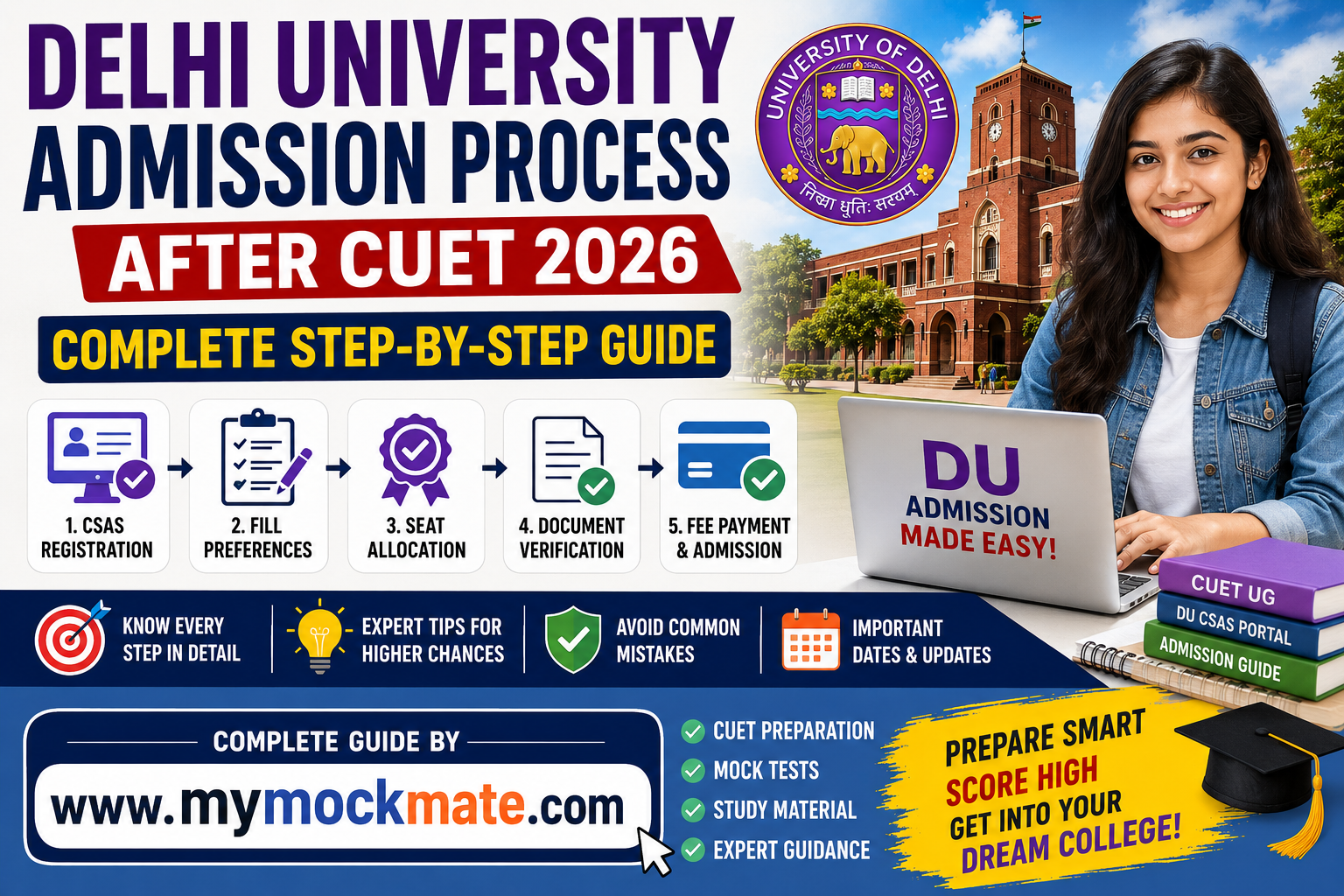
However, many students believe that obtaining a good CUET score automatically guarantees admission to Delhi University. In reality, the admission journey continues even after the CUET examination. Students must complete several important steps, including registration on the Common Seat Allocation System (CSAS) portal, preference filling, document verification, seat acceptance, and fee payment.
Understanding the complete Delhi University admission process after CUET is crucial for securing admission in your desired college and course. Missing a deadline or making a mistake during preference filling can affect your admission opportunities significantly.
This detailed guide by www.mymockmate.com explains every stage of the Delhi University admission process after CUET, helping students navigate the system confidently and successfully.
Understanding Delhi University Admissions After CUET
Delhi University admissions are conducted through the Common Seat Allocation System (CSAS).
After CUET results are announced by the National Testing Agency (NTA), Delhi University uses the scores to allocate seats in undergraduate programs.
The admission process involves:
- CUET Result Declaration
- CSAS Registration
- Program Selection
- College Preference Filling
- Seat Allocation
- Document Verification
- Fee Payment
- Final Admission Confirmation
Every step is important and must be completed within the prescribed timelines.
Why Understanding the Post-CUET Process Matters
Many students focus entirely on preparing for CUET and overlook the admission process that follows.
Even students with excellent CUET scores can face issues if they:
- Miss CSAS registration deadlines
- Choose incorrect preferences
- Upload wrong documents
- Fail to accept allotted seats
- Delay fee payment
Therefore, understanding the complete process is just as important as scoring well in CUET.
Students preparing through www.mymockmate.com not only gain exam preparation support but also access valuable guidance regarding admissions and counselling procedures.
Step 1: Check Your CUET Result Carefully
Once NTA declares CUET results, candidates should download their scorecards immediately.
Verify the Following Information
- Candidate name
- Application number
- Subject-wise scores
- Percentile scores
- Personal details
If discrepancies are found, students should contact the appropriate authorities immediately.
The CUET scorecard serves as the foundation for Delhi University admissions.

Step 2: Register on the DU CSAS Portal
The next and most important step is registering on the Delhi University Common Seat Allocation System (CSAS) portal.
Many students mistakenly believe CUET registration automatically registers them for DU admissions.
This is incorrect.
A separate registration on the CSAS portal is mandatory.
Information Required During Registration
- CUET application number
- Personal details
- Academic details
- Category information
- Reservation certificates
- Communication details
Students should carefully review all information before final submission.
What is the CSAS Portal?
CSAS stands for Common Seat Allocation System.
It is Delhi University’s centralized admission platform that manages:
- Registration
- Preference submission
- Merit calculation
- Seat allocation
- Admission confirmation
The portal ensures transparency and fairness in the admission process.
Phases of the DU CSAS Admission Process
The admission process generally consists of three major phases.
Phase 1: Candidate Registration
Students create their admission profiles.
Activities include:
- Personal information submission
- Academic record entry
- Category declaration
- Certificate uploads
Phase 2: Course and College Preferences
Students select:
- Desired programs
- Preferred colleges
- Priority order
This phase significantly influences admission outcomes.
Phase 3: Seat Allocation and Admission
Delhi University allocates seats based on:
- CUET performance
- Eligibility criteria
- Category reservations
- Candidate preferences
- Seat availability
Step 3: Understand Program Eligibility
Before selecting preferences, students must verify their eligibility.
Each DU course has specific subject requirements.
Examples
B.Com (Hons.)
May require:
- Mathematics or Accountancy
- Language subject
- Relevant domain subjects
BA (Hons.) English
May require:
- English Language
- Additional domain subjects
B.Sc. Physics
May require:
- Physics
- Mathematics
- Chemistry
Choosing a course without meeting eligibility requirements can lead to rejection during admission verification.
Step 4: Fill Course Preferences Strategically
Course selection is one of the most critical decisions.
Popular DU Programs
- B.Com (Hons.)
- B.Com
- BA (Hons.) English
- BA (Hons.) Political Science
- BA (Hons.) Economics
- B.Sc. Mathematics
- B.Sc. Physics
- B.Sc. Computer Science
- BA Programme
Students should rank courses according to their genuine interests and career goals.
Step 5: Fill College Preferences Wisely
Delhi University has numerous colleges with varying levels of competition.
Highly Competitive Colleges
- Hindu College
- SRCC
- Miranda House
- Hansraj College
- Lady Shri Ram College
- Kirori Mal College
Other Reputed Colleges
- Ramjas College
- Gargi College
- Daulat Ram College
- Sri Venkateswara College
- Motilal Nehru College
Students should create a balanced preference list including:
- Dream colleges
- Realistic colleges
- Backup options
Experts at www.mymockmate.com often recommend avoiding overly restrictive preference lists.
How Preference Order Affects Admission
Many students misunderstand preference filling.
The system attempts to allocate the highest preferred option available based on merit.
For example:
If your preference order is:
- SRCC B.Com (Hons.)
- Hindu College B.Com (Hons.)
- Hansraj College B.Com (Hons.)
And your score qualifies for Hansraj but not SRCC or Hindu, you may receive Hansraj College.
Therefore, preference ranking must reflect actual priorities.
Step 6: Seat Allocation Process
Delhi University conducts seat allocation rounds after preference submission.
Allocation Depends On
CUET Scores
Higher scores improve chances.
Merit Ranking
Program-specific merit lists are prepared.
Reservation Benefits
Applicable categories receive reservation benefits.
Seat Availability
Allocation depends on remaining seats.
Candidate Preferences
Preferences determine possible allotments.
Understanding Allocation Rounds
DU generally conducts multiple allocation rounds.
Round 1
Initial seat allocation.
Round 2
Vacant seats are offered.
Round 3
Additional opportunities for unfilled seats.
Spot Rounds
Conducted for remaining vacancies.
Students should participate actively in every eligible round.
Step 7: Accept the Allocated Seat
Once a seat is allotted, students must accept it within the specified deadline.
Failure to accept the seat may result in cancellation of the allotment.
After Acceptance
The college reviews submitted documents.
The verification process begins.
Step 8: Document Verification
Colleges verify all submitted information.
Common Documents Required
Identity Documents
- Aadhaar Card
- Passport
- Government-issued ID
Academic Documents
- Class 10 Marksheet
- Class 12 Marksheet
- Passing Certificate
CUET Documents
- CUET Admit Card
- CUET Scorecard
Reservation Certificates
If applicable:
- SC Certificate
- ST Certificate
- OBC-NCL Certificate
- EWS Certificate
- PwD Certificate
Students should ensure that all certificates are valid and updated.
Common Reasons for Verification Rejection
Incorrect Information
Mismatch between documents and application details.
Invalid Certificates
Expired or improperly formatted certificates.
Missing Documents
Failure to upload mandatory documents.
Eligibility Issues
Not meeting course-specific requirements.
Careful preparation can prevent these problems.
Step 9: Pay Admission Fees
After successful verification, students receive fee payment instructions.
Admission becomes provisional until fees are paid.
Payment Modes
Generally include:
- Online banking
- Debit cards
- Credit cards
- UPI payments
Students should save fee receipts for future reference.
Step 10: Final Admission Confirmation
Once payment is completed:
- Admission is confirmed
- Enrollment is finalized
- Students receive institutional communication
They can then prepare for orientation and the academic session.
Reservation Policy in DU Admissions
Delhi University follows reservation guidelines prescribed by the Government of India.
Categories typically include:
- Scheduled Castes (SC)
- Scheduled Tribes (ST)
- OBC-NCL
- EWS
- PwD
- Kashmiri Migrants
- Other special categories
Reservation benefits apply only when valid documentation is provided.
Upgradation Option in DU Admissions
Students may receive an opportunity for seat upgradation.
What is Upgradation?
If a higher-preference option becomes available in later rounds, students may be upgraded automatically according to university rules.
Benefits
- Better college
- Better course
- Improved academic opportunities
Students should carefully understand upgrade policies before making decisions.
Spot Admission Rounds
Some seats remain vacant after regular rounds.
Delhi University conducts spot admission rounds to fill these vacancies.
Who Can Participate?
Generally:
- Students without seats
- Eligible candidates
- Candidates meeting university requirements
Spot rounds can provide excellent opportunities for admission.
Common Mistakes Students Make After CUET
Missing CSAS Registration
A good CUET score alone is not sufficient.
Filling Preferences Randomly
Poor planning reduces admission chances.
Ignoring Eligibility Criteria
Students must meet course requirements.
Missing Deadlines
Admission schedules are strict.
Uploading Wrong Documents
Document discrepancies can cause rejection.
Not Checking Allocation Results
Important updates may be missed.
Tips for Successful DU Admission After CUET
Register Early
Avoid last-minute technical issues.
Research Colleges Thoroughly
Understand placement records, faculty, and campus facilities.
Keep Documents Ready
Prepare scanned copies in advance.
Follow Official Notifications
Stay updated regarding admission schedules.
Create a Balanced Preference List
Include ambitious, realistic, and safe options.
Practice Strategic Planning
Admission decisions should align with long-term career goals.
Students can find useful guidance and preparation support at www.mymockmate.com, which helps aspirants stay informed throughout the admission cycle.
Why MyMockMate is Helpful for DU Aspirants
Admission success begins with strong CUET performance.
www.mymockmate.com supports students through:
CUET Mock Tests
Simulate real examination conditions.
Topic-Wise Practice Questions
Strengthen subject knowledge.
Performance Analysis
Identify strengths and weaknesses.
Updated Educational Content
Stay informed about admissions and examinations.
Student-Centric Learning Tools
Enhance preparation efficiency.
Thousands of students rely on www.mymockmate.com to improve their competitive exam readiness and admission prospects.
Conclusion
The Delhi University admission process after CUET involves much more than simply appearing for the entrance examination. Students must carefully complete CSAS registration, verify eligibility, select appropriate course and college preferences, participate in seat allocation rounds, upload documents, and confirm admission through fee payment.
A high CUET score certainly improves opportunities, but successful admission depends equally on understanding and navigating the post-exam process effectively. Students who stay informed, meet deadlines, and make strategic decisions significantly improve their chances of securing admission to their preferred course and college.
For comprehensive CUET preparation, mock tests, performance tracking, and admission-related guidance, www.mymockmate.com serves as a trusted platform for students aiming to achieve their academic goals.
Frequently Asked Questions (FAQs)
1. Is CSAS registration mandatory after CUET?
Yes. Delhi University admissions require separate registration on the CSAS portal even after appearing for CUET.
2. Can I get admission to DU only with my CUET scorecard?
No. You must also complete the CSAS admission process.
3. What happens if I miss CSAS registration?
You may lose eligibility for Delhi University admissions during that admission cycle.
4. How many colleges can I choose in DU preferences?
Students can usually choose multiple colleges and programs according to university guidelines.
5. Does preference order matter?
Yes. The system attempts to allot the highest preferred option available based on merit.
6. Can I upgrade my allotted seat?
Delhi University may provide upgrade opportunities in subsequent rounds, subject to availability.
7. What documents are required for verification?
Class 10 and 12 marksheets, CUET scorecard, identity proof, photographs, and category certificates (if applicable).
8. What happens if my documents are rejected?
The college may request corrections or reject the admission depending on the issue.
9. Are spot rounds conducted every year?
Generally, spot rounds are conducted if seats remain vacant after regular allocation rounds.
10. How can MyMockMate help in DU admission preparation?
www.mymockmate.com provides CUET mock tests, practice questions, performance analytics, exam preparation resources, and educational guidance that help students improve their admission chances.




One Comment