




Short Intro
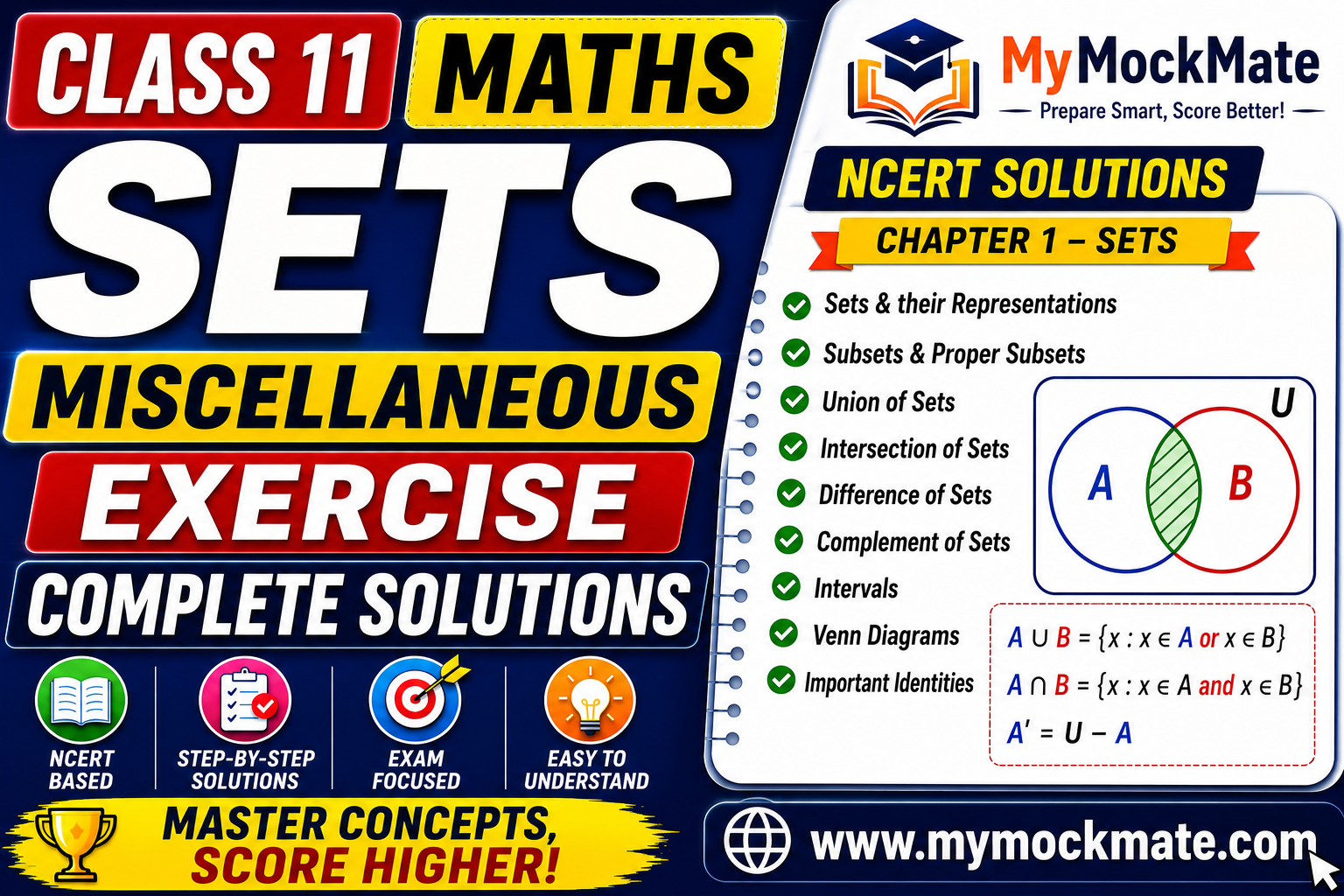
This article provides complete NCERT Solutions for Miscellaneous Exercise of Chapter 1 – Sets for Class 11 Mathematics. Students will learn important concepts such as sets, subsets, union, intersection, complement, intervals and Venn diagrams with easy step-by-step explanations. These solutions are highly useful for CBSE Board Exams and competitive exam preparation.
Quick Information Box
| Particular | Details |
|---|---|
| Class | 11 |
| Subject | Mathematics |
| Chapter | Sets |
| Exercise | Miscellaneous Exercise |
| Board | NCERT / CBSE |
| Main Topics | Set Operations & Venn Diagrams |
Concepts Used (Topics Covered)
- Representation of Sets
- Empty Set
- Finite & Infinite Sets
- Equal Sets
- Subsets
- Proper Subsets
- Universal Set
- Intervals
- Union & Intersection
- Difference of Sets
- Complement of Sets
- Venn Diagrams
The chapter introduces the fundamental theory of sets and their operations used in mathematics.
Important Formulas
Union of Sets
A∪B={x:x∈A or x∈B}
Intersection of Sets
A∩B={x:x∈A and x∈B}
Difference of Sets
A−B={x:x∈A and x∈/B}
Complement of Sets
A′=U−A
De Morgan’s Laws
(A∪B)′=A′∩B′
(A∩B)′=A′∪B′
Questions & Step-by-step Solutions
Question 1
Write the following sets in roster form.
(i)
A={x:x is an integer and −3≤x<7}
Solution
A = {−3, −2, −1, 0, 1, 2, 3, 4, 5, 6}(ii)
B={x:x is a natural number less than 6}
Solution
B = {1,2,3,4,5}(iii)
Two-digit natural numbers whose digit sum is 8.
Solution
C = {17,26,35,44,53,62,71,80}(iv)
Prime divisors of 60.
Solution
D = {2,3,5}Question 2
Find whether the following are finite or infinite sets.
(i)
Set of months in a year.

Solution
Finite Setbecause it contains 12 elements.
(ii)
Set of natural numbers.
Solution
Infinite Set(iii)
Set of points on a line.
Solution
Infinite SetQuestion 3
Determine equal sets.
(i)
A = {1,2,3}
B = {3,2,1}
Solution
Both contain same elements.
A = B(ii)
A = {a,b,c}
B = {a,b,c,d}
Solution
A ≠ Bbecause B has an extra element d.
Question 4
Find subsets of the following sets.
(i)
A = {a}Solution
φ , {a}(ii)
B = {a,b}Solution
φ , {a}, {b}, {a,b}(iii)
C = {1,2,3}Solution
φ, {1}, {2}, {3}, {1,2}, {1,3}, {2,3}, {1,2,3}Question 5
Write intervals in set-builder form.
(i)
(−3,0)Solution
{x:−3<x<0}
(ii)
[6,12]Solution
{x:6≤x≤12}
(iii)
(6,12]Solution
{x:6<x≤12}
Question 6
Find union and intersection.
Given:
A = {1,2,3,4}
B = {3,4,5,6}
(i) Union
A∪B
Solution
A ∪ B = {1,2,3,4,5,6}(ii) Intersection
A∩B
Solution
A ∩ B = {3,4}Question 7
Find difference of sets.
Given:
A = {1,2,3,4,5}
B = {2,4}
(i)
A−B
Solution
A − B = {1,3,5}(ii)
B−A
Solution
B − A = φQuestion 8
Find complement of set.
Given:
U = {1,2,3,4,5,6,7,8}
A = {2,4,6,8}
Solution
A′=U−A
A′ = {1,3,5,7}Common Mistakes
- Confusing ∈ and ⊂
- Repeating elements in sets
- Incorrect interval notation
- Mixing union and intersection symbols
- Forgetting complement is taken with respect to universal set
Exam Tips
- Learn all set symbols carefully.
- Practice Venn diagrams regularly.
- Remember:
A ∪ φ = Aand
A ∩ φ = φ- Use step-by-step method in board exams.
Practice MCQs
MCQ 1
Which set is subset of every set?
A. Universal Set
B. Empty Set
C. Singleton Set
D. Infinite Set
Answer
B. Empty SetMCQ 2
If:
A = {1,2}
B = {2,3}
then:
A∩B
equals:
A. {1}
B. {2}
C. {3}
D. φ
Answer
B. {2}MCQ 3
If:
A = {1,2,3}then number of subsets is:
A. 4
B. 6
C. 8
D. 16
Answer
C. 8FAQ Section
Q1. What is a set?
A well-defined collection of objects is called a set.
Q2. What is empty set?
A set having no element is called empty set or null set.
Q3. What is subset?
If every element of A belongs to B, then A is subset of B.
Q4. What is complement of set?
Complement contains all elements of universal set which are not in the given set.
CTA (Call To Action)
📘 Prepare smarter with MyMockMate!
✅ NCERT Solutions
✅ Chapter-wise Notes
✅ Important MCQs
✅ Online Mock Tests
✅ Instant Performance Analysis
Start your preparation today on MyMockMate