




Short Intro
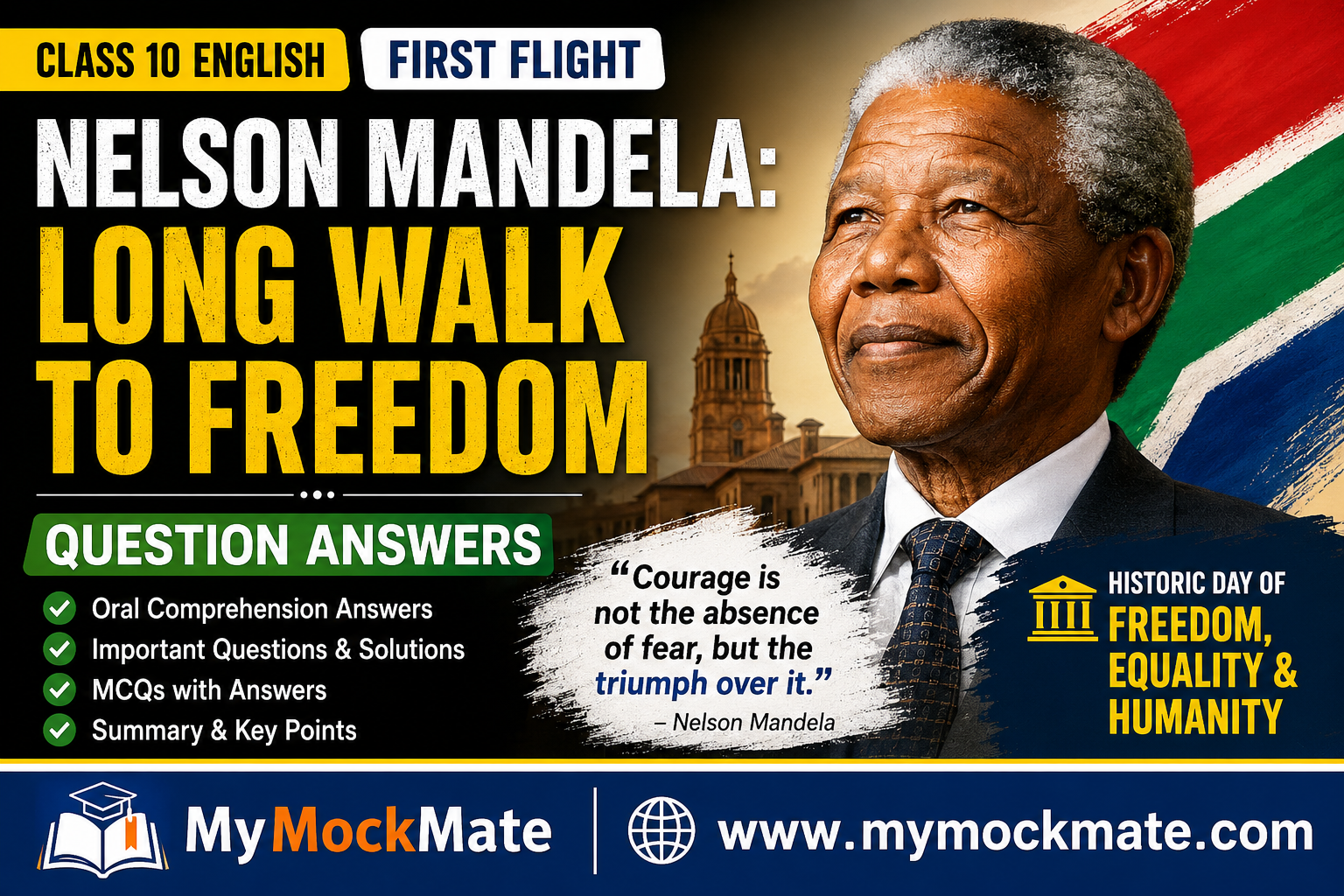
This chapter from the NCERT Class 10 English book First Flight highlights the historic inauguration of Nelson Mandela as the first Black President of South Africa. The lesson teaches students about freedom, equality, courage, and humanity. Below are complete question answers and explanations in easy English for exam preparation.
Quick Information Box
| Topic | Details |
|---|---|
| Chapter Name | Nelson Mandela: Long Walk to Freedom |
| Book | First Flight |
| Class | 10 |
| Author | Nelson Mandela |
| Genre | Autobiography |
| Main Theme | Freedom, Equality, Courage |
| Important Event | South Africa’s First Democratic Government |
Concepts Used (Topics Covered)
- Apartheid System
- Equality and Human Rights
- Courage and Leadership
- Freedom and Democracy
- National Unity
- Racial Discrimination
- Humanity and Forgiveness
Important Formulas
| Topic | Key Idea |
|---|---|
| Courage | Courage = Triumph over fear |
| Freedom | Freedom for all people |
| Humanity | Love is natural, hate is learned |
| Leadership | Sacrifice for society |
Questions & Step-by-step Solutions with Explanation
Oral Comprehension Check
Q1. Where did the ceremonies take place? Can you name any public buildings in India made of sandstone?
Answer:
The ceremonies took place in the sandstone amphitheatre formed by the Union Buildings in Pretoria.
Some Indian public buildings made of sandstone are:
- Red Fort
- Rashtrapati Bhavan
- Parliament House
Explanation:
Mandela describes the importance of the Union Buildings because it was once the center of white rule and later became the symbol of democracy.
Q2. How is 10 May an autumn day in South Africa?
Answer:
10 May is an autumn day in South Africa because seasons in the Southern Hemisphere are opposite to those in India.
Explanation:
When it is summer in India, it is winter in South Africa, and vice versa.
Q3. What does Mandela mean by “an extraordinary human disaster”?
Answer:
He refers to the apartheid system that caused racial discrimination and suffering to Black people.
What is the “glorious human achievement”?
It refers to the establishment of democracy and equal rights in South Africa.
Explanation:
Mandela contrasts the painful past with the hopeful future.
Q4. What does Mandela thank the international leaders for?
Answer:
He thanks them for coming to support South Africa’s new democratic government.
Explanation:
Their presence showed international respect and support for freedom and equality.
Q5. What ideals did Mandela set for the future of South Africa?
Answer:
Mandela wanted:
- Equality
- Freedom
- Justice
- Peace
- Human dignity
Explanation:
He dreamed of a nation free from discrimination and oppression.
Additional Important Questions
Q6. What does courage mean to Mandela?
Answer:
According to Mandela, courage is not the absence of fear but the victory over fear.
Explanation:
A brave person feels fear but overcomes it.

Q7. Which does Mandela think is natural — love or hate?
Answer:
Mandela believes love is natural.
Explanation:
People learn to hate, so they can also learn to love.
Q8. What “twin obligations” does Mandela mention?
Answer:
A man has obligations:
- Towards his family
- Towards his country and people
Explanation:
Mandela could not fulfill both because apartheid forced him into struggle.
Q9. What did freedom mean to Mandela as a child?
Answer:
As a child, freedom meant playing freely in nature and enjoying village life.
Explanation:
Later he realized that true freedom means equality and human rights.
Q10. How did Mandela’s hunger for freedom change his life?
Answer:
It transformed him from a normal man into a revolutionary leader.
Explanation:
He sacrificed personal comforts for the freedom of his people.
Summary of the Chapter
Nelson Mandela describes the historic day when he became the first Black President of South Africa. He remembers the long struggle against apartheid and honors those who sacrificed their lives for freedom. Mandela explains that courage means conquering fear and that love is more natural than hate. The chapter promotes equality, peace, and humanity.
Common Mistakes
- Confusing apartheid with poverty
- Writing incomplete explanations
- Forgetting Mandela’s definition of courage
- Ignoring themes like equality and humanity
- Mixing South African seasons with Indian seasons
Exam Tips
- Learn important quotations from the chapter
- Focus on themes of freedom and equality
- Practice long-answer questions
- Write answers in simple language
- Remember important events and dates
Practice MCQs
1. Who became South Africa’s first Black President?
A. Thabo Mbeki
B. Nelson Mandela
C. Oliver Tambo
D. Walter Sisulu
Answer:
B. Nelson Mandela
2. What was apartheid?
A. Democracy
B. Religious movement
C. Racial discrimination system
D. Economic reform
Answer:
C. Racial discrimination system
3. According to Mandela, courage is:
A. Fearlessness
B. Absence of pain
C. Triumph over fear
D. Power
Answer:
C. Triumph over fear
4. What is natural according to Mandela?
A. Hate
B. Violence
C. Love
D. Anger
Answer:
C. Love
FAQ Section
Q1. Who wrote Long Walk to Freedom?
It was written by Nelson Mandela.
Q2. What is the main theme of the chapter?
The main themes are freedom, equality, courage, and humanity.
Q3. What was apartheid?
Apartheid was a racial discrimination system in South Africa.
Q4. Why is this chapter important?
It teaches moral values and the importance of equal rights.
CTA (Call To Action)
Get more Class 10 English NCERT solutions, summaries, MCQs, and exam notes only on
🌐 MyMockMate