




Short Intro
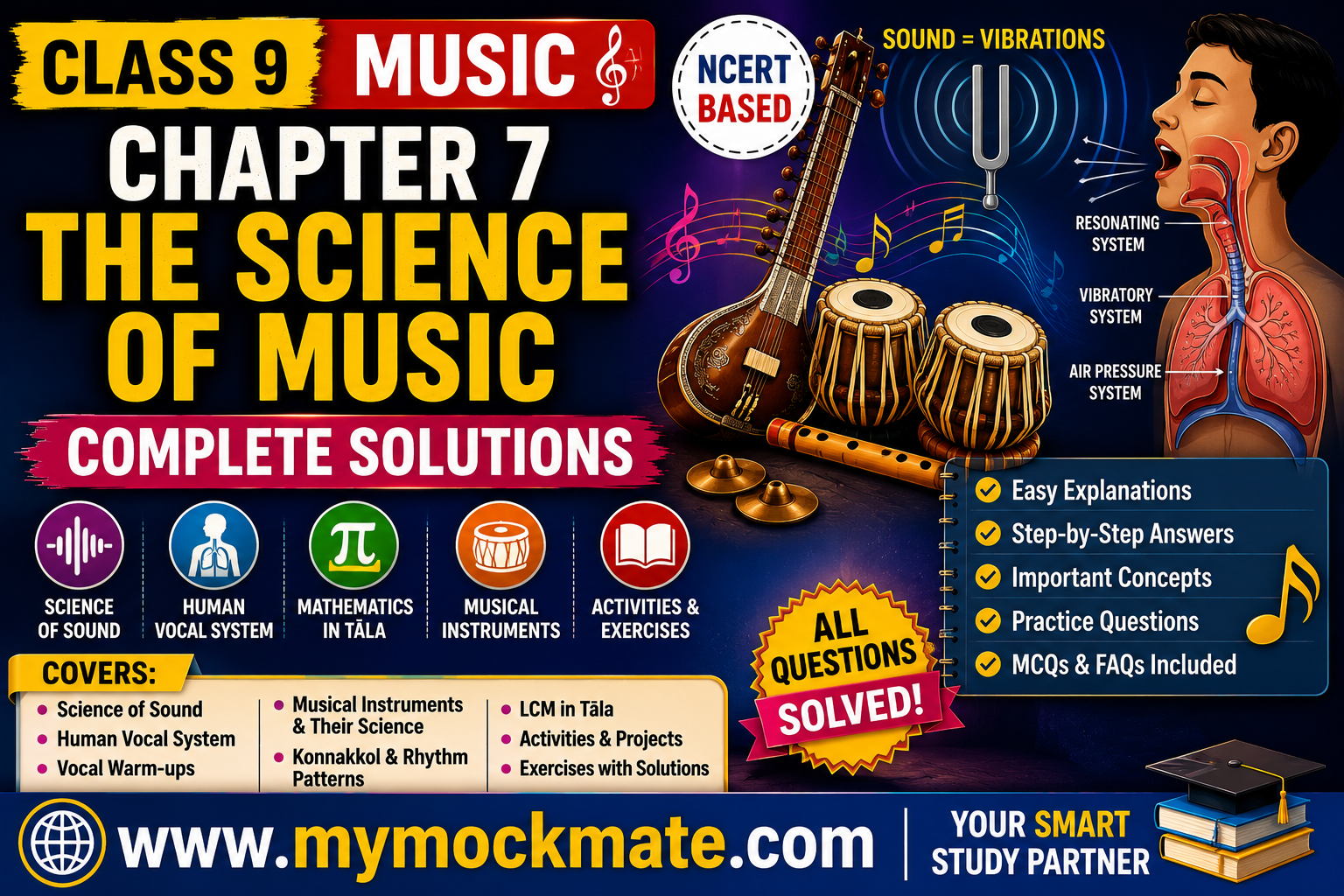
This chapter explains the scientific principles behind music and sound. Students learn about vibrations, pitch, loudness, human voice production, vocal care, rhythm patterns, mathematics in tāla, and musical instruments. These solutions provide easy explanations, MCQs, FAQs, exam tips, and detailed answers for better understanding.
Quick Information Box
| Topic | Details |
|---|---|
| Chapter Name | The Science of Music |
| Subject | Music |
| Class | 9 |
| Main Focus | Science Behind Music and Sound |
| Important Concepts | Vibrations, Pitch, Voice, Rhythm |
| Learning Goal | Understanding Physics, Biology, and Mathematics in Music |
Concepts Used (Topics Covered)
- Science of Sound
- Vibrations and Pitch
- Loudness and Resonance
- String Instruments
- Human Vocal System
- Air Pressure System
- Vibratory System
- Resonating System
- Vocal Warm-ups
- Mathematics in Tāla
- Konnakkol/Bol Patterns
- Lowest Common Multiple (LCM) in Rhythm
- C.V. Raman’s Research on Sound
- Categories of Musical Instruments
Important Formulas / Key Terms
- Sound = Produced by vibrations
- Pitch ↑ when string tension ↑
- LCM = Smallest common multiple of two numbers
- Resonance = Amplification of sound
- Tāla = Rhythmic cycle in music
- Nāda = Musical sound
- Śhruti = Discernible interval of sound
- Svara = Musical note
Questions & Step-by-Step Solutions
Q1. Fill in the blanks.
i. When a string is tightened, the pitch increases.
ii. The diaphragm and lungs form part of the air pressure subsystem.
iii. The hollow body of a musical instrument is important because it increases and amplifies the loudness of sound.
Explanation
Tighter strings vibrate faster and produce higher pitch. Hollow bodies help resonance and make the sound louder.
Q2. State whether the following statements are true or false.
| Statement | Answer |
|---|---|
| i. The thickness of a string affects the quality of sound. | True |
| ii. Drinking water is bad for the voice. | False |
| iii. C.V. Raman conducted experiments on the sound of the veena. | False |
Explanation
C.V. Raman mainly studied the sound patterns of instruments like the tabla and mṛidaṅgam.
Q3. Name the three subsystems of the human vocal system and describe their functions.
Solution
| Subsystem | Function |
|---|---|
| Air Pressure System | Controls airflow using lungs and diaphragm |
| Vibratory System | Produces sound using vocal cords |
| Resonating System | Amplifies and shapes sound through mouth and nasal cavities |
Explanation
These three systems work together to produce speech and singing voices.
Q4. Describe some ways to ensure our voices are in good condition.
Solution
- Drink sufficient water regularly.
- Eat healthy food rich in fruits and vegetables.
- Avoid shouting and speaking loudly.
- Practise vocal warm-ups daily.
- Take proper rest for the voice.
- Avoid very cold or oily foods.
Explanation
Healthy habits protect vocal cords and improve voice quality.
Q5. Jhaptāla has 10 beats and Kehervā has 8 beats. After how many beats will they both complete full cycles together?
Solution
We calculate the LCM of 10 and 8.
Factors:
- 10 = 2 × 5
- 8 = 2 × 2 × 2
LCM = 2 × 2 × 2 × 5 = 40
Final Answer
Both rhythms will complete full cycles together after 40 beats.
Explanation
The Lowest Common Multiple helps identify when two rhythmic cycles synchronise again.
Q6. Describe a warm-up routine that can be done daily to keep the voice in good condition.
Solution
Daily Vocal Warm-up Routine
- Deep breathing exercises
- Humming practice (Bhrāmarī prāṇāyāma)
- Lip trill exercises
- Sargam and alaṅkāra singing
- Pitch sliding exercises
Benefits
- Improves breath control
- Warms vocal cords
- Enhances resonance
- Increases vocal flexibility
Explanation
Regular warm-ups prepare the vocal system for speaking and singing.
Q7. Write a Konnakkol/Bol phrase for:
i. 5 akṣharas
taka takita
ii. 6 akṣharas
takita takita
Explanation
Rhythmic syllables are used in Indian music to create and practise rhythm patterns.
Q8. Describe the connection between the science of sound and musical instruments. (50 words)
Solution
Musical instruments produce sound through vibrations. The pitch depends on tension, length, and thickness of strings or air columns. Hollow bodies increase resonance and loudness. Scientific principles such as vibration, frequency, resonance, and airflow help musicians create different tones and musical effects in instruments.

Q9. If you were to design a string instrument using the principles of sound, how would it look and sound?
Solution
Design
- Wooden hollow body for resonance
- Multiple strings of different thickness
- Adjustable tuning pegs
- Curved neck for comfortable playing
Sound Quality
- Deep and melodious tone
- Adjustable pitch
- Sustained resonance
- Rich vibrations
Diagram Description
The instrument would resemble a combination of a guitar and sitar with a large resonating chamber.
Explanation
Scientific principles like vibration, resonance, and tension help design better musical instruments.
Q10. Which category of instrument does the human voice belong to? Justify your answer.
Solution
The human voice belongs to the suṣhira-like category because sound is produced through airflow and vibration.
Justification
- Air from the lungs passes through vocal cords.
- Vocal cords vibrate to create sound.
- Mouth and nasal cavities amplify the sound.
Explanation
The human vocal system works similarly to wind instruments where airflow creates vibrations.
Common Mistakes
- Confusing pitch with loudness
- Forgetting vocal subsystem names
- Incorrectly calculating LCM
- Ignoring resonance and vibration concepts
- Writing incomplete explanations for rhythmic patterns
Exam Tips
- Learn definitions of pitch, resonance, and vibration carefully.
- Practise LCM problems related to rhythm.
- Remember the three vocal subsystems.
- Use tables for theory-based answers.
- Revise examples of musical instruments regularly.
Practice MCQs
1. Sound is produced due to:
A. Heat
B. Vibrations
C. Light
D. Pressure
Answer:
B. Vibrations
2. Which subsystem contains vocal cords?
A. Resonating System
B. Vibratory System
C. Air Pressure System
D. Digestive System
Answer:
B. Vibratory System
3. Which scientist studied the sound of tabla and mṛidaṅgam?
A. Jagadish Chandra Bose
B. Homi Bhabha
C. C.V. Raman
D. Vikram Sarabhai
Answer:
C. C.V. Raman
4. What does LCM stand for?
A. Large Common Measure
B. Lowest Common Multiple
C. Long Cycle Method
D. Loudness Control Meter
Answer:
B. Lowest Common Multiple
5. Which exercise improves resonance?
A. Running
B. Humming
C. Writing
D. Dancing
Answer:
B. Humming
FAQ Section
Q1. What causes sound in musical instruments?
Sound is produced when parts of an instrument vibrate.
Q2. Why is a hollow body important in instruments?
It increases resonance and amplifies sound.
Q3. What is the role of vocal cords?
Vocal cords vibrate to produce sound while speaking or singing.
Q4. Why are vocal warm-ups important?
They prepare the vocal system and prevent strain.
Q5. How is mathematics connected to music?
Mathematics helps understand rhythm patterns, beat cycles, and timing in music.
For more chapter-wise solutions, MCQs, notes, music activities, and exam preparation materials, visit www.mymockmate.com and make your learning smarter, musical, and exam-ready.