





Short Introduction
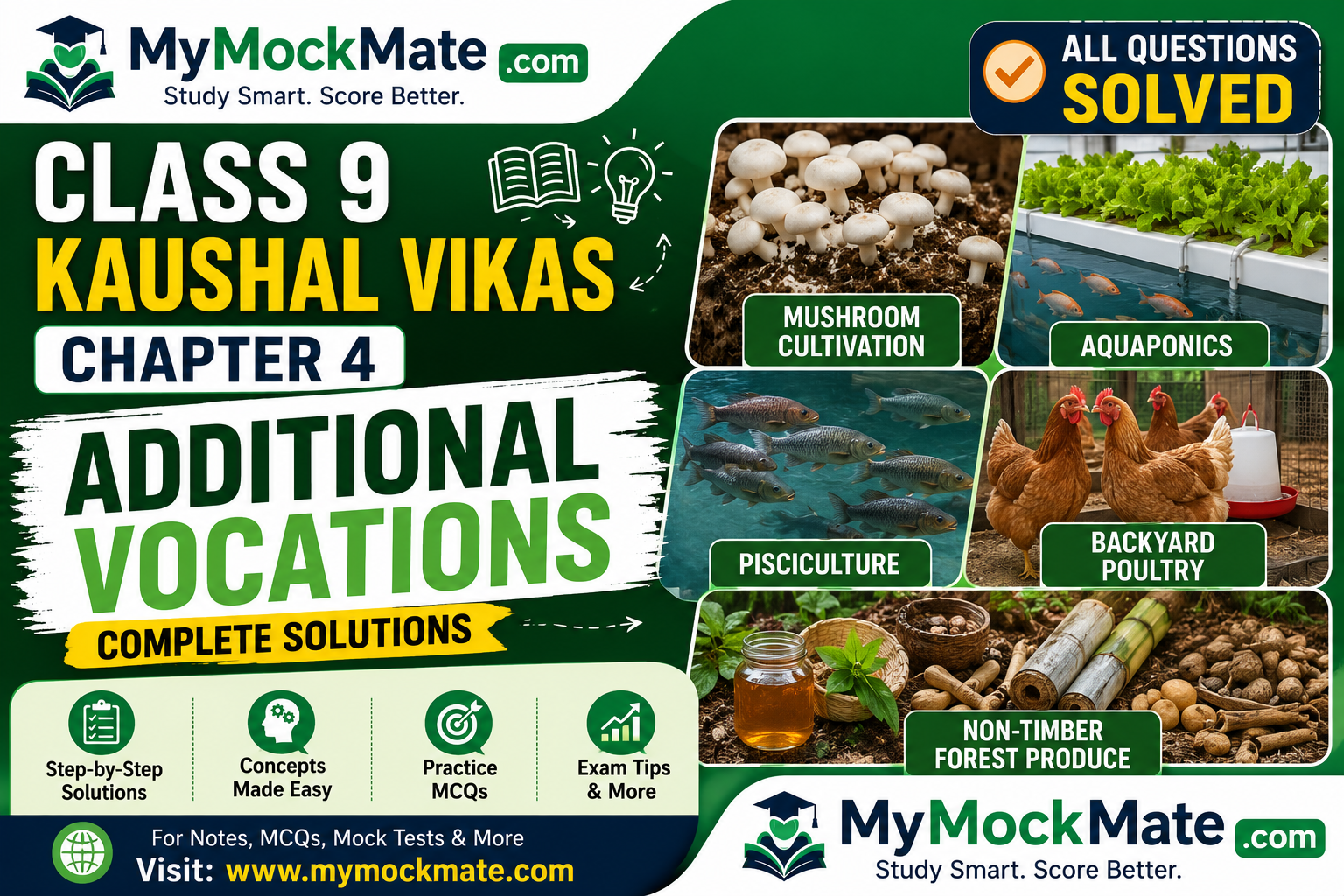
Agriculture and natural-resource-based livelihoods are not limited to traditional crop farming. Many useful vocations can be developed through the cultivation of mushrooms, integrated production of fish and plants, fish farming, backyard poultry, and sustainable collection and processing of non-timber forest products.
Chapter 4, Additional Vocations, introduces Grade 9 students to five practical livelihood areas:
- Mushroom Cultivation
- Aquaponics
- Pisciculture
- Backyard Poultry
- Non-Timber Forest Produce or NTFP
The chapter explains the materials and tools required for each vocation, important quality standards, safety precautions, environmental conditions, production processes, monitoring methods, harvesting practices, storage requirements and sustainability considerations.
This complete guide is designed for students, teachers and practical-project work. It explains each vocational process step by step and provides competency-based questions, MCQs, common mistakes, exam tips and FAQs.
Quick Information Box
| Particular | Details |
|---|---|
| Chapter | Chapter 4 – Additional Vocations |
| Class | Grade 9 |
| Subject Area | Kaushal Vikas / Skill Education |
| Vocational Area 1 | Mushroom Cultivation |
| Vocational Area 2 | Aquaponics |
| Vocational Area 3 | Pisciculture |
| Vocational Area 4 | Backyard Poultry |
| Vocational Area 5 | Non-Timber Forest Produce |
| Main Skills | Planning, production, monitoring, safety, harvesting and storage |
| Core Environmental Theme | Sustainable resource management |
| Mushroom Humidity | 80–90% |
| Mushroom Temperature in chapter | 25–30°C |
| Aquaponics Principle | Integration of aquaculture and hydroponics |
| Fish Farming Requirement | Clean water, oxygen and proper feeding |
| Poultry Requirement | Housing, feed, water, warmth and hygiene |
| NTFP Principle | Sustainable collection without destroying trees or resources |
The chapter presents separate materials, safety standards, quality standards and production workflows for all five vocational areas.
Concepts Used – Topics Covered
The major concepts covered in Chapter 4 include mushroom spores and mycelium, spawn, substrate, sterilisation, inoculation, incubation, mushroom environmental management, humidity control, mushroom harvesting and cold storage, aquaponics, the nitrogen cycle, biofilters, flow rate, grow beds, pumps and aerators, fish–plant compatibility, water-quality testing, pisciculture, pond preparation, plankton production, spawn and juveniles, fish feeding and growth monitoring, backyard poultry, coop and brooder design, poultry nutrition, wet bedding, bird-health monitoring, egg collection, NTFP, sustainable harvesting, lac, mulching, collection tools, maturity assessment, drying, sorting, storage and packaging.
Important Formulas and Calculations
Although this chapter is primarily process-oriented, the following formulas are useful for practical and competency-based questions.
1. Feed Requirement
Daily Feed Requirement = Number of Fish or Birds × Feed per Individual per Day
Example:
If 20 birds require 100 g feed each per day:
20 × 100 g = 2,000 g
Therefore:
Daily feed requirement = 2 kg
2. Average Fish Weight
Average Weight = Total Weight of Sampled Fish ÷ Number of Fish Sampled
Example:

Total sample weight = 4 kg
Number of fish = 20
Average weight:
4 ÷ 20 = 0.2 kg
Therefore:
Average fish weight = 200 g
3. Survival Percentage
Survival Percentage = (Number Surviving ÷ Number Initially Introduced) × 100
Example:
If 100 juveniles are introduced and 90 survive:
(90 ÷ 100) × 100 = 90%
4. Egg Production Percentage
Egg Production (%) = (Number of Eggs Collected ÷ Number of Laying Hens) × 100
Example:
If 40 hens produce 32 eggs in one day:
(32 ÷ 40) × 100 = 80%
5. Flow Rate
Flow Rate = Volume of Water ÷ Time
Example:
If 100 litres of water pass through a system in 20 minutes:
100 ÷ 20 = 5 litres per minute
6. Mushroom Yield Efficiency – Useful Practical Formula
For school-level record keeping:
Yield Efficiency (%) = Fresh Mushroom Weight ÷ Dry Substrate Weight × 100
This is a useful practical performance indicator, although the uploaded chapter itself focuses more on quality conditions and process control than numerical yield calculation.
Part A – Mushroom Cultivation Questions and Detailed Solutions
The chapter begins with mushroom cultivation and explains that mushrooms grow from spores rather than seeds. Their mycelium forms a root-like network through the substrate. The chapter lists spawn, substrate, nutrient additives, bags or trays, sterilisation equipment, sprayers, monitoring instruments and protective equipment as important materials.
Question 1. What is mushroom cultivation? Explain the role of spores and mycelium.
Answer
Mushroom cultivation is the controlled production of edible mushrooms by providing suitable growing material and environmental conditions.
Step-by-Step Explanation
Step 1: Mushroom growth begins from spores.
Unlike ordinary flowering plants, mushrooms do not grow from seeds.
Step 2: Spores develop fungal threads.
These fine threads spread through the growing material.
Step 3: A mycelial network develops.
The interconnected root-like fungal network is called mycelium.
Step 4: Mycelium absorbs nutrients.
It spreads throughout the substrate and uses nutrients from the material.
Step 5: Fruiting bodies appear.
When suitable temperature, humidity, airflow and moisture conditions are maintained, mushrooms develop.
Conclusion
Mycelium is essential because it colonises the substrate and supports mushroom development.
Question 2. Define sterilisation, mycelium, spawn, inoculation and incubation.
Answer
Sterilisation: The process of cleaning a growth medium and removing unwanted germs or organisms.
Mycelium: The root-like network of fungal threads that spreads through the substrate.
Spawn: A material containing actively growing mushroom mycelium. It acts as the starter material for cultivation.
Inoculation: The process of adding spawn to prepared and sterilised substrate.
Incubation: The stage during which suitable environmental conditions are maintained so that mycelium can spread throughout the substrate.
Process Sequence
Substrate Preparation → Sterilisation → Cooling → Inoculation → Incubation → Fruiting → Harvesting
Question 3. What materials and tools are required for mushroom cultivation?
Answer
The major materials are:
| Material/Tool | Purpose |
|---|---|
| Spawn | Starter material for mushroom growth |
| Straw/Sawdust/Compost | Growing substrate |
| Gypsum/Bran/Additives | Enrichment of substrate |
| Polybags/Trays | Holding the growing medium |
| Pressure Cooker/Drum | Sterilisation |
| Sprayer/Mist Bottle | Moisture maintenance |
| Thermometer | Temperature monitoring |
| Hygrometer | Humidity monitoring |
| Gloves and Mask | Hygiene and personal protection |
| Knife/Scissors | Cutting and harvesting |
These materials and uses are listed in the mushroom-cultivation section on page 61 of the uploaded PDF.
Question 4. What are the quality parameters for mushroom cultivation?
Answer
A successful mushroom-production unit should maintain the following quality standards:
Substrate: It should be clean and properly treated, without mould or foul odour.
Spawn: It should contain healthy, fresh and uncontaminated white mycelium.
Temperature: The chapter specifies a temperature range of approximately 25–30°C.
Humidity: The chapter recommends 80–90% humidity along with good airflow.
Moisture: The substrate should remain damp but not waterlogged.
Harvest quality: Mushrooms should be harvested when caps are firm and of good quality rather than flattened or brown.
Storage: The chapter recommends cool storage at approximately 4–8°C in ventilated packaging.
Question 5. Explain the complete process of mushroom cultivation.
Answer
Step 1: Selection and Site Design
Select a suitable edible mushroom according to local agro-climatic conditions. Plan a shaded, ventilated and humidity-controlled growing area.
Step 2: Prepare the Growth Medium
Prepare suitable straw, sawdust or compost substrate. Check its condition and moisture.
Step 3: Sterilise or Properly Treat the Substrate
Proper treatment reduces contamination from competing microorganisms.
Step 4: Inoculate with Spawn
After the prepared substrate has cooled to a safe temperature, introduce healthy spawn under hygienic conditions.
Step 5: Incubation
Maintain suitable conditions for mycelium to colonise the substrate.
Step 6: Manage Moisture and Environment
Use a squeeze test to judge substrate moisture. Maintain suitable temperature, humidity and ventilation.
Step 7: Monitor Growth
Observe colour, structure, smell, temperature and humidity regularly.
Step 8: Harvest
Harvest mushrooms at the appropriate maturity stage when they are firm and properly developed.
Step 9: Storage and Packaging
Store harvested mushrooms under cool conditions using suitable ventilated packaging.
The six-stage process presented in the chapter covers site design, growth-medium preparation, inoculation, management, monitoring, and harvesting/storage.
Question 6. Why are hygiene and ventilation important in mushroom cultivation?
Answer
Hygiene prevents contamination, while ventilation supports proper environmental conditions.
If the cultivation area, tools or hands are contaminated, unwanted microorganisms may compete with the mushroom mycelium. Similarly, poor airflow can create unsuitable growing conditions.
Therefore, students should:
- clean the work area,
- wash hands,
- use gloves and masks,
- clean trays,
- prevent stagnant water,
- use only known edible varieties,
- maintain suitable ventilation.
Part B – Aquaponics Questions and Detailed Solutions
Aquaponics integrates fish production with soil-free plant cultivation. The diagram on page 62 shows water circulating between the fish tank and the plant-growing section, illustrating the basic recycling principle of the system.
Question 7. What is aquaponics?
Answer
Aquaponics is a sustainable production system that combines:
Aquaculture + Hydroponics = Aquaponics
Fish are raised in water while plants grow without ordinary soil. Nutrients derived from the fish system are processed through biological activity and become available to plants. Water is then recirculated through the system.
Main Benefits
- simultaneous fish and vegetable production,
- efficient water use,
- nutrient recycling,
- reduced dependence on soil,
- suitable for controlled production environments.
Question 8. Explain the nitrogen cycle in an aquaponics system.
Answer
The nitrogen cycle is one of the most important processes in aquaponics.
Step 1: Fish Produce Waste
Fish release waste into the water.
Step 2: Ammonia Enters the System
Fish waste and other organic matter contribute nitrogen compounds.
Step 3: Beneficial Bacteria Act
Useful microorganisms convert harmful forms of nitrogen through biological processes.
Step 4: Plant-Available Nutrients Develop
The resulting nutrients can be absorbed by plants.
Step 5: Plants Remove Nutrients
Plant roots absorb nutrients from the circulating water.
Step 6: Water Recirculates
Water continues through the integrated system.
Conclusion
The biological conversion of fish waste into usable plant nutrients is central to aquaponics.
Question 9. What is the role of a biofilter?
Answer
A biofilter provides a suitable environment for beneficial microorganisms involved in water purification and nitrogen conversion.
Gravel or clay pellets can also provide surfaces where useful bacteria colonise.
Without adequate biological filtration, water quality may deteriorate and affect fish health and plant performance.
Question 10. List the important materials used in aquaponics.
Answer
The chapter lists:
- fish tank,
- grow beds,
- tubing,
- gravel or clay pellets,
- water pump,
- aerator,
- timer switch,
- seeds or seedlings,
- fish feed,
- water-testing kit.
The water-testing kit is used to check parameters such as pH, ammonia, oxygen and temperature.
Question 11. Explain the complete process of establishing an aquaponics system.
Answer
Step 1: Select the Space
Choose an accessible site with sufficient space and suitable environmental conditions.
Step 2: Design the System
Plan the positions of:
- fish tank,
- grow beds,
- pipes,
- pump,
- aerator,
- drainage system.
Step 3: Prepare Grow Beds
Fill the beds with suitable media such as gravel or clay pellets.
Step 4: Establish Water Circulation
Connect the tank, grow beds and return-water system.
Step 5: Test Water Quality
Monitor relevant water-quality parameters.
Step 6: Initiate Biological Cycling
The chapter advises establishing the nitrogen cycle before adding a full fish load.
Step 7: Transplant Seedlings
Place healthy seedlings in the grow beds with appropriate spacing.
Step 8: Manage the System
Track water level, flow rate, recirculation, drainage and fish feeding.
Step 9: Monitor Fish and Plants
Record plant growth and observe fish for feeding response, disease or stress.
Step 10: Harvest
Harvest plants according to crop maturity and record yield.
Question 12. What are the quality parameters of an aquaponics system?
Answer
A good aquaponics system should have:
- clear, odour-free water,
- suitable pH conditions,
- healthy new leaf growth,
- active fish movement,
- regular fish feeding,
- smooth water circulation,
- no pipe blockages,
- efficient water use,
- minimal unnecessary chemical use.
Part C – Pisciculture Questions and Detailed Solutions
The pisciculture section explains that fish health depends on clean water, appropriate temperature, dissolved oxygen and regular feeding. The illustration on page 64 shows a controlled tank-based fish-rearing system with aeration and monitoring equipment.
Question 13. What is pisciculture?
Answer
Pisciculture is the controlled breeding and rearing of fish for food, livelihood or commercial production.
Fish may be raised in:
- ponds,
- tanks,
- other suitable controlled water systems.
Successful pisciculture requires proper water quality, oxygen, temperature, feeding and health monitoring.
Question 14. Differentiate between spawn and juveniles.
Answer
| Spawn | Juveniles |
|---|---|
| Newly hatched or very young fish | Older and stronger young fish |
| More delicate | Comparatively stronger |
| Require careful handling | Better developed for further rearing |
Question 15. Why is aeration important in fish farming?
Answer
Aeration adds air or oxygen to water.
Fish need dissolved oxygen for respiration. If oxygen levels become too low, fish may become stressed, reduce feeding or suffer health problems.
An aerator therefore helps maintain suitable oxygen availability.
Question 16. Why is plankton important?
Answer
Plankton consists of tiny organisms present in water. In suitable pond systems, plankton can serve as a natural food source for fish.
The chapter describes the use of suitable organic manure before introducing fish to stimulate natural plankton production.
Question 17. Explain the complete process of pisciculture.
Answer
Step 1: Select and Prepare the Site
Choose a suitable pond or tank. Remove unwanted vegetation and ensure proper water inlet and outlet arrangements.
Step 2: Prepare the Water System
Fill with clean water and test important water-quality parameters.
Step 3: Encourage Natural Productivity
Where appropriate, follow expert-guided pond preparation practices to encourage natural food production.
Step 4: Introduce Fish
Introduce suitable spawn or juveniles according to the production plan and stocking capacity.
Step 5: Feed Properly
Provide suitable feed at the required frequency and use feeding trays where appropriate to observe consumption.
Step 6: Avoid Overfeeding
Excess feed can decompose and negatively affect water quality, including ammonia levels.
Step 7: Monitor Growth
The chapter recommends sample observations approximately every two weeks, measuring average weight and adjusting feed accordingly.
Step 8: Observe Behaviour
Monitor:
- movement,
- feeding response,
- disease signs,
- stress symptoms.
Step 9: Harvest
Harvest fish when they reach suitable marketable size.
Step 10: Sort and Store
Sort according to size and quality and maintain hygienic cool storage.
Question 18. Why should overfeeding be avoided?
Answer
Overfeeding causes several problems:
- uneaten feed accumulates,
- organic matter decomposes,
- water quality deteriorates,
- ammonia may increase,
- oxygen demand can rise,
- fish health may suffer.
Therefore, feeding should be based on observation and fish requirements.
Part D – Backyard Poultry Questions and Detailed Solutions
The backyard-poultry section explains that poultry can be managed in relatively small spaces such as courtyards, verandas or simple sheds. The chapter emphasises housing, balanced feed, clean water, predator protection, warmth for chicks, ventilation and hygiene.
Question 19. What is backyard poultry?
Answer
Backyard poultry is the small-scale rearing of chickens in household or community spaces using suitable local housing and management practices.
It does not necessarily require a large commercial farm.
A successful backyard poultry system needs:
- suitable shelter,
- balanced feed,
- clean drinking water,
- predator protection,
- ventilation,
- warmth for chicks,
- dry bedding,
- regular health monitoring.
Question 20. Define coop, brooder, feeding response and wet bedding.
Answer
Coop: A shelter where chickens are kept safely.
Brooder: A specially warm enclosure for very young chicks.
Feeding response: The eagerness and activity with which chicks consume feed; it can provide useful information about health.
Wet bedding: Damp litter material on the coop floor that should be removed because persistent wetness can contribute to poor hygiene and disease risk.
Question 21. Why is clean drinking water essential in poultry farming?
Answer
Clean drinking water is necessary for bird health and normal growth. Contaminated water may expose birds to harmful microorganisms.
The chapter specifically mentions water testing in relation to contamination concerns and stresses providing clean water and preventing contamination from droppings.
Question 22. What materials are required for backyard poultry?
Answer
Important materials include:
| Material | Purpose |
|---|---|
| Nesting boxes | Safe place for laying eggs |
| Bedding | Keeps floor dry and comfortable |
| Fencing/Mesh | Predator protection |
| Feed | Growth and egg production |
| Cleaning tools | Coop hygiene |
| Health kit | Basic cleaning and parasite-management support |
| Bulb/Solar Lamp | Lighting and suitable management support |
Question 23. Explain the complete backyard-poultry process.
Answer
Step 1: Select a Suitable Site
The site should be clean and dry.
Step 2: Construct the Coop
Use suitable materials and provide:
- ventilation,
- secure doors,
- predator barriers,
- dry floor,
- bedding.
Step 3: Prepare a Brooder
Young chicks require warmth. A suitable protected brooding arrangement should be established safely.
Step 4: Introduce Healthy Chicks
Introduce clean, healthy chicks into prepared housing and maintain appropriate conditions.
Step 5: Daily Management
- provide feed,
- replace drinking water,
- remove wet bedding,
- clean the coop,
- check security.
Step 6: Monitor Health
Observe:
- activity,
- feeding response,
- eyes,
- droppings,
- signs of illness,
- egg production.
Step 7: Egg Collection
Collect eggs gently and keep them in a suitable cool, clean place.
Step 8: Safe Handling
Handle mature birds carefully during movement or transport.
Question 24. Why must wet bedding be removed?
Answer
Wet bedding creates an unhealthy coop environment.
It may:
- increase moisture,
- contribute to unpleasant ammonia smell,
- support disease-causing organisms,
- create uncomfortable conditions,
- increase health problems.
Therefore, bedding should be kept dry and replaced when necessary.
Part E – Non-Timber Forest Produce Questions and Detailed Solutions
The NTFP section explains that forest-based livelihoods include honey, medicinal plants, gums, resins, fruits, seeds, leaves and bamboo. These products can support nutrition, health and livelihoods without cutting down trees when collected sustainably.
Question 25. What is Non-Timber Forest Produce?
Answer
Non-Timber Forest Produce, or NTFP, includes useful biological products obtained from forest ecosystems without harvesting timber as the main product.
Examples include:
- honey,
- medicinal plants,
- gums,
- resins,
- fruits,
- seeds,
- leaves,
- bamboo products.
NTFP can support food, health, handicrafts and livelihoods.
Question 26. What is sustainable harvesting?
Answer
Sustainable harvesting means collecting natural resources carefully so that the species or resource can regenerate and remain available in the future.
Important Practices
- do not uproot plants unnecessarily,
- collect only mature parts,
- use partial collection,
- avoid damaging host trees,
- avoid disturbing wildlife,
- keep collection sites clean,
- allow regeneration.
Question 27. What is lac?
Answer
Lac is a natural resin produced by a small insect living on suitable host trees such as ber and kusum.
The resin hardens on branches and can be collected and processed for products such as:
- varnishes,
- toys,
- dyes,
- polishes.
The lac description appears in the keyword section of the NTFP part of the chapter.
Question 28. What is mulching and why is it useful?
Answer
Mulching means covering the soil surface with materials such as:
- dry leaves,
- straw,
- grass,
- suitable sheets or other appropriate mulch material.
Benefits
Mulching can:
- reduce moisture loss,
- protect soil,
- reduce weed growth,
- moderate soil temperature,
- support better plant conditions.
Question 29. Explain the complete process of NTFP collection and management.
Answer
Step 1: Identify the NTFP
Identify the product and understand which part can be harvested.
Step 2: Select a Safe Collection Area
The collection site should be accessible, suitable and free from avoidable contamination.
Step 3: Study Environmental Conditions
Observe:
- soil texture,
- moisture,
- climate,
- sunlight,
- host-plant health.
Step 4: Manage the Area
Remove plastic waste and spoiled material without disturbing the ecosystem. Mulching or leaf-litter compost may be used where suitable.
Step 5: Monitor the Resource
Observe:
- health,
- stress,
- pests,
- maturity.
Step 6: Harvest Selectively
Use appropriate clean tools and collect only targeted mature parts.
Step 7: Clean and Sort
Remove dirt and unwanted material.
Step 8: Dry Properly
Where drying is required, use a clean and safe drying area away from fire hazards.
Step 9: Store and Package
Use suitable packaging according to the nature of the product and moisture sensitivity.
Comparative Question
Question 30. Compare the five additional vocations.
| Vocation | Main Production | Key Requirement | Major Risk |
|---|---|---|---|
| Mushroom Cultivation | Edible mushrooms | Humidity and hygiene | Contamination |
| Aquaponics | Fish + plants | Water circulation and biological balance | Water-quality failure |
| Pisciculture | Fish | Water quality, oxygen and feeding | Overfeeding and poor water quality |
| Backyard Poultry | Eggs and birds | Housing, water, feed and hygiene | Disease and predators |
| NTFP | Forest products | Sustainable collection | Overharvesting and ecosystem damage |
Application-Based Questions
Question 31. A mushroom grower finds the substrate soggy and foul-smelling. What may be wrong?
Solution
The substrate is likely too wet or contaminated.
Corrective Reasoning
- Mushroom substrate should be damp, not soggy.
- Excess water can reduce suitable air spaces.
- Poor hygiene may encourage unwanted microbial growth.
- Foul smell is a warning sign of deterioration or contamination.
Action
The grower should inspect moisture management, hygiene, airflow and substrate quality rather than simply adding more water.
Question 32. Fish in an aquaponics tank become inactive. What should be checked?
Solution
Check:
- dissolved oxygen,
- aeration,
- water temperature,
- pH,
- ammonia,
- water circulation,
- feeding,
- overcrowding,
- visible signs of disease or stress.
Inactive behaviour is a monitoring signal and should lead to systematic investigation.
Question 33. Fish farmers observe uneaten feed in feeding trays. What should they do?
Solution
They should reduce or adjust feeding according to observed consumption and fish requirements.
Uneaten feed can decompose and negatively affect water quality.
Question 34. Poultry bedding remains wet for several days. What problems can develop?
Solution
Persistent wet bedding may lead to:
- poor hygiene,
- unpleasant ammonia conditions,
- increased infection risk,
- discomfort,
- deterioration of coop quality.
The wet material should be removed and the cause of moisture should be corrected.
Question 35. A collector uproots entire medicinal plants during NTFP collection. Is this sustainable?
Answer
No.
Uprooting entire plants can prevent regeneration and reduce future availability. Sustainable collection should target appropriate mature parts and avoid unnecessary destruction of the resource.
Common Mistakes to Avoid
- Treating mushroom spawn as an ordinary seed.
- Using contaminated mushroom substrate.
- Keeping mushroom substrate waterlogged.
- Ignoring ventilation while maintaining humidity.
- Growing unknown wild mushrooms for consumption.
- Adding a full fish load before establishing biological cycling in aquaponics.
- Allowing aquaponic pipes to become blocked.
- Ignoring fish behaviour.
- Overfeeding fish.
- Ignoring dissolved oxygen and water quality.
- Keeping poultry bedding wet.
- Allowing droppings to contaminate drinking water.
- Using mouldy poultry feed.
- Overcrowding fish or birds.
- Collecting immature forest produce.
- Uprooting NTFP plants unnecessarily.
- Damaging host trees while collecting lac or other products.
- Drying forest products near open flames.
- Using dirty collection tools.
- Ignoring storage temperature and packaging requirements.
Exam Tips
For process-based answers, use a clear sequence:
Selection → Preparation → Initiation → Management → Monitoring → Harvesting → Storage
For comparison questions, compare the vocation on four dimensions: product, environmental requirement, tools and major risk.
For case studies, identify the visible symptom first. For example, inactive fish may indicate a water-quality or oxygen problem, while foul-smelling mushroom substrate may indicate excess moisture or contamination.
In safety questions, include personal safety, equipment safety, hygiene, environmental protection and ethical handling of living organisms.
For NTFP answers, always mention sustainable harvesting, because collection must allow the resource to regenerate.
Practice MCQs
1. Mushrooms grow from:
(a) Seeds
(b) Spores
(c) Roots
(d) Flowers
Answer: (b) Spores
2. The root-like network of a mushroom is called:
(a) Spawn
(b) Mycelium
(c) Plankton
(d) Mulch
Answer: (b) Mycelium
3. Adding spawn to prepared substrate is called:
(a) Aeration
(b) Inoculation
(c) Harvesting
(d) Mulching
Answer: (b) Inoculation
4. The chapter gives the mushroom humidity range as:
(a) 10–20%
(b) 30–40%
(c) 80–90%
(d) 100% only
Answer: (c) 80–90%
5. Aquaponics combines:
(a) Poultry and forestry
(b) Aquaculture and hydroponics
(c) Mushroom and poultry farming
(d) Forestry and fisheries only
Answer: (b) Aquaculture and hydroponics
6. Which device adds oxygen to fish water?
(a) Sieve
(b) Aerator
(c) Sickle
(d) Pruner
Answer: (b) Aerator
7. Flow rate refers to:
(a) fish weight
(b) rate of water movement
(c) number of plants
(d) amount of feed stored
Answer: (b) rate of water movement
8. Plankton can serve as:
(a) natural fish food
(b) poultry bedding
(c) mushroom spawn
(d) forest packaging
Answer: (a) natural fish food
9. A brooder is used for:
(a) mature fish
(b) young chicks
(c) mushroom storage
(d) NTFP drying
Answer: (b) young chicks
10. Wet poultry bedding should be:
(a) ignored
(b) removed and replaced as needed
(c) used as drinking water
(d) kept permanently
Answer: (b)
11. NTFP stands for:
(a) Natural Tree Farming Process
(b) Non-Timber Forest Produce
(c) National Timber Food Programme
(d) New Technology Farming Plan
Answer: (b)
12. Lac is a:
(a) fish feed
(b) natural resin
(c) mushroom substrate
(d) poultry medicine
Answer: (b) natural resin
13. Sustainable harvesting means:
(a) collecting everything at once
(b) destroying host trees
(c) collecting carefully while allowing regeneration
(d) uprooting every plant
Answer: (c)
14. Which instrument measures humidity?
(a) Hygrometer
(b) Net
(c) Sieve
(d) Knife
Answer: (a)
15. Which practice may lead to increased ammonia problems in fish systems?
(a) appropriate feeding
(b) overfeeding
(c) monitoring
(d) aeration
Answer: (b) overfeeding
FAQ Section
1. What are the five additional vocations covered in Chapter 4?
The chapter covers mushroom cultivation, aquaponics, pisciculture, backyard poultry and Non-Timber Forest Produce.
2. Do mushrooms grow from seeds?
No. Mushrooms grow from spores and develop a mycelial network in a suitable substrate.
3. What is spawn in mushroom cultivation?
Spawn is a prepared material containing growing mushroom mycelium and is used to initiate mushroom cultivation.
4. Why is humidity important for mushroom cultivation?
Suitable humidity helps maintain the moist environment required for healthy mushroom development. The chapter gives an 80–90% range for the quality conditions described.
5. What is the main principle of aquaponics?
Aquaponics integrates fish production and soil-free plant production through water circulation and nutrient recycling.
6. Why are beneficial bacteria important in aquaponics?
They support biological conversion processes that help transform fish-system waste into forms useful within the integrated system.
7. What is pisciculture?
Pisciculture is the controlled rearing of fish in ponds, tanks or other suitable water systems.
8. Why should fish not be overfed?
Uneaten feed can decompose and deteriorate water quality, including contributing to ammonia-related problems.
9. What is a poultry coop?
A coop is a protected shelter or house for chickens.
10. What is the purpose of a brooder?
A brooder provides a warm and protected environment for young chicks.
11. What does NTFP mean?
NTFP means Non-Timber Forest Produce.
12. Give examples of NTFPs.
Examples include honey, medicinal plants, gums, resins, fruits, seeds, leaves and bamboo products.
13. What is sustainable harvesting?
It means collecting resources in a way that avoids unnecessary damage and allows future regeneration and availability.
14. What is mulching?
Mulching is covering the soil surface with suitable materials to conserve moisture, protect soil and support plant growth.
15. What is the common skill across all five vocations?
All five require careful planning, quality control, safety, regular monitoring, responsible resource use and appropriate harvesting or collection.
CTA – Learn with MyMockMate
Build stronger concepts in Grade 9 Kaushal Vikas with chapter-wise solutions, practical activity guides, competency-based questions, MCQs and detailed explanations on MyMockMate.
Students can use this Chapter 4 guide to revise Mushroom Cultivation, Aquaponics, Pisciculture, Backyard Poultry and Non-Timber Forest Produce in one place. Practise the MCQs, understand each workflow step by step, and focus on safety, quality and sustainability for better performance in theory as well as practical assessment.