





Short Intro
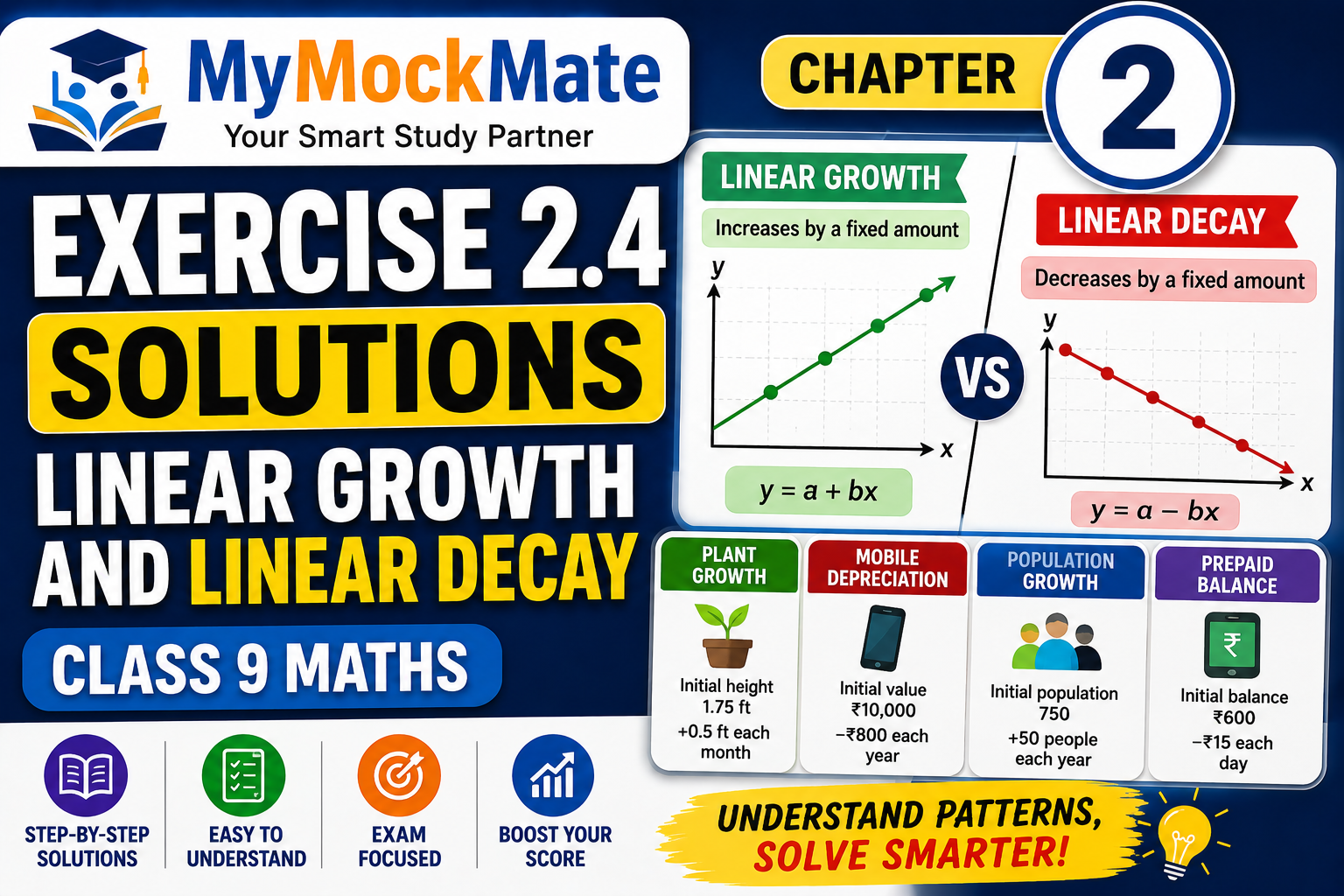
Exercise 2.4 explains the concepts of linear growth and linear decay using real-life situations like plant growth, mobile depreciation, population increase, and prepaid balance reduction. These detailed step-by-step solutions help students understand linear functions and algebraic modelling easily.
Quick Information Box
| Topic | Details |
|---|---|
| Chapter | Introduction to Linear Polynomials |
| Exercise | Exercise 2.4 |
| Subject | Mathematics |
| Class | Grade 9 |
| Main Concepts | Linear Growth & Linear Decay |
| Difficulty Level | Moderate |
| Useful For | School Exams & Olympiad Preparation |
Concepts Used (Topics Covered)
- Linear Growth
- Linear Decay
- Linear Functions
- Algebraic Expressions
- Table of Values
- Depreciation
- Population Growth
- Balance Reduction
- Mathematical Modelling
Important Formulas
Linear Growth Formula

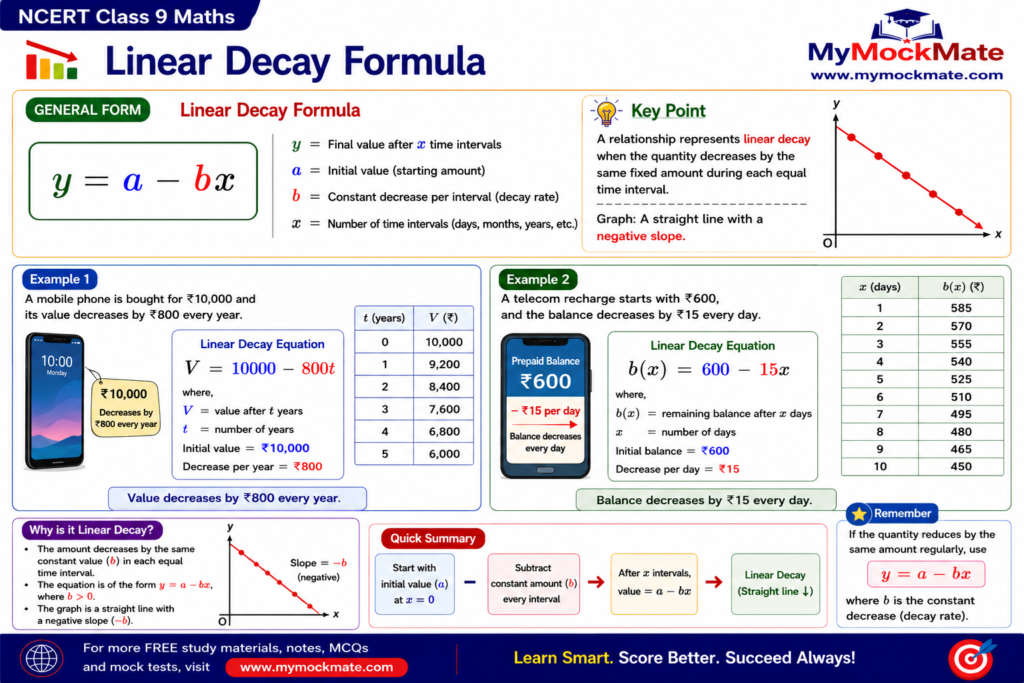
Linear Decay Formula
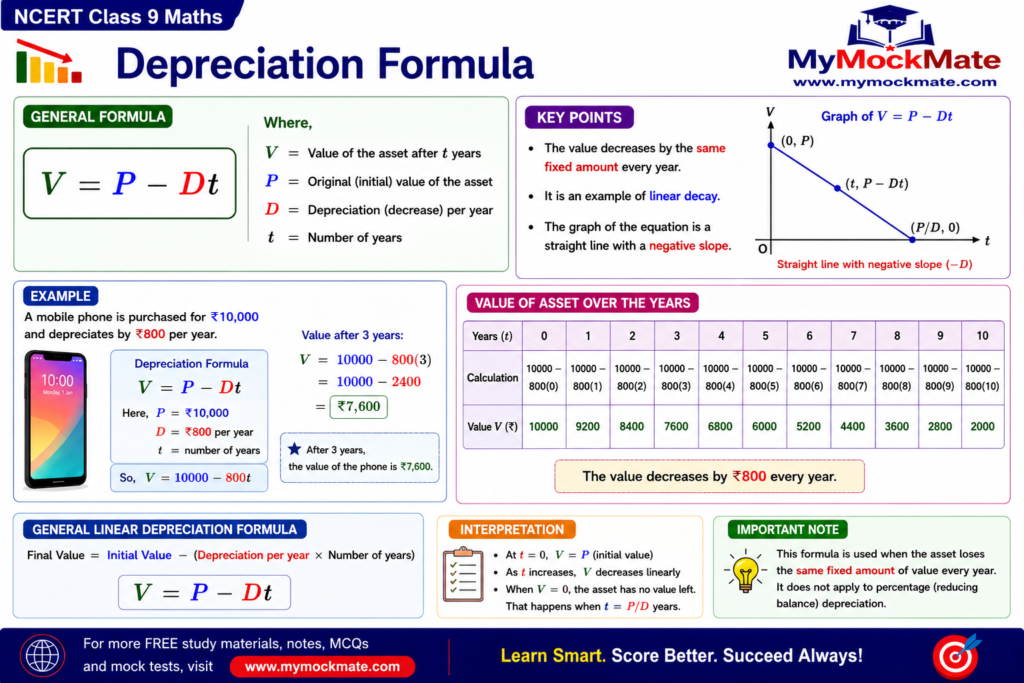
Depreciation Formula
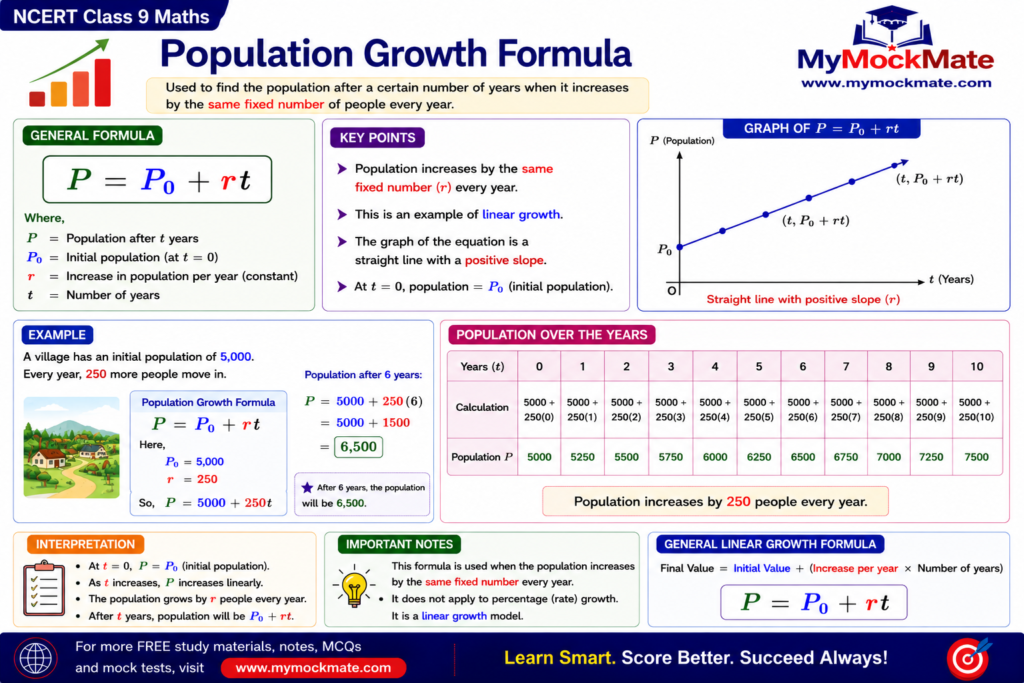
Population Growth Formula
Questions & Step-by-Step Solutions
Question 1
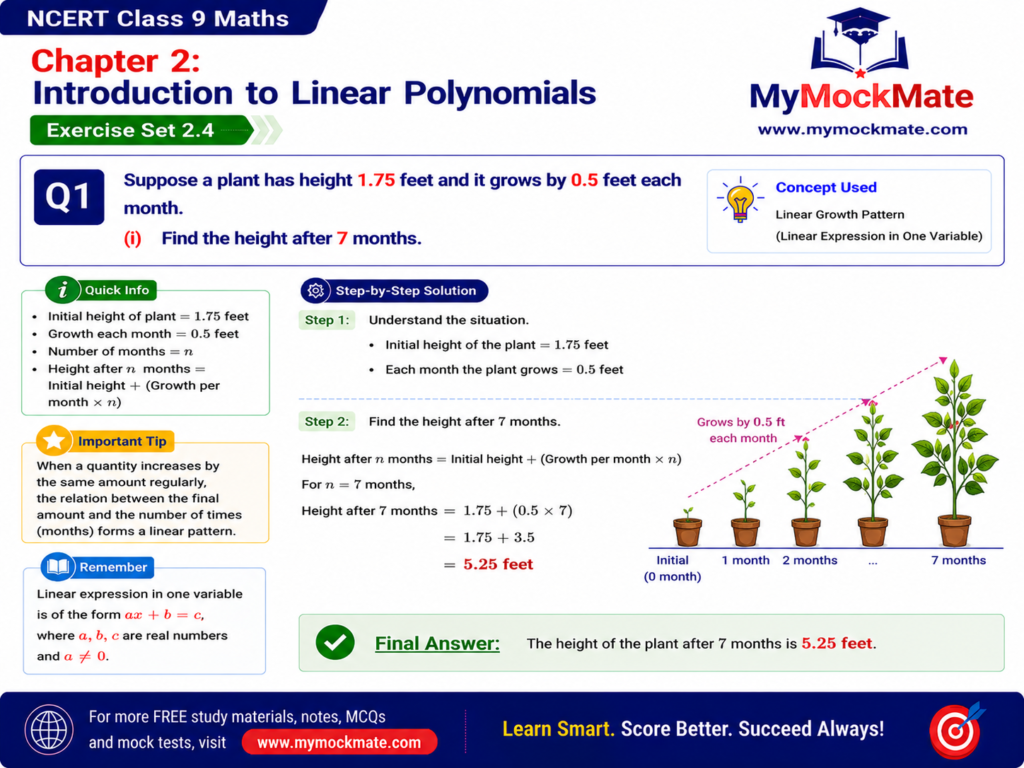
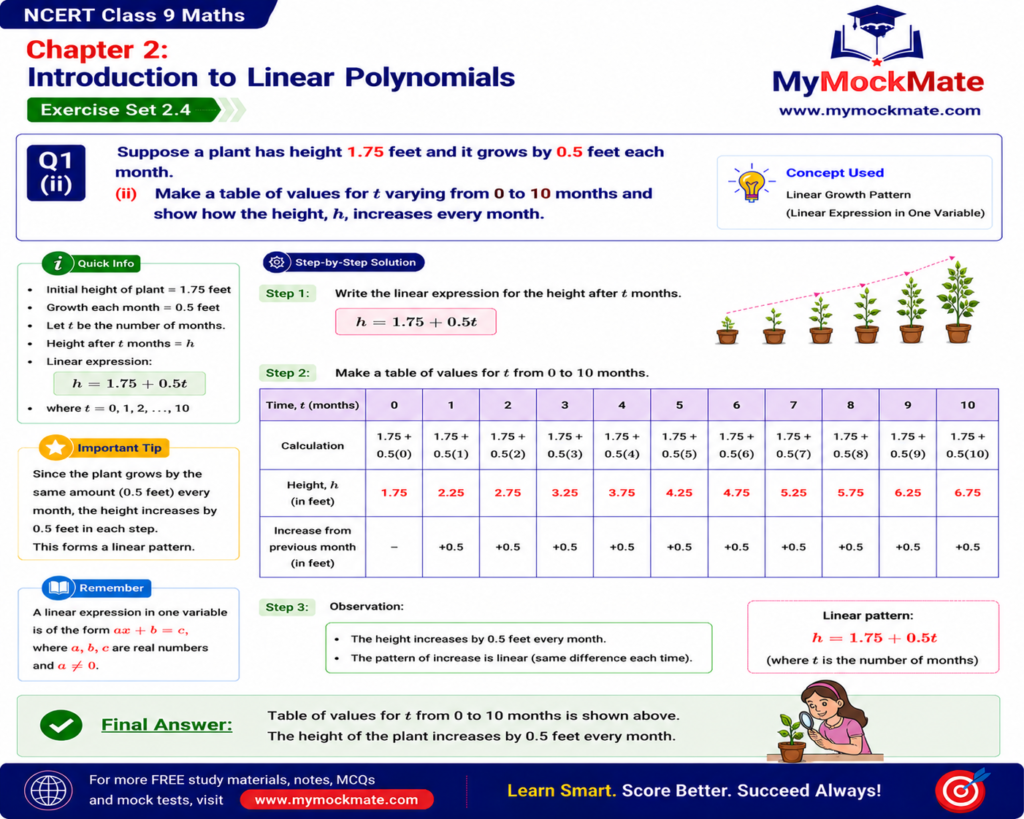
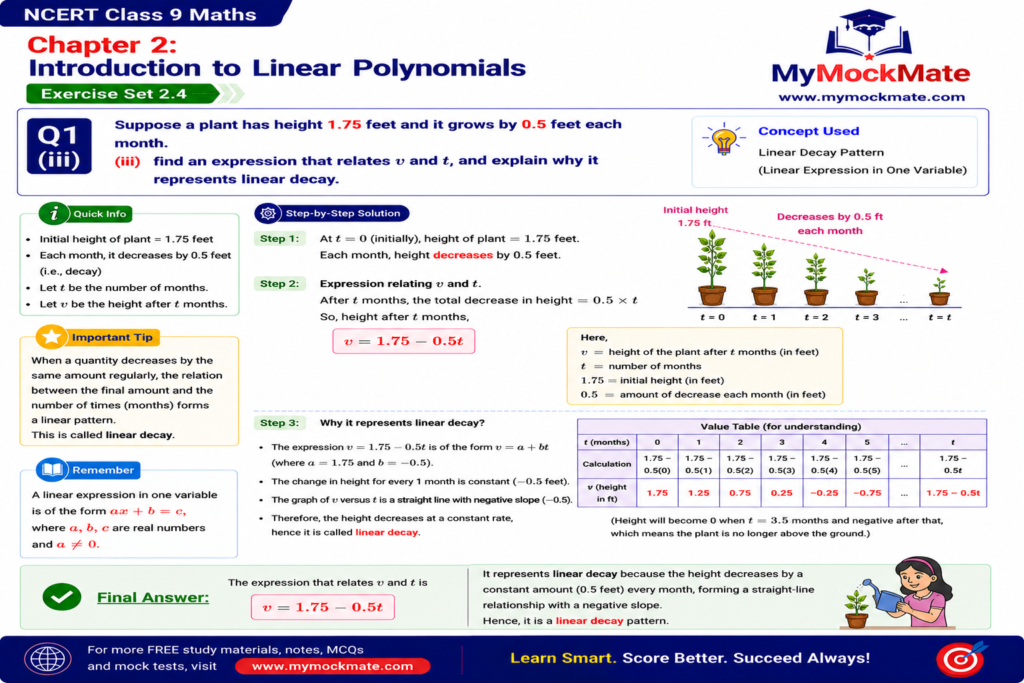
Suppose a plant has height 1.75 feet and it grows by 0.5 feet each month.
(i) Find the height after 7 months
Solution
(ii) Make a table of values for t varying from 0 to 10 months and
show how the height, h, increases every month.
(iii) Find an expression that relates v and t, and explain why it
represents linear growth.
Question 2
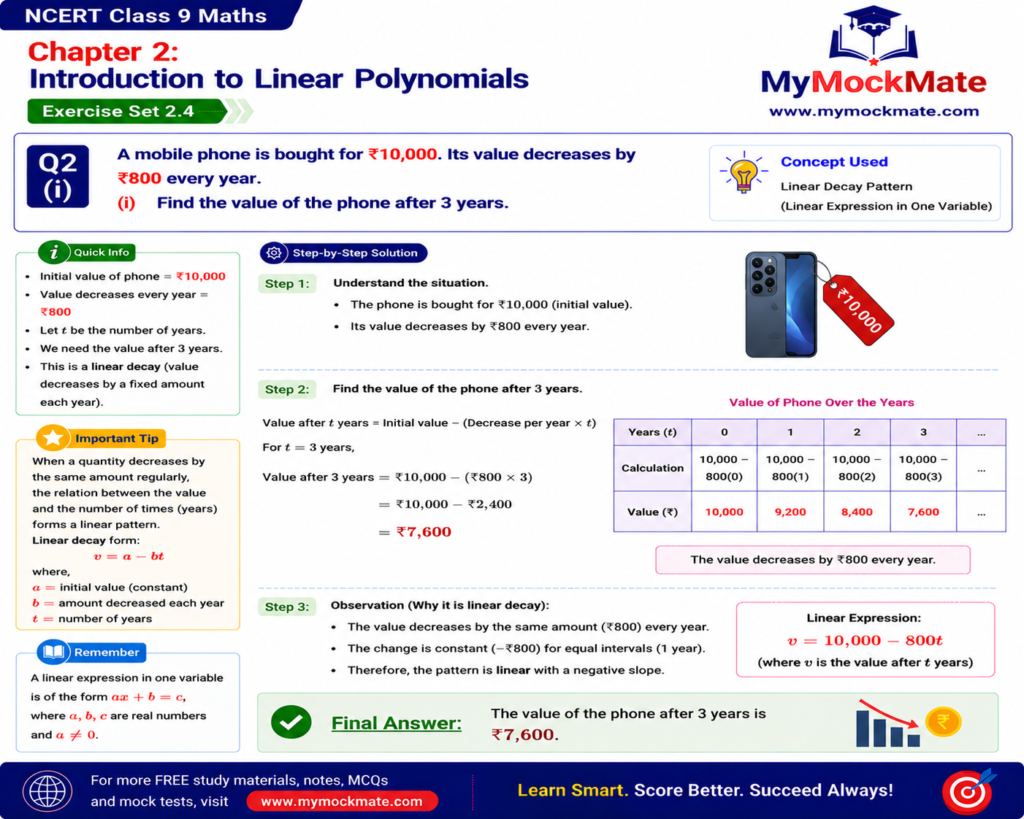
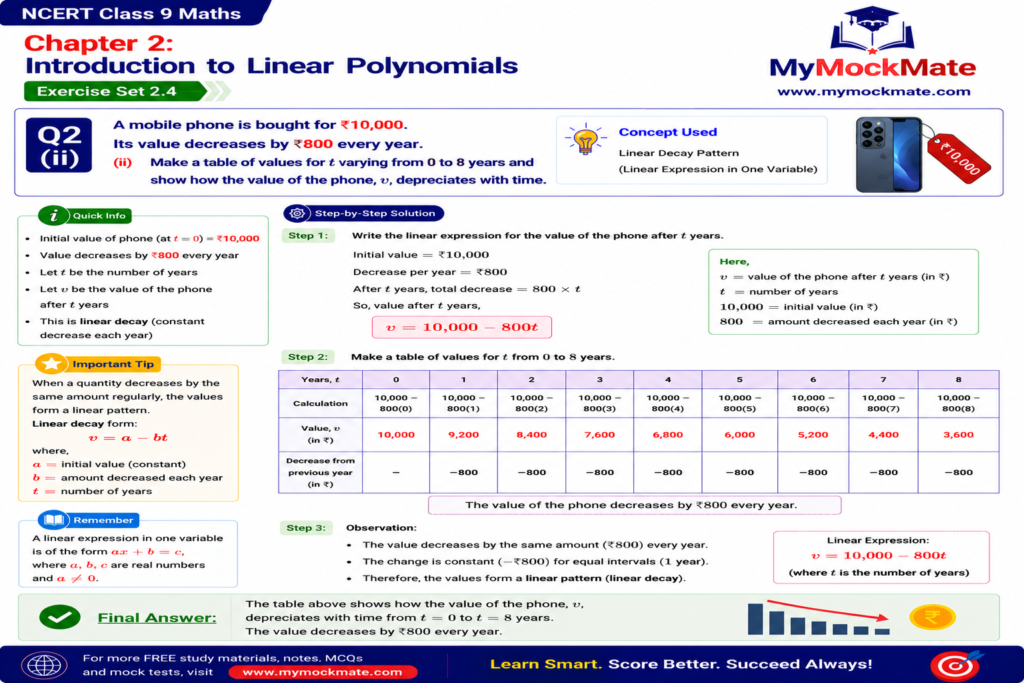
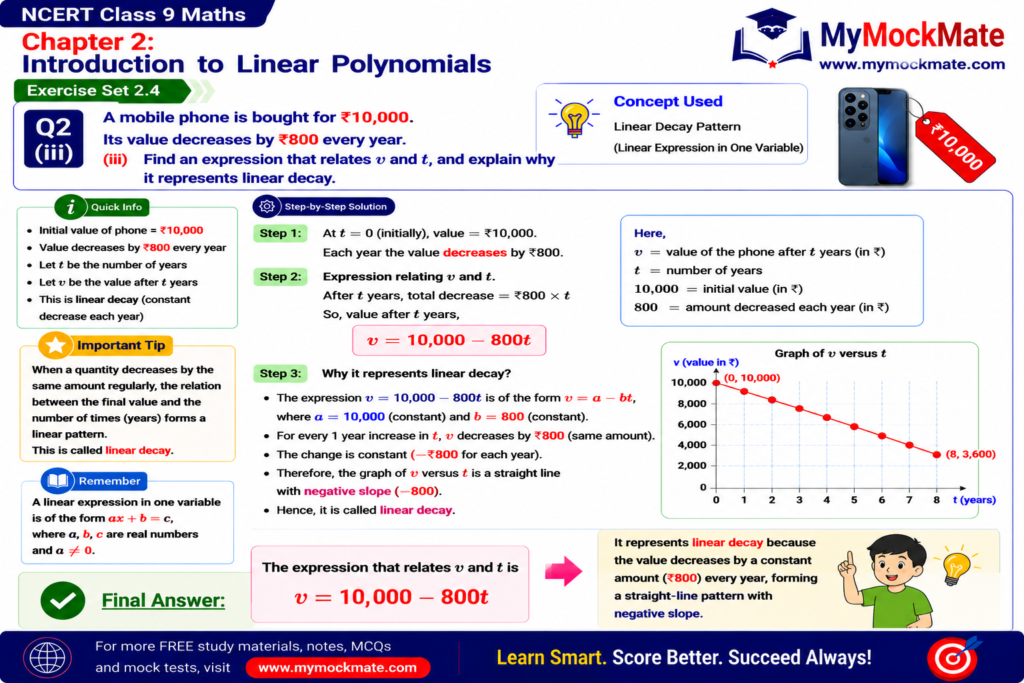
A mobile phone is bought for ₹10,000. Its value decreases by ₹800 every year.
(i) Find the value of the phone after 3 years.
Solution
(ii) Make a table of values for t varying from 0 to 8 years and
show how the value of the phone, v, depreciates with time.
(iii) Find an expression that relates v and t, and explain why it represents linear decay.
Question 3
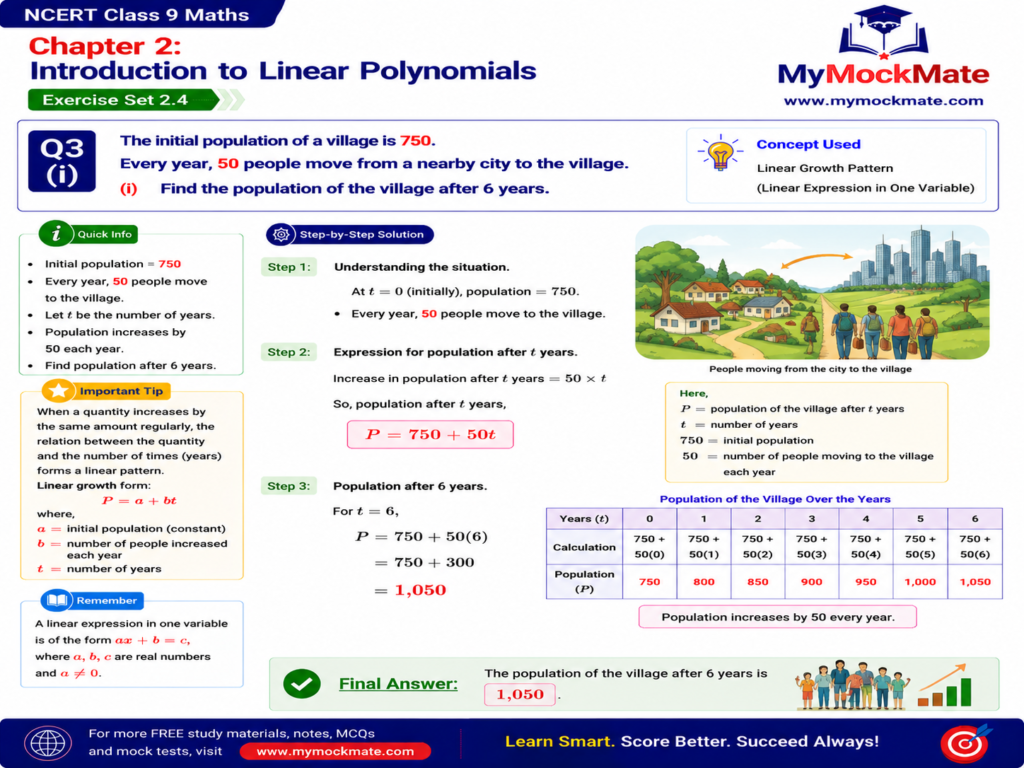
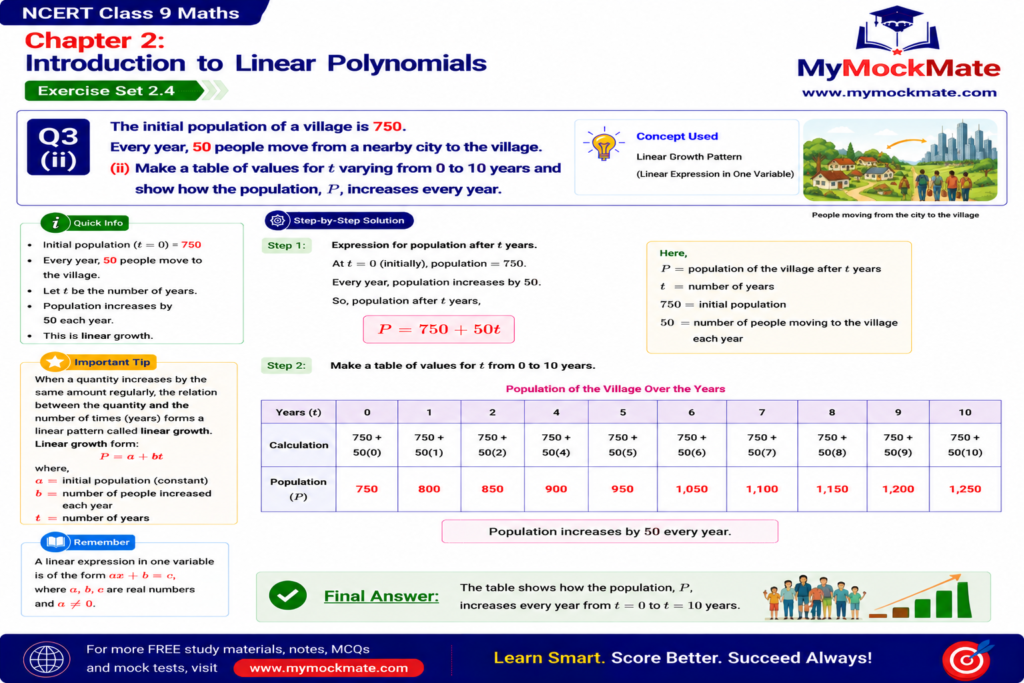
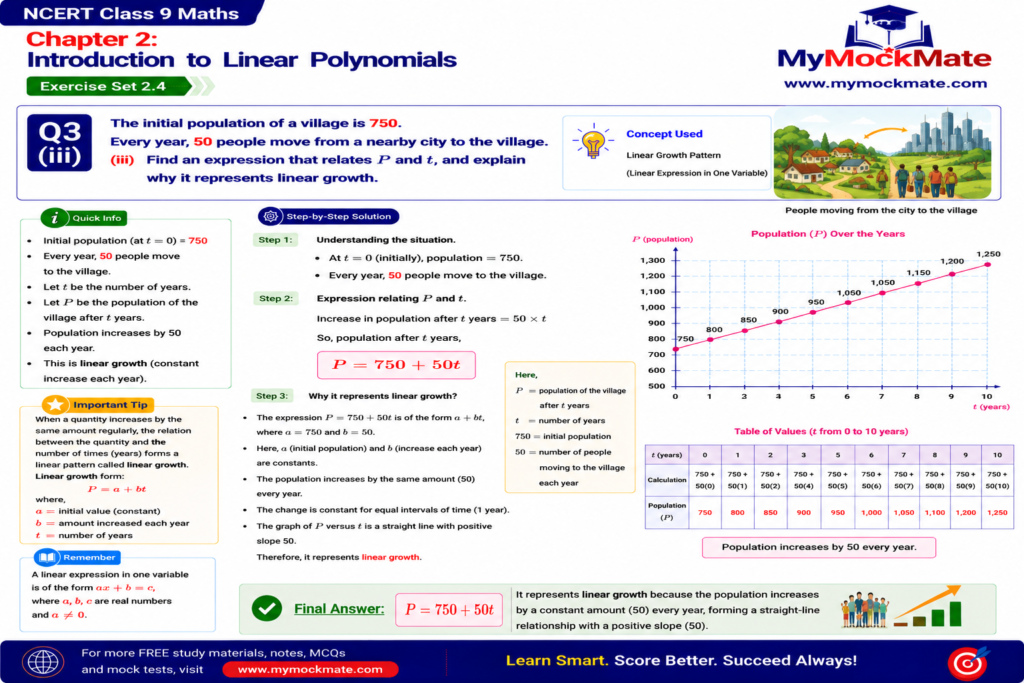
The initial population of a village is 750. Every year, 50 people move from a nearby city to the village.
(i) Find the population of the village after 6 years.
Solution
(ii) Make a table of values for t varying from 0 to 10 years and show how the population, P, increases every year.
(iii) Find an expression that relates P and t, and explain why it represents linear growth.
Question 4
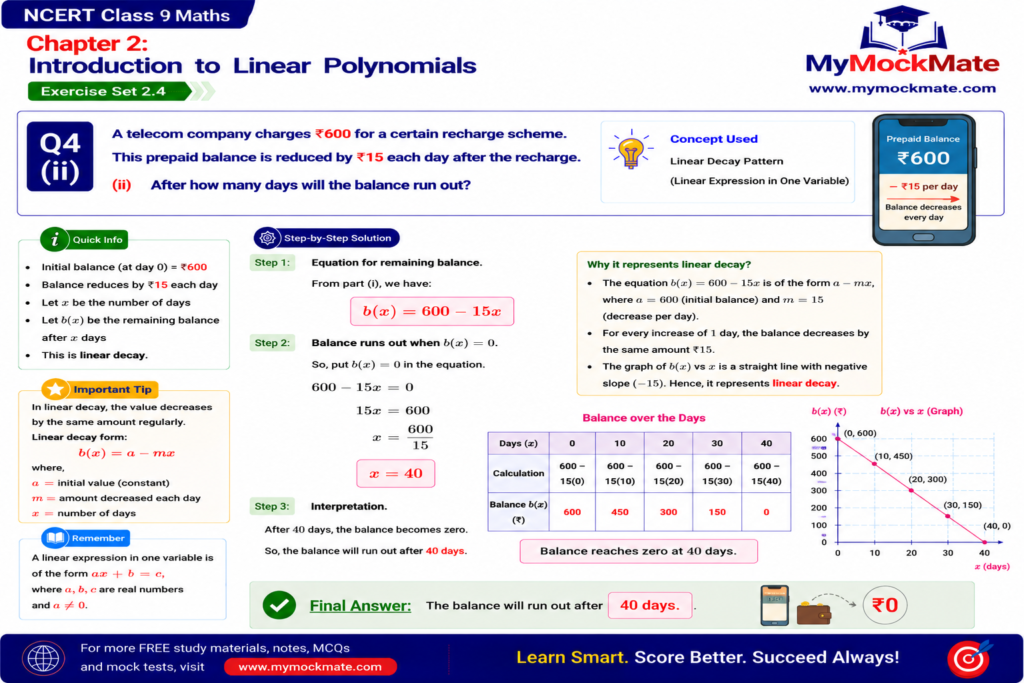
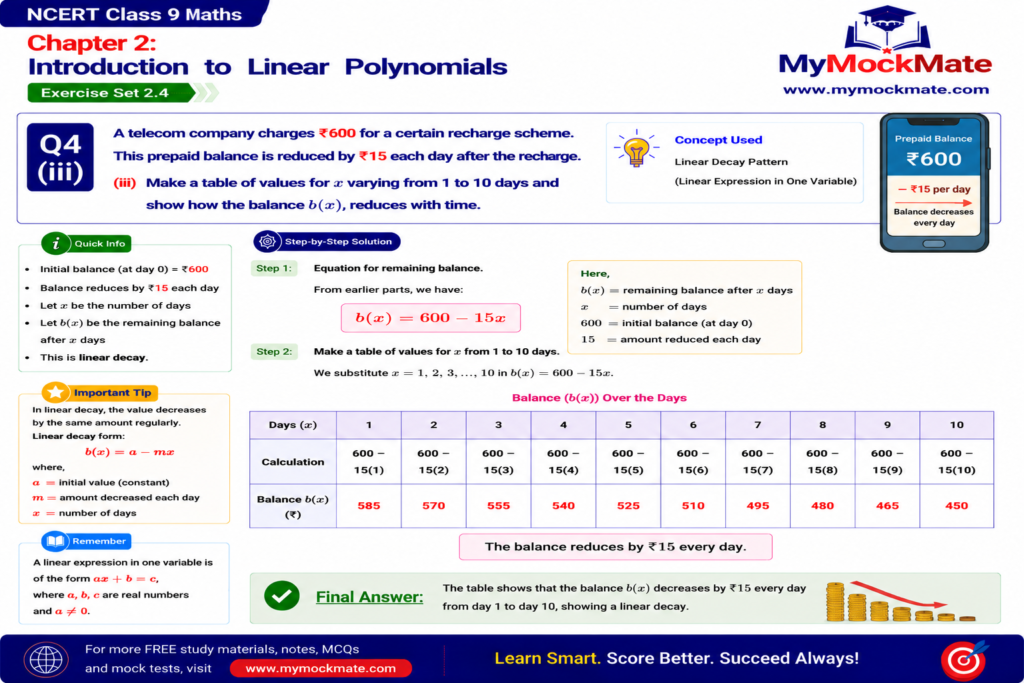
A telecom company charges 600 for a certain recharge scheme. This prepaid balance is reduced by15 each day after the recharge.
(i) Write an equation that models the remaining balance b(x) after using the scheme for x days. Explain why it represents linear decay.
Solution
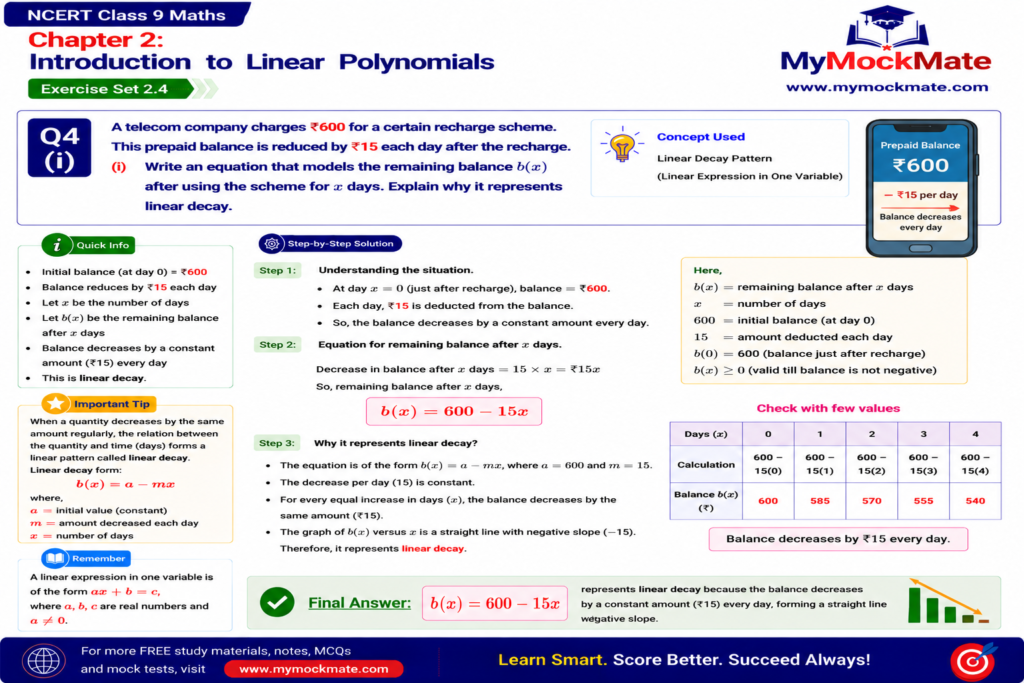
Reduction every day = ₹15
This represents linear decay because balance decreases by a fixed amount daily.
(ii) After how many days will the balance run out?
Solution
(iii) Make a table of values for x varying from 1 to 10 days and
show how the balance b(x), reduces with time.
Common Mistakes
❌ Using wrong sign in growth and decay problems
❌ Forgetting initial value in expressions
❌ Calculation mistakes in tables
❌ Confusing increase with decrease
Exam Tips
✔ Growth means addition (+)
✔ Decay means subtraction (−)
✔ Write formula before solving
✔ Make tables carefully and systematically
Practice MCQs
1. Which expression represents linear growth?
A)
B) 1000+50x
C)
D)
Answer
✅ B)
2. Which expression represents linear decay?
A)
B)
C)
D)
Answer
✅ B)
3. A value decreases by ₹100 every year. Which expression is correct?
A)
B)
C)
D)
Answer
✅ B)

4. Linear growth means:
A) Variable increase
B) Constant increase
C) Random increase
D) Quadratic increase
Answer
✅ B) Constant increase
FAQ Section
Q1. What is linear growth?
Linear growth means a quantity increases by a fixed amount over equal intervals.
Q2. What is linear decay?
Linear decay means a quantity decreases by a fixed amount over equal intervals.
Q3. What is a linear function?
A function represented by a straight-line equation is called a linear function.
Q4. Why are tables important in linear functions?
Tables help us understand patterns and relationships clearly.
Q5. Can real-life situations be represented using linear equations?
Yes, many daily-life situations can be represented using linear equations.
Practice more chapter-wise Maths solutions, MCQs, mock tests, and concept-based exercises on MyMockMate and strengthen your Class 9 Mathematics preparation with smart learning resources!