




Short Intro
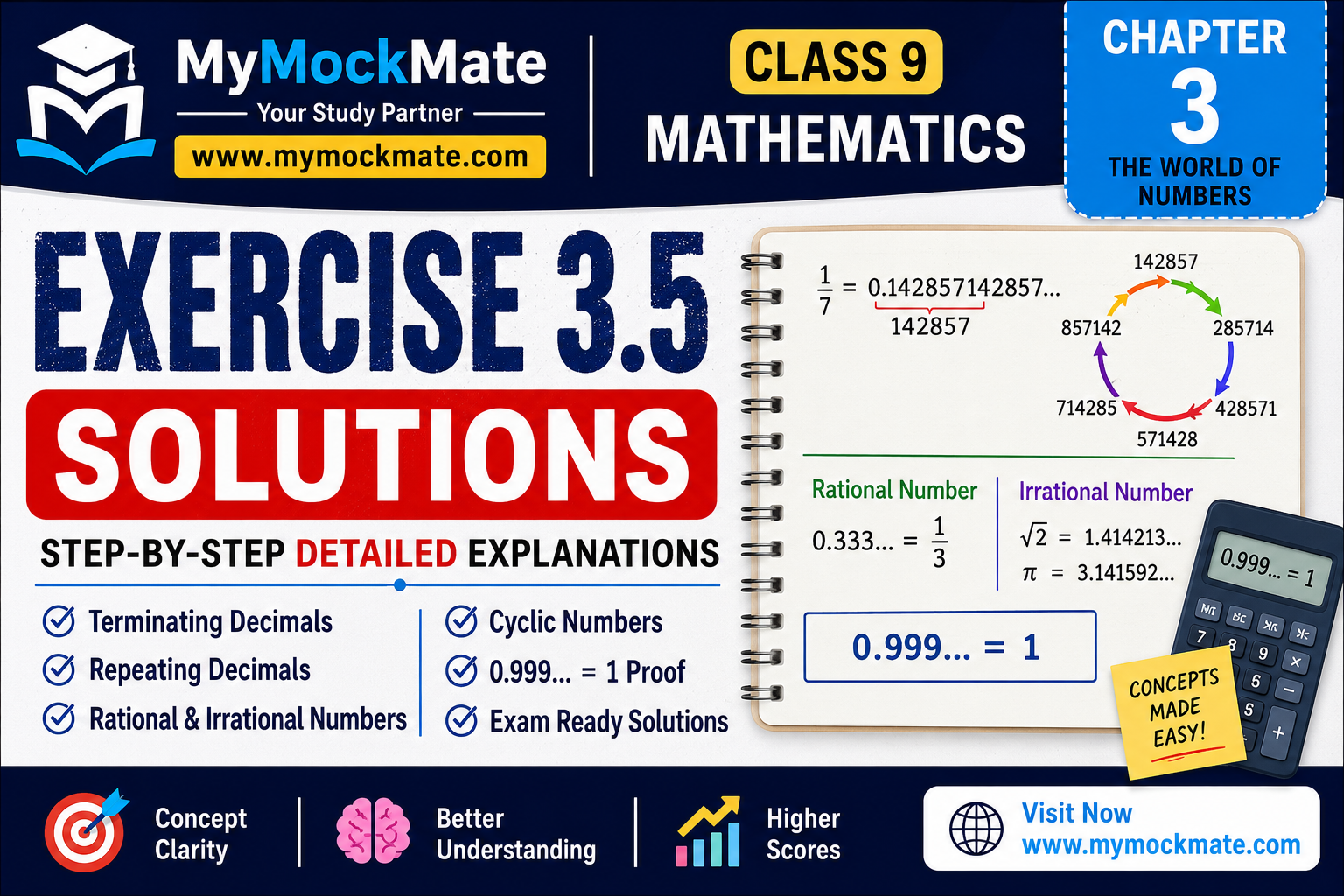
In this article, we provide complete step-by-step solutions of Exercise 3.5 from Chapter 3 “The World of Numbers”. This exercise focuses on decimal expansion of rational numbers, terminating and repeating decimals, rational and irrational numbers, and cyclic number patterns.
Quick Information Box
Chapter: The World of Numbers
Exercise: 3.5
Class: 9 Mathematics
Main Topic: Decimal Expansion of Rational and Irrational Numbers
Sub-topics: Terminating decimals, repeating decimals, rational numbers, irrational numbers, cyclic numbers, 0.999… = 1
Concepts Used
- Rational numbers can be written in the form p/q, where p and q are integers and q ≠ 0.
- A rational number has either a terminating decimal or a repeating decimal.
- If the denominator of a rational number in lowest form has only prime factors 2 and/or 5, then its decimal expansion terminates.
- If the denominator has any prime factor other than 2 or 5, then its decimal expansion is non-terminating repeating.
- Irrational numbers have non-terminating and non-repeating decimal expansions.
- Some repeating blocks show cyclic properties.
Important Formulas
- Terminating Decimal Test:
If q = 2ᵐ × 5ⁿ, then p/q has a terminating decimal. - Repeating Decimal Test:
If q has prime factors other than 2 and 5, then p/q has a repeating decimal. - Pure Repeating Decimal:
0.(abc) = abc/999 - Algebraic Method for 0.999…:
Let x = 0.999…
10x = 9.999…
10x − x = 9
9x = 9
x = 1
Questions and Step-by-Step Solutions
Question 1
Without performing long division, determine which of the following rational numbers will have terminating decimals and which will be repeating: 7/20, 4/15 and 13/250. Then check your answers by explicitly performing long divisions and expressing these rational numbers as decimals.
Solution
(i) 7/20
Step 1: Check the denominator.
20 = 2² × 5
Step 2: Since the denominator has only the prime factors 2 and 5, the decimal expansion will terminate.
Step 3: Convert into decimal.
7/20 = 35/100 = 0.35
Answer:
7/20 = 0.35, terminating decimal.
(ii) 4/15
Step 1: Check the denominator.
15 = 3 × 5
Step 2: Since the denominator contains 3, which is not 2 or 5, the decimal expansion will be non-terminating repeating.
Step 3: Convert into decimal.
4 ÷ 15 = 0.2666…
Answer:
4/15 = 0.2666… = 0.2(6), repeating decimal.
(iii) 13/250
Step 1: Check the denominator.
250 = 2 × 5³
Step 2: Since the denominator has only 2 and 5 as prime factors, the decimal expansion will terminate.
Step 3: Convert into decimal.
13/250 = 52/1000 = 0.052
Answer:
13/250 = 0.052, terminating decimal.

Final Answer:
7/20 = terminating
4/15 = repeating
13/250 = terminating
Question 2
Perform the long division for 1/13. Identify the repeating block of digits. Does it show cyclic properties if you evaluate 2/13? Now compute 3/13, 4/13, etc. What do you notice?
Solution
First, divide 1 by 13.
1/13 = 0.076923076923…
Repeating block = 076923
Now calculate other fractions:
2/13 = 0.153846153846…
3/13 = 0.230769230769…
4/13 = 0.307692307692…
5/13 = 0.384615384615…
6/13 = 0.461538461538…
7/13 = 0.538461538461…
8/13 = 0.615384615384…
9/13 = 0.692307692307…
10/13 = 0.769230769230…
11/13 = 0.846153846153…
12/13 = 0.923076923076…
Observation:
The repeating blocks are related to each other. They are not all simple rotations of 076923, but they form two cyclic groups.
Group 1:
076923, 230769, 307692, 692307, 769230, 923076
Group 2:
153846, 384615, 461538, 538461, 615384, 846153
Conclusion:
The decimal expansion of 1/13 has repeating block 076923. The multiples of 1/13 show cyclic patterns in two groups.
Question 3
Classify the following numbers as rational or irrational. Find explicit fractions in case they are rational.
(i) √81
(ii) √12
(iii) 0.33333…
(iv) 0.123451234512345…
(v) 1.01001000100001…
(vi) 23.560185612239874790120
Solution
(i) √81
√81 = 9
9 can be written as 9/1.
Answer:
√81 is rational.
Explicit fraction = 9/1
(ii) √12
√12 = √(4 × 3) = 2√3
Since √3 is irrational, 2√3 is also irrational.
Answer:
√12 is irrational.
(iii) 0.33333…
Let x = 0.33333…
10x = 3.33333…
Subtract:
10x − x = 3.33333… − 0.33333…
9x = 3
x = 3/9 = 1/3
Answer:
0.33333… is rational.
Explicit fraction = 1/3
(iv) 0.123451234512345…
The block 12345 repeats continuously.
So,
0.1234512345… = 0.(12345)
For a five-digit repeating block:
0.(12345) = 12345/99999
Simplify:
12345/99999 = 4115/33333
Answer:
0.123451234512345… is rational.
Explicit fraction = 4115/33333
(v) 1.01001000100001…
Here the number of zeros keeps increasing.
The pattern is not repeating as one fixed block.
So, it is non-terminating and non-repeating.
Answer:
1.01001000100001… is irrational.
(vi) 23.560185612239874790120
This decimal is terminating because it has a finite number of decimal digits.
Any terminating decimal is rational.
There are 21 digits after the decimal point.
So,
23.560185612239874790120
= 23560185612239874790120 / 1000000000000000000000
On simplification:
= 589004640305996869753 / 25000000000000000000
Answer:
23.560185612239874790120 is rational.
Explicit fraction = 589004640305996869753 / 25000000000000000000
Final Classification:
(i) Rational
(ii) Irrational
(iii) Rational
(iv) Rational
(v) Irrational
(vi) Rational
Question 4
The number 0.9, which means 0.99999…, is a rational number. Using algebra, explain why 0.9 is exactly equal to 1.
Solution
Let
x = 0.99999…
Multiply both sides by 10:
10x = 9.99999…
Now subtract the first equation from the second equation:
10x − x = 9.99999… − 0.99999…
9x = 9
Divide both sides by 9:
x = 1
But x = 0.99999…
Therefore,
0.99999… = 1
Answer:
0.9 repeating is exactly equal to 1.
Explanation:
0.999… is not slightly less than 1. It is exactly equal to 1 because the infinite repeating decimal has no gap left between itself and 1.
Question 5
We have seen that the repeating block of 1/7 is a cyclic number. Try to find more numbers n whose reciprocals 1/n produce decimals with repeating blocks that are cyclic.
Solution
We know:
1/7 = 0.142857142857…
Repeating block = 142857
Now check its multiples:
142857 × 1 = 142857
142857 × 2 = 285714
142857 × 3 = 428571
142857 × 4 = 571428
142857 × 5 = 714285
142857 × 6 = 857142
The same digits rotate cyclically. So 7 gives a cyclic number.
Now let us find more such numbers.
Example 1: n = 17
1/17 = 0.0588235294117647…
Repeating block = 0588235294117647
This block also shows cyclic behaviour when multiplied by 1, 2, 3, …, 16.
So, n = 17 is another example.
Example 2: n = 19
1/19 = 0.052631578947368421…
Repeating block = 052631578947368421
This also produces a cyclic pattern.
So, n = 19 is another example.
Example 3: n = 23
1/23 = 0.0434782608695652173913…
This also has a long repeating block with cyclic behaviour.
Answer:
Some values of n whose reciprocals produce cyclic repeating blocks are:
7, 17, 19, 23
Note:
Such cyclic behaviour is usually seen when the decimal expansion of 1/n has a repeating block of length n − 1.
Common Mistakes
- Students often think every non-terminating decimal is irrational. This is wrong. A non-terminating repeating decimal is rational.
- Students forget to reduce the fraction to its lowest form before applying the terminating decimal test.
- Many students classify 0.999… as less than 1, but it is exactly equal to 1.
- Students confuse repeating pattern with increasing pattern. For example, 1.01001000100001… is not repeating, so it is irrational.
- In recurring decimals, students sometimes write only a few digits and forget to use “…” or a repeating notation.
Exam Tips
- Always reduce p/q to lowest form before checking the denominator.
- If the denominator has only 2 and/or 5, the decimal terminates.
- If the denominator has any prime factor other than 2 or 5, the decimal repeats.
- A terminating decimal is always rational.
- A repeating decimal is always rational.
- A non-terminating and non-repeating decimal is irrational.
- For 0.999… = 1 type questions, use the algebraic method.
Practice MCQs
MCQ 1
Which of the following has a terminating decimal expansion?
A. 4/15
B. 7/20
C. 1/13
D. 2/3
Answer: B. 7/20
MCQ 2
The decimal expansion of 1/13 is:
A. Terminating
B. Non-terminating non-repeating
C. Non-terminating repeating
D. Irrational
Answer: C. Non-terminating repeating
MCQ 3
0.33333… is equal to:
A. 3/10
B. 1/3
C. 33/100
D. 3/100
Answer: B. 1/3
MCQ 4
Which number is irrational?
A. √81
B. 0.333…
C. √12
D. 23.56
Answer: C. √12
MCQ 5
0.999… is equal to:
A. 0.9
B. 0.99
C. Slightly less than 1
D. 1
Answer: D. 1
FAQ Section
Q1. What is a terminating decimal?
A decimal that ends after a finite number of digits is called a terminating decimal. Example: 0.35.
Q2. What is a repeating decimal?
A decimal in which one digit or a group of digits repeats forever is called a repeating decimal. Example: 0.333…
Q3. How do we know whether p/q is terminating?
First reduce p/q to lowest form. If the denominator has only 2 and/or 5 as prime factors, the decimal is terminating.
Q4. Is every repeating decimal rational?
Yes, every repeating decimal can be converted into a fraction, so it is rational.
Q5. Is 0.999… really equal to 1?
Yes. Algebraically, if x = 0.999…, then 10x = 9.999…, so 9x = 9 and x = 1.
Q6. Why is 1.01001000100001… irrational?
Because the number of zeros keeps increasing and no fixed block repeats forever. Therefore, it is non-terminating and non-repeating.
For more Class 9 Maths chapter-wise solutions, mock tests, practice questions, and exam preparation resources, visit www.mymockmate.com. Practice regularly with MyMockMate and improve your speed, accuracy, and confidence.