




Short Intro
This chapter explains the fascinating journey of discovering the structure of the atom. Students learn about atomic models proposed by Dalton, Thomson, Rutherford, and Bohr along with concepts such as atomic number, mass number, isotopes, isobars, electronic configuration, and valency.
Quick Information Box
| Topic | Details |
|---|---|
| Chapter Name | Journey Inside the Atom |
| Class | Grade 9 |
| Subject | Science |
| Main Concepts | Atomic Models, Electrons, Protons, Neutrons |
| Important Scientist | Rutherford, Bohr, Chadwick |
| Key Formula | Mass Number = Protons + Neutrons |
Concepts Used (Topics Covered)
- Dalton’s Atomic Theory
- Thomson’s Plum Pudding Model
- Rutherford’s Gold Foil Experiment
- Bohr’s Atomic Model
- Discovery of Electron, Proton and Neutron
- Atomic Number and Mass Number
- Electronic Configuration
- Valency
- Isotopes and Isobars
- Average Atomic Mass
Important Formulas
- Atomic Number
Z = Number of Protons - Mass Number
A = Number of Protons + Number of Neutrons - Number of Neutrons
Neutrons = Mass Number − Atomic Number - Maximum Electrons in Shell
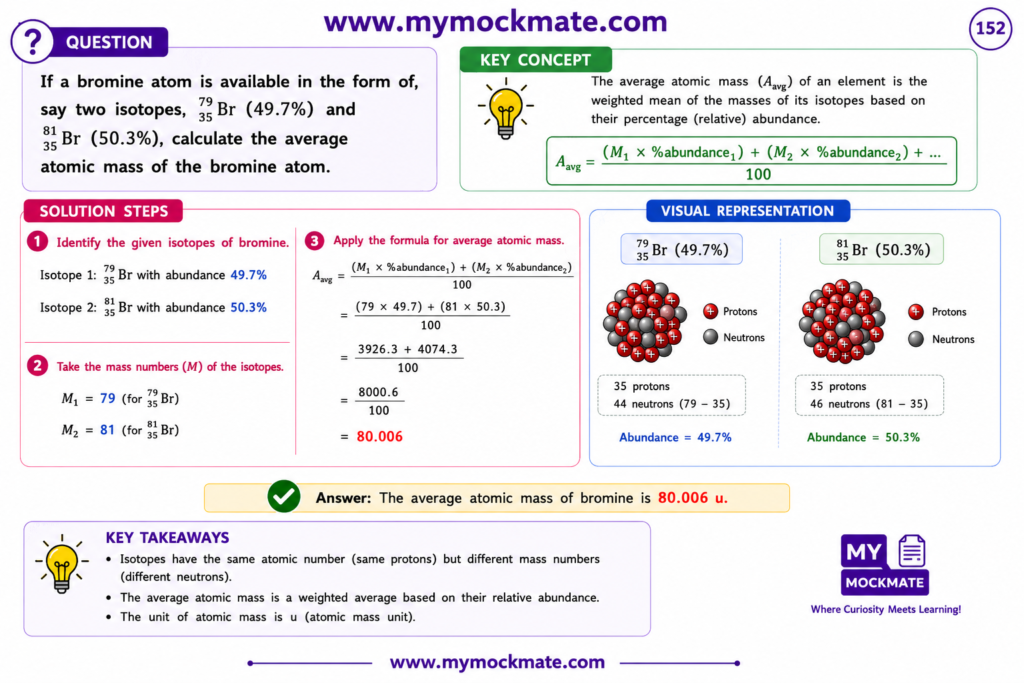
2n² - Average Atomic Mass
Average Mass = Σ(Isotopic Mass × Abundance)/100
Questions & Step-by-step Solutions with Explanation
Pause and Ponder
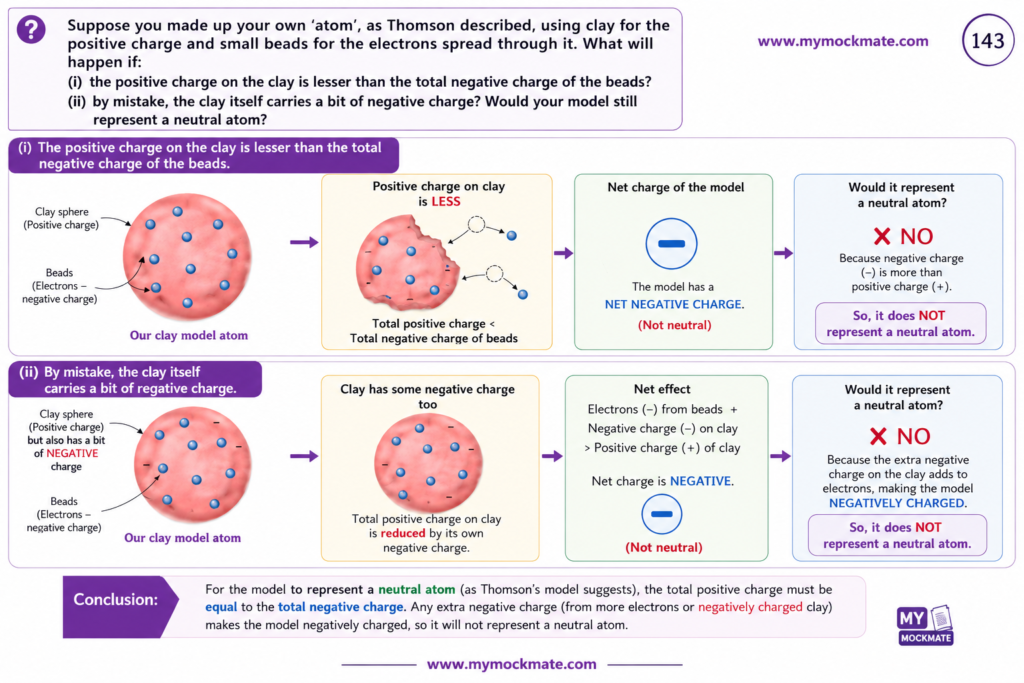
- Suppose you made up your own ‘atom’, as Thomson described, using clay for the positive charge and small beads for the electrons spread through it. What will happen if:
(i) the positive charge on the clay is lesser than the total negative charge of the beads?
(ii) by mistake, the clay itself carries a bit of negative charge? Would your model still represent a neutral atom?
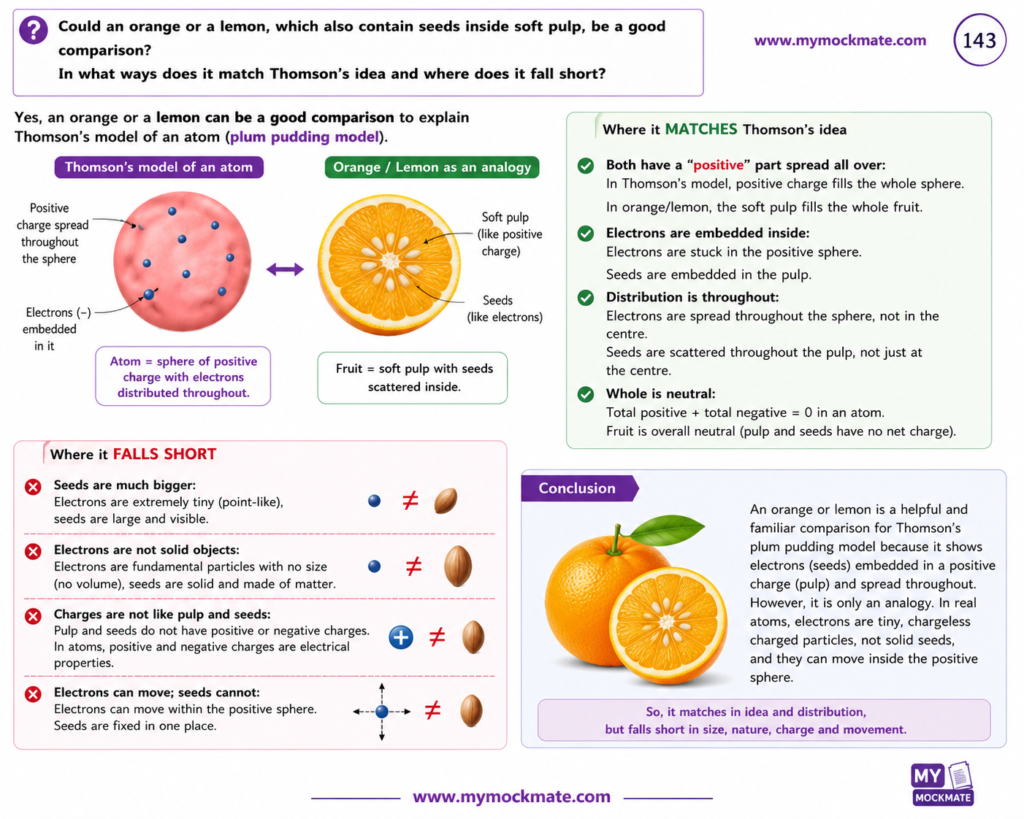
2. Could an orange or a lemon, which also contain seeds inside soft pulp, be a good comparison? In what ways does it match Thomson’s idea and where does it fall short?
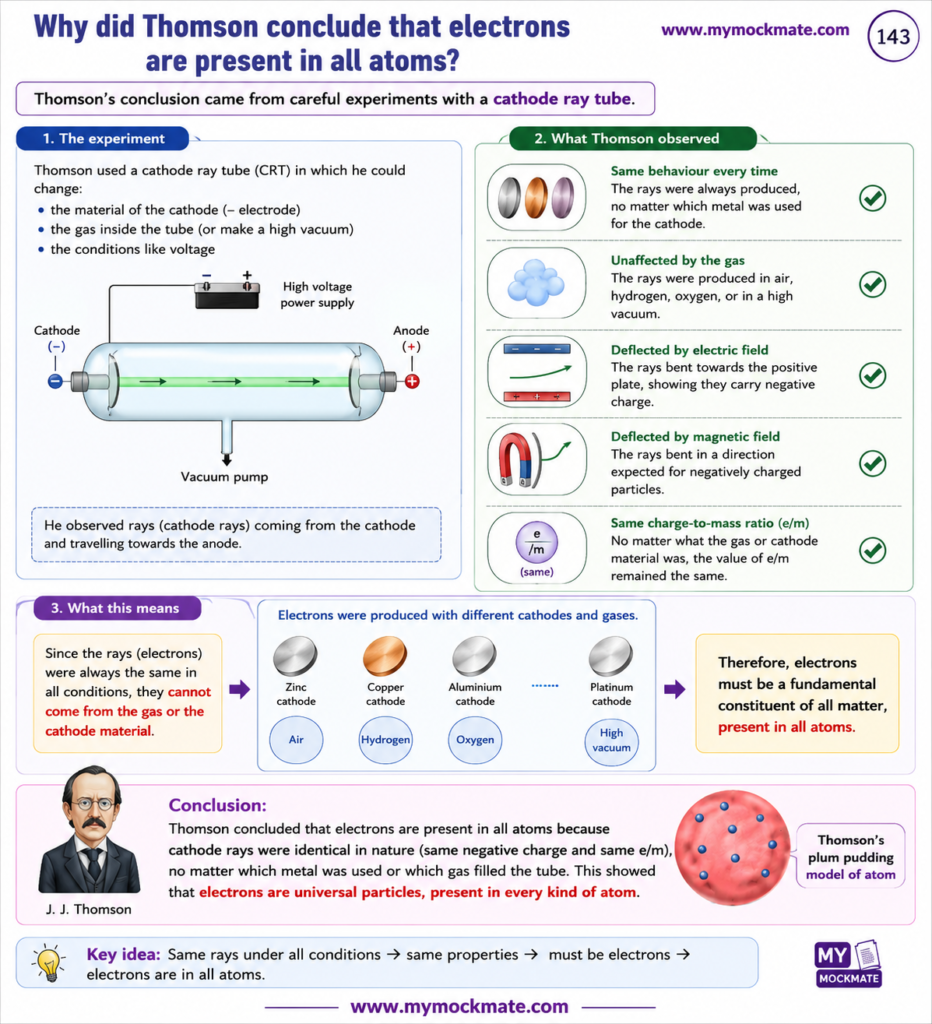
3. Why did Thomson conclude that electrons are present in all atoms?
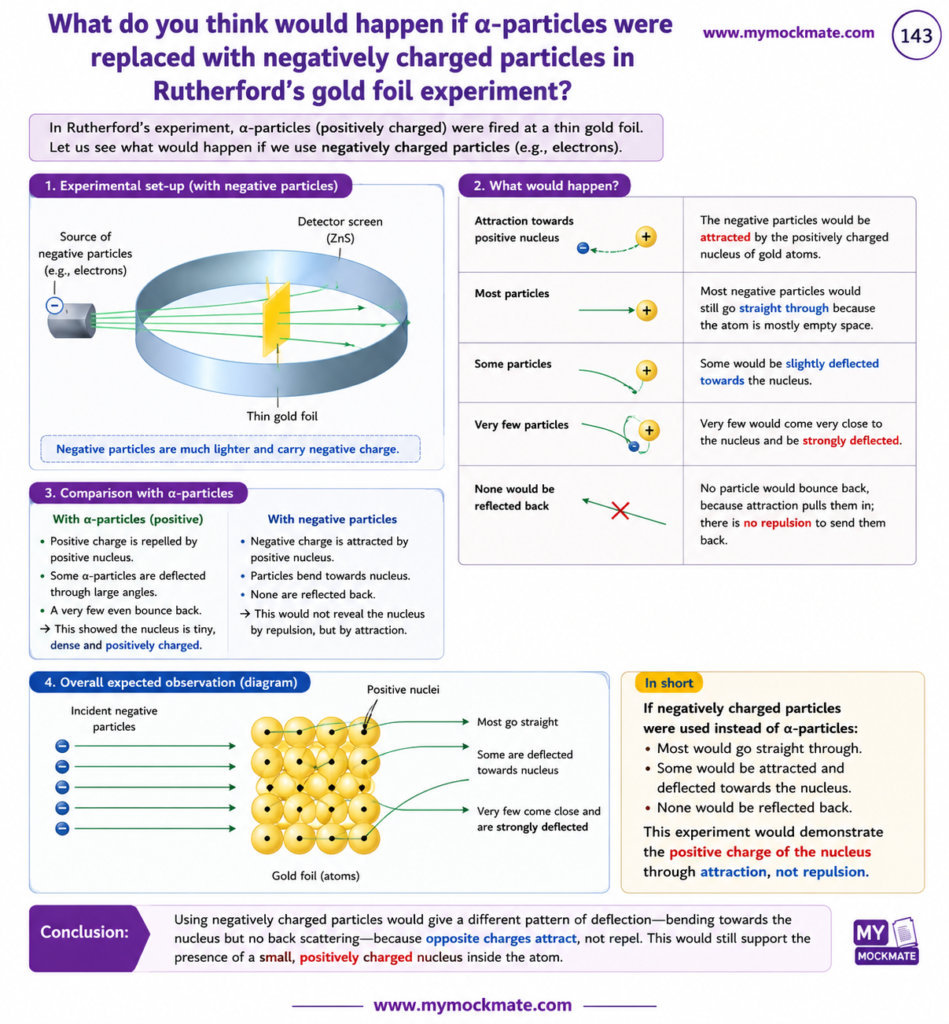
4. What do you think would happen if α-particles were replaced with negatively charged particles in Rutherford’s gold foil experiment?
5. Rutherford found that a few α-particles bounced back sharply. How does this single surprising result completely rule out Thomson’s ʻplum pudding modelʼ of the atom?

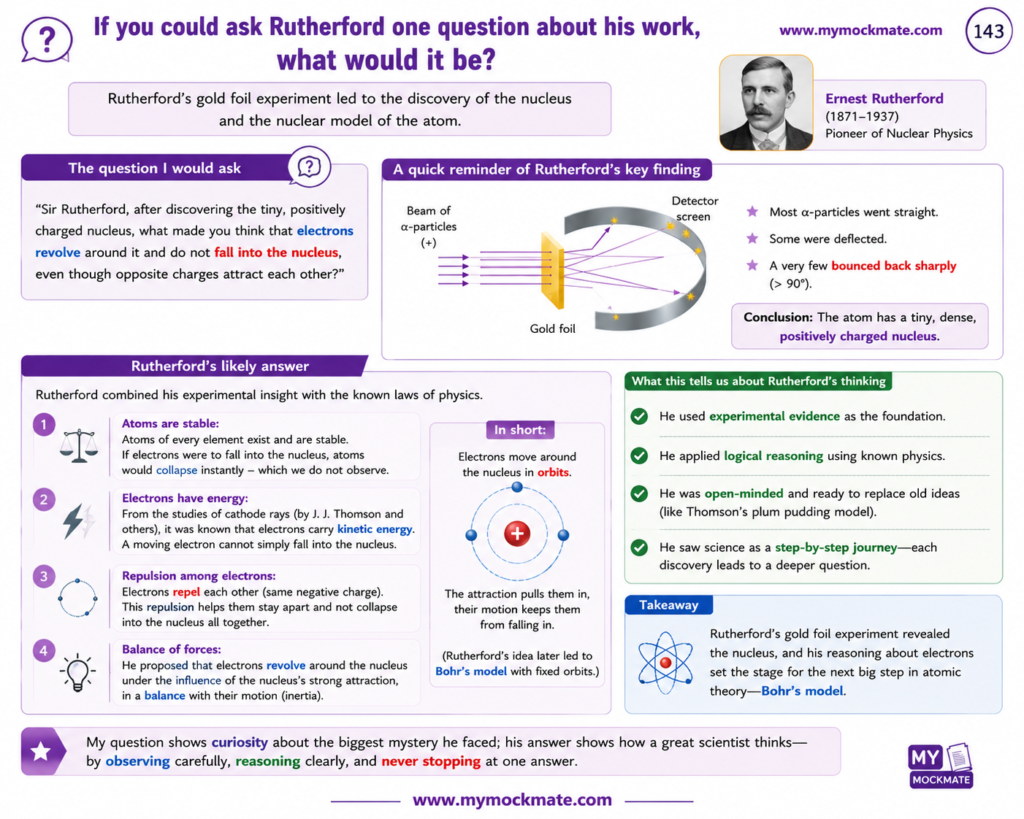
6. If you could ask Rutherford one question about his work, what would it be?
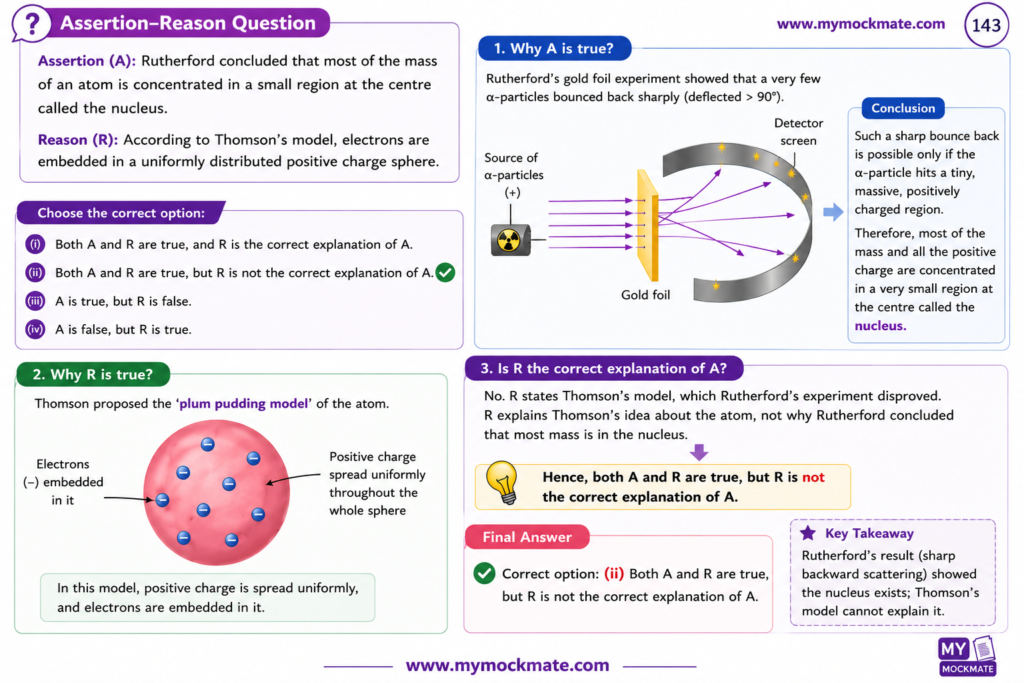
7. Assertion (A): Rutherford concluded that most of the mass of an atom is concentrated in a small region at the centre called the nucleus.
Reason (R): According to Thomson’s model, electrons are embedded in a uniformly distributed positive charge sphere.
Choose the correct option:
(i) Both A and R are true, and R is the correct explanation of A.
(ii) Both A and R are true, but R is not the correct explanation of A.
(iii) A is true, but R is false.
(iv) A is false, but R is true
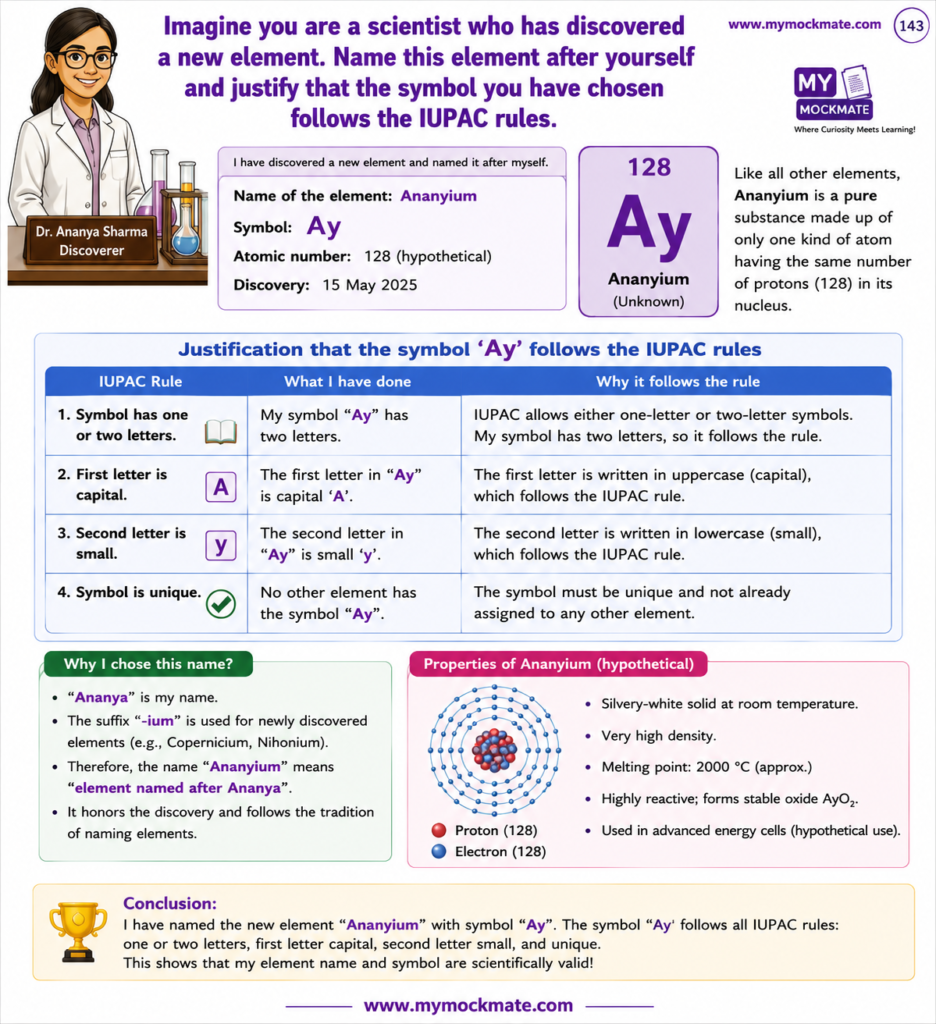
8. Imagine you are a scientist who has discovered a new element. Name this element after yourself and justify that the symbol you have chosen follows the IUPAC rules.
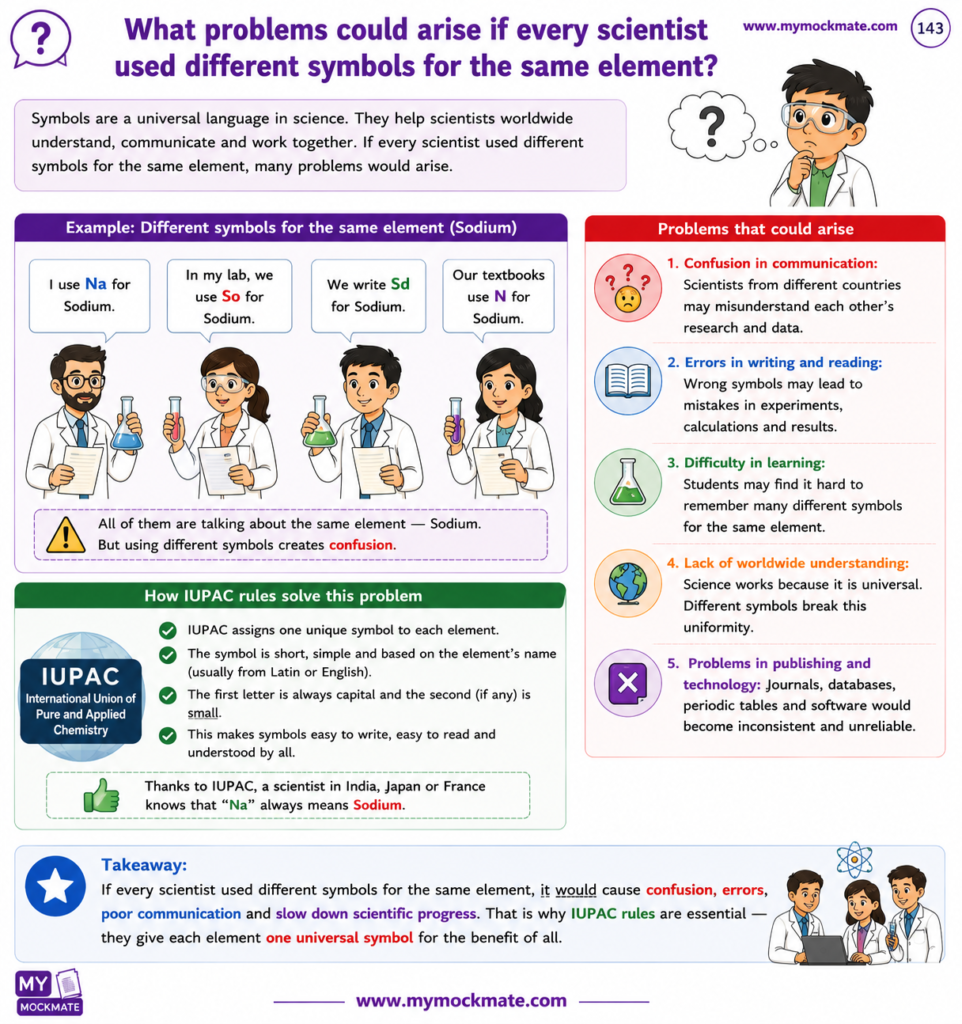
9. What problems could arise if every scientist used different symbols for the same element?
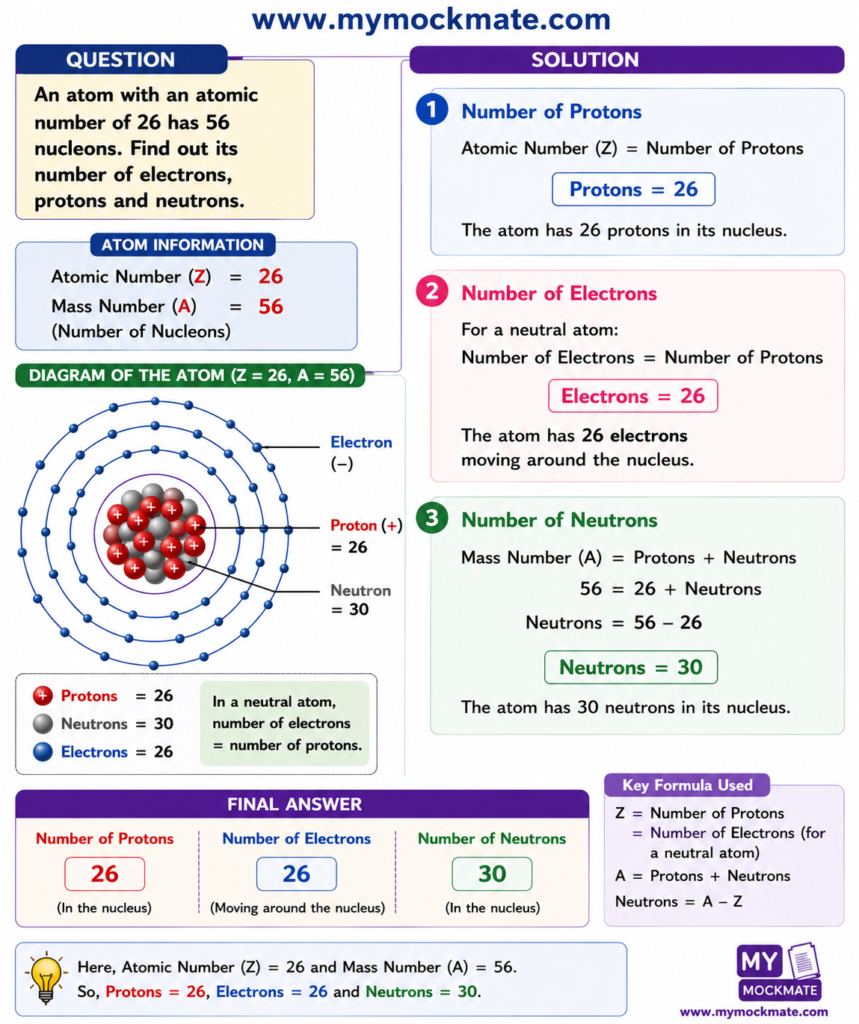
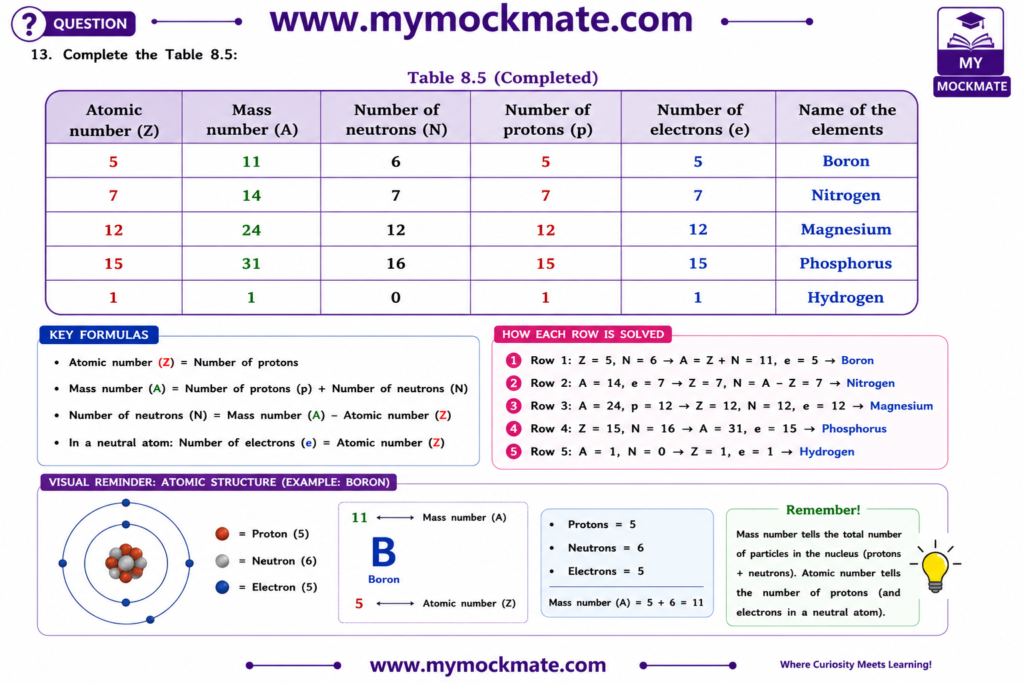
10. An atom with an atomic number of 26 has 56 nucleons. Find out its number of electrons, protons and neutrons.
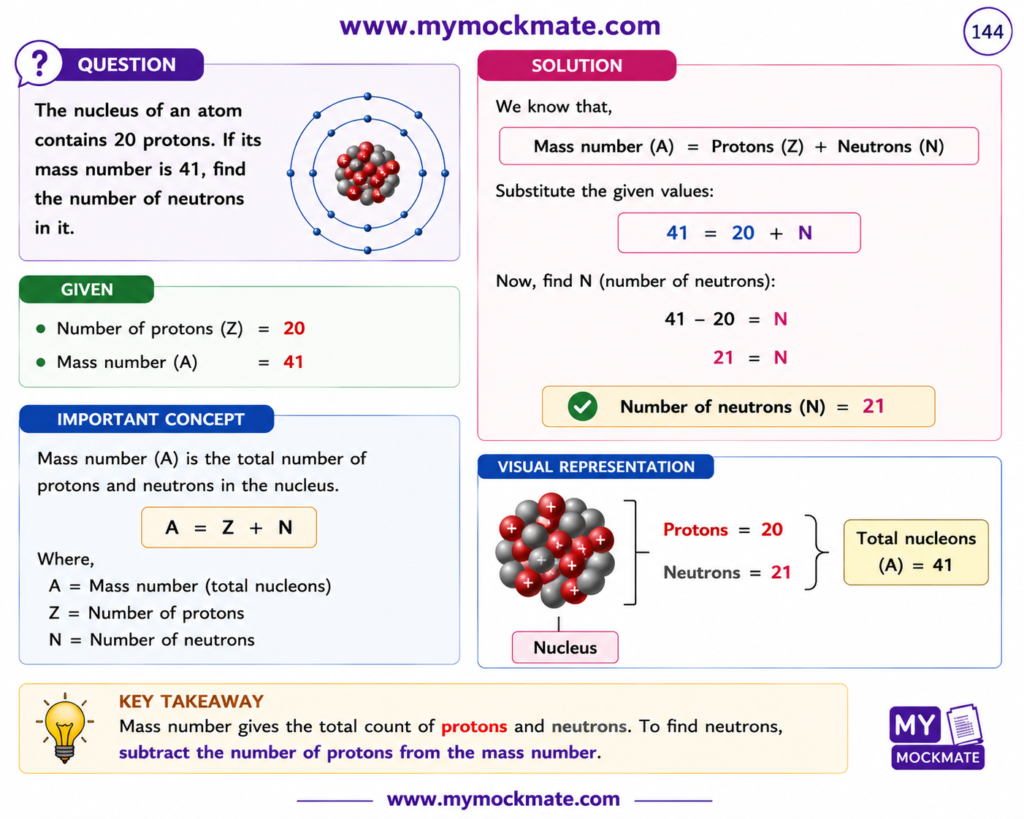
11. The nucleus of an atom contains 20 protons. If its mass number is 41, find the number of neutrons in it.
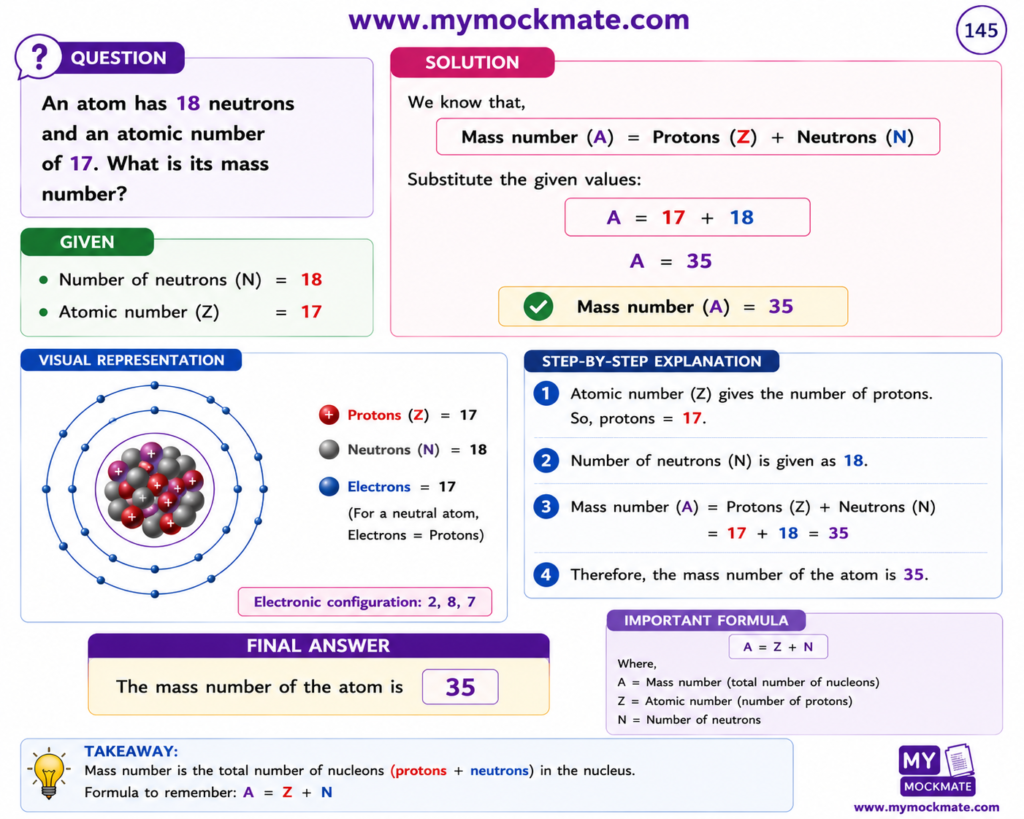
12. An atom has 18 neutrons and an atomic number of 17. What is its mass number?
13. An atom 23A has 11 electrons. Find the number of neutrons in it.


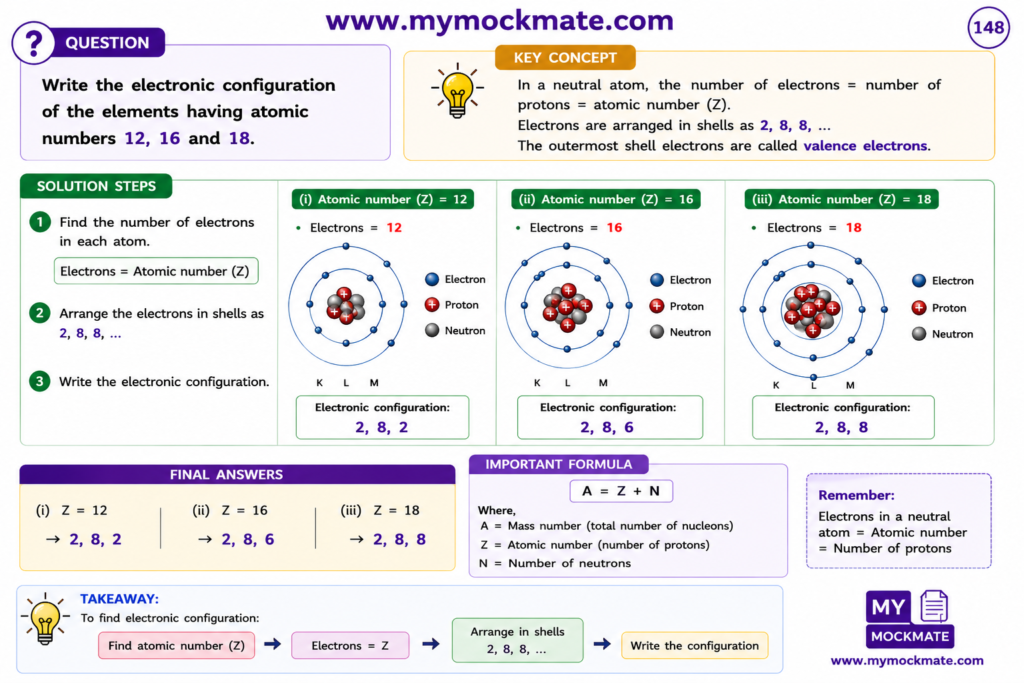
15. Write the electronic configuration of the elements having atomic numbers 12, 16 and 18.
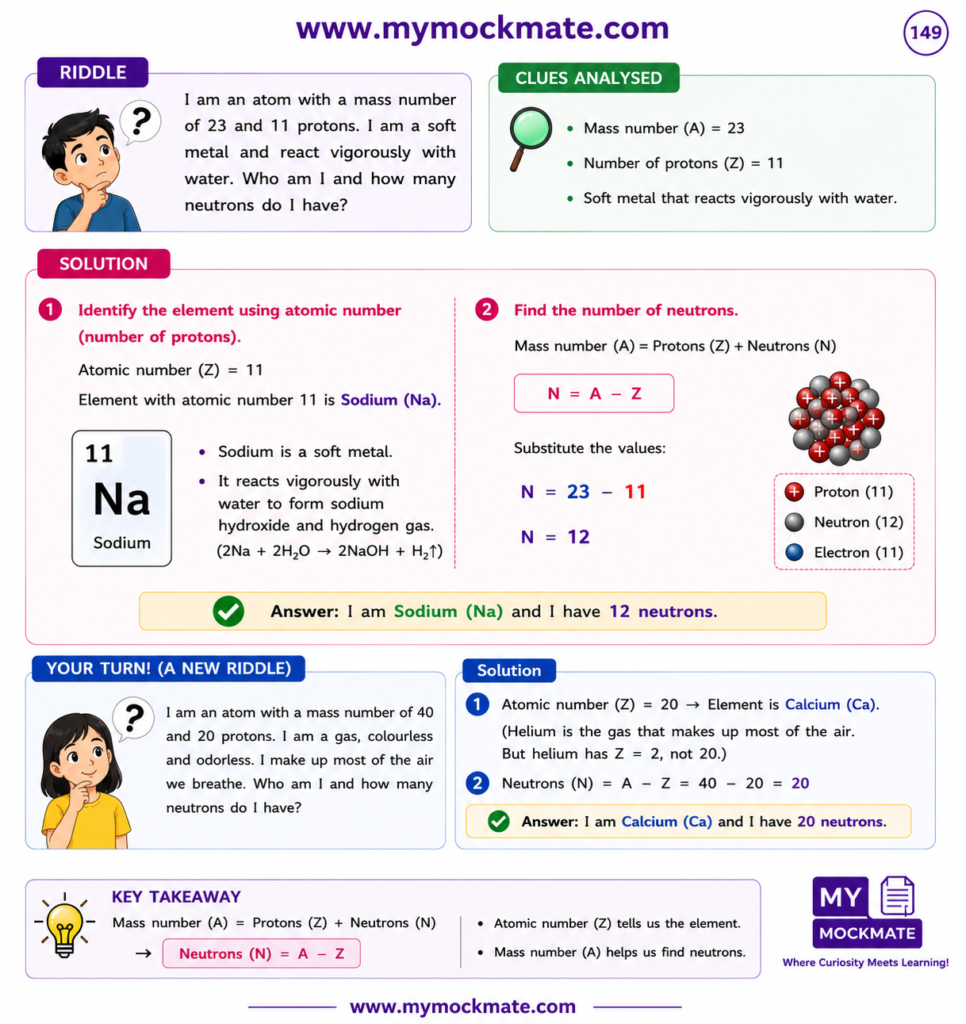
16. Solve this riddle: I am an atom with a mass number of 23 and 11 protons. I am a soft metal and react vigorously with water. Who am I and how many neutrons do I have? You can also create one such riddle.

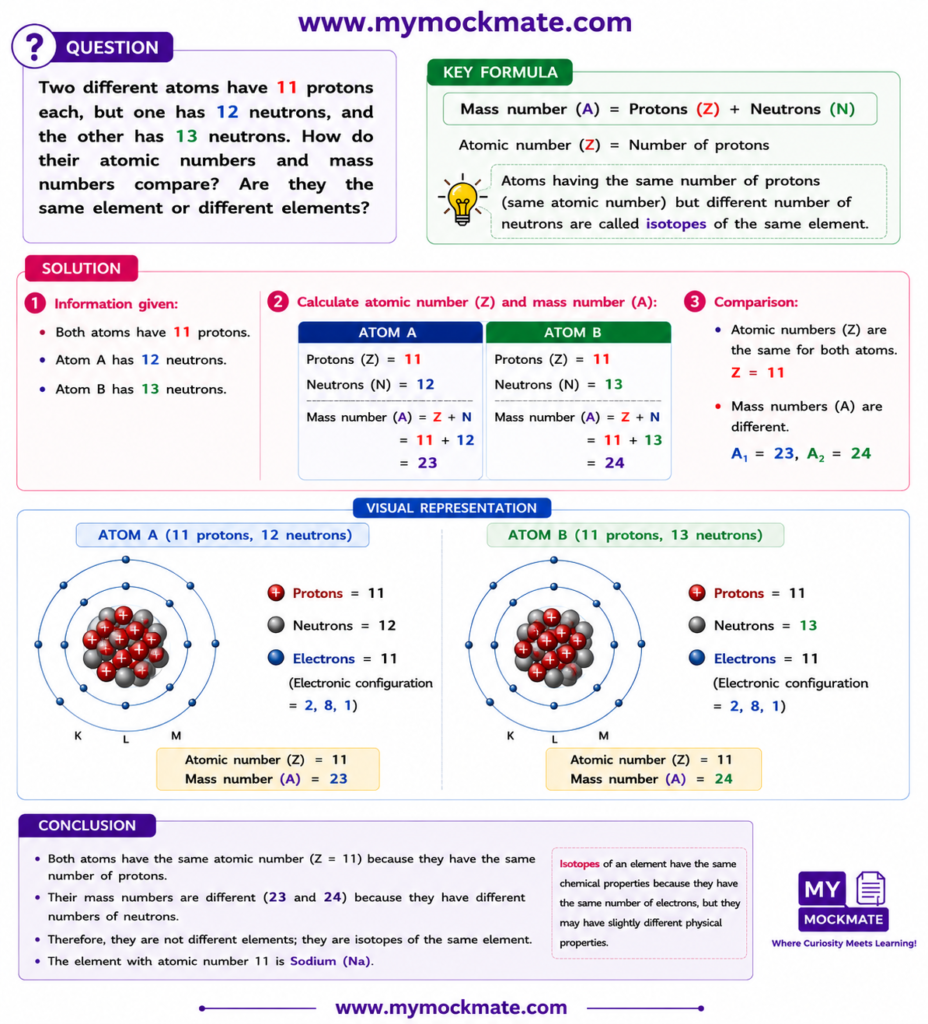
17. Two different atoms have 11 protons each, but one has 12 neutrons, and the other has 13 neutrons. How do their
atomic numbers and mass numbers compare? Are they the same element or different elements?

Revise, Reflect, Refine
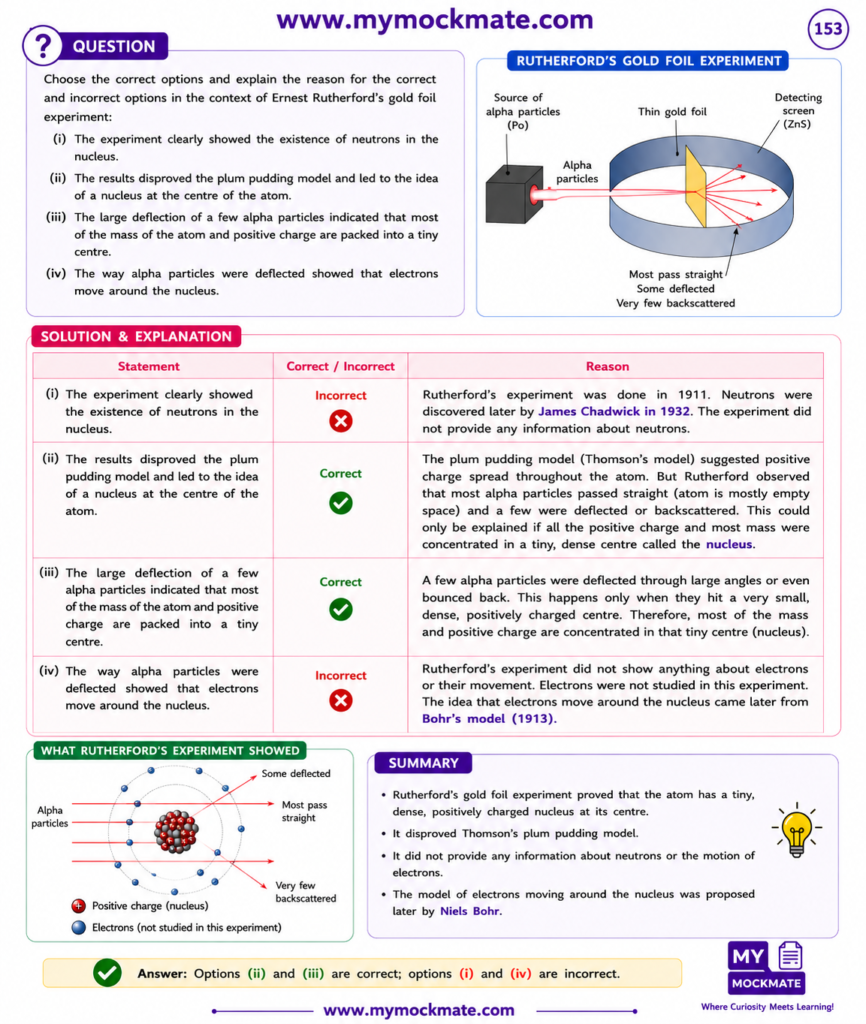
Q1. Choose the correct options and explain the reason for the correct and incorrect options in the context of Ernest Rutherford’s gold foil experiment:
(i) The experiment clearly showed the existence of neutrons in the nucleus.
(ii) The results disproved the plum pudding model and led to the idea of a nucleus at the centre of the atom.
(iii) The large deflection of a few alpha particles indicated that most of the mass of the atom and positive charge are packed into a tiny centre.
(iv) The way alpha particles were deflected showed that electrons move around the nucleus.
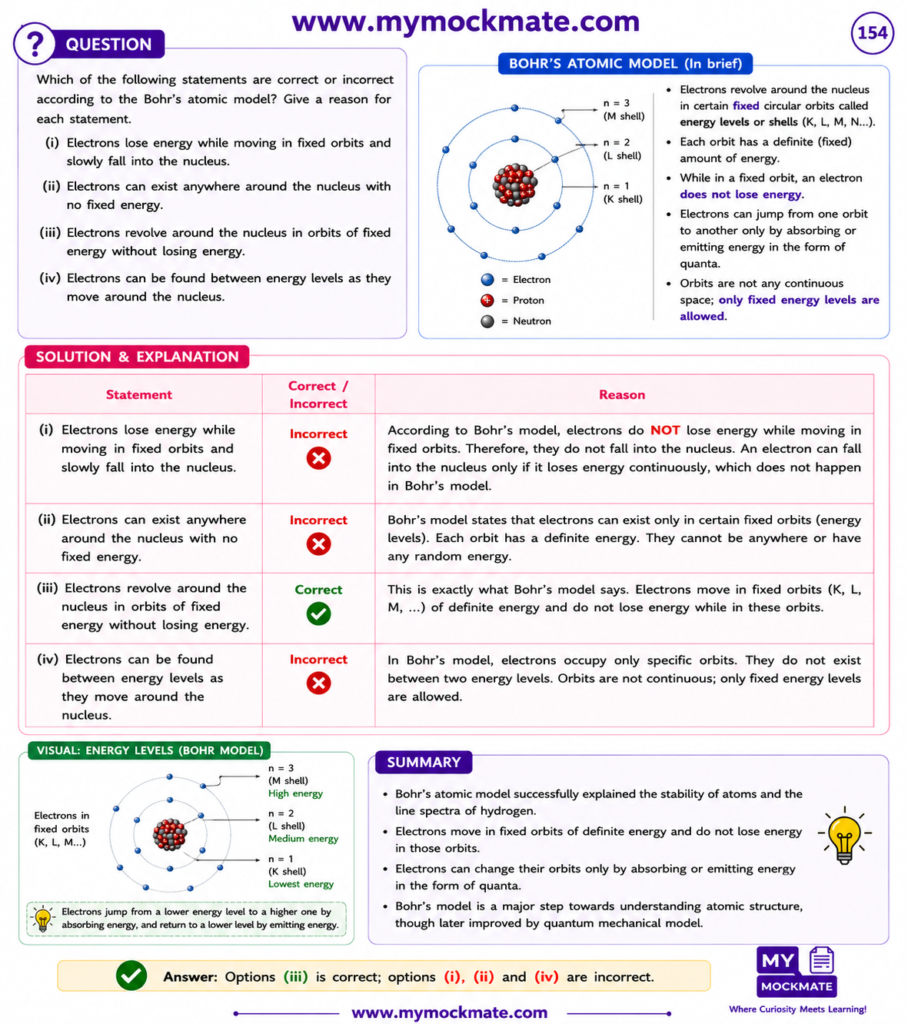
Q2. Which of the following statements are correct or incorrect according to the Bohr’s atomic model? Give a reason for each statement.
(i) Electrons lose energy while moving in fixed orbits and slowly fall into the nucleus.
(ii) Electrons can exist anywhere around the nucleus with no fixed energy.
(iii) Electrons revolve around the nucleus in orbits of fixed energy without losing energy.
(iv) Electrons can be found between energy levels as they move around the nucleus.
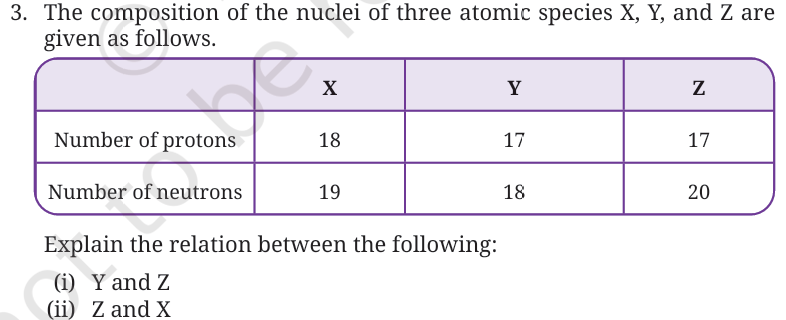
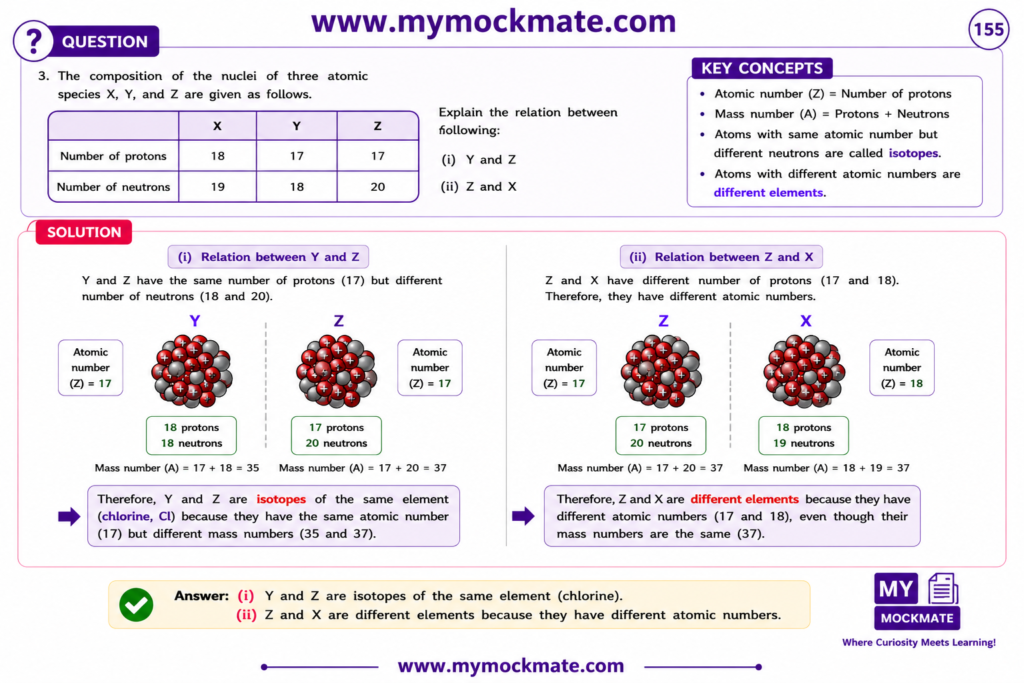
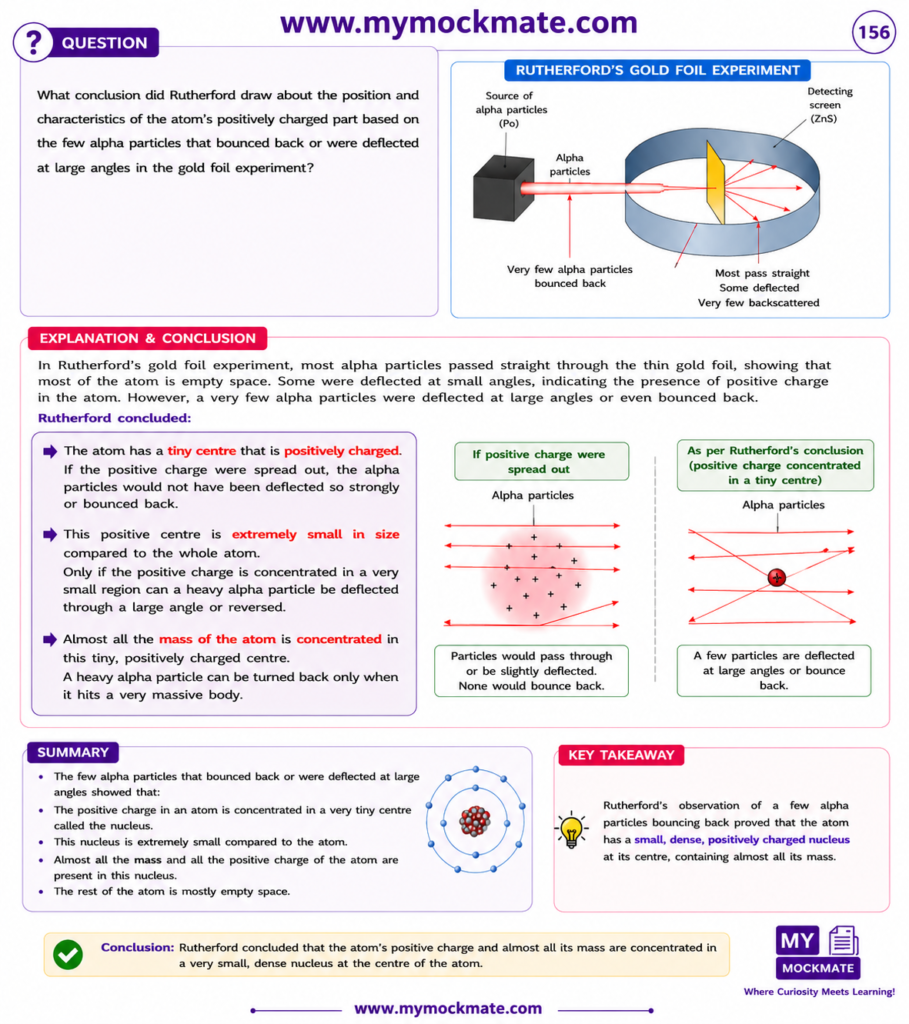
Q4. What conclusion did Rutherford draw about the position and characteristics of the atom’s positively charged part based on the few alpha particles that bounced back or were deflected at large angles in
the gold foil experiment?
Solution:
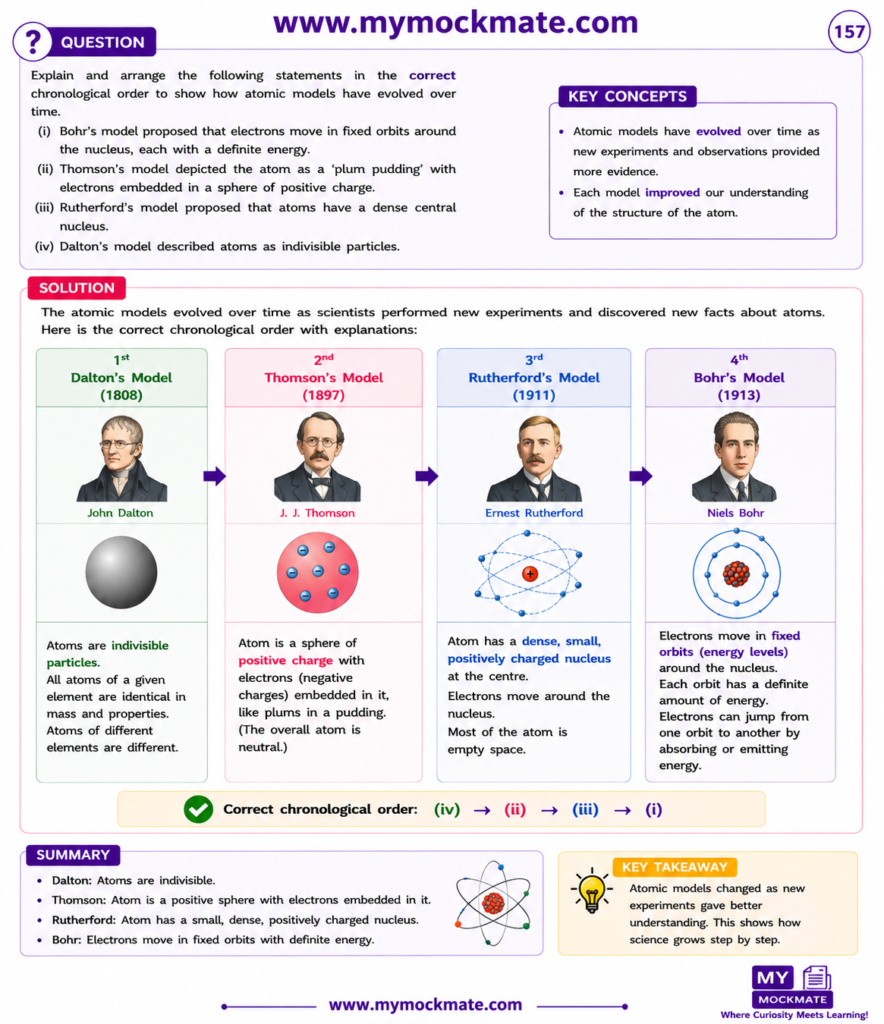
Q5. Explain and arrange the following statements in the correct chronological order to show how atomic models have evolved over time.
(i) Bohr’s model proposed that electrons move in fixed orbits around the nucleus, each with a definite energy.
(ii) Thomson’s model depicted the atom as a ʻplum puddingʼ with electrons embedded in a sphere of positive charge.
(iii) Rutherford’s model proposed that atoms have a dense central nucleus.
(iv) Dalton’s model described atoms as indivisible particles.
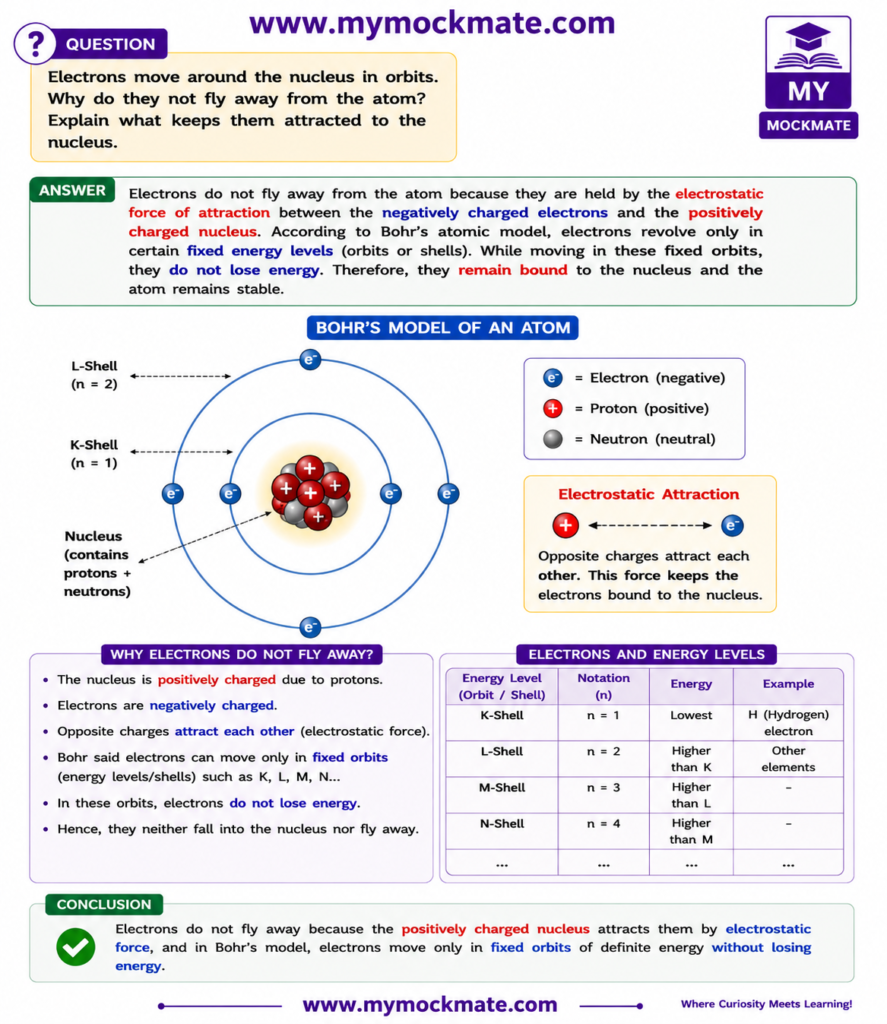
Q6. Electrons move around the nucleus in orbits. Why do they not fly away
from the atom? Explain what keeps them attracted to the nucleus.
Solution:
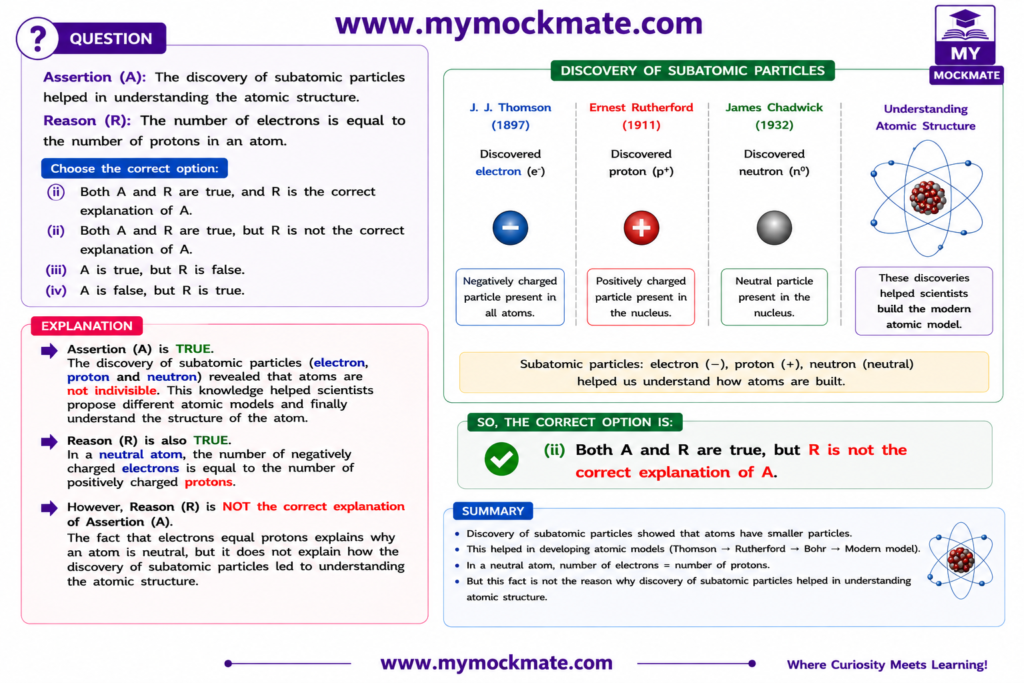
Q7. Assertion (A): The discovery of subatomic particles helped in
understanding the atomic structure.
Reason (R): The number of electrons is equal to the number of protons in an atom.
Choose the correct option:
(i) Both A and R are true, and R is the correct explanation of A.
(ii) Both A and R are true, but R is not the correct explanation of A.
(iii) A is true, but R is false.
(iv) A is false, but R is true.
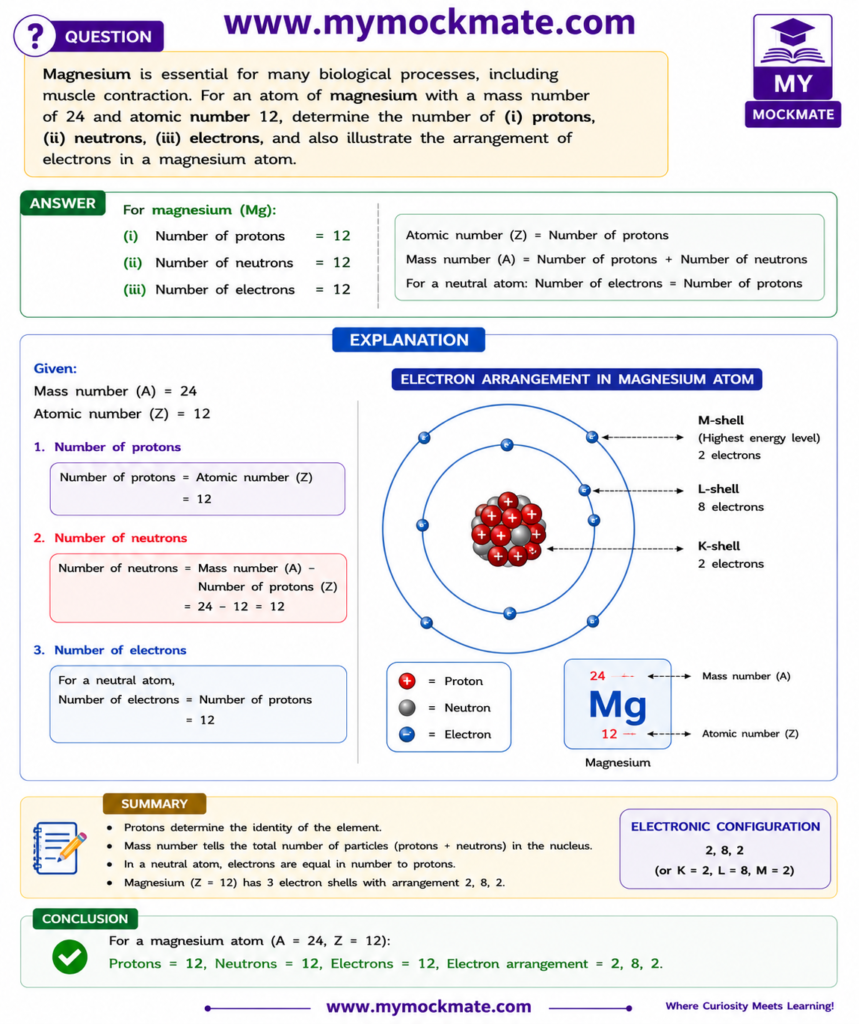
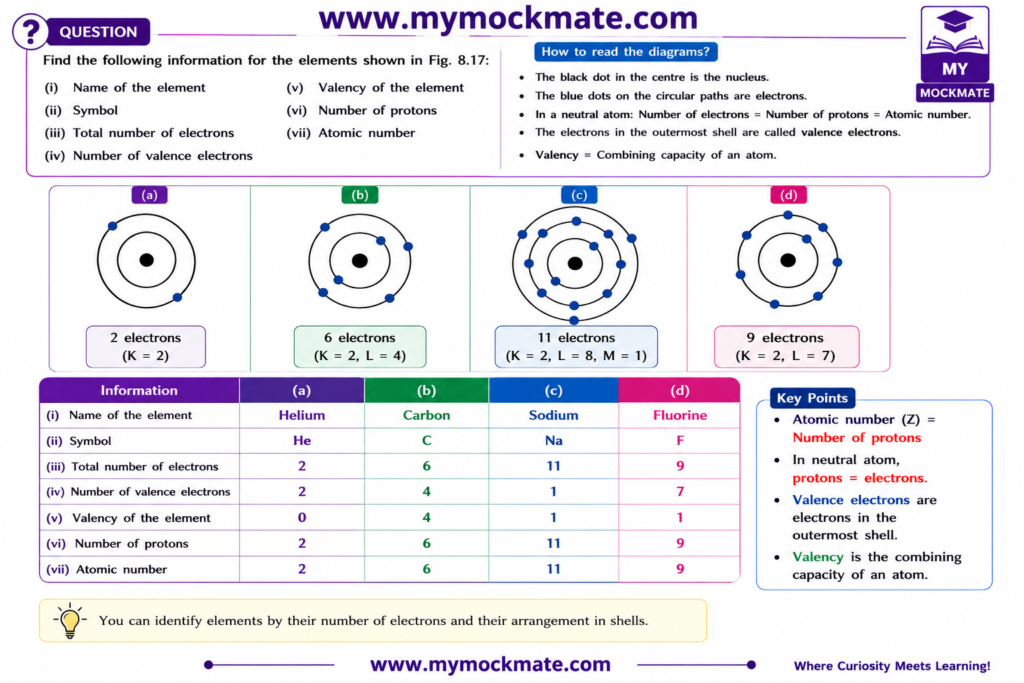
Q8. Magnesium is essential for many biological processes, including
muscle contraction. For an atom of magnesium with a mass number
of 24 and atomic number 12, determine the number of
(i) protons,
(ii) neutrons, (iii) electrons, and also illustrate the arrangement of electrons in a magnesium atom.
Q10. Both Rutherford’s and Bohr’s models have electrons orbiting the
nucleus. Why did Rutherford’s model fail to explain atomic stability,
while Bohr’s model succeeded?

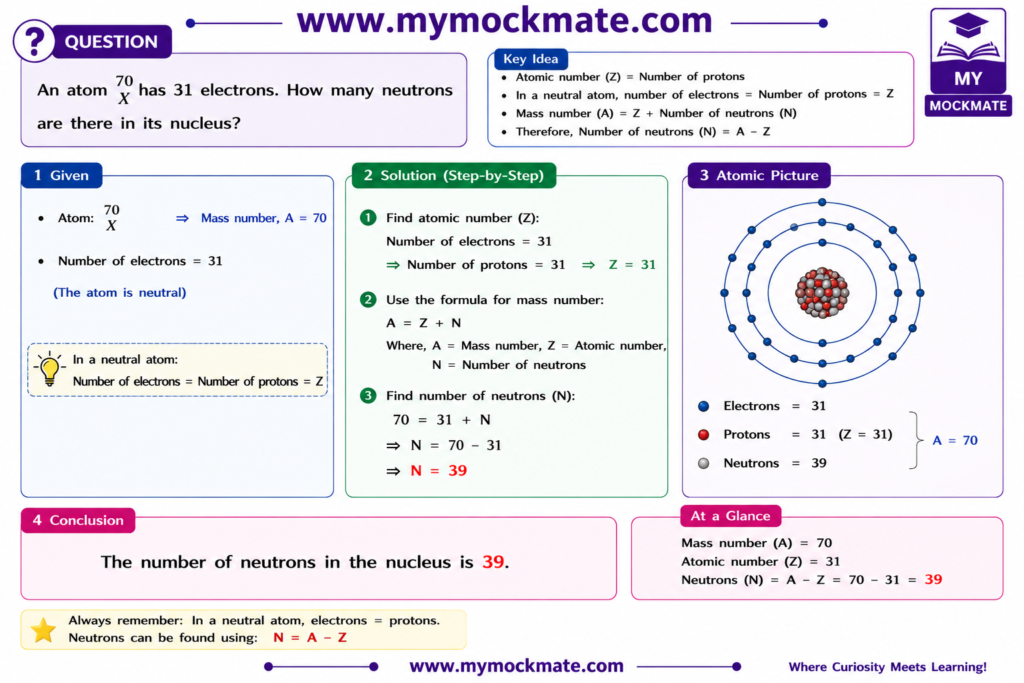
Q11. An atom 70 X has 31 electrons. How many neutrons are there in its nucleus?
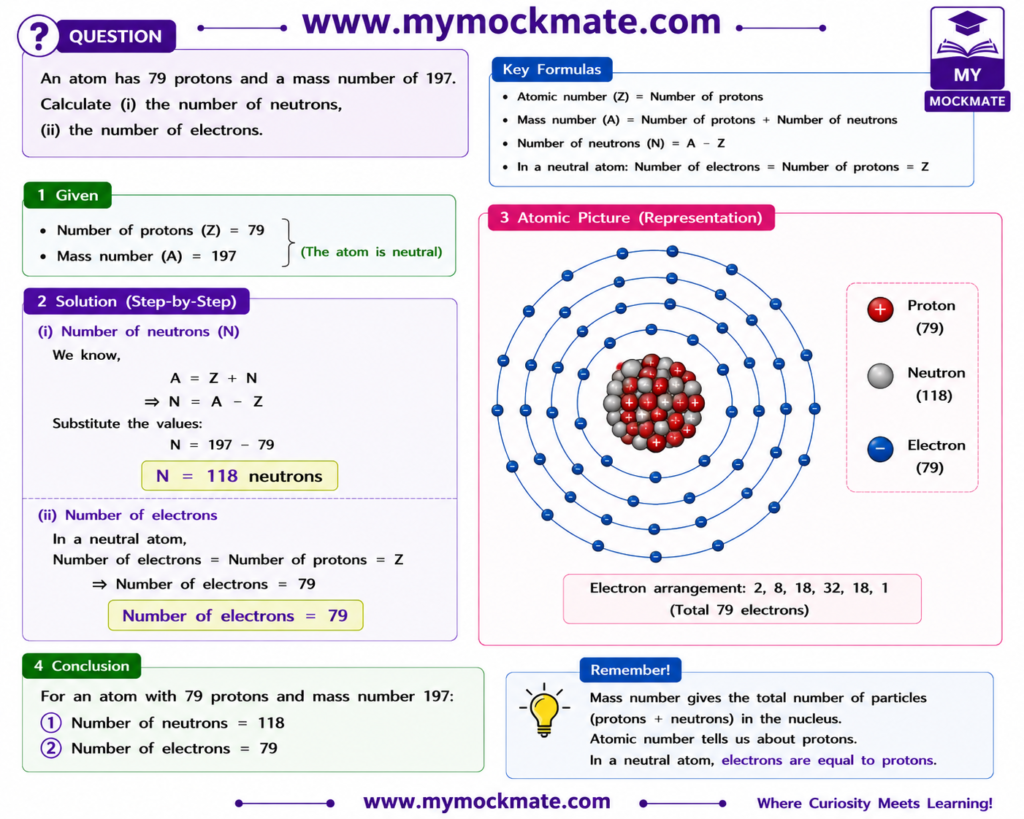
Q12. An atom has 79 protons and a mass number of 197. Calculate
(i) the number of neutrons, and
(ii) the number of electrons.
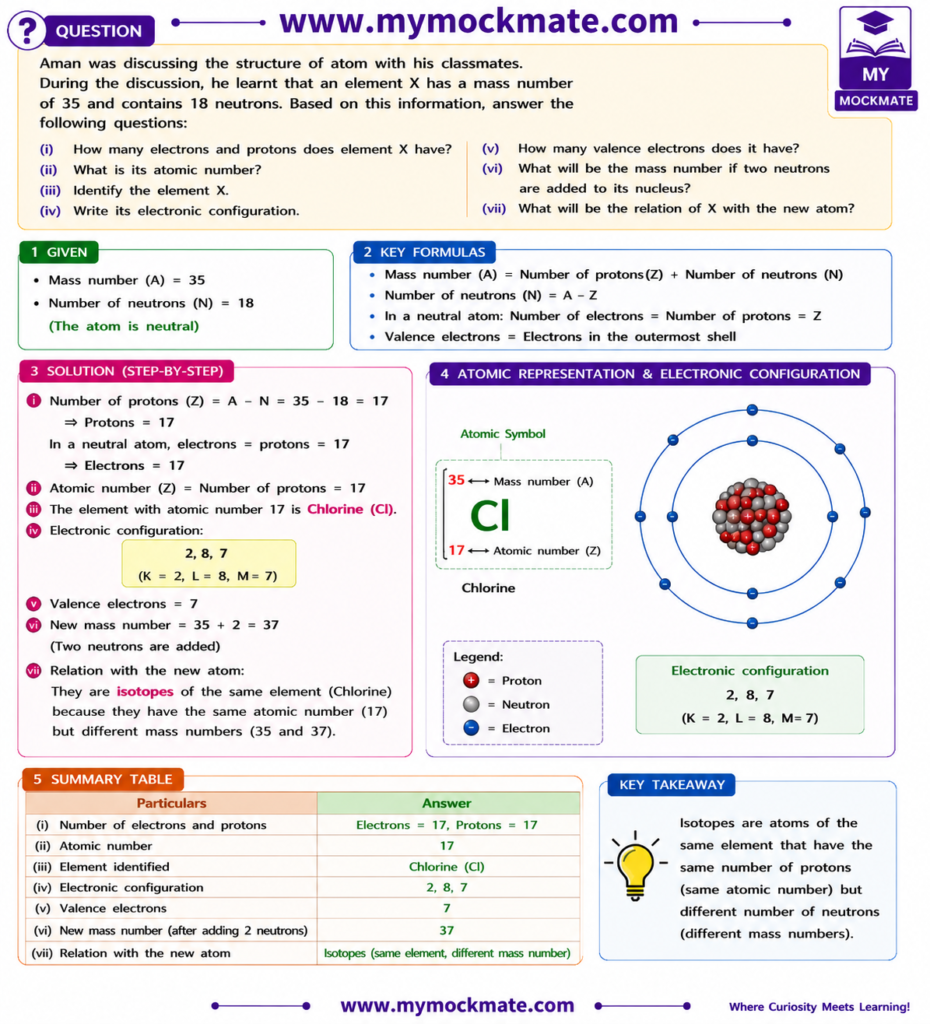
Q14. Aman was discussing the structure of atom with his classmates.
During the discussion, he learnt that an element X has a mass number
of 35 and contains 18 neutrons. Based on this information, answer the
following questions:
(i) How many electrons and protons does element X have?
(ii) What is its atomic number?
(iii) Identify the element X.
(iv) Write its electronic configuration.
(v) How many valence electrons does it have?
(vi) What will be the mass number if two neutrons are added to its nucleus?
(vii) What will be the relation of X with the new atom?
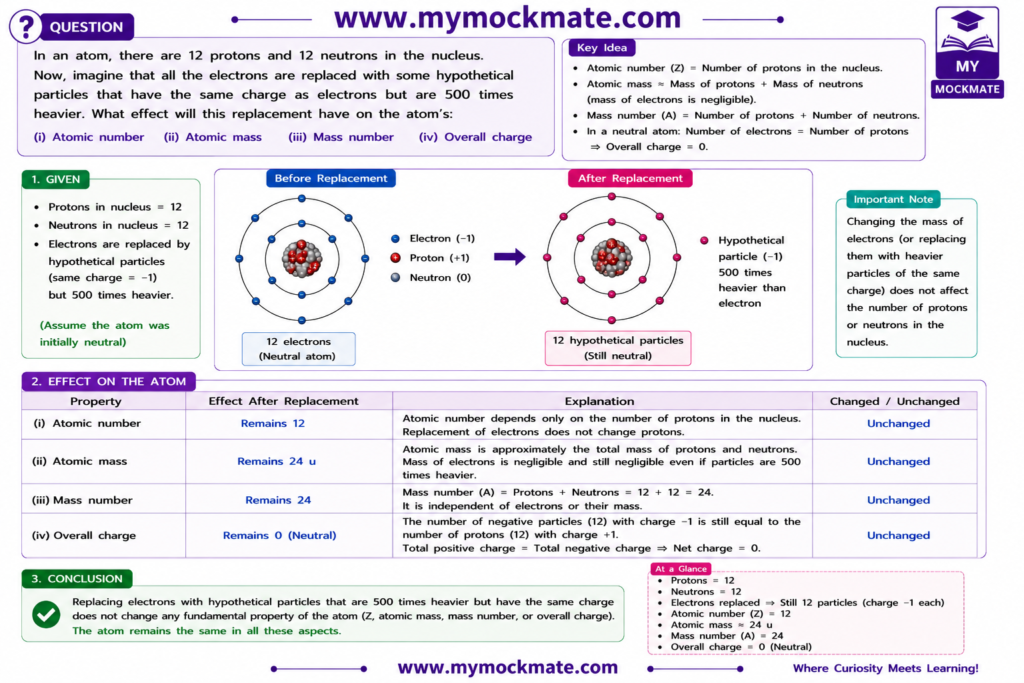
Q15. In an atom, there are 12 protons and 12 neutrons in the nucleus.
Now, imagine that all the electrons are replaced with some hypothetical
particles that have the same charge as electrons but are 500 times
heavier. What effect will this replacement have on the atom’s:
(i) Atomic number
(ii) Atomic mass
(iii) Mass number
(iv) Overall charge
Common Mistakes
- Confusing atomic number with mass number
- Forgetting neutrons calculation
- Writing incorrect shell capacities
- Mixing isotopes and isobars
- Incorrect electronic configuration
Exam Tips
- Learn all atomic models in sequence.
- Practice electron distribution regularly.
- Remember formulas for atomic number and mass number.
- Revise isotopes and isobars carefully.
- Draw neat atomic diagrams in exams.
Practice MCQs
1. Who discovered the nucleus?
A. Dalton
B. Rutherford
C. Bohr
D. Chadwick
Answer:
B. Rutherford
2. Maximum electrons in K-shell:
A. 8
B. 18
C. 2
D. 32
Answer:
C. 2
3. Atomic number equals:
A. Neutrons
B. Electrons + Neutrons
C. Protons
D. Mass number
Answer:
C. Protons
4. Isotopes have:
A. Same mass number
B. Same atomic number
C. Different electrons only
D. Same neutrons
Answer:
B. Same atomic number
5. Scientist who discovered neutron:
A. Bohr
B. Rutherford
C. Chadwick
D. Thomson
Answer:
C. Chadwick
FAQ Section
Q1. What is atomic number?
Atomic number is the number of protons in an atom.
Q2. What is mass number?
Mass number is total number of protons and neutrons.
Q3. What are isotopes?
Atoms with same atomic number but different mass numbers.
Q4. What are isobars?
Atoms with same mass number but different atomic numbers.
Q5. Why are noble gases stable?
Because they have complete outermost electron shells.
Prepare smarter with chapter-wise notes, solved questions, MCQs, quizzes, and mock tests only on www.mymockmate.com and boost your exam performance today!