Introduction
The announcement of the NEET Re Exam 2026 has generated significant interest among medical aspirants across India. Thousands of students are now searching for the latest information regarding the exam pattern, marking scheme, subject-wise distribution, and preparation strategy.
Understanding the paper pattern is one of the most important aspects of exam preparation. Students who know exactly how the examination is structured are able to manage time efficiently, avoid negative marking, and maximize their scores.
In this comprehensive guide by www.mymockmate.com, we explain everything you need to know about the NEET Re Exam Paper Pattern 2026, including the number of questions, marking scheme, subject-wise weightage, time duration, and expert preparation tips.
Why Understanding the NEET Re Exam Pattern Matters
Many students focus only on syllabus completion and ignore the examination pattern. However, understanding the paper format provides several advantages:
- Better time management
- Improved accuracy
- Smart question selection
- Reduced exam stress
- Higher score potential
- Effective mock test practice
Students who regularly attempt mock tests according to the actual NEET pattern generally perform better than those who only study theory.
Overview of NEET Re Exam 2026
NEET remains the single largest medical entrance examination in India for admission into:
- MBBS
- BDS
- AYUSH Courses
- Veterinary Sciences
- Nursing Programs
- Other Allied Medical Courses
The Re Exam is expected to follow the same structure as the original examination unless official changes are announced.
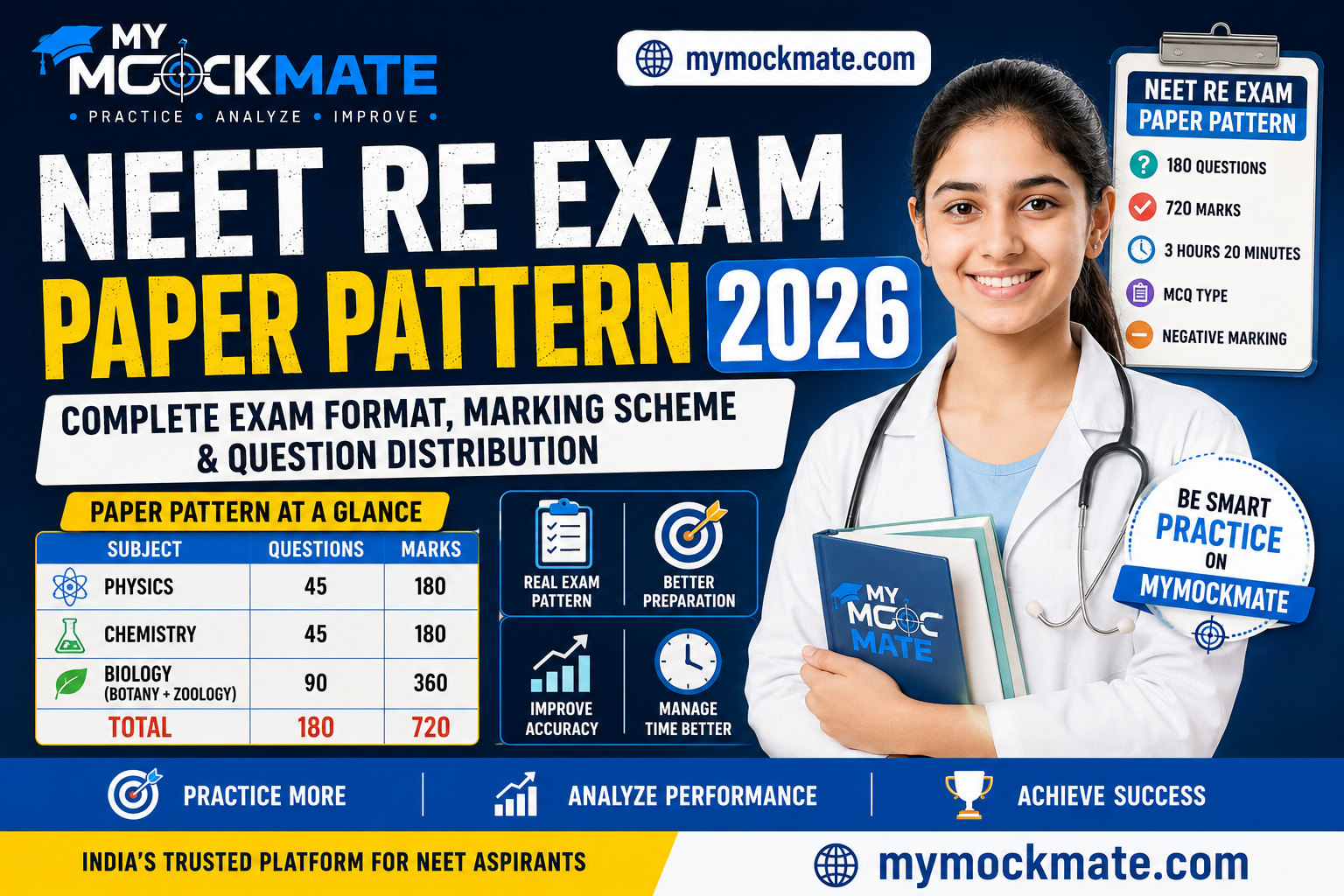
NEET Re Exam 2026 Paper Pattern at a Glance
| Particular | Details |
|---|---|
| Examination Mode | Offline (Pen & Paper) |
| Question Type | Multiple Choice Questions (MCQs) |
| Total Questions | 180 |
| Total Marks | 720 |
| Exam Duration | 3 Hours 20 Minutes |
| Subjects | Physics, Chemistry, Biology |
| Negative Marking | Yes |
| Medium | Multiple Languages |
Subject-Wise Distribution of Questions
The NEET paper consists of three subjects.
Physics
| Section | Questions |
|---|---|
| Physics | 45 |
Total Marks = 180
Chemistry
| Section | Questions |
|---|---|
| Chemistry | 45 |
Total Marks = 180
Biology
Biology carries the highest weightage.
| Section | Questions |
|---|---|
| Botany | 45 |
| Zoology | 45 |
Total Biology Questions = 90
Total Marks = 360
Total Question Distribution
| Subject | Questions | Marks |
|---|---|---|
| Physics | 45 | 180 |
| Chemistry | 45 | 180 |
| Biology | 90 | 360 |
| Total | 180 | 720 |
Biology contributes 50% of the entire paper.
NEET Re Exam 2026 Marking Scheme
Understanding the marking scheme is extremely important.

Correct Answer
+4 Marks
Incorrect Answer
-1 Mark
Unanswered Question
0 Marks
Multiple Answers Marked
-1 Mark
Example of Score Calculation
Suppose a student attempts:
- Correct Answers = 140
- Incorrect Answers = 20
Calculation:
140 × 4 = 560
20 × (-1) = -20
Final Score = 540
This shows why accuracy matters more than blind guessing.
Expected Difficulty Level of NEET Re Exam 2026
Based on previous years, the paper is generally divided into:
Easy Questions
Approximately 35%
Moderate Questions
Approximately 45%
Difficult Questions
Approximately 20%
Students should focus primarily on easy and moderate questions to secure a high score.
Important Chapters for Physics
Historically high-weightage topics include:
- Modern Physics
- Current Electricity
- Electrostatics
- Semiconductor Electronics
- Ray Optics
- Wave Optics
- Thermodynamics
- Magnetism
- Laws of Motion
These chapters often contribute a significant number of questions.
Important Chapters for Chemistry
Physical Chemistry
- Mole Concept
- Chemical Kinetics
- Electrochemistry
- Thermodynamics
Organic Chemistry
- Hydrocarbons
- Alcohols, Phenols and Ethers
- Biomolecules
- Amines
Inorganic Chemistry
- Coordination Compounds
- Chemical Bonding
- p-Block Elements
- d and f Block Elements
Important Chapters for Biology
Class 11 Topics
- Cell Structure
- Plant Physiology
- Human Physiology
- Diversity of Living Organisms
Class 12 Topics
- Genetics
- Biotechnology
- Ecology
- Reproduction
- Evolution
Biology remains the most scoring section for most candidates.
Time Management During NEET Re Exam
A recommended strategy:
Biology
45–50 Minutes
Chemistry
50–55 Minutes
Physics
70–80 Minutes
Final Review
10–15 Minutes
This ensures adequate time for all sections.
How Many Questions Should You Attempt?
The answer depends on your accuracy.
High Accuracy Students
Attempt 170–180 Questions
Average Accuracy Students
Attempt 150–165 Questions
Low Accuracy Students
Avoid risky guessing.
Quality matters more than quantity.
Common Mistakes Students Make
Ignoring Biology
Many students spend excessive time on Physics and Chemistry.
Biology carries 360 marks and should receive maximum attention.
Guessing Too Many Questions
Negative marking can significantly reduce your score.
Poor Time Allocation
Spending too much time on one difficult question affects overall performance.
Not Practicing Mock Tests
Students often study extensively but fail to simulate exam conditions.
Why Mock Tests Are Essential
Mock tests help students:
- Understand the paper pattern
- Improve speed
- Increase accuracy
- Build confidence
- Learn time management
The best way to prepare is by attempting full-length NEET-style mock tests.
At www.mymockmate.com, students can access realistic mock tests designed according to the latest examination pattern. Features include:
- Real Exam Environment
- Instant Results
- Detailed Analysis
- Topic-wise Performance Reports
- All India Ranking
These tools help students identify weaknesses before the actual examination.
Last 10 Days Preparation Strategy
Days 1-3
Complete revision of high-weightage chapters.
Days 4-6
Attempt one full mock test daily.
Days 7-8
Analyze mistakes and revise weak areas.
Days 9-10
Focus only on revision and confidence building.
Avoid new topics completely.
How MyMockMate Can Help NEET Aspirants
www.mymockmate.com is designed specifically for competitive examination preparation.
Benefits include:
- NEET Mock Tests
- Performance Analytics
- Exam-Like Interface
- All India Ranking
- Detailed Solutions
- Time-Based Practice
Regular practice on MyMockMate helps students become familiar with the actual examination pattern and improve their chances of scoring higher.
Conclusion
The NEET Re Exam Paper Pattern 2026 is expected to remain largely similar to the standard NEET examination format. The paper will consist of 180 MCQs carrying a total of 720 marks, with Biology contributing the highest weightage.
Students should focus on:
- NCERT Revision
- Mock Test Practice
- Error Analysis
- Time Management
- Accuracy Improvement
Success in NEET is not just about hard work; it is about smart preparation. Understanding the paper pattern is the first step toward achieving a top rank.
For realistic NEET mock tests and detailed performance analysis, students can regularly practice on www.mymockmate.com and strengthen their preparation before the examination.
Frequently Asked Questions (FAQs)
Q1. How many questions are there in NEET Re Exam 2026?
There are expected to be 180 questions.
Q2. What is the total mark of the NEET Re Exam?
The total mark is expected to be 720.
Q3. Is there negative marking in NEET Re Exam 2026?
Yes. One mark is deducted for every incorrect answer.
Q4. Which subject carries the highest weightage?
Biology carries 360 marks, which is 50% of the paper.
Q5. How many marks are awarded for a correct answer?
Four marks are awarded for every correct answer.
Q6. How much time is provided for the examination?
The duration is expected to be 3 hours and 20 minutes.
Q7. Should I attempt all 180 questions?
Only if your accuracy is high. Blind guessing should be avoided.
Q8. Which section is generally considered most difficult?
Most students find Physics comparatively more challenging.
Q9. How many mock tests should I attempt before the exam?
At least 5–10 full-length mock tests are recommended.
Q10. Where can I practice NEET pattern mock tests?
Students can practice NEET-style mock tests with detailed analysis and All India Ranking at www.mymockmate.com.