




Introduction
Railway Recruitment Board (RRB) examinations are among the most sought-after competitive exams in India. Every year, millions of aspirants apply for vacancies such as RRB NTPC, Group D, Assistant Loco Pilot (ALP), Technician, Junior Engineer (JE), and Paramedical Staff. Since the competition is intense, success depends on a well-structured preparation strategy, regular revision, and continuous mock test practice.
Many candidates study for months but fail to secure a good score because they lack proper planning and exam-oriented practice. A systematic preparation approach helps candidates cover the syllabus efficiently, improve speed, increase accuracy, and build confidence.
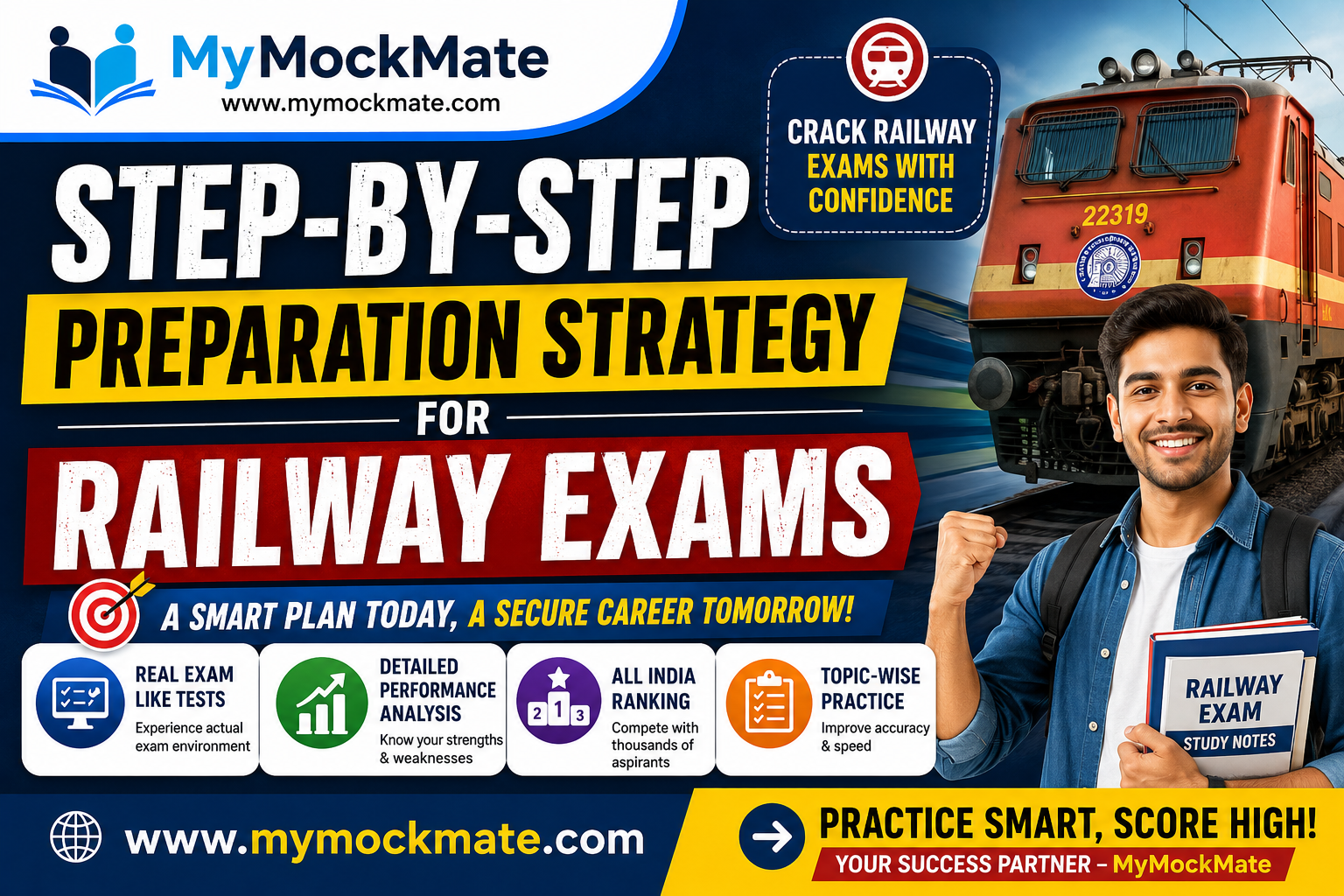
If you are serious about cracking Railway exams, www.mymockmate.com provides an ideal platform with real exam-like mock tests, All India Ranking, instant results, and detailed performance analysis to help you prepare smarter.
Quick Information Box
| Particular | Details |
|---|---|
| Conducting Authority | Railway Recruitment Board (RRB) |
| Popular Exams | NTPC, Group D, ALP, Technician, JE |
| Exam Mode | Computer Based Test (CBT) |
| Difficulty Level | Easy to Moderate |
| Selection Process | CBT 1, CBT 2 (if applicable), Skill Test/Typing Test (for selected posts), Document Verification |
| Best Preparation Method | Concept Building + Mock Tests + Revision |
| Recommended Platform | www.mymockmate.com |
Why Railway Exams Are Highly Competitive
Railway jobs offer:
- Excellent job security
- Attractive salary
- Pension and retirement benefits
- Medical facilities
- Career growth opportunities
- Work-life balance
- Nationwide postings
Because of these benefits, lakhs of candidates compete for every recruitment cycle. Therefore, your preparation must be focused and exam-oriented.
Understand the Railway Exam Pattern
Although the pattern differs slightly across various RRB examinations, most Computer Based Tests include:
Mathematics
Topics include:
- Number System
- Simplification
- Percentage
- Profit & Loss
- Ratio and Proportion
- Time & Work
- Speed, Time & Distance
- Simple & Compound Interest
- Algebra
- Geometry
- Mensuration
- Data Interpretation
General Intelligence & Reasoning
Important topics:
- Coding-Decoding
- Blood Relations
- Direction Sense
- Syllogism
- Puzzle
- Seating Arrangement
- Analogy
- Classification
- Series
- Statement & Conclusion
General Awareness
Focus on:
- Current Affairs
- Indian History
- Geography
- Polity
- Constitution
- Economics
- Science
- Environment
- Railway-related developments
- Sports
- Awards
- Government Schemes
General Science
Questions generally come from:
- Physics
- Chemistry
- Biology
Mostly based on NCERT concepts.
Step 1: Know the Complete Syllabus
Before opening any book, download the latest syllabus for your specific Railway examination.
Prepare a checklist of:
- Mathematics
- Reasoning
- General Science
- General Awareness
- Current Affairs
Mark completed topics regularly.
Step 2: Understand the Previous Year Papers
Previous year papers reveal:

- Frequently asked topics
- Difficulty level
- Weightage
- Question trends
- Time required
Solve at least the last 5–10 years’ papers before attempting advanced mock tests.
Step 3: Build Strong Concepts
Avoid memorizing shortcuts without understanding concepts.
Spend the first few weeks strengthening:
- Arithmetic basics
- Logical reasoning
- Grammar (if applicable)
- Science fundamentals
- Static GK
Strong concepts improve accuracy in difficult questions.
Step 4: Prepare a Daily Study Schedule
Consistency is the key to success.
Sample Daily Plan
| Time | Activity |
|---|---|
| Morning | Mathematics Practice |
| Afternoon | Reasoning |
| Evening | General Awareness |
| Night | Current Affairs + Revision |
Study for 6–8 hours daily, depending on your available time.
Step 5: Practice Topic-wise Questions
Do not jump directly into full-length tests.
Complete:
- Topic-wise exercises
- Chapter-wise quizzes
- Sectional practice tests
This builds confidence before attempting complete CBT mock tests.
Step 6: Start Taking Mock Tests
This is the most important stage of preparation.
Mock tests help you:
- Improve speed
- Increase accuracy
- Learn time management
- Identify weak areas
- Reduce exam anxiety
Platforms like www.mymockmate.com provide real exam simulations that closely resemble the actual Railway CBT interface.
Why Choose www.mymockmate.com for Railway Preparation?
Railway aspirants need more than practice questions—they need smart performance tracking.
Real CBT Experience
The interface is designed like the actual Railway Computer Based Test.
Detailed Performance Analysis
Every mock test provides:
- Subject-wise score
- Topic-wise accuracy
- Time spent per question
- Strong and weak topics
- Improvement suggestions
All India Ranking
Know your rank among thousands of aspirants across India.
This helps you understand your real competition level.
Instant Results
No waiting.
View your score and analysis immediately after completing the test.
Affordable Mock Tests
High-quality Railway mock tests at student-friendly prices.
Mobile Friendly
Practice from:
- Laptop
- Desktop
- Tablet
- Smartphone
Anytime, anywhere.
Step 7: Learn Time Management
Railway exams are speed-based.
Follow these rules:
- Solve easy questions first.
- Skip lengthy calculations.
- Avoid spending too much time on one question.
- Keep the last few minutes for review.
Regular mock tests on www.mymockmate.com help you develop this habit naturally.
Step 8: Improve Accuracy
Many candidates lose marks because of negative marking.
Tips:
- Avoid blind guessing.
- Read every question carefully.
- Eliminate wrong options first.
- Attempt only reasonably confident answers.
Accuracy is more valuable than attempting every question.
Step 9: Make Short Notes
Prepare concise notes for:
Mathematics
- Important formulas
- Short tricks
- Tables
- Squares
- Cubes
Science
- Definitions
- Diagrams
- Important facts
Current Affairs
- Monthly events
- Awards
- Government schemes
- Sports
Revision becomes much faster using self-made notes.
Step 10: Revise Regularly
A simple revision cycle works best.
Daily
Revise what you studied the same day.
Weekly
Revise all topics completed during the week.
Monthly
Take revision mock tests and revisit weak areas.
Weekly Railway Preparation Plan
| Day | Task |
|---|---|
| Monday | Mathematics |
| Tuesday | Reasoning |
| Wednesday | General Science |
| Thursday | Current Affairs |
| Friday | Mixed Practice |
| Saturday | Full-Length Mock Test |
| Sunday | Analysis + Revision |
Subject-wise Preparation Strategy
Mathematics
Practice daily.
Important chapters:
- Percentage
- Profit & Loss
- Ratio
- Time & Work
- Average
- SI & CI
- Algebra
- Geometry
Target:
Daily 40–50 questions.
Reasoning
Daily practice improves speed.
Important topics:
- Puzzle
- Coding-Decoding
- Analogy
- Classification
- Syllogism
- Seating Arrangement
Target:
30–40 questions daily.
General Science
Study NCERT concepts.
Focus on:
- Human Body
- Electricity
- Chemical Reactions
- Ecology
- Nutrition
Current Affairs
Read:
- Daily news
- Monthly magazines
- Government schemes
- Budget
- Economic Survey
- Railway projects
Maintain monthly revision notes.
Common Mistakes to Avoid
Studying Without a Plan
Random preparation wastes time.
Ignoring Mock Tests
Reading theory alone is not enough.
Not Analysing Performance
Always review:
- Wrong answers
- Time management
- Weak chapters
Over-Reliance on Guesswork
Negative marking can significantly reduce your score.
Ignoring Revision
Revision is as important as learning new topics.
How to Analyse Every Mock Test
Spend at least 45–60 minutes reviewing each mock test.
Analyse:
- Accuracy percentage
- Time per question
- Wrong attempts
- Skipped questions
- Guesswork
- Weak chapters
Maintain a notebook titled:
“Railway Mistake Register.”
Revise it weekly.
Last 30-Day Preparation Strategy
Week 1
- Complete syllabus revision.
- Two full-length mock tests.
Week 2
- Three full-length mock tests.
- Revise weak topics.
Week 3
- Four mock tests.
- Improve speed.
Week 4
- Five mock tests.
- Daily revision.
- Focus on confidence building.
Exam Day Tips
- Sleep well the night before the exam.
- Reach the exam centre early.
- Carry all required documents.
- Stay calm.
- Read instructions carefully.
- Manage time wisely.
- Don’t panic if a question seems difficult—move on and return later if time permits.
Why MyMockMate Can Boost Your Railway Preparation
Preparing for Railway exams requires more than hard work—it requires smart practice.
With www.mymockmate.com, aspirants can benefit from:
- Real Railway CBT interface
- Full-length and sectional mock tests
- Detailed performance reports
- Instant scorecards
- Topic-wise analysis
- All India Ranking
- Affordable pricing
- Easy access on desktop and mobile devices
These features help you continuously monitor your progress and prepare with greater confidence.
Final Thoughts
Railway examinations reward candidates who combine strong concepts with consistent practice and disciplined revision. Instead of relying solely on textbooks, integrate mock tests into your daily preparation routine to experience the real exam environment and identify areas for improvement.
A well-planned strategy, combined with continuous performance analysis, can significantly improve your chances of securing a high score.
Whether you are preparing for RRB NTPC, Group D, ALP, Technician, or JE, www.mymockmate.com provides the tools you need to practice smarter, compete nationally, and move one step closer to your dream Railway job.
Frequently Asked Questions (FAQs)
1. How many months are required to prepare for Railway exams?
Most candidates can prepare effectively in 4–6 months with a disciplined study plan, regular revision, and consistent mock test practice.
2. How many mock tests should I attempt before the Railway exam?
Aim for 30–50 full-length mock tests along with sectional tests. Focus on analysing your mistakes after every test.
3. Is NCERT enough for Railway General Science?
NCERT books provide an excellent foundation for Physics, Chemistry, and Biology, especially for questions commonly asked in Railway exams. Supplement them with regular revision and practice.
4. Why are mock tests important for Railway preparation?
Mock tests help improve speed, accuracy, time management, confidence, and familiarity with the CBT exam pattern. They also highlight your weak areas for focused improvement.
5. Which platform is recommended for Railway mock tests?
www.mymockmate.com offers Railway exam-oriented mock tests with real CBT simulations, All India Ranking, instant results, and detailed performance analytics, making it an excellent choice for serious aspirants.
6. How should I analyse a Railway mock test?
Review:
- Incorrect answers
- Accuracy percentage
- Time spent per question
- Weak topics
- Skipped questions
- Guesswork
Use this analysis to refine your preparation plan.
7. Can beginners start with full-length Railway mock tests?
Beginners should first complete topic-wise practice and sectional tests. Once the fundamentals are clear, they can gradually transition to full-length mock tests for better exam readiness.
Conclusion
A successful Railway preparation journey is built on planning, consistency, revision, and smart mock test practice. Cover the syllabus systematically, solve previous year papers, take regular mock tests, and learn from every mistake.
By leveraging the advanced mock testing features available on www.mymockmate.com, you can prepare with confidence, monitor your performance through detailed analytics, and compete with aspirants across India through the All India Ranking system. Stay focused, practice consistently, and your Railway career goals will be well within reach.