


Learn the complete step-by-step SSC preparation strategy for SSC CGL, CHSL, MTS, GD, and other SSC exams. Discover study plans, mock test strategies, and expert tips with MyMockMate.
Step-by-Step Preparation Strategy for SSC Exams
The Staff Selection Commission (SSC) examinations are among the most popular government job exams in India. Every year, millions of candidates apply for exams such as SSC CGL, SSC CHSL, SSC MTS, SSC GD Constable, SSC Stenographer, and SSC CPO. These examinations provide excellent career opportunities, job security, attractive salaries, and growth prospects.
However, due to increasing competition, simply studying hard is no longer enough. Candidates need a smart preparation strategy, proper planning, regular practice, and continuous performance evaluation to succeed.
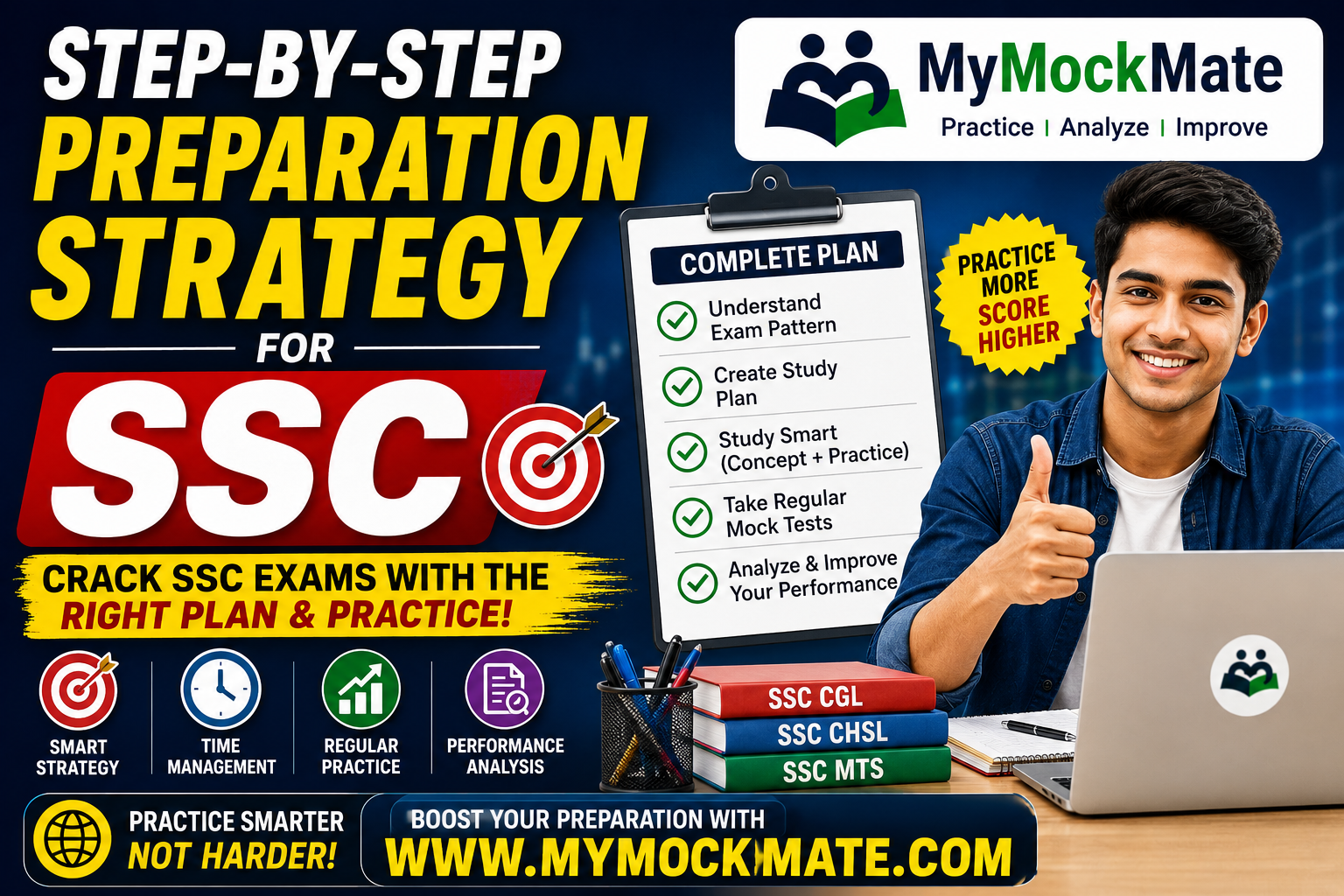
In this detailed guide, we will discuss a complete Step-by-Step SSC Preparation Strategy that can help aspirants improve their preparation and maximize their chances of success. We will also explain how regular practice through www.mymockmate.com can significantly improve exam performance.
Understanding SSC Exams
Before starting preparation, candidates must understand the exam they are targeting.
Popular SSC examinations include:
- SSC CGL
- SSC CHSL
- SSC MTS
- SSC GD Constable
- SSC CPO
- SSC Stenographer
- SSC Selection Post
Most SSC exams test four major areas:
- Quantitative Aptitude
- General Intelligence & Reasoning
- English Language
- General Awareness
A balanced preparation strategy is essential for all these sections.
Why a Proper SSC Preparation Strategy Matters
Many candidates spend months studying but fail to clear cutoffs because:
- They lack a study plan.
- They do not practice enough questions.
- They ignore mock tests.
- They fail to manage time effectively.
A systematic strategy helps candidates:
- Cover the syllabus efficiently
- Improve speed and accuracy
- Identify weak areas
- Build confidence
- Reduce exam stress
Step 1: Understand the SSC Exam Pattern and Syllabus
The first step is understanding the official syllabus and exam pattern.
Important Areas
Quantitative Aptitude
- Percentage
- Profit and Loss
- Ratio and Proportion
- Time and Work
- Simple and Compound Interest
- Geometry
- Trigonometry
- Data Interpretation
Reasoning
- Analogy
- Coding-Decoding
- Series
- Classification
- Blood Relations
- Direction Sense
- Puzzles
English
- Grammar
- Vocabulary
- Reading Comprehension
- Error Detection
- Cloze Test
General Awareness
- History
- Geography
- Polity
- Economics
- Science
- Current Affairs
Understanding the syllabus prevents wasting time on irrelevant topics.
Step 2: Create a Realistic Study Plan
A good study plan is the foundation of success.
Sample Daily Schedule
| Subject | Time |
|---|---|
| Quantitative Aptitude | 2 Hours |
| Reasoning | 1 Hour |
| English | 1 Hour |
| General Awareness | 1 Hour |
| Mock Test Analysis | 30 Minutes |
Key Principle
Consistency is more important than studying for very long hours occasionally.
Step 3: Build Strong Concepts
Many candidates immediately start solving questions without understanding concepts.
This leads to repeated mistakes.
Focus On
- Understanding formulas
- Learning shortcuts
- Mastering basic concepts
- Solving fundamental questions
Strong fundamentals make advanced questions easier.
Step 4: Practice Questions Daily
SSC exams reward speed and accuracy.
Both can only be developed through practice.
Daily Targets
Quantitative Aptitude
50–100 Questions
Reasoning
40–60 Questions
English
20–30 Questions
General Awareness
20–30 MCQs
Daily practice improves confidence and problem-solving skills.
Step 5: Strengthen Quantitative Aptitude
Quantitative Aptitude is often considered the most challenging section.
Important Topics
- Arithmetic
- Algebra
- Geometry
- Trigonometry
- Mensuration
- Data Interpretation
Preparation Tips
- Learn formulas thoroughly.
- Maintain a formula notebook.
- Solve questions daily.
- Revise weekly.
The more you practice, the faster you become.
Step 6: Master Reasoning Ability
Reasoning is one of the highest-scoring sections in SSC exams.
Important Topics
- Number Series
- Analogy
- Classification
- Coding-Decoding
- Syllogism
- Seating Arrangement
- Puzzles
Success Strategy
Practice a variety of question types regularly.
Reasoning rewards pattern recognition developed through repetition.
Step 7: Improve English Language Skills
English often becomes a deciding factor in SSC exams.
Focus Areas
- Grammar Rules
- Vocabulary Building
- Reading Comprehension
- Error Spotting
- Sentence Improvement
Daily Routine
- Learn 10–15 new words.
- Read newspaper articles.
- Solve grammar exercises.
- Attempt comprehension passages.
Small daily efforts create long-term improvement.
Step 8: Prepare General Awareness Smartly
Many students spend excessive time memorizing facts.
A smarter approach is needed.
Static GK
- History
- Geography
- Polity
- Economics
Current Affairs
Focus on:
- Government Schemes
- Awards
- Sports
- International Events
- Important Appointments
Tip
Maintain short notes for quick revision.
Step 9: Start Topic-Wise Mock Tests
Once basic concepts are covered, begin sectional testing.
Benefits
- Identifies weak areas
- Improves confidence
- Measures progress
- Builds exam temperament
Start with:
- Quantitative Aptitude Tests
- Reasoning Tests
- English Tests
- General Awareness Tests
Step 10: Take Full-Length Mock Tests
This is where many serious aspirants separate themselves from average candidates.
Mock tests provide:
- Real exam experience
- Time management practice
- Performance evaluation
- Confidence building
Candidates should regularly practice on:
to simulate actual examination conditions.
Step 11: Analyze Every Mock Test
Taking a mock test is only half the process.
Analysis is where improvement happens.
Review
- Incorrect Answers
- Unattempted Questions
- Time Consumed
- Silly Mistakes
- Weak Topics
Maintain an error notebook.
Avoid repeating the same mistakes.
Step 12: Focus on Speed and Accuracy
SSC exams are highly competitive.
A candidate who knows the answer but takes too much time still loses marks indirectly.
Improve Speed By
- Practicing shortcuts
- Solving timed quizzes
- Regular mock testing
Improve Accuracy By
- Reading questions carefully
- Avoiding guesswork
- Revising concepts
Step 13: Revise Regularly
Without revision, learning fades quickly.
Revision Strategy
Daily Revision
15–20 minutes
Weekly Revision
2–3 hours
Monthly Revision
Complete syllabus review
Revision improves retention and confidence.
Step 14: Use Previous Year Papers
Previous year papers help understand:
- Exam pattern
- Difficulty level
- Frequently asked topics
- Important concepts
Solve at least the last 5 years’ papers.
Step 15: Prepare for the Final Month
The final month is critical.
Focus On
- Mock Tests
- Revision
- Formula Review
- Current Affairs
Avoid
- Learning entirely new topics
- Excessive study pressure
- Random study plans
Stay calm and focused.
How MyMockMate Helps SSC Aspirants
Modern competitive exam preparation requires continuous evaluation.
MyMockMate Official Platform helps aspirants through:
Comprehensive Mock Tests
Practice exam-like questions.
Detailed Performance Analysis
Identify strengths and weaknesses.
Time Management Training
Learn how to complete papers efficiently.
Regular Practice Opportunities
Improve speed and accuracy.
Affordable Preparation
Study from anywhere at your convenience.
Mock tests are one of the most effective tools for SSC success.
Common Mistakes SSC Aspirants Must Avoid
Ignoring Mock Tests
Theory alone is insufficient.
Lack of Revision
Leads to forgetting important concepts.
Poor Time Management
Reduces overall score.
Ignoring Weak Subjects
Creates imbalance in performance.
Studying Without Analysis
Improvement becomes difficult.
Avoiding these mistakes can significantly improve results.
Conclusion
Cracking SSC examinations requires a combination of smart planning, disciplined execution, continuous practice, and regular performance analysis.
Candidates who follow a structured preparation strategy, revise consistently, solve previous year papers, and regularly attempt mock tests are far more likely to achieve success.
Remember that SSC preparation is a marathon, not a sprint. Consistency, patience, and continuous improvement are the keys to success.
Start your preparation journey today and strengthen your exam readiness through quality mock tests and performance analysis available at MyMockMate.
Frequently Asked Questions (FAQ)
1. How many hours should I study daily for SSC preparation?
Most candidates should aim for 4–6 focused study hours daily.
2. When should I start taking SSC mock tests?
Begin sectional tests after understanding concepts and move to full-length mocks after syllabus completion.
3. Is Quantitative Aptitude the toughest SSC section?
Many candidates find it challenging initially, but regular practice can make it one of the highest-scoring sections.
4. How important are previous year papers?
They are extremely important for understanding trends, difficulty level, and frequently asked topics.
5. How many mock tests should I attempt before the exam?
Aspirants should ideally attempt 30–50 quality mock tests with proper analysis.
6. Can I crack SSC without coaching?
Yes. Many candidates clear SSC through self-study combined with disciplined preparation and mock test practice.
7. How do I improve speed in SSC exams?
Practice regularly, use shortcuts, and take timed mock tests.
8. How should I prepare General Awareness?
Focus on static GK, current affairs, and regular revision.
9. Why is mock test analysis important?
It helps identify mistakes, improve weak areas, and boost overall performance.
10. How does MyMockMate help SSC aspirants?
MyMockMate provides SSC-focused mock tests, performance tracking, and exam-oriented practice to help candidates improve speed, accuracy, and confidence.