




Short Intro
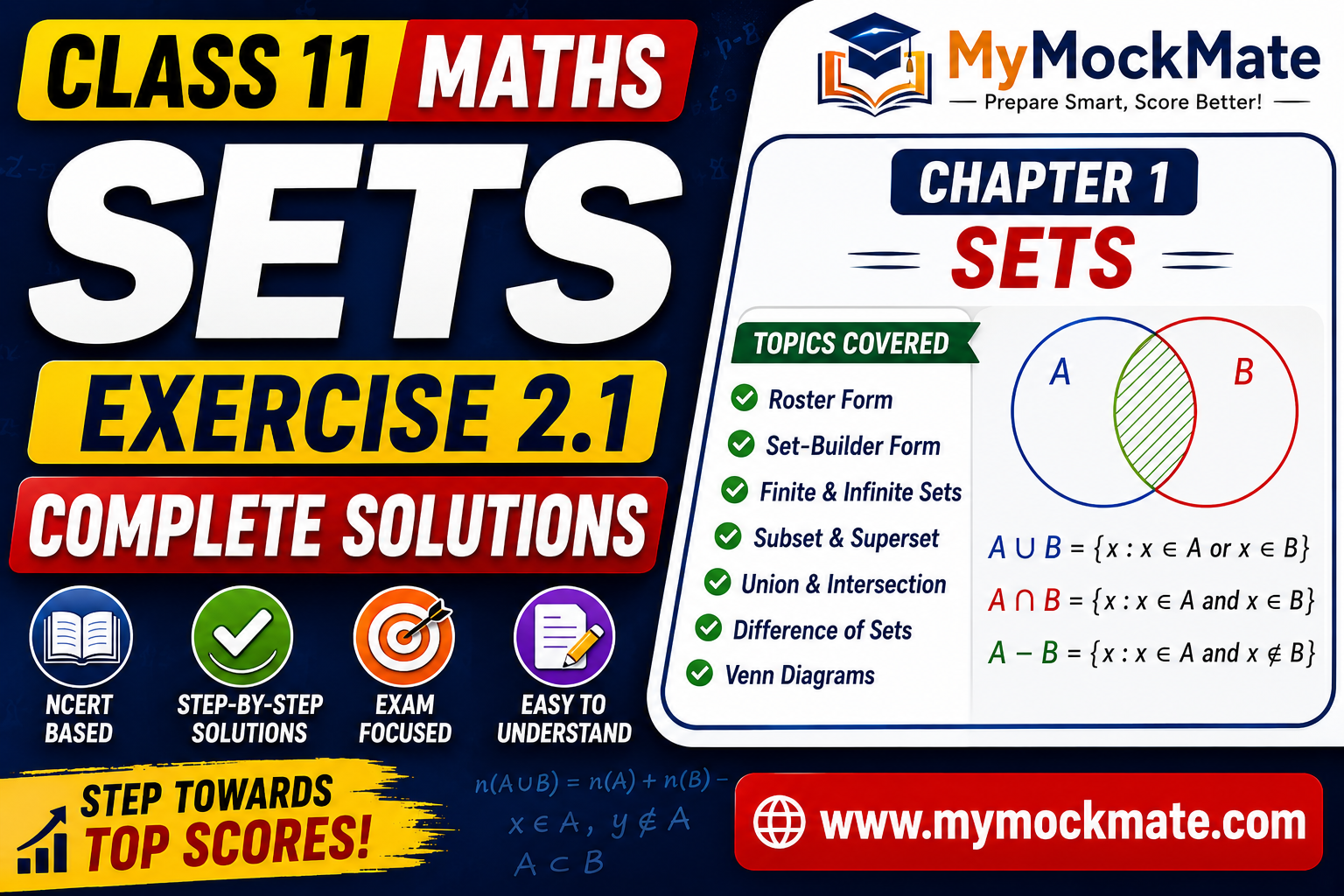
In this post, students can find complete step-by-step solutions for Class 11 Maths Chapter 1 Exercise 2.1 – Sets based on the latest NCERT syllabus. This exercise covers basic concepts of sets, roster form, set-builder form, empty sets, finite and infinite sets, subsets, intervals, union, intersection and difference of sets in an easy and exam-oriented format.
Quick Information Box
| Item | Details |
|---|---|
| Board | NCERT / CBSE |
| Class | 11 |
| Subject | Mathematics |
| Chapter | Sets |
| Exercise | 1.1 |
| Main Topics | Sets & Operations |
Concepts Used (Topics Covered)
- Definition of Sets
- Roster Form
- Set-Builder Form
- Empty Set
- Finite & Infinite Sets
- Equal Sets
- Subsets
- Universal Set
- Union of Sets
- Intersection of Sets
- Difference of Sets
- Venn Diagrams
The chapter introduces the fundamental concept of sets and their applications in mathematics.
Important Formulas
Union of Sets
Intersection of Sets
Difference of Sets
Complement of Set
Questions & Step-by-step Solutions
Question 1
Which of the following are sets?
Solution
(i) Collection of months beginning with J
Setbecause it is well-defined.
(ii) Collection of ten most talented writers
Not a setbecause “talented” is not well-defined.
(iii) Eleven best cricket batsmen
Not a set(iv) All boys in your class
Set(v) Natural numbers less than 100
Set(vi) Novels written by Munshi Prem Chand
Set(vii) Collection of all even integers
Set(viii) Collection of questions in this chapter
Set(ix) Collection of most dangerous animals
Not a setQuestion 2
Let:
A = {1,2,3,4,5,6}Insert ∈ or ∉.
Solution
(i)
5 ∈ A(ii)
8 ∉ A(iii)
0 ∉ A(iv)
4 ∈ A(v)
2 ∈ A(vi)
10 ∉ AQuestion 3
Write the following in roster form.
(i)
Solution
A = {−3,−2,−1,0,1,2,3,4,5,6}(ii)
Solution
B = {1,2,3,4,5}(iii)
Two-digit natural numbers whose digits sum to 8.
Solution
C = {17,26,35,44,53,62,71,80}(iv)
Prime divisors of 60.
Solution
D = {2,3,5}(v)
Letters in TRIGONOMETRY
Solution
E = {T,R,I,G,O,N,M,E,Y}(vi)
Letters in BETTER
Solution
F = {B,E,T,R}Question 4
Write in set-builder form.
(i)
{3,6,9,12}Solution
(ii)
{2,4,8,16,32}Solution
(iii)
{5,25,125,625}Solution
Question 5
List all elements.
(i)
Odd natural numbers
Solution
A = {1,3,5,7,9,...}(ii)
Integers satisfying:
Solution
B = {0,1,2,3,4}(iii)
Integers satisfying:
Solution
C = {−2,−1,0,1,2}(iv)
Letters in LOYAL
Solution
D = {L,O,Y,A}(v)
Months not having 31 days
Solution
E = {February, April, June, September, November}Question 6
Match the sets.
Solution
(i)
{1,2,3,6} → divisors of 6(ii)
{2,3} → prime divisors of 6(iii)
{M,A,T,H,E,I,C,S} → letters of MATHEMATICS(iv)
{1,3,5,7,9} → odd natural numbers less than 10Common Mistakes
- Repeating elements in roster form
- Confusing ∈ and ⊂
- Writing incorrect set-builder notation
- Ignoring distinct elements
- Using undefined collections as sets
Exam Tips
- Learn proper symbols carefully.
- Practice roster and set-builder conversion.
- Memorize standard set notations.
- Draw Venn diagrams for clarity.
Practice MCQs
MCQ 1
Which is a well-defined collection?
A. Beautiful flowers
B. Best students
C. Prime numbers less than 20
D. Intelligent boys
Answer:
C. Prime numbers less than 20MCQ 2
Which symbol denotes “belongs to”?
A. ⊂
B. ∈
C. ∪
D. ∩
Answer:
B. ∈MCQ 3
Set of vowels is:
{a,e,i,o,u}FAQ Section
What is a set?
A well-defined collection of objects is called a set.
What is roster form?
Listing all elements inside braces.
What is an empty set?
A set having no element.
What is subset?
If every element of A belongs to B, then A is subset of B.
📘 Prepare Smarter with MyMockMate!
✅ Chapter-wise NCERT Solutions
✅ Important Notes & MCQs
✅ Online Mock Tests
✅ Instant Result & Analysis
✅ CBSE Board Preparation
Start learning now on MyMockMate